
So, what ISBN do you actually need? The short answer is simple: you need a unique ISBN for every single format of your book.
Think of an ISBN as your book's fingerprint in the global marketplace. Your paperback, hardcover, and ebook versions might share the same title, but in the eyes of the publishing world, they are completely different products. Each one needs its own distinct fingerprint to be identified correctly.
Your Essential Guide to Choosing the Right ISBN
Figuring out which ISBN to use can feel a bit overwhelming at first, but the logic behind it is pretty straightforward. If you're selling a version of your book as a separate product, it needs its own International Standard Book Number. This 13-digit code is the universal identifier that lets retailers, libraries, and distributors track your book's sales and inventory accurately.
Without the right ISBN, your book is practically invisible to the systems that run the book world. It’s what prevents a customer who ordered your paperback from accidentally receiving the ebook, and it’s how libraries keep their catalogs straight. Getting your ISBNs sorted out is a fundamental part of publishing professionally.
Understanding Format and Edition Requirements
The most common snag for authors is knowing precisely when a new number is required. The rule of thumb is this: if a reader can buy it in a different form, it needs a new ISBN.
This applies to a few key scenarios:
- Different Bindings: A hardcover needs one ISBN, a paperback needs another, and a spiral-bound version would need a third.
- Electronic Formats: An EPUB file sold on Kobo needs a different ISBN than the MOBI file for Amazon Kindle. Your audiobook also needs its own unique identifier.
- Major Revisions: If you release a second edition with substantial changes—like adding new chapters or completely rewriting sections—it’s considered a new product and needs a new ISBN. Don't worry, fixing a few typos doesn't count.
This flowchart breaks down the decision-making process for assigning ISBNs based on your book's different versions.
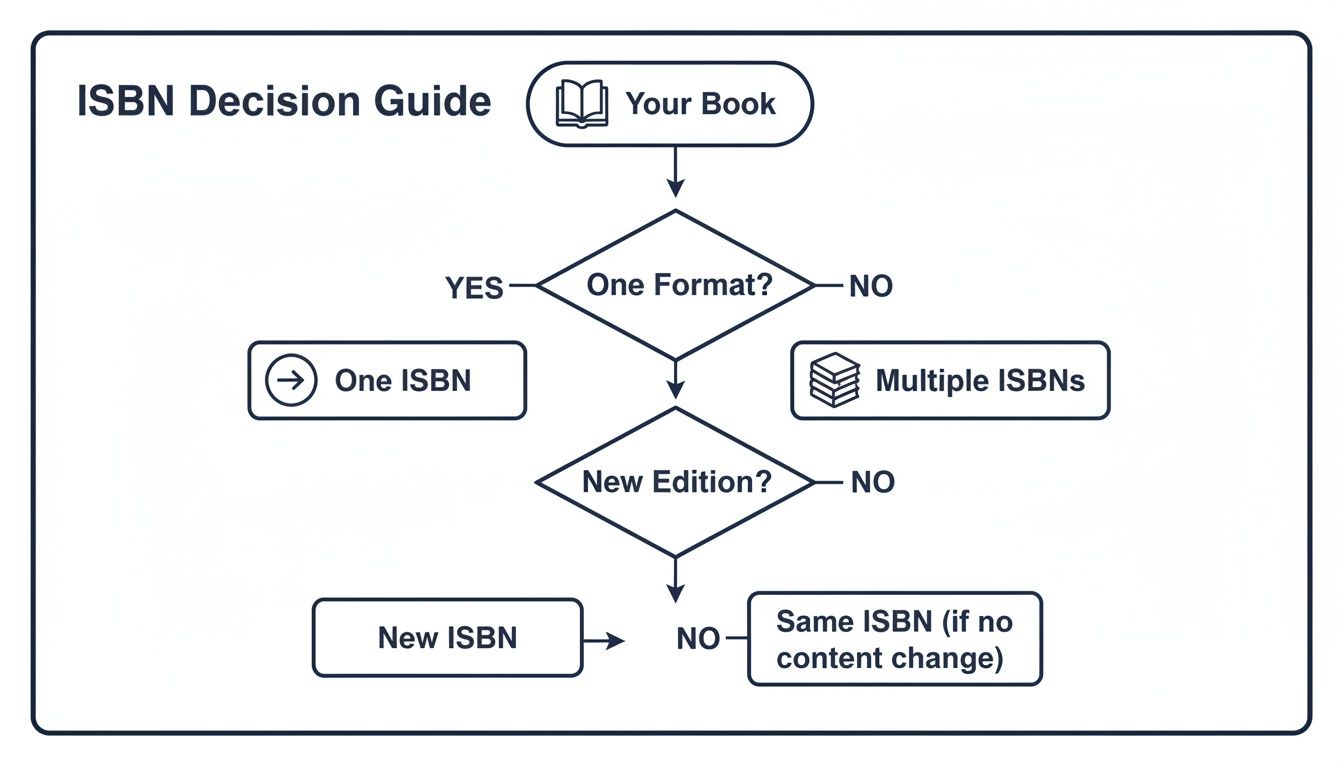
As you can see, more formats mean more ISBNs. It’s all about making sure each product can be cataloged and sold correctly.
For a quick reference, this table summarizes the most common situations you'll encounter.
Quick Guide to ISBN Usage by Book Format
| Scenario | Do You Need a New ISBN? | Why It Matters |
|---|---|---|
| Publishing a paperback and hardcover | Yes | They are distinct physical products with different prices and inventory. |
| Releasing an ebook (e.g., EPUB, MOBI) | Yes | Each digital format is sold and distributed separately. |
| Creating an audiobook version | Yes | This is a completely different product type from print or ebook. |
| Fixing typos in the current edition | No | Minor corrections don't create a new product for the consumer. |
| Releasing a revised 2nd edition | Yes | Significant content changes make it a new, distinct edition. |
| Creating a large-print version | Yes | It's a separate format tailored for a specific audience. |
| Translating your book into Spanish | Yes | Each language version is a new product for a different market. |
This table should help you quickly determine your ISBN needs as you expand your book's offerings.
Global Publishing Considerations
Thinking about taking your book global? That's fantastic, but remember that each translated version also falls into the "new product" category. A Spanish translation needs its own ISBN to be tracked properly in Spanish-speaking markets, just as a French version needs one for Francophone regions.
This is non-negotiable if you want to build a worldwide audience. For anyone exploring this path, this ultimate guide to AI book translation offers some great insights on preparing different language editions for publication.
An ISBN isn't just a number; it's the key that unlocks global distribution. It connects your specific book format to a worldwide network of retailers, libraries, and databases, making it discoverable and sellable everywhere.
When in doubt, just think like a bookseller. If you have multiple versions of your product on the shelf, you’d need a unique barcode for each one to avoid logistical headaches and get paid for every sale. It’s the same exact principle.
What an ISBN Is and Why It Matters for Your Book
Let's cut right to it. Think of an ISBN (International Standard Book Number) as your book's unique fingerprint. In a world with well over 150 million published titles, this 13-digit code is what makes your book identifiable from all the others.
This number isn’t just a formality; it’s the universal language of the book business. Every single retailer, distributor, wholesaler, and library—from Amazon to your local indie bookstore—relies on it to pinpoint a specific book, in a specific format, from a specific publisher.
Without a legitimate ISBN, your book is essentially invisible to the industry’s ordering, sales, and inventory systems.
The Language of the Book Supply Chain
Imagine trying to find someone in a new country without knowing their name or address. That’s what it's like for bookstores trying to find a book without an ISBN. It would be total chaos.
The ISBN system, overseen by the International ISBN Agency, brings order to that chaos. It's a standardized cataloging method that ensures when a bookstore orders your paperback, they don’t get the audiobook by mistake. This code is the common ground that everyone in the supply chain stands on. To dig a bit deeper into the basics, you can find out more about what an ISBN is and how it functions.
Honestly, having an official ISBN signals that you’re a serious publisher. It tells the industry you understand how things work and that your book is ready for business.
How an ISBN Powers Your Book’s Journey
The moment your ISBN is assigned, it connects your book to its core metadata—things like the title, author, publisher, format, and price. This information gets fed into massive global databases, like Bowker's "Books in Print," which thousands of booksellers and librarians check every single day.
Here's what that actually means for you:
- Discoverability: Retailers and libraries can easily look up your book and all its ordering information.
- Inventory Management: A quick scan of the barcode lets bookstores order, stock, and reorder your title without any guesswork.
- Sales Tracking: Your sales get accurately logged by services like Nielsen BookScan, which is how bestseller lists and market trends are compiled.
- Professionalism: It opens doors. An ISBN legitimizes your book, making it eligible for much wider distribution channels that would otherwise be closed off.
When you're focused on creating and selling an ebook, this becomes even more important. An ISBN is what allows your ebook to be properly identified and sold on platforms beyond just a single retailer.
An ISBN is more than a product code; it's your book's passport to the global marketplace. It validates your work and makes it accessible to readers, retailers, and libraries worldwide, turning your manuscript into a commercially viable product.
Without this passport, your book is stuck at the border, unable to enter the vast network that connects authors to readers.
Why You Can’t Ignore the ISBN
Some self-published authors, especially those who only sell on Amazon KDP, might think they can skip it. It's true that Amazon gives you its own identifier (an ASIN), but that code only works within Amazon's four walls.
If you have any dreams of seeing your book at Barnes & Noble, getting it into your local library's collection, or selling it on other online stores, an official ISBN is completely non-negotiable.
Figuring out what ISBN number to use is one of the first, most fundamental decisions in the publishing process. It's a small investment in your book's future, giving it the infrastructure it needs to find its audience. Skipping it is like building a fantastic car but forgetting to add the wheels—it might look great, but it's not going anywhere.
Decoding the Different Types of ISBNs
Not all ISBNs are created equal, and figuring out the differences is the first big step toward making the right call for your book. You'll hear a few terms thrown around, but it really boils down to two things: the number format itself and, more importantly, who is listed as the publisher.
Think of it like a car's VIN (Vehicle Identification Number). That number is unique to one specific car, but it also tells you the manufacturer, model, and year it was made. An ISBN works the same way—it points to your exact book while also carrying key details about its publisher and format.
ISBN-10 vs. ISBN-13: A Quick History Lesson
For a long time, the book world ran on a 10-digit ISBN. But by the early 2000s, with the explosion in publishing, it was clear we were going to run out of numbers. So, on January 1, 2007, the industry officially switched to the ISBN-13, which is now the global standard.
Every book published since then has a 13-digit number. Any older book with a 10-digit ISBN was also given a corresponding 13-digit one to keep everything consistent. For you, this is simple: you’ll only ever be dealing with the 13-digit format. It even includes a special check digit that slashes ordering errors by an estimated 99%.
The Most Important Distinction: The Publisher of Record
Okay, this is the part you really need to pay attention to. The most critical decision you'll make isn't about 10 digits versus 13, but about who gets the ISBN for your book. This choice determines the "Publisher of Record" in your book's official data, and that has major implications for your author career.
You have two main paths:
- You buy your own ISBN. You go directly to the official agency in your country (like Bowker in the U.S.) and purchase it. When you do this, you or your publishing company are listed as the publisher.
- You use a "free" or assigned ISBN. Platforms like Amazon KDP or aggregators such as Draft2Digital will give you an ISBN, often at no cost. In this case, they are listed as the publisher, not you.
This might seem like a tiny detail, but it's a huge deal for your control and your brand. Owning your ISBN means you control your book's identity everywhere. Using an assigned one often ties that specific version of your book to that one platform, limiting your flexibility down the road.
Below is the homepage for Bowker, the official U.S. ISBN agency. This is where authors and publishers go to purchase their own identifiers.
For any U.S.-based author wanting full control, this is the starting point. It’s how you establish yourself as the publisher of your own work.
Why Every Single Format Needs Its Own ISBN
Here’s a common stumbling block for new authors. You've finished your manuscript, but that single file can be turned into several different products. Each one of those products needs its own unique ISBN.
Let’s say your masterpiece, "The Silent Forest," is ready. You plan to release it in a few formats to reach as many readers as possible.
- The Paperback: This physical book needs its own ISBN. It has a specific size, cover finish, and production cost.
- The Hardcover: This is a totally different product. It feels different, costs more to make, and has a higher price tag. It needs a second, separate ISBN.
- The EPUB Ebook: Your digital version is another format entirely. To get it listed properly on stores like Apple Books, Kobo, and Barnes & Noble, it needs a third ISBN.
You're not just publishing one book; you're manufacturing three distinct products from a single manuscript. Each of those products needs its own barcode to be tracked and sold in the global retail system. Getting this wrong creates a logistical nightmare for distributors and can lead to lost sales.
The self-publishing world is bigger than ever. In 2023 alone, independent authors in the US registered over 2.6 million ISBNs. That number really shows you how many unique book formats are hitting the market every year. You can dig into more of these trends by checking out the latest statistics on annual book publications.
Making the right decision from the start saves you from massive headaches later. If you're serious about building an author career and plan on releasing multiple books or formats, learning where to buy an ISBN is one of the most important first steps. It’s a direct investment in your brand’s independence and professionalism.
How to Get Your Official ISBN
Alright, now that you've got a handle on what an ISBN does and why it's so critical, let's talk about actually getting one. The process itself is pretty straightforward, but it does change a bit depending on where you live. The most important thing to remember is to go directly to the official agency for your country. This ensures your ISBN is legitimate and plugged into the global book ecosystem.
Think of these agencies as the official record-keepers for the publishing world. When you get an ISBN from them, you're guaranteeing your book's unique identity is properly logged in the international databases that retailers, libraries, and distributors depend on every single day. Any other source is just a reseller, and that can come with strings attached.
Finding Your Official ISBN Agency
Every country has one designated organization that handles issuing ISBNs. You absolutely must get your ISBN from the agency in the country where you, the publisher, are located. It's a common mix-up to think you need an ISBN from where you plan to sell your books, but it’s all about your home base.
Here are the official sources for the major English-speaking markets:
- United States: Bowker is the one and only official agency. If you see another US-based site selling ISBNs, they are a third-party reseller.
- United Kingdom: The Nielsen ISBN Store is the go-to for authors and publishers in the UK.
- Australia: Head over to Thorpe-Bowker, the designated agency for all Australian ISBN assignments.
- Canada: Good news for Canadian authors—ISBNs are provided free of charge through Library and Archives Canada.
If you're publishing from outside these countries, the International ISBN Agency website has a handy directory to help you find your local provider.
The Cost of Your ISBN: Single vs. Bulk Purchases
One of the first questions authors ask is, "How much is this going to cost me?" The price varies, but there's one universal truth: buying in bulk saves you a ton of money. Let's use the standard pricing from Bowker in the US to see how this plays out.
A single ISBN will run you $125. That can feel a little steep when you're just starting out.
But a block of 10 ISBNs costs $295. Do the math, and that brings the cost down to just $29.50 per ISBN. That’s a huge savings and a no-brainer for any author planning to publish more than one book or even just one book in multiple formats (like a paperback, hardcover, and ebook).
Even if you only have one book finished, you'll probably need at least three separate ISBNs for the paperback, hardcover, and ebook editions. In that case, the 10-pack is already a better deal than buying three individual ISBNs.
Buying a block of 10 ISBNs is the most strategic financial decision for a career author. It provides the flexibility to publish multiple formats and future titles without paying premium prices for single identifiers, setting you up for long-term success.
The Myth of the "Free" ISBN
You’ve probably seen platforms like Amazon KDP or aggregators such as Draft2Digital offering a "free" ISBN. It sounds like a great deal, but there’s a major catch. When you take that free ISBN, the company providing it becomes the Publisher of Record—not you.
This has some pretty big implications:
- Limited Distribution: That "free" ISBN is almost always tied to their platform. A free KDP ISBN, for example, can only be used to sell your print book on Amazon. Want to sell that same paperback at Barnes & Noble or an indie bookstore? You’ll need a brand new ISBN that you own.
- Loss of Control: Since they are listed as the publisher, they ultimately control the metadata linked to that ISBN. You're playing in their sandbox, by their rules.
- Brand Perception: Listing your own name or your publishing imprint as the publisher simply looks more professional. It shows the industry you're serious about your work.
Look, using a free ISBN isn't the end of the world if you're 100% certain you'll only ever sell on one platform and you're okay with these trade-offs. But for authors who want wide distribution and complete control over their publishing career, buying your own ISBN is the only way to go. It firmly establishes you as the true publisher of your work.
Common ISBN Mistakes You Need to Avoid

Learning the ins and outs of ISBNs is mostly a smooth ride, but a few common slip-ups can turn into major headaches. We're talking distribution delays, confused retailers, and—worst of all—lost sales. Knowing which ISBN to use is just as much about dodging these pitfalls as it is about following the rules. Get this right from day one, and you'll save yourself a world of trouble later on.
Think of an ISBN as a permanent, unique address for a specific version of your book. If you give two different houses the same street address, the mail gets lost. It’s the exact same logic here; one wrong move can throw the whole supply chain into chaos.
Reusing an ISBN for a New Edition
One of the most common blunders is slapping an old ISBN onto a new, updated edition of a book. The rule is refreshingly simple: if you make substantial changes to the content, you need a new ISBN. What counts as "substantial"? Anything that would make someone who bought the old version feel like they need to buy the new one.
This usually includes things like:
- Adding a brand-new foreword or introduction
- Including a new chapter or significantly fleshing out existing ones
- Revising more than 10% of the content
- Changing the book’s title or subtitle
On the flip side, minor tweaks like fixing typos, correcting a few grammatical errors, or even updating the cover design do not require a new ISBN. The core product hasn't changed. Reusing an ISBN for a major revision is a fast way to mislead your readers and create a mess for warehouse inventory systems.
Applying One ISBN Across Multiple Formats
Another critical error is assuming one ISBN can cover your paperback, ebook, and audiobook. I’ve seen this mistake pop up again and again. Every single format of your book is considered a unique product in the marketplace, and each one needs its own identifier.
You absolutely cannot use the same ISBN for:
- Your paperback and your hardcover
- Your EPUB ebook and your audiobook
- Your standard print edition and a large-print version
Using one ISBN for different formats is like trying to use the same barcode for both milk and orange juice at the grocery store. It completely breaks the inventory and sales tracking systems. This is one of the non-negotiable rules of the publishing world.
"An ISBN is tied to a specific format and edition forever. Attempting to recycle or misapply an ISBN doesn't just look unprofessional; it fundamentally breaks the system that allows your book to be discovered, ordered, and sold correctly."
Ignoring the Global Scale of Publishing
Finally, a lot of authors don't realize just how massive and regulated the ISBN system is. This sometimes leads them to fall for sketchy online "free ISBN" generators. These are not legitimate, and using one will keep your book out of official databases and distribution channels.
The integrity of the whole system relies on recognized national agencies. To put it in perspective, the United States alone registered a staggering 3.9 million ISBNs in 2020, far more than any other country. This highlights the sheer volume of new products hitting the market. To get a better feel for this global network, you can learn more about the International Standard Book Number system. When you buy a real ISBN, you're not just getting a number; you're plugging your book into a trusted, worldwide network.
Frequently Asked Questions About ISBNs
Even when you've got the basics down, you'll inevitably hit a few practical snags when it's time to actually publish. Let's walk through some of the most common questions I hear from authors about which ISBN to use and when.
These are the real-world scenarios that often trip people up, but the answers are usually straightforward once you know the rules of the road.
Do I Need an ISBN to Sell on My Own Website?
Technically, you don't. If you're the sole seller and the only place your book is available is your personal website, you control the whole transaction. No ISBN is required.
However, think about the future. The second you decide you want to get your book into online stores like Amazon, partner with a distributor, or see it on a library shelf, an ISBN becomes non-negotiable. For that reason alone, I always advise authors to get an ISBN from the get-go. It's the best way to keep your options open.
What Happens If I Publish Without an ISBN?
Skipping the ISBN essentially makes your book invisible to the entire book industry. It won't show up in the massive databases that bookstores, libraries, and online retailers rely on to find and order new titles.
This puts a major roadblock in front of your distribution potential, making it incredibly difficult for anyone outside your personal circle to discover your work. You might save a few bucks initially, but you're trading that for discoverability and the professional legitimacy that is vital for any author's long-term success. To get a better handle on the numbers, you can read this detailed breakdown of how much an ISBN costs and see why it's a smart investment.
Choosing to publish without an ISBN is like opening a shop but not putting a sign on the door or listing it in any directory. People who already know you might find it, but you're missing out on every potential new customer who walks down the street.
Do I Need a New ISBN for a New Cover Design?
Nope! Just giving your book a cover refresh doesn't require a new ISBN. Think of it this way: as long as the book's core—the content, title, and trim size—remains identical, you can update the packaging as much as you like.
You only need a new ISBN when you're making a change that fundamentally creates a new version of the book. This would include major revisions to the text, changing the format (like from paperback to hardcover), or retitling it. The cover is just the wrapper; a new ISBN is for a new product inside.
Can I Transfer an ISBN to Another Author?
This is a hard no. An ISBN can never be transferred, sold, or reassigned to another author or publisher. When you buy an ISBN from an official agency like Bowker, your name or publishing imprint is permanently registered as the Publisher of Record.
That link is set in stone. The ISBN is forever tied to the publisher who acquired it and the specific book it was assigned to. This strict rule is what maintains the integrity of the global book tracking system, ensuring there's never any confusion about who published what.
At BarkerBooks, we handle all the technical details like ISBN registration and copyright protection so you can focus on writing. Let us turn your manuscript into a professionally published book, available to readers worldwide. Learn more about our publishing packages today!