
The price to print a book isn’t a single, fixed number. It can be less than $3 per copy for a simple paperback printed on-demand, or it can climb past $15 per copy for a beautiful, full-color hardcover printed in bulk. The final cost all comes down to the specific choices you make—page count, book size, color, paper, and binding all play a huge role. Think of it like building a house: the blueprint and materials you select will ultimately determine the final price tag.
Your Quick Guide to Book Printing Costs
Trying to figure out the exact cost to print your book can feel like trying to hit a moving target. Dozens of variables are at play, each one nudging your per-unit cost up or down. To make it simpler, let’s use an analogy: printing a book is a lot like ordering a custom pizza. Your printing method is the “base price,” but every topping you add—from a vibrant color interior to a glossy cover—adds to the final bill.
This first section is all about giving you a solid, practical starting point. We’ll break down the core ingredients that make up your printing quote so you can get a real feel for what to expect. This way, you can make smarter decisions before you get bogged down in the more technical side of things.
The Key Cost Drivers at a Glance
Before we get into the nitty-gritty calculations, it helps to see the big picture. Every printing quote you receive is built on a handful of key decisions that you, the author, will make. Getting a handle on these is the first step to keeping your budget in check.
Here are the most important factors:
- Printing Method: Will you go with Print-on-Demand (POD) for its flexibility or Offset printing to get a lower per-unit cost on a big order?
- Book Specifications: This is everything from your final page count and trim size (like the popular 6×9 format) to the binding (paperback vs. hardcover) and the quality of the paper inside.
- Color vs. Black & White: This is a big one. Full-color interiors cost significantly more to print than standard black-and-white text pages.
- Print Run Size: How many copies are you ordering? With offset printing, the more you print, the less you pay per book. It’s all about economies of scale.
The U.S. book printing industry is a massive $4.9 billion powerhouse, and like many industries, it’s seen production costs rise. Factors like labor, energy, and paper prices have a direct impact on the final quote an author receives. If you’re curious, you can explore more data about the book production market to see how these trends are shaping author expenses.
Estimated Costs Per Book
To give you some real-world numbers, let’s look at a quick comparison. The table below gives you a ballpark idea of printing costs for a standard 200-page, 6×9-inch paperback. The real takeaway here is seeing how the per-book cost plummets when you order a larger quantity using offset printing.
Estimated Cost Per Book Based on Printing Method
| Printing Method | Print Run Size | Estimated Cost Per Book |
|---|---|---|
| Print-on-Demand (POD) | 1 – 100 | $3.50 – $5.50 |
| Offset Printing | 500 – 1,000 | $3.00 – $4.50 |
| Offset Printing | 1,000 – 2,000 | $2.25 – $3.75 |
| Offset Printing | 2,000+ | $1.50 – $2.50 |
As you can see, the difference is dramatic. While POD offers incredible flexibility for printing just one book at a time, offset printing provides powerful cost savings once you’re ready to print in bulk.
Choosing Your Path: Print on Demand vs. Offset Printing
Sooner or later, every author hits a fork in the road: how will my book actually get printed? This isn’t just a technical detail; it’s a choice between two completely different ways of thinking about printing: Print-on-Demand (POD) and Offset Printing. Getting this decision right is crucial because it shapes your upfront costs, how much you pay for each book, and ultimately, how profitable your project will be.
Let’s break it down with a simple analogy.
Think of POD like a fantastic food truck. It makes one delicious, custom meal at a time, right after you order. There’s no food waste, no need for a giant restaurant kitchen, and it can serve a small, dedicated crowd without prepping hundreds of dishes. It’s agile, low-risk, and the perfect way to see if people love your new recipe—or your new book.
Offset printing, on the other hand, is like a massive catering operation. It takes a huge initial investment to set up the industrial kitchen, buy all the ingredients in bulk, and hire the staff. But once everything is humming, it can churn out thousands of meals for an incredibly low price per plate. The setup is the big hurdle; after that, you’re benefiting from massive economies of scale.
When Print on Demand Makes Sense
Print-on-Demand has totally changed the game for independent authors, and it’s easy to see why. With POD, a single copy of your book isn’t printed until a customer actually buys it. This digital printing approach means you don’t have to worry about inventory, warehousing, or shelling out a ton of cash upfront.
This model is a perfect fit in a few key situations:
- You’re a New Author: If this is your debut, POD lets you dip your toes in the water. You can test the market and start building a following without the nightmare scenario of a garage full of unsold books.
- Your Book is Niche: Writing for a very specific, limited audience? POD is your friend. You’ll never print more copies than there are readers who want them.
- You’re on a Tight Budget: Since there’s no minimum order, the barrier to entry is almost non-existent. You can make your book available to the world with practically zero upfront printing costs.
The real magic of POD is the financial safety net it provides. It lets you gauge reader interest and build momentum without putting a huge chunk of money on the line. Yes, you’ll pay a higher price for each book, but you completely sidestep the risk of unsold inventory.
The Power of Offset Printing
Offset printing is the classic, time-tested method the big publishing houses use. It’s a more involved process where metal plates are created for your book’s pages, which then transfer ink to paper. The setup is pretty complex and has a significant cost, which is why it only makes sense for larger batches—typically 500 copies or more.
But here’s where offset truly shines: volume. While that initial setup is pricey, the cost to print each individual book afterward is tiny. As your print run gets bigger, the per-unit price plummets. This is exactly how major publishers can produce paperbacks for just a buck or two a pop.
Offset printing is the clear winner when:
- You already have an established audience and feel confident you can sell a large volume of books.
- You plan on selling books in person at events, workshops, or making bulk sales to businesses or schools.
- You need the absolute best print quality and want more custom options for paper, cover finishes, and binding types.
As production costs rise, especially for things like textbooks or technical manuals, getting a low per-unit price is more critical than ever. Tapping into the bulk power of offset printing helps authors keep their books affordable. You can dig into some of the data on these rising production expenses to see why professional offset services remain such a vital tool.
Decoding Your Quote: The 5 Core Factors Driving Your Book Printing Price
Getting a printing quote can feel like a mechanic is showing you a car engine for the first time—it’s a jumble of parts and numbers that don’t make much sense. But once someone walks you through what each part does, it all starts to click. That’s what we’re going to do right now for your book printing costs.
Think of these five core factors as levers you can pull. Nudging one up or down—say, your page count or paper choice—can dramatically change the final price tag. Getting a handle on these five elements will put you in the driver’s seat, allowing you to make smart decisions that balance your creative vision with your budget.
First, let’s look at the two fundamental paths you can take: Print-on-Demand (POD) and Offset printing. This quick breakdown shows how they stack up.
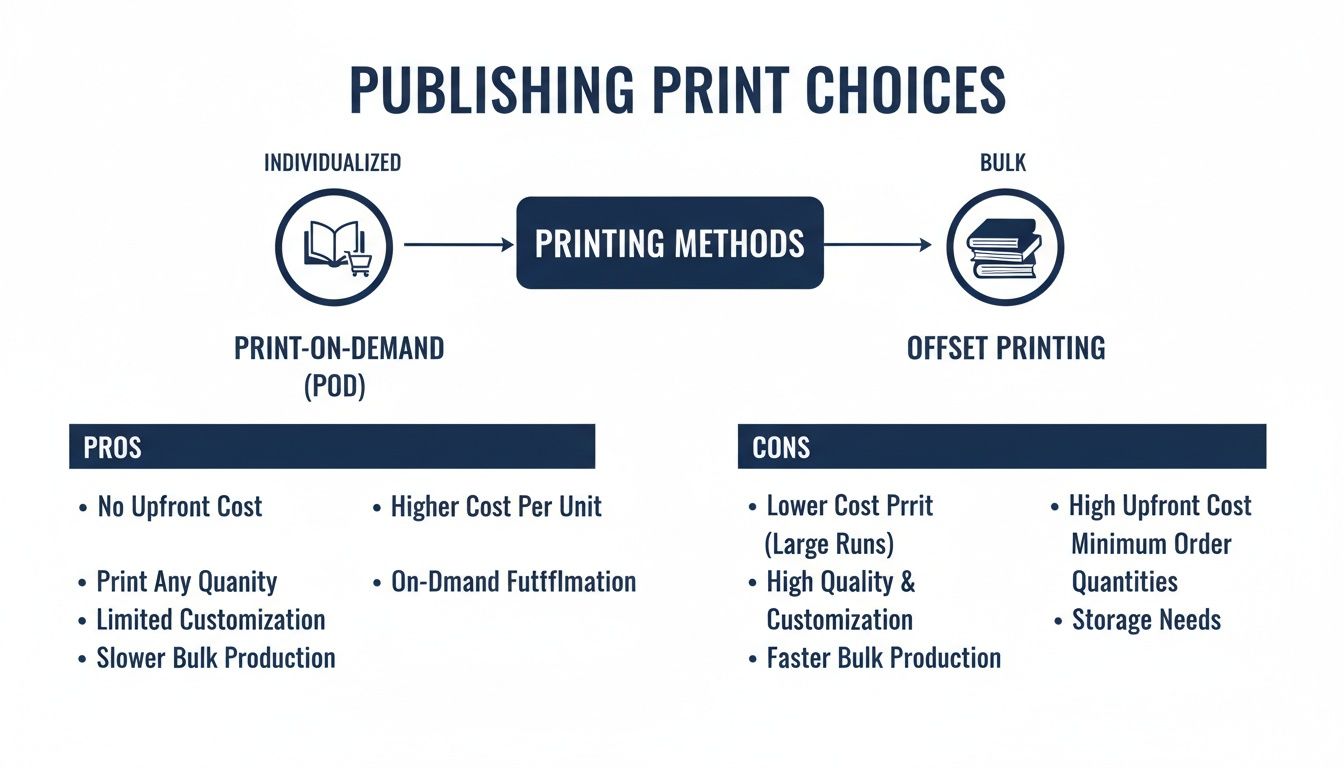
As you can see, POD is all about flexibility and avoiding upfront risk, making it great for getting started. Offset printing, on the other hand, is built for scale—it’s how you get the lowest possible cost per book when you’re ready to print in volume.
1. Page Count: The Biggest Cost Driver
Of everything we’ll discuss, page count has the single biggest impact on your printing price. It’s a straight-up calculation: more pages mean more paper, more ink, and more time on the press. It’s as simple as that.
This is where a professional interior formatter becomes your best friend. A good designer can work some magic with margins, fonts, and spacing to bring your page count down without anyone noticing. Even trimming just a few pages can lead to real savings, especially when you’re printing hundreds of copies.
2. Trim Size: How Shape Affects Efficiency
The physical dimensions of your book, or its trim size, play a bigger role in cost than most authors realize. Printers don’t use 6″x9″ sheets of paper; they use massive “parent sheets” that your book pages are cut out of.
Standard trim sizes like 5.5″ x 8.5″ or 6″ x 9″ are popular for a reason: they are designed to fit perfectly onto these parent sheets with almost no waste. If you choose a custom size, the printer has to throw away all the leftover paper, and you can bet that cost gets passed on to you. Sticking to industry standards is one of the simplest ways to keep your project affordable.
3. Color vs. Black & White: A Major Price Jump
Choosing between a color or black-and-white interior is another massive decision for your budget. Think of it as the difference between a quick pencil sketch and a full-color painting. Black ink is cheap and only needs one pass through the printer.
Full-color printing is a whole different ballgame. It requires four separate inks (cyan, magenta, yellow, and black—CMYK) that have to be layered with absolute precision to create the millions of colors we see. This process is far more complex and expensive.
The bottom line? A full-color book can easily cost 3 to 4 times more per page than a standard black-and-white one. If you only have a handful of photos or illustrations, consider grouping them into a special color insert. You get the visual punch you need without paying for color on every single page.
4. Paper Stock: The Feel of Quality
The paper you choose is like the fabric for a custom suit—it defines the look, feel, and durability of your book. Paper is measured by its weight (in pounds or GSM) and comes in different finishes, like uncoated, matte, or glossy.
Here’s a quick guide to what’s common:
- 50-60 lb Uncoated: The workhorse for novels and other text-heavy books. It’s lightweight, easy on the eyes, and budget-friendly.
- 70-80 lb Coated (Gloss or Matte): A heavier, smoother paper that makes images pop. This is what you’ll find in art books, cookbooks, or business guides where quality visuals are key.
- 10-12 pt Cover Stock: This is the thick, sturdy cardstock used for paperback covers, usually with a protective laminate finish.
While a heavier, premium paper feels luxurious in your hands, it also adds to your per-book cost. The best way to see how these choices affect the final price is to play around with the numbers yourself. Our free book printing cost calculator lets you see the price change in real-time as you adjust the specs.
5. Binding: How It All Holds Together
Finally, the binding is the engineering that turns a stack of paper into a book. For most authors, the choice comes down to paperback (perfect binding) or hardcover (case binding).
Perfect binding is the industry standard for paperbacks. The pages are stacked and glued into the cover with a super-strong, flexible adhesive. It’s efficient, durable, and by far the most cost-effective option for most projects.
Case binding (the classic hardcover) is a more complex, premium process. The pages are sewn or glued into a “book block,” which is then fitted into a rigid cover wrapped in cloth or paper. Hardcovers are more expensive to produce, but they offer unmatched durability and a much higher perceived value in the marketplace.
Real Authors, Real Printing Costs
All the theory is great, but let’s be honest—nothing makes sense until you see the numbers. The final price to print your book isn’t just a number; it’s a reflection of your goals, your audience, and your entire publishing strategy.
To really get a feel for this, let’s walk through three common author scenarios. Each one takes a different path, showing how your choices in book specs and print run size can drastically change both your per-book cost and how much you’ll need to invest upfront.
Scenario 1: The Debut Novelist
First up is Alex, a first-time fiction author. He’s written a fantastic 300-page novel, but he has no idea how it will sell. The last thing he wants is a garage full of unsold books. For Alex, flexibility and low risk are everything, which makes Print-on-Demand (POD) the perfect fit.
Here’s a look at his book’s simple, cost-effective setup:
- Book Type: Standard Paperback
- Trim Size: 6″ x 9″
- Page Count: 300 pages
- Interior: Black & White on 55 lb cream paper
- Printing Method: Print-on-Demand (POD)
With POD, there are no minimum orders. A book is only printed when someone buys it, so Alex’s upfront investment is a grand total of $0. The printing cost comes out to around $4.75 per book, which is simply taken out of his royalty when a sale is made. It’s a zero-risk way to get his book out into the world.
Scenario 2: The Children’s Book Author
Next, meet Maya. She’s created a gorgeous 40-page children’s book filled with her own illustrations. For a book like this, quality is king. The colors need to pop, and the book itself has to be sturdy enough for little hands. This isn’t a project where you cut corners on production.
Maya opts for a small offset run to get that premium quality and vibrant color that POD just can’t match for this type of project.
- Book Type: Hardcover (Casebound)
- Trim Size: 8.5″ x 8.5″ Square
- Page Count: 40 pages
- Interior: Full-Color on 80 lb coated paper
- Printing Method: Offset Print Run of 500 copies
The hardcover binding and full-color pages make this a more expensive book to produce. By printing 500 copies, the cost per unit comes down to about $7.20. This means she needs to make an upfront investment of $3,600, but in return, she gets a stunning, high-quality product that can justify a higher retail price and truly shine on a bookstore shelf.
Choosing offset for a smaller run is a classic “invest in quality” move. It’s the right call for projects like art books, cookbooks, or children’s stories where the physical book itself is a huge part of the experience.
Scenario 3: The Established Expert
Finally, let’s look at Dr. Chen, a business consultant with a large, engaged following. He’s written a 200-page book he plans to sell directly at speaking events and through bulk corporate deals. His main goal is to get the per-unit cost as low as humanly possible to maximize his profit on every sale.
For Dr. Chen, a large offset print run is the only way to go. He’s confident he can move 2,000 copies without breaking a sweat.
- Book Type: Premium Paperback
- Trim Size: 5.5″ x 8.5″
- Page Count: 200 pages
- Interior: Black & White on 60 lb white paper
- Printing Method: Offset Print Run of 2,000 copies
By going big, Dr. Chen taps into serious economies of scale. His cost per book plummets to just $2.15. While this requires a hefty upfront investment of $4,300, that incredibly low unit cost means his profit margin on each sale is massive. For his business model, this is an easy decision.
Comparing the Printing Costs
The best way to see how these factors play out is to put them side-by-side. The table below breaks down our three scenarios, clearly showing the relationship between your choices, your unit cost, and your upfront investment.
Sample Printing Cost Scenarios
| Author Scenario | Book Specs | Printing Method & Run Size | Estimated Cost Per Unit | Total Upfront Cost |
|---|---|---|---|---|
| The Debut Novelist | 300-page, B&W Paperback | Print-on-Demand | $4.75 | $0 |
| The Children’s Author | 40-page, Full-Color Hardcover | Offset, 500 copies | $7.20 | $3,600 |
| The Established Expert | 200-page, B&W Paperback | Offset, 2,000 copies | $2.15 | $4,300 |
As you can see, there’s no magic number for book printing. The “right” price is completely tied to your specific situation—your budget, your appetite for risk, the nature of your book, and how you plan to sell it.
Smart Strategies to Lower Your Printing Costs
Knowing what drives the cost to print a book is half the battle. The other half is using that knowledge to make smart decisions. The good news? Creating a high-quality book doesn’t mean you have to empty your bank account. A few strategic choices can dramatically lower your expenses without sacrificing that professional finish you’re after.
Think of it like planning a home renovation on a budget. You have to decide where to spend and where to save. Maybe you splurge on the custom countertops but go with standard-sized cabinets to keep costs in check. The same logic applies to printing your book.
Optimize Your Interior Formatting
One of the easiest ways to bring down your printing bill is to reduce your total page count, and you can often do this without cutting a single word from your manuscript. It all comes down to the interior layout.
A skilled book designer can work magic by making small adjustments to the margins, font size, and line spacing. These subtle tweaks can condense your text efficiently, shaving off 10-20 pages or more. That might not sound like a huge deal, but when you’re printing hundreds or thousands of copies, that per-page saving really adds up. Readers won’t notice the difference, but your budget certainly will.
Stick to Standard Trim Sizes
A unique, custom book size can be appealing, but veering off the beaten path usually costs more. Printers don’t work with individual book-sized sheets; they use massive “parent sheets” of paper. Standard trim sizes, like the popular 6″ x 9″ or 5.5″ x 8.5″ paperbacks, are calculated to get the maximum number of pages from these sheets with minimal waste.
When you choose a non-standard size, you’re creating more waste paper that gets trimmed off and discarded. Guess who pays for that waste? You do. Sticking with a standard size is a simple, no-effort way to make sure you’re only paying for the paper that actually goes into your book.
Pro Tip: If your book has images, you don’t necessarily need to print the entire interior in color. A fantastic cost-saving trick is to group all your photos or illustrations into a dedicated color “insert.” This gives you that pop of color where it counts while the rest of your book stays in affordable black and white, potentially saving you hundreds or even thousands of dollars.
Bundle Services for Greater Savings
Trying to manage the printing process on your own can be a real headache, not to mention expensive. When you partner with a full-service publisher like BarkerBooks, you can bundle printing with other crucial services like editing, cover design, and formatting. This all-in-one approach almost always results in significant savings compared to hiring a separate freelancer for every job.
Beyond the package deals, an established publishing partner brings something else to the table: relationships and volume. We have long-standing connections with printers and get access to volume discounts that just aren’t available to individual authors. This is a huge advantage. To see how printing fits into the bigger picture, take a look at our guide on the overall cost to publish a book.
Bringing Your Manuscript to Life
You’ve made it through the weeds of printing specs and cost factors. At this point, one thing should be crystal clear: the final price to print a book is a direct result of the choices you make along the way. Every detail, from the paper’s thickness to the cover’s finish, shapes both your budget and the finished book your readers will hold.
The biggest fork in the road is deciding how you’ll print. Are you leaning toward the incredible flexibility of Print-on-Demand (POD), where there’s no inventory to manage? Or does the high quality and lower per-unit cost of a large offset print run make more sense for your goals? One gives you agility; the other delivers powerful economies of scale. Interestingly, professional printing has become so efficient that the price gap between physical and digital books is shrinking. For a deeper dive, you can discover more insights about book price statistics on TonerBuzz.com.
From Quote Confusion to Clarity
Instead of trying to decipher technical jargon and compare quotes from a dozen different printers, working with an expert partner just makes everything simpler. Let’s be honest, navigating these choices alone can be a real headache, but you don’t have to go it alone. This is where we come in at BarkerBooks—we walk authors through every single decision.
We’re here to help you find that sweet spot between your creative vision and your budget. We do this by giving you practical advice on the things that matter most, like:
- Trim Size: Did you know that picking a standard dimension can dramatically cut down on paper waste and, therefore, your costs? Check out our guide on the most popular standard book sizes to find the perfect fit for your project.
- Paper Weight: We’ll help you pick a paper stock that feels substantial and professional in your readers’ hands without needlessly driving up your per-book price.
- Binding Options: Whether you’re dreaming of a durable hardcover that becomes a timeless keepsake or a budget-friendly paperback for wider distribution, we’ll find the right match.
Your goal is to create a professional masterpiece you can be proud of. Our goal is to make that happen without any nasty financial surprises. We help you understand the “why” behind each cost so you can feel completely confident in your investment.
Your Best Next Step
You now have a solid grasp of the core factors that drive the cost of printing a book, from the big-picture methods to the nitty-gritty material choices. The clearest path forward from here is to get a personalized plan that’s built specifically for your manuscript and your publishing goals.
The single most effective way to turn your vision into a real, tangible book is to connect with a publishing specialist. A dedicated expert can give you a detailed quote, answer all your unique questions, and lay out a clear roadmap to ensure your manuscript becomes the professionally printed book it deserves to be.
Common Questions About Book Printing Costs
Once you get a handle on the core factors that shape your printing quote, the practical questions start to surface. It’s one thing to understand the difference between offset and POD, but it’s another to apply that knowledge to your own book.
Let’s dig into the questions I hear most often from authors trying to navigate this process.
What’s a Good Price Per Book for a First-Timer?
For a first-time author, a “good” price isn’t just about the lowest number. It’s about minimizing your financial risk while getting a book you can be proud of. That’s why, for most debuts, Print-on-Demand (POD) is the smartest way to go. It completely sidesteps upfront printing costs and the nightmare of a garage full of unsold books.
With POD, you can expect the cost for a standard black-and-white paperback to be somewhere in the $3.50 to $5.50 range. Yes, that’s a higher per-book cost than a big offset run, but you pay absolutely nothing until a reader buys your book. The cost is just deducted from your royalty.
A price in this ballpark lets you set a competitive retail price for your book and still earn a decent royalty on each sale. It’s the perfect balance of quality and affordability when you’re just starting to build an audience.
How Many Copies Should I Print for My First Run?
This is a big one, and my answer is almost always, “fewer than you think.” It’s incredibly tempting to imagine selling thousands of copies and ordering a huge batch to match that dream. But overestimating demand is one of the most common—and costly—mistakes I see new authors make.
To avoid that trap, you have two great options to start:
- Start with Print-on-Demand (POD): This is your ultimate safety net. You print zero copies upfront, so there’s no initial investment to worry about. It’s the perfect way to test the market, see what readers think, and build momentum without financial stress.
- Consider a Small Offset Run: If you’ve got speaking gigs, book signings, or local events lined up where you need physical copies, a small offset run of 250 to 500 books is a great strategic move. This gets you a better per-unit price than POD without tying up a ton of cash in inventory.
Do I Have to Pay All Printing Costs Upfront?
That really depends on how you choose to publish. If you’re managing the whole project yourself and decide on offset printing, then yes—the printer will almost certainly require full payment before they start the presses.
A more predictable route is to work with a partner who offers full-service publishing. This approach bundles all the production costs—editing, design, and printing—into a single, transparent fee. It takes the guesswork out of budgeting and prevents any surprise bills down the road. You know exactly what you’re paying for and what you’re getting, turning a complicated process into a clear investment in your career as an author.
At BarkerBooks, we handle all the complexities so you don’t have to. Our all-inclusive packages cover everything from professional editing to global distribution. Discover how we can help you publish your book with confidence and clarity.