
So, you've written an ebook. The big question now is, do you actually need an ISBN for it? While it's not always mandatory, especially if you plan to stick exclusively to Amazon KDP, getting one is a smart, strategic move for any author with serious ambitions.
Think of an ISBN as your book's official passport. It’s a universal identifier that lets it travel seamlessly across global retailers, libraries, and distribution platforms way beyond the world of Amazon.
Do You Actually Need an ISBN for Your Ebook?

Making the call on an ISBN can feel like one of the first major hurdles in self-publishing. The simple answer? It all comes down to your long-term goals.
If your only ambition is to sell on Amazon’s Kindle Direct Publishing (KDP), you can technically skip buying your own. Amazon will assign its own internal tracking number, an ASIN (Amazon Standard Identification Number), completely free of charge.
But that convenience comes with a pretty big string attached. Using Amazon's free identifier essentially locks your ebook into their ecosystem. You can't take that ASIN and use it to sell your book on other major platforms like Apple Books, Kobo, or Barnes & Noble.
Maximizing Your Reach and Professionalism
For authors who dream of reaching a wider audience, purchasing a dedicated ISBN isn't just a good idea—it's a must. An ISBN that you own acts like a universal key, unlocking the doors to a huge network of distributors and retailers.
More importantly, it signals to the entire industry that you are the publisher of record. This gives you complete control over your book's metadata and distribution, which is a much bigger deal than it sounds.
This control is about more than just technical details; it’s about looking professional and future-proofing your career as an author. A proper ISBN ensures your book is easily found in the global databases used by:
- Online Retailers: Platforms like Kobo, Google Play, and Apple Books all use ISBNs to list books and track their sales.
- Libraries and Schools: Librarians rely on ISBNs to order ebooks for their digital catalogs through services like OverDrive.
- Subscription Services: Many of the newer ebook subscription platforms require an ISBN to add your book to their library.
Owning your ISBN puts you firmly in the driver's seat. It lets you maintain a consistent, professional identity across every sales channel and ensures your book is treated as a legitimate product in the global marketplace.
The Growing Importance of a Unique Identifier
As the ebook market continues to explode, having a professional identifier is more critical than ever. Global ebook revenues are projected to hit $14.92 billion in 2025, with the number of readers expected to grow to 14.1% of the population by 2027.
Self-published ebooks alone are already pulling in over $1.25 billion each year. Much of that data is tracked using ISBNs, giving indie authors invaluable insights into how their books are performing across the market.
To help you decide, here’s a quick guide based on common author goals.
Quick Decision Guide: Should You Get an ISBN for Your Ebook?
| Publishing Goal | ISBN Recommended? | Reasoning |
|---|---|---|
| Sell only on Amazon KDP | No | Amazon provides a free ASIN, which is sufficient for their platform alone. |
| Sell on multiple platforms (wide distribution) | Yes, absolutely | An ISBN is the universal standard required by Apple Books, Kobo, Google Play, and others. |
| Get my ebook into libraries | Yes | Libraries and distributors like OverDrive use ISBNs to acquire and catalog ebooks. |
| Maintain full control as the publisher | Yes | Owning the ISBN lists you as the publisher, giving you control over metadata and distribution rights. |
| Publish in different formats (e.g., EPUB, PDF) | Yes (one per format) | Each distinct format you sell commercially needs its own unique ISBN to avoid confusion in the supply chain. |
| Build a long-term author brand | Yes | It adds a layer of professionalism and makes your work discoverable in global book databases. |
Ultimately, investing in an ISBN for your ebook is an investment in your author brand. It's a clear statement that your work is ready for the world stage, not just a single online storefront. By understanding what an ISBN is and the role it plays, you can make a powerful, informed decision that truly matches your publishing ambitions.
Decoding the Different Book Identifier Codes
Jumping into publishing can feel like trying to learn a new language, especially with all the acronyms floating around. To get your eBook out there successfully, you've got to get a handle on three of the big ones: the ISBN, the ASIN, and the DOI.
Think of them as different forms of ID for your book. Each one serves a very specific purpose in a different context, and they are definitely not interchangeable.
Getting them mixed up can cause real headaches and even limit how many readers you can reach. So, let’s clear up the confusion and break down exactly what each code does.
The ISBN: Your Book’s Universal Passport
The ISBN (International Standard Book Number) is the gold standard for identifying books worldwide. It's a unique 13-digit code that acts like a passport, recognized by retailers, libraries, distributors, and wholesalers everywhere.
A great analogy is a car's VIN (Vehicle Identification Number). Just as a VIN identifies one specific car forever, no matter who owns it or where it's sold, an ISBN permanently identifies one specific edition of your book. This is absolutely essential if you want a wide distribution strategy for your eBook.
If you have any plans to sell your eBook on platforms beyond Amazon—like Apple Books, Kobo, or Barnes & Noble—an ISBN is non-negotiable. It’s the number they use to:
- List your book: Retailers use the ISBN to pull up all your book's details (title, author, price, etc.).
- Track sales: It guarantees that every copy sold is reported accurately, no matter the storefront.
- Manage inventory: It allows libraries and bookstores to order and catalog your eBook correctly.
Simply put, the ISBN is your ticket to the global book market. It makes your eBook a legitimate, trackable product within the international publishing supply chain.
The ASIN: Amazon’s In-House Tracking Number
When you upload your book to Amazon's KDP without an ISBN, they'll assign it an ASIN (Amazon Standard Identification Number) for free. This is a 10-character code that works only within Amazon's massive ecosystem.
Think of an ASIN as an internal stock number for a single company's warehouse. It’s crucial for helping Amazon keep track of millions of products, but it has zero meaning or function outside of Amazon.com.
An ASIN is Amazon’s language, while an ISBN is the world’s language. You can’t use an ASIN to sell your book on Apple Books, just as you can’t use a store-specific SKU at a competitor’s shop.
This is a critical distinction to make. Relying only on a free ASIN essentially locks your eBook into the Amazon ecosystem, preventing you from reaching readers on other major platforms. If you want to maximize your audience, owning your own ISBN is the only way to go.
The DOI: The Permanent Link for Academic Work
Finally, there's the DOI (Digital Object Identifier), but it plays in a completely different ballpark. A DOI is a permanent link used to identify and find digital documents, primarily academic articles, research papers, and data sets.
Think of it as a super-powered, unbreakable web link. A regular URL can easily break if a website gets restructured, but a DOI always points to the right document, no matter where it moves on the internet. This is a lifesaver for researchers who need to cite sources that will remain stable for years.
For most authors of fiction or general non-fiction, a DOI simply isn’t necessary. It’s a specialized tool for the academic and scientific communities. Knowing the difference helps you focus your energy on the codes that actually matter for your commercial publishing goals.
How an ISBN Unlocks Wider Distribution and Sales
So, what does an ISBN really do for your eBook? It’s more than just a 13-digit number; it’s your book’s passport to the global marketplace. Think of it as the central nervous system connecting your book to a massive network of retailers, libraries, and distributors all over the world. Without it, your book is effectively invisible.
When you attach an ISBN to your eBook, you’re giving it a universal identity. This is the code that allows major players like Apple Books, Barnes & Noble, and Kobo to instantly recognize and list your title. They use the ISBN to pull in all the essential details—your title, author name, price, and cover art—from a central database.
This isn't just about convenience; it's about professionalism. This automated system ensures your eBook looks polished and consistent on every platform. The alternative is manually inputting your book's data for each and every retailer, a mind-numbing task that’s begging for typos and errors.
The Backbone of Accurate Sales Reporting
Here’s where the ISBN really proves its worth: tracking your sales. Let's say you've published your book in a few different formats—an EPUB eBook, a paperback, and maybe even an audiobook. Each one of these is a separate product.
For clean, reliable sales data, you absolutely need a unique ISBN for each format.
- EBook ISBN: Tracks every digital sale from stores like Google Play and Kobo.
- Paperback ISBN: Follows each print copy sold, whether online or in a physical bookstore.
- Audiobook ISBN: Monitors every download and stream from services like Audible.
This separation is non-negotiable. Without it, you’re left with a confusing jumble of sales figures, making it impossible to know which format is your bestseller or where your revenue is actually coming from. It's a data nightmare. A proper ISBN strategy prevents this, giving you crystal-clear insights into what your readers really want.
Expanding Your Reach Beyond a Single Store
Amazon's KDP is a great place to start, but if that's the only place your book is listed, you're leaving a huge chunk of potential readers on the table. An ISBN is your key to "going wide"—industry speak for making your eBook available on every major retail and library platform at once.
Sure, in 2023, about 75% of US/UK eBook buyers went through Amazon. But that other 25% still represents millions of readers on Apple Books, Barnes & Noble, and other stores that depend on ISBNs to manage their catalogs. The library market is another massive opportunity. Global eBook borrows shot up to 370 million by 2023, a huge jump from 155 million in 2017. You can dig into these eBook market statistics on TonerBuzz.com.
An ISBN doesn’t just get your book listed in more places; it makes it discoverable. It ensures your eBook is properly cataloged in global databases, allowing bookstores, libraries, and even international distributors to find and order it.
That discoverability is a game-changer. It elevates your eBook from a single product in one digital storefront to a legitimate title in the global literary marketplace. At BarkerBooks, we provide comprehensive book distribution services to help authors navigate this landscape and get their work in front of the largest possible audience.
Building a Professional Author Brand
At the end of the day, buying an ISBN for your eBook is an investment in your career as an author. It sends a clear signal to the industry that you’re a serious publisher who understands how the book world works.
When you use a "free" identifier from a platform, you're essentially letting them act as the publisher. But when you own the ISBN, you are the publisher. That small distinction gives you the power to make your own decisions, switch distributors if you find a better partner, and maintain a consistent brand across all your books and formats. That control is the foundation of a long-term, successful author career.
Your Step-by-Step Guide to Getting an Ebook ISBN
Getting an ISBN for your ebook might feel a bit intimidating, but it’s actually a pretty straightforward process once you know the ropes. Think of it as getting an official birth certificate for your book so it can be recognized by the global publishing community. I'll walk you through everything, from finding your country's official ISBN source to entering your book's data correctly.
The whole system is designed to be methodical, ensuring every book gets cataloged properly. Your very first step is to figure out who issues ISBNs where you live.
Find Your National ISBN Agency
Every country has a single, designated agency that’s in charge of issuing ISBNs. These are the only legitimate places to get an identifier that will be accepted everywhere. I’ve seen authors run into major distribution headaches by buying cheap ISBNs from unauthorized resellers, so trust me on this one—stick to the official source.
Here’s a quick rundown for a few major countries:
- United States: The official agency is Bowker, and you'll use their MyIdentifiers.com website.
- United Kingdom: The go-to is Nielsen.
- Canada: It’s handled by the government’s Library and Archives Canada, and they are actually provided for free.
For any other country, a quick search for “[Your Country] ISBN agency” should get you exactly where you need to go.
Choose Your ISBN Purchase Option
Once you've found your agency, you'll see a few different options for buying ISBNs. Most agencies offer packages, and you can save a lot of money by buying in bulk.
It really comes down to your publishing plans. Buying a single ISBN is fine if you're certain you're only releasing one book in one format, but it's the most expensive way to do it. If you're planning a series or want to release a paperback and an audiobook alongside your ebook, a block of 10 is far more economical. For those of you aiming to be prolific or even start your own small press, a block of 100 offers the absolute best value.
To help you decide, here’s a quick comparison of the most common options.
Comparing ISBN Purchase Options: Single vs. Bulk
| Purchase Option | Best For | Average Cost Per ISBN | Key Benefit |
|---|---|---|---|
| Single ISBN | Authors publishing just one book in a single format. | Highest | Low upfront cost for a single project. |
| Block of 10 | Authors planning a series or multiple formats (ebook, print, audio). | Significantly Lower | Excellent value and future-proofing. |
| Block of 100 | Prolific authors or those starting a small publishing company (imprint). | Lowest | Best long-term investment. |
Remember, each version of your book is a distinct product and needs its own unique ISBN. Your EPUB file, a PDF version, the paperback, and the audiobook all require their own number to be tracked correctly in the system.
Register Your ISBN and Enter Metadata
After you’ve bought your ISBN, the next job is to assign it to your ebook and fill out the metadata. This is, without a doubt, the most critical part of the whole process.
The information you enter here—your title, author name, book description, categories—becomes your book's permanent digital fingerprint.
This metadata is what feeds into online store listings, library catalogs, and book databases all over the world. If it’s wrong or incomplete, you'll look unprofessional, and worse, readers won't be able to find your book.
So, take your time with this step. Double-check every single field before you hit submit. This is how you introduce your book to the world.
This diagram helps visualize how your ISBN and metadata act as the bridge between you and the entire retail ecosystem.
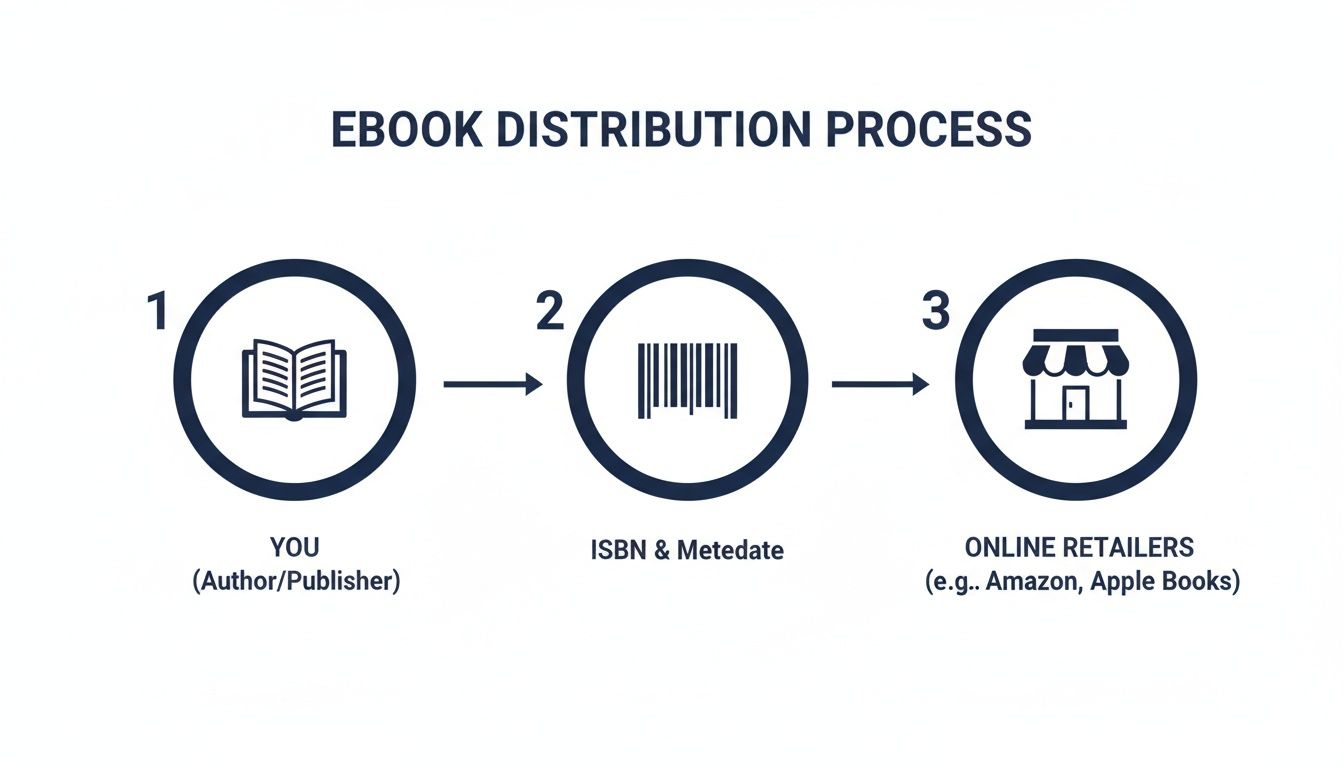
As you can see, that little number is what allows your ebook to be found, ordered, and sold by retailers everywhere.
Understand the Publisher of Record
Finally, there’s one last crucial concept to grasp: the "imprint of record." Whoever buys the ISBN is listed in the global database as the official publisher. When you buy your own ISBN, you can list your name or your own publishing company name.
This gives you complete control over your book’s destiny. Some distributors offer a "free" ISBN, which sounds tempting. But be careful. If you take it, they become the publisher of record, and that specific edition of your book is tied to their platform forever.
Owning your ISBN from the start ensures you remain a fully independent publisher with the freedom to make your own choices.
Common ISBN Mistakes and How to Avoid Them
Getting into the world of ISBNs for the first time can feel a little like navigating a minefield. A few simple misunderstandings can snowball into major distribution headaches, lost sales, and a whole lot of wasted time. The good news is that by learning from the most common errors, you can sidestep these issues entirely and manage your publications like a seasoned pro.
The whole point is to set your ebook up for success right from the start. Avoiding these pitfalls ensures your book is discoverable, trackable, and gives you the most control over your author career.
Mistake 1: Reusing Your Paperback ISBN
This is easily one of the most frequent—and costly—mistakes authors make. It’s tempting to use the same ISBN for your paperback and your ebook. After all, it’s the same book, right? Well, not in the eyes of the global publishing industry. Each format is considered a unique product.
Think of it like a movie. The version you see in theaters, the Blu-ray you buy later, and the version you stream are all the same film, but they're sold and tracked as completely different products. The exact same principle applies here. Reusing an ISBN just creates chaos for retailers and distributors, leading to jumbled sales reporting and inventory confusion.
Pro Tip: Always assign a separate, unique ISBN to each format of your book.
- One ISBN for your EPUB ebook.
- Another for your paperback.
- A third for your audiobook.
- And so on for any other format you release.
This is the only way to guarantee your sales data is clean and accurate across all channels. For a deeper dive, check out our complete guide on what an ISBN is and why this distinction is so important.
Mistake 2: Accepting a "Free" ISBN Without Understanding the Catch
Platforms like Amazon KDP offer a "free" ISBN, and for new authors on a tight budget, that can be incredibly tempting. But this convenience comes with a significant string attached that many don't realize until it's too late.
When you accept a free ISBN from a distributor, they become the publisher of record for that specific edition of your book. What this really means is the ISBN they give you is tied exclusively to their platform. You can't take that ISBN and use it to sell your ebook on Apple Books, Kobo, or anywhere else.
This effectively locks your ebook into a single ecosystem, seriously limiting your reach and your control. If you ever decide you want to "go wide" and sell on other platforms, you'll have to start over with a new ISBN, which can fragment your sales history and reviews.
Pro Tip: It's almost always better to purchase your own ISBNs from your country's official agency. This lists you or your publishing company as the publisher, giving you the freedom to distribute your ebook anywhere you choose, now and in the future.
Mistake 3: Changing Your Metadata After Publication
Your book's metadata—the title, subtitle, author name, and description—is permanently linked to its ISBN the moment you register it. Once your book is out in the world, trying to make major changes to this core information is a critical mistake.
Sure, minor tweaks like fixing a typo are generally okay. But if you decide to completely change the book’s title or do a major rewrite that really constitutes a new edition, you absolutely must assign a new ISBN. If you try to change the title on an existing ISBN, you risk having it delisted by retailers because the metadata no longer matches the official record. This digital identity crisis can make your book impossible for readers to find.
The accuracy of this data is more important than ever. As of 2022, around 30% of adults in the US and UK read ebooks. And with Amazon holding a dominant 79% market share, its system relies on consistent ISBN data to pull in information from competitors like Kobo and Apple. You can learn more about global ebook trends on Statista.com.
Pro Tip: Finalize all your core metadata before you assign and register your ISBN. Think of this information as being set in stone to avoid breaking your book’s connection to the global supply chain.
Your Top Ebook ISBN Questions, Answered
Alright, we’ve covered the basics, but I know from experience that this is where the really specific "what-if" questions start to pop up. When you're in the trenches of self-publishing, the details matter. Let's tackle some of the most common questions I hear from authors trying to get this right.
Think of this as a quick-reference guide for those nagging little uncertainties. I’ve pulled these directly from the kinds of conversations authors are having every day, so you can be sure the answers are practical.
Can I Use the Same ISBN for My Ebook on All Platforms?
Absolutely. In fact, you should. This is one of the biggest perks of buying your own ISBN. That number is tied to your specific ebook format (your EPUB file, for instance), not to the store selling it.
So, when you upload that EPUB to Kobo, Apple Books, Barnes & Noble, or anywhere else, you use that very same ISBN. Doing this keeps your sales data neat and tidy, giving you a single, unified view of how your book is performing across the market.
Do I Need a New ISBN if I Update My Ebook?
That all depends on what you mean by "update." If you're just fixing a few typos, correcting a broken link, or tweaking a sentence here and there, then no, you don't need a new ISBN. Those are considered minor touch-ups to the same edition.
But if you're making significant changes, you've essentially created a new edition, and that requires a new ISBN. The official agencies are pretty clear on this.
A "new edition" isn't just a typo fix. It means you've added or deleted chapters, rewritten large sections of the text, changed the book's title, or even added a new foreword. A new ISBN tells everyone—retailers, librarians, readers—that this version is substantially different from the old one.
Who Is Listed as the Publisher with a Free ISBN?
This is the big catch with "free" ISBNs. When you get one from a platform like Amazon KDP, they are listed as the publisher of record in the global database. Not you.
While it might seem convenient, it locks that version of your book to their platform. You can't take that Amazon-assigned ISBN and use it to sell your book elsewhere. To have your own name or publishing imprint listed as the publisher—and to have complete control over your distribution—you have to purchase the ISBN yourself from your country's official agency.
Does an Audiobook Version Need Its Own ISBN?
Yes, it definitely does. Every format of your book is a separate product. Think of it like a can of soda versus a bottle of soda—same drink, different package.
Your paperback has one ISBN, your hardcover has another, and your ebook has a third. Your audiobook is no different. It needs its own unique ISBN so it can be properly cataloged and tracked by audiobook-specific platforms like Audible, Scribd, and OverDrive.
Ready to move forward and get your book into the hands of readers? The team at BarkerBooks lives and breathes this stuff. We can help you navigate everything from ISBN registration and professional editing to getting your book distributed worldwide. Let's turn your manuscript into the professionally published book it deserves to be. Learn more about our author services at https://barkerbooks.com.