
A hook is your first—and often only—chance to grab a reader. It’s that one compelling question, surprising fact, or intriguing statement that stops them in their tracks and makes them need to know what comes next. It’s a promise you make in the opening sentence or two.
The Undeniable Power of a Killer Hook
Let’s get real for a second. We live in a world of endless scrolling, and you have just moments to make an impression. This isn't an exaggeration; it's a fact. The average human attention span has dwindled to a mere 8.25 seconds—that’s shorter than a goldfish’s.
This is exactly why a powerful hook isn't just a nice-to-have; it's your most critical tool as a writer.
A hook does more than just kick things off. It works on a psychological level, creating an "open loop" in the reader's mind. This creates a small gap in their knowledge, a nagging feeling that they can only satisfy by reading on. It's the secret ingredient that turns skimmers into dedicated readers.
Beyond the First Sentence
Think of your hook as an unwritten contract. You're promising the reader that their time and attention will be rewarded, whether with fascinating information, an emotional journey, or a satisfying story.
This principle holds true everywhere, from the first line of a thriller to a pithy social media caption. You can see this in how creators make viral YouTube Shorts by hooking viewers within the first three seconds. They deliver on that initial promise—fast.
A weak opening is passive. A killer hook, on the other hand, is active. It gets to work immediately. It can:
- Generate Curiosity: "It started with a secret that wasn't mine to keep."
- Establish a Connection: "Have you ever felt like you were shouting into the void?"
- Challenge an Assumption: "Everything you know about productivity is wrong."
Each of these examples makes the reader pause, think, and engage. They don't just start the story; they set the entire stage.
Quick Guide to Common Hook Types
To get you started, here’s a look at some of the most effective hook strategies out there. Think of this as your toolkit for turning a casual browser into a committed reader, no matter what you're writing.
| Hook Type | Core Principle | Best For |
|---|---|---|
| Anecdotal Hook | Telling a short, relatable story. | Blog posts, nonfiction books, speeches. |
| Question Hook | Asking a thought-provoking question. | Articles, social media, marketing copy. |
| Statistic Hook | Using a surprising or shocking number. | Reports, presentations, persuasive essays. |
| Quotation Hook | Starting with a powerful quote. | Academic papers, feature articles. |
| Statement Hook | Making a bold or controversial claim. | Opinion pieces, sales pages, fiction. |
Ultimately, a great hook is less about the words themselves and more about the emotional reaction they spark. It’s your best shot at convincing someone that what you have to say truly matters. Mastering this skill is the foundation of powerful writing in any medium.
Breaking Down the Anatomy of a Killer Hook
A hook that grabs a reader and refuses to let go isn't magic. It's an engine, and every part has a job to do. While hooks come in all shapes and sizes, the ones that truly work—the ones that stop the scroll and silence the room—are built from the same core components. Once you understand this DNA, you can start crafting powerful openings by design, not by chance.
Think of it like a four-legged stool. If you pull one leg out, the whole thing wobbles and collapses. A great hook needs all four of these elements working together to be stable, strong, and effective.
Clarity and Intrigue: The One-Two Punch
First off, your hook has to be crystal clear. If I have to read your first sentence twice just to figure out what you’re saying, you've already lost me. Confusion is the ultimate engagement killer. Your opening needs to land with instant, gut-level understanding.
But clarity on its own is just a statement. It needs a partner: intrigue. This is the spark that lights a fire in the reader’s mind, making them desperately need to know what happens next. Intrigue creates an open loop, a little mental itch that can only be scratched by reading on. It's the difference between stating a fact and posing a riddle.
An irresistible hook makes a promise. It’s a pact with the reader, assuring them that their time will be rewarded with a surprising twist, a valuable secret, or an unforgettable story. Delivering on that promise is what builds trust and earns you a loyal audience.
Specificity and Emotion: Making It Real
Next up, the best hooks are incredibly specific. Vague statements are weak and forgettable. Don't just say, "A study found interesting things." Instead, hit them with, "A new study revealed that people who skip breakfast are 27% more likely to miss their deadlines." See the difference? Specifics add weight, credibility, and give the reader's brain something concrete to hold onto.
Finally, and maybe most importantly, a truly great hook connects on an emotional level. It taps into a universal hope, a nagging fear, a deep-seated desire, or a frustrating problem. When your opening makes someone feel seen and understood, you create an immediate bond. That emotional resonance is often the final push that convinces them to invest their precious time in your words.
These aren't just rules for novelists. They apply to everything—blog posts, emails, social media captions, you name it. As our attention spans have gotten shorter, the need for a stronger opening has actually grown. In fact, content marketers have noted that the average length of a compelling introduction has shot up by 41% in just three years. This isn't fluff; it's the extra runway needed to truly capture and hold a modern reader's attention. You can find more stats like this over at HookAgency.com.
Seeing the Four Elements in Action
Let's look at a practical example. Say you're writing an article about beating procrastination.
- Weak Hook: "Procrastination is a common problem for many people." (True, but boring. No intrigue, no specifics, no emotion.)
- Strong Hook: "What if you could reclaim five hours of your week, starting tomorrow?" (Now we're talking. It's clear, intriguing, offers a specific benefit, and hits the emotional desire for more time.)
The second hook just works. It’s a clear question that sparks intrigue, it quantifies the benefit (five hours), and it connects with the frustration every procrastinator feels. To see more detailed breakdowns, studying a great book introduction example can give you a fantastic blueprint. Once you start seeing how these pieces fit together, you'll be able to build your own powerful hooks from the ground up.
Your Genre-Specific Hook Writing Toolkit
A hook that works for a high-stakes thriller will fall flat in a quiet literary novel. That shocking statistic grabbing eyeballs in a blog post would feel completely out of place in a memoir. The truth is, a great hook isn't a one-size-fits-all magic trick. It's about knowing your audience and your genre.
Think of it as having the right tool for the right job. You wouldn't use a sledgehammer to hang a picture frame. This toolkit will break down how to craft the perfect hook for your specific context, with real-world examples to guide you.
No matter the genre, every powerful hook is built on three core pillars.
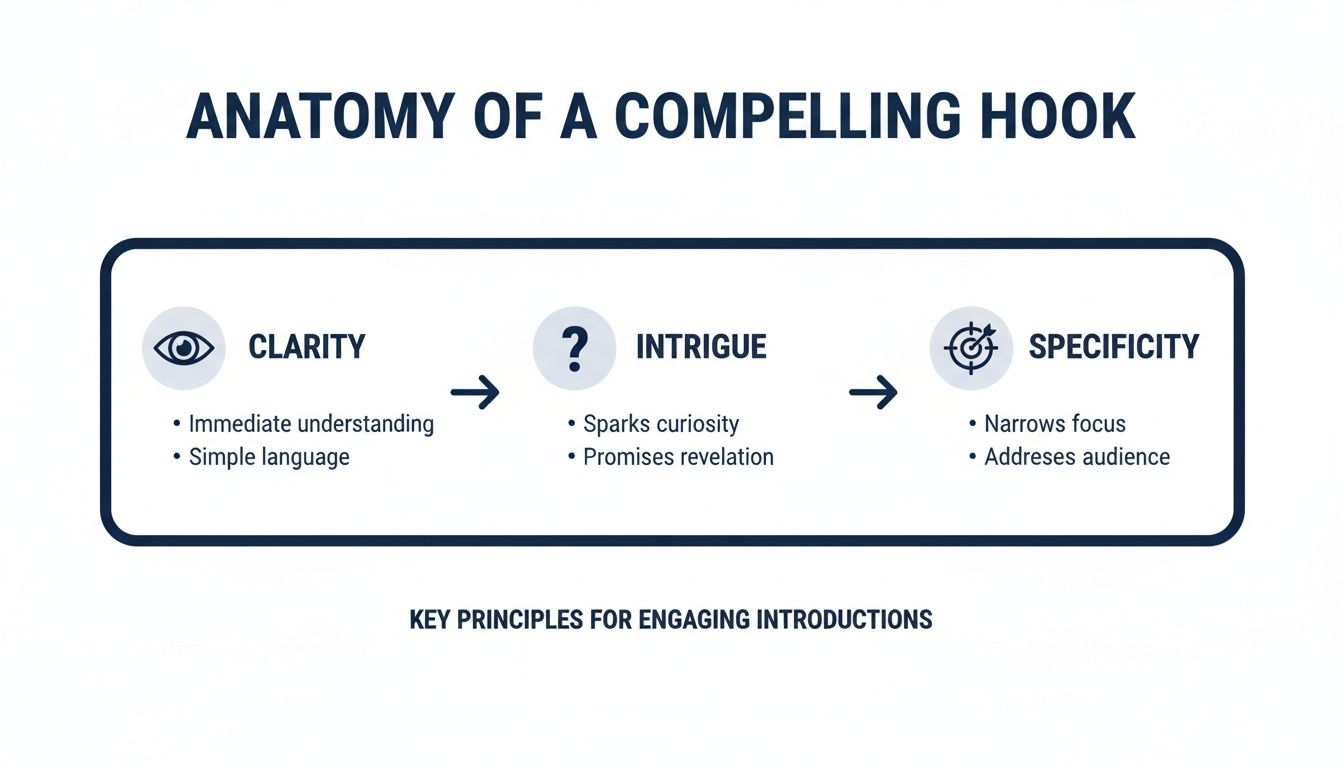
As you can see, the sweet spot is where clarity and intrigue meet, grounded by specific details that make the idea feel real and urgent.
Crafting Hooks for Fiction
In fiction, your first few sentences carry a lot of weight. They need to do more than just start the story; they have to hint at a world, introduce a distinct voice, and, most importantly, create a question that the reader must see answered.
Here are a few ways to pull readers in from the very first line:
- Plunge them into action. Don't waste time with warm-ups. Drop the reader right into a moment of high stakes or conflict.
- Example: "The moment the diamond left my fingers, I knew I’d made the biggest mistake of my life."
- Let a unique voice shine. Introduce a character with an unforgettable perspective or a startling way of seeing the world.
- Example: "It’s a universally acknowledged truth that the best way to hide from your past is to get a job at a small-town library. Or so I thought."
- Introduce a strange new reality. Hook them with a peculiar rule, a fascinating setting, or a bit of lore that immediately makes them question everything.
- Example: "In the city of Aethel, it was illegal to dream."
These openings work because they instantly create a mystery or a problem. They don't just tell the reader what's happening; they invite them to help figure it out. If you’re setting the stage before the main story kicks off, our guide on how to write a prologue has more in-depth strategies for those crucial opening pages.
Nailing the Hook for Non-Fiction and Blog Posts
With non-fiction, you’re dealing with a reader who is asking one simple question: “Why should I care?” Your hook has to answer that immediately. You need to connect your topic to a problem they're facing, a question they're asking, or a goal they want to achieve.
Here are some proven approaches:
- The Shared Problem: Start by describing a frustration you know your audience experiences. It builds an immediate sense of, "This person gets me."
- Example: "You’ve spent hours crafting the perfect email, only to see an open rate of less than 10%. What went wrong?"
- The Startling Statistic: Use a surprising number or a counterintuitive fact to challenge their assumptions and make them lean in, curious for the explanation.
- Example: "More than 73% of professionals admit to checking their work email on vacation, yet only a fraction of them actually complete any meaningful tasks."
- The Bold Claim: Make a provocative statement that pushes back against common knowledge. This instantly positions you as an expert with a fresh take.
- Example: "Everything you’ve been taught about morning routines is actively sabotaging your productivity."
Each of these hooks makes a clear promise of a solution or a valuable insight, giving your reader a compelling reason to keep reading.
A great non-fiction hook doesn’t just present information; it frames that information as the key to solving a puzzle, easing a pain point, or achieving a desired outcome for the reader.
Writing Hooks for Marketing and Social Media
Welcome to the world of the infinite scroll. You don't have seconds to grab attention—you have a fraction of one. Hooks for social media need to be short, punchy, and disruptive enough to stop a thumb in its tracks.
Here are a few battle-tested formulas I've seen work time and again on platforms like Instagram, TikTok, and X (formerly Twitter):
- The "Mistake" Hook: "You're still [doing common activity] wrong. Here's why."
- The "Secret" Hook: "Here's the one thing [successful people/experts] know about [topic] that you don't."
- The "How-To" Hook: "How I achieved [amazing result] in [short timeframe] without [common pain point]."
These formulas are effective because they are direct, promise a clear benefit, and create an instant information gap the viewer wants to close. For platforms where video is king, mastering Instagram Reels hooks is a non-negotiable skill for growth.
Crafting Hooks for Academic Writing
Even in the formal world of academic writing, you still need to engage your reader, whether it's a professor, a journal editor, or a peer reviewer. While you'll want to avoid overly casual language, the core principles of intrigue and relevance are just as important.
An effective academic hook might:
- Pinpoint a Gap in the Research: Start by showing what question existing literature has failed to answer, setting the stage for your contribution.
- Example: "While extensive research has explored the economic impact of the Industrial Revolution, its direct effect on rural family structures remains underexamined."
- Use a Contextualizing Anecdote: A brief, relevant historical story can provide a fascinating entry point to your research question.
- Example: "In 1888, a single misprinted map in London led to a border dispute that would simmer for nearly a century."
- Lead with the Core Question: Open your paper by posing the central inquiry that your work will spend its time exploring.
- Example: "To what extent did ancient Roman trade routes facilitate the spread of not just goods, but also democratic ideals?"
By adapting your hook to the conventions of your genre, you turn a simple opening line into your most powerful tool for reader engagement.
Common Hook Mistakes and How to Avoid Them
Even veteran writers can miss the mark with an opening line. It’s surprisingly easy to fall into traps that feel safe but actually push readers away. The first step to writing a killer hook is learning to spot the bad ones.
Think of this as a quick field guide to the most common hook-writing blunders. Once you know what to look for, you can self-edit with a sharper eye and turn a lukewarm opening into one that’s impossible to ignore. A great hook is rarely a first draft—it’s polished.
The Vague Generalization
This is probably the most frequent offender. It’s that opening sentence that’s technically true but has absolutely zero punch. It’s a broad, lazy statement that anyone would nod along to, and that’s precisely why it fails. It doesn't provoke thought; it just takes up space.
- Weak: "Marketing is very important for businesses today."
- Strong: "What if 75% of your marketing budget was being spent on channels your ideal customer actively ignores?"
See the difference? The second example swaps a sleepy platitude for a specific, provocative question. It immediately raises the stakes and forces the reader to wonder about their own strategy. Now they need to read on to get the answer.
The Overused Cliché
Clichés are the zombies of the writing world—phrases that were once alive with meaning but have been used so often they’re just mindless husks. Kicking off your article with "In this day and age…" or "A picture is worth a thousand words…" is a red flag to the reader that you probably don't have anything new to say.
Your hook is your first impression. Make it count by being original.
- Weak: "Thinking outside the box is key to innovation."
- Strong: "In 1997, Steve Jobs returned to a nearly bankrupt Apple and saved it by killing more than 70% of its product line."
Instead of leaning on a tired phrase, the revised version tells a tiny, gripping story with a surprising statistic. It shows what radical thinking looks like through a real-world example, which is far more memorable than just telling someone to be innovative.
A hook's job is to disrupt the reader's pattern of thinking. A cliché does the exact opposite; it reinforces familiar patterns, allowing the reader's mind to skim right over your words without engaging.
The 'Data Dump' Introduction
A surprising statistic can be a fantastic hook. But just dropping a string of numbers on your reader without context is more confusing than compelling. This usually happens when a writer is trying too hard to sound credible and forgets to be interesting.
A single, well-framed statistic almost always hits harder than a cluster of mediocre ones. The magic is in the context you provide.
- Weak: "Our company saw 15% growth, a 22% increase in engagement, and a 10% reduction in churn last quarter."
- Strong: "Last quarter, we discovered a simple two-minute change to our onboarding process that cut customer churn by 10%."
The second hook isn't just a number; it’s a story. It zeroes in on the most impressive result and frames it as a solution. It teases a valuable insight, making you want to know what that "two-minute change" was. That’s the kind of curiosity that keeps people reading.
Testing and Refining Your Hook for Maximum Impact
Writing a hook is a creative burst, but refining it is pure strategy. An opening that sounds incredible in your head can fall completely flat with a real audience. The final, most important step isn't just writing the hook—it's moving from hoping it works to knowing it works.
This doesn't need to be some complicated, drawn-out process. A few simple, real-world checks can expose weak spots in your opening lines and help you sharpen them until they’re impossible to ignore. Think of it as quality control for the most important sentences you’ll write.
Putting Your Hook to the Test
Before you send that manuscript off or hit "publish" on a post, run your hook through a few quick diagnostics. These little exercises take just a few minutes, but they can dramatically change how your work lands. They're all about getting out of your own head and seeing your words through fresh eyes.
Here are a few of my tried-and-true methods:
- The Read Aloud Test: The simplest test on the planet. Just read your hook out loud. Does it flow, or does it sound clunky and unnatural? Your ear catches awkward phrasing and clunky sentences far better than your eyes do. A great hook should roll off the tongue.
- The "So What?" Test: Right after you read your hook, ask yourself, "So what?" If you can't fire back an immediate, convincing reason why a reader should care, your hook has failed. It needs to scream relevance and promise something worthwhile from the very first word.
- The 24-Hour Test: This one is a classic for a reason. Step away from your hook for a full day. When you come back to it with a clear head, does it still have that same spark? Time gives you the distance you need to tell the difference between a hook that’s just clever and one that’s truly compelling.
These quick checks force you to judge your hook on what really matters: its clarity, its power to create intrigue, and its immediate gut-punch impact.
Data-Driven Refinements for Digital Content
If you're writing for an online audience, you have a massive advantage: real-time feedback. You can ditch the guesswork and use actual data to see what grabs people. This is where you can fine-tune your hook for peak performance.
The best way to do this is with A/B testing, sometimes called split testing.
An A/B test is just a straightforward experiment. You create two or more versions of something—like a social media post's opening line—and show them to different groups within your audience to see which one performs better.
You could, for example, run two Facebook ads for the same article, but with a different hook for each. Within a day or two, you'll see which ad got more clicks. That's your winner. It’s no longer a matter of opinion; the data tells you exactly what your audience responds to.
You can use this same idea for all kinds of content:
- Email Subject Lines: Test two hooks and see which one gets more people to open the email.
- Social Media Posts: Try two different opening lines and track which one gets more likes, shares, and comments.
- Blog Post Titles: Use a plugin or tool to test multiple headlines for the same article.
This kind of feedback loop is gold. It doesn’t just improve the piece you’re working on now; it teaches you what your audience craves, making you a sharper writer in the long run. Honing your hook is every bit as crucial as writing great book blurbs or back cover copy, since both are your first and best chance to win a reader over.
Hook Effectiveness Quick Tests
Here's a quick summary of simple, actionable tests you can run to evaluate and improve your hook before you share it with the world.
| Test Name | How It Works | What It Measures |
|---|---|---|
| The Read Aloud Test | Read your hook out loud. Listen for awkward phrasing, rhythm, and flow. | Clarity & Flow: Measures how natural and easy to process the language is. |
| The "So What?" Test | After reading the hook, ask "So what?" and see if you have a compelling answer. | Relevance & Stakes: Measures if the hook immediately establishes why the reader should care. |
| The 24-Hour Test | Step away from the hook for a day and re-read it with fresh eyes. | Lasting Impact: Measures if the hook's initial appeal fades or holds up over time. |
| The Friend Test | Read only the hook to a friend (without context) and ask them what they think will happen next. | Intrigue: Measures how well the hook creates curiosity and makes someone want more information. |
Running these tests helps ensure your opening isn't just good—it's effective. And an effective hook is the first step toward building a loyal audience.
Frequently Asked Questions About Writing Hooks
Even with a solid understanding of what makes a hook work, a few questions always seem to pop up. Writing a killer opening is as much an art as it is a science, and it's in the nuances where authors often get stuck. Let's tackle the most common questions we hear from writers just like you.
Think of this as your go-to guide for those nagging little uncertainties. Getting these details right can be the difference between a hook that's just "good" and one that's absolutely magnetic.
How Long Should a Hook Be?
This is the classic "how long is a piece of string?" question. There's no magic word count because the ideal length is completely dictated by the format. For a tweet, your hook might just be the first five words. For a novel, it could be the entire opening paragraph.
The real goal isn't hitting a specific number. It's about how quickly you can land a punch of curiosity, emotion, or tension.
As a general rule of thumb for most online content like blog posts, you need to grab the reader's full attention within the first one to three sentences. Your job is to stop the scroll, and you have to do it fast.
Can a Hook Be a Question?
Absolutely! In fact, it's one of the most powerful tools in a writer's toolkit. Asking a provocative or deeply relatable question is a fantastic way to write a hook.
Why does it work so well? A question forces the reader's brain to pause and engage. They can't help but start formulating an answer, which means they're instantly invested in hearing your take on it.
The secret is to ask something open-ended that taps into a reader's existing desire, fear, or curiosity. It's far more compelling than a simple statement. Instead of saying, "Confidence is important," you could ask, "What would you do if you had unbreakable confidence?" See the difference?
A great question hook doesn't just ask for information; it invites the reader into a conversation. It makes them an active participant from the very first word, which is a powerful way to build an immediate connection.
What's the Difference Between a Hook and a Thesis Statement?
This one trips up a lot of writers. They often live right next to each other in an introduction, but they have completely different jobs. Think of them as a one-two punch.
- A hook's job is to grab attention. It's all about intrigue, emotion, and making someone desperately want to know what comes next.
- A thesis statement's job is to provide clarity. It lays out the main point or argument you're going to prove or explore in the rest of the piece.
A well-crafted introduction uses both. It starts with a compelling hook to pull the reader in, then transitions smoothly into a clear thesis that sets expectations. The hook makes them lean in; the thesis tells them what they're leaning in for.
How Do I Write a Hook for a Technical or "Boring" Topic?
Ah, my favorite challenge. This is where a great hook proves its worth. When your subject is dense, dry, or complex, your opening line has to work overtime. The absolute biggest mistake you can make is leading with jargon or technical minutiae.
Instead, you have to find the human element. Find the surprising result, the hidden drama, or the relatable problem. Your mission is to build a bridge from something your reader understands to the complex topic you need to explain.
Here are a few strategies that work wonders for drier subjects:
- Lead with a Shocking Statistic: Find a number that completely shatters expectations. Instead of explaining the finer points of logistics, you could start with: "Every year, $60 billion worth of cargo simply vanishes from shipping containers." Now that's a story.
- Tell a Relatable Story: Frame the technical information as the solution to a familiar problem. A piece on data security could begin with: "It started with a single, innocent-looking email. A week later, it had cost the company everything."
- Create a Powerful Analogy: Connect your complex idea to something simple and universal. Writing about quantum computing? Try something like: "Imagine a library where a single book could contain every story ever written, all at the same time."
By focusing on the surprising, the problematic, or the relatable, you can spark genuine curiosity for even the most daunting topics.
Feeling ready to hook your readers but want a professional eye to make sure your manuscript shines from the very first page? The expert editors at BarkerBooks specialize in transforming great ideas into unforgettable books. Let us help you perfect your opening and prepare your book for global success.
Discover our full range of editorial and publishing services at https://barkerbooks.com.