
So, you're ready to print your book. One of the first and most pressing questions is always, "How much is this going to cost?" The truth is, the cost to print a book can land anywhere from $2 to over $15 per copy. That's a huge range, and it all boils down to your printing method, the book's specific features, and how many copies you order.
You essentially have two main roads to choose from: Print-on-Demand (POD), which is incredibly flexible and requires no big upfront investment, and traditional offset printing, which costs much less per book but means you have to buy a large quantity at once.
Your Quick Guide to Book Printing Costs
Figuring out your final printing cost can feel a bit like trying to hit a moving target. The final price tag isn't just one number; it's a mosaic built from dozens of small decisions you'll make along the way. Think of it like ordering a new car. The base model has a set price, but as you add premium features like leather seats, a sunroof, or a high-end sound system, the cost climbs. Your book is no different.
The two printing methods—Print-on-Demand (POD) and offset—represent entirely different financial philosophies for an author. Let’s break them down.
The Two Roads of Book Printing
Print-on-Demand (POD) has become a modern author's best friend, especially for anyone looking to minimize financial risk. Just as the name implies, with POD, books are printed one by one as customers order them. There are no massive upfront costs for buying inventory, which makes it a perfect fit for new authors, books in niche genres, or anyone just testing the waters with a new idea. It's a total game-changer.
This technology has dramatically lowered the barrier to entry. Setup fees for most POD services range from $0 to around $295. Some platforms, like IngramSpark, charge a small fee of about $49 to get your book into their massive distribution network. This means you no longer have to gamble thousands of dollars on a bulk print run, hoping the books don't end up gathering dust in your garage. A typical per-copy cost for a standard paperback usually lands between $2–$6, depending on the specs.
Offset printing, on the other hand, is the traditional powerhouse of the publishing industry. This is how the big publishing houses do it. The process involves creating metal printing plates and running thousands of copies in a single, massive batch. The economy of scale here is fantastic, leading to a significantly lower cost for each individual book. The catch? You need a substantial upfront investment and a place to store all those books.
Key Takeaway: POD offers low financial risk and incredible flexibility, making it the go-to for most self-publishers. Offset printing delivers the lowest possible per-unit cost but demands a serious initial budget and confidence in your sales forecast.
To get a handle on all the potential expenses involved, it can be incredibly helpful to map everything out in a detailed crowdfunding budgeting proposal, which can serve as a solid financial roadmap.
POD vs Offset Printing Quick Comparison
To really see the difference, let's put these two methods head-to-head. This table breaks down the core distinctions in cost, volume, and when to use each one. It's a quick way to see which path aligns best with your budget and publishing goals.
| Feature | Print-on-Demand (POD) | Offset Printing |
|---|---|---|
| Upfront Cost | $0 – $50 (for setup) | $1,500 – $10,000+ |
| Per-Unit Cost | Higher ($4 – $10+) | Lower ($1 – $3) |
| Minimum Order | 1 copy | 500 – 1,000+ copies |
| Best For | New authors, testing the market, managing cash flow | Established authors, large print runs, bulk distribution |
| Turnaround Time | Fast (days) | Slower (weeks) |
| Quality Control | Varies by print | Consistent across run |
As you can see, the right choice really depends on your specific situation. There's no single "best" answer, only what's best for you.
For a personalized estimate based on your book's unique details, feel free to play around with our book printing cost calculator. It’s a great tool for getting a more concrete idea of your potential costs.
Breaking Down the Price of a Single Book
Ever wonder why one 200-page book costs $3 to print and another of the same size costs $10? It’s because the final cost to print a book isn't one single number. It’s the sum of a dozen little decisions you make about what your book will look and feel like.
Think of it like ordering a pizza. The base price is for a plain cheese pizza, but every topping—pepperoni, mushrooms, extra cheese—adds to the final bill. Your book works the same way. The size, the paper, the cover… they're all "toppings" that build your final per-unit cost.
The Core Four Cost Factors
While there are many small details, four big decisions drive the majority of your printing cost: trim size, paper type, interior color, and binding. Getting a handle on these is the key to balancing your creative vision with a real-world budget. Let’s break them down.
Trim Size and Page Count
First up is the physical size of your book, or its trim size. A bigger book, like a 6" x 9" non-fiction or an 8.5" x 11" workbook, simply uses more paper and ink than a standard 5" x 8" novel. The difference might seem tiny on a per-page basis, but it really adds up.
Along those same lines, your page count is a huge cost driver. It’s simple math: a 400-page epic is going to cost more to print than a lean 150-page novella. This is why a tight, well-edited manuscript isn’t just good for your readers—it’s great for your wallet.
Paper Type and Weight
The paper you choose completely sets the tone for the reading experience. Do you want that creamy, off-white stock that’s so common in novels? Or a crisp, bright white that makes charts and graphs pop in a business book?
Paper is also measured by its weight (you'll see numbers like 50 lb. or 60 lb.). Heavier paper feels more substantial and premium, but you guessed it, it also costs more. For most authors, a standard 50-60 lb. paper is the sweet spot, giving you a professional feel without breaking the bank.
Black and White vs. Color Interior
This is easily one of the biggest cost decisions you’ll make. Printing a book with a full-color interior can multiply the per-unit cost by two to four times compared to a standard black-and-white print. It's a massive jump.
For novels, memoirs, and most non-fiction, black and white is the standard for a reason—it’s economical. But if you’re writing a children’s book, a cookbook, or a photography collection, color is essential. It's just a necessary investment you have to plan for.
Budgeting Insight: Unless color is absolutely critical to your book's mission, sticking to a black-and-white interior is the single most powerful way to keep your printing costs down.
Binding Style: Paperback vs. Hardcover
Finally, we have the binding that holds it all together. The two most common choices for independent authors are:
- Paperback (Perfect Bound): This is the workhorse of the publishing industry. The pages are glued securely into a flexible cover, making it affordable and popular.
- Hardcover (Case Bound): Offering a more premium, durable feel, hardcovers feature a rigid board cover, often wrapped in a dust jacket. That extra quality comes at a price, typically adding $2 to $5 or more to each book's cost compared to its paperback cousin.
Sample Per-Unit Printing Cost Estimates
To help you see how these choices play out in the real world, here are some ballpark estimates for common book formats. The table below uses Print-on-Demand (POD) pricing to show how quickly the cost can change based on your specifications.
Sample Per-Unit Printing Cost Estimates
| Book Format | Page Count | Interior | Binding | Estimated Per-Unit Cost (POD) |
|---|---|---|---|---|
| Standard Paperback | 200 pages | Black & White | Paperback | $3.50 – $4.50 |
| Large Paperback | 350 pages | Black & White | Paperback | $5.00 – $6.50 |
| Standard Paperback | 200 pages | Standard Color | Paperback | $7.00 – $9.00 |
| Children's Book | 32 pages | Premium Color | Paperback | $3.75 – $5.00 |
| Standard Hardcover | 200 pages | Black & White | Hardcover | $8.00 – $11.00 |
| Premium Hardcover | 200 pages | Premium Color | Hardcover | $12.00 – $16.00+ |
As you can see, your design decisions have very real financial consequences. A standard black-and-white paperback is incredibly affordable, while a premium color hardcover is a significant investment. By understanding these trade-offs, you can create a beautiful, professional book that perfectly matches your goals and your budget.
Choosing Your Printing Path: POD vs. Offset
Deciding how to print your book isn't just about crunching numbers; it's a strategic choice that can define your entire publishing journey. The best path forward really depends on your goals, your budget, and how you plan to get your book into the hands of readers. This single decision is one of the biggest factors in the total cost to print a book.
To make this crystal clear, let's walk through the stories of two very different authors.
First, meet Maya, a debut novelist with a tight budget. Her dream is to reach a global audience, but the thought of filling her garage with hundreds of unsold copies is a nightmare. This makes her a perfect candidate for Print-on-Demand (POD).
Then there's David, an established author with a loyal fanbase. He's planning a nationwide book tour and knows he needs thousands of copies ready for his events. For David, the much lower per-unit cost of a large offset printing run is the only way to go.
By following their paths, you'll see the pros and cons of each method play out in the real world.
The Print-on-Demand Advantage for New Authors
For someone like Maya, POD is a lifesaver. It completely eliminates the need for upfront inventory costs. With POD, a book is only printed after a customer places an order online. This means she has zero financial risk tied up in physical stock.
Her per-unit cost might be higher—let's say $4.50 per book—but she never has to lose sleep over unsold inventory. This model lets her test the market, build an audience, and maintain a positive cash flow from day one. It's all about flexibility and tapping into global distribution without a massive initial investment.
The POD Bottom Line: You trade a lower per-unit profit for zero upfront financial risk and incredible flexibility. It's the ultimate "pay-as-you-go" model for authors who need to be agile and budget-conscious.
While the printing itself has a low barrier to entry, it's important to remember the bigger picture. The total cost of self-publishing a professional-quality book often lands between $2,940 and $5,660. This includes essentials like editing and cover design, which can easily eat up 40–60% of the total budget.
The Offset Printing Strategy for Established Authors
David's situation is the complete opposite. He knows from experience that he can sell 2,000 copies during his tour and through pre-orders from his mailing list. By choosing offset printing, his per-unit cost drops dramatically to around $1.75 per book.
Sure, he has a significant upfront cost of $3,500 for the print run. But his profit margin on each sale is substantially higher. This economy of scale is the core benefit of offset printing. It requires confidence in your sales forecast and a plan for storage and fulfillment, but the financial rewards on large volumes are unmatched.
This flowchart shows how key decisions like binding and color directly influence your final printing costs, no matter which path you choose.
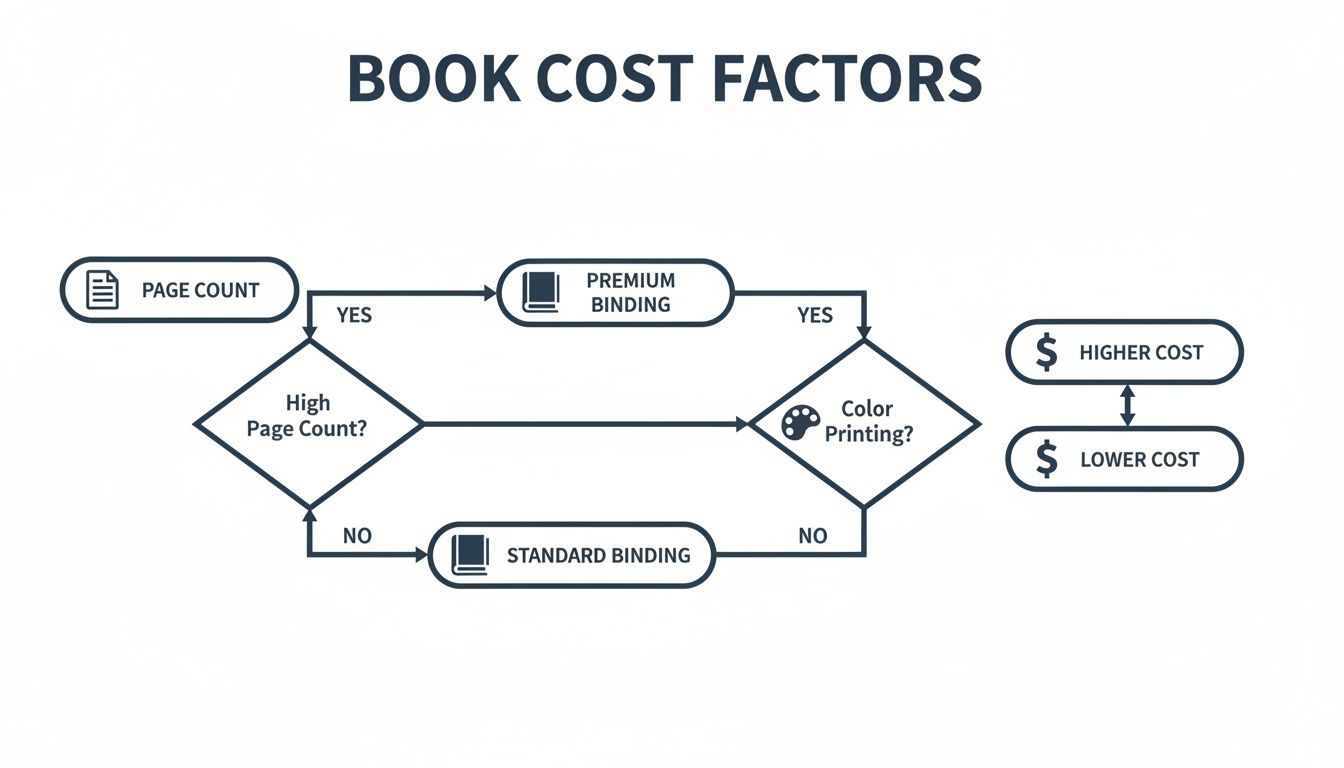
As you can see, factors like your book's page count, binding choice, and use of color are fundamental cost drivers in both printing methods.
Which Author Profile Fits You?
To choose your path, you need to figure out which author profile sounds more like you. Are you a Maya or a David? Ask yourself these questions:
- What is your upfront budget? If it's minimal, POD is your best starting point.
- How confident are you in your sales projections? If you have a proven audience and a solid distribution plan, offset might be more profitable.
- Do you have space to store inventory? A 1,000-book order takes up a surprising amount of room.
- How important is the per-unit profit margin? Offset printing delivers higher margins, but only if you can sell through your stock.
Another pro-tip: choosing a standard book size can also help manage costs for both POD and offset runs. By answering these questions honestly, the right path will become clear, ensuring your printing strategy aligns perfectly with your career goals and financial reality.
Uncovering the Hidden Costs of Publishing
Getting that per-book print quote can feel like you’ve crossed the finish line, but in reality, it's just one part of the financial picture. The total cost to print a book involves several other critical expenses that often catch new authors off guard. Knowing what these "hidden" costs are from the start is the only way to build a realistic budget and avoid nasty surprises later on.
Think of it like buying a car. The sticker price is the big, obvious number, but you can't drive it off the lot without also paying for tax, title, and insurance. Book printing is the same—let's break down the other costs you need to get your book on the road.
ISBN and Barcode Registration
If you plan to sell your book in any store, online or brick-and-mortar, you need an International Standard Book Number (ISBN). This is your book's unique identifier across the entire global market. Some services will offer you a "free" ISBN, but there's a huge string attached: they list themselves as the publisher, not you.
This might not sound like a big deal, but it can seriously restrict where and how you sell your book. To keep full control, you'll want to buy your own. A single ISBN costs $125, but you can get a block of 10 for $295, which is a much better deal if you plan on publishing more than one book or multiple formats (like an ebook or audiobook). It's a one-time fee that establishes you as the official publisher.
Proof Copies and Quality Control
Never, ever skip this step. Before you commit to a full print run or make your book available to the public, you absolutely must order a physical proof copy. Holding the actual book in your hands is the only way to spot subtle formatting errors, typos, or cover issues that just aren't visible on a screen.
Crucial Insight: Skipping the proofing stage is one of the most common and costly mistakes a self-publisher can make. Finding an error after your book is live can lead to negative reviews and the expensive process of re-uploading files and re-ordering copies.
The cost for a proof is usually just the price of printing one book plus shipping. It’s a tiny investment for some priceless quality insurance.
Shipping, Handling, and Warehousing
How you choose to print your book will dramatically change your shipping and handling costs. With Print-on-Demand, it's simple. Those costs are handled on a per-order basis whenever a customer buys a book or you order author copies.
Offset printing is a whole different ballgame. First, you have to pay a hefty freight shipping charge just to get the pallets of books—we're often talking thousands of copies—from the printer to you. This isn't cheap. And with global paper prices and freight charges on the rise, this cost can be a real budget-buster.
Then, where do you put them all? Unless you've got a massive garage, you might need to rent space at a warehouse, which adds a recurring monthly fee. From there, you're on the hook for buying mailers, paying for postage, and shipping every single book yourself. These "little" costs stack up fast and can eat into your profit margins.
By looking at the complete financial picture, not just the per-unit price, you can build a budget that actually works. For a deeper dive into all the expenses involved, check out our guide on the full cost to publish a book.
Smart Strategies to Lower Your Printing Costs
Knowing what goes into your printing bill is one thing, but actively managing those costs is how you save real money. Thankfully, lowering the cost to print a book doesn’t mean you have to compromise on quality. It’s all about making smart, strategic decisions early in the game that will pay dividends down the line.
Think of it like packing for a trip. The choices you make at home—rolling your clothes, using packing cubes, grabbing travel-sized toiletries—directly impact how much you can fit and whether you’ll get hit with an overweight baggage fee. The same principle applies here; small, deliberate adjustments can lead to big savings.
Optimize Your Book’s Core Specifications
The most powerful cost-saving moves happen long before you’re ready to hit "print." Your book's physical DNA—its size, its length, the paper you choose—are the biggest levers you can pull to control your budget. Getting these right sets the foundation for a much more affordable project.
Here are a few practical tweaks that can dramatically lower your per-unit cost:
- Stick to Standard Trim Sizes: Printers calibrate their massive, expensive machines for common sizes like 5" x 8" or 6" x 9". If you request a custom size, they have to stop everything and reconfigure their setup, and guess who pays for that time? You do. Sticking to industry standards is an easy win.
- Be Ruthless with Your Page Count: Every single page adds to your final cost. A tight, focused manuscript isn't just better for keeping your reader engaged; it's also a powerful tool for your wallet. A good, sharp edit that cuts even 20-30 pages can make a noticeable dent in your per-book price.
- Use Color Only When Necessary: Full-color printing is a premium feature, and it comes with a premium price tag that can easily double or triple your costs. For novels, memoirs, or most text-heavy non-fiction, black-and-white is the way to go. Save the full-color treatment for projects where it’s absolutely essential, like children’s books or photography-heavy cookbooks.
Make Smart Choices About Ordering and Shipping
Beyond the book itself, how you order and manage your copies can also unlock significant savings. This is especially true when ordering author copies for events, marketing, or selling directly to readers. A little bit of planning can help you sidestep unnecessary expenses.
Ordering author copies in smaller, more frequent batches might seem counterintuitive, but it can actually save you a bundle on shipping. A single, manageable box of 20-30 books often ships for less per unit than a massive, heavy order that requires expensive freight services.
This approach also keeps you from tying up cash in a mountain of inventory that you then have to pay to store. Managing your cash flow is just as important as managing the per-unit cost. A great way to compare options and nail down your budget is to use an instant print quote tool, which can give you a clear picture of what different printers will charge.
By putting these strategies into practice, you take back control of your expenses. Every decision, from trim size to order frequency, becomes a deliberate move to reduce your costs and free up valuable funds for what really matters—getting your book into the hands of readers.
Your Questions on Book Printing Costs Answered
Even after you've wrapped your head around the basics, a few nagging questions about the financial side of printing can stick around. Let's tackle the most common ones authors ask about the cost to print a book, giving you clear, direct answers so you can finalize your budget and move forward with confidence.
Think of this as your final checklist. We'll clear up those practical, last-minute concerns that often pop up right before you’re ready to hit "print."
What Is the Most Cost-Effective Page Count?
There’s no single magic number, but for most authors, a book between 200 and 300 pages (that’s about 50,000 to 75,000 words) seems to be the sweet spot. This is especially true for print-on-demand services. A book in this range feels substantial enough for a reader to value, but it keeps the per-unit printing costs from getting out of hand.
Why? Books under 100 pages can have a surprisingly high cost per page because some fees are fixed no matter the length. On the flip side, once you push past 400 pages, the sheer amount of paper and ink makes the cost climb quickly. Sticking to that 200-300 page range is a great way to balance reader value with your own expenses.
How Much More Does a Hardcover Really Cost?
It’s a pretty significant jump, to be honest. You can generally expect a hardcover to cost an extra $3 to $5 per copy to print compared to the same book in paperback. For a typical 250-page black-and-white book, a paperback might run you $4.25, while the hardcover version could easily be $8.50.
This higher price comes down to the materials—rigid boards, laminated or cloth-wrapped covers, and dust jackets all cost more. The binding process itself is also more complex. While it's a bigger upfront investment, the durability and higher retail price of a hardcover can definitely pay off, especially for certain genres or for creating special editions.
Can I Use My Own ISBN with a POD Service?
Yes, absolutely—and it's something I strongly recommend. Most POD platforms like Amazon KDP will offer you a free ISBN, but there's a catch: they become the publisher of record. This can tie your book to their platform and limit your distribution options down the line.
Buying your own ISBN (a block of 10 for $295 is the best deal) makes you or your company the official publisher. This gives you total control to print anywhere and distribute your book across every platform, no strings attached. All the major POD services have a spot for you to enter your own ISBN during setup.
How Do I Calculate Royalties After Printing Costs?
Figuring out your royalty is actually pretty straightforward. Here’s the basic formula:
Retail Price – Wholesaler Discount – Printing Cost = Your Royalty
Let's walk through a real-world example for a paperback:
- You set the retail price at $15.99.
- The standard wholesaler discount is 40% (which is $6.40).
- Your printing cost is $4.10.
The math is simple: $15.99 – $6.40 – $4.10 = $5.49 in royalties for every copy sold through a bookstore or other retailer. If you sell directly through a platform like KDP, the wholesaler discount usually doesn't apply. Instead, they give you a fixed royalty rate (like 60% of the list price) and then subtract the printing cost from that.
Getting your printing plan locked in is the final hurdle before you can hold your book in your hands. At BarkerBooks, our publishing packages are built to manage all these details for you—from ISBNs to worldwide distribution—so you can get back to what you do best: writing. Explore our author services and simplify your publishing journey.