
When people ask about the best way to self-publish a book, they're often looking for a single platform or a magic button. But the truth? It’s not about a tool; it's about a process.
A successful book launch is built on four key phases: perfecting your manuscript, professional design, smart distribution, and a killer launch plan. This is your roadmap—it keeps you in the driver's seat, making smart business decisions without sacrificing your creative vision.
Your Blueprint for Self-Publishing Success
Stepping into self-publishing means you're not just an author anymore. You’re the CEO of your book. It’s an incredibly empowering position to be in, giving you total control over your work and a much bigger slice of the royalties than you'd ever see with a traditional publisher.
But that freedom comes with responsibility. The "best way" to do this is to move methodically through a series of stages, each one building on the last. You're not just uploading a Word doc; you're creating a professional product designed to compete with books from the biggest publishing houses. You're building a business around your art.
The Four Phases of a Successful Self-Publishing Journey
I've seen countless authors navigate this path, and the successful ones always master four distinct areas. Think of these as the non-negotiable pillars of your project. Each one is critical to giving your book the best possible shot at finding its readers.
The table below breaks down these core stages, outlining what you need to do and what you're trying to achieve in each one.
| Phase | Key Activities | Primary Goal |
|---|---|---|
| Manuscript Perfection | Self-editing, developmental editing, copyediting, and professional proofreading. | Create a polished, compelling, and error-free story that delivers a professional reading experience. |
| Professional Design | Genre-specific cover design, interior layout for ebook and print, and final file formatting. | Produce a book that looks and feels as good as a traditionally published title, inside and out. |
| Smart Distribution | Obtaining ISBNs, copyright registration, choosing between KDP Select (exclusive) and "going wide." | Make your book available for purchase where your target readers shop. |
| Dynamic Launch | Pre-launch buzz, launch day promotions (reviews, ads, social media), and ongoing post-launch marketing. | Generate initial sales momentum and build a sustainable plan for long-term discoverability. |
This structured approach turns what can feel like an overwhelming journey into a series of clear, manageable steps.
Breaking it down this way prevents you from getting lost in the weeds. If you're looking for an even more granular, step-by-step guide, our comprehensive self-publishing checklist will walk you through the entire process from start to finish.
And you're in good company. The rise of accessible platforms has led to an explosion of independent authors taking charge of their careers. In 2023, more than 2.6 million self-published books with ISBNs were released worldwide—that’s a 7.2% jump from the year before. This isn't a niche corner of the industry anymore; it's a mainstream movement. You can explore more data on the self-publishing boom to see just how massive this trend has become.
Polishing Your Manuscript Until It Shines

Before you even think about a cover design or a marketing plan, your manuscript has to be bulletproof. This is the bedrock of your entire publishing journey. I've seen too many authors with fantastic stories get torpedoed by negative reviews because of typos or plot holes—issues that are entirely fixable.
Don't think of professional editing as just another expense. It's a direct investment in your career as an author. It's what elevates a raw draft into a polished, professional book that can stand shoulder-to-shoulder with titles from traditional publishers.
Editing Is More Than Just a Spell Check
Most new authors hear "editing" and immediately think of someone fixing commas and spelling mistakes. That's part of it, sure, but it's only the final coat of paint. Real editing is a multi-layered process, and skipping a step is like trying to build a house on a shaky foundation. The cracks will show.
Here are the essential layers you can't afford to ignore:
- Developmental Editing: This is your big-picture reality check. A developmental editor is looking at the bones of your story—plot, pacing, character arcs, and overall structure. Does the middle of your book sag? Is your main character's motivation clear? This edit makes sure your story works on a fundamental level.
- Line Editing: With the structure solid, a line editor gets down to the sentence level. Their job is to make your prose sing. They'll smooth out clunky phrasing, tighten your language, and ensure your authorial voice comes through clearly and powerfully.
- Copyediting: Now we get to the nitty-gritty. The copyeditor is your grammar guru, hunting down errors in spelling, punctuation, and syntax. They also ensure consistency, catching things like a character's eye color changing mid-book or a timeline that doesn't add up.
- Proofreading: This is the last line of defense. After your book is edited and formatted for printing, a proofreader does one final pass to catch any lingering typos or formatting errors that slipped through or were introduced in previous stages. It's a final polish before it goes to the reader.
I once worked with a first-time author who hired a proofreader for their rough draft. The proofreader did a great job with commas, but they couldn't fix the fact that the villain disappeared for three chapters without explanation. The book launched, and the reviews all mentioned how "confusing" the plot was. That's a classic developmental issue that a proofread was never going to solve.
How to Find an Editor You Can Trust
Finding the right editor can feel like searching for a needle in a haystack, but it's worth the effort. The best place to start is by looking for editors who specialize in your genre. A brilliant sci-fi editor might not understand the subtle reader expectations of a cozy mystery, and that genre knowledge is invaluable.
Once you have a few candidates, always ask for a sample edit. Most professionals will edit a few pages of your manuscript (sometimes for a small fee), and this is your chance to see them in action. It lets you gauge their style, the depth of their feedback, and whether you click professionally.
Don't just look for corrected grammar in the sample. Ask yourself: Did they get my voice? Were their suggestions insightful? Did they improve the writing without gutting its soul?
Budgeting for Quality Editing
Let's be upfront: professional editing is a serious investment. The costs can vary dramatically based on the editor's experience, your book's length, and which type of editing you need. Developmental editing is usually the most expensive because it’s the most intensive.
For a typical 80,000-word novel, you can expect to see prices in these ballpark ranges:
- Developmental Edit: $2,000 – $4,000
- Line & Copyedit Combo: $1,500 – $3,000
- Proofread: $500 – $1,000
Those numbers might feel steep, but a poorly edited book is one of the quickest ways to kill your reputation. Before you move on, also make sure your manuscript has all the right parts in all the right places. This guide to the sections of a book is a great checklist to ensure you haven't missed anything from the title page to the acknowledgments.
Once the words are perfect, it's time to make them look the part. To learn more about that critical next step, check out our guide on how to format a book.
Designing a Book Readers Can't Resist
Let’s be honest. Everyone judges a book by its cover. In the crowded world of online bookstores, your cover is the first—and often the only—chance you get to make an impression. A killer design can stop a reader dead in their tracks, while a homemade-looking one is a surefire way to get scrolled past.
But it’s not just about the outside. The interior design is just as critical. A clean, professional layout makes for a smooth, enjoyable read. Bad formatting, on the other hand, is distracting and can yank a reader right out of the world you’ve built. Your cover and interior are a team, working together to signal quality from the first glance to the last page.
Your Cover Is Your #1 Salesperson
Think of your book cover as your most powerful marketing asset. It has to convey your book's genre, tone, and a hint of intrigue, all within a split second and often as a tiny thumbnail on a screen.
It’s all about meeting reader expectations. A thriller cover that uses dark, high-contrast imagery and sharp fonts immediately signals suspense. A contemporary romance might use soft pastels and a flowing script to promise a light, feel-good story. These aren't just arbitrary rules; they're visual shortcuts that tell readers, "Hey, if you like those kinds of books, you'll love this one." Straying too far from these conventions can confuse potential buyers and kill your sales before they even happen.
A few key elements make all the difference:
- Typography: The font you pick says so much. An elegant serif font can ground a historical novel in its time period, while a clean, geometric font might be perfect for a forward-thinking sci-fi adventure.
- Color Psychology: Colors are packed with emotion. Blues can feel mysterious or calming, while a splash of red might signal passion, action, or danger. Using them wisely helps set the right mood instantly.
- Imagery: Whether you use a photograph, an illustration, or an abstract design, the main image needs to be compelling. It should be relevant to your story but leave enough to the imagination.
Don't forget that your cover is the centerpiece of your online presence. Most guides on optimizing Amazon product listings emphasize that it all starts with a cover that grabs attention and refuses to let go.
Interior Formatting That Keeps Them Reading
Once your stunning cover has reeled them in, the interior design has to deliver. The goal here is simple: make the reading experience effortless. A well-formatted book becomes invisible, letting the reader sink into the words without a single thought about page layout.
A poorly formatted book, however, is a constant annoyance. Here’s what to focus on:
- Font Choice: For print, you can’t go wrong with classic, highly readable serif fonts like Garamond or Caslon. They're specifically designed for long-form reading and are much easier on the eyes.
- Print vs. Ebook: These are two totally different animals. Print books need precise margins, gutters (that inside space where the pages meet), and page numbers. Ebooks need to be "reflowable," so the text can adjust to different screen sizes and user font settings.
- White Space: Let your text breathe! Proper line spacing and generous paragraph breaks make the page feel open and inviting, not like a dense wall of text.
One of the most common mistakes I see is authors trying to use the same file for both their print and ebook editions. This almost always results in a formatting disaster—think weird page breaks in the Kindle version or text crammed into the spine of the paperback. Always, always create separate, optimized files for each format.
DIY Tools vs. Hiring a Professional Designer
So, do you tackle the design yourself or bring in a pro? The right answer really comes down to your budget, your own design eye, and how complex your book is.
- The DIY Route: Modern tools have made creating beautiful interiors easier than ever. Software like Vellum (for Mac) or Atticus (for PC/Mac) can produce professional results for text-heavy books like novels and memoirs. They’re a fantastic investment, typically a one-time fee of around $200-$250.
- Hiring a Pro: For your cover, I almost always recommend hiring a professional. It's the best way to self publish a book and make it look the part. A good designer lives and breathes genre conventions and has the artistic skill to make your book stand out. For a high-quality ebook cover, expect to invest anywhere from $300 to $800. If your book's interior is complex—full of images, tables, or unique layouts like a cookbook or children's book—a professional formatter is a must.
Finding a designer can feel overwhelming. A great way to start is by browsing the top-selling books in your genre and finding covers you love. The designer is often credited right inside the book. To get the most out of the experience, check out our guide with essential book cover design tips.
Choosing Your Distribution Channels
https://www.youtube.com/embed/GKE0dLlHJKQ
Alright, your manuscript is polished, the cover is a work of art, and your book is finally ready for the world. Now for the big question: where will people actually buy it?
This is a huge decision, and it really boils down to two main paths. You can either go all-in with Amazon, or you can spread your book far and wide across every retailer you can find. There's no single "right" answer here—it all depends on your goals, your genre, and the kind of author career you want to build.
The Big Decision: Exclusive or Wide?
At the center of this decision is a program from Amazon called KDP Select. When you enroll your ebook, you're agreeing to sell it only in the Kindle store for a 90-day period. In return, Amazon gives you a few special perks, including access to their massive ebook subscription service, Kindle Unlimited (KU).
The other route is to "go wide." This just means you skip KDP Select and get your book onto as many digital shelves as possible—Apple Books, Barnes & Noble, Kobo, Google Play, you name it. This approach is all about diversifying your income and building a fanbase across the entire market, but it means you miss out on the KU readership.
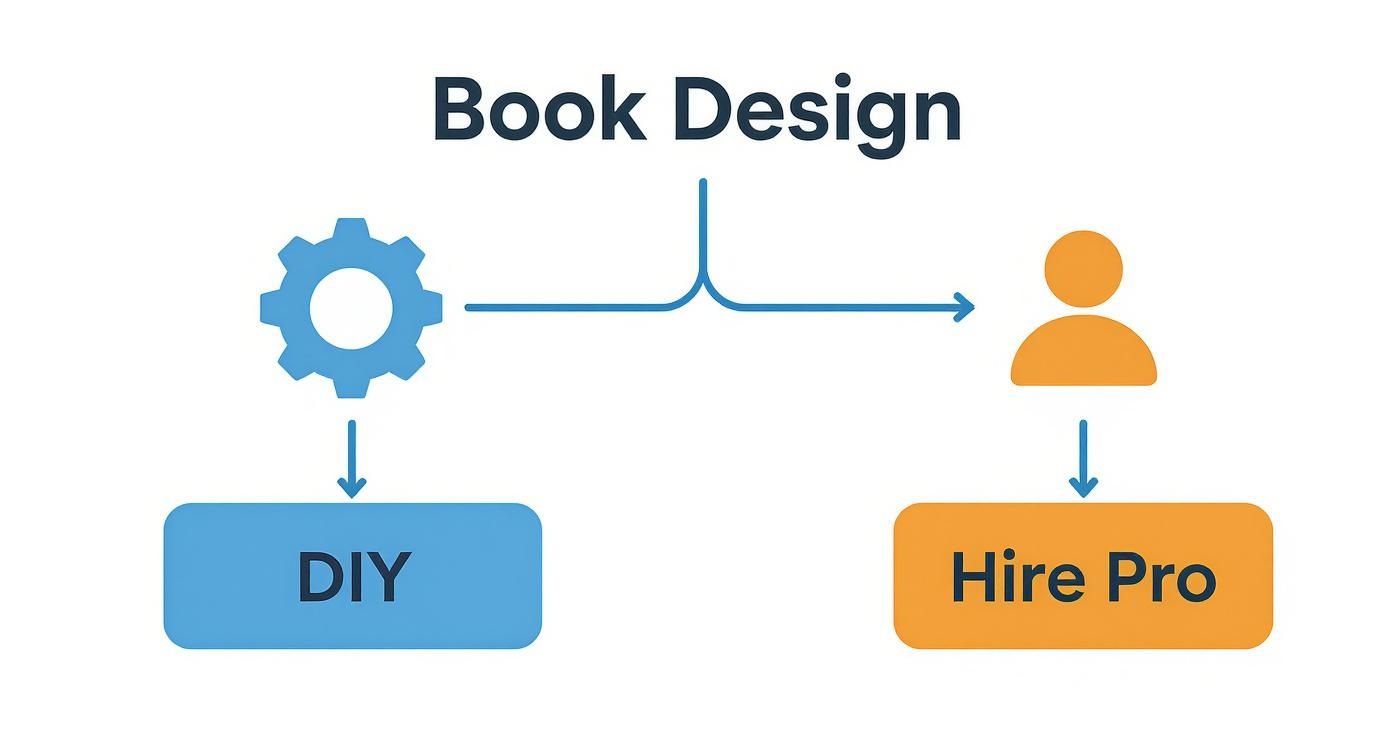
Think of it like the choice between DIY design and hiring a pro. Each path is a strategic fork in the road, and what you prioritize—reach, control, income stability—will guide your choice.
KDP Select: The Power of Amazon Exclusivity
For a lot of authors just starting out, KDP Select looks incredibly tempting. The biggest draw, by far, is Kindle Unlimited. Millions of readers pay a monthly fee to borrow and read as many books as they want from the KU library. As an author, you get paid from a global fund based on how many pages of your book are read.
For certain genres—think romance, fantasy, and fast-paced thrillers—this can be a massive income stream right out of the gate.
Enrolling in KDP Select also gives you access to a couple of unique promotional tools:
- Kindle Countdown Deals: You can schedule a limited-time discount on your book while still collecting a 70% royalty, which is a huge deal.
- Free Book Promotions: You get five days per 90-day term to make your book free. It's a classic strategy for getting a huge number of downloads and hopefully hooking new readers on your series.
The downside is obvious: you're putting all your eggs in the Amazon basket. If Jeff Bezos sneezes and the algorithm changes, your sales can plummet overnight. It’s a high-reward but higher-risk strategy.
Going exclusive with KDP Select can be a fantastic way to build initial momentum. The page reads from Kindle Unlimited can provide a crucial income boost right after launch, allowing you to reinvest in ads and your next book.
Going Wide: Building a Resilient Author Business
Choosing to go wide is about playing the long game. By getting your book onto multiple platforms, you're building a much more stable and resilient business as an author. You're not totally dependent on one company's ever-changing rules.
And it's not as complicated as it sounds. You don't have to upload your book to a dozen different sites. Aggregators like Draft2Digital and Smashwords are your best friend here. You upload your book files once, and they distribute it everywhere for you, collecting all your royalties and sending you one simple payment.
Here’s why many seasoned authors swear by the wide strategy:
- Diverse Income Streams: A slow month on Amazon can be balanced out by a great month on Apple Books or Kobo.
- Access to International Markets: Retailers like Kobo are huge in places like Canada, where Amazon isn't quite as dominant. You can reach readers you'd otherwise miss.
- More Promotion Opportunities: You can run sales exclusive to B&N or feature your book in an Apple promotion, targeting audiences that aren't glued to the Kindle store.
With the ebook market projected to hit $14.92 billion by 2025, spreading your bets across multiple platforms is a smart move for long-term growth. If you want to dig deeper into the numbers, these book sales statistics offer some great insights.
KDP Select (Exclusive) vs. Wide Distribution: A Comparison
So, which path should you take? It’s a tough call, and many authors even switch strategies from one book to the next. This table breaks down the core differences to help you decide what fits your goals right now.
| Feature | KDP Select (Amazon Exclusive) | Wide Distribution (Multiple Retailers) |
|---|---|---|
| Primary Audience | Kindle Unlimited (KU) subscribers, loyal Amazon shoppers. | Readers on Apple Books, Nook, Kobo, and other global platforms. |
| Key Advantage | Access to KU page read income and exclusive promotional tools. | Diverse income streams and a more resilient, long-term business. |
| Royalty Structure | 35% or 70% on sales, plus per-page-read payments from the KU fund. | Varies by retailer (typically 40%-70%). |
| Promotional Tools | Kindle Countdown Deals, Free Book Promotions. | Retailer-specific promotions (e.g., Apple Books features). |
| Main Drawback | All your income is tied to a single retailer (Amazon). | You miss out on the large, concentrated KU readership. |
| Best For… | New authors needing initial traction, authors in KU-heavy genres. | Authors focused on building a long-term brand across all markets. |
Ultimately, neither choice is permanent. You can always enroll a book in KDP Select for 90 days, see how it performs, and then opt-out to go wide if it’s not working for you. The key is to make an informed decision, track your results, and be ready to adapt your strategy as you grow.
Launching and Marketing Your Book for the Long Haul

So, you’ve hit the “publish” button. Take a moment to celebrate—that’s a massive accomplishment! But it’s not the finish line. In many ways, it's the starting gun for the most critical phase of your journey: connecting your book with its ideal readers.
A successful author understands that a book launch isn’t just a single event. It’s the beginning of a long-term marketing marathon. This isn’t about spamming social media or chasing every trend. It's about a strategic, three-part process that builds momentum before, during, and long after your book is live. This is where you put on your author-entrepreneur hat.
The Pre-Launch Runway: Building Your Audience Early
The groundwork for a killer launch begins months before your publication date. This pre-launch phase is all about building anticipation and gathering a tribe of supporters who are genuinely excited to buy, review, and share your book on day one. It's this initial surge that pokes the retailer algorithms and tells them your book is worth noticing.
During this time, two assets are your absolute lifeline: your email list and your advance review team.
-
Build Your Email List: I can't stress this enough: your email list is the single most powerful marketing tool you have. Unlike social media, you own this direct line to your readers. Get a simple author website up and running and offer a compelling "reader magnet"—a free short story, a prequel novella, or a helpful checklist—to get people to sign up.
-
Assemble an Advance Review Team (ART): Think of these folks as your launch-day champions. An ART is a small, dedicated group of readers who get a free, early copy of your book. Their only job is to leave an honest review on launch day. Services like BookSirens or StoryOrigin are fantastic for finding these readers and managing the whole process.
The entire point of the pre-launch is to avoid launching to crickets. Having even a small crew of 20-30 people in your corner on release day can make a monumental difference in your book's initial visibility and sales velocity.
Igniting Momentum During Launch Week
Launch week is when all that preparation catches fire. Your mission is simple: drive as much focused activity—sales, downloads, and reviews—as you can in a very short window. This initial explosion of engagement sends a powerful signal to retailers like Amazon, telling them your book is relevant and deserves to be shown to more potential readers.
A well-orchestrated launch week isn't chaotic; it's a planned series of strategic moves.
For instance, a new fiction author might follow a game plan like this:
- Run a Price Promotion: Launch the ebook at a tempting $0.99 or $2.99 for the first week. This encourages impulse buys and gets the sales numbers climbing.
- Blast Your Email List: The moment the book is live, send an email to your subscribers, letting them know about the special launch price. This is your pre-launch work paying off in real-time.
- Fire Up Amazon Ads: Start a small Amazon Ads campaign targeting authors and books similar to yours. Even $10-$20 a day can give you a significant visibility boost right out of the gate.
- Make Some Noise on Social Media: Announce the launch on your preferred platforms. Share the cover, post a compelling hook from the book, and let people know it's finally here.
The secret is to concentrate your energy. Don't try to do everything. Just focus on a few high-impact activities that you know will generate immediate results.
Sustaining Sales for the Long Haul
A big launch week is incredible, but the true measure of success is a book that keeps selling month after month. Post-launch marketing is all about building sustainable systems that keep your book discoverable long after the initial excitement has faded. This is what turns a one-hit-wonder into a long-term asset.
Think of it like tending a fire. You’ve got it blazing; now you just need to keep adding fuel.
- Consistent Advertising: Take what you learned from your launch-week ads and refine them. Double down on the keywords and targets that delivered a positive return, and turn them into "always-on" campaigns that bring in new readers every day.
- Backlist Promotion: As you publish more books, your older titles become your best marketing tools. Use the back matter of each new book to point readers to your other work, creating a web that keeps them in your world.
- Periodic Price Promotions: You can reignite interest anytime by running a planned discount. Use services like BookBub, Fussy Librarian, or Robin Reads to feature your book in their newsletters, exposing it to tens of thousands of new readers in your genre.
- Engage Your Email List: Don't let that list go cold! Keep nurturing it with regular updates, behind-the-scenes content, and personal stories. An engaged email list will be the most reliable and enthusiastic audience for all your future releases.
Ultimately, the goal is to build a marketing plan that feels authentic to you and your book. You don't have to become a slick salesperson; you just have to find genuine ways to connect with the people who are waiting to fall in love with your story.
Common Questions About Self-Publishing
Let's cut through the noise. When you're new to self-publishing, the sheer volume of information can be paralyzing. I'm going to tackle the big questions I hear from authors every single day, giving you the straight-up, practical answers you need to set clear expectations.
How Much Does It Really Cost to Self-Publish a Book?
The platforms themselves, like Amazon's KDP, won't charge you a fee to upload your book. But don't let that fool you—getting a book to a professional standard is far from free. Your two non-negotiable investments are editing and cover design. Trying to cut corners here is the quickest way to sink your book with bad reviews before it even has a chance to float.
A realistic budget to produce a high-quality book that can compete in the market is typically between $1,500 and $4,000. And that's before you spend a dime on marketing.
Here's where that money goes:
- Professional Editing: This is a huge range, anywhere from $500 to $5,000. The final price tag depends on your book's length and what kind of editing it needs. A simple proofread is one thing; a deep developmental edit is another beast entirely.
- Cover Design: You can find a decent pre-made cover for around $150, but if you want a custom design from a proven genre artist, you should expect to pay $1,000 or more.
A hard-earned lesson: Trying to do it all yourself to save cash is a trap. Readers have incredibly sharp eyes for amateur covers and typo-riddled text. Every dollar you spend on quality editing and design is a direct investment in your book's potential—and your reputation.
How Long Does the Self-Publishing Process Take?
So, you've typed "The End." Congratulations! But the race isn't over. The production phase is where the real patience comes in. I've seen countless authors rush this part, and it almost always ends in a compromised, sloppy final product. Remember, the best editors and cover designers are often booked solid for months.
From a finished first draft to launch day, you should plan for 6 to 9 months. Yes, really.
That timeline breaks down like this:
- Editing (3–6 months): This isn't just one pass. It involves finding the right editor for your genre, waiting for an opening in their schedule, and then working through several rounds of feedback and revisions.
- Design and Formatting (1 month): While the final proofread is happening, your cover and interior layout should be in the works. These two things often happen at the same time.
- Pre-Launch Marketing (2–3 months): This is your runway. You'll spend this time building buzz, sending out copies to get early reviews, and planning your big push for launch week.
Should I Create a Publishing Company or Use My Own Name?
For most authors just starting out, publishing under your own name is the simplest, most straightforward path. It minimizes the paperwork and lets you pour all your energy into what matters most: writing and marketing.
However, if you're serious about building a career as an author, setting up your own publishing company—often called an "imprint"—is a smart long-term play. Registering it as an LLC creates a legal firewall between your personal finances and your book business. It looks more professional and, crucially, allows you to buy your own ISBNs. Owning your ISBNs gives you total control over how your book is listed and distributed, which can be a huge advantage down the line.