
Most advice about how to get an ISBN number for free starts with the wrong assumption: that free ISBNs are available everywhere if you find the right website. They aren't. An ISBN isn't a globally transferable coupon, and a number assigned by a publishing platform may identify that platform, not you, as the publisher.
The practical question is more specific: which agency or platform is allowed to issue an ISBN for your publishing situation, and what control will you keep afterward? A free number can remove an upfront expense, but it may restrict distribution, metadata ownership, or your ability to move an edition elsewhere. Those trade-offs matter long after publication day.
What Getting a Free ISBN Actually Requires
An ISBN follows a country-based issuing system. The appropriate route depends primarily on where the publisher is based, not where the author lives, where the manuscript was written, or where readers will buy the book. The International ISBN Agency's agency directory identifies the authority responsible for each territory and provides the correct starting point.
Applying through another country because its agency appears to offer free numbers usually fails the eligibility test. The book's language and intended sales territory generally do not determine which agency may issue the ISBN. A publisher based in one country normally applies through that country's agency, subject to its requirements.
Practical rule: Use a free ISBN only when the issuing body is authorized and the identifier matches the exact publisher, edition, and format you intend to distribute.
“Free” can describe two different arrangements. A national agency may provide an ISBN without charging the publisher. A self-publishing platform may instead assign an identifier as part of its service. In that second arrangement, the platform may appear as publisher of record in bibliographic and retailer data. The identifier may also remain tied to that platform if you later change distributors.
The cost saving can therefore affect ownership and portability. Before accepting a platform-assigned number, check who controls the publisher metadata, whether the ISBN can be used through another distributor, and whether each format receives its own identifier.
What an ISBN actually identifies
The ISBN system began as Standard Book Numbering in the United Kingdom in 1966, was implemented in 1967, became an international ISO standard in 1970, and changed to 13 digits for new assignments on 1 January 2007, according to the International ISBN Agency's history of the ISBN. It now operates in more than 150 countries.
An ISBN distinguishes a specific publication, edition, and format within an international identification framework. It does not provide copyright protection or automatically give the author control of publisher metadata. Informal sellers are poor sources because they may not be authorized to issue identifiers. For a plain-language explanation, see this guide to what an ISBN is.
How ISBNs Are Issued at No Cost
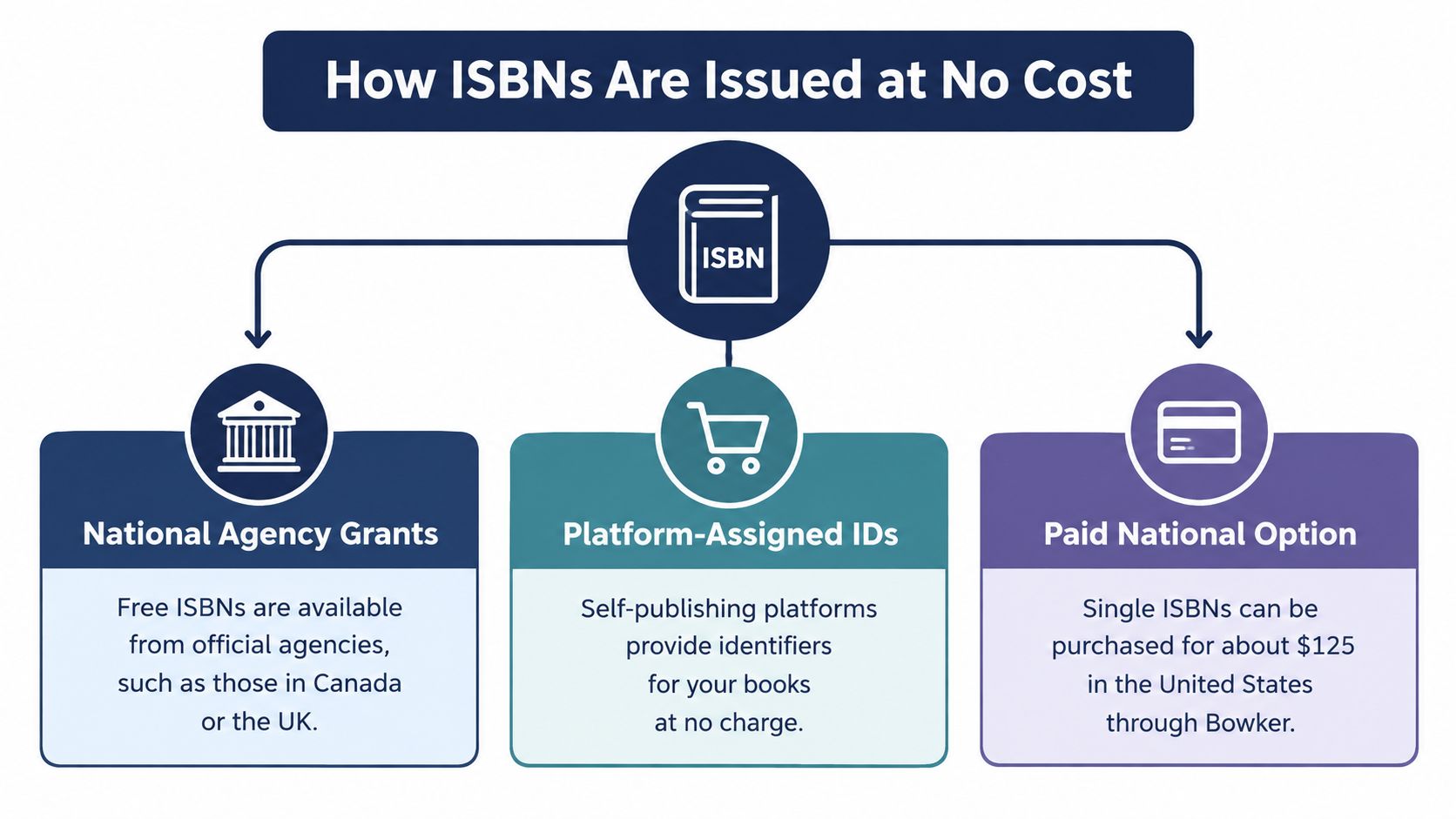
Free ISBNs generally come from three legitimate arrangements, and each has a different ownership profile.
The first is a national agency funded or supported through public or institutional resources. In that arrangement, the publisher applies directly to the official agency, receives an ISBN under local eligibility rules, and may be recorded as the publisher. Availability varies by country, so “free” must be confirmed locally rather than assumed.
The second route is institutional administration. A library, public body, university, or publishing program may obtain and administer identifiers for eligible authors or publishers. The institution's rules determine who appears in the metadata, whether the number can be used elsewhere, and whether the arrangement applies to every format.
The third is a platform-assigned identifier. A distributor or retailer may give you an ISBN at no charge while you publish through its ecosystem. The process is convenient, but the platform may be listed as publisher and may control how the identifier works across channels.
Separate the number from the rights attached to it
A no-cost identifier doesn't necessarily mean no conditions. Before accepting one, check:
- Publisher identity: Find out whether your name or imprint appears as publisher, or whether the platform does.
- Portability: Confirm whether you can use the ISBN with another distributor later.
- Format scope: Ask whether it covers only one edition, file type, or retailer listing.
- Metadata control: Establish who can change the title, author, format, and publisher information.
- Distribution limits: Verify which retailers, libraries, and wholesalers accept the identifier.
The ISBN itself is an identifier, not a guarantee of distribution. A platform can assign a valid number while still limiting where that specific edition may appear. For a practical discussion of related costs and options, consult this guide to how much an ISBN costs.
Finding Your Country-Specific ISBN Agency
A free ISBN starts with the agency responsible for your publishing base, not a search result advertising cheap or instant numbers. The International ISBN Agency directory identifies the official agency for the country or territory where your publishing operation is located.
Use the correct geographic test
Ask first: Where is the publisher based? The answer may be the country where you operate, where your publishing business is registered, or the location recognized by the relevant national agency. It is not automatically the country where you were born, where you temporarily live, or where your readers are concentrated.
The book's language does not determine eligibility. An English-language book published by an author outside the United Kingdom generally does not qualify for a United Kingdom ISBN just because it will be sold there. Worldwide distribution also does not allow a publisher to choose an agency based only on its fee structure.
Use this sequence:
- Open the International ISBN Agency's list of national agencies, linked in the previous section.
- Select the country or territory where your publishing operation is based.
- Read the agency's eligibility, registration, fee, and residency requirements.
- Confirm whether ISBNs are issued without charge and identify any conditions attached.
- Apply through the agency's own publisher-registration process, not through a reseller.
- Contact the agency or the International ISBN Agency if your location or eligibility is unclear.
The United Kingdom and Republic of Ireland agency directs applicants outside those territories to their own local agency. That instruction reflects the wider system. National agencies issue ISBNs for their assigned territories, while the International ISBN Agency coordinates the network rather than ordinarily issuing individual numbers.
Keep sales territory separate from issuing territory
A retailer may distribute your book worldwide, yet the appropriate issuing agency still depends on your publishing base. Keep records of your operating location, registration details, and the agency's eligibility decision. Those records can help if a retailer later questions the publisher information or the connection between your imprint and the ISBN.
A free national allocation can give you stronger control than a platform-assigned number, provided you qualify and follow the agency's process. If your country offers no free national route, compare platform convenience with the portability and control available from purchasing an ISBN in your own publishing name. That choice affects how easily the edition can move between distributors later.
Platform-Assigned Identifiers vs National ISBNs
A platform-assigned ISBN solves an immediate problem: you can publish a particular edition without paying an upfront fee to obtain the number. For an author releasing one format through one ecosystem, that may be a sensible operational choice.
The limitation appears when your publishing plan expands. The platform may be recorded as the publisher, and the identifier may be tied to that service. You could need a different identifier if you move the edition to another distributor, even though the underlying manuscript is unchanged.
| Decision factor | Platform-assigned identifier | National ISBN |
|---|---|---|
| Upfront expense | No charge through the platform | May be free or paid, depending on country |
| Publisher of record | May be the platform | Usually the publisher or imprint applying |
| Portability | May be restricted | Designed for broader distribution |
| Metadata control | Subject to platform rules | More directly managed by the publisher |
| Best fit | One-platform publishing | Multi-channel and long-term publishing |
The difference isn't cosmetic. Booksellers, libraries, distributors, and bibliographic databases use publication metadata to distinguish editions. A useful discussion of catalog data and product identifiers shows why publisher identity and consistent records deserve attention alongside the number itself.
A free identifier can be the right short-term tool and the wrong long-term asset.
When the platform route makes sense
Choose a platform-assigned identifier when the edition will remain inside that platform's permitted distribution system, the publisher-of-record designation is acceptable, and portability isn't important. An ebook sold only through a retailer may not require an ISBN at all if that retailer uses its own identifier and doesn't require one. That distinction is covered in this guide to whether an ebook needs an ISBN.
Choose a national ISBN when you want your imprint associated with the edition, expect to distribute through multiple channels, or want the option to change printers and distributors. Before accepting a platform number, download or record its terms. Platforms can change their rules, and your future distribution plans may be different from your launch plan.
The Complete Application Process for a Free ISBN
Once you've found the correct national agency, treat the application as a metadata registration task, not a casual formality. The information you submit establishes how the publisher and publication will be represented in industry records.
Prepare before opening the form
Have your publisher contact information ready, along with the bibliographic details the agency requests. These commonly include the title, author, format, edition information, and publisher or imprint details.
Use the same spelling and presentation everywhere. A small inconsistency between your agency application, copyright page, retailer record, and cover metadata can create duplicate or confusing listings.
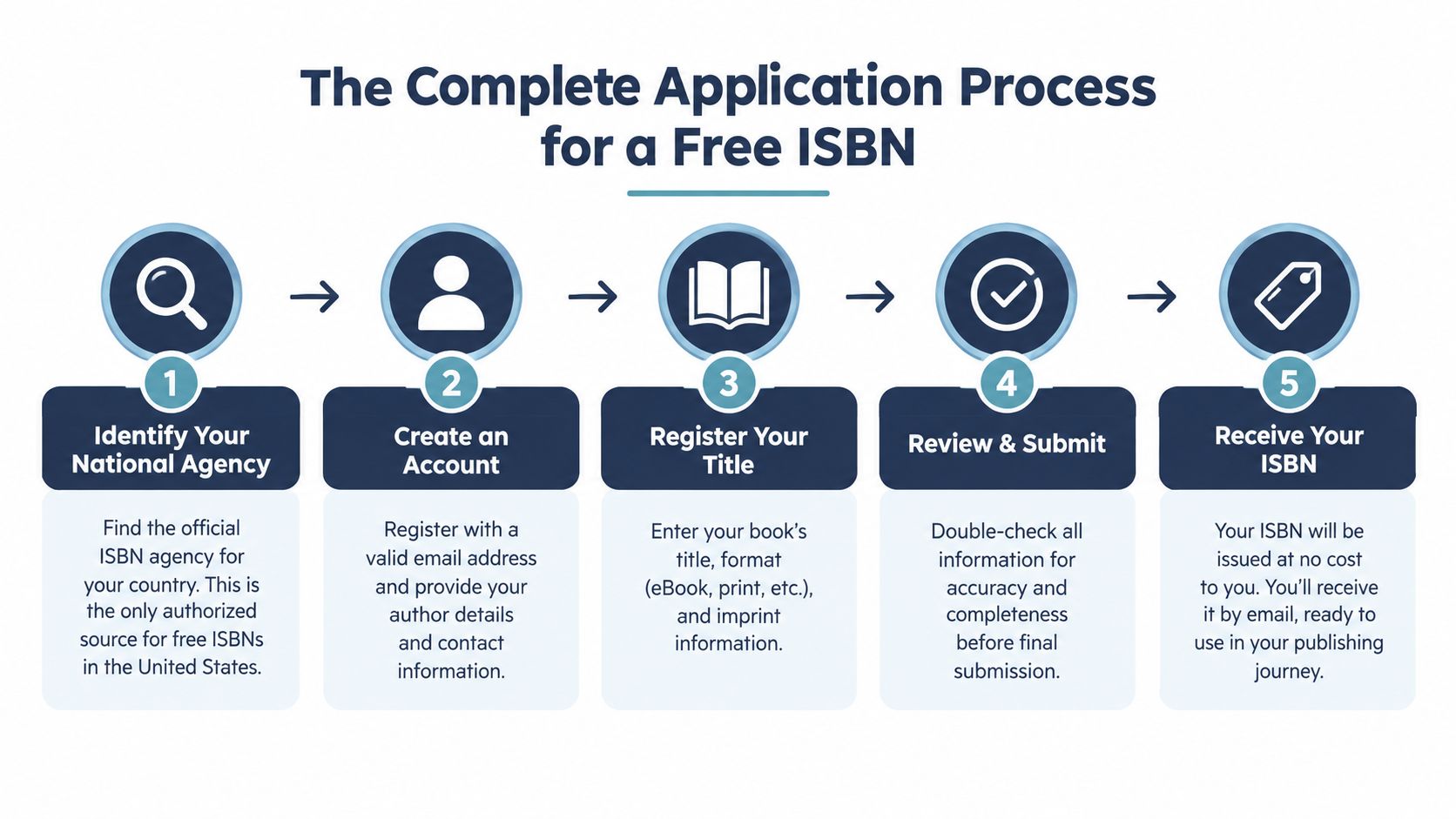
The process usually follows this pattern:
- Register as a publisher: Create the agency account or submit the publisher-registration form.
- Enter publication details: Provide the title, author, format, and other requested fields.
- Review carefully: Check publisher identity, edition type, and format before submission.
- Receive the assignment: Save the ISBN and any agency confirmation.
- Record the metadata: Maintain a private title sheet linking the number to the exact edition.
Don't assign the number to a project before you know which format it represents. If the application describes a paperback, don't place that ISBN on a hardcover, EPUB, or audiobook. The identifier needs to match the publication product recorded by the agency.
Planning Your ISBN Strategy Across Formats
The most expensive ISBN mistake isn't always paying for a number. Sometimes it's using a free number on the wrong product and discovering later that your distribution plan needs a different identifier.
An ISBN identifies a specific publication in a specific format and publisher context. A paperback, hardcover, EPUB, and audiobook generally need separate ISBNs. The International ISBN Agency's ebook assignment guidance also addresses separate ebook files and enhanced editions containing audio or video.
Build a format map first
Before applying, write down every edition you expect to make publicly available. Don't begin with the number. Begin with the product.
| Planned product | Separate ISBN planning |
|---|---|
| Paperback | Treat as its own edition |
| Hardcover | Treat as a distinct edition |
| EPUB | Review separately from print and other ebook files |
| Audiobook | Treat as a separate format |
| Enhanced ebook | Check whether added audio or video makes it a distinct product |
A retailer may not require an ISBN for a retailer-exclusive ebook. That can make a platform identifier, or no ISBN at all, practical for a narrowly defined release. The calculation changes if you want libraries, multiple distributors, bookstores, or a later move between services.
Match identifiers to distribution
Keep a spreadsheet with the title, edition, format, publisher name, file version, ISBN, retailer, and distributor. Record revisions too. A substantially changed edition may need its own identifier, while a minor correction may be handled differently under agency rules.
This approach prevents a common planning error: treating “the book” as one inventory object. In publishing operations, the paperback and audiobook are separate products even when they share a manuscript. A free allocation is valuable only when it is attached to the right product and remains useful for the channels you intend to serve.
Choosing the Right ISBN Path for Your Publishing Goals
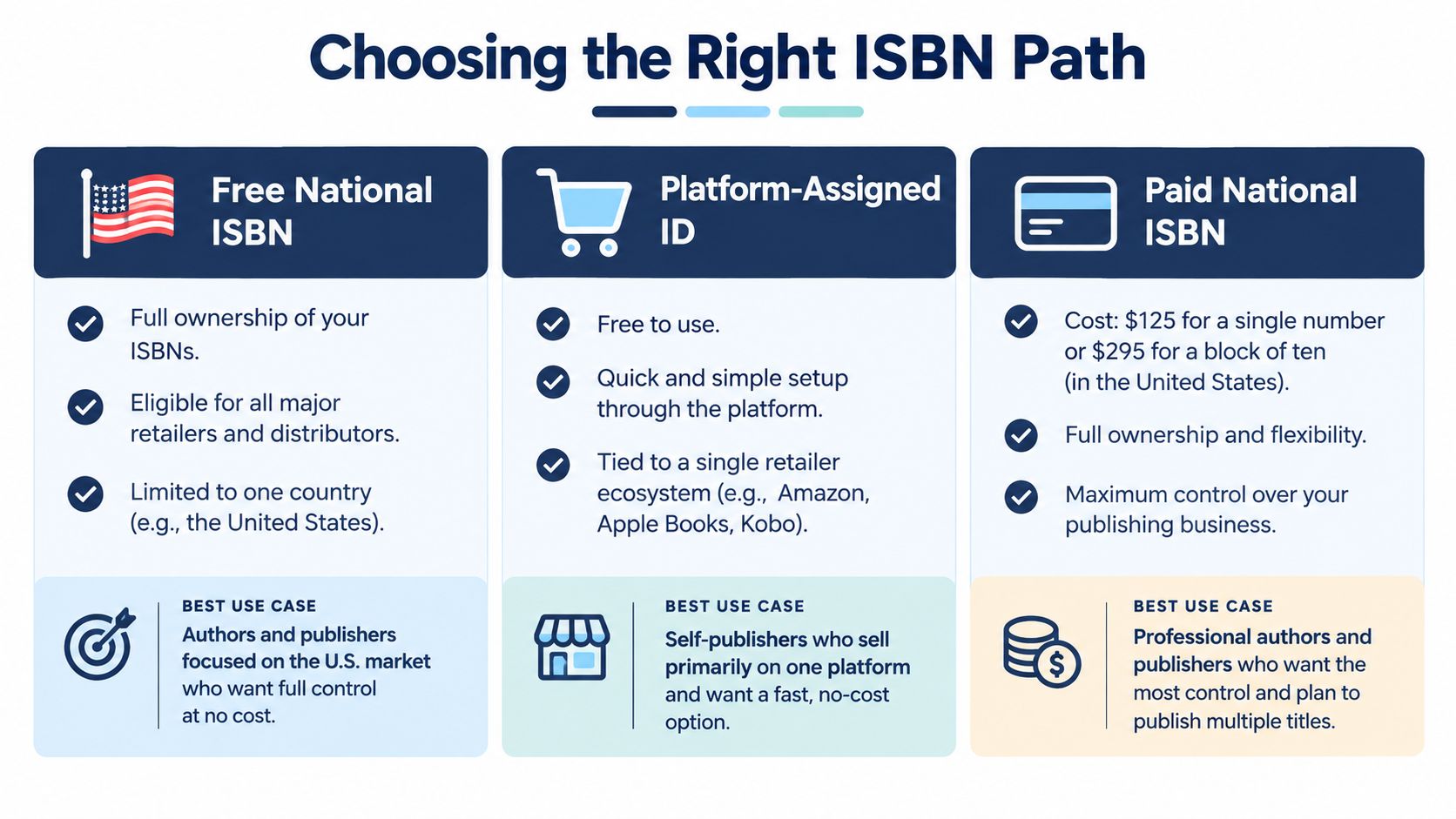
The correct choice depends less on the word free than on the publishing job you need the ISBN to perform. An author testing one retailer can reasonably prioritize speed and zero upfront cost. An author building an imprint for wide distribution usually needs control over publisher identity, metadata, and future channel changes.
Consider three common situations. A publisher eligible for a free national ISBN can pursue that route when the agency records the publisher correctly and the number supports the intended channels. A retailer-exclusive author may accept a platform-assigned identifier when the platform's publisher designation and distribution limits are acceptable. A U.S.-based independent publisher seeking an official national ISBN generally won't find a free route through the official agency, so the practical alternatives are a platform identifier, institutional sponsorship, or a paid national number. The International ISBN Agency's U.S. guidance explains that Bowker is the sole official ISBN source for publishers based in the United States and that national pricing is determined locally.
A practical decision matrix
| Your priority | Most suitable path | Main caution |
|---|---|---|
| No upfront cost, eligible national program | Free national ISBN | Confirm eligibility and publisher identity |
| One retailer or platform ecosystem | Platform-assigned identifier | Check portability and metadata rules |
| Wide distribution and imprint ownership | Paid national ISBN, where required | Plan every format before assigning numbers |
Don't let a free number decide your publishing strategy after the manuscript is finished. Decide first where the edition will be sold, who should appear as publisher, and whether you may move the book later. BarkerBooks offers publishing support that can include ISBN registration, formatting, distribution, and related production services for authors who want help coordinating those details.
The practical choice is straightforward once the trade-off is visible: use a free national ISBN when you're eligible and the terms fit, accept a platform identifier when its limits match your plan, and choose a national ISBN you control when portability and imprint ownership matter.
If you want help mapping your formats, preparing publication metadata, and coordinating ISBN registration with wider distribution, visit BarkerBooks to review its publishing services. Bring your planned editions and target retailers so the team can help you choose an ISBN path before you assign the first number.