
Ever wonder what that string of numbers on the back of a book is for? That's the International Standard Book Number (ISBN), and it's far more than just a barcode. Think of it as your book's unique fingerprint in the vast world of publishing.
This 13-digit code is the universal language spoken by publishers, bookstores, libraries, and online giants like Amazon. It's how they track, order, and manage every single book. Simply put, without an ISBN, your book is a ghost in the commercial machine.
Your Book's Official Passport to the World
An ISBN is like a license plate for your book. It distinguishes your specific work—your unique combination of story, format, and edition—from the millions of other books out there. This simple number is what turns a manuscript on your hard drive into a legitimate product ready for the global market.
The system wasn't just invented for the digital age. It actually grew out of a classic business problem back in the 1960s. A major British retailer, W.H. Smith, was computerizing its massive warehouse and realized it needed a standard way to track every book. This logistical challenge led to the creation of the Standard Book Numbering (SBN) system in 1966, the direct ancestor of the ISBN we use today. You can learn more about the history of the ISBN and how it evolved.
Why Every Author Needs to Understand ISBNs
If you want your book to be available anywhere beyond your own website, getting a handle on ISBNs isn't optional—it's essential. This isn't just some technical detail to check off a list; it's the core component that connects your book to the entire sales and distribution network.
This quick table breaks down what an ISBN really does for you.
ISBN at a Glance: Key Functions for Authors
| Function | What It Means for Your Book |
|---|---|
| Universal Identification | Guarantees that a customer in Tokyo gets your book, not another with a similar title. |
| Retail & Distribution Access | It’s your non-negotiable ticket into major retailers, wholesalers, and library systems. |
| Efficient Inventory Management | Makes it simple for booksellers to order, track sales, and manage stock of your book. |
| Professional Credibility | Signals to the industry that you're a serious publisher, putting your book on a professional footing. |
In short, the ISBN is the glue that holds the book industry together.
The ISBN is the official code that allows your book to be found, ordered, sold, and tracked anywhere in the world. It’s the single most important piece of data attached to your publication for commercial purposes.
Decoding the 13-Digit ISBN Code
That string of numbers on the back of a book might look like a random jumble, but it’s far from it. The 13-digit ISBN is a highly organized code, a kind of global address that tells a detailed story about that specific book.
Once you understand the logic behind it, the whole system clicks into place. You start to see how this simple number connects your book to you as the publisher and carves out its spot in the worldwide marketplace. Let's break down this powerful code into its five distinct parts.
This visual from the International ISBN Agency gives a great overview of the five components that make up a standard 13-digit ISBN.
As you can see, each segment of the number provides another layer of information, from the type of product all the way down to its unique edition.
The Five Elements of an ISBN
Every 13-digit ISBN is made of five elements separated by hyphens. The length of each part can change, but their order and what they represent never do.
1. The Prefix Element (The "Continent")
This is always a 3-digit number and will be either 978 or 979. This prefix is what tells the entire global supply chain, "Hey, this product is a book." It’s the key that integrates the ISBN system with the broader EAN (European Article Number) barcode system used for pretty much all retail products. Think of it as identifying the product's "continent" in the massive world of commerce.
2. The Registration Group Element (The "Country")
Right after the prefix, you'll find a 1- to 5-digit number that identifies the country, region, or language area where the book was published. It’s like a country code for your book.
For instance:
- 0 or 1 is for English-speaking regions (like the US, UK, Canada, and Australia).
- 2 is for French-speaking regions.
- 3 is for German-speaking regions.
Key Takeaway: The first two parts—the Prefix and the Registration Group—identify the product as a book and pin down its geographical or language origin. They set the broad context.
Pinpointing Your Unique Publication
The next two parts are all about you and your specific book. These numbers are assigned by your national ISBN agency and are what make your publication unique.
3. The Registrant Element (The "City" or Publisher)
This section identifies the publisher. A big publishing house that churns out thousands of books gets a short number here, which leaves more digits available for all their individual titles. A self-publisher buying just one ISBN, on the other hand, will get a much longer registrant number. This is your unique signature as the publisher of record.
4. The Publication Element (The "Street Address")
Here it is—the unique identifier for your specific book, in its specific format. If you release a paperback, a hardcover, and an ebook of the same title, each version gets its own ISBN. The first three parts of the number will be the same, but this publication element will be different for each one. This is the "street address" that points to the exact version of your work.
If you’re wrestling with how this applies to different formats, our guide on getting an ISBN for your ebook breaks it down even further.
5. The Check Digit (The Final Validation)
The last number is a single digit called the check digit. This isn't a random number; it's the result of a complex mathematical formula that uses the previous 12 digits. Its only job is to confirm that the ISBN is valid. If just one of the other numbers is typed incorrectly, the calculation won't work, and the system will flag the ISBN as an error. It’s a clever, built-in failsafe to prevent costly mistakes in ordering and distribution.
The Evolution from ISBN-10 to ISBN-13
Before 2007, the publishing world ran on a 10-digit ISBN system. But with the explosion of publishing, especially as self-publishing took off, the industry started to hit a wall. It was literally running out of numbers.
Think of it like a growing city that’s outgrown its original telephone area code. There were just too many new books hitting the market each year for the old system to handle. A major change was needed to keep the global book identification system from grinding to a halt.
The Shift to a 13-Digit Standard
The solution was the move to the 13-digit ISBN, a change that essentially future-proofed the entire book world. This wasn't just a minor update; it was a fundamental upgrade that brought the book industry in line with the global EAN-13 standard used for pretty much every other product you can buy.
This change was made official in May 2005, giving the industry a couple of years to adapt. By January 1, 2007, the 13-digit number became the mandatory format for all new books. You can actually dig into the full history of this massive publishing shift if you're curious about the details.
This diagram breaks down the structure of the modern 13-digit ISBN we use today.
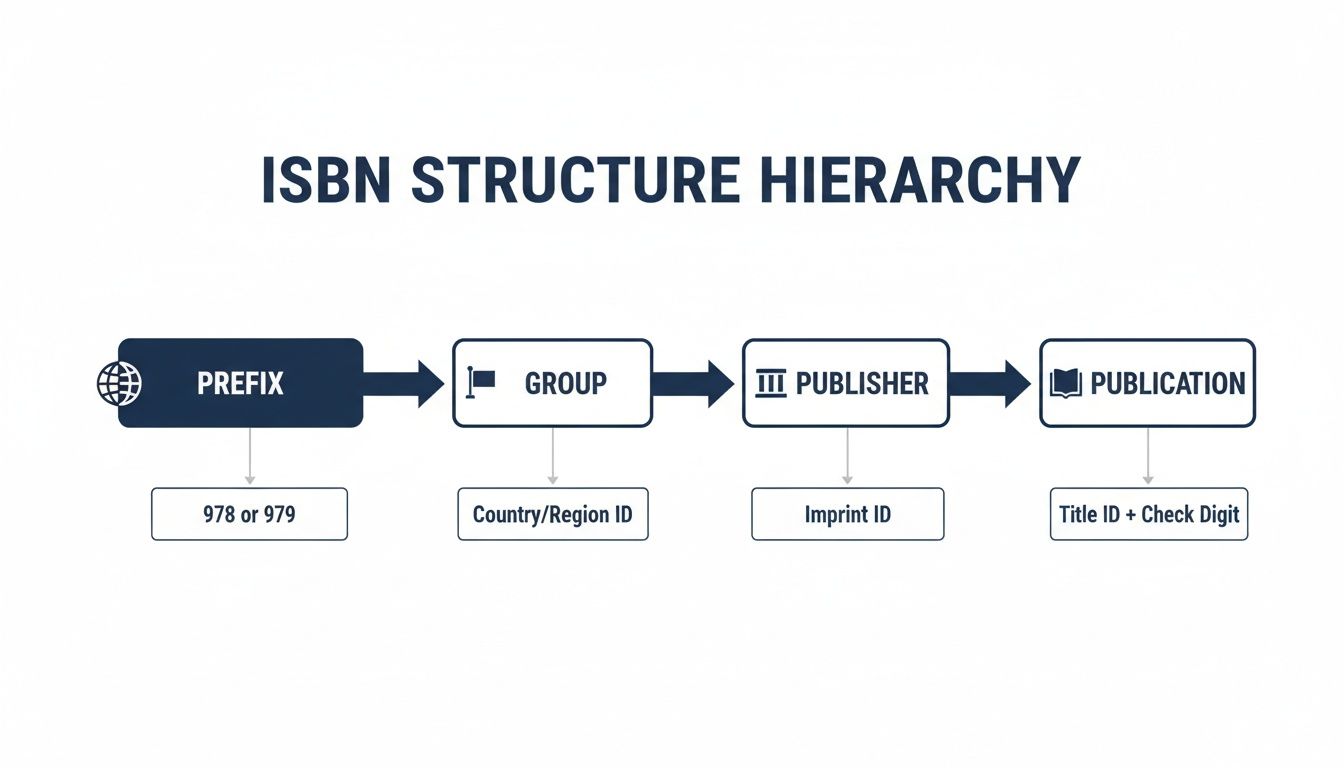
As you can see, the prefix is the new key element that immediately identifies the product as a book before the code dives into its more specific regional and publisher information.
From 10 Digits to 13: A Simple Conversion
So, what happened to all those old 10-digit ISBNs? They weren't just thrown out. A straightforward mathematical formula was created to convert them into the new 13-digit system. It’s a matter of adding the "978" prefix and then recalculating the final check digit.
Let's use a famous example. The original UK edition of Harry Potter and the Philosopher's Stone had the ISBN-10: 0-7475-3269-9.
Here’s the quick conversion process:
- Step 1: Drop the last number (the old check digit), which is 9. You're left with 074753269.
- Step 2: Add the "978" prefix to the front. Now you have 978074753269.
- Step 3: A special algorithm runs on these 12 digits to generate a new final check digit.
The result is the new 13-digit ISBN: 978-0-7475-3269-9.
This table gives a side-by-side look at the two formats, making the differences crystal clear.
Key Differences Between ISBN-10 and ISBN-13
| Feature | ISBN-10 | ISBN-13 |
|---|---|---|
| Number of Digits | 10 | 13 |
| Active Since | Before 2007 | January 1, 2007 – Present |
| Prefix | None | 978 or 979 (identifies product as a book) |
| Compatibility | Not compatible with global retail (EAN) systems | Fully compatible with EAN-13 barcodes |
| Check Digit | Calculated using a Modulus 11 algorithm | Calculated using a Modulus 10 algorithm |
| Issuance Today | No longer issued for new publications | The mandatory standard for all new books |
This comparison highlights how the ISBN-13 isn't just longer; it's a more robust system designed for the scale of modern commerce.
The Bottom Line: While you'll still find 10-digit ISBNs printed on books published before 2007, they are a thing of the past. Every new book, regardless of its format, must have a 13-digit ISBN to be properly registered and sold through the global supply chain. This is the only standard that matters for authors today.
When Your Book Needs a New ISBN
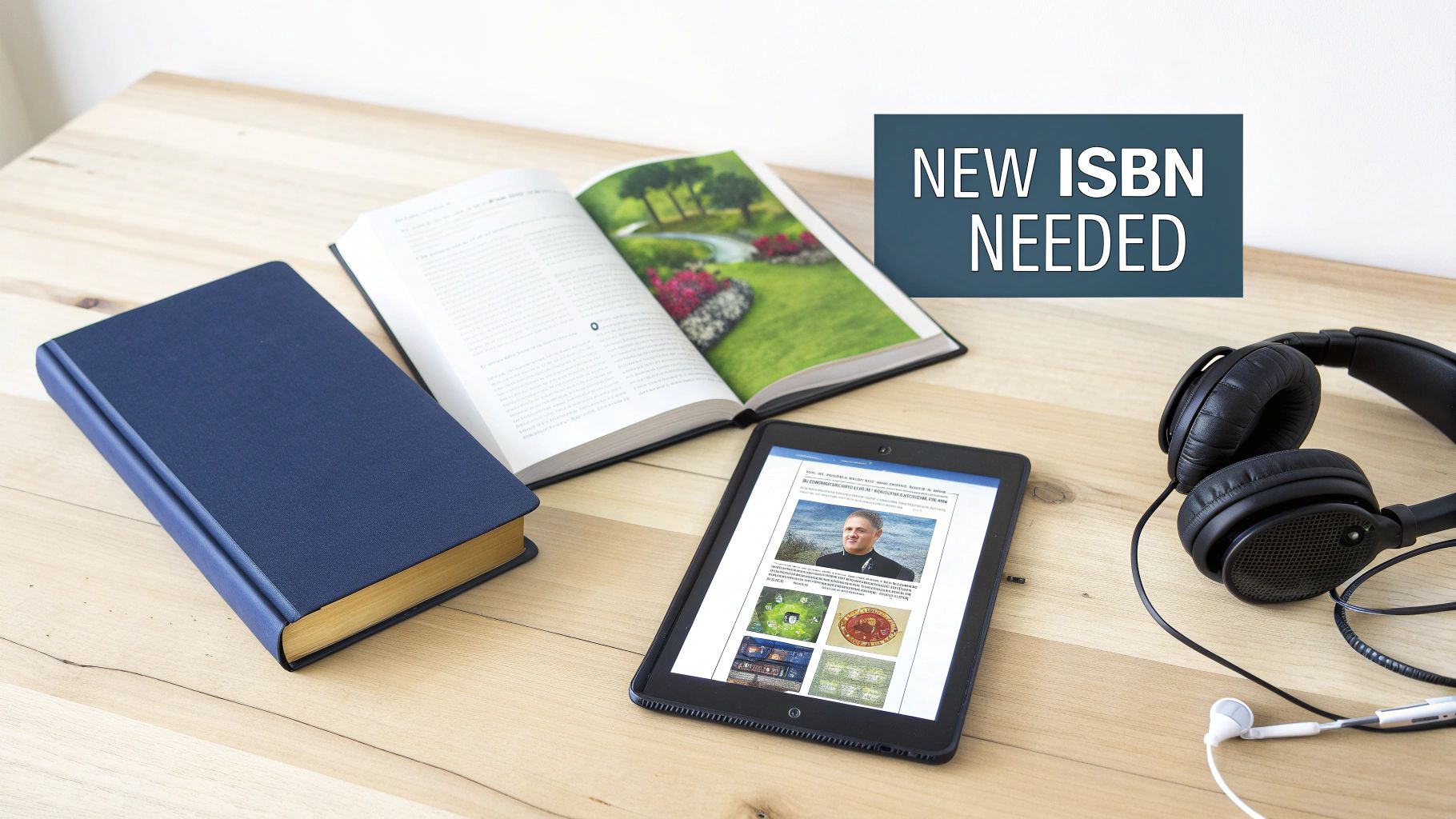
One of the questions I hear most often from authors is, "Do I need a new ISBN for this?" The confusion is understandable, but the core principle is actually quite simple. You need a new ISBN whenever you create a new, distinct product. Think of each ISBN as a permanent fingerprint for one specific version of your book.
This isn't just about following rules for the sake of it; it's a critical part of how the global book supply chain functions. Retailers, distributors, and libraries all rely on the ISBN to order the exact product their customers are looking for. You wouldn't want a reader who ordered your new hardcover to accidentally receive an audiobook file, and the ISBN is what prevents that kind of mix-up.
Changes That Always Require a New ISBN
Getting this right from the start will save you from costly publishing mistakes and headaches down the road. It ensures every version of your book is properly cataloged, tracked, and—most importantly—paid for. If you're making any of the following changes, it's time to assign a new ISBN.
-
Different Formats: This is the big one. Every format is considered a unique product in a retailer’s inventory system. Your paperback, hardcover, large-print edition, ePub ebook, and audiobook are all separate items and must each have their own ISBN.
-
Substantial Content Revisions: If you release a second edition with significant updates, it needs a new number. What counts as "significant"? We're talking about things like adding a new chapter, rewriting large sections of the text, or including a new foreword. The rule of thumb in the industry is this: if the changes are big enough that a previous owner might want to buy the new version, a new ISBN is necessary.
-
Language Translations: A translation is a completely new publication. The Spanish version of your English-language novel is a different product aimed at a different market, and it absolutely requires its own unique ISBN.
-
Changing Publishers: If you take your book from one publisher to another, or even if you move it from a self-publishing platform to your own imprint, you must assign a new ISBN. The "registrant" part of the ISBN is tied directly to the publisher, so a change there automatically triggers the need for a new number.
Here's a helpful way to frame it: Ask yourself if a customer could reasonably say, "This isn't the version I wanted." If the answer is yes, then the two versions probably need separate ISBNs. The whole point is to eliminate ambiguity for everyone.
For example, updating a non-fiction book with new research and an extra chapter is a clear-cut case for a new ISBN. The same goes for audiobooks. If you record an audiobook with one narrator and later re-record it with someone else, that new recording is a different audio product and needs a fresh ISBN.
When You Do Not Need a New ISBN
Just as important is knowing when not to use a new ISBN. Assigning one when it's not needed can actually hurt you by confusing the marketplace and splitting your sales data across multiple records.
You do not need a new ISBN for minor tweaks like these:
- Minor Corrections: Fixing a handful of typos or cleaning up a few grammatical errors doesn't create a new edition.
- Price Changes: You can change the retail price of your book anytime you want without affecting its ISBN.
- A New Cover Design: A fresh cover can do wonders for marketing, but as long as the content inside is the same, the original ISBN stays.
- Marketing Updates: Rewriting your book's description or back-cover copy doesn't require a new ISBN either.
In the end, it all comes down to that one question: is this a fundamentally different product? If the answer is yes, then assigning a new ISBN is the correct and professional move.
How to Get an ISBN for Your Book
Alright, so you’re convinced. You know what an ISBN is and why it’s a non-negotiable part of your publishing journey. The next logical step? Getting one.
Thankfully, the process is pretty straightforward, but it comes with a fundamental choice that really defines your role as an author. You have two main paths to take, and the one you choose depends entirely on your long-term goals, your budget, and how much control you want over your career.
Option 1: Go Straight to the Source
The most direct route is to buy an ISBN from the official national agency in your country. This path establishes you—or your publishing company—as the official publisher of record. It’s the professional standard.
- In the United States: The one and only official source is Bowker, via its MyIdentifiers.com website.
- In the United Kingdom: Authors work with the Nielsen ISBN Agency.
- In Canada: Good news! The government provides ISBNs for free through Library and Archives Canada.
Not sure where to go? The International ISBN Agency website has a handy directory to help you find your country's designated agency. This is the only way to guarantee you’re buying a legitimate ISBN that lists you as the publisher.
Why This Matters: Buying your own ISBN gives you complete freedom. Your book's metadata is tied directly to you, not a corporation. You can use that same ISBN with any printer, distributor, or retailer you choose, today and ten years from now.
This is the best option for authors who see themselves as entrepreneurs building a business. It offers maximum flexibility but also means you're in the driver's seat for managing all your book’s data.
Option 2: Use a Publishing Service or Distributor
The other path is to get an ISBN from a third-party service. Many self-publishing platforms (like Amazon KDP), aggregators, and full-service publishers offer to provide an ISBN, sometimes for free or at a steep discount. It’s undeniably convenient.
Here’s the catch: when you get an ISBN this way, the company providing it is listed as the publisher of record. Not you. This is a critical distinction. While it gets you up and running quickly, it chains your book to their platform. If you ever want to move your book to another printer or distributor, you can't take that ISBN with you. You'll have to start over with a new one.
This route is often a great fit for authors who just want to focus on writing and would rather not deal with the business side of things. It takes a technical step off your plate, but you trade control for convenience. Before making a final decision, check out our detailed guide on where to buy ISBN numbers to weigh all your options.
Comparing Your Two Main ISBN Pathways
| Feature | Buying Direct (e.g., Bowker) | Using a Service (e.g., Amazon KDP) |
|---|---|---|
| Publisher of Record | You or Your Imprint | The Service Provider |
| Control & Flexibility | Maximum control; use with any printer or distributor | Limited; tied to the provider's platform |
| Upfront Cost | Yes, you pay per ISBN or for a block | Often free or discounted |
| Long-Term Portability | Fully portable; you own the number | Not portable; cannot be used elsewhere |
| Best For | Authors building a publishing brand | Authors seeking simplicity and convenience |
The ISBN system is truly a global powerhouse, now operating in over 110 countries. Today, this system serves not just the big publishing houses but also millions of independent authors and self-publishers worldwide. Modern publishers like BarkerBooks help authors navigate this process in more than 91 countries, enabling global distribution through platforms like Amazon Kindle, Apple Books, and Barnes & Noble—all of which require a unique ISBN.
Ultimately, the right choice boils down to your vision. If you plan to publish multiple books and build a lasting author brand, investing in your own block of ISBNs is a smart long-term move. But if you’re just testing the waters with a single ebook on one platform, a free ISBN from that service might be all you need for now.
Common ISBN Questions Answered
Even after you get the basics down, a few tricky questions always seem to pop up right when you’re ready to publish. Let’s tackle those lingering uncertainties head-on. Think of this as your final check-in to make sure you’re using ISBNs correctly and with total confidence.
We’ll dig into the most common hang-ups, from navigating Amazon's KDP system to the difference between an ISBN and a barcode. Each answer builds on what we’ve already covered, clearing up any confusion so you can make the right call for your book.
Do I Need an ISBN for an Amazon KDP Ebook?
This is easily one of the most-asked questions in self-publishing circles. When you upload an ebook to Amazon KDP, they assign it a free ASIN (Amazon Standard Identification Number). The key thing to remember is that an ASIN only works inside Amazon's walls—it’s not a real ISBN.
If your only goal is to sell your ebook on Amazon, the free ASIN will work just fine. But if you have bigger plans for your book, you'll absolutely need a proper ISBN.
- Go Global: To sell your ebook on other major platforms like Apple Books, Barnes & Noble (for the Nook), or Kobo, you need an ISBN. They simply won’t list it without one.
- Get into Libraries: Digital library services like OverDrive depend on ISBNs to catalog and lend ebooks to their patrons.
- Look Professional: Using your own ISBN tells the world that you are the publisher. This gives you full control over your book's metadata and distribution, which is a huge deal.
Ultimately, an ASIN tethers you to the Amazon ecosystem. An ISBN sets your book free to travel the world. For the widest possible reach, getting your own ISBN is a smart move for any serious author.
Think of it this way: An ISBN is your book's passport to the world. An ASIN is a temporary visa valid only for entry into the Amazon marketplace. One gives you freedom; the other limits where you can go.
What Is the Difference Between an ISBN and a Barcode?
It’s easy to mix these two up because you always see them together on the back of a print book. But they do two completely different jobs. Simply put, the ISBN is the information, and the barcode is the tool that reads the information.
Imagine your ISBN is your phone number. The barcode is like a QR code that lets someone scan and instantly save that number. They aren't the same thing, but they work as a team.
The ISBN is the unique 13-digit number identifying your book’s specific title, edition, and format. The barcode is the scannable image of black-and-white lines that visually represents that number, often with the book's price embedded in it. You must have an ISBN first before you can generate the right barcode for your print book.
Can I Reuse an ISBN for Another Book?
The answer here is a hard, unequivocal no. An ISBN is assigned to one specific version of a book for all time. Once it’s assigned, it can never be reused, transferred, or switched to another title.
This rule is the bedrock of the entire global book identification system. It’s what guarantees that ISBN 978-0-7475-3269-9 will always point to the original UK paperback of Harry Potter and the Philosopher's Stone and absolutely nothing else.
Even if your book goes out of print, that ISBN stays with it forever. This is crucial for maintaining the integrity of bookstore catalogs, library records, and sales data around the world. If you write a new book or create a significantly new edition of an old one, it needs a brand-new ISBN. No exceptions.
Who Is the Publisher If I Buy My Own ISBNs?
When you buy an ISBN directly from your country's official agency (like Bowker in the US), you become the publisher of record. It’s that simple. As part of the registration, you’ll establish an "imprint," which is just the publishing name tied to your block of ISBNs.
This imprint can be your name ("Jane Doe Publishing") or a more creative company name you’ve come up with ("Silver Maple Press"). This is the name that will show up as the publisher in online stores and industry databases.
This is a massive advantage for authors wanting to build a real brand. It gives you total ownership over your book's metadata and makes you look far more professional. It’s the official step from being just a writer to becoming a publisher.
Of course, this control comes with a price tag. You can learn more about the investment by checking out our guide on how much an ISBN costs, which breaks down the different options. Taking on the publisher role is a powerful step in any author’s career.
At BarkerBooks, we simplify the entire publishing process, including ISBN registration and global distribution. Let our team of experts handle the technical details so you can focus on what you do best—writing. Turn your manuscript into a professionally published book today.