
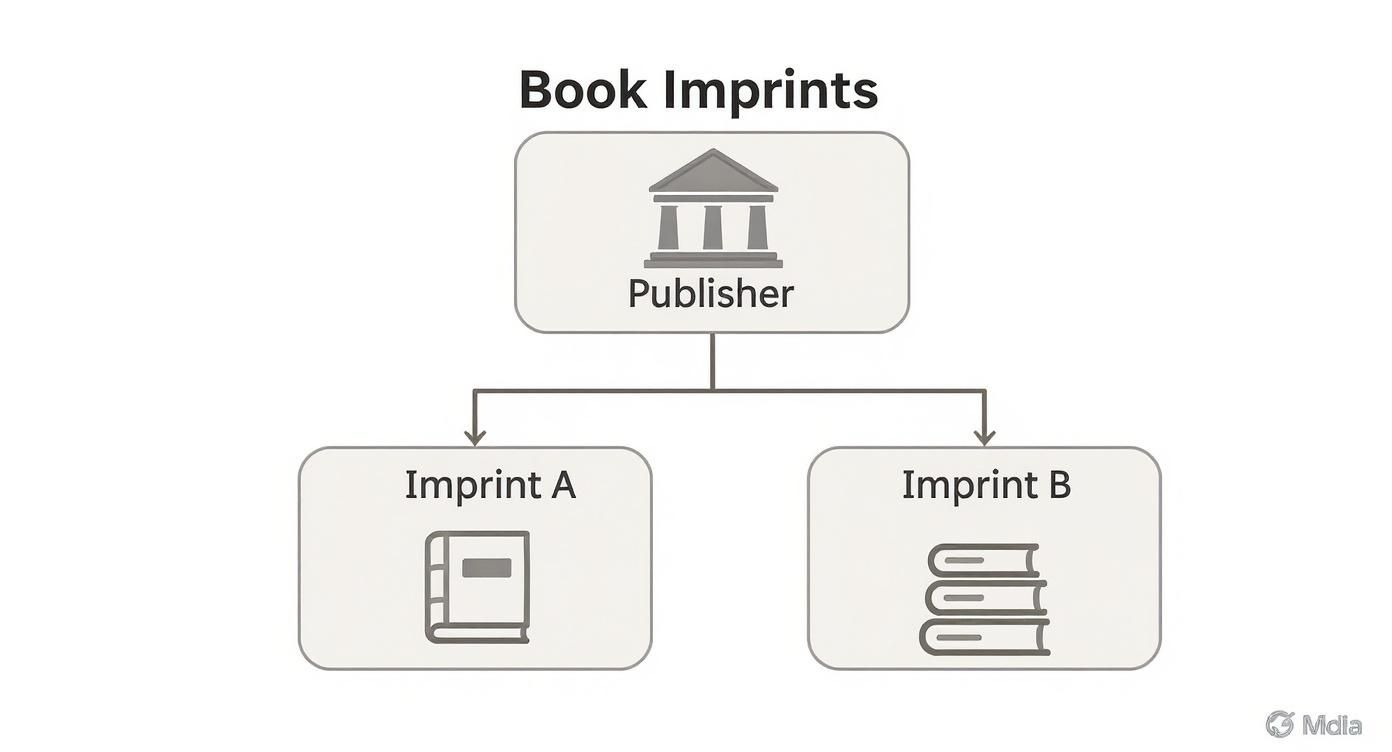
Think of a book imprint as the brand name a publisher puts on a book's spine. It's the name you see right alongside the author's. The publishing house itself, like Penguin Random House, is the big parent company behind the scenes. But imprints, like Viking or Doubleday, are the specialized brand names they use to connect with specific types of readers.
What Is a Book Imprint in Publishing
Let's make this simple with an analogy. You know Kraft Heinz, right? That’s the massive corporation. But you don't buy "Kraft Heinz Ketchup." You buy Heinz ketchup. You buy Kraft macaroni and cheese. Each brand has its own identity, its own flavor, and its own audience, even though they're all owned by the same parent company.
Publishing houses work the exact same way. The main publisher is the corporate engine—handling the big stuff like payroll, large-scale distribution, and legal contracts. The imprints are the public-facing personalities. They're the ones building a reputation for a certain kind of book.
An imprint is basically a specialized division inside a bigger publisher. This setup lets the parent company publish everything from dense historical nonfiction to lighthearted children's books, all under different brand names that make sense to those specific readers.
This separation is all about marketing and focus. A publisher might use one imprint for its edgy, award-winning literary fiction and a completely different one for its commercial, page-turning thrillers. Each imprint has its own team of editors who live and breathe that genre, hunting for manuscripts that fit their unique brand. It's a smart way to get the right books into the hands of the right readers.
Publisher vs Imprint At a Glance
Still a bit fuzzy? This table should clear things up instantly. It's a simple cheat sheet to see how the parent company and the imprint brand work together.
| Concept | Publishing House (The Parent Company) | Imprint (The Brand Name) |
|---|---|---|
| Primary Role | The legal and financial entity; the corporate umbrella. | The curated, public-facing brand with a specific identity. |
| Focus | Overall business operations, high-level strategy, and administration. | Acquiring, editing, and marketing books for a niche audience. |
| Analogy | A major automotive corporation like General Motors. | A specific car brand under that corporation, like Chevrolet or Cadillac. |
So, while the publishing house is the whole car company, the imprint is the specific model you choose to drive—each designed for a different purpose and a different driver.
How Publishers Differ from Imprints
It’s easy to get "publisher" and "imprint" mixed up because they're so tightly connected, but they play very different roles. The simplest way to think about it is this: the publisher is the parent company, the one handling the big-picture business. They're the legal entity signing the checks, managing corporate finances, and steering the overall ship.
The imprint, on the other hand, is the creative identity—the specific brand you see on the spine of a book. It’s built to appeal to a very particular type of reader. An imprint has its own editors who hunt for books that fit its unique flavor and its own marketing team that knows exactly how to reach its target audience.
This setup allows a massive publisher to operate several smaller, specialized brands all under one roof.
It's how the giants of the industry can be masters of everything from dense historical nonfiction to breezy beach reads, all at the same time.
The Corporate Structure vs. The Creative Brand
The publisher takes care of the foundational work—the infrastructure that makes everything else possible. A lot of what they do is invisible to readers but absolutely essential. To get a better sense of their wide-ranging responsibilities, it's worth taking a look at what a book publisher does behind the scenes.
In contrast, an imprint's job is all about creative vision and connecting with a specific community. When you hear "Tor Books," you immediately think of science fiction. When you see "Ace," you know you're in for fantasy. That sharp brand identity is a powerful signal to everyone—readers, agents, and booksellers—about what kind of book they’re getting. This kind of focused branding and marketing just wouldn't be possible under a single, generic corporate name.
Think of it this way: The publisher provides the money, the warehouses, and the legal framework. The imprint brings the editorial taste, the brand personality, and the niche marketing expertise to make a book a success.
This model has been a game-changer for the publishing world, allowing for incredible specialization. A behemoth like Penguin Random House runs hundreds of imprints, which is how it dominates so many different corners of the market. This strategy is so effective that the company now controls roughly 50% of all books in print in the U.S. Even their academic arms, like Oxford University Press, operate on a massive scale, publishing over 6,000 new scholarly works in 2022 alone.
Why This Matters to Authors
So, why should you, as an author, care about this distinction? Because it directly impacts your career.
When you land a book deal, your contract will be with the parent publisher—the corporate entity. But the people you'll work with every day? They’re at the imprint. Your editor, your cover designer, your publicist—they are all part of the imprint's dedicated team. Understanding an imprint's focus, reputation, and recent successes is critical. It helps you find the right home for your manuscript and partner with a team that truly gets your vision.
Exploring Different Types of Book Imprints
So, how do publishing houses actually organize all these different books? They use imprints. Think of it like a car company—the parent corporation might be General Motors, but under that umbrella, you have distinct brands like Chevrolet, Cadillac, and GMC, each with its own identity and target customer.
In publishing, it's the same idea. A massive publisher uses different imprints to signal to readers, booksellers, and authors exactly what kind of book they're getting. Once you understand these categories, you can start to see where your own work might fit in.
Genre-Specific Imprints
This is the most straightforward and common type of imprint you'll encounter. These imprints build their entire reputation on being the best in a particular genre. They become a trusted signal for readers who know exactly what they want. The editors are experts, the marketing is razor-sharp, and the community is deeply engaged.
- Tor Books: If you're into science fiction and fantasy, you know Tor. It’s a legendary name and the destination for epic space adventures and complex magical worlds.
- Harlequin: This imprint is so tied to romance that its name has become a synonym for the genre itself. They publish everything from sweet contemporary romances to historical dramas.
- Scribner: Known for its heavy hitters in literary fiction, Scribner is the home of authors like Stephen King and holds the rights to some of the most important works of the 20th century.
Audience-Specific Imprints
Some imprints don't define themselves by genre, but by who they're publishing for. They might release books across several genres, but they're all created with a specific demographic in mind. This could be based on age, profession, or a shared interest.
A great example is Simon & Schuster Children's Publishing. Under this division, you'll find imprints like Aladdin Books, which publishes a whole range of content—picture books, middle-grade novels, graphic novels—all for young readers. Other imprints might focus exclusively on the Young Adult (YA) market or serve academic and professional audiences with scholarly texts. Looking into the various types of publishing can shed more light on how these different models work.
Format-Specific Imprints
The way we read is always evolving, and publishers have created imprints to keep up. These brands aren't concerned with what a book is about, but rather how it's delivered to the reader.
The explosion in digital reading has given rise to imprints that focus entirely on ebooks and audiobooks. To meet readers where they are, major publishers have launched digital-only brands. With ebook sales now accounting for around 20% of total U.S. book sales, it's a huge part of the market.
These format-first imprints often include:
- Audiobook Imprints: These divisions specialize in producing and distributing audio versions of books, often with high-quality narration and production.
- Digital-First Imprints: Brands like Simon & Schuster’s Simon451 are built to release books as ebooks first. This allows them to bring new authors and niche stories to market quickly and with less upfront investment, often using print-on-demand for physical copies later on.
Why Publishers Rely on the Imprint System
To really get what a book imprint is, you have to look at the business strategy behind it. Publishers aren’t just dreaming up different names for the fun of it. The whole imprint system is a seriously effective tool for connecting with more readers and managing a massive, diverse catalog of books. Think of each imprint as a specialized team with its own unique mission.
This approach is built on a few smart business principles. It lets a single, huge publishing house act with the focus and speed of many smaller, niche presses. If they didn't do this, a publisher's main brand could get incredibly muddled, trying to be everything to every reader all at once.
The primary benefit of the imprint system is market segmentation. It allows a publisher to create highly targeted brands for specific audiences without diluting the parent company's overall identity.
Essentially, imprints are a publisher’s way of speaking directly to different tribes of readers. Someone looking for a fast-paced thriller has completely different expectations than a reader hunting for a thoughtful, literary novel. By using distinct imprints, a publisher can build a rock-solid reputation in each of these worlds, earning the trust of very specific reader groups.
Building Distinct Brand Identities
An imprint is a publisher's secret weapon for carving out a strong, focused brand. A prestigious literary imprint, for example, attracts award-winning authors and sends a clear signal of quality to critics, booksellers, and serious readers. Its entire brand is built on literary merit and cultural importance.
On the other hand, a commercial imprint might build its reputation on explosive bestsellers and can't-put-it-down plots. Its identity is all about entertainment and mass appeal. These two missions are worlds apart, and trying to house both under one corporate banner would just confuse everyone.
This strategy is now the industry standard, especially as major publishers have consolidated. HarperCollins, for instance, operates over 120 imprints around the world. It’s a strategy that lets them stay dominant in dozens of markets, from romance and sci-fi to academic textbooks. You can learn more about how major publishers use imprints on harpercollins.co.uk.
Managing Risk and Retaining Talent
Imprints also function as a savvy way to manage risk. A publisher can launch an experimental imprint to test a new or emerging genre without putting the reputation of its established, flagship brands on the line. If the new venture fizzles out, the core brands are completely unharmed.
Finally, the imprint system is absolutely critical when one publishing house buys another. The acquiring company often keeps the purchased house running as its own imprint. This is a brilliant move for a few key reasons:
- It retains author loyalty: Authors who have built a career and a relationship with a specific editor or house are far more likely to stick around if its identity remains intact.
- It keeps the reader base: Readers who trust a certain brand will keep buying its books, often without even realizing the ownership has changed hands.
- It maintains brand equity: A well-respected name has immense value built up over years. Keeping it as an imprint preserves that hard-won value.
How Imprints Shape Your Journey as an Author

This is where the idea of a book imprint stops being a bit of industry trivia and becomes a real, practical tool for your career. It doesn’t matter if you’re chasing a traditional book deal or mapping out your indie author business—imprints will play a huge part in what happens to your book.
For authors navigating the traditional route, the imprint is the destination. Getting a contract with a well-known imprint isn't just a notch on your belt. It’s a loud and clear signal to booksellers, reviewers, and readers about your book's quality and where it fits in the market.
This one decision sets the course for everything that follows. The imprint's editors shape the manuscript, their designers create a cover that aligns with their brand, and their marketing team targets an audience they know inside and out. It’s the difference between being lost in a massive corporate structure and working with a curated team that is passionate about your specific genre.
The Traditional Publishing Path
When you sign a contract with a traditional house, you’re not really joining the parent company. You're joining a specific imprint, with its own distinct vision and reputation. An offer from a respected literary imprint like Scribner, for example, can put your book on the radar for major awards and critical reviews.
On the other hand, a commercial powerhouse like Atria Books has the distribution network and marketing budget to make a serious run at the bestseller lists. Spending time researching imprints is one of the most important things you can do. In fact, our guide on how to find a publisher for your book digs into the strategies you need to find the perfect home for your manuscript.
An imprint isn’t just a logo on your book’s spine; it’s the specialized team responsible for turning your manuscript into a finished product. It's the creative engine and the marketing force that will champion your work.
Knowing an imprint's catalogue helps you customize your query letters and proposals. It shows agents and editors that you’ve done your homework and you understand exactly where your book fits on the shelf. That kind of targeted approach can make all the difference in a crowded inbox.
The Self-Publishing Advantage
If you're an independent author, the idea of an imprint becomes a powerful branding and business tool. Instead of having "Independently Published" show up as the publisher on Amazon or Barnes & Noble, you can establish your own.
This simple change adds an immediate sense of professionalism. It signals that your book is a serious product from a dedicated press, not just a hobby project. Setting up your own imprint is a smart business move with some big upsides:
- Professional Branding: It gives you a consistent identity, which is especially valuable if you're writing a series or multiple books in the same niche.
- ISBN Ownership: You can buy and register your own ISBNs under your imprint name, giving you total control over how your book is listed and tracked.
- Future Growth: It builds the foundation to one day publish other authors, turning your personal brand into a small press.
At the end of the day, it doesn't matter if you're pitching agents or building your own publishing empire. The imprint is the brand that will carry your book out into the world and connect it with the readers you wrote it for.
Common Questions About Book Imprints
Once you start thinking about the practical side of publishing, a lot of specific questions tend to bubble up. It's one thing to understand the concept of a book imprint, but it's another thing entirely to know how it all works in the real world. This section is all about giving you clear, direct answers to the questions I hear most often from authors.
My goal here is to cut through the noise and give you the straightforward information you need to move forward confidently, whether you're aiming for a traditional deal or forging your own path as an indie author.
Do I Need to Legally Register a Self-Publishing Imprint?
This is a fantastic and absolutely crucial question for any self-publishing author. The short answer is: no, you don't have to. You can simply come up with a name—let's say, "Fireside Stories"—and enter that as the publisher when you set up your book on a platform like Amazon KDP.
However, just because you can do that doesn't always mean you should. Taking the next step to legally register your imprint brings some serious advantages to the table. By filing for a Doing Business As (DBA) or setting up a Limited Liability Company (LLC), you’re turning your publishing operation into a formal business. This is a game-changer if you want to open a business bank account, purchase your own ISBNs directly from an agency like Bowker, or build a brand that might eventually publish other writers.
Think of it this way: Just using a name is like giving your publishing a cool nickname. Legally registering it gives that nickname an official identity, unlocking a whole new level of professional doors.
Can a Book Be Moved Between Imprints?
Yes, and it happens more than you might think, especially inside the big publishing houses. A publisher might shift a book for all sorts of strategic reasons. For example, imagine a title released under a serious literary imprint suddenly becomes a viral commercial hit. The publisher might move the paperback edition to a more commercial imprint to better reach that massive new audience.
It also happens when a company restructures or closes an imprint. When that occurs, the books on that imprint's list are usually just absorbed by sister imprints under the same corporate umbrella. For the author, this shift is mostly a behind-the-scenes maneuver designed to keep the book in print and in front of the right readers.
Does the Imprint Name Always Appear on the Spine?
Almost always, yes. The imprint's name or logo on the spine is a vital piece of its branding. For booksellers, librarians, and sharp-eyed readers, it’s a quick visual signal about the book's genre, tone, and potential quality—a trusted stamp of approval.
You’ll typically see it at the base of the spine, sometimes right next to the parent company's logo. And inside the book, the imprint gets top billing on the copyright page, cementing its status as the official publisher of that edition. It's a core part of the book's professional identity.
Ready to turn your manuscript into a professionally published book with a team that understands the industry inside and out? BarkerBooks has helped over 7,500 authors bring their stories to life with comprehensive services from editing and design to global distribution. Discover how we can help you achieve your publishing dreams today!