
So, what exactly is this ISBN thing everyone talks about? Think of an International Standard Book Number, or ISBN, as your book's unique fingerprint. It's a 13-digit code that identifies your specific book—and only your book—to the entire global publishing industry. For any author serious about getting their work into readers' hands, securing an ISBN is a crucial first step.
What Is an ISBN and Why Your Book Needs One
Imagine trying to find a specific house in a massive city with no street names or house numbers. That’s what the book world would be like without ISBNs. This simple number is the universal language that publishers, bookstores, libraries, and distributors use to talk about and track your book.
It's the system that turns your finished manuscript into a legitimate product, ready to be ordered, stocked, and sold. Without an ISBN, your book is basically invisible to the very systems designed to get it on shelves.
The Role of an ISBN in the Publishing Ecosystem
An ISBN isn’t just a string of digits; it’s your book's passport to the world. Once you assign an ISBN, your book’s information—title, author, format, price—gets listed in massive bibliographic databases like Bowker's Books In Print. This is the master catalog that retailers and libraries consult every single day.
Here's what an ISBN really does for you:
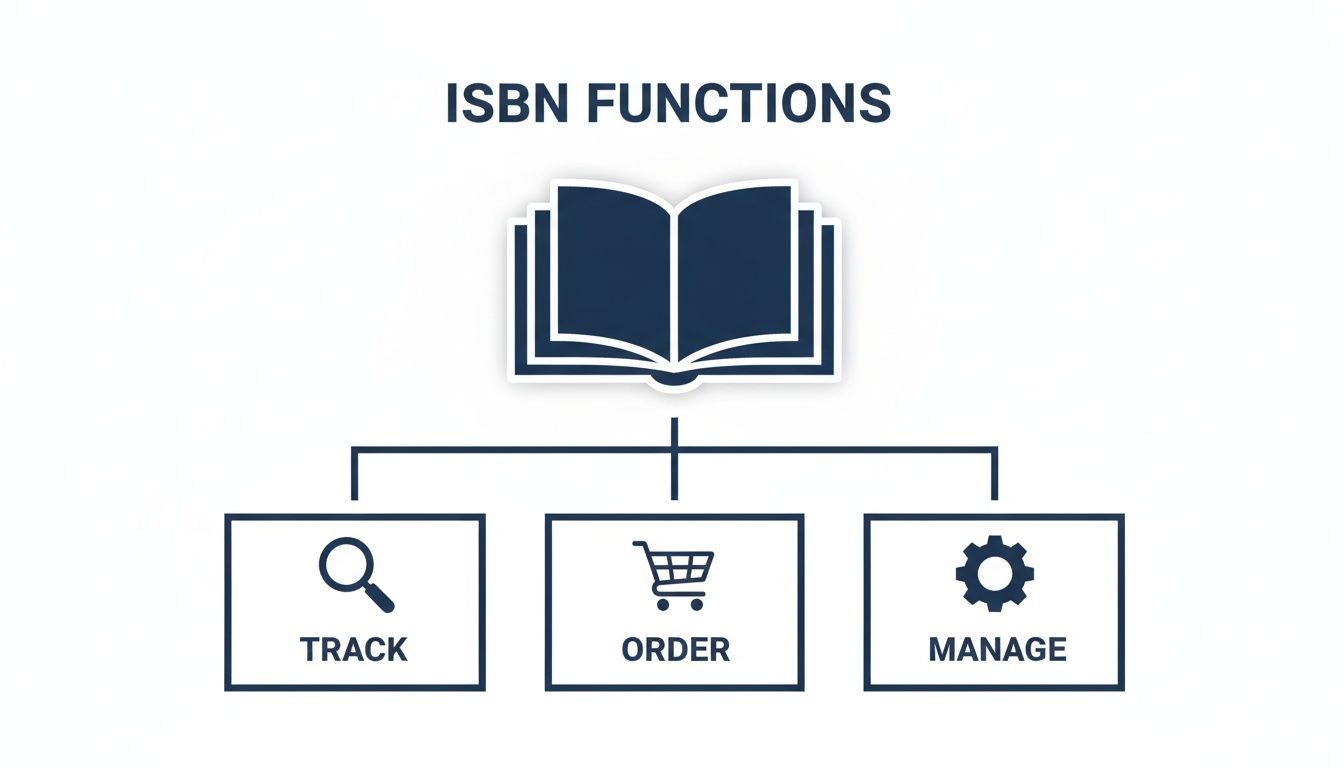
- Pinpoint Identification: It differentiates your paperback from your hardcover, and your ebook from your audiobook. Every single format of your book needs its own unique ISBN to avoid confusion.
- Effortless Ordering: When a store like Barnes & Noble wants to stock your book, they just punch in the ISBN. It’s a direct line from their ordering system to your distributor.
- Smarter Inventory: From giant warehouses to the coziest indie bookstore, the ISBN is the key to managing stock, tracking sales, and handling returns.
- Worldwide Discovery: It allows a bookstore in London or a library in Sydney to find and order your title just as easily as one down the street.
To give you a better sense of how this all works in practice, here’s a quick summary of what an ISBN accomplishes.
An ISBN's Core Functions at a Glance
This table breaks down the essential roles an ISBN plays throughout your book's journey, from the moment it's published to when it lands in a reader's hands.
| Function | Why It Matters for Authors |
|---|---|
| Product Identification | Uniquely identifies your book's specific format (e.g., paperback, hardcover). |
| Supply Chain Management | Enables bookstores and distributors to order, track, and manage inventory efficiently. |
| Sales Reporting | Allows for accurate tracking of sales across various retailers and channels. |
| Bibliographic Data | Connects your book to essential metadata in global databases like Books In Print. |
| Global Discoverability | Makes your book searchable and available for purchase by anyone, anywhere in the world. |
Ultimately, each of these functions ensures your book can move smoothly through the complex machinery of the publishing world.
When you see a barcode on the back of a book, you're actually looking at the ISBN in a scannable format. It's called an EAN-13 barcode.
This little graphic is what allows a cashier's scanner to instantly pull up your book's price and log the sale, linking the physical copy to its digital record in the store's system.
Key Takeaway: If you dream of seeing your book in bookstores, libraries, or sold by major online retailers (other than exclusively on KDP), an ISBN isn't optional. It's the fundamental piece of the puzzle that connects your work to the commercial book world.
What’s in a Number? Decoding the 13 Digits of an ISBN
At first glance, an ISBN just looks like a random string of numbers on the back of a book. But it’s anything but random. Think of an ISBN as your book’s unique fingerprint—a carefully structured code that tells a detailed story about its origin, publisher, and specific edition to anyone in the book world.
This code is the universal language for the entire publishing supply chain. From massive distributors to cozy independent bookstores and local libraries, this number lets them track, order, and manage millions of titles without a hitch. Let's pull back the curtain and break this powerful identifier down into its five key parts.
The Five Elements of an ISBN
Every 13-digit ISBN is made up of five distinct parts, usually separated by hyphens for easy reading. The length of each segment isn't fixed, and that flexibility is exactly what makes the system so robust.
The Prefix (978 or 979): This is always the first three digits. It’s a product code that tells any scanning system, "Hey, this is a book!" For years, 978 was the only prefix you’d see. But as the number of published books skyrocketed, the 979 prefix was added to make sure we never run out of numbers.
Registration Group: This part, which can be anywhere from 1 to 5 digits long, identifies the country, region, or language area where the book was registered. For example, 0 and 1 are common for English-speaking countries like the U.S., U.K., and Canada. You might see 2 for French-speaking regions or 3 for German-speaking ones.
Registrant (Publisher): This section identifies the specific publisher or imprint. The length of this number is intentional—a publishing giant with a huge catalog gets a short, efficient number, while a smaller press or a self-published author gets a longer one. It’s a clever way to ensure the system can handle everyone, big or small.
Publication: Here’s where your specific book gets its unique ID. This segment identifies the exact title and its format (like paperback, hardcover, or audiobook). The length of this part depends on the publisher's number; together, they always add up to a set number of digits to keep the overall 13-digit structure consistent.
Check Digit: This final, single digit is the ISBN’s built-in quality control. It’s calculated using a special formula based on the first 12 digits. When a barcode is scanned, the system instantly re-calculates it to make sure the number was read correctly. This tiny digit prevents a world of costly ordering and inventory headaches.
Why This Matters: Think of the ISBN as a book's DNA—it encodes its entire publishing identity. After January 1, 2007, the 13-digit ISBN-13 became the global standard, a necessary move as book production exploded. To give you an idea, over 2.2 million new titles were published in the U.S. alone in 2019. You can learn more about how we got here by exploring the history of the ISBN.
This simple number is the key that unlocks a book's journey through the global supply chain, making it easy to track, order, and manage.
Putting It All Together: A Real-World Example
Let's see how this works in practice by decoding a real ISBN: 978-1-942556-02-1.
- 978: The prefix tells us this is a book.
- 1: The registration group shows it's from an English-speaking country.
- 942556: This is the unique identifier for this specific publisher.
- 02: This number pinpoints this particular book and its format.
- 1: And finally, the check digit confirms the entire sequence is valid.
Once you know what to look for, that long string of numbers starts to make a lot more sense. It's the elegant, invisible system that keeps the entire world of books running smoothly.
The All-Important Shift from ISBN-10 to ISBN-13
If you've ever picked up a book printed before the mid-2000s, you might have noticed its ISBN was only 10 digits long. For authors just starting out, this can be a little confusing, but the story behind the change is a great window into how the book world adapted to its own explosive growth.
The original 10-digit system, ISBN-10, worked perfectly well for decades. But as publishing grew—with more authors, more titles, and the dawn of digital formats—the industry started to face a surprising problem: it was running out of numbers.
Why the Book World Needed More Numbers
Think of it like a city that's running out of phone numbers. When a city's population booms, the original seven-digit system just isn't enough to give every new home and business a unique line. The book industry hit a similar wall. The pool of available 10-digit ISBNs was shrinking fast.
To fix this, the industry made a planned, critical switch. On January 1, 2007, the 13-digit ISBN became the one and only global standard. This wasn't just about tacking on three more digits; it was a forward-thinking move to make sure the system could handle the future of publishing.
"The expansion from ISBN-10 to ISBN-13 was a critical update, future-proofing the identification system for an era of digital formats and exponential growth in publishing."
This change also brought a huge practical advantage. It brought the book industry's identifier in line with the EAN-13 (European Article Number) system—the 13-digit barcode standard already used by most retailers worldwide. This made it much easier for all stores, not just bookstores, to scan and sell books with their existing equipment.
The Magic of the 978 Prefix
So how did the industry update the millions of existing 10-digit ISBNs overnight? The solution was simple but incredibly effective.
A new prefix, 978, was added to the front of an old 10-digit ISBN. Then, a new final "check digit" was calculated for the end. Just like that, an old ISBN-10 became a brand new, fully scannable ISBN-13.
It’s just the latest step in a long evolution. Before the late 1960s, booksellers often tracked inventory with handwritten cards—a system that became impossible to manage. This led to the UK's 9-digit SBN (Standard Book Number), which grew into the international 10-digit standard in 1970. The move to 13 digits in 2007 was the next logical step, ensuring ISBNs worked seamlessly with the electronic point-of-sale systems that had become common since the 90s. Today, this massive global system is managed by 150 national agencies across over 200 countries. You can learn more about this fascinating journey from the global history of the ISBN.
As an author today, the bottom line is simple: you only need to think about the ISBN-13. It's the universal standard that every retailer, distributor, and library on the planet requires. When you get an ISBN for your book, you'll always be given the 13-digit version, making your work ready for the modern marketplace.
How to Get an ISBN for Your Book
Alright, you get why an ISBN is so important. Now for the practical part: how do you actually get one? Securing this identifier for your book is a pretty clear-cut process, but it involves a couple of key decisions that will shape your publishing journey.
Your choice here isn't just about cost—it determines who is officially listed as your book's publisher in all the industry databases. You really have two main roads you can take: buy your ISBN directly from your country's official agency or get one through a publishing service. Each path comes with its own set of pros and cons you'll want to think about carefully.
The Two Main Paths to Obtaining an ISBN
Choosing how to acquire your ISBN is one of the first real business decisions you'll make as an author. It has a direct impact on your distribution options and how your book is seen by retailers, libraries, and the publishing world at large.
Let's break down the two options on the table.
Buying Directly from an Official Agency: This is the most straightforward route. You purchase the ISBN directly from the one organization authorized to issue them in your country. For authors in the United States, that’s Bowker. In the UK, it’s Nielsen. Going this route means you—or your own publishing company—are the official publisher of record. Full stop.
Receiving an ISBN from a Third Party: Lots of publishing platforms and aggregators like Amazon's KDP, IngramSpark, or Draft2Digital offer "free" or low-cost ISBNs. It's a tempting offer, for sure. But here's the catch: using their ISBN almost always means they are listed as the publisher, not you.
A Crucial Point to Remember: The publisher listed in the ISBN metadata is who the industry considers the owner of that specific book format. Owning your ISBN gives you total control over your book's destiny, letting you work with any printer or distributor you want, whenever you want.
Comparing Your Options for Getting an ISBN
So, which path is the right one for you? It really boils down to your long-term goals as an author and what your budget looks like right now. To make it clearer, let's put them side-by-side.
| Method | Who is the Publisher of Record? | Typical Cost | Best For |
|---|---|---|---|
| Direct Purchase (e.g., Bowker) | You or your publishing company. You have full control and ownership. | A single ISBN is pricey ($125 in the US), but buying blocks of 10 or 100 offers a massive discount. | Authors aiming for maximum control, planning multiple books or formats, and seeking wide distribution. |
| Third-Party Provider (e.g., KDP) | The platform or company providing the ISBN. They are listed as the publisher. | Often free or heavily discounted as part of their printing and distribution service. | Authors on a tight budget, those publishing exclusively on one platform, or writers who aren't concerned with being the publisher of record. |
If you're serious about building a lasting career as an author, investing in your own block of ISBNs is almost always the best move. It solidifies your professional identity and gives you the freedom to run your author business on your own terms. For a deeper dive into this topic, check out our complete guide on how to get an ISBN for your book.
Should You Buy a Single ISBN or a Block?
Once you decide to buy your own ISBN, you'll hit another fork in the road: do you buy just one, or a block of 10 or 100? The math here is pretty compelling. A single ISBN from Bowker will set you back $125. A block of 10, however, costs $295—that drops the price per ISBN to just $29.50.
Why on earth would you need more than one? Simple: every single format of your book needs its own unique ISBN.
- Your paperback edition needs one.
- Your hardcover edition needs another.
- Your ebook version needs a third.
- An audiobook would need a fourth.
Even if your grand plan is just a paperback for now, what happens when you want to release a hardcover next year? Or a revised second edition a few years down the road? Each one will require a brand-new ISBN.
Given the huge discount, buying a block of 10 is the most sensible and cost-effective strategy for any author planning to be in this for the long haul. It sets you up for future success without having to pay top dollar every time you want to publish something new.
Common ISBN Myths and Costly Mistakes to Avoid
The world of ISBNs can feel like a maze, full of confusing rules that often trip up new authors. Getting the details wrong isn't just a small hiccup; it can lead to expensive delays and doors slamming shut on distribution opportunities.
Let's clear the air and bust some of the most common myths out there. Think of this as your guide to sidestepping the classic mistakes that can derail a book launch before it even starts.
Myth 1: One Book, One ISBN
This is probably the most persistent—and costly—myth of them all. Many authors assume a single ISBN covers their book in all its forms, but that’s a fundamental misunderstanding. An ISBN identifies a specific product, and each format of your book is a unique product.
Without a distinct ISBN for each version, bookstores and distributors simply can't order or stock them. It’s a non-negotiable rule of the publishing supply chain.
Let's say you've written a brilliant manuscript. That one story might become several different products, each needing its own identifier:
- The paperback version needs an ISBN.
- The hardcover edition is a separate product, so it needs another ISBN.
- Your ebook (whether EPUB or MOBI) also needs its own.
- And if you create an audiobook, that's a fourth product requiring a fourth ISBN.
Key Takeaway: The ISBN is tied to the format, not just the content. If you release your book in three formats, you need three separate ISBNs. For a deeper look at the investment, check out our guide on how much an ISBN costs.
Myth 2: My Barcode Is the Same as My ISBN
This is an easy mistake to make. Your barcode and ISBN are definitely related, but they are not the same thing. They work together, but they have very different jobs.
The ISBN is the 13-digit number that uniquely identifies your book in a global database. The barcode is the scannable graphic that represents that number (plus pricing data). You absolutely must have the ISBN first before you can generate a barcode for it.
Here’s a simple analogy: think of your ISBN as your home address and the barcode as the scannable QR code that instantly brings up that address in a GPS. Retailers need the barcode to scan your book at the checkout, but the ISBN is the critical piece of data that makes the whole system work.
Myth 3: I Can Reuse an ISBN for a New Edition
Never. Once an ISBN is assigned to a specific title and format, it's permanently locked to that product forever in global databases. It can never be reused for a different book or even a significantly updated version of the same book.
Trying to reuse an ISBN would be like giving two different houses the exact same street address—it would create absolute chaos for distributors, libraries, and retailers. The entire purpose of the system is to provide a one-of-a-kind identifier.
So, when does an update require a fresh ISBN?
- Minor Fixes: No new ISBN is needed for correcting a few typos, fixing minor grammar issues, or making small formatting tweaks. These are considered the same edition.
- Major Revisions: You absolutely need a new ISBN if you're releasing a "new edition." This includes adding or removing chapters, rewriting large sections, changing the title, or even significantly altering the cover design.
Myth 4: An Amazon ASIN Replaces an ISBN
This is a huge one for self-publishers. When you upload an ebook to Amazon's KDP without an ISBN, they assign it a free ASIN (Amazon Standard Identification Number). While that's convenient, it's critical to understand that an ASIN is just an internal tracking number for Amazon's warehouse. It has no meaning outside their ecosystem.
An ASIN is not a substitute for a real ISBN. If you dream of selling your book on other platforms like Barnes & Noble, Kobo, or Apple Books, or getting it into libraries and physical bookstores, you need an official ISBN that you own.
Relying on Amazon's free ASIN effectively locks your book to their platform. It dramatically limits your reach and puts a ceiling on your book's potential. If you want true independence and the ability to distribute your book globally, purchasing your own ISBN is the only path forward.
Frequently Asked Questions About ISBNs
Even with a solid grasp of the basics, a few specific questions always seem to come up as authors get deeper into the publishing process. Getting these details right can save you a ton of headaches (and money) down the road. Let’s tackle some of the most common things people ask me about ISBNs.
Do Minor Edits Require a New ISBN?
This is a great question. If you’re just fixing a handful of typos, correcting a few grammatical errors, or maybe tweaking a sentence here and there, you do not need a new ISBN. Think of it like a minor software patch—it's still the same core product.
You only need a fresh ISBN when you make substantial changes that effectively create a new version of the book. We're talking about adding new chapters, completely rewriting large sections, or even changing the title.
And remember, a single ISBN doesn’t cover all your bases. Each format of your book needs its own unique identifier. Your paperback, hardcover, ebook, and audiobook are all considered separate products in the eyes of the industry. Understanding the process of how to create audiobooks, for instance, will make it clear why each format requires its own ISBN for tracking and sales.
Is an ISBN the Same as a Copyright?
Nope, not at all. This is probably the biggest point of confusion I see, and it’s critical to understand the difference. They serve two completely separate purposes.
An ISBN is a commercial tool. It’s a product number used by bookstores, libraries, and distributors to order, track, and sell your book. A copyright, on the other hand, is your legal claim to the intellectual property—the words you actually wrote. It’s what proves you own your creative work.
Technically, your work is copyrighted the moment you write it down. However, officially registering that copyright with your country's designated office gives you much stronger legal footing if you ever need to defend your work. I always recommend authors take this extra step.
Can I Get an ISBN for Free?
Yes and no. It’s a bit of a "you get what you pay for" situation.
Platforms like Amazon's KDP will offer to assign a free identifier to your book. The catch? They list themselves as the publisher of record, and that number is often only valid on their platform. This can seriously hamstring your ability to sell your book anywhere else.
If you want true independence and the freedom to sell your book through any retailer or distributor worldwide, you need to buy your own ISBN from your country's official agency. This lists you or your publishing company as the publisher. For a deeper dive, check out our guide on if you need an ISBN for an ebook.
Ready to turn your manuscript into a professionally published book with full global distribution? At BarkerBooks, we handle everything from editing and design to ISBN registration and marketing, ensuring your book reaches its widest possible audience. Let us help you publish your masterpiece today!