
Walk into any bookstore, and you’ll see hundreds of books in standardized shapes and sizes. These are traditional book sizes, with common formats like the 6″ x 9″ trade paperback and the smaller 4.25″ x 6.87″ mass-market paperback dominating the shelves. For any author, picking one is a crucial first step that shapes everything from printing costs to the reader’s experience.
Why Your Book’s Size Is a Crucial First Decision
Choosing your book’s trim size is one of the most foundational decisions you’ll make, yet it’s surprisingly easy to overlook. Think of it like an architect deciding on the footprint of a house before drafting the blueprints—the dimensions dictate everything that comes after. This isn’t just about looks; it’s about strategy.
The size you pick sends an instant, unspoken message to potential readers about your book’s genre and quality. A tall, slender volume might suggest poetry, while a big, glossy book just screams “coffee table art book.” Get this wrong, and you can create a jarring disconnect before a single page is even turned.
The Ripple Effect of Trim Size
Your choice of trim size creates a ripple effect that touches nearly every aspect of your publishing journey. Making a smart decision here requires understanding how this single choice connects to everything else—it can either support your goals or quietly undermine them.
Here’s a quick rundown of what your book size directly influences:
- Printing Costs and Royalties: More paper means a higher print cost, especially with print-on-demand services. An inefficient size can eat into your profit margin with every single sale.
- Distribution Channels: Some non-standard sizes aren’t eligible for the expanded distribution programs offered by platforms like IngramSpark, which can limit your book’s reach into physical bookstores.
- Reader Experience: The simple act of holding a book matters. An awkwardly large paperback can be cumbersome to read on a commute, while a size that feels familiar and balanced just feels right.
- Genre Expectations: Readers have built-in expectations. A thriller printed in a large, square format would feel out of place on the shelf and might get skipped over by its very own target audience.
Your book’s size is a silent promise to the reader. It sets expectations for the story inside, aligns with industry standards, and ultimately impacts whether your book feels like a professional publication or an amateur project.
This guide will demystify the world of traditional book sizes, showing you how to match your project with the industry standards you see in every bookstore. We’ll break down how picking the right size can boost your credibility and sales, while the wrong one can lead to costly mistakes and a frustrating experience for your readers. Let’s get started—your first step toward publishing success begins here.
How Printing History Shaped Modern Book Sizes
Ever wonder why a 6×9-inch book feels so right in your hands? It’s not an accident. The book sizes we consider standard today are a direct legacy of centuries-old printing practices, born from a simple but powerful constraint: paper was incredibly expensive.
Early printers couldn’t just cut paper to any dimension they dreamed up. They started with large, standard sheets and had to figure out how to get the most out of every single one. Their solution? An ingenious system of folding that has defined the shape of books for over 500 years.
From Folios to Pocket-Sized Books
The first printed books were enormous, almost monumental objects. Take the Gutenberg Bible, printed around 1455. It used a folio format, where a single large sheet of paper was folded just once, creating four pages. This produced massive volumes, often over a foot tall, that were reserved for the wealthy.
But as the world’s appetite for books grew, printers had to find ways to make them cheaper and more portable. The answer was simple: more folds.
- Quarto: Folding the sheet twice created eight pages, making a smaller, more manageable book.
- Octavo: Folding it a third time gave you sixteen pages, resulting in a size very close to the trade paperbacks we know and love today.
This progression wasn’t just about changing size; it was about making knowledge accessible. Each extra fold made books less expensive to produce and easier for an ordinary person to own, carry, and read.
The Enduring Legacy of the Octavo Fold
The octavo format was a true game-changer. By the 16th century, pocket-sized octavos were already taking off in Italy and France, serving the same role as our modern mass-market paperbacks. This single innovation set the stage for the most common book sizes still in use, especially the classic 6×9-inch format.
That familiar dimension is a direct descendant of those early paper-saving folds. It’s the reason it became an industry standard for paperbacks and hardcovers in the US, UK, and Europe. To really grasp this, it helps to understand the influence of standard paper sizes and how they’ve always shaped what’s possible in printing.
The dimensions of your favorite novel aren’t a modern invention. They are an echo of a 15th-century printer’s clever solution to make knowledge accessible to everyone, one fold at a time.
When you publish a book, choosing a standard size like 6×9 or 5.5×8.5 inches connects your work to this long tradition. These sizes don’t just feel familiar to readers; they dominate bookstore shelves and are perfectly optimized for global distributors like Amazon and Barnes & Noble. In fact, these two sizes make up the overwhelming majority of all trade books published. Understanding this history isn’t just trivia—it’s the key to making a smart decision that respects the craft while succeeding in today’s market.
Matching Your Book Size to Your Genre
Believe it or not, your book’s size is a powerful piece of marketing. Long before a reader even glances at the cover, the physical dimensions of your book send a signal. It’s a silent handshake, a first impression that tells them what kind of experience they’re about to have.
Choosing a size that lines up with genre expectations isn’t about blindly following rules. It’s about speaking the language of the bookstore shelf. When a reader picks up a book, its weight, height, and width instantly trigger subconscious associations. A slim, small paperback feels like a perfect beach read, while a heftier volume suggests a deep, immersive story. By picking the right trim size, you’re helping your book find its ideal reader.
Mass Market Paperbacks: The Impulse Buys
Think about the books you see crammed into wire racks at the airport or next to the checkout at the grocery store. Those are almost always mass-market paperbacks. Their signature compact size is typically 4.25″ x 6.87″. This format is the undisputed king for genres built for high-volume sales and pure accessibility.
- Thrillers & Mysteries: They’re easy to stuff in a bag and read anywhere, which perfectly complements the fast-paced, page-turning nature of the stories.
- Romance: The low production cost means a lower price point, which is ideal for voracious readers who buy several books a month.
- Sci-Fi & Fantasy: For epic series with tons of installments, this affordable format makes it easier for fans to collect them all without breaking the bank.
Everything about this size screams portability and affordability. It’s designed to be an easy, low-commitment purchase.
Trade Paperbacks: The Industry Standard
Walk into any bookstore and you’ll be surrounded by two dominant sizes: 5.5″ x 8.5″ and 6″ x 9″. These are trade paperbacks, the real workhorses of the publishing world. They strike a brilliant balance between quality and cost, feeling much more substantial and “serious” than their mass-market cousins.
These dimensions have become the sweet spot for an enormous range of genres, from literary fiction to popular nonfiction. There’s a reason for their dominance—they are optimized for comfortable reading, efficient printing, and standard-sized shelving. For authors using platforms like Amazon KDP or IngramSpark, sticking to these sizes ensures your book looks professional and fits right in. You can learn more about how these standard book sizes became industry leaders to understand the history behind the trend.
Key Takeaway: For most authors, a trade paperback is the safest and most effective choice. Their familiar feel and professional look make them the go-to for literary fiction, memoirs, nonfiction, and just about any story that wants to be taken seriously.
A Quick Guide to Common Sizes and Genres
To make it even clearer, here’s a quick rundown of which sizes work best for which types of books. Think of this as your cheat sheet for matching your story to its perfect physical form.
Standard Book Sizes and Their Common Genres
| Trim Size (Inches) | Common Genres | Primary Format | Key Characteristics |
|---|---|---|---|
| 4.25″ x 6.87″ | Romance, Mystery, Thrillers, Sci-Fi, Fantasy | Mass-Market Paperback | Compact, portable, inexpensive, designed for high volume |
| 5″ x 8″ | Novels, Novellas, Literary Fiction | Trade Paperback (Small) | Slightly smaller, classic feel, great for shorter works |
| 5.5″ x 8.5″ | Fiction, Nonfiction, Memoirs, Poetry | Trade Paperback (US) | The most common US standard; versatile and professional |
| 6″ x 9″ | Nonfiction, Textbooks, Commercial Fiction | Trade Paperback (Large) | Offers more space per page; feels substantial |
| 8.5″ x 8.5″ | Children’s Books, Art Books, Catalogs | Specialty Format | Square shape provides a great canvas for illustrations |
| 8.5″ x 11″ | Workbooks, Manuals, Photography Books | Large Format | Standard letter size; ideal for complex layouts and visuals |
Choosing a size from this table is a great starting point for ensuring your book meets reader expectations and fits comfortably on both physical and digital shelves.
Specialty and Large Format Sizes
While paperbacks rule the roost, some books just need more breathing room. Stepping outside the standard sizes isn’t a mistake—it’s often a strategic move to let the content shine.
Children’s Books: You’ll often see these in square (8.5″ x 8.5″) or landscape (11″ x 8.5″) formats. Why? Because the story is told as much through the pictures as the words. These larger dimensions create a wide canvas for vibrant, full-page illustrations that capture a child’s imagination.
Coffee Table Books: Reserved for highly visual subjects like photography, art, or fashion, these are the heavyweights. Their oversized format is deliberately impressive, designed for display and to showcase high-resolution images in all their glory.
This diagram shows how today’s book formats evolved from a very practical process: folding paper.
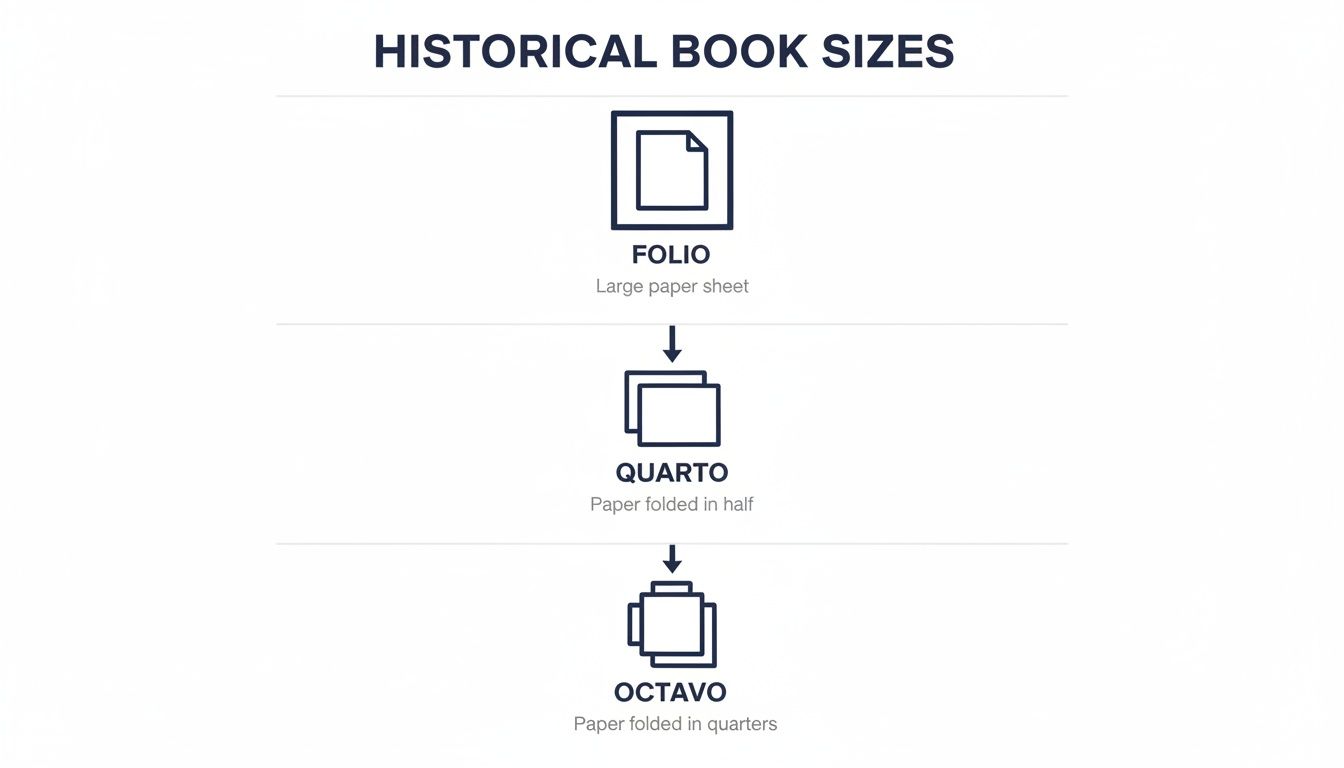
You can see a clear progression from the large, exclusive Folio to the smaller, more accessible Octavo. Efficiency has always been a driver of book design. Matching your book’s size to its genre is just the modern version of that principle—making sure the physical format is the absolute best vehicle for the story inside.
Navigating Print-On-Demand Platform Sizes
For authors today, print-on-demand (POD) services like Amazon’s Kindle Direct Publishing (KDP) and IngramSpark have completely changed the game. They’ve torn down the old financial walls, getting rid of the need for massive, risky print runs. Now, anyone can publish a book without a garage full of unsold inventory.
But this incredible freedom comes with a few ground rules, especially when it comes to traditional book sizes.
Think of these platforms as enormous, highly efficient print shops. To keep things moving smoothly and prices low, they rely on a specific menu of “standard” trim sizes that fit their machinery and distribution models perfectly. You can often request custom dimensions, but stepping outside their preferred options can have hidden consequences that hit both your book’s reach and your wallet.
KDP and IngramSpark Preferred Sizes
Both KDP and IngramSpark give you a bunch of trim size options, but a handful are the undisputed industry standards. Picking one of these isn’t just playing it safe; it’s a strategic decision. These sizes are popular for a reason—they’re built for maximum compatibility, cost-effectiveness, and access to the widest possible audience.
The most common and highly recommended sizes you’ll see are:
- 5.5″ x 8.5″: A versatile and professional go-to for just about everything—fiction, nonfiction, memoirs. It’s the quintessential North American trade paperback.
- 6″ x 9″: The other industry heavyweight. It’s slightly larger and often the choice for nonfiction or any book that needs a bit more breathing room on the page.
- 5″ x 8″: A more compact option that feels classic and literary, making it a great fit for novels or poetry collections.
Choosing one of these is like buying a popular car model. You know the parts (or in this case, printing and distribution) will be easy to find and more affordable. This directly translates to lower per-unit print costs, which lets you set a competitive price for your book while keeping a healthy royalty for yourself.
The Hidden Costs of Going Custom
It’s tempting to pick a unique, custom size to make your book stand out on the shelf. Maybe a trendy square format for your design book or a tall, slender volume for your poetry. While the platforms can often print these odd sizes, doing so might lock you out of some of their best features.
For instance, Amazon’s Expanded Distribution program—the one that gets your book into other retailers and libraries—is typically restricted to a shortlist of standard trim sizes. If your book is even a quarter-inch off, it could be disqualified, gutting your chances of being discovered outside the Amazon bubble. Digging into the details of paperback book dimensions shows just how critical these standards are for getting your book out there.
Choosing a non-standard size on a POD platform is like ordering an off-menu item at a fast-food joint. They might be able to make it, but it’ll probably take longer, cost more, and you might not get the fries with it.
On top of that, a non-standard size can drive up your print cost. The whole POD system is built on using paper efficiently. Unconventional dimensions create more waste, and that cost gets passed straight to you. A higher print cost forces a tough choice: either raise your book’s price and potentially scare off buyers, or settle for a smaller royalty on every sale.
Making the Smart Choice for Profit and Reach
At the end of the day, your goal is to choose a size that makes your book profitable and available to as many readers as possible. For 95% of authors, the smartest move is to stick with the tried-and-true POD sizes like 5.5″ x 8.5″ or 6″ x 9″.
These dimensions guarantee your book looks professional, qualifies for the widest distribution channels, and keeps your printing costs down. By working with these industry-standard traditional book sizes, you’re setting yourself up for success, dodging common pitfalls, and giving your story the best possible chance to find its audience.
How Trim Size Shapes Your Book’s Interior Design
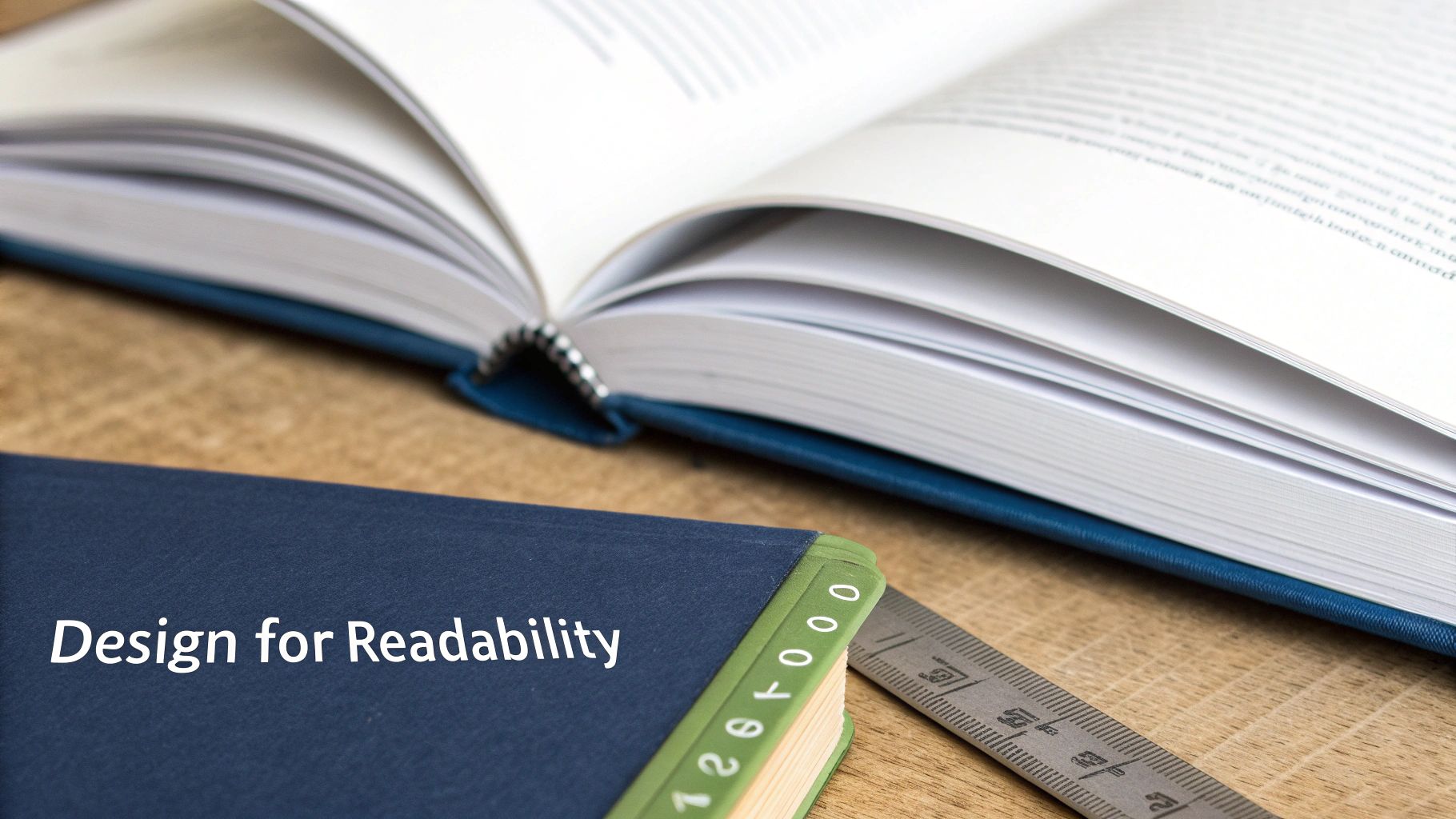
Think of your book’s trim size as the foundation of a house. It’s a decision you make early on, and it dictates the layout and feel of everything that comes after. This single choice does more than just determine the final shape of your book; it sets the rules for the entire interior design, directly affecting readability, page count, and even production costs.
A smaller book, like a cozy 5″ x 8″ trade paperback, forces you to be economical with your space. Every element needs to be placed carefully to avoid a cramped page that feels overwhelming to the reader. On the other hand, a more spacious 6″ x 9″ format gives your words room to breathe, allowing for more generous whitespace and creating a more relaxed, premium reading experience.
The Building Blocks of Your Page Layout
Once your trim size is locked in, you have to get a handle on three crucial elements that define your interior layout. Nailing these is the difference between an amateur-looking book and a professional one.
Margins: These are simply the empty spaces bordering your text on all four sides. They’re the “white space” that keeps your text from crashing into the edge of the page, giving the design a clean, polished look.
Gutter: This is the single most important margin. The gutter is the space on the inner edge of each page, right where the book is bound. If it’s too small, your reader will have to wrestle with the book to see the words disappearing into the spine.
Bleed: This one only comes into play if you have images or graphics that you want to run right to the very edge of the page. To achieve this, your designer has to extend the image slightly beyond the final trim line (usually by 0.125 inches). This tiny overlap ensures that when the printer’s blade comes down, you don’t end up with an ugly, accidental white sliver along the edge.
The gutter is the unsung hero of book design. Too narrow, and your readers will have to pry the book open to read the inner columns. Too wide, and you waste precious space. It’s the critical buffer that separates a professional layout from a frustrating reading experience.
If you’re serious about creating a beautiful interior, diving deeper into professional book design and layout principles will pay off immensely.
Calculating Your Book’s Spine Width
Getting the spine width right is a common source of anxiety for authors, but it’s really just simple math. It’s not a guess; it’s a precise calculation based on two things: your final page count and the thickness of the paper you’re printing on.
Print-on-demand services like KDP have simple formulas for this. For example:
- Cream Paper: Page count x 0.0025″
- White Paper: Page count x 0.002252″
Let’s run a quick example. Say your 80,000-word manuscript formats to a 320-page book in a 6″ x 9″ trim size. If you opt for cream paper, the math is 320 x 0.0025 = 0.8 inches. That 0.8-inch number is critical for your cover designer. Get it wrong, and the cover simply won’t fit, leading to frustrating delays and redesign costs.
To see how a simple change in trim size can have a big impact, take a look at the table below. It shows how the same 80,000-word manuscript would change in page count and spine width just by adjusting the book’s dimensions.
Impact of Trim Size on Page Count and Spine Width
| Trim Size (Inches) | Estimated Page Count (80k words) | Paper Type | Estimated Spine Width (Inches) |
|---|---|---|---|
| 5″ x 8″ | 364 | Cream | 0.91″ |
| 5.5″ x 8.5″ | 340 | Cream | 0.85″ |
| 6″ x 9″ | 320 | Cream | 0.80″ |
| 5″ x 8″ | 364 | White | 0.82″ |
| 5.5″ x 8.5″ | 340 | White | 0.77″ |
| 6″ x 9″ | 320 | White | 0.72″ |
As you can see, a smaller trim size means more pages, which in turn means a thicker spine. This is a perfect example of the domino effect in book design—your very first decision about the size of your book sends ripples through every other technical aspect of its creation.
How to Pick the Right Book Size: A Simple 4-Step Framework
Alright, you’ve waded through the history, the genre standards, and the nitty-gritty technical details. Now comes the moment of truth: picking the final, perfect trim size for your own book. It can feel overwhelming, but it doesn’t have to be.
Instead of getting paralyzed by options, let’s walk through four essential questions. Think of this as your final checklist. Answering these honestly will cut through the noise and point you directly to the right dimensions, striking that crucial balance between your creative vision and the realities of the market.
1. What Are the Norms in My Genre?
Your first stop should be the bookstore shelf, whether it’s the one at your local shop or the virtual one on Amazon. What are the go-to sizes for the current bestsellers in your category? This isn’t about blind imitation; it’s about speaking the same subconscious language as your readers.
- Your Mission: Go find five to ten successful books published in your niche within the last couple of years.
- Do Some Digging: Look up their dimensions online. You can usually find this in the “Product Details” section.
- Spot the Trend: Is there a clear winner? You’ll likely see 6″ x 9″ dominating nonfiction or 5.5″ x 8.5″ popping up constantly for contemporary novels.
When your book fits in, it signals to readers that it belongs. You can absolutely break the mold, but make sure it’s a deliberate, strategic choice—not a rookie mistake.
2. What’s My Budget and Target Price?
This is where the dream meets the spreadsheet. Your book’s dimensions are directly wired to its printing cost, which then shapes its retail price and, ultimately, your royalty.
It’s a common misconception that a larger trim size automatically saves money by reducing the page count. In reality, print-on-demand services are often optimized for common sizes, making them more cost-effective to produce. A full self-publishing project, including editing and design, can run anywhere from $2,000 to $5,660, and the physical printing cost is a huge piece of that pie.
Run the numbers. Use a print cost calculator to see how a few different sizes impact your profit per sale. This simple step can be the difference between a book that’s just a beautiful object and one that’s also a financially sound product.
3. Where Will I Actually Sell This Book?
Think about your primary storefront. Are you aiming for online dominance, or is your dream to see your book sitting on a shelf in a brick-and-mortar store? This choice matters more than you might think.
- Selling Online (Amazon, etc.): You have a lot more wiggle room here. However, sticking to standard dimensions like 5.5″ x 8.5″ can be the key that unlocks expanded distribution programs, getting your book onto more platforms.
- Selling in Physical Bookstores: Booksellers live and die by standard shelving. If your book is an oddball size, it’s a logistical headache for them to stock and display. Choosing a common trade paperback size makes it easy for them to say “yes.”
4. What Kind of Reading Experience Am I Creating?
Last but not least, put yourself in your reader’s hands. The physical object you’re creating is the medium for your message. How do you want it to feel?
Is your book a breezy beach read that someone can toss in a tote bag? A smaller, portable mass-market size would be perfect. Or is it a dense, thoughtful work meant to be savored with a cup of tea? A larger trade paperback with generous, airy margins would create a much more immersive experience.
This final question connects your artistic heart to the practical reality of your book’s physical form. By thoughtfully working through these four points, you’ll land on a trim size that feels right, looks professional, and sets your book up for success from the very first impression.
Got Questions About Book Sizes? We’ve Got Answers.
As you get closer to hitting that “publish” button, the nitty-gritty details of book sizes can start to feel overwhelming. It’s normal to have last-minute questions. Let’s clear up some of the most common ones so you can move forward with confidence.
Can I Pick a Custom Size on KDP or IngramSpark?
You absolutely can. Both KDP and IngramSpark let you plug in your own custom dimensions, which sounds like a great way to make your book stand out on a crowded shelf.
But there’s a catch, and it’s a big one. Going rogue with a non-standard size can get you kicked out of crucial distribution channels, like Amazon’s Expanded Distribution network. That means fewer opportunities to get your book into physical bookstores and libraries, which can seriously hamstring your sales. Custom sizes can also nudge your printing cost up, chipping away at your royalties with every copy sold.
How Does Trim Size Affect My Retail Price?
Think of it this way: your book’s size is one of the biggest factors in its manufacturing cost, which in turn dictates its retail price. It all boils down to page count.
A bigger trim size, like the popular 6″ x 9″, fits more words per page, leading to a shorter book overall. A smaller size, say 5″ x 8″, will naturally inflate your page count for the very same manuscript. Since print-on-demand services charge a base fee plus a per-page cost, the math can get tricky. You’re looking for that sweet spot where the book feels right, the price is competitive, and you still make a decent profit.
Pro Tip: Before you lock anything in, play around with your platform’s print cost calculator. You’d be shocked at how a half-inch difference in trim size can ripple through your entire pricing strategy and affect your bottom line.
What’s the Most Common, Can’t-Go-Wrong Book Size?
If there’s a king of the hill for trade paperbacks in the U.S., it’s the 6″ x 9″ format. It has become the go-to standard for a huge range of both fiction and nonfiction, and for good reason.
This size just works. It strikes a perfect balance between feeling substantial in the reader’s hands, offering a comfortable reading experience, and being economical to print. The runner-up, 5.5″ x 8.5″, is another fantastic, professional choice that looks right at home on any bookstore shelf. For most authors, sticking with one of these two is the safest and smartest bet.
At BarkerBooks, we help authors navigate these decisions every single day, from picking the perfect trim size to setting up global distribution. Our team ensures your book has the professional polish it needs to compete. Ready to turn your manuscript into a beautifully crafted book? Learn more about our process at BarkerBooks.com.