
Long before your book hits the virtual shelves, the real marketing work begins. The secret to a successful launch isn’t a flurry of last-minute activity; it’s the slow, steady work of building a genuine connection with your future readers. This all comes down to your author platform, and at its core are two assets you truly own: your author website and your email list.
Think of it this way: everything you build in these early stages creates a dedicated community, primed and excited to hit “buy” the moment your book goes live.
Building Your Author Platform Before You Publish

So many first-time authors fall into the trap of waiting until their book is available for sale to start thinking about promotion. I’ve seen it time and again. But the truth is, the most powerful marketing happens months in advance. You’re not just trying to sell a product; you’re inviting people into a world you’ve created and building a brand around your name.
Your author platform is your digital headquarters. It’s the one place on the internet where readers can always find you, get updates on your work, and, most importantly, sign up to hear from you directly. Social media algorithms are fickle beasts, but your website and email list give you an unfiltered line to your most passionate fans.
First, Pinpoint Your Ideal Readers
Before you write a single line of web copy or design an email template, you have to know exactly who you’re talking to. Just saying “I write for fantasy readers” isn’t nearly specific enough. You need to get granular and paint a vivid picture of your perfect reader.
Ask yourself these kinds of questions:
- What other authors are on their bookshelf? Knowing this reveals their tastes and the specific tropes they can’t get enough of. For instance, a reader who loves Tana French is probably looking for atmospheric, character-driven mysteries, not fast-paced thrillers.
- Where do they hang out online? Are they deep in conversations on specific Subreddits? Do they frequent certain Goodreads groups or BookTok hashtags? Being part of the communities where your readers already are is how you build authentic relationships.
- What are they really looking for in a book? For non-fiction, what problem are you solving for them? For fiction, what emotion are they chasing? Is it a heart-pounding escape, a comforting romance, or a mind-bending puzzle?
Getting this right is everything. It allows you to shape your messaging, your blog posts, and even your book’s keywords to resonate with the right people—the ones who will not only buy your book but will also tell all their friends about it.
Setting Up Your Core Assets: The Non-Negotiables
Once you have that clear reader profile, it’s time to build the two pillars of your platform: your website and your email list. In a market that’s only getting more crowded—the self-publishing industry is expected to grow by a 16.7% CAGR and hit $6.16 billion by 2033—having a direct line to your audience is your greatest advantage.
Your author website doesn’t need to be fancy. In the beginning, simple and professional is perfect. All you really need is a homepage, an “About” page, a page for your books, and a very obvious email signup form. If you’re looking for a great walkthrough, BarkerBooks has an excellent guide on creating an author website that breaks it all down.
Your email list is, without a doubt, your single most powerful marketing tool. Social media platforms can change their algorithms or even disappear, but your email list is yours. It’s a direct connection to people who have literally raised their hands and said, “Yes, I want to hear from you.”
Of course, people won’t just hand over their email addresses. You need to give them a compelling reason to sign up. This is where your lead magnet comes in—a valuable freebie you offer in exchange for their subscription.
Here are a few lead magnet ideas that work wonders:
- A bonus short story or deleted scene set in your book’s universe.
- The first few chapters of your upcoming novel.
- A handy checklist or resource guide related to your non-fiction topic.
- Exclusive character art or a beautifully designed map of your world.
This isn’t a trick; it’s a value exchange. You’re not just taking their email; you’re giving them a gift that makes them feel like part of an exclusive club. This is how you start turning casual browsers into a loyal community—the very people who will champion your book on launch day.
Making Your Book Discoverable with Keywords and Categories

If a reader can’t find your book on Amazon, it might as well not exist. This is a hard truth of self-publishing. Your marketing lives and dies by your book’s visibility, and that visibility is powered entirely by data.
Think of your book’s metadata—its keywords, categories, title, and blurb—as the instructions you give to Amazon’s algorithm. You’re telling it exactly who your ideal reader is so it can place your book right in their path. Your cover and title might make a reader pause, but it’s your keywords and categories that put you on their screen in the first place.
Uncovering Keywords That Actually Work
Keywords are simply the words and phrases readers type into the search bar. Getting this right isn’t about guesswork; it’s about climbing inside your reader’s head and figuring out what they’re looking for. Amazon gives you seven keyword slots in KDP—make every single one count.
The goal here is to find search terms that are highly relevant to your story but have manageable competition. Single, generic words like “thriller” or “romance” are basically useless. You need to dig into the specific tropes, settings, and character archetypes that make your book unique.
- Think “billionaire boss romance” instead of just “romance.”
- Try “cyberpunk detective novel” instead of the broader “sci-fi.”
- Target a passionate niche with “cozy mystery with a cat.”
A great starting point is the Amazon search bar itself. Type in your main genre and see what phrases auto-populate; those are real terms people are searching for. Then, go stalk the bestsellers in your niche. Scroll down their product pages to the “Product details” section and look at the categories they’re ranking in. This is a goldmine for keyword ideas.
Choosing Categories That Will Actually Sell Your Book
Picking the right categories is one of the most powerful things you can do for your book’s visibility. Dropping your new release into a massive, hyper-competitive category like “Thrillers & Suspense” is the equivalent of shouting into a hurricane. It won’t be heard.
The real strategy is to find smaller, niche subcategories where you have a legitimate shot at hitting the #1 spot.
Earning that little orange #1 Bestseller tag, even if it’s just for a few hours in a tiny category, is a massive form of social proof. It signals quality and can seriously boost your click-through rate.
Don’t just pick categories that sound right; pick categories you can realistically dominate. It’s so much better to be a big fish in a small pond than to be completely invisible in the ocean. This simple strategic shift can trigger Amazon’s algorithm to show your book to thousands more readers.
To find these opportunities, browse the Kindle Store and click down through the subcategories as far as you can. Look for niches where the #1 book has a sales rank of 5,000 or higher. This is a good indicator that the top spot is within reach. And remember, you can email KDP support and ask to be placed in up to ten categories, giving you more chances to get noticed.
Writing a Book Description That Hooks Readers
Once a potential reader lands on your page, your book description has one job: sell the book. This isn’t the place for a dry plot summary. This is sales copy, plain and simple.
You need to lead with a powerful, one-sentence hook that stops them cold. Then, use a few short, punchy paragraphs to introduce your character, their core conflict, and what’s at stake. You should end with a cliffhanger or a compelling question that makes them desperate to find out what happens next.
Make your description easy to read by using smart formatting:
- Use bold or italics to make key phrases pop.
- Keep paragraphs short—just one or two sentences is perfect.
- Break up the text with bullet points to highlight tropes or selling points.
This is where you close the deal. For a deeper dive, our guide on how to promote your book on Amazon breaks down how to optimize every single element of your book’s page. Getting your keywords and categories right is the foundation of any solid marketing plan.
Building Pre-Launch Buzz That Actually Works
A huge launch day doesn’t just happen. It’s the end result of months of groundwork, all designed to turn your book release into a real event. This isn’t about just dropping links everywhere and hoping for the best. It’s about creating an atmosphere of genuine anticipation so that on day one, you have a crowd of people excited to buy, review, and spread the word.
The whole point of a pre-launch campaign is to make readers feel like they’re on the inside. You’re not just pitching them a story; you’re inviting them behind the scenes and making them part of the whole journey. This simple shift in mindset is what turns passive followers into your most vocal supporters, which is the secret to any big launch.
Get Your ARC Team Ready
Your Advance Reader Copy (ARC) team is your single most important pre-launch tool. Think of them as your launch-day ground crew. This is a hand-picked group of readers who get a free, early copy of your book. In exchange, they agree to leave an honest review as close to launch day as possible. Those first few reviews are pure gold—they give your book the social proof it needs to convince new readers to click “buy.”
So, how do you find these people?
- Start with your email list. These are your warmest leads and most dedicated fans. Send out an email inviting them to apply.
- Use your social media. Announce you’re looking for ARC readers and link to a simple application form (a Google Form works perfectly for this).
- Tap into reader groups. Look for communities on Facebook or Goodreads that are focused on your specific subgenre. Just make sure you check the group rules first, as many have specific guidelines for authors.
Once you have your team, communication is everything. I recommend using a service like BookFunnel or StoryOrigin to send out the digital copies securely. It keeps things professional and simple. From there, just send a few gentle reminders about the launch date and, most importantly, thank them for their help.
Honestly, having even just 5-10 honest reviews on launch day can make a massive difference in how many books you sell. A book with zero reviews is a gamble; a book with a handful of them feels like a safe bet to a new reader.
Map Out a Simple Social Media Calendar
Your social media in the weeks before launch shouldn’t feel like a constant sales pitch. It should be more like a slow burn of excitement, dropping little breadcrumbs that lead your audience right to launch day. A basic content calendar will keep you from feeling overwhelmed and ensure you’re building momentum, not just noise.
Try mixing up your content to tease the book without spoiling it:
- Quote Graphics: Pull a few punchy one-liners or evocative sentences from the book and pop them onto a nice background.
- Character Intros: Share little tidbits about your main characters. What are their weird habits? What makes them tick?
- Behind-the-Scenes Peeks: People love seeing the process. Post a photo of your messy desk, share a cool fact you learned during research, or mention a song that inspired a key scene.
You’re just trying to spark curiosity and make people wonder what’s coming. To make sure all this great content gets seen, it really pays to do a little research on finding the best time to post on social media to hit your audience when they’re most active.
Make Your Email List Feel Like VIPs
Social media is great for casting a wide net, but your email list is where you build your core, loyal fanbase. Recent data shows that over 80% of independent authors have a dedicated website, mostly for direct sales and building that all-important list. This channel is priceless because you’re not at the mercy of some algorithm—you can talk directly to your biggest fans. If you want to dive deeper, you can read the full insights on the power of direct author-reader connections.
Treat your subscribers like the insiders they are. Give them things no one else gets.
Exclusive Goodies for Your Email List:
| Content Idea | Why It Works | How to Do It |
|---|---|---|
| The Cover Reveal | Creates a huge burst of excitement and gives them something to share. | Email the final cover to your list a day or two before you post it anywhere else. |
| Deleted Scenes | Offers a unique peek into the story’s world that feels super exclusive. | Share a short scene that you had to cut from the final manuscript. |
| First Chapter Sneak Peek | Gets them hooked on the story and practically guarantees a launch-day sale. | Send them a PDF of the first chapter a week or so before the book goes live. |
This strategy is all about reciprocity. When you give your subscribers exclusive stuff, you build a ton of goodwill and make them feel invested in your success. By the time launch day rolls around, they’re not just customers—they’re part of your team, ready to cheer you on.
Bringing It All Home: Your High-Impact Launch Week
Launch week is the moment everything comes together. All that prep work—the ARC team, the email list, the cover design—it all funnels into these first few critical days. Your mission isn’t just to sell some books; it’s to create a big enough splash to get Amazon’s algorithm to sit up and take notice.
A strong launch is a carefully orchestrated event. It’s about building a wave of momentum that carries your book up the charts and puts it in front of brand-new readers. Think of it as a domino effect: every review, email, and ad contributes to the push.
Coordinating Your Launch Day Push
The very first thing you do on launch day is rally your ARC team. You’ve built a relationship with these readers, and now it’s their time to shine. A simple, friendly email is all you need. Just let them know the book is live and how much you’d appreciate their honest review.
Getting even 5-10 reviews on day one can make a world of difference. A book with zero reviews feels like a risk to a potential buyer, but a handful of reviews provides instant social proof.
The name of the game during launch week is sales velocity. It’s the speed and consistency of your sales, and it’s the metric Amazon’s algorithm cares about most. A quick burst of sales tells the system your book is a hot commodity, and it will start showing it to more people organically.
Once the reviews start rolling in, it’s time to tell everyone else. Start with your email list—they’re your warmest audience. Send them an enthusiastic email with a direct, no-fuss link to buy the book. Right after that, hit up your social media channels with the awesome graphics and copy you already prepared.
This timeline gives you a great visual for how all the pre-launch pieces fit together to build that crucial day-one buzz.
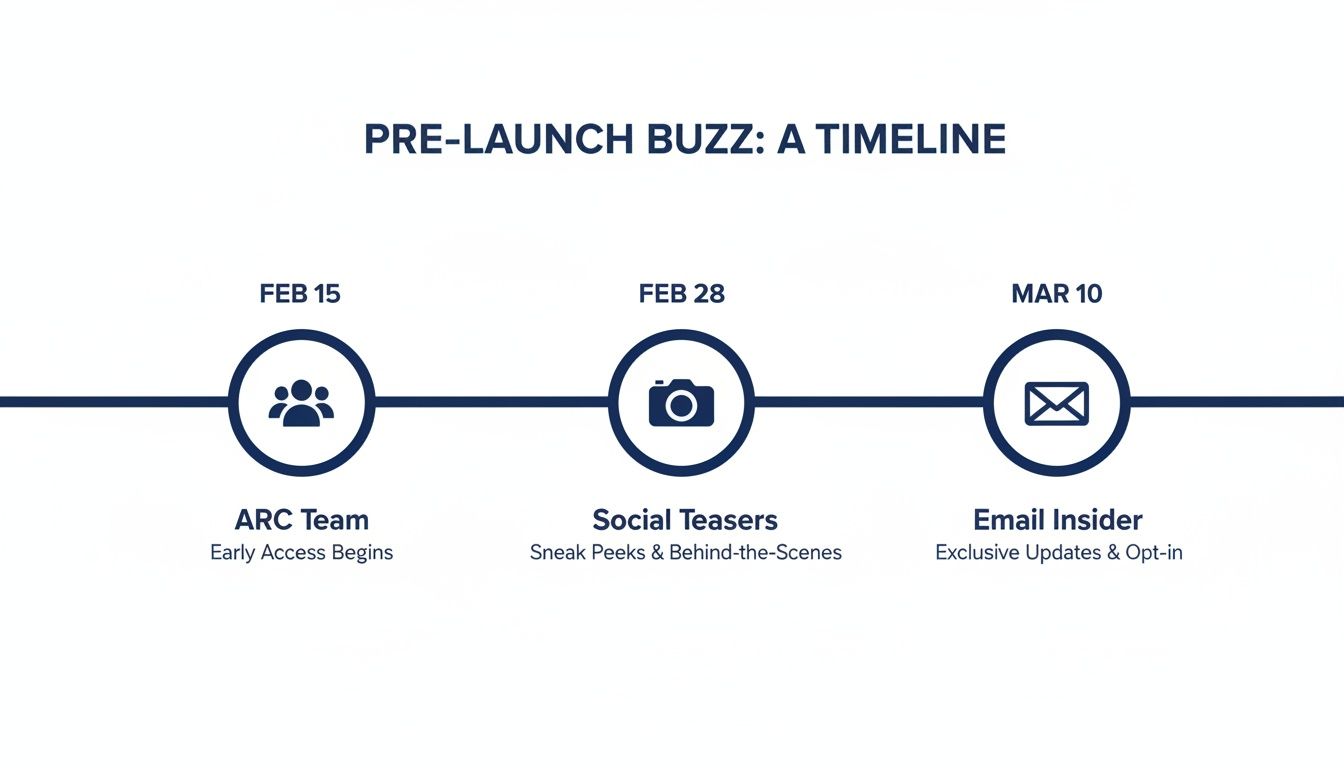
As you can see, the ARC team, social media teasers, and your email insiders all work in concert to create a foundation of excitement long before your book even goes live.
Stacking Promotions for Maximum Impact
One of the smartest moves you can make during launch week is promo stacking. This is where you schedule paid promotions with different book newsletter sites to run on consecutive days. Instead of getting one giant, short-lived sales spike, you create a sustained lift that keeps your book higher in the rankings for longer.
Here’s what that might look like in practice:
- Day 1: Your ARC team drops their reviews, you email your list, and you switch on your Amazon Ads.
- Day 2: A promo with a site like Fussy Librarian goes live, driving a fresh wave of traffic.
- Day 3: Another newsletter, maybe a genre-specific one like Ereader News Today, sends out your book.
- Day 4: You could run a targeted Facebook Ad campaign to readers of a comp author.
This steady drumbeat of sales is exactly what the algorithm wants to see. Each promotion gives the next one a higher starting point, pushing your rank up and boosting your organic visibility. It’s a powerful snowball effect. If you want to get even more creative, you can find some fantastic book launching ideas to mix into your strategy.
Your Launch Day Checklist
Launch day can feel like a whirlwind. A checklist is your best friend to make sure nothing important gets missed in the excitement.
- Confirm Everything is Live: The moment you wake up, check your book’s page on Amazon. Is the price right? Is the description correct? Does the “Look Inside” feature work?
- Email Your ARC Team: Send out that polite reminder with a direct link to the review page.
- Announce to Your Email List: This is your big moment. Make the email exciting and the “buy” link impossible to miss.
- Post Everywhere on Social Media: Get your launch graphics and announcements out there. Pin the main launch post to the top of your profiles for the whole week.
- Turn On Your Ads: Activate any prepared Amazon or Facebook ad campaigns. Keep a close eye on them for the first few hours to make sure they’re running smoothly.
- Engage, Engage, Engage: This is the fun part! Respond to comments, thank people for their support, and share in the excitement. Your enthusiasm is contagious.
Sustaining Sales for the Long Haul

The launch week high is fantastic, but it’s just the beginning. The real goal for any author serious about their career is to turn that book into an asset that keeps selling, month after month, year after year. This is where you pivot from simply launching a book to building a business.
Lasting success isn’t about that one big sales spike. It’s about building an evergreen system that consistently pulls in new readers. We’re moving beyond the short-term launch tactics and into strategies that work quietly in the background, keeping your book discoverable long after the initial buzz dies down.
Automate Your Welcome Wagon with Email
Your email list is your single most important long-term marketing tool. Full stop. When someone new subscribes, they are at their absolute peak of interest in you and what you do. It’s the perfect time to draw them into your world and show them what else you’ve got.
This is where an automated welcome email sequence comes in. Think of it as a series of pre-written emails that drip out to new subscribers over a few days or weeks. You set it up once, and it runs on autopilot, turning fresh leads into dedicated readers while you sleep.
Here’s a simple, effective structure you can use:
- Email 1 (Immediate): The moment they sign up, send them the freebie they were promised along with a warm, personal welcome. Tell them a little about yourself and what kind of emails they can expect from you.
- Email 2 (2 Days Later): Share the story behind your first book. What was the spark? What makes it personal to you? End with a low-pressure link to check it out.
- Email 3 (4 Days Later): Give them something of value that isn’t a sales pitch. Share a fascinating tidbit from your research, a deleted scene, or a fan-favorite quote. Keep them engaged.
- Email 4 (7 Days Later): Now you can introduce another book or your entire series, connecting it back to what they’re already interested in.
This little system ensures every new fan gets a consistent, engaging introduction to your author brand, nurturing that relationship from day one.
The Power of a Strong Backlist
One book is a project. A collection of books is a career. The most successful indie authors I know understand this deeply. Every new book you release isn’t just another source of income; it’s a powerful marketing tool for everything you’ve already written. This collection of your previously published books is your backlist.
A solid backlist creates an incredible flywheel effect. A reader finishes one of your books, loves it, and immediately thinks, “What else have they written?” If the answer is “a lot,” you’ve just turned a single sale into a binge-read. This is especially true for series authors.
The real magic happens when your backlist is deep enough to amortize marketing costs. For long-term sales and to effectively reach your audience, consider researching the best platforms to sell digital products, which includes self-published books and direct sales opportunities.
Once you have multiple books out, the marketing math starts to look very good. A single promotion can send ripples across your entire catalog. New data shows that for authors with a deep backlist, a single $100 promotion can trigger sales across a 7-10 book series as new readers get hooked and start burning through your entire world.
Content That Attracts New Readers
To keep that sales engine running, you need a constant trickle of new people discovering your work. Content marketing is a fantastic, low-pressure way to make that happen. By creating helpful, interesting, or entertaining content related to your genre, you can attract your ideal readers and introduce them to your books organically.
This doesn’t mean you have to become a full-time blogger or YouTuber. Just pick one platform where your readers hang out and create content that serves them.
- For Fiction Authors: Think about writing blog posts on the real-world history behind your setting. Or maybe create short videos explaining the cool mythology in your fantasy world. Even sharing character-inspired music playlists can work wonders.
- For Non-Fiction Authors: This is your chance to shine. Create checklists, how-to guides, or short tutorials that solve a tiny piece of the big problem your book addresses. Give them a quick win.
Every piece of content you create is another door into your world. It builds your authority, provides real value, and gives you something to share that isn’t just another “buy my book!” post. It makes your marketing feel authentic and, most importantly, sustainable for the long run.
Your Top Book Marketing Questions, Answered
Let’s be honest, figuring out how to market your book can feel like a whole separate job on top of writing it. It’s easy to get lost in the weeds. But here’s the good news: you don’t need a massive budget or a ridiculously complicated plan to get your book into the hands of readers.
I get asked the same questions all the time, so let’s break down the big ones with some straight-to-the-point advice.
So, How Much Do I Really Need to Spend on Marketing?
There’s no magic number, but you can definitely make a real impact without breaking the bank. A smart starting budget for a new author is typically somewhere between $300 and $1,500. The secret isn’t the total amount you spend, but how strategically you spend it.
If you’re on a tight budget, say $300-$500, put every penny into just two things: a professionally designed, genre-perfect cover and a small test campaign for Amazon ads. Seriously. Your cover is your number one salesperson, and skimping on it is the fastest way to kill your book’s chances.
Got a little more wiggle room, maybe $500-$1,500? Now you can build on that foundation. Add in a paid book promotion from a reputable site and consider getting a professional to punch up your blurb. The key is to start small with your ad spend, see what works, and then pour your earnings back into what’s getting you results.
When Should I Actually Start This Whole Marketing Thing?
Yesterday. The best time to start marketing was the moment you decided to write the book. But the next best time is right now. Realistically, you need to kick things off a bare minimum of 3-6 months before you plan to launch.
This early phase isn’t about shouting “buy my book!” from the rooftops. It’s about building your foundation so that when you do have a book to sell, you’re not launching to crickets.
During this pre-launch window, focus on these core tasks:
- Stake your claim online. A simple author website is your home base.
- Start an email list. Create a compelling freebie (a short story, a checklist, a prequel) to give people a reason to sign up.
- Be social, not salesy. Pick one or two social media platforms where your readers hang out and start building genuine connections.
Do this groundwork, and you’ll have a group of people genuinely excited for your launch day, not a cold audience you’re desperately trying to win over.
What Marketing Channels Actually Work?
For new authors, trying to be everywhere at once is a classic mistake that leads straight to burnout. The smart move is to pick one or two high-leverage channels and get really good at them before you even think about expanding.
Your most effective marketing channels are always the ones that put you directly in front of readers who are already looking for a new book. You’re not trying to create readers; you’re trying to meet them where they already are.
Three channels consistently punch above their weight for indie authors:
- Your Email List: This is gold. It’s the only audience you will ever truly own, completely independent of any algorithm change. These are your superfans.
- Amazon Ads: The beauty here is simple: you’re targeting people who are literally on Amazon with their credit card in hand, actively searching for something to read. It doesn’t get much warmer than that.
- Paid Newsletter Promotions: Using services like The Fussy Librarian or the legendary BookBub can give you a huge, immediate spike in sales. They’re perfect for launching a book with a bang or reviving a backlist title.
Focus your energy and your budget on these proven winners, and you’ll build real, sustainable momentum without running yourself ragged.
Ready to turn your manuscript into a professionally published book that reaches readers worldwide? BarkerBooks offers end-to-end support, from editing and cover design to global distribution and targeted marketing. Let our team of experts guide you through every step of the publishing process. Learn more about our author services and get started today!