
You've finished the manuscript, chosen a cover, and may already be planning distribution through several retailers. Then the ISBN question appears. Which portal should you use? Does a free ISBN protect your publishing identity? Will the agency approve your documents before your launch date?
ISBN registration online isn't one global application. It's a network of national and regional systems, each with its own eligibility rules, document checks, account process, and approval timeline. The most important decision also happens before you open a form: whether you'll control the ISBN and imprint yourself or accept an identifier connected to a distributor.
Why Every Author Needs an ISBN and How to Get One
An ISBN is more than a barcode printed on a book cover. It gives a specific edition a recognized identity that publishers, retailers, libraries, distributors, and metadata systems can use to distinguish it from other editions and formats. That identity becomes especially important when you want your book available through multiple sales channels rather than inside one platform's ecosystem.
You can learn the basic terminology in this guide to what an ISBN is, but the strategic choice deserves more attention than most form tutorials provide. A distributor's free ISBN may be convenient, yet the distributor can become associated with the book as the publisher or imprint of record, depending on that system's rules. That can limit your control over how the title appears in catalogs and how easily you can move it between distribution partners.
My recommendation: If you're building a durable publishing career, register your own ISBN through the agency responsible for your publishing base.
Owning the identifier supports consistent imprint ownership, title metadata, and publisher attribution across the channels you choose. It also gives you a cleaner foundation if you later change printers, add a retail partner, release another format, or work with a publishing service. A free identifier can still suit an author who plans to remain within one distributor's system, especially when broad retail distribution and imprint control aren't priorities.
Decide before you register
Ask yourself three practical questions:
- Where will the book be distributed? A print book intended for bookstores and libraries generally needs a recognized book identifier. A title sold only through a closed digital platform may follow that platform's internal identification system instead.
- Who should appear as publisher? If your author business or imprint should remain visible, don't accept a provider's identifier without checking its ownership and attribution rules.
- Will the book have multiple editions? Print, digital, audio, revised, and translated editions may require separate identifiers under the applicable agency or distribution rules. Confirm the treatment for each format before assigning numbers.
ISBN registration should support your wider launch, not sit apart from it. If you're also deciding how to promote your book as an author, settle the publishing identity first, then make sure the same author, imprint, title, and format information appears consistently in your marketing materials.
Understanding the Global ISBN Infrastructure
The ISBN system was built as a publishing standard, not as a single online service. It was approved as an ISO standard in 1970 and became ISO 2108, establishing a shared method for identifying books across markets before online applications existed. The original 10-digit format expanded to 13 digits on 1 January 2007, aligning ISBNs with the wider GS1/EAN barcode ecosystem and supporting machine-readable identification across major markets. These milestones are documented in the International ISBN Agency's history of the ISBN system.
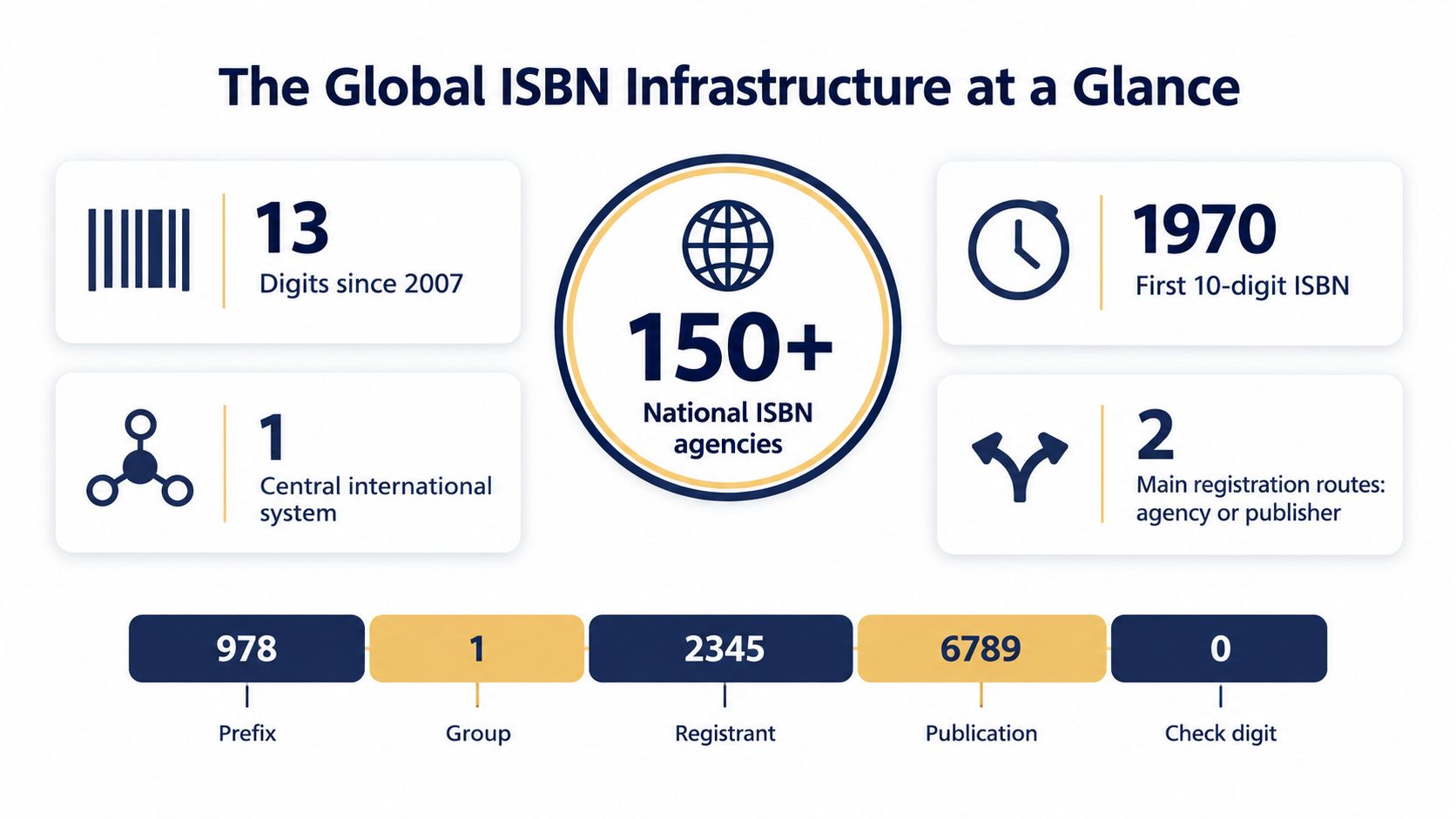
The infrastructure is coordinated internationally but fragmented at the point of application. The International ISBN Agency reports that 150 national or regional registration agencies have assigned ISBNs to more than 1.5 million publishers in over 200 countries. This scale explains why an online application requests more than an author's name and book title. It records your publishing entity and title metadata in a system intended to function across borders, retailers, libraries, and distribution channels.
Why the agency matters
Authors often search for one international registration website. No such universal portal exists. The International ISBN Agency coordinates the standard and identifies national agencies, while the agency serving your publishing base generally reviews eligibility and issues the identifier under local rules.
The result is international interoperability without a consistent user experience. One country may offer a straightforward web account. Another may request formal entity records, address evidence, or additional information before approval. Your ISBN can work internationally, but the application route remains local.
That fragmentation affects imprint strategy. If you want your own imprint to appear as publisher, establish which entity owns the publishing identity before submitting an application. Registering through an agency tied to the wrong business location, distributor, or service provider can create attribution problems that are harder to correct after assignment. Treat the agency's ownership and eligibility rules as part of your publishing setup, not as a minor form field.
Before researching where to buy an ISBN, identify the agency responsible for your publishing base. Do not select a portal because it appears first in search results or because a distributor directs you to its own supply. The correct agency depends on where the publisher is based and what evidence that agency requires. When those rules are unclear, ask a publishing professional to confirm the route before you register.
Navigating Country-Specific Online Portals
The country named in an ISBN search can matter more than the software used to submit it. There is no single universal application flow. National portals set their own rules for eligibility, documents, account access, review, and issuance. For authors working across borders, residence, business registration, language, and distribution plans may point to different jurisdictions.
India shows how large a national system can become. Its online ISBN system received 25,999 applications, registered 12,178 new users, and issued 362,989 ISBNs between 1 January and 31 December 2023, according to the India ISBN portal's annual report. The report states that applications had been fully online since 1 January 2007 and that the portal was revamped in July 2023.
Scale does not guarantee immediate issuance. National portals change, and redesigns can require applicants to learn a new interface or create an account again. India's portal was revised in 2025, with applicants required to register afresh on the redesigned system, as stated on the official India ISBN portal.
Compare the system, not just the form
Canada illustrates a different administrative pattern. Applicants create an account and confirm their email address, but credentials are assigned after review. The official ISBN application guidance describes approval as taking approximately 2 months. Treat that route as queued validation, not instant self-service.
Other portals add different gates. Portugal requires legal entities to submit formal registration documents or statutes before proceeding. India warns that administrator identity proof will be required later. Canada may request further information during review. A checklist copied from another country can therefore send the application to the wrong place or leave it incomplete.
Imprint ownership deserves separate attention. If your imprint should appear as the publisher, confirm which legal person or publishing entity the agency will verify before opening an account. A portal connected to the wrong business location, distributor, or service provider can create attribution problems after assignment. Settle ownership first, then choose the application route.
Use this decision path:
- Identify your publishing base. Start with the country or region where your publishing entity is based, not where your readers live.
- Read eligibility rules first. Confirm whether the portal accepts individuals, legal entities, publishers, or only residents.
- Prepare the requested records. Match identity, address, business, or entity documents to the agency's accepted format.
- Allow for review. Online submission does not remove human validation or administrative queues.
- Ask the agency about cross-border cases. Do not submit through several countries because one interface looks faster.
Practical rule: Treat every national ISBN portal as a separate administrative system connected to a common standard.
The Standard Online Registration Workflow
An ISBN application can appear simple while hiding a fragmented administrative system. India labels its opening stage Applicant Registration. Canada requires account creation and email confirmation, then assigns credentials after review. The shared standard does not create one shared portal, so follow the agency's own sequence rather than copying another country's instructions.
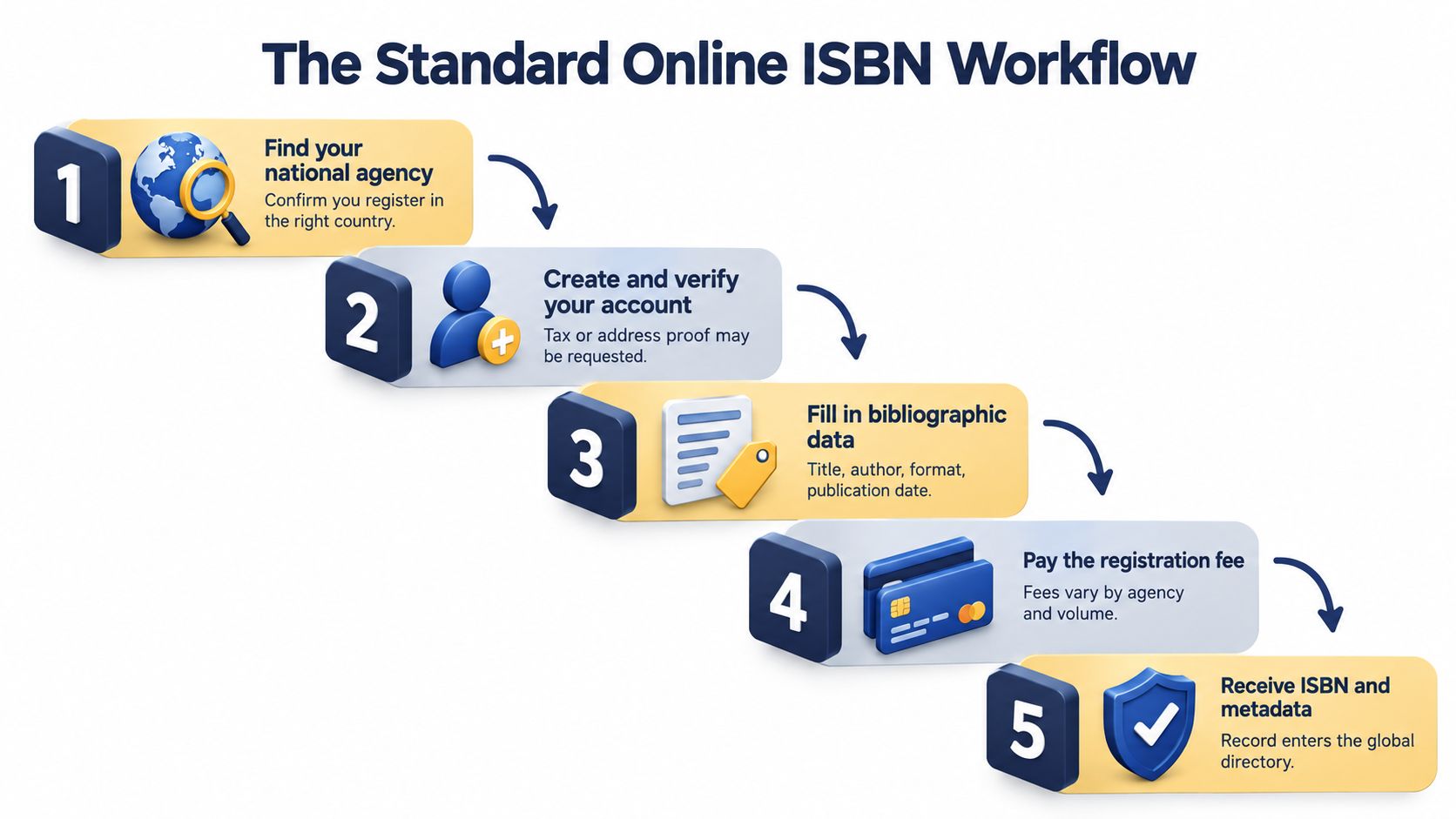
First, create the right applicant account
Select the account category that matches your legal publishing position. A sole author, registered company, nonprofit, university, and established publishing house may face different eligibility rules. Enter the applicant name exactly as it appears on the identity or entity documents the agency accepts.
Do not create an account under a future imprint if the portal verifies a legal applicant. The imprint and publisher details may belong in the title record, but the agency decides which name it connects to the account. Confirm ownership before registration, especially if a distributor or service provider is involved.
Second, confirm access and secure the account
Portals commonly send credentials or a confirmation message by email. Use the official portal, change any temporary password when required, and store the account details in a secure password manager.
Choose an email address you will retain after publication. Losing access can delay later title or format registrations, particularly when the agency requires account-based follow-up.
Third, prepare the metadata before opening the form
Draft the bibliographic information separately before entering the application:
- Title and subtitle: Copy the final wording, punctuation, and capitalization.
- Author and contributor names: Use the form in which you want the names cataloged.
- Publisher and imprint: Confirm which legal entity and imprint should appear in the record.
- Format and edition information: Identify the specific product represented by the ISBN.
- Publication details: Enter the expected date and any other fields the agency requests.
- Supporting documents: Keep identity, address, or entity records ready in the accepted upload format.
Treat every field as permanent catalog data. Errors can flow into retailer catalogs and distribution feeds, where a corrected cover will not repair a wrong title or publisher record.
Fourth, submit and monitor the application
Upload the requested documents, review each field, and submit one complete application. Save the reference number, confirmation email, and final ISBN record. If the agency uses a review queue, monitor the existing account instead of opening duplicate requests.
The agency may issue the ISBN only after validation. Wait for confirmation, then check the associated publisher and title data before using the identifier publicly.
The ISBN application instructions provide India-specific guidance, while the flowchart above shows the general account and submission sequence. Use them as process aids, not as a substitute for your own agency's eligibility rules.
Metadata discipline: Treat the registration form as the first permanent catalog record for your book, not as a disposable administrative questionnaire.
Avoiding Common Application Rejections and Delays
Submitting an online form doesn't guarantee fast approval. Agencies use the application to verify that the applicant is eligible and that the publishing entity can be connected to the title record. A rejected or delayed application usually reflects an avoidable mismatch, missing document, incomplete payment, or duplicate request.
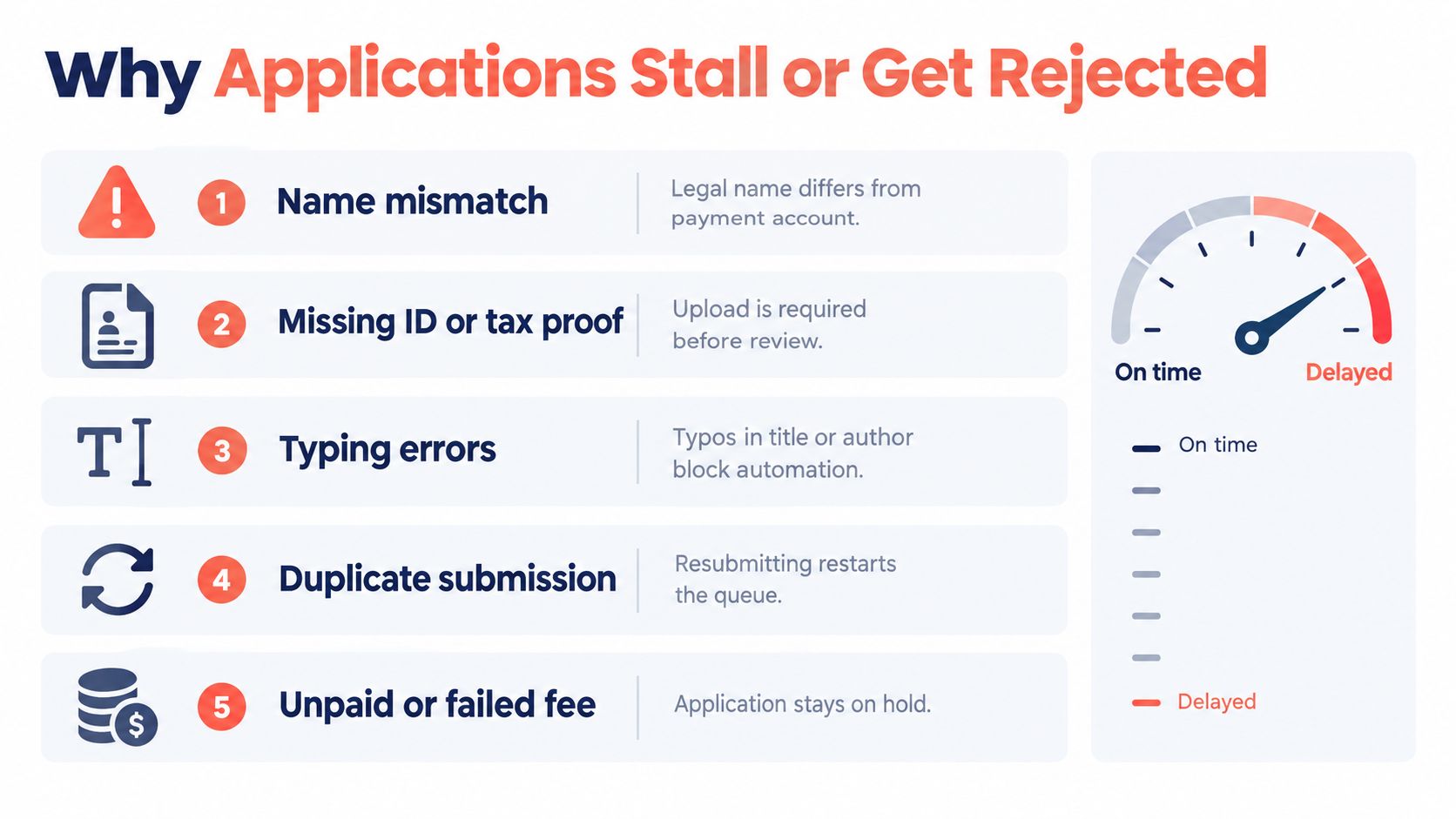
The identity record must match
Portugal's national agency requires legal entities to provide formal registration documents or statutes before proceeding. India's portal warns that administrator identity proof will be required later, and Canada reserves the right to request additional information during its review, as described in the official ISBN registration guidance.
Those requirements point to the same operational lesson. Agencies need to connect the account holder to a legitimate person or publishing entity. If your account uses an informal imprint, your payment record uses another name, and your uploaded document shows a third name, expect questions.
Check these details before submission:
- Legal name: Match the identity or incorporation document character for character.
- Address: Use the address format accepted by the agency and keep supporting evidence current.
- Administrator details: Ensure the person named in the account can provide the requested proof.
- Entity status: Upload the formal registration record, statutes, or equivalent document when the portal requires it.
- File quality: Make every document readable and submit it in an accepted file format.
Don't restart the queue
A second application rarely solves a missing-document problem. It can create duplicate records, confuse the reviewer, or send you back through the same validation process. Reply to the agency's request through the existing account and preserve the original reference.
Payment can create another hold. If the agency charges a fee, confirm that the transaction completed and retain the receipt. An application that appears submitted may still remain incomplete if the payment failed or the portal didn't attach it correctly.
Before you submit: Ask someone who hasn't worked on the manuscript to compare the portal fields against your legal documents and final title sheet. Fresh eyes catch mismatches that authors overlook.
Build review time into your launch schedule, particularly if your agency uses manual approval. If your publication date is close, delegate the administrative work rather than gambling the release on an untested portal. A professional can also tell you when the issue is an agency rule, an incomplete record, or a genuine eligibility problem.
How BarkerBooks Handles ISBN Registration for You
An author can complete ISBN registration alone when the publishing entity is clear, the national portal accepts the application, and the schedule allows for document review. The calculation changes when the author is bilingual, lives outside the main readership market, changes formats, or coordinates print and digital distribution together. National ISBN systems are fragmented, and the portal may not be the hardest part. Deciding who owns the imprint and controls the record often matters more.
BarkerBooks presents ISBN registration and copyright protection as parts of its publishing services. Its packages connect that administrative work with editorial, design, formatting, and distribution, which can reduce mismatches between ISBN records, retailer accounts, and other publication materials. Review the BarkerBooks book publishing program to judge whether that support fits your manuscript and release plan.
Delegate with ownership terms in writing
A publishing service can handle applications, but you must decide who owns the imprint before signing. Request written answers to these questions:
- Publisher of record: Which name will appear in the ISBN metadata?
- Account owner: Who controls the agency login and title record?
- Distribution scope: Which editions and channels will the registration support?
- Metadata process: Who approves the title, author, format, and publication information?
- Handover terms: What happens if you leave the service or change distributors?
BarkerBooks says its services can connect ISBN and copyright work with distribution through Amazon Kindle, Apple Books, Barnes & Noble, and Google Books. Those channels still depend on consistent metadata. Review the final record before publication, and keep a copy of the approved details.
Marketing partnerships should remain separate from imprint ownership. A person helping publishers find services may join the partner program from Trendy, but that arrangement should not determine who controls your ISBN, agency account, or imprint.
Choose direct registration when you can identify the correct national agency and maintain the record carefully. Delegate when cross-border eligibility, portal fragmentation, documentation, or metadata coordination threatens the launch schedule. Before handing over the task, confirm ownership, access, deliverables, and exit terms. Keep copies of every submission, approval, and final title record.