
A prologue isn't just a place to warm up before Chapter One; it's a strategic choice. At its best, it’s a short, separate opening that delivers a punch—offering essential context, a specific tone, or a unique perspective that just won't fit anywhere else in the main story. Think of it as your chance to hook the reader with a glimpse of a critical historical event, a flash-forward to a coming conflict, or a chilling look through the villain’s eyes.
Deciding If Your Story Actually Needs a Prologue
Before you even think about writing a prologue, you have to ask yourself the big question: is this really necessary? A good prologue is a powerful tool, but a bad one is a speed bump that can make readers slam the book shut.
Its purpose isn't to dump a bunch of backstory. Instead, a prologue should provide a single, vital piece of the puzzle that makes the main story hit harder. It’s a self-contained scene that sits outside the main character's immediate timeline or point of view.
A great prologue has a specific job to do. Maybe it needs to:
- Establish a crucial tone or mood. A dark, foreboding prologue can immediately set the stage for a thriller, basically making a promise of tension and danger to come.
- Reveal a key piece of history. If a long-forgotten battle directly caused your story’s central conflict, showing it firsthand creates fantastic dramatic irony. The reader knows something the characters don't.
- Introduce a different Point of View (POV). Opening with a scene from the antagonist’s perspective is a classic way to establish the threat and raise the stakes for your hero from page one.
If you're on the fence, this quick visual guide can help clarify your decision.
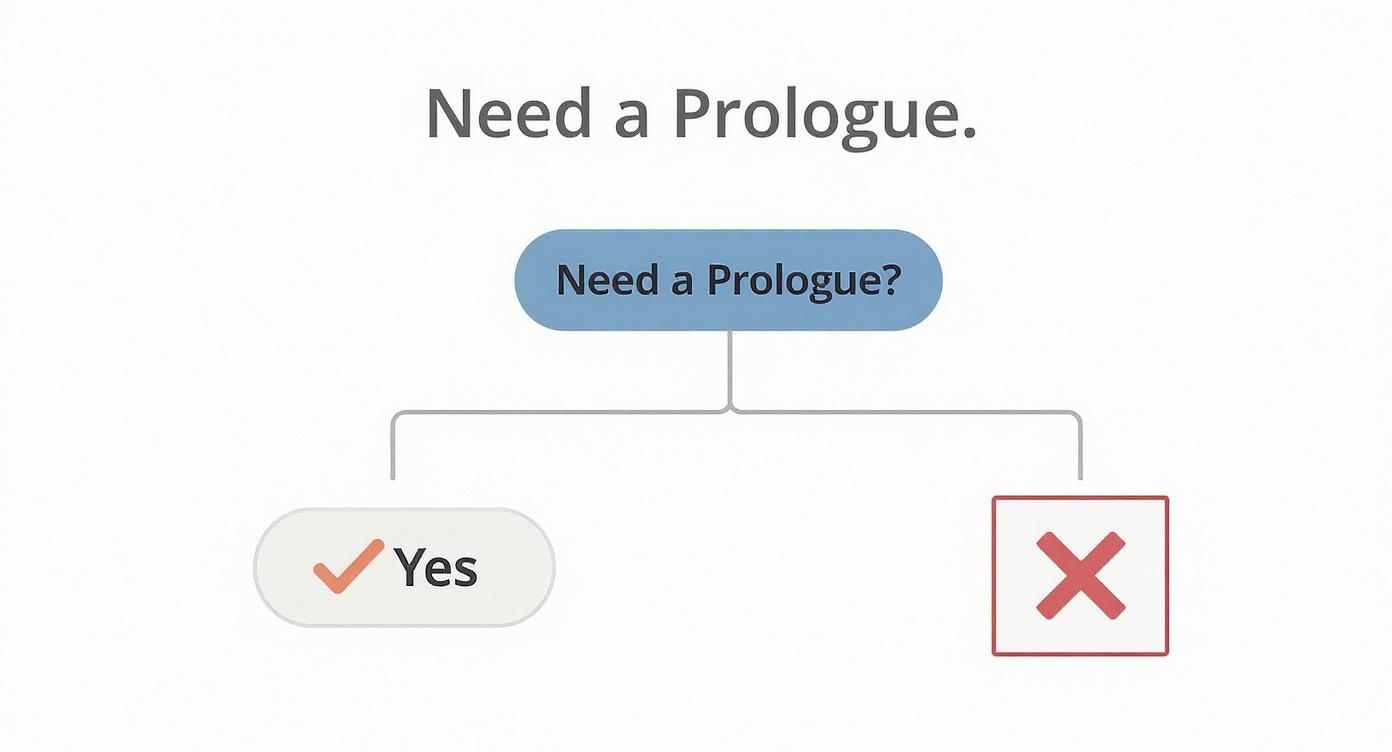
As the flowchart suggests, a prologue is for delivering essential, standalone information that hooks the reader—it’s not a shortcut for exposition.
The Agent and Editor Test
Let’s be honest: you need to approach prologues with caution. In the publishing world, they can be a bit of a red flag for agents and editors. Many see them as a sign of clunky exposition or an author's struggle to weave backstory into the main narrative naturally. If your prologue reads like a textbook entry or a magic system manual, that info probably belongs somewhere else.
The litmus test is this: "If I cut this prologue, would the story still make sense and have the same emotional impact?" If the answer is yes, you probably don't need it.
In fact, most agents and editors today prefer manuscripts that drop them right into the action with the main character. A great deal of prologues—I’d wager over half of what shows up in submissions—end up on the cutting room floor during revisions. The market just leans toward strong, immediate pacing.
Getting a clear sense of the fundamental parts of a book and their functions can also help you figure out where your introductory material truly belongs.
Making the Call: A Quick Reference
To boil it all down, here’s a simple table to help you weigh the pros and cons for your specific story.
Prologue Decision Matrix: Should You Use One?
| Use a Prologue When… | Avoid a Prologue If… |
|---|---|
| It reveals a critical past event that shapes the entire plot. | You're just dumping backstory or world-building facts. |
| It introduces a perspective (like the villain's) that won't appear again for a long time. | The information could easily be revealed in dialogue or a flashback later. |
| It sets a specific tone or mood that contrasts with the opening chapter. | It slows down the story's start and delays meeting the main character. |
| It presents a 'bookend' or framing device for the narrative. | It's just a cool scene that doesn't connect directly to the main plot. |
| It's a genuine hook that creates mystery and raises stakes from the first page. | It reads like a history lesson or an info-dump. |
Ultimately, the choice comes down to whether the prologue serves a unique, indispensable function.
When a Prologue Is the Right Choice
Despite the risks, a masterfully executed prologue is unforgettable. Imagine a fantasy epic where the opening scene shows the forging of a cursed sword a thousand years before the story begins. That isn't just backstory; it's the inciting incident for the entire saga.
Or think of a crime thriller that opens with the killer’s POV as they commit the novel's central crime. This immediately creates a powerful sense of dread and mystery, forging a contract with the reader that the main story will answer how and why this happened. When you decide to write a prologue, your focus should always be on creating an essential, intriguing hook—not just an introduction.
The 3 Flavors of an Effective Prologue
Prologues aren't a one-size-fits-all tool. Think of them as specialized lenses, each designed to bring a different part of your story into focus right from the start. Getting a feel for the main archetypes is the first real step toward writing a prologue that does its job without getting in the way.
Most of the prologues you see out in the wild fall into one of three main categories.
The right choice really boils down to what your story needs before Chapter One kicks off. Do you need to show the spark that lit the flame centuries ago? Hint at a disaster waiting down the road? Or maybe see the initial crime through the eyes of someone other than your hero?
Let’s dig into the big three.
1. The Historical Deep Dive
This is the quintessential prologue, a favorite in sprawling fantasy and rich historical fiction. It yanks the reader back in time—sometimes centuries, sometimes millennia—to witness a single, pivotal moment that set the entire story in motion.
Its whole purpose is to show the origin of the book's central conflict, not just summarize it.
Instead of a dry explanation about an ancient magical war, you throw the reader into the chaotic final battle. This move instantly creates dramatic irony. Your reader now has a piece of the puzzle that the characters living in the book's "present day" don't, and they'll spend the rest of the book waiting for that history to catch up.
This approach works wonders when:
- An ancient event is the direct cause of your main plot.
- You need to establish the origins of your world's lore or a crucial artifact.
- The backstory is just too complex or clunky to reveal naturally through dialogue.
For instance, a fantasy novel could open with a prologue showing the forging of a cursed sword. When that same sword turns up in Chapter Three, the reader’s understanding of the stakes is immediately ten-feet-deep.
Pro Tip: This isn't a history lesson. A historical prologue must focus on a specific, plot-defining moment. It's a scene, not an encyclopedia entry.
2. The Flash-Forward
Acting as the polar opposite of the historical deep dive, the flash-forward drops the reader straight into a high-octane moment from much later in the book. It’s a calculated teaser—a snapshot of chaos, danger, or a baffling mystery, all served up with zero context.
This technique is all about manufacturing questions. Who is this? How did they end up here? What on earth happens next? The rest of the novel then becomes the answer. It's an incredibly potent hook in thrillers and suspense novels where cranking up the tension is the name of the game.
Picture a thriller opening with a character desperately wiping down a crime scene. We don't know who they are, who the victim was, or why it happened. Then, the book slams back to "Three Days Earlier." The reader is now leaning in, hungry to connect the dots. You've made a promise of future conflict, and that promise keeps the pages turning.
3. The Alternate Point of View
Sometimes, the best window into the story's inciting incident doesn't belong to your protagonist. This is where the Alternate POV prologue comes in, giving the microphone to a secondary character—often a victim, a villain, or a simple observer—to frame the stakes from a completely different angle.
This is a seriously powerful tool for a few key reasons:
- It can introduce the antagonist. Seeing the world through the villain's eyes for a few pages can establish their power and motivation, making them a far more terrifying threat from page one.
- It shows the first domino to fall. In a mystery, you could show the crime through the victim's eyes, creating instant empathy and intrigue.
- It provides privileged information. A side character might witness something your hero knows nothing about, giving the reader a vital clue to hold onto.
This isn’t the same as just starting Chapter One with a different character. A prologue is a self-contained scene that stands apart, often with a unique tone or voice. A strong example of a book introduction can use this kind of framing device to set a very specific mood. By using an alternate POV, you can set the chessboard and introduce the key players before your hero even knows they're in the game.
Structuring Your Prologue for Maximum Impact
A powerful prologue isn’t just about what you say, but how you say it. Its structure is the skeleton holding your brilliant idea together, making sure it grabs the reader and pulls them seamlessly into Chapter One. Think of it as a perfectly crafted short scene, not a rambling introduction.
The first rule? Keep it brief. Your prologue should almost always be shorter than a standard chapter. If your chapters typically run 3,000 words, a 1,000 to 1,500-word prologue is a great target. This keeps the pacing tight and reassures the reader they’ll get to the main story soon.

This conciseness also forces you to be ruthless, cutting everything but the absolute essentials of the scene you’re setting.
Start with an Immediate Hook
You simply don't have time to ease the reader in. Your very first paragraph—often the first sentence—has to land a punch. This might be a shocking action, a mysterious line of dialogue, or an unsettling image. Whatever you choose, your goal is to make the reader ask a question. Instantly.
Let's look at a few examples:
- Action-Oriented: "The assassin polished his blade in the moonlight, a ritual he’d performed before every king he had ever killed." (Instant question: Who is this next king and why must he die?)
- Mystery-Driven: "Elara was the only one who knew the city would be underwater by morning." (Instant question: How does she know, and can she stop it?)
- Atmospheric: "The ancient tree had not bloomed in a thousand years, but tonight, a single blood-red petal unfurled." (Instant question: What does this bloom signify?)
Mastering the art of the hook is crucial. The principles behind crafting engaging hooks and pacing are universal, whether you're writing a novel or a video script; it's all about creating immediate curiosity.
Introduce a Central Question
Once you've hooked them, the body of your prologue needs to build on that initial intrigue. This is where you introduce a larger, central question or conflict. This question is the promise your prologue makes—a promise that the rest of the book will answer.
You're not giving away the plot; you're framing the stakes. If your prologue shows a queen hiding her magical infant from shadowy figures, the central question becomes, "What will happen to that child, and why was she in so much danger?"
A great prologue doesn’t provide answers; it presents a compelling mystery. It hands the reader a single, tantalizing puzzle piece and promises that the full picture is worth waiting for.
End with Unresolved Tension
The final paragraph of your prologue might just be its most important. You have to end on a cliffhanger, a moment of unresolved tension, or a foreboding statement. The reader should feel a magnetic pull toward Chapter One, a desperate need to find out what happens next.
Whatever you do, don't wrap up the prologue’s little story in a neat bow. Leave the scene at its absolute peak.
- The Cliffhanger Ending: A character pries open a forbidden box, but you cut away just before we see what’s inside.
- The Foreboding Ending: A wise old scholar deciphers a terrible prophecy and whispers, "It's already begun."
- The Question Ending: The scene closes with a character asking a critical question that hangs in the air, like, "But who was the man in the silver mask?"
This final, lingering note of tension is the bridge that carries your reader right into the main narrative.
Strategic POV and Tense Choices
Your technical choices—Point of View (POV) and tense—are just as critical as the content. Deliberately using a different POV or tense from the main narrative is a powerful way to signal to the reader that this section is something special and separate.
Here are a few ways you can play with this:
- Third-Person Omniscient: This is perfect for historical prologues or those showing a grand, sweeping event. An all-knowing perspective can efficiently convey the weight of a prophecy, a battle, or a kingdom's fall without it feeling like an info-dump.
- Third-Person Limited: This choice puts the reader right inside the head of a specific character, maybe the villain or an early victim. It’s fantastic for building intimacy and suspense, letting you show the story's inciting incident through a deeply personal and often biased lens.
- First-Person: Want to create an immediate, memorable voice? This is how you do it. A prologue from the perspective of an unknown character who witnesses a key event can create a powerful, personal hook that resonates through the entire novel.
Ultimately, every structural choice you make should serve one goal: to make your prologue an essential, unskippable part of the reading experience.
Common Prologue Mistakes and How to Avoid Them
Even a fantastic idea for a prologue can fall flat if you stumble into a few common traps. I've seen it happen time and again. But knowing what these pitfalls look like is the first step to crafting an opening that hooks readers instead of losing them on page one.
Think of this as your field guide for spotting and fixing these issues before they ever land in front of an agent or reader.

So many prologues fail because they prioritize information over intrigue. They become lectures, not stories. Let’s break down the most notorious errors and, more importantly, how you can steer clear of them.
The Infamous Info-Dump
The absolute number one sin of prologue writing is the dreaded info-dump. This is where an author crams in every bit of world-building, ancient history, or magical lore they've ever created. It reads less like a story and more like a textbook.
Trust me, readers don't need the entire thousand-year history of the Elven civil war before they've even met a single character. That information might be vital to you as the creator, but for the reader, it's completely unearned. You haven't given them a reason to care yet.
This is a huge reason agents often sigh when they see "Prologue" at the top of a manuscript. An informal survey highlighted this, showing that while tons of submissions have prologues, most are just backstory dumps. They present facts before readers have a chance to connect with a character. If you want to see why many authors skip their prologues in query letters to avoid this pitfall, you can read this agent's perspective on the matter.
The Fix: Don't explain; show the information through action. Instead of telling us about a legendary war, show us the final, desperate moments of a single soldier fighting in it. Don't just describe your magic system; show a character using a forbidden spell and facing the disastrous consequences. Always anchor your information to a character and a conflict.
The Disconnected Tone and Voice
Another all-too-common mistake is creating a jarring mismatch between the prologue and the main story. If your prologue is a dark, gritty battle scene from an epic fantasy, but Chapter One opens with a lighthearted, witty character baking bread in a cozy village, the shift can give readers whiplash. It feels like you've slammed two different books together.
This kind of dissonance breaks the promise your opening pages made and leaves the reader feeling confused. Your prologue's tone needs to be a deliberate setup for what's to come, even if it contrasts with the early chapters. For instance, a grim prologue can hang over a cheerful Chapter One like a storm cloud on the horizon, creating a fantastic sense of foreboding and dramatic irony.
To pull this off, you need a solid handle on your narrative voice. Understanding what voice is in writing and how to control it is the key to creating a cohesive experience, even when you're playing with sharp tonal contrasts.
The Prologue That Goes Nowhere
This one's a killer: a prologue that has no real connection to the rest of the book. Every single word in your prologue must be directly relevant to the main plot. It can't just be a "cool scene" that you loved but couldn't squeeze in anywhere else. If the events or characters from the prologue are never mentioned again or have no clear impact on the protagonist's journey, then it’s just dead weight.
Your prologue should plant a seed—a mystery, a prophecy, a past trauma—that will grow and blossom throughout the entire story.
- Before (Irrelevant): A prologue shows a dramatic meteor shower. The main story is a political thriller where meteors are never mentioned again.
- After (Relevant): The prologue shows a court astrologer warning the king that a falling star signals the birth of a usurper. The main story then follows the king's paranoid hunt for this prophesied child.
The connection has to be clear and consequential. By the final chapter, the reader should be able to look back and think, "Ah, that's why the story had to start there."
The Unbeatable Opening Scene
This might sound backward, but sometimes a prologue can be too exciting. If you kick things off with a massive, world-altering battle full of dragons and wizards, but Chapter One slows down to follow a quiet farmhand for several chapters, you risk a huge letdown. The pacing plummets, and your reader gets impatient, wondering when the action is coming back.
You've set an impossibly high bar, and the slower, necessary character development in your early chapters can feel boring by comparison.
How to Balance the Action:
- Match the Stakes, Not the Scale: The emotional stakes in Chapter One should feel just as high as the action in the prologue, even if the scene is much quieter. A character facing eviction can feel just as tense as a soldier facing an army.
- Show the Connection Quickly: Make sure the fallout from the prologue's events is felt almost immediately in the main story. If a city falls in the prologue, Chapter One should feature characters dealing with the direct aftermath—waves of refugees, new oppressive laws, a tangible sense of loss.
- Tease the Future: Use the slower pace of the opening chapters to build on the mystery established in the prologue. Drop hints that the high-octane excitement is not just a one-off event, but a promise of what's to come.
By sidestepping these common traps, you can turn your prologue from a risky gamble into a powerful, strategic tool for your story.
Your Practical Checklist for Revising a Prologue
Getting the first draft of your prologue down is a solid start, but the real magic happens in revision. This is where you shape that raw idea into an unforgettable hook that grabs a reader and refuses to let go.
Let’s be honest: a weak prologue is a story-killer. It can stop a reader dead in their tracks before they even meet your protagonist. But a sharp, focused prologue? That’s what gets them invested for the entire journey. Think of this checklist as your tool for being ruthless—for asking the tough questions that will make your opening truly essential.
Is the Purpose Crystal Clear?
Before you do anything else, you have to nail this down. Why does this scene absolutely have to be a prologue instead of Chapter One? If you can't state its specific, singular purpose in a single, clear sentence, you might have a problem.
Every great prologue has a job to do. Maybe it's establishing a piece of ancient history the reader needs to know, showing the villain’s motivation firsthand, or dropping a breadcrumb of foreshadowing for a future event. What it is not is a dumping ground for backstory you couldn't fit elsewhere.
Key Takeaway: Your prologue must have one undeniable reason for existing. If you could easily weave its contents into the main story with the same (or even better) impact, it’s probably a prime candidate for the cutting room floor.
Ask yourself: Does this scene raise a central, burning question that the rest of the book will answer? If it's just a "cool scene" without a true narrative function, it has to go.
Does It Connect Directly to the Main Plot?
A prologue isn't a standalone short story; it’s the first domino in a long line leading to your story's climax. The events, characters, and secrets revealed in it must have real, tangible consequences for your main characters and the central conflict.
When a reader gets to the final page, they should be able to look back and see the invisible thread connecting the end right back to the beginning.
- Weak Connection: A prologue shows a dramatic dragon attack on a remote village. The main story is about a political coup in a capital city hundreds of miles away, and dragons are never mentioned again. This feels like a bait-and-switch.
- Strong Connection: A prologue shows that same dragon attack, but this time a single child is secretly saved from the flames. In Chapter One, we meet a teenage orphan with a strange, scale-like birthmark, living in the shadow of that long-ago tragedy. Now we’re talking.
The link doesn't need to be obvious from the get-go, but it absolutely must be foundational to the story that follows.
Evaluating Pacing and Tension
Pacing is everything in these first few pages. A prologue should feel tight and lean—almost always shorter than a typical chapter. Its job is to get in, deliver its punch, and get out, leaving the reader desperate for more.
Pay special attention to the very last line. This is your launchpad into Chapter One. Does it leave the reader with a haunting question, a chilling sense of dread, or a shocking reveal? A flat final sentence is a huge missed opportunity.
When you’re revising, zero in on these three points:
- The Hook: Does the very first sentence immediately command attention?
- The Body: Have you mercilessly cut every single unnecessary description, line of dialogue, and piece of exposition? Be brutal here.
- The Ending: Does the final paragraph create an irresistible pull, making it impossible not to turn the page?
Your Ultimate Prologue Revision Checklist
Once you've self-edited, it's time for a more structured approach. This checklist will help you methodically break down your prologue to ensure it’s doing its job effectively.
| Checklist Item | Key Question to Ask | Revision Strategy |
|---|---|---|
| Essential Purpose | Does this absolutely have to be a prologue? | Try rewriting the scene as Chapter One. If it works better, make the change. If not, you've confirmed its purpose. |
| Plot Connection | Can I draw a direct line from this scene to the story's climax? | List 3 specific ways the prologue's events or information will directly impact the protagonist's journey. |
| Point of View | Is this the most effective POV for this specific scene? | Experiment by rewriting a paragraph from a different character's perspective to see if it adds more tension or mystery. |
| Opening Hook | Does the first sentence grab the reader by the throat? | Write 5 alternative opening sentences. Pick the one that is the most intriguing and concise. |
| Pacing & Flow | Is every word on the page necessary? | Read the prologue aloud. Anywhere you stumble or feel the energy lag is a spot that needs trimming. |
| Tone Consistency | Does the prologue's tone match the genre and promise of the book? | Ensure the mood (e.g., horror, mystery, epic fantasy) is established clearly and aligns with the story to come. |
| The Final Line | Does the last sentence leave the reader with a question or a feeling of unease? | The ending should be a cliffhanger, a promise, or a puzzle. Make sure it propels the reader forward, not satisfies them. |
This systematic check will help you spot weaknesses and turn them into strengths, ensuring your prologue is as powerful as it can be.
Getting Crucial Outside Feedback
You've done all you can. Now it's time to see how it lands with fresh eyes. Your beta readers and critique partners are gold here, but don't just ask them if they liked it. Give them specific questions to guide their feedback.
Here are a few great ones to use:
- "What questions did the prologue leave you with?"
- "At the end, did you feel more confused or more intrigued?"
- "Was there any point where you got bored or felt like it was an info-dump?"
- "Did the shift into Chapter One feel natural or jarring?"
This kind of targeted feedback is invaluable for finding the blind spots you’re too close to see. What feels perfectly clear to you might be a confusing mess to someone new to your world. Combining your own ruthless revision with this outside perspective is the final step to making your story’s opening truly shine.
Answering Your Lingering Prologue Questions
Even when you've got the fundamentals down, a few tricky questions about prologues tend to pop up. These are the little details that can make or break your opening pages, turning a good idea into a great one. Let's dig into the common queries I hear from writers all the time.
Getting these smaller decisions right is what separates a professional, intentional opening from one that feels clunky or confusing. It’s all about making every choice count.
How Long Should a Prologue Be?
This is a big one. Thankfully, there’s a pretty clear guideline here. While there's no single magic number, the golden rule is to keep your prologue noticeably shorter than your average chapter.
You're aiming for that sweet spot between 500 and 2,000 words.
The whole point is to deliver a quick, impactful punch—a taste of what's to come, not a full meal. If you see your word count creeping past the 3,000-word mark, it's time to hit the brakes. You’re likely writing a "Chapter Zero," and that’s a red flag that this material might be better off woven into the main story later on.
Key Takeaway: Brevity is your best friend. A tight, concise prologue respects the reader’s patience and reassures them that the real story, with your protagonist, is just a page-flip away.
Can I Use a Different Tense or POV in My Prologue?
Absolutely. In fact, you probably should. Shifting the tense or Point of View (POV) is one of the clearest ways to signal to the reader, "Hey, this part is different. It's a setup."
This contrast is a powerful tool for managing expectations. For instance:
- A Tense Shift: You could write the prologue in the past tense to cover a key historical event, then jump into the present tense for Chapter One.
- A POV Shift: Show us the villain’s perspective in a third-person prologue to build immediate dread, before switching to your hero’s first-person narrative in the main story.
The trick is making sure the transition to Chapter One feels intentional, not jarring. The contrast should feel like a deliberate choice that frames the story, not a stylistic mistake.
Should I Include the Prologue When Querying Agents?
This is a strategic decision, and you need to be honest with yourself about how good your prologue really is. Many agents are skeptical of prologues because they've read a mountain of them that are just boring info-dumps in disguise.
Here’s a practical approach:
- If an agent asks for the first ten pages and your prologue is a tight three pages, go ahead and send it along with the first seven pages of Chapter One. This gives them a taste of both the setup and the story's start.
- But if your prologue is a slow, meandering history lesson, you’re almost always better off cutting it from your submission and leading with your knockout first chapter.
A brilliant prologue can hook an agent on the spot. A mediocre one can get you a rejection before they even meet your main character. When in doubt, lead with your strongest work.
Why Not Just Call It Chapter One?
You could, but it’s a move that rarely works. Seasoned agents and editors can spot a prologue a mile away. They know it by its function: a section set apart by time, place, or character that serves as a prelude.
Trying to sneak it by with a different label can look like you’re either trying to trick them or you’re not confident in your choice to write a prologue in the first place.
Instead of playing with labels, own it. Focus on making your prologue so compelling, so essential, and so masterfully written that no one would ever question why it's there.
At BarkerBooks, we know that a powerful opening is just the first step. Our team of seasoned editors, designers, and publishing pros is here to guide you from a polished manuscript to global distribution. If you’re ready to see your story become a professionally published book, check out our services at https://barkerbooks.com.