
Writing a memoir isn't about spilling every detail of your life onto the page. It’s about finding that one thread, that universal truth tucked inside your personal story, and weaving it into something that truly connects with people. You’re not writing a day-by-day diary; you’re shining a spotlight on a specific theme, a critical period, or a relationship that changed everything.
Finding the Story Only You Can Tell

Everyone’s life is filled with countless stories, but a great memoir zeroes in on just one. So, the first and most crucial step is to let go of the idea that you need to write a chronological summary of your entire existence. An autobiography simply catalogs a life. A memoir, on the other hand, dives deep into its meaning.
Your job is to pinpoint the core story that hits hardest—for you and, eventually, for your reader. Think of your life as a vast, sprawling landscape. Instead of trying to map the whole territory, you’re choosing one specific trail to guide your reader along, one that winds through transformative moments and defining conflicts.
Uncovering Your Central Theme
The engine of any powerful memoir is its central theme. This isn’t just what happened; it’s what it all meant. Was your story really about overcoming the odds? Maybe it was about finding where you belong, wrestling with grief, or finally discovering who you are.
To get to the heart of it, you have to ask yourself some tough questions:
- What moments in my life genuinely changed me at my core?
- Which relationships taught me my most profound lessons?
- What’s the biggest challenge I’ve ever stared down, and what did I learn from it?
- If a reader could walk away with only one idea from my story, what should it be?
This kind of soul-searching is non-negotiable. You aren't hunting for high drama; you're looking for what feels true. If you're feeling stuck, browsing through some diverse ideas for a memoir can often crack open a new perspective on your own life.
The Power of a Focused Narrative
Once a potential theme starts to emerge, you can begin shaping the story around it. This is where you have to be ruthless, separating what’s essential from what’s merely incidental. For instance, if your memoir is about your journey to becoming a chef, the story probably shouldn't start the day you were born. It should start with the first taste of a dish that blew your mind.
And the appetite for these kinds of focused, personal stories is enormous. Memoirs have become a commercial powerhouse. Recent data shows that nearly 50% of all nonfiction bestsellers on the New York Times list were memoirs. It’s also interesting to note that women wrote 54% of those bestselling memoirs and their books, on average, tended to outsell those written by men.
Your story doesn't need to be extraordinary to be compelling. It just needs to be honest. The most powerful memoirs find the universal human experience in a deeply personal story.
Distinguishing between a sprawling autobiography and a tight, focused memoir is key. This simple breakdown can help clarify your path.
Defining Your Memoir's Scope
| Element | Autobiography (What to Avoid) | Memoir (What to Aim For) |
|---|---|---|
| Timeframe | Covers an entire lifetime, from birth to the present. | Focuses on a specific period, event, or relationship. |
| Focus | A comprehensive record of personal and professional life. | A specific theme or emotional journey. |
| Narrative | Often chronological and fact-driven. | Thematic and emotionally driven, using scenes and reflection. |
| Purpose | To document a life in its entirety. | To explore a universal truth through personal experience. |
Choosing this focused approach isn’t just a stylistic choice—it’s the foundational step in crafting a story that will not only honor your experience but also connect with the hearts and minds of readers everywhere.
Structuring Your Narrative for Emotional Impact

A powerful memoir is never just a list of things that happened. It’s an experience you meticulously craft for the reader, guiding them through the very real highs and lows of your story. The secret sauce here is structure—the architectural blueprint that gives your narrative its shape, momentum, and ultimately, its meaning.
While telling your story chronologically seems like the most logical starting point, it's rarely the most compelling. Real emotional impact comes from how you arrange events to build tension, create suspense, and deliver a satisfying emotional payoff. This is where you have to stop being a reporter of your life and become its storyteller.
Understanding the Narrative Arc
The narrative arc is a classic storytelling framework that traces a story's progression from beginning to end. It's perfectly suited for memoir because it gives readers a familiar and deeply satisfying structure, turning your personal experiences into a genuine page-turner. This doesn't mean your life has to fit perfectly into a rigid three-act play, but using the arc helps you identify the pivotal moments that truly drive your story forward.
Let’s break down its essential parts in the context of your life:
- The Inciting Incident: This is the spark. It's the event that shatters the status quo and officially kicks off your journey. Maybe it was the day you received a diagnosis, the morning you left your hometown for good, or the moment you met a person who changed everything.
- Rising Action: This is a series of events where you face escalating challenges and conflicts. Each one should raise the stakes, building tension and pushing you toward a critical turning point.
- The Climax: This is the emotional peak of your entire story. It's that moment of maximum tension where you confront your primary conflict head-on—the breaking point, the final confrontation, or the irreversible decision that seals your fate.
- Falling Action: This part of the story deals with the immediate aftermath of that climax. It shows the consequences of your actions and begins to tie up loose ends as the raw tension starts to subside.
- Resolution: Finally, the conclusion. This is where you reflect on your journey and the transformation you’ve undergone. It provides a sense of closure and reveals the "so what?" of your entire experience.
Mapping your key life events onto this arc is a crucial first step in shaping your manuscript. For a more granular look, exploring a detailed outline for an autobiography can give you a solid framework to build on, even as you adapt it to a memoir’s more focused scope.
Crafting Scenes Instead of Summaries
The difference between a dull memoir and a captivating one often comes down to one thing: scenes versus summary. A summary tells the reader what happened. A scene shows them. To create that emotional gut-punch, you have to immerse your reader in the moment.
Don’t just tell me you were scared. Describe the way your hands trembled as you held the letter, the cold sweat on your neck, and the metallic taste of fear in your mouth. Let the reader feel it with you.
Think cinematically. Instead of saying, "I had a difficult relationship with my father," write a scene of a specific, tense argument at the dinner table. Use sensory details—the smell of the burnt roast, the grating sound of silverware on the plates, the tight look on his face—to bring that memory roaring back to life.
Exploring Non-Linear Structures
While the classic narrative arc is incredibly effective, it’s not your only option. Sometimes, your story’s central theme is better served by a structure that plays with time. This is certainly a more advanced technique, but when you pull it off, it can add incredible depth and meaning to your work.
Consider these alternative approaches:
- Thematic Structure: You could organize chapters around recurring ideas or themes rather than a strict timeline. One chapter might explore key moments of betrayal, while another focuses on acts of forgiveness, allowing you to connect disparate events from your life in a powerful way.
- Framed Narrative: This is where you start your memoir in the present day, then use flashbacks to tell the core story. It creates an immediate hook and allows your present-day voice to reflect on past events, adding a rich layer of wisdom and perspective.
- Braided Narrative: Try weaving two or more storylines together. For example, you could alternate between chapters about your experience training for a marathon and your journey through recovering from an illness, showing how the two experiences informed and mirrored each other.
Choosing the right structure is all about finding the most powerful way to convey your theme. Don't be afraid to experiment with different arrangements of your key scenes. The goal isn’t to confuse the reader, but to reveal your story’s deeper truths in the most resonant way possible.
Writing Your Truth with Honesty and Care

This is where the real work begins. Writing a memoir is an act of courage, a journey into a landscape where memory, emotion, and responsibility all collide. You’re going to run into some tough questions along the way. How do you tell your truth when memory itself is so fallible? How do you write about real people without causing real harm or inviting legal trouble?
And, just as importantly, how do you protect your own heart while digging through painful experiences?
Telling your story requires more than just good writing chops; it demands a deep sense of care. Your story is absolutely yours to tell, but doing so ethically and compassionately is what will give your memoir its soul.
Navigating the Haze of Memory
Let's get one thing straight: no one expects you to have a perfect, videotape-like recall of events from 10 or 20 years ago. It’s impossible. The real goal of a memoir is to capture an emotional truth, not to create a flawless historical record.
Memory is subjective. It’s shaped by time, perspective, and emotion—and that's not a weakness, it's a fundamental part of the human experience. So, instead of getting hung up on the exact dialogue or the precise timeline, zoom in on the sensory and emotional core of a memory. What did the air smell like? What was that knot in your stomach feeling?
These are the details that create a truly authentic experience for the reader. They’ll connect with the feeling, even if you can’t remember if it happened on a Tuesday or a Wednesday. Your main job is to be honest about the nature of your memory. It's perfectly fine to say so when details are fuzzy or when you’re piecing things together. That transparency actually builds trust with your reader.
The Legal and Ethical Tightrope
When you write about other people, you aren’t just sharing your story; you’re sharing a piece of theirs. This comes with some serious ethical and legal considerations you simply can't afford to ignore. The biggest boogeyman for memoirists is defamation—making false statements that damage someone's reputation.
To write responsibly and protect yourself, here are a few practical strategies I’ve seen work time and time again:
- Change Identifying Details: This is the easiest and most effective tactic. For most secondary characters, you can change names, physical descriptions, and locations to grant them anonymity. This is non-negotiable when writing about anything sensitive.
- Own Your Perspective: Frame everything through your own experience. Start sentences with "I felt," "I remember," or "From my point of view." This makes it crystal clear that you're sharing your interpretation of events, not stating objective facts.
- Tell Your Side, Not Theirs: You have every right to write about how someone's actions affected you. What you can't do is claim to know their inner motivations or intentions. Stick to what you know for certain: what happened and how it made you feel.
A common piece of advice I hear from publishing lawyers is this: just write the first draft. Get it all out on the page without fear. The legal vetting and cautious edits come much, much later in the process.
Prioritizing Your Emotional Well-Being
Dredging up the past can be emotionally draining, especially if your story involves trauma or grief. You aren't just recalling memories; you're reliving them. That’s why building a solid support system and having a self-care plan isn't a luxury—it's an essential part of the process.
Here are a few ways to stay grounded when the work gets heavy:
- Set Boundaries: Don't force yourself to tackle the hardest chapter on a day you already feel fragile. Give yourself permission to walk away from the keyboard and come back tomorrow.
- Create a "Cool-Down" Ritual: After a tough writing session, you need to decompress. Do something completely unrelated to your book. Go for a long walk, blast some music, or call a friend and talk about anything else.
- Find Your People: Whether it's a trusted friend, a therapist, or a writers' group, find someone you can talk to. You don't have to carry the emotional weight of your story all by yourself.
Writing your truth is a brave and powerful act. By approaching it with honesty, ethical awareness, and a real commitment to your own well-being, you can create a memoir that honors your story, the people in it, and yourself.
Transforming Your Draft Into a Polished Manuscript
Getting that first draft finished is a huge milestone. Seriously, take a moment to celebrate it. But as any author will tell you, the first draft is just getting the clay on the wheel. The real artistry of writing a memoir happens during revision, where you mold that raw story into something that truly connects with a reader.
I know this part can feel overwhelming. The secret is to stop trying to fix everything at once. You need a process. Think of it as moving from a wide-angle lens down to a microscope, tackling the big structural problems before you even think about comma splices.
Start With the Big Picture Structural Edit
Before you sweat the small stuff, you have to make sure the foundation of your story is solid. This first, crucial pass is all about the structural edit. You aren't fixing sentences here; you're fixing the story itself.
Imagine you're a film director in the editing bay, shuffling scenes around to create the most powerful narrative. You've got to be ruthless and honest.
Ask yourself these kinds of questions:
- Pacing: Where does the story drag? Where does it feel too rushed?
- Narrative Arc: Is my central theme or conflict clear from the beginning? Does the tension build effectively toward a climax?
- Voice: Does this sound like me all the way through? Is the tone consistent?
- Cohesion: Does every single chapter and scene serve the main story, or have I gone off on a tangent that needs to be cut?
This is where the biggest changes happen. You might end up reordering entire chapters, deleting a section you loved but that didn't serve the story, or rewriting scenes from a different angle to ramp up the emotional impact. It’s all about making sure the skeleton of your memoir is strong.
How to Find and Work With Beta Readers
Once you’ve wrestled the structure into shape, it's time for fresh eyes. Beta readers are simply trusted people who read your manuscript and give you feedback from a reader's perspective. They are your first audience, and their gut reactions are gold. They’ll spot the plot holes, confusing paragraphs, and emotional moments that just aren't landing the way you intended.
Choose them wisely. Your mom or best friend might be your biggest cheerleader, but you also need people who will give you honest, constructive feedback. When you hand over the manuscript, give them specific questions. Don't just ask, "Did you like it?"
Instead, ask things like:
- "Where did you get confused or find yourself skimming?"
- "Which parts resonated with you the most emotionally?"
- "Was the ending satisfying? Why or why not?"
Demystifying the World of Professional Editing
While friends and fellow writers are invaluable, a professional editor brings a trained eye that can take your manuscript from good to truly exceptional. This is an investment in your story's potential. And the demand is there—biographies and memoirs consistently top the hardcover non-fiction sales charts in the U.S., often outselling even popular categories like self-help. A polished manuscript is what breaks through the noise.
To help you decide what you need, here’s a quick breakdown of the three main stages of professional editing.
Three Stages of Editing Your Memoir
This table breaks down the editing process to guide your revision workflow from big-picture changes to a final, flawless polish.
| Editing Stage | Primary Focus | Key Questions to Ask |
|---|---|---|
| Developmental Editing | The big picture: structure, pacing, theme, narrative arc, and overall story cohesion. | Is the central theme clear and compelling? Does the narrative structure work? Are the character arcs satisfying? |
| Line & Copy Editing | The sentence level: clarity, flow, voice, grammar, punctuation, and consistency. | Is the prose tight and impactful? Is the author's voice consistent? Are there any grammatical errors or typos? |
| Proofreading | The final check: catching any remaining typos, formatting errors, or inconsistencies before publication. | Is the manuscript completely free of errors? Is the formatting correct for printing or digital distribution? |
Understanding these stages helps you know where to focus your energy and where you might need professional help. Let's dig a little deeper into what each one means for you.
Developmental Editing
This is the most intensive and holistic edit. A developmental editor looks at the same big-picture elements you did—structure, pacing, character arcs—but with years of industry experience and a completely objective viewpoint. They help you see the forest for the trees. To get a better sense of this foundational stage, you can learn more about what is developmental editing and see if it’s the right first step for your book.
Line Editing and Copyediting
Once the structure is locked in, a line editor works their magic on your prose, going through the manuscript line by line to enhance clarity, tighten language, and make your voice shine. A copyeditor follows, focusing on the technical side—grammar, spelling, punctuation, and consistency (like making sure a character's name is spelled the same way in Chapter 2 and Chapter 22).
Proofreading
This is the absolute final pass. A proofreader is your last line of defense, catching any stray typos or formatting glitches that somehow slipped through all the other stages. Their job is to ensure your book is perfect before it goes out into the world.
As you navigate these steps, remember that becoming a better writer is a continuous journey. Supplementing your revision process with resources on general writing craft and refinement can give you new tools and perspectives to improve not just this manuscript, but your skills as a whole.
Navigating Your Path to Publication
You’ve done it. You’ve poured your heart onto the page, and now you’re holding a polished manuscript. The intensely private act of writing is over, and it's time to think about the public act of sharing.
The publishing world can feel like a maze, but it really comes down to two main roads: traditional publishing and self-publishing. There's no single "right" answer. The best path for you depends entirely on your goals, your budget, and how much control you want to keep.
The Traditional Publishing Route
This is the path most people imagine. A major publishing house loves your memoir, offers you an advance on royalties, and takes care of everything—the editing, cover design, printing, distribution, and marketing. It’s a huge undertaking, and they foot the bill.
Getting there almost always requires a literary agent. Think of an agent as your champion, the one who pitches your manuscript to editors and negotiates on your behalf. It’s a fiercely competitive world, but landing a deal this way can be a game-changer.
- The Upside: The publisher carries all the financial risk. You get a team of seasoned professionals backing your book, and the credibility that comes with a major publisher's name can open a lot of doors. Your book also gets a shot at being in physical bookstores across the country.
- The Downside: Be prepared for a long journey, often filled with rejection. Just finding an agent can take months, sometimes years. If you do get a deal, you’ll hand over a good deal of creative control and earn a smaller slice of the royalties.
But here’s some encouraging news for memoirists. The old idea that only celebrities can sell memoirs is dead. The market for powerful, personal stories from everyday people is booming. In fact, there's been an 85% jump in memoir book deals over the last decade, with around 267 author contracts inked in a single recent year alone. Readers are hungry for authentic stories.
The Self-Publishing Alternative
If you’d rather be the captain of your own ship, self-publishing is for you. In this model, you are the publisher. You call all the shots, from hiring the editor and cover designer to managing the formatting, distribution, and marketing.
This route gives you total freedom and gets your book to market much, much faster. It's become a respected and highly viable option for thousands of authors who want to keep their hands on the wheel.
- The Upside: You have 100% creative control. The final book is exactly what you want it to be. You also earn a significantly higher royalty rate—often up to 70% on platforms like Amazon's KDP. Best of all, you can go from finished manuscript to published book in weeks, not years.
- The Downside: The initial investment comes out of your own pocket. You have to pay for editing, design, and marketing. Your book’s success rests squarely on your shoulders; if you don’t promote it, no one will find it.
Many memoirists find the digital route especially appealing. For a deep dive into the nuts and bolts, you can find great resources on how to create an ebook to sell. This is a fantastic entry point for authors learning how to write a memoir and get it into the hands of readers.
Making an Informed Decision
So, which way do you go? Traditional publishing offers a powerful team and a stamp of validation, but it demands patience and a willingness to compromise. Self-publishing offers speed and complete autonomy but requires you to be an entrepreneur as much as a writer.
Your best choice depends on your goals, budget, and tolerance for risk. Are you seeking the prestige of a major publisher, or do you value creative freedom and a faster timeline above all else?
No matter which path you take, one thing is non-negotiable: a rigorous editing process. Every manuscript needs to go through several rounds of revision to be truly ready for readers.
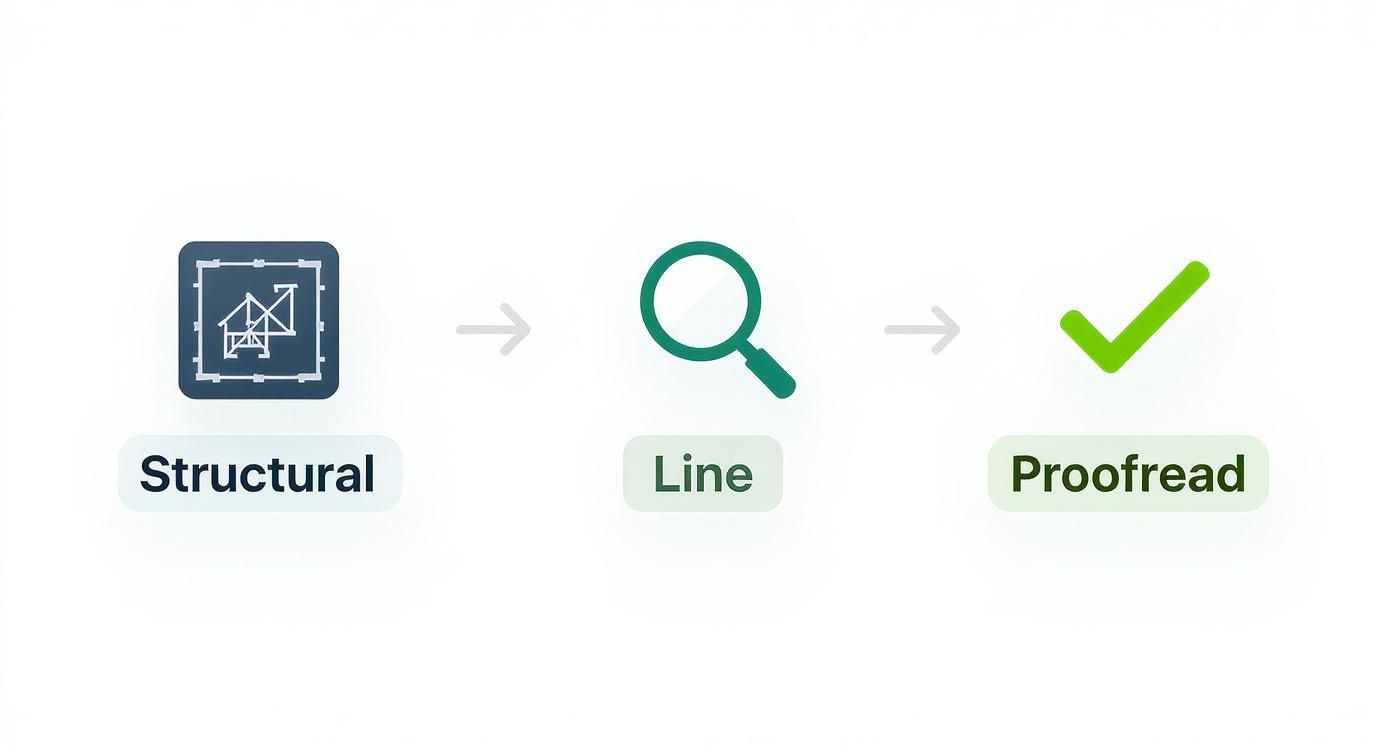
This workflow shows the essential phases, from the big-picture structural edit down to the final, meticulous proofread. This is how you ensure your story is as powerful as it can possibly be before you send it out into the world.
Answering the Tough Questions: A Memoirist's FAQ
As you get closer to the finish line, a few nagging, practical questions always seem to pop up. Don't worry, it's completely normal. You start wondering about industry standards, the nitty-gritty of word counts, and the delicate art of writing about real people. Getting some straight answers can be just the confidence boost you need.
Let's tackle some of the most common questions I hear from writers just like you. We'll cover everything from how long your book should be to the critical difference between a memoir and an autobiography.
How Long Should a Memoir Be?
I get this one all the time. While there's no single magic number, the sweet spot for a traditionally published memoir is usually somewhere between 60,000 and 80,000 words.
Why that range? It's mostly a practical consideration from the publishing world. A book of that length typically ends up being around 250 to 300 pages, which feels substantial to a reader but isn't so long it becomes intimidating to pick up (or expensive to print).
But listen, there are always exceptions. I've seen powerful, laser-focused memoirs that clock in at 50,000 words and sprawling, epic stories that push past 90,000. The most important thing to remember is this: let the story dictate the length, not the other way around. If you find yourself padding chapters just to hit an arbitrary word count, you're weakening your narrative.
Focus on telling your story in the most compelling way you can. A tight, impactful 65,000-word memoir will always be better than a rambling 85,000-word one.
What’s the Difference Between a Memoir and an Autobiography?
This is probably the most crucial distinction you need to grasp. Getting this wrong is a common pitfall that can lead to a manuscript that feels unfocused and emotionally distant. Both genres are about your life, yes, but they come at it from completely different angles.
Here’s how to think about it:
- Autobiography: This is the story of an entire life, from birth to the present. It's often chronological, fact-based, and aims to be a comprehensive historical record. Think of it as a wide-angle lens, capturing the entire landscape of a person's existence.
- Memoir: This is a snapshot, not the whole photo album. A memoir zooms in on a specific period, a central theme, or a set of relationships that profoundly shaped you. It’s driven by emotion and reflection, using specific scenes to explore a larger, universal truth.
An autobiography answers the question, "What happened in my life?" A memoir answers, "What did this part of my life mean?" Your job isn't just to document memories, but to mine them for meaning.
By choosing the memoir format, you give yourself permission to craft a tight, resonant story that truly connects with readers, instead of getting bogged down in a sprawling life history.
Can I Get Sued for Writing About My Family?
This is a big one, and a completely valid fear. The short answer is, technically, yes—anyone can file a lawsuit for just about anything. The good news is that the risk of a successful defamation suit can be dramatically reduced if you're thoughtful and intentional.
First things first: your first draft is for you and you alone. Write it all down. Be messy. Be honest. Get the raw, unfiltered truth onto the page without censoring yourself. If you start worrying about lawyers during this stage, you'll paralyze your creativity. The time for caution comes later, during revision.
When you're ready to polish your manuscript with an eye toward publication, here are a few protective steps to take:
- Change Identifying Details: This is standard practice. For anyone you portray in a sensitive or unflattering light, change their name, physical appearance, job, and even the city they live in. Create a composite character that holds the emotional truth of your experience without pointing a finger at a specific, real-life person.
- Own Your Perspective: Frame everything as your subjective experience. Lean heavily on phrases like, "The way I remember it," "From my point of view," or "I felt that…" This makes it clear you are sharing your truth, not claiming to state objective, legally binding facts about someone else.
- Talk to a Pro: If your story involves very serious allegations or you're just losing sleep over it, investing in a one-hour consultation with a publishing lawyer can be worth its weight in gold. They can offer specific guidance on your manuscript and give you genuine peace of mind.
The goal is never to silence your story, but to learn how to tell it responsibly.
Ready to transform your manuscript into a professionally published book available worldwide? The expert team at BarkerBooks has helped over 7,500 authors achieve their publishing dreams. Learn more about our full-service support, from editing and design to global distribution and marketing, by visiting us at https://barkerbooks.com.