
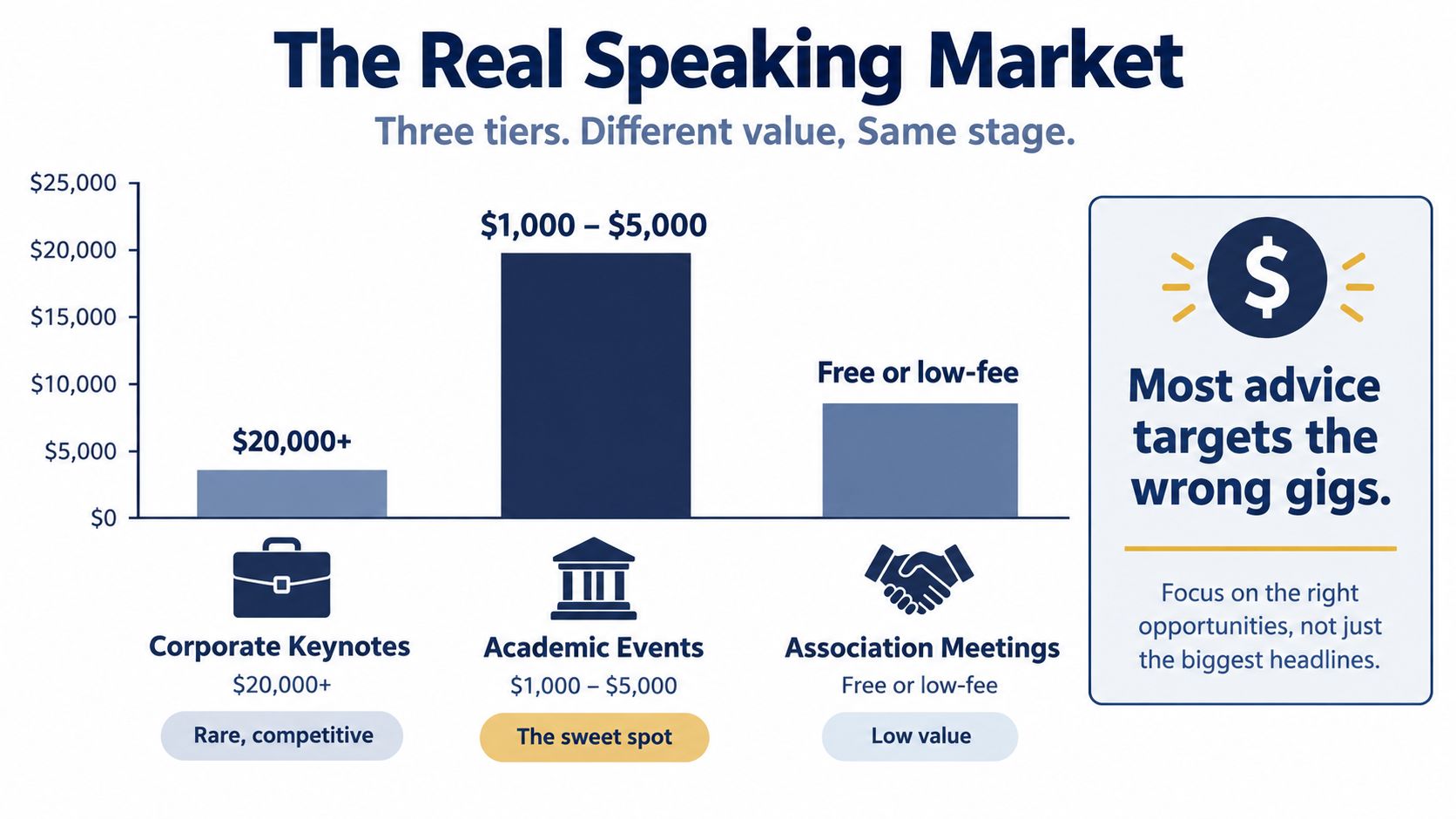
About 67% of paid speaking engagements in 2025 paid under $5,000, so the practical way to get booked is to target that broad middle with a specific audience outcome and a repeatable outreach pipeline. Stop waiting for a celebrity platform or a major keynote invitation, and start selling a session an organizer can justify buying.
The familiar advice to build your brand, post more, and wait to get noticed leaves out the business model. You need identifiable buyers, useful proof, a relevant proposal, and a way to track whether your effort produces revenue.
For authors, that means treating your book as the foundation of an offer, not the offer itself.
Why Most Speaking Advice Targets the Wrong Gigs
A prestigious stage isn't a business strategy. If you judge every opportunity against an international convention keynote, you'll overlook the organizations that could realistically hire you.
The opening figure comes from Talkadot's speaking-fee research, which also reports a median engagement fee of $2,500, with 21% paying $5,000–$10,000 and only 3% paying $20,000 or more. That's a better starting point for your expectations than a celebrity speaker's rate card.
Use the market graphic as an orientation, not a precise breakdown by buyer type or a judgment that unpaid events are automatically worthless.
Target useful rooms rather than impressive stages
My recommendation is to start with buyers whose audience already needs your expertise. An association serving your profession, a university program aligned with your subject, or a company training team gives you a concrete reason to make contact.
Evaluate opportunities against business criteria:
- Audience fit: Do attendees face the problem you help solve?
- Buyer access: Can you identify the person responsible for programming or training?
- Commercial value: Does the engagement provide revenue, relevant introductions, or usable evidence?
- Preparation burden: Can you adapt your existing material without creating an entirely new product?
A panel or webinar may be worthwhile. So might a small workshop. The deciding factor isn't stage size, it's whether the engagement advances a defined business objective.
Your book establishes expertise, not entitlement
An organizer doesn't owe you a slot because you've published a book. They need to understand what their audience will gain and why you're equipped to deliver it.
Translate your manuscript into a buyer's language. A book about professional reinvention might support a session on evaluating career options. A leadership manuscript might become training on handling difficult team conversations. Neither pitch should begin and end with your publication story.
Practical rule: Lead with the audience's problem. Use the book to explain why your solution deserves consideration.
Don't wait until your platform looks impressive enough. Build an offer that makes your current expertise useful to a specific buyer, then test whether that buyer wants it. That's a more actionable answer to how to get speaking engagements than endlessly polishing your personal brand.
Defining Your Signature Talk and Target Buyer
“I'm available to speak about leadership” gives an organizer work to do. “Your new managers will leave with a framework for handling difficult feedback conversations” gives them something to evaluate.
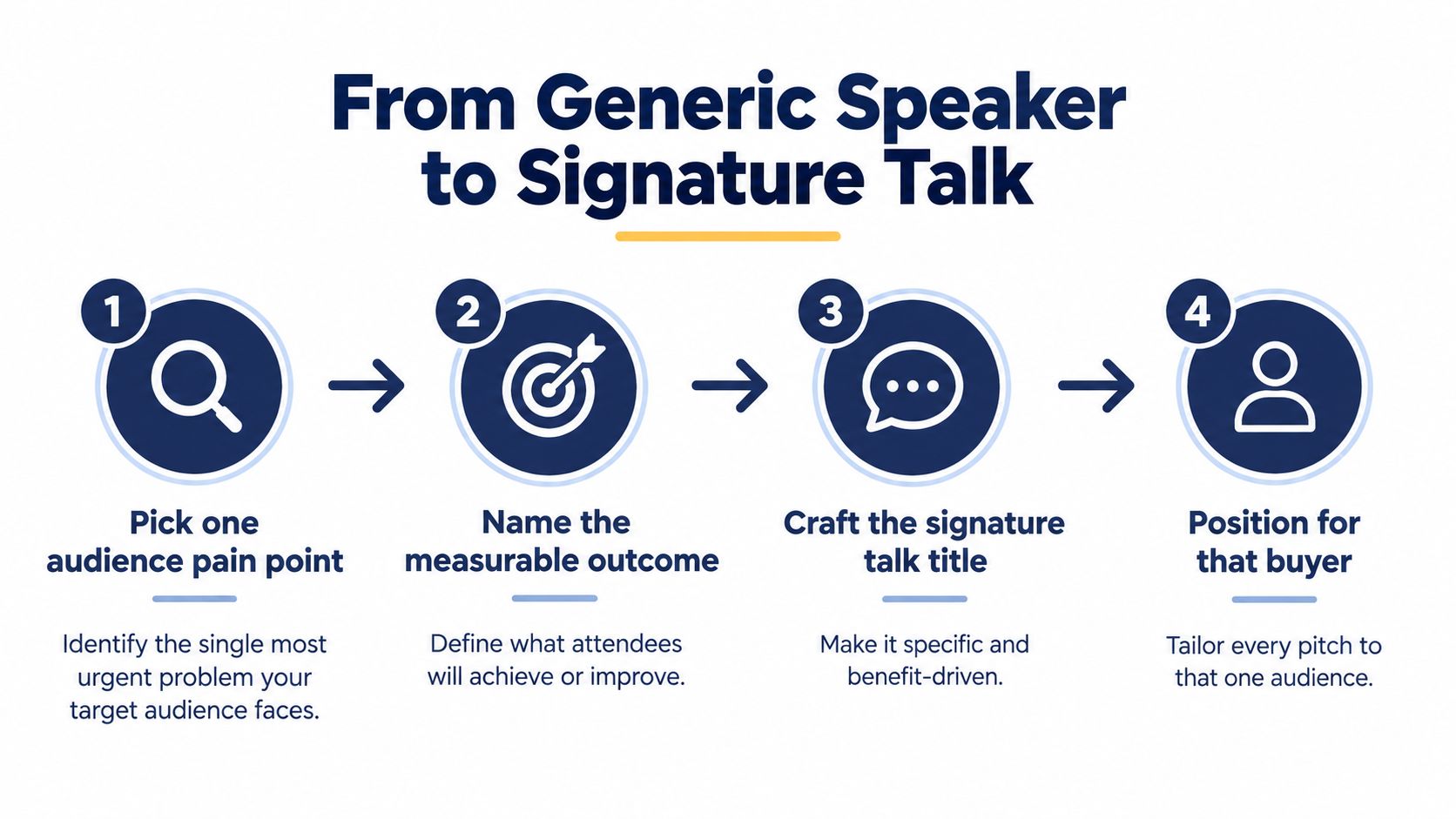
Start with a signature talk, a repeatable session built around a particular audience problem. Don't mistake repeatable for rigid. Keep the underlying method consistent while adapting examples, language, and participation to the room.
The process should be straightforward enough to explain without a long sales presentation.
Choose the buyer before writing the slides
I recommend specialized associations as an initial prospecting category because you can match your expertise to a clearly defined membership. VisitBritain's business-events research recorded 10,187 international association meetings in 2023, demonstrating the breadth of that event category, not guaranteeing demand for your particular topic.
Name the buyer precisely: a professional-development director at an engineering association, for example, rather than “anyone who organizes conferences.”
Then complete this positioning statement:
I help [specific audience] address [specific problem] so they leave able to [observable action].
For an author who writes about expertise and professional visibility, a proposed outcome could be a completed authority statement and a draft presentation outline. Those are observable deliverables. “Feel inspired to become a thought leader” isn't.
Possible titles for that hypothetical offer include:
- From Expertise to a Clear Professional Message
- Turn Your Book's Core Idea Into a Useful Presentation
- Build an Authority Platform Without Chasing Followers
Adapt the format to the job
Use a keynote to introduce a compelling framework. Use a workshop when attendees need to apply it. Offer a panel contribution when your expertise complements other perspectives, and a webinar when remote delivery suits the buyer.
Don't assume longer means more valuable. Event Industry News reports that 72% of surveyed attendees preferred keynotes lasting 20–40 minutes, alongside growth in interactive and conversational bookings. Ask whether the organizer wants inspiration, practical instruction, discussion, or a combination.
Build your session around a recognizable problem, a useful method, and an application exercise. If your argument is strong but your delivery wanders, you can polish your talk with Intonetic before presenting it to buyers.
Finish with a named audience, a clear title, an observable outcome, and format options. You don't need a sprawling topic catalog.
Building Proof Assets That Book the Gig
An organizer considering an emerging speaker is assessing risk. Your materials should help them judge your relevance, delivery, and professionalism without scheduling a lengthy investigation.
Your visual presentation should support that assessment, but polished photography alone won't demonstrate audience value.
Assemble a buyer-ready evidence package
Your bio should explain relevance. Name your field, the problem you address, and the experience that supports your approach. Cut unrelated career history and unsupported descriptions such as “world-renowned.” Use this speaker bio sample to help organize the material without borrowing someone else's credentials.
Your speaker sheet should support a decision. Include the session title, audience fit, learning objectives, available formats, technical needs, and contact information. Add genuine results when you have them. If you're still building experience, describe the method and attendee deliverables instead of inventing a client history.
Your demo should show actual delivery. Include clear speech, a coherent teaching moment, and audience interaction when available. Label rehearsal footage clearly. Don't edit practice footage to imply you've addressed an event that never happened.
Your testimonials should describe something specific. With permission, use feedback about clarity, practical application, facilitation, or relevance. A genuine observation about what someone used is more informative than a vague compliment.
Turn delivery into documented evidence
Before an appearance, agree with the organizer on recording, photography, and feedback permissions. Afterward, ask participants what they completed, what they can apply, and what remained unclear.
- Capture the deliverable: Save anonymized examples of completed exercises when consent allows.
- Request usable feedback: Ask what changed in the participant's understanding or intended action.
- Keep context attached: Record the audience type, format, and topic alongside each testimonial.
- Protect accuracy: Don't turn intention-to-act feedback into a claim of proven business results.
When you have longer recordings, use a practical workflow to edit conference videos efficiently. Select clips that demonstrate your teaching, not just your entrance music or applause.
Use the embedded video as a delivery-review prompt: notice how you assess clarity, pacing, and structure while watching a speaker.
Your evidence doesn't have to look like a celebrity's portfolio. It has to be truthful, relevant, and easy for a buyer to inspect.
Running the Outreach Pipeline Like a Sales System
An occasional pitch isn't a pipeline. It's an isolated attempt with no reliable way to diagnose what happened.
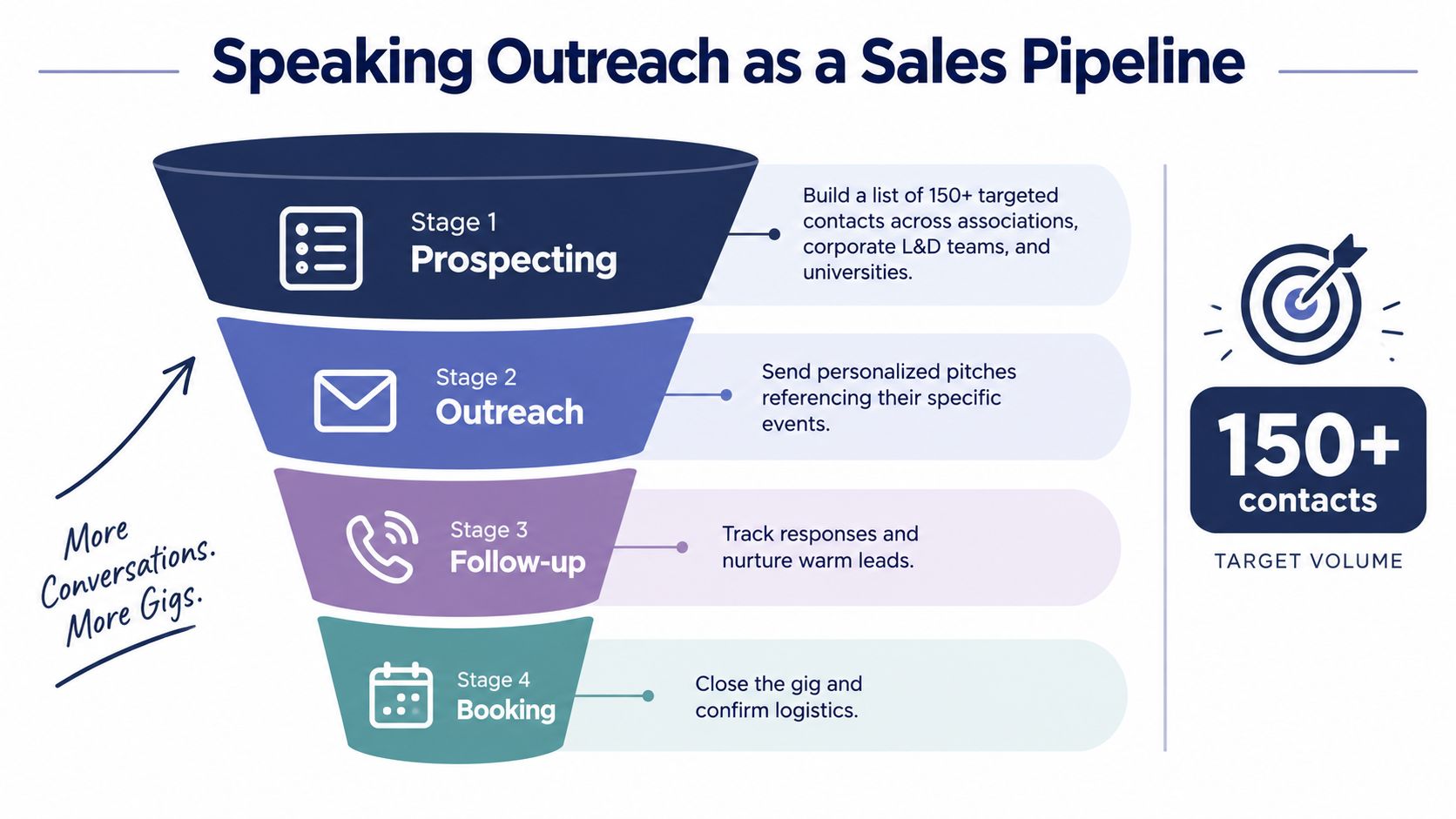
Build your prospect list around audience fit, then record each organization's event, programming contact, submission process, and next action. Keep conference committees, association education teams, and corporate learning buyers identifiable as separate channels. Track podcasts separately when their purpose is visibility rather than paid speaking revenue.
Talkadot's booking analysis recommends outreach 4–12 months before an event, describes a typical direct-outreach cycle of 1–6 months and approximately 4.5 months from first audience exposure to organizational booking, and offers a planning funnel of roughly 150 targeted contacts → 15 meaningful conversations → 3 strong-fit opportunities → 1 paid booking. Those are planning benchmarks, not promised conversion rates.
Track movement rather than activity alone
Use a spreadsheet or a CRM such as HubSpot. The tool matters less than clear stage definitions and consistent updates.
| Field | What to record |
|---|---|
| Organization and buyer | Who can approve or influence the engagement |
| Audience and event | Why your offer belongs there |
| Current stage | Researched, contacted, conversation, proposal, booked |
| Timing | Submission deadline, event date, next action |
| Commercial details | Proposed fee, expenses, confirmed revenue |
| Outcome | Won, lost, deferred, or disqualified, with a reason |
A qualified conversation should establish actual audience fit, a plausible event, and a route to a decision. Don't count a polite acknowledgment as buying intent.
The funnel below is a useful reminder to manage the entire process, not just the first email.
Set volume from your capacity
Choose a weekly outreach commitment you can sustain while researching buyers properly and following up. Work toward a complete benchmark-sized prospect cohort rather than drawing sweeping conclusions from a handful of unanswered messages.
EmailScout's sales pipeline management guide can provide additional structure for organizing stages. For your speaking business, make sure every open prospect has an owner, a next action, and a decision status.
Your website should support that process. These author website design considerations can help you organize a dedicated speaking page that puts the offer, evidence, and inquiry path together.
Don't optimize for emails sent. Diagnose where relevant buyers stop moving toward a booking.
If contacts don't respond, examine targeting and message relevance. If conversations don't become proposals, inspect fit and qualification. If proposals stall, ask about budget, approval, timing, and unresolved risk before rewriting your entire talk.
Pitches, Follow-Up, and Booking Conversations
Consider an author pitching a session on turning professional expertise into a clear message. The underlying material stays consistent, but the reason to book it changes with the buyer.
The following are adaptable templates, not examples of actual bookings. Replace every bracket with truthful details, and don't claim outcomes you can't substantiate.
Tailor the message to the buyer
Conference pitch
Subject: Session proposal for [event] on [program theme]
Your program's focus on [theme] aligns with a challenge facing [audience]: explaining valuable expertise without relying on jargon.
I propose [title]. Attendees will identify their central message, connect it to an audience problem, and draft a practical presentation outline.
My relevant background is [specific credential or experience]. [Demo or session outline] shows the approach.
Would this fit your program, and should I submit it through your speaker application?
Podcast pitch
Subject: Guest idea for your episodes on [topic]
Your episode about [specific subject] raised a useful follow-on question: how can professionals turn what they know into something others can use?
I can help listeners identify a useful idea, explain its relevance, and choose a practical way to share it.
My background is [truthful expertise], with a sample conversation available at [relevant asset].
Is that a fit for your editorial calendar?
Corporate event pitch
Subject: Practical session for [team] on clearer expertise sharing
Your [initiative or stated priority] suggests a need to help [team] communicate specialized knowledge.
My proposed workshop would help participants define their audience, simplify their core message, and draft an internal briefing.
[Relevant experience or permissioned feedback] supports my approach.
Who owns this training need, and would a session outline help assess fit?
Association committee pitch
Subject: Member education proposal on [specific challenge]
Your members' work in [field] makes [problem] especially relevant.
I propose [title], helping participants clarify their message, adapt it for stakeholders, and prepare an application plan.
My supporting expertise is [specific background], and I can share [honest proof asset].
Are you reviewing proposals for an upcoming member program?
Follow up with a reason
Use an initial pitch, a useful follow-up, and a courteous close-out. Let the event deadline and the organizer's stated timeline determine spacing rather than inventing urgency.
- Value-add message: “I've attached a sample exercise so you can assess how the session would work for your audience.”
- Close-out message: “I'll close this inquiry for now. If the topic fits a later program, I'm happy to reconnect.”
When an organizer responds, ask about audience, desired change, date, format, budget, and approval process. Confirm the agreed scope in writing and move to an agreement, not an indefinite exchange of enthusiastic emails.
Workshops, Pricing, and Protecting Your Time
A keynote and a workshop are different products. Price and sell them according to the work involved, not according to which title sounds more prestigious.
Talkadot's industry analysis reports repeat engagements at about 6% for workshop relationships, compared with approximately 1% for keynote relationships, and recommends outcome-led workshop design and documented audience feedback. That supports making workshops part of your offer, not assuming every workshop will generate repeat business.
Workshop vs Keynote Economics
| Factor | Keynote | Workshop |
|---|---|---|
| Primary purpose | Introduce a perspective or framework | Help participants apply a method |
| Participant role | Listen, reflect, and discuss | Practice, produce, and receive feedback |
| Preparation focus | Narrative, pacing, and audience relevance | Exercises, instructions, tools, and facilitation |
| Scope risk | Unbounded requests for customization | Added coaching, reviews, or follow-up work |
| Potential next offer | Related presentation or discussion | Further implementation or team training |
Build a workshop around a defined task: diagnose the problem, demonstrate the method, let participants apply it, and review their work. Provide a worksheet or downloadable tool that supports that task.
Offer virtual delivery when appropriate. Offer bilingual delivery only if you can facilitate confidently in both languages, including questions and discussion, not merely translate slides.
Build a fee ladder around scope
Don't copy a celebrity fee or undercut everyone by default. Talent Bureau's industry overview reports that approximately 47% of North American planners have keynote budgets below $10,000, while 41% prioritize staying within budget. Budget fit belongs in discovery, not at the end of a proposal.
Use a scope-based ladder:
- Virtual briefing: A focused presentation with limited customization and clearly bounded discussion.
- In-person keynote: Audience preparation, presentation, agreed interaction, and separately defined travel arrangements.
- Applied workshop: Facilitation, participant tools, relevant customization, and explicitly priced follow-up support.
These aren't universal price rankings. Set your own fees after accounting for preparation, delivery, travel, administration, and the value of the assignment.
Reduce scope before reducing price. A smaller budget should buy a smaller commitment, not unlimited access at a discount.
Put the boundaries in writing
Your agreement should identify deliverables, audience, date, format, fee, payment timing, travel responsibility, technical requirements, cancellation terms, and recording rights. Distinguish permission to record from permission to distribute or sell the recording.
If you discount, identify what you're receiving in exchange, such as simpler delivery or a confirmed additional engagement. Don't accept vague promises of exposure as payment for extensive customization.
Your 90-Day Launch Plan and Common Questions
Treat this as a proposed launch schedule, not a promise that revenue will arrive by a particular date. Your job during the launch is to build a usable offer, test it with relevant buyers, and learn where your sales process needs work.
Build, launch, and refine
| Launch phase | Weekly actions | Evidence of progress |
|---|---|---|
| Weeks 1–3 | Define the buyer and talk, assemble proof, research prospects | A complete offer, accessible assets, qualified names |
| Weeks 4–8 | Send tailored pitches, follow up, hold discovery conversations | Contacts reached, replies, qualified conversations |
| Weeks 9–12 | Advance proposals, resolve objections, request relevant introductions | Proposals, decisions, bookings, recorded loss reasons |
| Final launch review | Reconcile the pipeline and choose the next priorities | Clear next actions and a realistic revenue outlook |
During the build phase, resist endless polishing. A buyer-ready outline and honest demonstration are more useful than an elaborate website with no clear session offer.
During outreach, reserve recurring calendar blocks for research, sending, and follow-up. Choose a sustainable weekly contact target from your available hours, then track whether you meet it. Keep proposal work and delivery preparation visible so you don't sell more customization than you can support.
Review these indicators each week:
- New contacts: Relevant buyers approached, separated by channel.
- Qualified conversations: Discussions with a credible event and decision path.
- Proposals: Written offers with scope, price, and an expected decision.
- Revenue: Signed commitments tracked separately from payments received.
- Learning: Objections and lost opportunities recorded in the buyer's language.
Should you ever speak for free?
Yes, when the exchange is deliberate and bounded. A relevant audience, permissioned footage, useful feedback, or access to appropriate organizers can justify an unpaid appearance.
Decline when the organizer expects extensive preparation, unreimbursed travel, or broad recording rights without a concrete benefit to you. “Exposure” needs a specific meaning before you accept it.
What if an association can't afford your offer?
Ask what the budget can support, then propose a reduced scope if it still works for your business. A remote briefing or facilitated discussion may be appropriate where a customized workshop isn't.
Don't apologize for having fees. Be clear about what you can deliver responsibly.
How do book readers become speaking leads?
Give readers a visible speaking inquiry path on your website and relevant author profiles. Use your social media for authors activity to demonstrate your teaching and direct interested organizers toward that page.
Make the invitation specific: who the session serves, what participants will do, and how an organizer can inquire. A reader shouldn't have to guess that you're available.
BarkerBooks offers editorial support, ghostwriting, book design, and publishing services to help you turn your expertise into a professionally published book. If your speaking platform starts with a manuscript that needs development or publication, visit BarkerBooks to discuss the support your project needs.