
When it comes to getting an ISBN for your book, you're faced with one big question right out of the gate: should you buy your own, or use a free one from a publishing platform? This isn't just a technical detail; it's a strategic decision that shapes your entire publishing journey.
Owning your ISBN means you are officially the publisher of record. This is the path for authors who want total control and the freedom to sell their book absolutely anywhere.
Your ISBN Decision: Owning vs. Borrowing
Think of it this way: when you purchase an ISBN directly from your country's official agency, you're putting your own name (or your publishing company's name) on the deed. This gives you the keys to the kingdom. You can sell your book through Amazon, Barnes & Noble, IngramSpark, and that quirky little indie bookstore down the street, all using the same identifier.
Now, if you take a "free" ISBN from a platform like Amazon KDP, you're essentially borrowing it. In this scenario, Amazon becomes the publisher of record, not you. This ties that specific edition of your book exclusively to their platform. You can't take that free KDP ISBN and use it to sell your book elsewhere.
If you ever wanted to branch out, you’d have to get a new ISBN and republish your book, which can create duplicate listings and a whole lot of confusion for readers and retailers. The distinction here is a massive part of the broader https://barkerbooks.com/traditional-vs-self-publishing/ conversation.
This decision really boils down to your goals as an author.
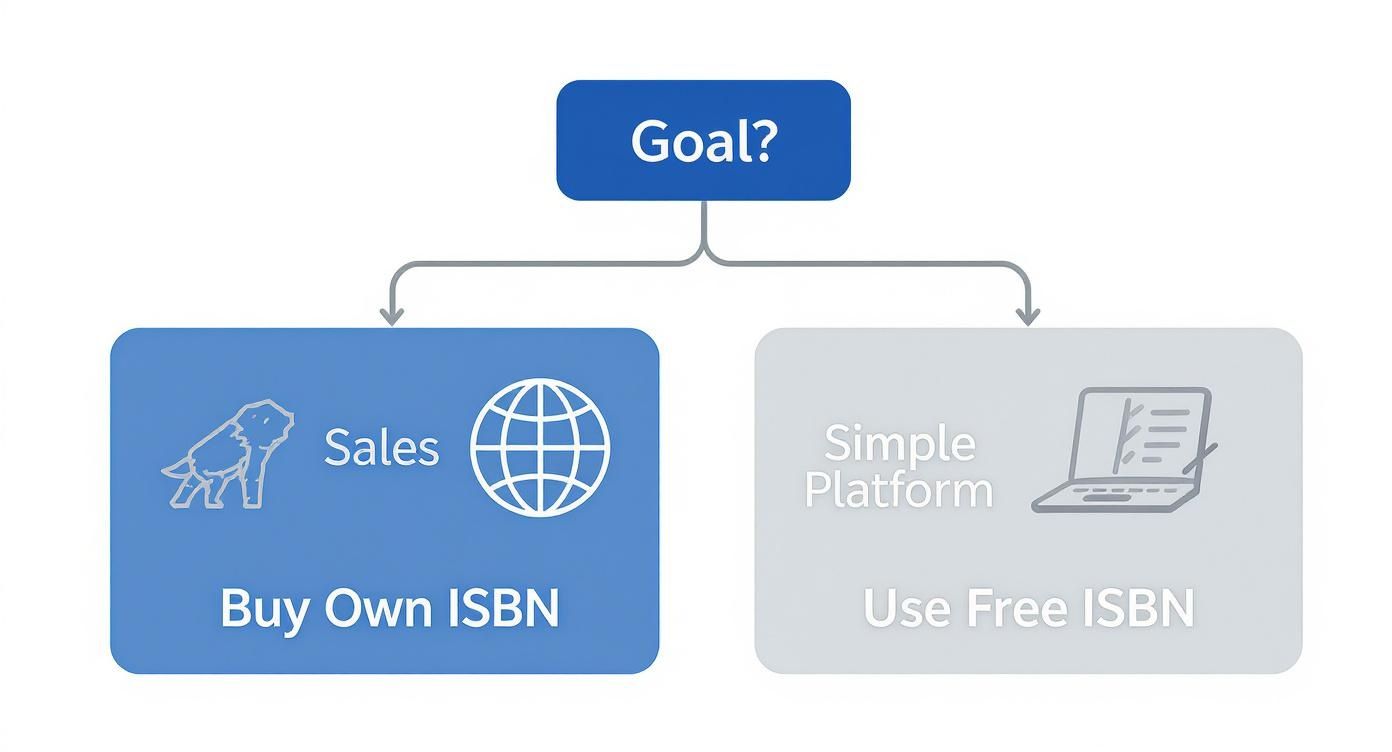
As you can see, if your primary goal is to sell your book widely and build a long-term author career, buying your own ISBN is the clear choice.
Purchased ISBN vs Free ISBN: What Authors Need to Know
Let's break down the practical differences side-by-side. Understanding these distinctions is crucial before you commit.
| Feature | Purchased ISBN (You are the publisher) | Free ISBN (Platform is the publisher) |
|---|---|---|
| Publisher of Record | You or your publishing company | The platform providing the ISBN (e.g., Amazon) |
| Distribution Control | Complete freedom; sell on any platform or in any store | Restricted to the platform that issued it |
| Flexibility | High. Use the same ISBN with multiple printers or distributors | None. Locked into a single platform for that edition |
| Professionalism | Seen as more professional and serious by industry insiders | Can signal a hobbyist or a new author |
| Cost | Upfront investment required | Free |
Ultimately, the choice comes down to control versus cost. While a free ISBN is tempting, the limitations can be a significant roadblock later on.
For many authors, self-publishing is more than just a creative outlet; it’s a business. They explore passive income opportunities through publishing, and owning the ISBN is the foundational step. It ensures you can get your book into as many hands as possible without being tied to a single corporation's ecosystem.
Treating your ISBN purchase as an investment in your career is the right mindset. It’s a small price to pay for long-term flexibility and total control over your work.
So, Do You Actually Need an ISBN?
Before you pull out your credit card, let’s figure out if you even need an ISBN for your book. This is a common sticking point for new authors, but the answer usually becomes crystal clear once you know your publishing goals.
An ISBN isn't a legal requirement for writing or even creating a book. But the moment you want to sell that book through most retail channels, it becomes absolutely essential.
Think of it this way: if you dream of seeing your book on the shelves at Barnes & Noble, listed on Amazon, or stocked in your local indie bookstore, you need an ISBN. Full stop. It's your book's passport into the commercial world. Retailers and libraries use this unique 13-digit number for everything—tracking inventory, processing sales, and organizing their catalogs. Without it, your book is essentially invisible to their systems.
Scenarios Where an ISBN Is a Must-Have
For certain formats and distribution goals, an ISBN isn't just a good idea—it's mandatory. You'll definitely need to get one if you plan on:
- Selling Print Books: Every print version, whether it's a paperback or a hardcover, needs its own unique ISBN if you want it sold in stores or online. This is the number one reason authors buy them.
- Distributing Audiobooks Widely: To get your audiobook onto major platforms like Audible or Apple Books, it needs an ISBN for listing and tracking.
- Selling Ebooks Beyond Amazon KDP: Amazon's KDP will give you a free ASIN for Kindle-exclusive ebooks. But if you want to go "wide" and sell on Apple Books, Kobo, or through aggregators like Draft2Digital, you'll need to bring your own ISBN to the party.
The ISBN system is really the backbone of the global book industry. It was introduced back in 1970 to create a universal standard for identifying books, and it’s now managed by the International ISBN Agency. It’s what keeps the entire publishing supply chain running smoothly.
When You Can Probably Skip It
While an ISBN is critical for broad commercial sales, there are a few situations where you can get by without one.
For instance, if you're only planning to sell your ebook directly from your own website to your email list, you're in the clear. You control the entire transaction, so there's no need for a universal tracking number. Likewise, if you’re just printing a small batch of poetry books as gifts for family and friends, an ISBN is completely unnecessary.
Key Takeaway: The decision boils down to one word: distribution. If your book needs to be found, ordered, and tracked by third parties like retailers, wholesalers, or libraries, an ISBN isn't optional. It's your ticket in.
The Golden Rule of Formats
This is a big one, and it trips up new authors all the time. Every single format of your book needs its own, unique ISBN. This is a non-negotiable rule in publishing and a critical part of getting an ISBN for your book correctly.
Let's say you're about to release your masterpiece, a new sci-fi novel. You will need:
- One ISBN for the paperback version.
- A second, totally different ISBN for the hardcover edition.
- A third ISBN for the ebook.
- And yes, a fourth ISBN for the audiobook, if you decide to make one.
Why? Because retailers treat each format as a separate product. The paperback has a different price point and inventory count than the hardcover. Giving each one a unique identifier is what prevents total chaos in the supply chain. You can dive deeper into the nuts and bolts in our guide on what is an ISBN. Trust me, trying to cut corners here will only lead to major sales tracking headaches and distribution nightmares down the road.
Finding Your Official ISBN Agency and What to Expect
Right out of the gate, your journey to get an ISBN hits a major fork in the road, and it’s determined entirely by where you live. This isn’t just a small detail; the cost and process for getting an ISBN can be wildly different from one country to another.
In some places, authors will have to budget a significant fee, while in others, they’re handed out for free. The most important thing to remember is to go directly to the source: your country's one-and-only designated national agency. Trust me, you want to avoid the unofficial resellers. Going through them can cause a world of hurt later on with metadata problems and even questions about who truly owns the ISBN.
Your first move is to pinpoint the official provider for your region. Thankfully, the International ISBN Agency maintains a global directory that makes this simple. Just find your country on their list, and it will point you straight to the right place. This step alone ensures you're getting a legitimate number and not a resold or invalid one.
Let’s dig into what this looks like in some of the major publishing markets.
Who Sells ISBNs in Your Country?
The landscape for authors varies so much based on location. Here’s a quick breakdown of the official agencies and the costs you can expect in a few key countries.
- United States: The sole official source is Bowker. US-based authors face some of the highest costs globally. A single ISBN will set you back $125, which is pretty steep for just one format of your book.
- United Kingdom: In the UK, you’ll need to go through Nielsen. They sell ISBNs starting in a block of 10, which currently runs about £180 + VAT.
- Australia: The designated agency is Thorpe-Bowker. Their pricing is also tiered, with a single ISBN costing around AU$45, but you get much better value when you buy in bulk.
- Canada: Here’s where a lot of authors get lucky. The national agency, Library and Archives Canada, provides ISBNs to Canadian authors and publishers completely free of charge.
This huge difference in cost is why you see so much conflicting advice online. An author in Toronto will have a completely different experience and financial outlook on ISBNs than an author in Texas.
Doing the Math: Why Buying in Bulk Pays Off
If you’re in a country where ISBNs cost money—especially the United States—a little strategic thinking can save you a bundle. Buying a single ISBN is almost never the smart financial move if you plan to write more than one book.
Let's use Bowker's US pricing as a perfect example. A single ISBN is $125. But if you buy a block of 10 ISBNs, the price is $295. That drops your cost per ISBN from $125 all the way down to $29.50. That’s a massive 76% discount.
My Two Cents: Even if you're only focused on one book right now, buying a block of 10 ISBNs is one of the wisest investments you can make. Remember, you'll need separate numbers for the paperback, hardcover, ebook, and audiobook versions. That’s four ISBNs for just one title. If you plan on a second book, you've already used eight.
Thinking ahead literally saves you hundreds of dollars. This quick comparison of Bowker’s pricing really drives the point home:
| Number of ISBNs | Total Cost | Cost Per ISBN |
|---|---|---|
| 1 ISBN | $125 | $125.00 |
| 10 ISBNs | $295 | $29.50 |
| 100 ISBNs | $575 | $5.75 |
| 1,000 ISBNs | $1,500 | $1.50 |
The pricing is clearly designed to encourage authors to think like publishers managing a catalog of work, not just as someone releasing a single product.
By finding your official national agency and understanding the pricing tiers, you can make a sound financial decision that sets you up for future success without overspending. It’s a foundational piece of the puzzle that ensures your book is legitimately registered and ready for the world.
How to Purchase and Register Your ISBN
https://www.youtube.com/embed/TDDXE3dUXgc
Alright, you've figured out which agency issues ISBNs for your country. Now comes the main event: actually buying and registering your number. This is where things start to feel very official, and it's easy to get a little intimidated. Don't be.
Think of this process as filling out your book's birth certificate. The details you enter here will follow your book everywhere it goes—from online listings to bookstore shelves. That’s why accuracy is so important. Rushing this can lead to headaches, like realizing you need to buy a whole new ISBN because of a typo in your publisher name. Let’s get it right the first time.
First, Gather Your Book's Core Details
Before you even visit the agency's website, get your essential book metadata sorted out. Having this checklist ready to go makes the whole registration process incredibly smooth. This isn't just busywork; this is the core information that identifies your book to the entire global supply chain.
Here's exactly what you need to have finalized:
- Final Book Title and Subtitle: This must be the absolute final version. An ISBN is tied permanently to a specific title. If you decide to change the title down the road, you'll technically need a new ISBN.
- Author Name: Use the name you'll be publishing under, whether it's your legal name or a pen name.
- Publisher Imprint: This term trips up a lot of new authors, but it’s simple. The "imprint" is just the publisher's name. As a self-published author, you are the publisher. You can use your own name, or you can create a publishing name (like "Elm Street Press" or "Jane Doe Books").
- Book Format: Is this ISBN for your paperback, hardcover, or ebook? You have to declare this when you assign the number.
- BISAC Codes: These are the codes that tell bookstores and libraries where to shelve your book. You'll choose categories like "FICTION / Thrillers / Suspense" or "BUSINESS & ECONOMICS / Entrepreneurship."
My Advice: When picking an imprint name, do a quick web search to make sure it isn't already used by a big publisher. This helps you carve out your own unique identity. Honestly, something as straightforward as "[Your Last Name] Books" works perfectly.
A Walkthrough of the Process (Using Bowker as an Example)
Let's make this real. Since Bowker is the US agency, I’ll use its site, MyIdentifiers.com, to show you how this typically works. The process is going to look very similar on other national agency websites.
You'll start by creating an account. This is your home base where all your purchased ISBNs will live. Once you're in, find the section for buying ISBNs. As I've mentioned before, buying a block of 10 ISBNs for $295 is a much better deal than getting a single one for $125.
After you've paid, the new ISBNs will show up in your account, usually under a tab called "My Identifiers." Right now, they're just a list of unassigned numbers. They don't belong to any book yet. Your next move is to assign one.
You’ll pick an unassigned number from your list and click a button that says something like "Assign Title." This is where you’ll start plugging in all that metadata you prepared.
Assigning the ISBN and Making It Official
The assignment form is basically a digital version of the checklist from earlier. You'll carefully type in your final title, author name, and the publisher imprint you decided on. You’ll select the book’s format from a dropdown menu (e.g., Paperback, Ebook), and you'll be prompted to add your BISAC codes. Knowing where to buy an ISBN is the first step, but this assignment process is what brings it to life.
Before you click that final button, stop and review everything one last time.
- Is the title spelled correctly?
- Is the author name exactly how you want it?
- Is the publisher imprint right?
Once you’ve triple-checked it, hit "Submit." And that's it! You've officially registered and assigned an ISBN. That 13-digit number is now uniquely and permanently linked to your book, ready for distribution, sales, and tracking anywhere in the world.
Assigning Your ISBNs and Creating Barcodes
So, you've gone through the process and have a block of ISBNs ready to go. Now what? This next part is where a lot of authors get tripped up, but getting it right is crucial for your book's journey into the world.
The biggest mistake I see is authors trying to use one ISBN for multiple versions of their book. It seems efficient, but it creates a massive headache for retailers and distributors. Think of it this way: each format of your book is a completely separate product on a store's shelf.
The "One ISBN Per Format" Rule
The golden rule is simple: every unique format of your book needs its own unique ISBN. This isn't just bureaucracy; it's the backbone of how the global book supply chain functions.
Let's say you've written a brilliant sci-fi novel. You plan to release it in a few different ways to reach the widest audience. Here’s how you’d assign your ISBNs:
- The Paperback: This is your standard print version. It gets its own ISBN.
- The Hardcover: Even if the story inside is identical, the hardcover is a different physical product with a different size, weight, and price. It needs a separate ISBN.
- The Ebook: Your digital version for Kindle, Kobo, Apple Books, and others will be sold as a single file. That file gets one ISBN.
- The Audiobook: This is a completely different medium, so your audiobook recording requires its own dedicated ISBN for platforms like Audible.
Trying to use the same ISBN for your paperback and hardcover is like a grocery store using the same barcode for a bag of apples and a box of cereal. It just doesn't work. The system breaks down, and your book becomes impossible to track, order, and sell.
This has become even more important with the explosion of digital reading. The global market for digital formats is expected to grow from $52.61 billion in 2024 to $58.73 billion in 2025. Each one of those new ebook or audiobook editions entering the market needs its own unique identifier. For a deeper dive, you can find more insights about the global book publishing market and see how these trends are reshaping the industry.
Turning Your ISBN Into a Scannable Barcode
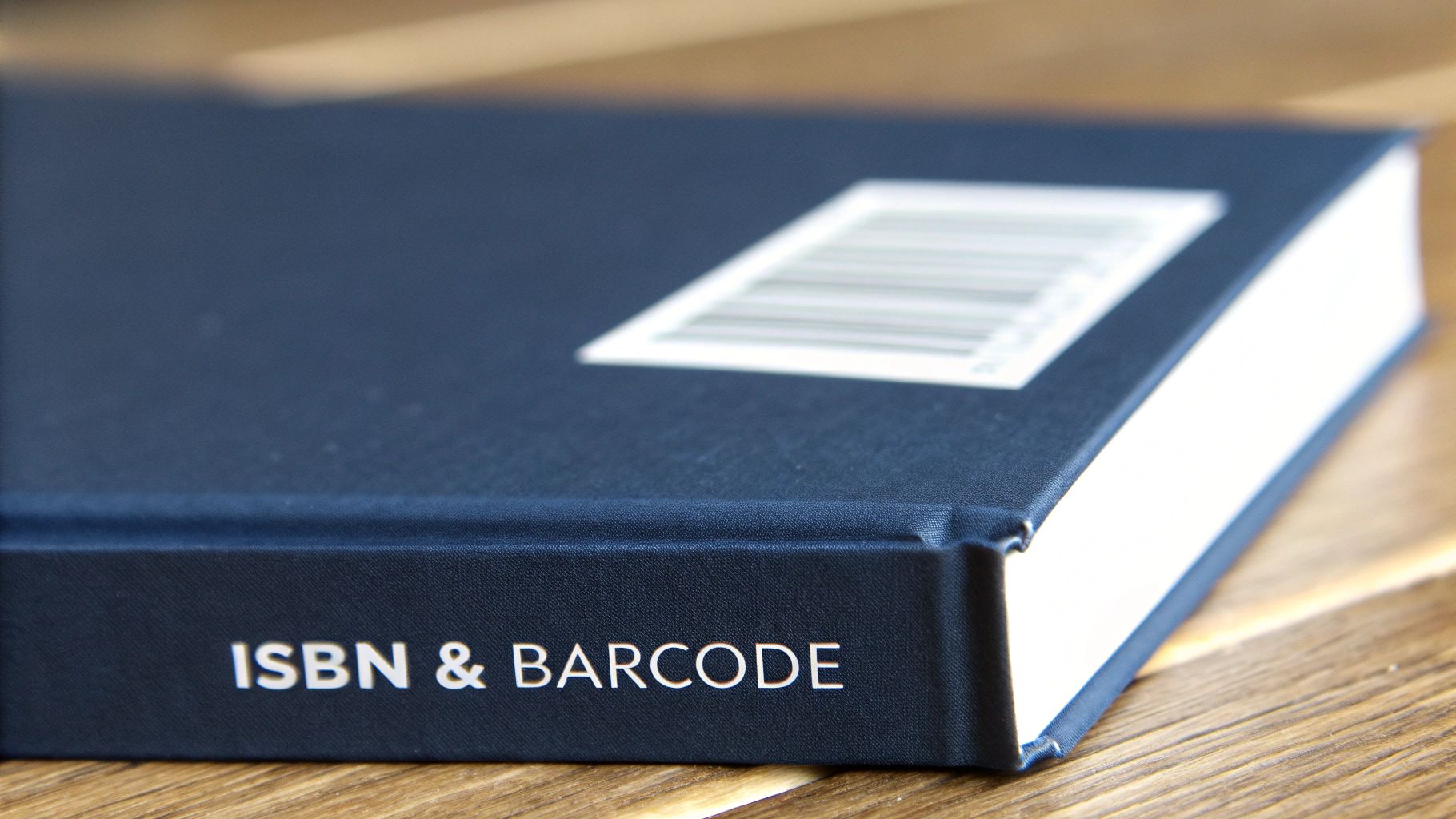
Once you've assigned the correct ISBN to your print book, you're not quite done. You need to convert that 13-digit number into a scannable barcode for the back cover. This is a non-negotiable step for any book you hope to sell in a physical store.
Just printing the numbers "ISBN: 978-X-XX-XXXXXX-X" on the cover won't cut it. Retailers need a machine-readable EAN (European Article Number) barcode to scan at the checkout.
You have a few solid options for getting this done:
- Buy it from your ISBN Agency: When you purchase ISBNs from a place like Bowker, they usually offer a barcode creation service for an extra fee. This is the easiest, most reliable route, as they can embed your retail price directly into the barcode for you.
- Use a Cover Designer: Most professional book cover designers are well-versed in this and include barcode generation in their packages. They'll know the exact specifications and placement needed to make it look professional.
- Try Free Online Generators: There are free tools out there, but proceed with caution. Some create low-resolution images that print poorly, and many don't include the price data, which can be a problem for some distributors.
Pro Tip: I always recommend getting a barcode that includes your book's price. This is encoded in a smaller, five-digit barcode that sits next to the main one. While not every store requires it, many major retailers do, and its absence could be the one thing that keeps your book off their shelves.
Answering Your Top ISBN Questions
As an author, you're bound to have questions about the ISBN process. It can seem a bit technical at first, but getting the right answers from the start will save you a world of headaches down the road. Let's clear up some of the most common points of confusion I see from writers.
Can I Just Reuse an ISBN for My Book's New Edition?
The short answer is a definite no, assuming you've made significant changes. Think of an ISBN as a unique fingerprint for a specific product. If you've made major revisions—adding new chapters, rewriting large portions, or even just changing the title—you've created a new product. That new product needs a new ISBN.
Now, if you're just fixing a few typos or tweaking a sentence here and there, you're fine. No new number needed.
Here's my rule of thumb: if the changes are big enough that someone who bought the first version might want to buy this new one, it needs a new ISBN. This is crucial for booksellers and librarians to tell the editions apart.
Beyond just the ISBN, it's always a good time to double-check that your work upholds ethical writing practices and avoiding plagiarism. Protecting your book's integrity is just as important as getting the logistics right.
What’s the Catch With a "Free" ISBN?
This is a huge one, and a trap many new authors fall into. When a platform like Amazon KDP gives you a "free" ISBN, they become the publisher of record for that version of your book. That ISBN is locked into their system forever.
So, what happens when you want to expand your reach and sell on IngramSpark, Barnes & Noble, or Apple Books? That free ISBN is completely useless. You'll have to go out and buy your own, which lists you as the publisher, and then republish your book on all those other stores with the new number.
It's precisely why authors who are serious about their careers and want maximum control over their distribution buy their own ISBNs from day one. It's an investment in your book's future.
How Long Does It Actually Take to Get an ISBN?
You'll be happy to hear this is one of the fastest parts of the publishing process. In most cases, it’s practically instant.
When you purchase ISBNs from the official agency for your country, like Bowker in the US, the numbers are added to your account as soon as your payment clears. You can log in moments later and start assigning them. The whole process—from creating an account to having a usable ISBN—can easily be done in under an hour.
Do I Need Separate ISBNs for My EPUB and Kindle Ebooks?
Thankfully, the industry has simplified this over the years. While retailers use different file types (EPUB is the standard, while Amazon uses its own), you do not need a separate ISBN for each ebook format.
The best practice today is to assign a single ISBN to the "ebook version" of your book. You can then use that one number across all the platforms where you sell your ebook—Amazon KDP, Apple Books, Kobo, you name it. It keeps things clean and is the most efficient way to manage your digital editions.
Publishing your book is a major achievement, but navigating the technical details can be daunting. At BarkerBooks, we handle everything from ISBN registration and copyright to professional editing and global distribution, so you can focus on what you do best—writing. Let us help you turn your manuscript into a professionally published book. Learn more about our author services at https://barkerbooks.com.