
So, how much is this little string of numbers going to set you back? The answer is… it depends. The cost of an ISBN can swing wildly based on where you are in the world and whether you’re buying one or a whole batch.
For authors in the United States, a single ISBN purchased directly from Bowker will cost you $125. However, if you buy a block of 10, the price plummets to just $29.50 each. Then you have countries like Canada, where authors can get their ISBNs completely free of charge.
A Global Snapshot of ISBN Pricing
Getting a handle on the financial side of ISBNs is your first step toward making a smart publishing decision. The price isn’t the same everywhere; it’s more of a global patchwork reflecting different national policies and philosophies about the publishing industry. This variation can have a real impact on your upfront costs and your overall book launch strategy.
The United States: A Commercial Approach
In the U.S., the one and only official source for ISBNs is Bowker, and they run it as a business. A single ISBN is a pretty steep $125. But they offer some serious bulk discounts. A block of 10, for example, runs about $295.
Do the math, and that brings the per-book cost down to under $30. If you’re planning to release an ebook, a paperback, and a hardcover, you’re already looking at three ISBNs right there. Suddenly, that block of 10 looks like a much smarter long-term investment.
The International Perspective
Head outside the U.S., and the picture changes dramatically. Many countries, including Canada and parts of Scandinavia, view ISBNs as a piece of essential infrastructure for their creative economy, not a commercial product.
In these places, national agencies issue ISBNs to authors and publishers for free. While this removes a direct cost, keep in mind you’ll still have all the other usual expenses that come with publishing a book.
The core difference comes down to philosophy: Is an ISBN a product to be sold or a public utility to be provided? This distinction creates the vast price differences authors see worldwide.
This initial investment is just one piece of a much larger puzzle. Many authors also need to figure out how to successfully launch and fund your book to cover everything from editing to marketing.
To give you a clearer picture, here’s a quick side-by-side comparison of the costs.
ISBN Cost at a Glance US vs International
| Purchase Option | Cost in the United States (via Bowker) | Cost in Canada (via Library and Archives Canada) |
|---|---|---|
| Single ISBN | $125 | Free |
| Block of 10 | $295 (or $29.50 per ISBN) | Free |
| Block of 100 | $575 (or $5.75 per ISBN) | Free |
| Block of 1000 | $1500 (or $1.50 per ISBN) | Free |
As you can see, the financial starting line for an author is very different depending on their location. This is a critical factor to consider when budgeting for your book’s publication.
Why an ISBN Is Your Book’s Global Passport
Before we get into the dollars and cents, let’s talk about why an ISBN is so important in the first place. Asking “how much does an ISBN cost” without understanding its job is like shopping for a car without knowing you need one to drive on the highway. This isn’t just some administrative checkbox; the ISBN is your book’s passport to the entire global marketplace.
Think of your finished book as a traveler, ready to see the world. Without a passport, it’s stuck. A book without an ISBN is similarly grounded, completely cut off from the supply chains that feed bookstores, libraries, and online giants like Amazon and Barnes & Noble. It’s essentially invisible to the very systems built to get it into readers’ hands.
Your Book’s Unique Fingerprint
At its core, this 13-digit number is a universal identifier—a unique fingerprint for one specific version of your book.
When a shop in London wants to order 20 copies of your paperback, they use its ISBN. When a library in Sydney adds your hardcover to its collection, they catalog it with the ISBN. The system just works.
Every single format—paperback, hardcover, ebook, audiobook—needs its own unique ISBN. This is crucial because it lets the entire publishing world track, order, and manage sales with pinpoint accuracy. It’s how a customer gets the exact version they wanted, and it’s how you get paid for the right sale. For a deeper dive, check out our guide on what an ISBN is and why you need one.
Managing this “digital passport” and other essential metadata is a lot easier with the right tools, and good digital asset management software can be a lifesaver here.
Evolving for a Bigger World
The system we use today wasn’t always so big. The original Standard Book Numbering system, which came about in the 1960s, only used 10 digits. But as publishing grew into a global industry, it became clear they were going to run out of numbers. A bigger, better system was needed.
This screenshot from Wikipedia shows you how a modern, 13-digit ISBN is put together.
The main thing to notice is that each part of the number tells a story, identifying the book’s country of origin, its publisher, and more.
To make sure there would be enough numbers for the future, the standard was officially switched to 13 digits between 2005 and 2007. This move aligned it with the EAN-13 barcode system used in retail worldwide and massively expanded its capacity—by a factor of 10,000, in fact. That single change ensured we won’t run out of unique identifiers for a very, very long time.
In essence, an ISBN isn’t a cost to be minimized but an investment in your book’s legitimacy and reach. It’s the key that unlocks global distribution channels and places your work on the world’s bookshelf.
The Real Cost of Single vs. Bulk ISBNs
Alright, let’s do the math that separates savvy authors from the rookies. When you first ask, “how much does an ISBN cost?” the initial sticker shock of $125 for a single number can be tough to swallow. This is the exact moment many first-time authors make a common mistake that costs them dearly in the long run: buying ISBNs one at a time.
On the surface, it seems logical. Why buy more than you need right now? The problem is, a single book title almost never requires just one ISBN. Modern publishing demands a separate identifier for every single format you release.
Why Every Format Needs Its Own ISBN
Getting this one rule right is fundamental to your success as a publisher. A paperback, an ebook, and an audiobook are not the same product in the eyes of the global supply chain, even if they contain the same story. Each one has different production costs, distribution channels, and inventory needs.
Think of it like selling t-shirts. You wouldn’t use the same product code for a small red shirt and a large blue one—it would create chaos. It’s the same principle for your book. Assigning a unique ISBN to each format ensures that:
- Retailers can order the correct version for their customers.
- Libraries can catalog each format properly for their collections.
- You can accurately track sales data to see which versions are really selling.
- Readers can find and buy the exact format they want without any confusion.
Without separate ISBNs, your distribution becomes a tangled mess. A bookstore might accidentally order an ebook file when they wanted 50 paperbacks, simply because the system couldn’t tell them apart.
A single title released in three formats—like a paperback, an ebook, and an audiobook—already requires three separate ISBNs. This is the baseline for most modern book launches, making a single ISBN purchase immediately insufficient.
This requirement is where the economics of buying in bulk become impossible to ignore. Let’s walk through a realistic scenario.
The Compelling Math of Buying in Bulk
Imagine you’re ready to launch your first novel. You plan to release a paperback, a Kindle ebook, and an audiobook. Buying those three ISBNs individually from Bowker at $125 each would set you back a cool $375.
Now, consider the alternative. A block of 10 ISBNs costs $295. By choosing this option, you cover all three of your initial formats for $80 less than buying them separately. Better yet, you’ll have seven extra ISBNs ready for future projects, sequels, or even that hardcover edition you’ve been dreaming about.
The savings become even more dramatic as your career grows. Supply chain rules state you need a new ISBN for each format and any major new edition. You can explore the details of the International Standard Book Number system to see just how deep these requirements go.
This logic shows that buying in bulk isn’t just a discount; it’s a strategic investment in your future as an author.
A Cost Comparison Example
Let’s look at the numbers for an author planning two book releases, each with three formats (paperback, ebook, audiobook). That’s six ISBNs in total.
| Purchase Method | Calculation | Total Cost | Cost Per ISBN |
|---|---|---|---|
| Buying Singles | 6 ISBNs x $125 each | $750 | $125.00 |
| Buying a 10-Pack | 1 pack of 10 ISBNs | $295 | $29.50 |
| Total Savings | $750 – $295 | $455 | – |
In this scenario, buying in bulk provides a staggering 60% savings. You get all the identifiers you need for both books and still have four left over for future use. The choice is clear: purchasing ISBNs one by one is a financial trap for any author with long-term ambitions. Investing in a block from the start sets you up for success without breaking the bank.
Uncovering the Hidden Costs of ISBNs
The price you pay for an ISBN is just the beginning. So many authors budget for the number itself, only to be sideswiped by the administrative legwork and extra costs needed to actually put it to use. To really understand the cost of an ISBN, you have to look past the sticker price.
Here’s the thing: just owning an ISBN isn’t enough. You have to activate it and connect it to the global book supply chain. An unregistered ISBN is like having a passport with no name or photo in it—it’s technically a valid document, but it won’t get your book past the front door. The real work starts after you buy it.
This next step is all about registering your ISBN with complete and accurate metadata. This is the digital DNA of your book—all the critical details retailers, distributors, and libraries need to find, categorize, and sell it.
The Critical Role of Metadata Registration
Metadata is what makes your book discoverable. Think of it as the detailed product label that tells the industry everything it needs to know. Without it, your book is essentially invisible to the very systems you need to reach.
Proper registration means getting your book’s data into global databases, and the king of them all is Bowker’s Books in Print®. This is the master catalog that tens of thousands of librarians, booksellers, and publishers rely on every single day to look up and order titles.
Your metadata has to be flawless. It includes:
- Book Title and Subtitle: The official, complete name of your work.
- Author Name: Exactly how you want to be credited.
- Publisher Information: Your publishing name, which is you if you’re self-publishing.
- Book Format: Is it a paperback, hardcover, ebook, or audiobook? Each one needs its own ISBN.
- Pricing and Availability: How much it costs and where people can buy it.
Sloppy or incomplete registration is a recipe for disaster. It leads directly to lost sales, ordering headaches, and a whole lot of frustration. For any author who’s serious about selling books, this administrative step is absolutely non-negotiable.
An ISBN without registered metadata is a dead end. It’s the data attached to the number—not the number itself—that allows a bookstore in another country to find your book, understand its price, and place an order.
Potential Administrative and Distribution Fees
On top of the core registration, other costs can pop up as you bring your book to market. These aren’t technically part of the ISBN fee, but they are tangled up in the process of making that number work for you.
For instance, some distributors or aggregators might charge a one-time setup fee to add your book to their system, even if you bring your own ISBN. These services are the bridge connecting you to a huge network of retailers, and they often have costs associated with bringing a new title on board.
Also, while registering your title in Books in Print® is a key part of buying an ISBN from Bowker, you’re responsible for keeping it current. If you change your book’s price, update the cover, or make any other significant edits, you need to update your metadata. If you don’t, the entire supply chain will be working with outdated information.
When it’s all said and done, the true cost of an ISBN is the price of the number plus the time and focus required for a perfect registration. Thinking this way ensures you’re budgeting not just for an identifier, but for the entire process of turning it into a powerful tool for your career.
The Truth About Paid vs. Free ISBNs
When you first dip your toes into self-publishing, especially on a platform like Amazon’s Kindle Direct Publishing (KDP), you’ll almost immediately stumble upon a very tempting offer: a free ISBN. On the surface, it sounds like a no-brainer. Why on earth would you pay for something you can get for nothing?
But this is one of those classic moments where the old saying, “there’s no such thing as a free lunch,” is spot on.
That “free” ISBN isn’t really a gift. It’s a trade. You’re trading long-term control over your book’s identity for a little bit of short-term savings. This one decision can have a huge ripple effect on your author brand, your ability to sell your book in different places, and where you can take your publishing career down the road.
Before you click that “accept” button, it’s absolutely crucial to understand the real difference between buying your own ISBN and using a free one from a platform.
The Single Most Important Difference: You Own It
When you boil it all down, the most critical distinction comes down to one word: publisher.
When you buy an ISBN directly from an official agency like Bowker, you are listed as the publisher of record. Your name, or your publishing company’s name, gets permanently tied to that number. This simple fact makes you the official owner of your book’s unique identifier, giving you total freedom to use it on any platform, with any distributor, anywhere in the world.
Now, let’s look at the other side. When you accept a free ISBN from a service like KDP or IngramSpark, they are listed as the publisher of record. Your book is now officially published under their company name, not yours. This arrangement immediately chains your book’s fate to their platform, creating frustrating limitations if you ever want to expand.
Think of it this way: buying your own ISBN establishes you as an independent publisher. Using a free one makes you a subcontractor for the platform, which limits your book’s reach and your control.
Breaking Down the Pros and Cons
To make the right call, you need to see the good and the bad laid out side-by-side. The best path for you really depends on your goals as an author. Are you just testing the waters with a single ebook on one platform? Or are you trying to build a career and a brand that lasts?
If you need help figuring out the official sources, our detailed guide explains where to buy an ISBN for your book.
To make this crystal clear, let’s compare what you gain—and what you give up—with each choice.
Comparing Purchased ISBNs vs Free ISBNs
This table breaks down the key differences between buying your own ISBN and using a free one provided by a publishing platform. It’s designed to help you quickly see the trade-offs involved.
| Feature | Purchased ISBN (e.g., from Bowker) | Free ISBN (e.g., from KDP) |
|---|---|---|
| Publisher of Record | You or your publishing company. | The platform (e.g., Amazon, IngramSpark). |
| Distribution | Universal. Use it anywhere—online or in physical stores—worldwide. | Limited. Only valid on the platform that issued it. |
| Portability | Fully portable. Move your book to any new store or distributor anytime. | Not portable. The ISBN is locked to the original platform. |
| Professionalism | Seen as more professional by bookstores and libraries. | May be perceived as less professional by industry insiders. |
| Upfront Cost | Yes (e.g., $125 for one, but much cheaper in bulk). | $0 |
| Best For | Authors serious about building a brand and maximizing distribution. | Authors publishing exclusively on one platform or just starting out. |
As you can see, the “free” option comes with some pretty significant strings attached.
Choosing a free ISBN essentially puts your book in a cage. If you decide later you want to sell your book through other online stores or get it into libraries, you can’t take that “free” ISBN with you. You’d have to get a completely new ISBN for each new channel, which creates a messy and unprofessional situation where the same book has multiple identifiers from different “publishers.”
At the end of the day, the question of “how much does an ISBN cost” is about more than just a dollar amount. It’s about the cost of lost opportunities, lost control, and lost flexibility. Investing in your own ISBN is an investment in your author career, giving you the freedom to grow without being tied down.
How BarkerBooks Simplifies the ISBN Process
Let’s be honest: navigating the world of ISBNs, metadata registration, and global distribution can feel like a full-time job. What starts as a simple question—”how much does an ISBN cost?”—can quickly spiral into a confusing mess of technical forms, bulk pricing dilemmas, and logistical headaches. This is exactly where having a publishing partner can turn a major roadblock into just another step on your path to publication.
At BarkerBooks, we’ve walked over 7,500 authors through this exact maze. We don’t just give you a map; we handle the entire ISBN assignment and registration for you. It’s a core part of our publishing packages, meaning you get to sidestep the confusing and often expensive process of dealing directly with agencies like Bowker.
A Full-Service Solution for Authors
Forget about wrestling with high per-unit prices or trying to make sense of metadata submission forms. Our team manages it all. We make sure a unique, correctly configured ISBN is assigned to every single format of your book—paperback, ebook, hardcover, you name it.
This hands-on approach delivers two huge benefits for our authors:
- It’s far more affordable. You completely avoid the steep $125 fee for a single ISBN. Because we buy ISBNs in bulk, we can pass those savings on to you, baking the cost right into our services.
- We guarantee it’s done right. We take on the painstaking task of registering your book’s metadata. This ensures every technical detail is spot-on, making your book easily discoverable in the databases used by retailers and libraries in over 91 countries.
This decision tree helps visualize the paths you can take.
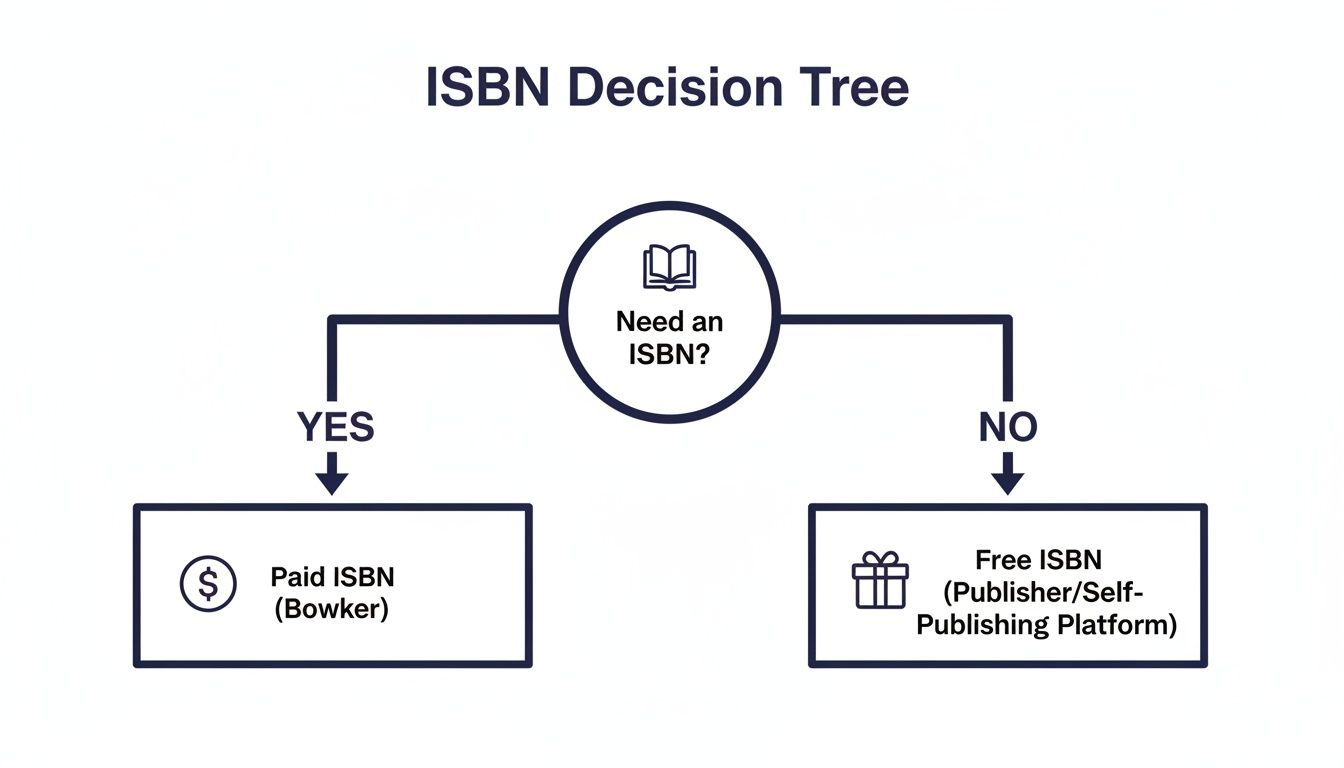
As the flowchart shows, a “free” ISBN from a publishing platform keeps you tied to them. In contrast, a paid ISBN—whether you buy it yourself or get it through a service like ours—is your key to unlocking true global distribution.
Focus on Your Book, Not the Bureaucracy
Our goal is simple: to lift the administrative weight off your shoulders so you can focus on what you love—writing. When you trust us with the technical side of publishing, you’re not just getting an ISBN. You’re gaining a partner who is genuinely invested in connecting your story with readers around the world. We handle the logistics so your book has the professional foundation it deserves.
Choosing the right path for your ISBN is one of the first major decisions in your publishing career. Our process is designed to make that choice simple, ensuring your book is set up for maximum reach and professionalism from day one.
Ultimately, our all-in-one service takes the mystery out of the whole thing. If you want to dig deeper into the specific steps, check out our guide on how to get an ISBN for your book. Working with BarkerBooks means you can move forward with confidence, knowing the critical task of ISBN management is in expert hands, paving the way for a smooth and successful book launch.
Frequently Asked Questions About ISBNs
Alright, let’s get into the nitty-gritty. As you get closer to hitting that “publish” button, the practical questions about ISBNs start to pop up. Getting these details right is crucial for a smooth launch, so let’s clear up some of the most common questions authors ask.
Think of this as the final checklist before your book heads out into the world. Knowing these answers will help you navigate the system with confidence and avoid those little hang-ups that can frustrate even seasoned authors.
Do I Really Need a Different ISBN for My Paperback and Ebook?
Yes, absolutely. This is a non-negotiable rule in the publishing world, and it’s one of the first things every new author needs to understand.
Each format of your book—paperback, hardcover, ebook, audiobook—is a completely separate product. A paperback has a physical weight and size, while an ebook is just a digital file. Retailers, warehouses, and libraries need a unique identifier for each one to manage their inventory and sales data correctly.
Trying to use the same ISBN for both your paperback and ebook would be like a car dealership using the same VIN for a pickup truck and a sedan. It would create a logistical nightmare.
Can I Use an ISBN I Bought in the US on Amazon UK?
You bet. An ISBN is your book’s international passport. Once you buy and register an ISBN to your own publishing name, it’s valid everywhere on the planet.
This means you can use it on any of Amazon’s global stores, from the UK to Japan to Australia, as well as with any other international retailer or distributor. This is one of the biggest reasons to buy your own ISBN—it gives you total freedom and control over where and how you sell your book. It unlocks the global market without tying you down to a single platform.
Your purchased ISBN acts as a worldwide passport for your book. Its authority isn’t limited by the country where you bought it, giving you complete control over your international distribution strategy.
Does a Second Edition of My Book Need a New ISBN?
This is a great question, and the answer depends on how significant the changes are. The industry has some pretty clear guidelines on this.
You don’t need a new ISBN for minor tweaks. Things like:
- Fixing a few typos or grammatical mistakes.
- Slight formatting adjustments that don’t affect the page count.
- Changing the price.
However, you absolutely must get a new ISBN if you’ve made substantial changes. This is when you’ve basically created a new product. A new ISBN is required when you:
- Add or remove entire chapters or large chunks of content.
- Perform a major rewrite of the existing material.
- Change the book’s title or subtitle.
- Release the book with a completely new cover design.
Assigning a new ISBN for a major revision is a signal to the entire book world—from distributors to readers—that this is an updated version. It keeps everything clean and professional, preventing confusion and ensuring everyone gets the correct edition of your work.
Wrangling ISBNs and managing all the metadata can feel overwhelming, but it doesn’t have to be a solo mission. At BarkerBooks, we handle this entire process for you, making sure your book is set up professionally for success around the world. Learn more about how our publishing services can simplify your journey from manuscript to marketplace.