
Before you can find the right ghostwriter, you need a solid plan. Think of it like this: you wouldn't start building a house without a blueprint, and you shouldn't start searching for a writer without a clear project brief. Getting this part right saves you time, money, and a lot of headaches down the road.
It’s tempting to jump right into browsing freelancer profiles, but the most important work happens before you ever post a job ad.
First Things First: Your Vision, Outline, and Budget
To find a ghostwriter who can truly capture your voice and vision, you have to define that vision with crystal clarity first. A well-prepared plan is your single most powerful tool in this entire process. It ensures you and your future writer are on the same page from the very beginning.
This prep work really boils down to three key steps.
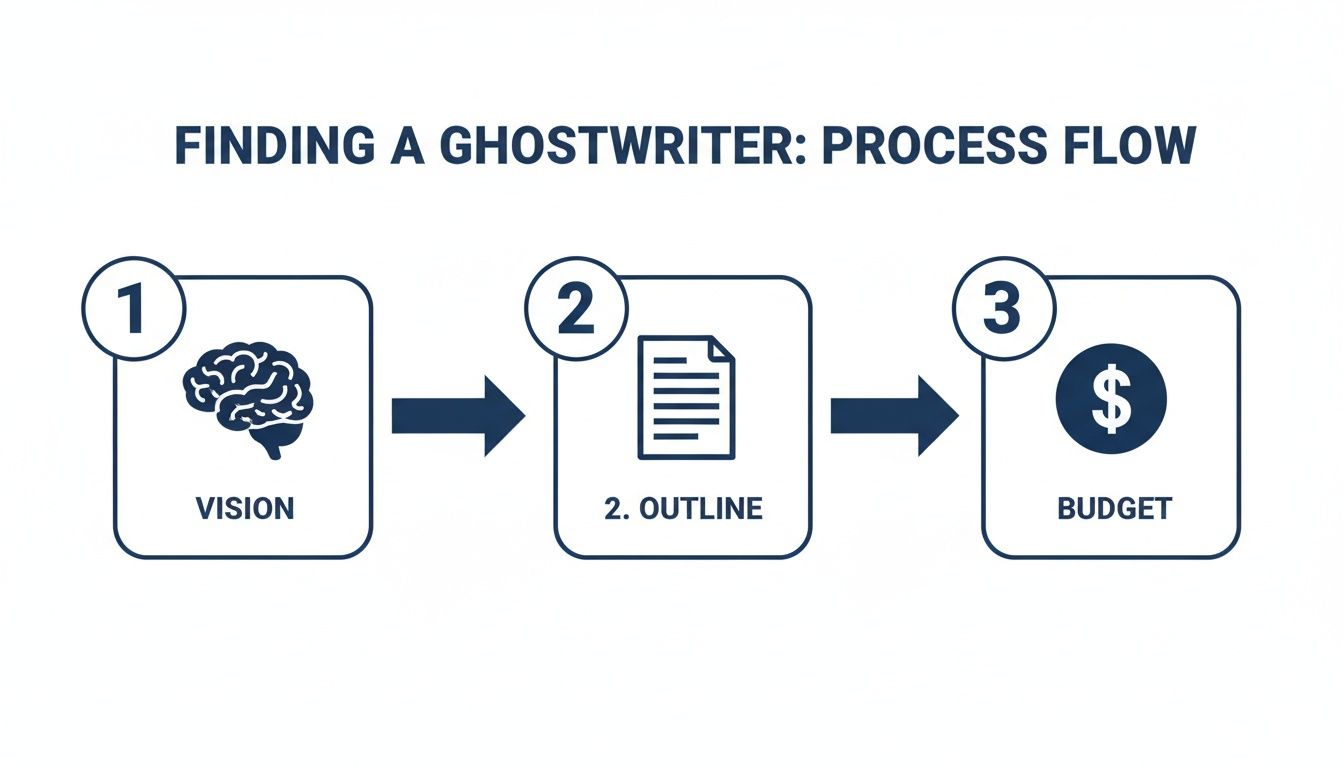
Get these three elements nailed down, and your search will be infinitely more focused and successful.
Who Are You Talking To? Define Your Message and Audience
Let's start with the basics. What's the one big idea you want your reader to walk away with? And, just as importantly, who is that reader?
A book for seasoned C-suite executives needs a completely different tone, style, and vocabulary than a guide for new parents navigating sleep training. You can't be everything to everyone.
A quick and incredibly helpful exercise is to create a simple reader persona. Give this person a name, a job title, and a specific problem your book is going to solve for them. This small step helps a potential ghostwriter understand who they’re writing for, not just what they’re writing about. If you're still fuzzy on the details, exploring what a ghostwriter does can bring a lot of clarity to the kind of partnership you're looking for.
A great project brief goes beyond a simple chapter list. It should capture the feeling of the book. Do you want to inspire action, provide a step-by-step education, entertain with a gripping story, or challenge conventional wisdom?
What’s Your Budget? Setting Realistic Expectations
Money talk can be tricky, but it’s essential to have a realistic budget in mind. The ghostwriting market is growing fast—industry reports estimate its growth rate between 6.8% and 7.8% annually. This means more choices for you, but it also means a huge range in pricing and quality.
A full-length book could cost a few thousand dollars if you hire a newcomer looking to build their portfolio. Or, it could easily run into the high five figures (or more) for a seasoned professional with a track record of bestsellers. Your budget will directly determine the experience level and quality of the writers you can attract.
To help you get a feel for the market, here's a quick breakdown of what you can generally expect at different price points.
Ghostwriting Service Level Comparison
This table gives you a snapshot of what to expect from different types of ghostwriting services, helping you match your budget to your project's needs.
| Service Level | Typical Provider | Common Price Range (per book) | Best For |
|---|---|---|---|
| Entry-Level | New freelancers, content mills | $5,000 – $15,000 | Simple projects, blog-to-book conversions, or those on a very tight budget. |
| Mid-Range | Experienced freelancers, boutique agencies | $20,000 – $60,000 | Business books, memoirs, and thought leadership projects requiring solid research and writing skills. |
| Premium | Top-tier freelancers, established agencies | $70,000 – $200,000+ | High-profile authors, celebrity memoirs, and projects aiming for a traditional publishing deal. |
Remember, these are just general guidelines. Pricing can vary based on the book's length, complexity, research required, and the writer's specific expertise. The key is to know what’s realistic for your investment level before you start your search.
Where to Find Your Ideal Ghostwriter

Okay, you've got your project scoped out and a budget in mind. Now for the big question: where do you actually find these talented, behind-the-scenes writers?
The good news is, they’re out there. The challenge is that they hang out in different places, and each of those places has its own pros and cons. Think of it as three main hunting grounds.
The Big Freelance Marketplaces
Platforms like Upwork and Fiverr are the first stop for many. They are absolutely packed with writers of every imaginable skill level and price point. It’s a massive talent pool, which means you can get proposals pouring in just hours after posting a job.
But that volume is a double-edged sword. To find the real gems, you have to be ready to sift. Don't get distracted by a five-star rating alone; you need to dig into their profiles, read past client feedback, and scrutinize their portfolios for work that genuinely feels like what you're after.
A few tips for success here:
- Write a killer job post. The more specific you are about your genre, word count, timeline, and tone, the better your applicants will be.
- Toss the generic proposals. If a writer sends a copy-paste bid that doesn't mention your project specifically, they're not the one. Move on.
- Look for platform credentials. Badges like "Top Rated" or "Pro" are usually good indicators that a writer has a solid track record.
Your Professional and Social Networks
Sometimes, the best person for the job is someone already in your orbit—or just one connection away. This approach is less about volume and more about finding a specialist with proven expertise.
LinkedIn is a fantastic resource. A simple search for "book ghostwriter" or "business ghostwriter" combined with filters for your industry can uncover professionals who already speak your language.
Beyond that, look at writers’ associations. Groups like the American Society of Journalists and Authors (ASJA) or the Nonfiction Authors Association have directories of vetted members. You'll typically find more seasoned, higher-caliber talent this way, though their rates will reflect that experience.
Don't forget to just ask around. A referral from a trusted colleague is gold. It’s one of the surest ways to find someone who’s not only skilled but also reliable and easy to work with.
Reputable Ghostwriting Agencies
If you'd rather not manage the search and vetting process yourself, a ghostwriting agency is your best bet. Think of them as matchmakers who do all the heavy lifting for you. They’ve already built a team of proven writers, and they’ll pair your project with the best fit.
This option saves a ton of time and seriously reduces the risk of a bad hire. Agencies also offer a more complete package—you often get a project manager, editor, and proofreader included. It’s a structured, all-in-one approach that ensures quality control every step of the way.
If that kind of full-service support sounds right for you, looking into professional ghostwriting services will show you what a comprehensive partnership entails.
Ultimately, deciding between a platform, your network, or an agency comes down to your budget, how quickly you need to move, and how involved you want to be in the hiring process.
Vetting Ghostwriters and Spotting Red Flags

Finding a list of potential ghostwriters is one thing. The real work starts when you have to figure out who’s a true professional and who just talks a good game. Getting this part right saves you from massive headaches down the road and ensures you find a partner who can actually bring your vision to life.
This isn't just about reading a few blog posts they wrote. Vetting is a deep dive into a writer’s professionalism, their reliability, and—most importantly—their ability to become your voice. You need a solid plan to make a decision you can feel confident about.
Scrutinize the Portfolio
Think of a portfolio as a writer's resume and audition combined. Don't just give it a quick glance.
First, look for stylistic range. A fantastic ghostwriter is a chameleon, able to adapt their voice to different authors, industries, and tones. If every sample sounds exactly the same, you might have found someone who only knows how to write in their own style, not yours.
Also, look for relevance. If you're putting together a leadership book for tech executives, a portfolio filled with beautifully written romance novels probably isn't the right fit. Pay close attention to how they structure arguments, handle complex topics, and maintain a consistent tone.
A strong portfolio shows versatility. Can they write with authority for a CEO, with empathy for a memoirist, and with crystal clarity for a technical guide? That ability to switch voices is the mark of a pro.
The Power of the Paid Test Project
Reading someone's past work is great, but seeing how they handle your material is the real test. That’s why a paid test chapter is an absolute must. Asking a writer to work for free is a bad look; paying them for a sample shows you’re serious and you respect their craft.
Give your top two or three candidates the exact same prompt—maybe the introduction from your outline or a pivotal chapter. Make sure they all get the same background materials, like interview recordings or your own notes. This small investment, often just a few hundred dollars per writer, is the single best way to find out who can genuinely capture your unique voice and style.
Essential Questions for References
References can tell you things a portfolio never will. Don’t just ask a past client, "Were you happy?" You need to dig deeper to get a sense of the entire working relationship.
Try asking these specific questions:
- Communication: "How responsive was the writer? Did you get regular updates, and did they stick to deadlines?"
- Collaboration: "How did they take feedback and handle revisions? Were they open to your ideas and willing to make changes?"
- Process: "Could you walk me through what it was like working with them? Did the project stay on track with the timeline you both agreed on?"
- Overall Experience: "Were there any surprises—good or bad—that came up while you were working together?"
Listen carefully for any hesitation or overly generic praise. A genuinely happy client will be enthusiastic and give you specific examples.
Critical Red Flags to Watch For
Knowing what to avoid is just as important as knowing what to look for. If you spot any of these warning signs, it’s usually best to move on, no matter how impressive their portfolio seems.
- Poor Communication: If they’re slow to respond, miss calls, or send confusing emails during these early stages, imagine what it will be like once the project is underway.
- Pushback on Contracts: A writer who resists signing a contract, an NDA, or a clear scope-of-work document is a huge liability. Professionals welcome these things.
- Vague or Generic Portfolio: Be wary of samples that lack any real context or feel like they could have been pulled from anywhere. This can signal a lack of specialized experience.
- Pricing That's Too Good to Be True: You get what you pay for. Rock-bottom rates often lead to low-quality writing, missed deadlines, and a boatload of frustration. A professional knows their worth and prices their services accordingly.
Navigating Contracts and Pricing Models

Alright, you've found a writer who seems like a great fit. Now comes the part that makes many people nervous: talking about money and getting a contract in place.
Let’s be clear—a solid contract isn't just a stuffy legal formality. It's the foundation of a successful project. Think of it as a shared roadmap that keeps both you and the writer heading in the same direction, preventing any wrong turns or misunderstandings later on.
Understanding Common Pricing Structures
Before you can even talk contracts, you need to understand how ghostwriters actually bill for their work. When the proposals start rolling in, you’ll likely see a few different approaches.
- Flat Project Fee: This is the gold standard for book-length projects. You agree on one fixed price for the entire manuscript. It’s clean, simple, and gives you total budget certainty from day one. No surprises.
- Per-Word Rate: You'll often see this for blog posts or articles. A writer might charge anywhere from $0.50 to $2.00+ per word. While it’s transparent, it can make budgeting for a big book tricky since the final word count is rarely set in stone.
- Hourly Rate: This is less common for writing a full manuscript from scratch but might pop up for services like developmental editing, research, or extensive outlining. It’s flexible, but you have to watch it closely to avoid the budget spiraling.
Frankly, for a full book, a flat fee is almost always the way to go. It focuses everyone on the most important thing: finishing a fantastic book, not counting hours or words. Knowing how much a ghostwriter costs upfront will give you a huge advantage when you get to the negotiation table.
What Goes Into a Ghostwriting Contract
Any ghostwriter worth their salt will present you with a professional contract—and if they don't, you should run, not walk, in the other direction. This document is your shield. It protects your investment, your idea, and your ownership of the final product.
Your contract is the single most important document in your ghostwriting partnership. It should eliminate ambiguity and clearly define the rights, responsibilities, and expectations for both parties before any writing begins.
While the exact wording will vary, there are several non-negotiable clauses that absolutely must be in your agreement.
- Detailed Scope of Work: This needs to be crystal clear. What, exactly, are they delivering? A full 60,000-word manuscript? Chapter-by-chapter outlines? How many rounds of revisions are included? Spell it all out.
- Payment Schedule: Never pay the full amount upfront. Payments should be tied to tangible progress. A typical structure is 25% to start, with subsequent payments triggered by the delivery of specific sections of the book. This keeps the project moving and protects your cash flow.
- Copyright Ownership: This is the big one. The contract must explicitly state that you, the author, retain 100% of the copyright and all related rights upon final payment. The ghostwriter is being paid for a service; they have no future claim to royalties or credit unless you've agreed to that separately.
- Confidentiality (NDA): A non-disclosure agreement is standard practice. It legally binds the writer to keep your ideas, your materials, and the very existence of your arrangement completely private.
- Termination Clause: What if things just aren't working out? A good contract outlines a fair exit strategy for both parties, clarifying how completed work is handled and what final payments are due.
As a benchmark, for a standard 60,000–90,000-word nonfiction book, you can expect quotes to fall somewhere in the $10,000 to $50,000 range, with seasoned experts often charging much more. Having these figures in mind gives you a realistic baseline and reinforces why a detailed contract is so essential for protecting that kind of investment.
Discussing AI Use in Modern Ghostwriting
Let's be honest: you can't talk about writing today without bringing up artificial intelligence. The explosion of AI tools has thrown a major curveball into the world of ghostwriting, and it's a topic you absolutely have to tackle head-on with anyone you’re thinking of hiring.
Sweeping the AI conversation under the rug is a huge mistake. Some writers use these tools responsibly for brainstorming or organizing research, which is fine. But others might lean on them to crank out entire drafts, leaving you with flat, soulless content that sounds nothing like you. Even worse, it can lead to factual errors or sneaky plagiarism that could seriously harm your credibility.
When you start looking for a ghostwriter, make this conversation a priority from day one. It’s not an afterthought; it’s part of the initial interview.
Setting Clear Expectations for Originality
Your number one goal here is to make sure the finished product is 100% original and truly reflects your voice and ideas. To do that, you need to get a crystal-clear picture of how a writer operates.
This isn't about being accusatory. It's about building trust. Industry reports show that somewhere between 61–68% of writers now use AI tools in some capacity, so this is a completely normal—and necessary—discussion to have. In fact, professional groups like the American Society of Journalists and Authors now advise clients to get a signed statement of originality and spell out any permitted AI use right in the contract. You can see more on their professional standards over at ASJA.org.
Here are a few direct questions you should ask every single candidate:
- What is your policy on using AI writing tools for client work? A professional should have a clear, confident answer ready to go.
- Walk me through your research and fact-checking process. This tells you a lot about their commitment to accuracy and going beyond what an AI can pull from the web.
- Can you guarantee the final work will be free of AI-generated text? If your standard is zero AI text, "yes" is the only answer you want to hear.
The most important conversation you can have with a potential ghostwriter today is about their use of AI. Be direct, set firm boundaries in your contract, and ensure their workflow prioritizes human creativity and originality above all else.
It's also smart to have a basic understanding of how platforms are dealing with this new reality. Learning a bit about Turnitin's AI detection capabilities, for example, highlights just how important human-driven originality is.
Ultimately, this all comes down to the contract. Make sure it includes a clause that explicitly defines (or prohibits) the use of AI. This gives you legal protection and, just as importantly, total peace of mind.
Common Questions About Finding a Ghostwriter
Even with a solid game plan, you're bound to have questions when looking for a ghostwriter. It's a unique process, and that's okay. Getting straight answers to the most common concerns will give you the confidence you need to hire the right person for your project.
Let's dive into the questions I hear most often from authors.
How Much Should I Budget to Hire a Ghostwriter?
This is always the first question, and the honest answer is: it really depends. The price tag for a ghostwriter is a moving target, influenced by their experience, the length and complexity of your book, and how much research is involved.
For a typical 60,000-word book, you could be looking at a range from $15,000 for a skilled but newer writer up to $75,000 or more for a top-tier professional with a string of bestsellers to their name.
Keep in mind that agencies often roll writing, editing, and project management into one package. Sometimes, that bundled approach can be a smarter investment than juggling multiple freelancers on your own.
How Can I Ensure the Writer Captures My Voice?
This is the make-or-break part of the entire process. A writer’s portfolio gives you a sense of their skill, but the only way to know if they can truly sound like you is to test them.
I always recommend a paid sample chapter. Give your top two or three candidates the same source material and prompt, then see who comes back with the most authentic draft. It’s a small investment that can save you a massive headache later.
To set them up for success, give them:
- Recordings of you speaking—a podcast, a presentation, or even a quick voice memo.
- Examples of your own writing, whether it’s old blog posts, company emails, or social media updates.
- The raw, personal stories you want to see in the book.
From there, it’s all about a tight feedback loop. Be ready to give clear, constructive notes on the first few drafts to really dial in the voice until it feels like it came straight from your head.
Who Legally Owns the Book After It Is Written?
You do. Period. In any standard ghostwriting agreement, you, the named author, retain 100% of the copyright and all other rights. The ghostwriter is paid for their service, and that's where their involvement ends—no royalties, no future claims.
This needs to be crystal clear in your contract. Look for a clause that explicitly transfers all intellectual property to you upon final payment. Any professional ghostwriter will not only expect this but will also readily sign a non-disclosure agreement (NDA) to protect your ideas and your privacy.
What Does a Typical Ghostwriting Process Look Like?
Think of it as a structured partnership. It almost always kicks off with a series of in-depth interviews where the writer’s main job is to listen and absorb your knowledge, your stories, and your unique perspective.
From those conversations, they’ll create a detailed outline, mapping out the book chapter by chapter. You have to sign off on this blueprint before any real writing begins. Once you give the green light, they’ll start drafting, usually delivering the manuscript in chunks for you to review. You give feedback, they revise, and you repeat that cycle until you have a finished book.
The whole collaboration lives or dies by clear communication and setting expectations right from the start.
Ready to turn your idea into a professionally published book? BarkerBooks offers comprehensive ghostwriting, editing, and publishing services to guide you every step of the way. Learn how we can bring your story to life.