
So, you've written a book. Congratulations! That's a massive achievement. But now comes the next big question: how do you get it into the hands of readers?
Before you start firing off emails to agents or uploading files to Amazon, you need to make a foundational decision. This choice will shape your entire journey as an author. You're essentially choosing your own adventure between three main routes: traditional publishing, hybrid publishing, or going it alone with self-publishing.
Each path comes with its own set of rules, costs, and timelines. Let's break them down.
Choosing Your Publishing Path
Think of this as the most important strategic decision you'll make for your book. It impacts everything—your creative control, how much you earn, and where your book ends up. There’s no single "best" way; the right choice depends entirely on your goals, your budget, and how much of the process you want to handle yourself.
Traditional Publishing: This is the classic path most people imagine. You find a literary agent, they pitch your book to a publishing house (like Penguin Random House or Simon & Schuster), and if they buy it, they handle everything. Editing, cover design, marketing, distribution—it’s all on them. You get an advance and then earn royalties.
Hybrid Publishing: This is a middle ground that's gained a lot of traction. You essentially partner with a publishing company, investing your own money to cover some of the production costs. In return, you get professional support but maintain more creative control and earn a much higher royalty rate than you would with a traditional deal.
Self-Publishing: Here, you are the publisher. You’re in the driver's seat for the entire process, from hiring an editor and cover designer to managing marketing and distribution through platforms like Amazon KDP. You keep the vast majority of the profits, but all the upfront investment and workload falls on you.
This decision tree can help you visualize which path might be the best fit for your specific needs and priorities.
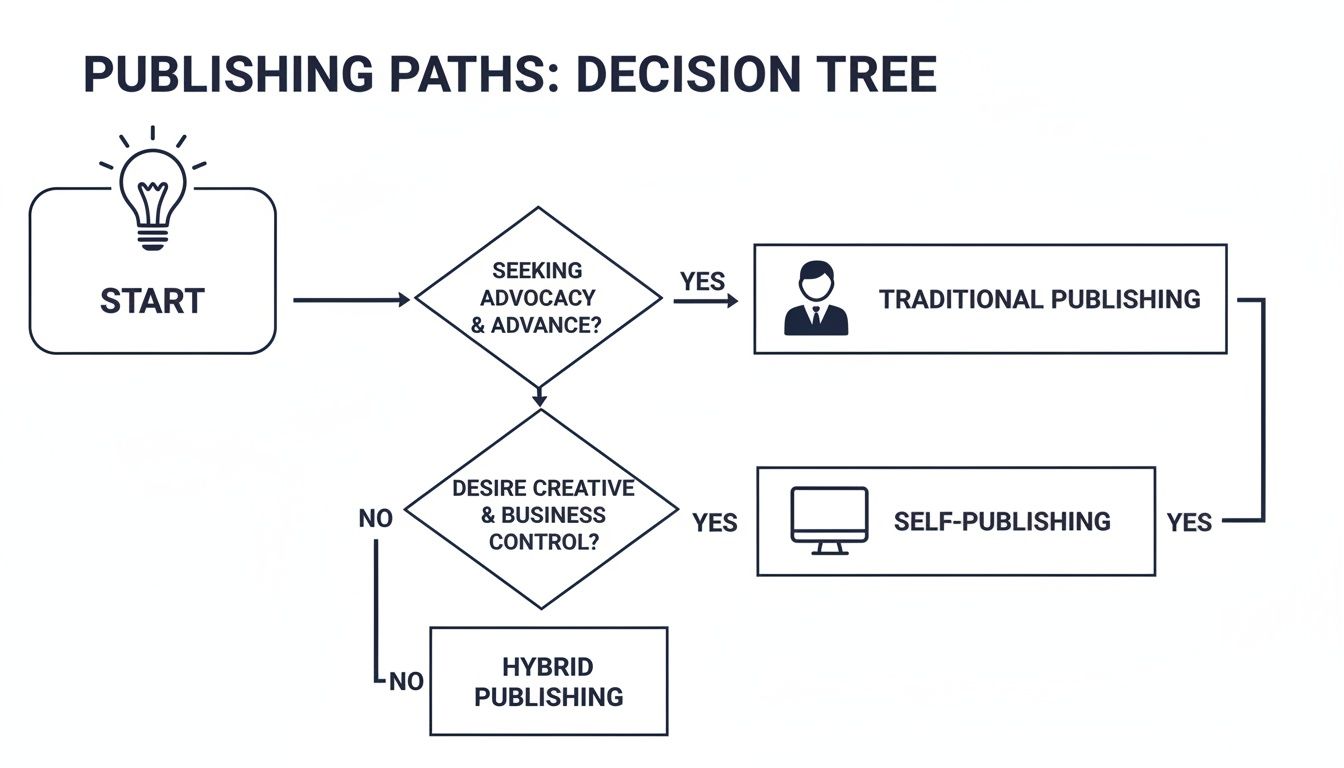
As you can see, if total creative control is your non-negotiable, self-publishing is probably your lane. If you want the prestige and marketing muscle of a big house and don't want to spend a dime, traditional is the goal.
A Look at the Odds and Your Options
Let's be real for a moment: landing a traditional publishing deal is tough. It's like trying to win the lottery. The big publishers receive a flood of manuscripts every year and end up accepting less than 1% of them.
And here’s the kicker: over 90% of the books they do publish come through a literary agent, not from an author's direct submission. Agents are the gatekeepers, and they are just as selective.
This isn't meant to discourage you, but to empower you. Knowing the reality of the market helps you make a smarter, more strategic choice. For a deeper dive, our guide on https://barkerbooks.com/traditional-vs-self-publishing/ breaks down the pros and cons even further.
To make things even clearer, here's a quick cheat sheet comparing the three models.
Quick Guide to Publishing Models
This table offers a snapshot of the three main paths, helping you quickly see where your project and personality might fit best.
| Publishing Path | Who It's For | Key Benefit | Major Challenge |
|---|---|---|---|
| Traditional | Authors seeking prestige and wide distribution with no upfront cost. | Professional validation and marketing support. | Extremely competitive; loss of creative control. |
| Self-Publishing | Entrepreneurial authors who want full creative and financial control. | 100% creative control and higher royalties (up to 70%). | All costs and marketing responsibilities fall on the author. |
| Hybrid | Authors who want professional guidance but more control and better royalties than traditional. | A partnership model with expert support. | Requires a significant financial investment from the author. |
Ultimately, the best path is the one that aligns with your vision for your book and your career.
As you move forward, it's also smart to stay informed about industry trends. For example, the conversation around the ethics of writing with AI is becoming more and more relevant for authors.
Taking the time to understand your options now will save you a world of frustration down the road and put you on the clearest path to seeing your book in print.
Building an Irresistible Submission Package

Before you even think about querying, you need to assemble your toolkit. Think of your submission package as your professional handshake, elevator pitch, and audition all rolled into one. It’s your first—and often only—chance to convince an agent or editor that your book is worth their incredibly limited time.
A polished, professional package screams, "I'm serious about my craft and I understand this business." On the flip side, a sloppy or incomplete submission is a fast pass to the rejection pile, no matter how brilliant your manuscript is. The goal here is to make it as easy as possible for them to say "yes."
This all comes down to meticulously preparing three key documents. Each one has a distinct job to do, but they all work together to tell a compelling story about your book and you as its author.
Crafting the Perfect Query Letter
Your query letter is a one-page sales pitch. Let me be clear: it’s not a summary of your book; it's an invitation to read it. Its sole purpose is to hook an agent and get them to request more materials. To do that, it needs to be concise, professional, and feel personal.
Every solid query letter has these core components:
- The Hook: A killer opening that introduces your protagonist, the central conflict, and the stakes. Think of it as the copy you’d find on the back of a bestseller.
- The Mini-Synopsis: A short paragraph or two expanding on the plot. You'll want to hit the major turning points but without giving away that jaw-dropping ending.
- The Author Bio: A quick bit about yourself. Focus on relevant writing credits, awards, or personal experience that makes you the only person who could have written this story.
- The Logistics: The nuts and bolts—title, genre, final word count, and a few comparable titles (comps) to show you know where your book fits on the shelf.
And please, personalize it. A generic "Dear Agent" is an instant red flag. Use their name and mention why you're querying them. Maybe you adored another book they represented, or you saw on their manuscript wishlist that they're hunting for a story just like yours. It shows you’ve done your homework.
Writing a Synopsis That Sells, Not Spoils
The synopsis is a completely different beast. The query letter teases; the synopsis tells all. This is a 1-2 page summary of your entire plot, from the first page to the final resolution. Don't be shy about spoilers—agents and editors need to see that your story has a solid structure and a satisfying ending before they commit to reading 90,000 words.
A common mistake I see is authors treating the synopsis like a creative writing exercise, filling it with flowery prose. Its job is purely functional. You need to demonstrate a clear and compelling plot arc. Stick to a third-person, present-tense narrative and just hit the major plot points, one after the other.
For nonfiction authors, the equivalent document is the book proposal. This is a much heavier lift, acting as a complete business plan for your book by outlining the core concept, target market, and a chapter-by-chapter breakdown. If you're tackling a nonfiction project, it’s worth taking a look at a sample book proposal to get a feel for what’s required.
Formatting Your Sample Chapters
Finally, we get to the main event: your writing. Agents typically ask for the first 5, 10, or 50 pages, and these pages have to be absolutely flawless. This is where they look for a strong voice, characters that jump off the page, and a narrative that grabs them from the very first sentence.
Show your professionalism by sticking to the industry standard for formatting. No exceptions.
- Font: 12-point Times New Roman.
- Spacing: Double-space the entire document.
- Margins: Standard one-inch margins on all sides.
- Indentation: Indent the first line of each paragraph by 0.5 inches. (Pro tip: set this in your paragraph styles instead of hitting the tab key every time).
Every agent and publisher has specific submission guidelines on their website—follow them to the letter. If they ask for a PDF, send a PDF. If they ask for the first ten pages, don't send fifteen. Deviating from their instructions is a terrible first impression. It suggests you can't follow directions, which is a deal-breaker for any editor. Putting together an irresistible package is all about that perfect blend of creativity and meticulous professionalism. It’s how you give your book the best possible shot.
Finding Agents and Publishers Who Are a Perfect Match

Okay, you’ve polished your submission package until it shines. Now for the real work: finding the right person to send it to.
This isn't about blasting your manuscript out to a hundred agents and hoping something sticks. That’s a surefire way to rack up rejections and burn yourself out. The goal is precision. You’re looking for a handful of agents and editors who are actively searching for a book just like yours.
Think of yourself as a detective. Your mission is to build a hyper-focused list of potential partners who are already primed to fall in love with your story.
Your Research Toolkit
Forget about flipping through an outdated, phonebook-sized directory of agents. Today, a couple of powerhouse online databases can give you an incredible edge.
Publisher's Marketplace: This is the industry's digital town square. For a small monthly fee, you get an insider’s view of the business. You can see a massive database of agents and editors, their recent sales, their client lists, and their submission guidelines. It's the best way to see who is actually selling books like yours and to which publishers.
QueryTracker: This is a fantastic, community-driven resource for finding agents, tracking your submissions, and seeing real-time data from fellow authors. You can filter by genre, check average response times, and even read comments from other writers about their experiences. It’s an invaluable tool for managing the whole process.
These tools let you move beyond guesswork. You're not just looking for any agent; you're looking for an agent with a proven track record of selling books in your genre to editors at reputable publishing houses. If this part of the industry is new to you, it's worth taking a moment to understand the key role an agent plays. We've put together a detailed guide on what a literary agent does and why they are so essential.
Decoding Agent Wishlists and Social Media Feeds
Beyond the big databases, some of the best intel comes directly from the agents themselves. Many are active on social media, especially on X (formerly Twitter), where they often share exactly what they're looking for.
The hashtag #MSWL (which stands for Manuscript Wishlist) is your golden ticket. Agents use it to post about specific themes, character archetypes, or settings they are desperate to find in their inbox.
An agent might post something like, "Would love to see a clever, atmospheric mystery set in a remote Scottish village. Give me all the moody vibes! #MSWL." If that describes your book, you've just found a warm lead. When you query them, you can—and should—mention their tweet. It shows you've done your homework.
A targeted submission list of 10-15 well-researched agents is infinitely more effective than a generic blast to 100. Quality over quantity is the mantra here. Each query should feel like it was written for one person and one person only.
Vetting Your Potential Partners
Finding an agent who reps your genre is just the first step. You need to dig a little deeper to make sure they’re the right long-term partner for your career. This is a business relationship, after all.
Before adding anyone to your final list, ask yourself these questions:
- What's their sales record like? Look at their recent deals on Publisher's Marketplace. Are they selling to reputable publishers? Do they sell consistently?
- What do their clients say? Check out the websites and social media feeds of the authors they represent. Do they seem to have a good relationship? Do they champion their clients' work?
- Does their communication style fit yours? Some agents are highly editorial and hands-on, while others are more focused on the business side of things. Think about what kind of partnership you’re looking for.
This research phase is non-negotiable. By dedicating time to thoughtful, strategic detective work, you dramatically increase your odds of connecting with the perfect champion to bring your book to the world.
Mastering the Querying Process and Managing Responses

You’ve got your polished submission package and a list of dream agents or publishers. Now comes the hard part: sending your work out into the world. Let’s be honest, this stage is a marathon of patience and organization, not a sprint to the finish line.
Think of it less as a single, dramatic moment and more as a sustained, professional campaign. Your goal is to follow instructions to the letter, track everything like a hawk, and manage your own expectations.
Sending It Out: Your Submission Strategy
Every single agent and publisher has their own set of submission guidelines. They aren't suggestions; they're rules. Following them shows you're a professional who respects their time. One agent might want the first ten pages pasted into the body of an email, while another requires a PDF attachment of the first fifty. Get it wrong, and you’re likely headed straight to the "no" pile without a second glance.
Your best friend in this process? A simple spreadsheet. You don't need fancy software—just a way to stay organized and sane.
At a minimum, your tracker should include:
- Agent/Publisher Name: Who you queried.
- Date Sent: The exact date you hit "send."
- Materials Sent: Be specific. Note whether you sent a query, a synopsis, and the first 10 pages or the first 3 chapters.
- Response: Log the date and the type of response you received (e.g., form rejection, request for the full manuscript).
- Follow-Up Date: Based on their guidelines, note when it's appropriate to check in.
This simple tool is a lifesaver. It prevents embarrassing mistakes like querying the same agent twice or forgetting who has your full manuscript. It transforms a potentially chaotic mess into a manageable project.
The Art of Handling Rejection
Rejection is the one universal truth of publishing. Everyone faces it. The secret is to not take it personally, but to see it as data. Not all "no's" mean the same thing, and learning to read between the lines can give you invaluable feedback.
The reality is that agents and editors reject manuscripts for countless reasons that have nothing to do with the quality of the writing. Their list might be full, they may have just signed a similar book, or it might just not be the right fit for their personal taste. Resilience is your greatest asset here.
Most rejections you receive will fall into one of three buckets:
- The Form Rejection: This is the generic, copy-and-paste email. It’s the publishing equivalent of "it's not you, it's me." It offers zero feedback and simply means your project wasn't a fit. Don't waste a second trying to analyze it. Just log it in your spreadsheet and move on.
- The Personalized Rejection: Okay, this is a small win! It means your query or pages were compelling enough for the agent to take a moment and write a specific comment, like, "I loved the voice but the plot wasn't quite for me." This is a huge piece of positive feedback—it tells you that your writing is connecting, even if this particular book wasn't the one for them.
- The Revise and Resubmit (R&R): This is the holy grail of rejections. An R&R means an agent sees serious potential in your book but thinks it needs significant work before it’s ready. They’ll often provide detailed notes and invite you to send it back once you've made the changes. This is a massive opportunity and a strong sign of genuine interest.
Following Up and Handling Offers Like a Pro
Knowing when to follow up is a delicate dance. Your first and only guide should be the agent's submission guidelines. If they say to expect a response in 8-12 weeks, don't you dare email them at week seven. If their website says, "no response means no," take them at their word and move on. If their deadline passes, a polite, brief nudge is perfectly acceptable.
And then, the moment comes—you get an offer of representation. First, take a breath and celebrate! This is a huge milestone.
Now for the professional part. You must notify any other agent who is currently considering your work, especially those who have your full manuscript. It's standard industry etiquette to give them a reasonable deadline—usually 1-2 weeks—to read and make their own decision. Not only is this the right thing to do, but it can also generate competing offers. Handling this moment with grace sets the tone for your entire author career.
Decoding Your Publishing Offer and Contract
Getting the offer—it's the moment you've been working toward. The validation, the excitement, it's all real. But once the champagne cork has been popped, it's time to get down to business. That publishing contract isn't just a handshake; it's a serious legal document that will dictate the future of your book and, in many ways, your writing career.
This is where a good literary agent really earns their commission. While you can land a deal without an agent, particularly with smaller independent presses, their expertise becomes indispensable when it's time to negotiate. They've seen it all, they know the industry benchmarks, and they'll fight to get you the best terms possible.
Key Terms You Must Understand
A publishing agreement can look like a thicket of legalese, but a few critical terms form the heart of the deal. Getting these right is everything. Pay close attention to the advance, royalties, and the rights you're signing over. A misunderstanding here can impact you for years to come.
The Advance: Think of this as a down payment on your future earnings. The publisher pays you a lump sum upfront, but you won't earn any more money until your book sells enough copies to cover that initial payment. This is called "earning out."
Royalty Rates: This is the percentage you get for every copy sold after your advance has earned out. These rates will differ based on the book's format—hardcover, paperback, ebook, and audiobook—and are often tiered, meaning your percentage might increase after you sell, say, 10,000 copies.
Rights Granted: The contract will spell out exactly which rights you are giving the publisher. This always includes print and ebook, and usually audiobook rights. It can also include subsidiary rights like foreign translations, film and TV options, and even merchandising. It’s crucial to know what you’re giving away and what you’re retaining.
Don't ever feel intimidated about asking for clarification. A reputable agent and publisher will walk you through any clause that seems confusing. If you feel rushed to sign or get vague answers, that’s a major red flag. This is your intellectual property—be its staunchest defender.
From Signed Deal to Bookstore Shelf
Signing on the dotted line is a huge milestone, but it’s also the starting pistol for another marathon. The road from a signed contract to a book on a shelf is longer than most writers expect, typically taking anywhere from 18 to 24 months.
This period is a flurry of activity behind the scenes. You'll dive into developmental edits with your editor to refine the story's structure, followed by line edits to polish the prose. After that, a copyeditor scrubs the manuscript for grammar and consistency. At the same time, a cover is being designed, and the marketing and publicity teams are building out a launch plan.
This long runway is one of the main reasons many authors are looking at other options. Self-publishing, once seen as a last resort, has become a powerful and legitimate career path. In 2023 alone, more than 2.6 million self-published books with ISBNs hit the market. These titles generated an estimated $1.25 billion in U.S. sales from over 300 million copies sold, proving that readers are eager for stories outside the traditional system. You can discover more self-publishing statistics to see just how much the industry is changing.
A Closer Look at the Contract
To truly feel confident, you need to get comfortable with the language of a publishing agreement. Below is a breakdown of some common clauses you'll encounter.
Key Publishing Contract Terms Explained
| Contract Term | What It Means for the Author | Standard Range/Practice |
|---|---|---|
| Advance | An upfront, recoupable payment against future royalties. You don't get more royalties until this is "earned out." | Varies wildly from a few thousand dollars to six figures or more, depending on the book and publisher. |
| Royalty Rates | The percentage you earn per sale. This is calculated on the net price (what the publisher receives) or list price. | Hardcover: 10-15% of list price. Paperback: 5-8% of list price. Ebook: 25% of net receipts. |
| Grant of Rights | Specifies which rights you are selling (e.g., print, audio, film, foreign). | Most publishers want "World English" rights at a minimum. Agents often try to retain foreign and film/TV rights to sell separately. |
| Option Clause | Gives the publisher the first right to consider (and often make an offer on) your next book. | Often called "first right of refusal." Aim for an "option on next work" rather than a multi-book deal, unless the terms are excellent. |
| Out of Print Clause | Defines when a book is considered "out of print," allowing you to request the rights back. | Crucial for regaining control of your work. The definition should be specific (e.g., sales below a certain number per year). |
| Warranty & Indemnity | You guarantee the work is original and not libelous, and agree to cover legal costs if that's proven false. | This is a standard clause. Publisher's insurance often covers a portion, but the author is ultimately responsible. |
Understanding these terms puts you in the driver's seat. It's about knowing what you're agreeing to so you can build a strong, transparent partnership with your publisher, which is the ultimate goal in the complex process of finding a publisher for a book.
Exploring Modern Publishing Alternatives
The old path to getting published—waiting years for an agent, then years for a publisher—isn't the only way anymore. In fact, many authors are skipping the line and finding incredible success with modern alternatives that give them more control and a much quicker route to getting their books into readers' hands.
These new models fill the space between doing everything yourself (self-publishing) and handing over the keys to a traditional house.
Hybrid and Full-Service Publishing: The New Middle Ground
The two big players here are hybrid publishing and full-service publishing. With these models, you, the author, invest in the professional production of your book. This covers essential services like top-tier editing, compelling cover design, and professional formatting.
What do you get in return? A much, much larger slice of the pie. Royalties are often 50% or more, a stark contrast to the single-digit percentages common in traditional deals. Plus, you keep creative control. It’s your book, your vision.
Think of it like being a film producer. You're funding the project and hiring a team of experts—editors, designers, marketers—to bring your vision to life and ensure it meets industry standards.
How to Spot a Partner from a Predator
This is the most critical part. The waters of alternative publishing can be murky, and it's vital to tell a legitimate partner from a predatory vanity press.
A true publishing partner is invested in your book's success because they only make money when your book actually sells. A vanity press, on the other hand, couldn't care less if your book sells a single copy; they've already made their profit from the huge fees they charged you upfront.
Here’s a quick guide to vetting potential partners:
- Do they have standards? A real hybrid publisher is selective. They have a submission process and won't publish just anything. Their reputation is built on quality, not quantity.
- Is the money talk clear? A trustworthy partner gives you a transparent, itemized list of costs. You should know exactly what you’re paying for. No hidden fees, no last-minute surprises.
- Can they actually sell books? Ask to see their catalog. Where are their books sold? They should have a real distribution network that gets books onto major platforms like Amazon, Barnes & Noble, and Apple Books.
- Who gets the reward for the risk? If you're footing the bill, you should get the lion's share of the profits. A legitimate partner will offer you a royalty rate that reflects your investment.
A huge red flag is high-pressure sales tactics. If a company is pushing you to sign a contract immediately or making wild promises about bestseller status, walk away. A real partner is a professional who focuses on building a quality book, not just taking your cash.
For many authors dipping their toes into these models, print-on-demand is a game-changer. You can bring a niche idea to life with almost no upfront inventory costs. To see how this works in practice, check out this guide on Print On Demand Coloring Books.
Ultimately, finding the right publisher is about finding a true partner—one who respects your work and has the professional muscle to help you share it with the world.
Answering Your Top Questions About Finding a Publisher
The road to publication is filled with twists and turns, and it's natural to have a lot of questions. Let's tackle some of the most common ones that authors ask when they're trying to land a book deal.
So, How Long Does It Really Take to Find a Publisher?
Patience is more than a virtue in publishing—it's a necessity. If you're going the traditional route, you need to prepare for a marathon, not a sprint. Just getting a literary agent to represent you can take anywhere from 6 to 18 months.
Once you've signed with an agent, the clock starts again. They'll begin shopping your manuscript around to editors, and that submission process can easily take another 6 to 18 months. After you finally get that "yes" and sign a contract, it's typically another one to two years before your book actually hits the shelves. That time is filled with editing, cover design, printing, and marketing prep.
On the other hand, if you opt for a hybrid or full-service publisher, the timeline shrinks dramatically. With these models, you could be holding your published book in just a few months after your manuscript is ready to go.
Do I Absolutely Need a Literary Agent?
This is a huge question, and the answer really comes down to your publishing goals. If you're aiming for a deal with one of the "Big Five" publishers (think Penguin Random House, Hachette, etc.), then yes, a literary agent is non-negotiable. These major houses simply don't accept manuscripts directly from authors.
An agent is your champion and your guide in the world of traditional publishing. They have the industry connections to get your manuscript past the gatekeepers and onto the right editor's desk. Beyond that, they’re your business partner, negotiating the best possible contract and managing things like foreign and film rights for you.
But an agent isn't the only way forward. Many excellent independent and smaller presses are happy to review submissions sent directly by authors. And if you decide on a hybrid, assisted, or self-publishing path, you won't need an agent at all. You'll be working directly with your chosen publishing service or taking the reins yourself.
What Are the Biggest Red Flags to Watch Out For?
Knowing what to avoid is just as critical as knowing what to look for. The single biggest red flag is any "publisher" that demands a large fee just to publish your book without providing a clear breakdown of high-quality, professional services. That's the classic sign of a vanity press, not a real publishing partner.
Keep an eye out for these other warning signs:
- Confusing contracts. If the terms about your rights, royalties, and what you’re paying for are vague, walk away.
- High-pressure sales pitches. A legitimate partner will give you time to think. Anyone rushing you to sign is a major red flag.
- A shoddy portfolio. Look at the books they've already published. Do the covers look amateurish? Is the formatting sloppy? Their past work is the best indicator of their quality.
- No real distribution plan. They should be able to tell you exactly how they'll get your book onto major platforms like Amazon and into bookstores.
Remember, a true publisher—whether traditional or hybrid—invests in your book's success because it's also their success.
At BarkerBooks, we believe in a transparent, professional, and collaborative path to publication. We offer the dedicated support and global distribution network your manuscript deserves. Learn more about our full-service publishing packages.