
Turning your manuscript into a stream of sales isn't just about writing a great book. The real journey begins after you type "The End." It's a three-part process that combines professional polish, smart distribution, and a marketing engine that gets your work in front of the right readers. Get these three things right, and you're not just an author; you're a business.
Your Blueprint For Selling Ebooks Successfully

Let's get practical. This is your real-world roadmap for taking your finished manuscript and turning it into a product that sells. Forget the romantic idea of just writing; we're diving into the business of being an author in a digital world. It’s far more than just uploading a file—it's about strategically placing your book into a massive, hungry global market.
And the opportunity has never been bigger. The global ebook market is on track to hit $18.02 billion by 2025, and it's all powered by over 5.4 billion internet users. Independent authors are a huge part of this, moving 300 million self-published books every single year. The potential to connect with a worldwide audience is staggering.
The Three Pillars Of Ebook Success
I’ve seen it time and time again: successful authors build their careers on three fundamental pillars. If you neglect even one of these, you're seriously capping your book's potential before it even has a chance to find its audience.
- Professional Production: This is all about first impressions. It means meticulous editing, clean and professional interior formatting, and a cover design that doesn't just look good—it screams "buy me" to your ideal reader.
- Strategic Distribution: You have to be where the readers are. This involves choosing the right retailers, crafting compelling metadata (your book description, keywords, and categories), and sorting out the administrative details like your ISBN and copyright.
- Targeted Marketing: A great book won't sell itself. This is the active, ongoing work of connecting with your audience through a coordinated book launch, smart advertising, email marketing, and social media.
Your ebook is more than just a story; it's a product. Building a strong author brand is essential for standing out in a crowded marketplace. It establishes credibility and helps readers connect with you and your work on a deeper level.
A cohesive brand informs everything from your cover art to your website copy. To get this right from the start, it's worth understanding How to Brand Your Business.
This guide will walk you through each of these pillars with clear, actionable steps. For an even more detailed look at the sales process, you can explore our full breakdown of how do you sell ebooks. Every stage has its own unique hurdles, but with a solid plan, you can navigate them confidently.
Here’s a quick overview of the key stages we'll cover, and how we at BarkerBooks can help you nail each one.
Key Stages For Ebook Publishing Success
| Publishing Phase | Key Objective | BarkerBooks Solution |
|---|---|---|
| Professional Production | Transform a manuscript into a polished, market-ready ebook. | Editing, formatting, and cover design services. |
| Strategic Distribution | Make the ebook available for sale on major global platforms. | Platform setup, metadata optimization, and ISBN/copyright assistance. |
| Targeted Marketing | Connect the ebook with its ideal readers to drive consistent sales. | Launch strategy, paid advertising, and email funnel creation. |
| Growth & Expansion | Scale your author business by reaching new markets and formats. | Audiobook production, internationalization, and ongoing promotion. |
Each step builds on the last, creating a powerful system for generating long-term income from your writing. Let's dive into the details.
Getting Your Manuscript Ready for Readers

Before a single sale can happen, you have to shift your mindset. Your manuscript is no longer just a story; it's a product. In a marketplace with millions of books, readers have zero patience for anything that feels amateur. This first stage is where you build the foundation for success, turning a passion project into a professional asset that can hold its own against the competition.
It all begins with taking a hard, honest look at the words on the page—and that means bringing in outside experts who can see what you can't.
The Make-or-Break Layers of Professional Editing
I’ve seen it time and time again: a fantastic story that falls flat because the editing was skipped or rushed. Editing isn't a one-and-done task. It's a multi-stage process, and each layer is critical for a different reason. Mixing them up or skipping one is a rookie mistake you can't afford to make.
Think of it like building a house. You can't paint the walls before the foundation is solid. Here are the three non-negotiable stages your manuscript must go through:
- Developmental Editing: This is the blueprint phase. A developmental editor examines the very bones of your story—plot, pacing, character arcs, and structure. They’re asking the big questions: Is the plot sagging in the middle? Are the characters' actions believable? This is where you fix the core story before you worry about commas.
- Copy Editing: Once the story is structurally sound, the copy editor comes in to work on the sentence level. They are masters of grammar, punctuation, and syntax, but they also polish your prose for clarity and flow. Their work ensures the reading experience is smooth, not clunky.
- Proofreading: This is the final walkthrough. After all other edits and formatting are done, a proofreader hunts down any typos, missed punctuation, or formatting glitches that slipped through. They are your last line of defense against embarrassing, review-killing errors.
A brilliant plot can be torpedoed by sloppy grammar, and perfect prose can't save a story that goes nowhere. They all work together. For a deeper dive, check out our complete guide on how to prepare an ebook for publishing.
Designing a Clean, Immersive Reading Experience
With the words polished, it’s time to think about presentation. Ebook formatting, or interior design, is about creating a seamless and distraction-free experience for the reader, whether they're on a Kindle, an iPad, or their phone. Bad formatting is an instant red flag that screams "self-published" in the worst way.
Professional interior layout means everything looks clean and consistent—from chapter headings and scene breaks to paragraph indents. The goal is for the formatting to become invisible, allowing the reader to get completely lost in your story.
A book cover is your single most important marketing tool. In the seconds it takes a reader to scroll past your book on Amazon, the cover must communicate genre, tone, and professionalism, compelling them to stop and click.
Crafting a Cover That Actually Sells
Now for your most crucial marketing asset: the cover. A reader sees your cover long before they ever read your book's description. It has an incredibly tough job to do in just a few seconds.
A great cover isn't just a pretty picture; it's a piece of strategic communication. It has to instantly signal the genre to your target audience. The visual language of a thriller is completely different from that of a contemporary romance or an epic fantasy. Getting this wrong means you’ll attract the wrong readers, leading to bad reviews and dead-end sales.
Study the covers of the top 100 bestsellers in your specific sub-genre. Look at the common fonts, color schemes, and imagery. You’re not trying to copy them, but you need to understand reader expectations so your book looks like it belongs on the same shelf.
At BarkerBooks, our editorial and design pros collaborate to make sure every part of your book, from the first sentence to the final cover, meets the highest industry standards. We help you create a product that's truly ready to compete.
Choosing Where To Sell Your Ebook
You’ve poured your heart and soul into your manuscript. It's edited, polished, and ready to meet the world. Now comes the exciting part: getting it into the hands of readers. This isn't just about uploading a file; it's about making smart, strategic decisions on where your book will live online. Picking the right platforms is a game-changer for turning your manuscript into a sales success.
The digital bookshelf is dominated by a few heavyweights, and each one operates in its own unique universe with different audiences, rules, and opportunities. Understanding how they work is the first step in building a distribution plan that actually fits your goals.
Navigating The Major Ebook Retailers
For most indie authors, the road to publication starts and often centers around Amazon's Kindle Direct Publishing (KDP). You simply can't ignore it. KDP is the undisputed giant, controlling a massive slice of the ebook market. Being on Amazon means you have direct access to millions of customers who are already there, actively looking for their next read.
But Amazon isn't the only game in town. Smart authors look beyond a single storefront to reach different pockets of readers.
- Apple Books: This is the premium marketplace for anyone in the Apple ecosystem. It’s known for a clean, curated experience that attracts readers who often value quality and are willing to pay for it.
- Barnes & Noble Press: Don't discount the digital arm of America's most famous bookstore. B&N Press connects you with a loyal base of readers who have trusted the brand for decades.
- Google Play Books: With the Android operating system on billions of devices, Google offers incredible international reach right out of the box.
As you weigh your options, it's worth exploring the broader landscape. Taking a look at the best platforms to sell digital products can give you a better sense of where your ebook fits in the wider digital world.
The biggest strategic choice you'll face is whether to go "exclusive" with a single retailer like Amazon KDP Select or "go wide" and sell across multiple platforms. Exclusivity gives you powerful marketing tools, but a wide strategy builds a more resilient, diversified income stream. It’s a classic trade-off.
To help you visualize the key players, here's a quick comparison of the top ebook retailers.
Comparing The Top Ebook Retail Platforms
Each platform offers a unique proposition for authors, from market dominance to niche audiences. This table breaks down the main contenders to help you decide where your book will thrive.
| Platform | Primary Market | Standard Royalty Rate | Key Advantage |
|---|---|---|---|
| Amazon KDP | Global (Dominant in US/UK) | 35% or 70% | Massive built-in audience and powerful marketing tools (KDP Select). |
| Apple Books | Global (iOS users) | 70% | Premium platform with a high-quality feel and access to a discerning readership. |
| Barnes & Noble Press | Primarily US | 40% or 65% | Strong brand recognition and a loyal customer base of traditional book lovers. |
| Google Play Books | Global (Android users) | 52% | Unmatched international reach through the Android ecosystem. |
Ultimately, the right choice depends entirely on your personal goals—whether you're aiming for maximum visibility on one platform or building a broader, more independent author business.
Getting The Essential Paperwork In Order
Before you can upload your book anywhere, you need to handle a couple of administrative tasks. They aren't the most exciting part of the process, but they are absolutely critical for protecting your work and making it officially available for sale.
First up is the ISBN (International Standard Book Number). Think of it as your book's social security number—a unique identifier for that specific edition. While Amazon provides a free ASIN for its own store, you'll need your own ISBN to sell on Apple, B&N, and other retailers. Owning your ISBNs means you are the publisher of record, giving you full control over how your book is listed everywhere.
Next is copyright registration. Officially registering your work with your country's copyright office (like the U.S. Copyright Office) creates a public record of your ownership. This is your ultimate legal shield, giving you the power to defend your intellectual property if anyone ever tries to use it without permission.
Optimizing Your Book For Discovery
Your book's metadata is the collection of information—title, author, description, keywords, categories—that tells retailers and readers what your book is about. Nailing your metadata is the closest thing to a "magic bullet" for driving organic sales. It's basically SEO for your book.
- Book Description: This is your sales pitch. It needs to grab a reader, introduce the central conflict or promise, and end with a compelling reason to click that "buy" button. It’s not a summary; it’s advertising copy.
- Keywords: These are the search terms people actually type into the search bar. Amazon gives you space for seven keyword phrases. Do your research! Think like a reader and use the exact phrases they would to find a book like yours.
- Categories: Choosing the right categories is crucial. Don't just pick "Fiction > Fantasy." Drill down into niche sub-categories where you have a real shot at hitting a bestseller list. A #1 tag in a smaller category gives you a massive visibility boost across the entire store.
For a deeper dive into these strategic choices, our complete guide on where to sell your ebook breaks it all down even further.
Let's be honest, this can all feel like a lot to manage. This is exactly where a publishing partner can make all the difference.
At BarkerBooks, we handle the entire distribution puzzle for you. We’ll set up your book on all the major platforms, meticulously optimize your metadata to attract the right readers, and distribute your ebook in over 91 countries. With North America making up roughly 38% of the global ebook market, having a seamless global strategy is non-negotiable. We'll get you there, taking care of the technical headaches so you can get back to what you love—writing.
Executing A High-Impact Book Launch
Just hitting ‘publish’ is one of the biggest anti-climaxes in an author's journey. The real work—and the real excitement—starts with a powerful, well-planned launch. This is your chance to create that initial burst of momentum that retailer algorithms absolutely love, driving the crucial early sales that can set the stage for your book's long-term success.
Think of your launch not as a single event, but as a full-blown campaign. It all starts long before your book is even available for sale.
Building Your Pre-Launch Buzz
Your single most valuable asset as an author? A direct line to your readers. That means building an email list is non-negotiable. This is your core group of fans—the people most likely to buy your book, drop a review, and tell their friends about it. You can draw them in by offering a great freebie, like a prequel chapter, a short story from your book's world, or a cool character guide.
At the same time, you need to assemble your launch team. This is a hand-picked group of beta readers, influencers, or just your most dedicated fans who get an Advance Reader Copy (ARC) of your ebook for free. Their job is simple but vital: read the book and get ready to post an honest review on sites like Amazon and Goodreads the moment it goes live. Social proof is everything; a book with zero reviews is a tough sell.
Your launch isn't a single day—it's a carefully orchestrated campaign. Success is determined by the groundwork you lay in the weeks and months leading up to your release date. Building anticipation is just as important as the launch day itself.
Getting those early reviews helps new readers feel confident hitting the 'buy' button. It's one of the most powerful ways to get that initial traction and make your book stand out.
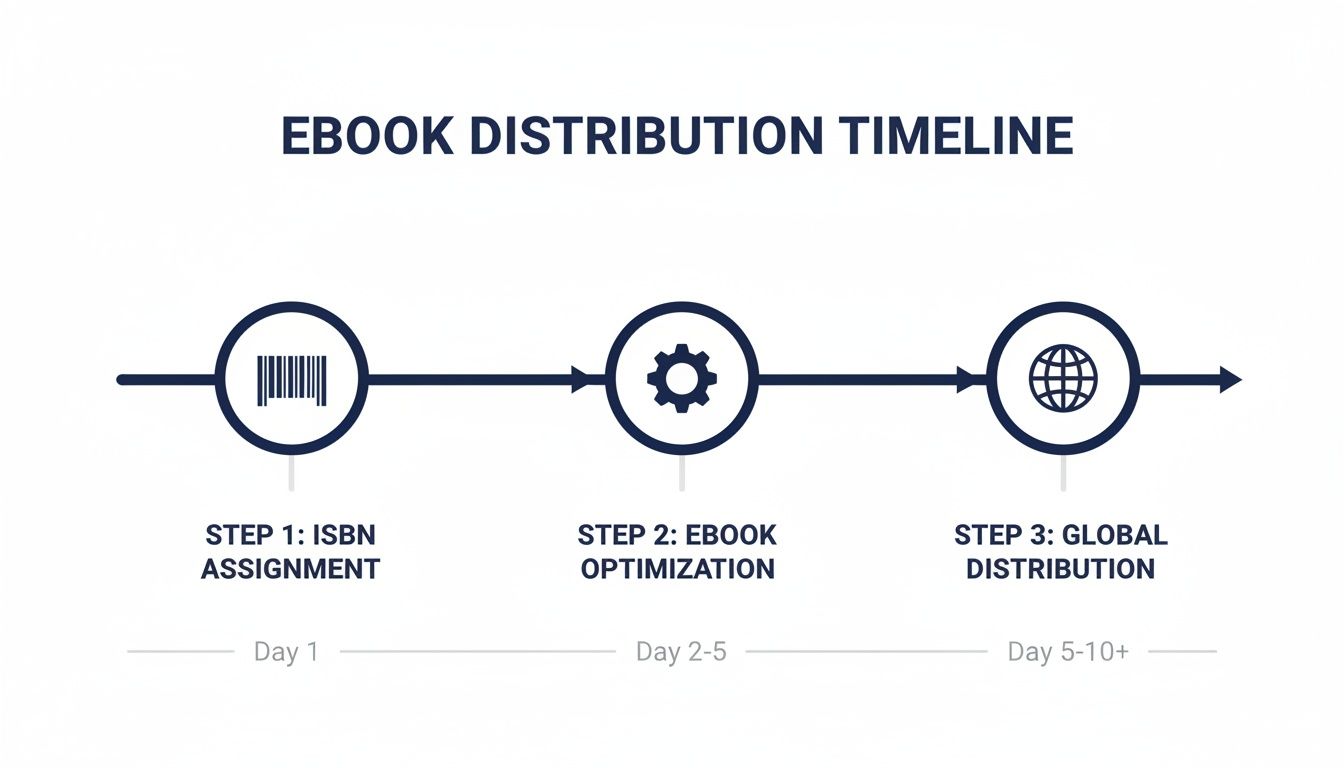
This timeline really drives home that distribution isn't just one step. It's a strategic sequence, from getting your ISBN to fine-tuning your metadata before you even think about launching.
Crafting Your Launch Week Strategy
When launch week finally arrives, the goal is simple: concentrate as many sales as you can into a very short window. This sales velocity is a huge signal to retailer algorithms that your book is hot, which can trigger them to start showing it to more potential buyers organically.
A classic, highly effective strategy is to kick things off with a promotional price. Launching your ebook at $0.99 or $2.99 for the first few days can massively increase your sales volume. The low barrier to entry encourages impulse buys from new readers and helps you rocket up the bestseller charts in your categories. After you’ve gained some visibility and reviews, you can bump the price to its regular, full value.
Your launch week plan should be a coordinated push across every platform you have.
- Email Your List: Your subscribers should be the first to know. They're your biggest supporters, so make them feel like VIPs with a direct link and a personal note.
- Social Media Blitz: Get a series of posts scheduled across all your social channels. Use eye-catching graphics, share snippets of early reviews, and create a sense of urgency around the limited-time launch price.
- Run Paid Ads: If you've got the budget for it, launch week is the perfect time to run targeted ads on platforms like Amazon or Facebook to reach readers who have no idea who you are… yet.
A Real-World Launch Timeline
A chaotic launch leads to chaotic results. Planning is everything. Here’s a practical timeline you can steal and adapt for your own high-impact release.
90 Days Out
- Finalize that manuscript and get it to your editor.
- Start brainstorming and commissioning your cover design.
- Get your author website live with an email list sign-up form.
30 Days Out
- Your book should be formatted and uploaded for pre-order on all major platforms.
- Send out the ARCs to your launch team.
- Start teasing the cover reveal and the official release date on social media.
Launch Week
- Day 1: The book is live! Email your list, blast it on social media, and switch on your ads.
- Day 2-3: Follow up with your launch team with a friendly reminder to post their reviews. Share any amazing reader feedback you're getting.
- Day 5-7: Announce that the special launch price is ending soon. This creates a final surge of sales before you raise the price.
Pulling off a launch of this scale involves a ton of moving parts, and honestly, it can be overwhelming. This is where getting professional support can make all the difference. The BarkerBooks Elite package is specifically designed for authors who want a blockbuster release, handling everything from creating stunning 3D promotional videos to managing your entire social media marketing campaign. We bring the tools and expertise to make sure your book launch gets the buzz—and sales—it truly deserves.
Marketing Your Ebook For Long-Term Success
That first-week launch buzz is an incredible feeling, but it’s just the starting line. The true measure of a successful ebook isn't a quick sprint but a marathon—its ability to sell consistently, month after month, long after the confetti has settled. This is where your long-term marketing strategy comes into play, turning your book from a one-off project into a reliable, income-generating asset.
It’s time to shift your thinking from launch-day tactics to building a sustainable engine that puts your book in front of fresh eyes, day in and day out. This means creating a system for discovery and conversion that works for you even when you're not actively promoting. Let's dig into the core pieces that make this happen.
Demystifying Paid Advertising For Authors
Paid ads can feel like a black box to many authors, but they are one of the most direct routes to finding your perfect reader. Platforms like Amazon Ads and Facebook Ads are powerful tools, giving you the ability to target readers based on their favorite authors, genres, and even specific reading habits.
Amazon Ads are the perfect place to start. Why? Because you're reaching people who are literally on the site to buy books. You can have your ad pop up when a reader searches for a specific keyword phrase (think "gritty space opera with aliens") or even place it directly on the product pages of authors who write books just like yours. It’s like setting up a billboard right outside the bookstore.
Facebook Ads work a bit differently. You're not catching someone mid-purchase; you're interrupting their social scroll with something they can't ignore. Here, you target by interests—people who follow Brandon Sanderson or are part of a cozy mystery book club, for instance. Your job is to craft an ad so compelling that it stops them in their tracks and makes them want to know more about your book right now.
Setting A Smart Ad Budget And Strategy
You don't need a Hollywood budget to get started, but you do need a smart one. I always tell authors to begin small. Think $5 to $10 per day on a single platform. In the early days, your goal isn't to hit the bestseller list; it’s to gather crucial data. You’re testing everything: different ad images, catchy headlines, and various audiences to see what actually connects with readers and makes them click.
Once you find that magic combination—an ad that brings in sales at a cost that still leaves you with a profit—you can begin to slowly, carefully increase your daily spend. This methodical approach is key. It stops you from burning through cash and helps you build a scalable advertising machine that you can rely on.
Effective ad copy for an ebook doesn't summarize the plot. It hooks the reader with a compelling question, presents a tantalizing conflict, and makes an emotional promise that the book will deliver on. It's the "blurb" on steroids, designed for a single, powerful impression.
Running successful ads is a long game of testing, tweaking, and refining. At BarkerBooks, our ad specialists live and breathe this stuff. We manage targeted campaigns that take all the guesswork out of the process, handling the complex setup, monitoring the numbers, and optimizing your ads to make sure every dollar is working hard to find your next loyal reader.
Building Your Author Brand With Content Marketing
Paid ads are fantastic for immediate results, but content marketing is how you build a lasting foundation for your author career. This is all about creating and sharing valuable content that pulls your ideal audience toward you organically.
- Author Blogging: A blog on your website is your home base. It’s where you can share behind-the-scenes looks at your writing, dive deeper into the themes of your books, or offer advice to aspiring writers. This isn't just content; it's community-building.
- Guest Posting: Writing for other, more established blogs in your genre is one of the best ways to get in front of a whole new audience. Imagine your article on a popular fantasy blog—it can drive a wave of new, highly interested readers straight to your website and books.
- Social Media Presence: Show up where your readers are. The goal isn’t to constantly yell "buy my book!" but to share engaging content, ask questions, and build real relationships. It’s about being part of the conversation, not just broadcasting a sales pitch.
Content marketing is a slow burn, but every post you write becomes a permanent asset, working to attract new readers for years to come.
Tapping Into New Revenue With Audiobooks
Looking for one of the most powerful ways to boost your long-term income from a single book? Turn it into an audiobook. The audiobook market is exploding as people listen on their commute, at the gym, or while doing chores. Creating an audio version can essentially double the revenue potential of one manuscript.
Yes, there's an upfront investment in hiring a professional narrator and engineer to get that polished, retail-ready sound. But that investment opens your story up to an entirely new audience—people who might have never picked up the ebook version. You're making your work more accessible while adding a significant and largely passive income stream to your author business.
BarkerBooks simplifies this entire process with our professional audiobook production services. We connect you with top-tier voice actors and manage the recording, editing, and mastering from start to finish. You get a finished product that meets the exacting standards of platforms like Audible and Apple Books, ready to reach a whole new world of listeners.
Your Ebook Publishing Questions Answered
When you decide to publish an ebook, it feels like a whole new world opens up—and with it, a flood of questions. It's a path filled with technical hurdles and strategic choices that can feel pretty overwhelming. Let's cut through the noise and tackle the most common questions I hear from authors every single day.
My goal here is to give you the straight-up answers you need to stop wondering and start moving forward with real confidence. These aren't just abstract concerns; they're the practical details that make the difference between a frustrating launch and a book that truly succeeds.
How Much Does It Really Cost To Publish An Ebook?
This is the big one, isn't it? The honest-to-goodness answer is: it really, really depends. Your total investment comes down to how much you're willing to do yourself versus where you bring in the pros. You could try to do it all for free, but that approach almost never leads to meaningful ebooks for sales.
A more realistic budget looks something like this:
- The Smart DIY-er: You hire a freelance editor and a cover designer to handle the most critical parts. You're probably looking at a few hundred to a couple of thousand dollars.
- The Full-Service Route: A comprehensive package that handles editing, cover design, formatting, and getting your book on all the stores can run from $2,000 to $5,000+.
- All-In with Marketing: For authors who want a team to manage marketing campaigns, run ads, and maybe even produce an audiobook, the investment will naturally be higher.
Try to think of this as an investment in your book's quality and its ability to compete. Skimping on professional editing or a cover that grabs attention is a classic false economy—it almost always costs you more in lost sales than you saved upfront.
How Should I Price My Ebook To Maximize Sales?
Pricing isn't just a number; it's one of your most powerful marketing tools. For most indie authors, the sweet spot is somewhere between $2.99 and $9.99. This is the golden range on platforms like Amazon KDP, where you earn the highest royalty rate of 70%. If you price below $2.99 or above $9.99, your royalty rate plummets to 35%.
Here’s a strategy I’ve seen work wonders: launch at a lower price. Starting at $0.99 or $2.99 for the first week can create a surge of early sales and reviews. That initial activity signals to the store's algorithms that your book is worth showing to more people. Once you've got that momentum, you can nudge the price up to its permanent home.
Before you decide, always do your homework. Check out the bestsellers in your specific genre. See what they're charging and price your book in a way that meets reader expectations.
Do I Actually Need An ISBN For My Ebook?
This one is a firm "it depends on your goals." If you only ever plan to sell on Amazon, you can get away with using the free ASIN (Amazon Standard Identification Number) they give you. It works perfectly within their world.
But if you want your book available on Apple Books, Barnes & Noble, Google Play Books, and other retailers around the globe, then yes, you absolutely need your own ISBN.
When you buy your own ISBN, you or your company become the official publisher of record. This gives you total control over your book’s metadata and ensures it's properly listed across the entire industry. It’s the non-negotiable key to a "wide" distribution strategy and building a truly independent author career.
How Long Does It Take To Get An Ebook Ready For Sale?
I know you're excited to get your book out there, but patience is a publisher's best friend. Rushing the process is a surefire way to launch a product that feels unfinished. From the moment you hand over a polished final manuscript, a realistic timeline to a live, for-sale ebook is about 2 to 3 months.
Here’s a rough sketch of how that time breaks down:
- Professional Editing: This is usually the longest part of the journey, often taking 2 to 6 weeks, depending on how much work the manuscript needs.
- Design and Formatting: Getting the cover just right and laying out the interior typically takes another 2 to 4 weeks, factoring in time for revisions.
- Distribution Setup: Uploading your final files to all the retailers and setting up your sales pages is the quickest step, usually just a few days.
Having a clear project plan from the start is the best way to avoid that last-minute scramble and make sure every piece of the puzzle gets the attention it deserves.
At BarkerBooks, we lay out a clear, transparent project timeline for every single author. Our packages are built to fit different budgets and goals, so you get the exact support you need—from handling ISBN registration to managing a full launch—without any of the guesswork. Explore our author services and see how we can help you publish with confidence.