
So, the big question is: do you actually need an ISBN for your ebook? The simplest answer is, it depends entirely on where and how you want to sell it.
If your master plan is to sell exclusively on Amazon, you can get by without one. They'll assign your book their own internal identifier, an ASIN, for free. But if you have bigger ambitions—like selling on Apple Books, Kobo, Barnes & Noble, or getting your ebook into libraries—then getting your own ISBN isn't just a good idea, it's essential.
Your Publishing Goals Dictate Your ISBN Needs
I like to think of an ISBN as a book's passport. With that passport, your ebook can travel the world, showing up in online stores and library catalogs everywhere. Without it, your book is stuck in one country, unable to cross the border and find new readers.
It really boils down to a trade-off: convenience versus control.
Using a platform-specific ID like the Amazon Standard Identification Number (ASIN) is easy and costs nothing, but it locks that specific edition of your ebook to their platform. On the other hand, buying your own ISBN makes you the official publisher and gives you the freedom to sell your work far and wide.
This flowchart breaks it down nicely, showing how your sales channels determine the best path forward.
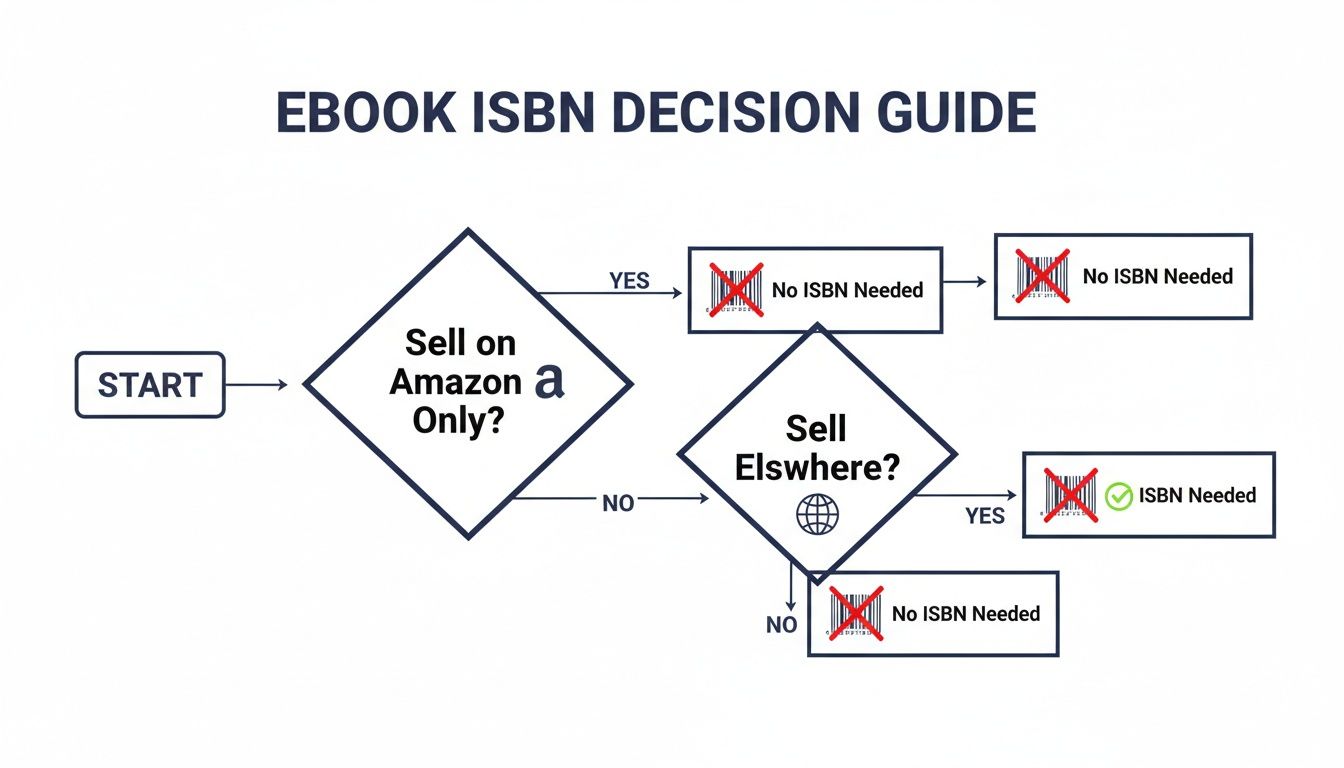
As you can see, the decision really hinges on one question: Do you want to sell your ebook anywhere besides Amazon? If the answer is yes, an ISBN quickly becomes a non-negotiable part of your strategy.
To make this even clearer, here's a quick reference table to help you decide.
ISBN Quick Decision Guide for Ebook Authors
Use this table to quickly determine if you need an ISBN based on your publishing goals and distribution strategy.
| Your Publishing Goal | Do You Need a Self-Purchased ISBN? | What You Get Instead (If Applicable) |
|---|---|---|
| I only want to sell my ebook on Amazon KDP. | No. You can publish on KDP without your own ISBN. | An ASIN (Amazon Standard Identification Number), assigned for free by Amazon. |
| I want to sell on multiple platforms (Apple, Kobo, etc.). | Yes. To distribute widely, you need a unique ISBN for your ebook. | N/A – The ISBN is your key to wide distribution. |
| I want to get my ebook into libraries and schools. | Yes, absolutely. Libraries and educational distributors rely on ISBNs for cataloging. | N/A – An ISBN is required for these channels. |
| I want to be listed as the official publisher. | Yes. Purchasing your own ISBN makes you the publisher of record for that edition. | A free platform identifier will list the platform (e.g., Amazon) as the publisher of that version. |
| I'm using an aggregator service to distribute my ebook. | It depends. Some aggregators (like Smashwords or Draft2Digital) offer free ISBNs. | A "free" ISBN from an aggregator, but they will be listed as the publisher. |
This table should help clarify the most common scenarios, but the decision is ultimately a strategic one.
Making the Strategic Choice
In the end, this isn't just a technical box to check. It's a choice that reflects your ambition as an author. Ask yourself a few key questions:
- What's my long-term vision? Are you just testing the waters, or are you building a writing career with a backlist of books you want available everywhere?
- Where is my target audience? Do your ideal readers only shop on Amazon, or are they spread across different e-reading apps and devices?
- How important is professional credibility? Do you want your author name or publishing imprint listed as the official publisher?
Getting a handle on this framework is the first step. Once you know what you want to achieve, you can make an informed choice about whether an ISBN is the right tool for the job.
What Exactly Is an ISBN and Why Does It Matter?
So, you’ve written a book. What’s the next step? Before you can get it into the hands of readers, you need to understand the system that makes the book world go 'round. At the heart of it all is the ISBN, or International Standard Book Number.
Think of an ISBN as your book's unique fingerprint. It's a 13-digit code that tells everyone—retailers, distributors, libraries, and readers—exactly which book they're looking at. Just like a barcode at the grocery store ensures you're buying the right brand of cereal, an ISBN makes sure the right book gets ordered, tracked, and sold. Without it, your book is just another file floating in a sea of digital content.
This little number connects your specific book, in a specific format (like an ebook or paperback), to all its crucial information: title, author, publisher, and more. It's the backbone of the entire book supply chain.
The Universal Language of Books
Every time a bookstore scans a book or a library catalogs a new arrival, they're using the ISBN. It creates a standardized, universal language that works across the globe.
Imagine a reader in Japan wants to buy your ebook. The ISBN ensures they get your book, not a different one with a similar title. It cuts through the noise and removes any guesswork from the process. It's this global system, coordinated by the International ISBN Agency, that allows a book published in one country to be easily found and sold in another.
Debunking the Myth of the "eISBN"
Let's clear up a common misconception right away. I often hear authors asking if they need a special "eISBN" for their digital book. The short answer? There's no such thing as an eISBN.
The standard ISBN system covers every format you can think of—paperback, hardcover, audiobook, and all types of ebooks. The rule is simple but strict: each format is considered a different product, and each product needs its own unique ISBN.
This means your EPUB file needs a different ISBN than your PDF file, and both will need different ISBNs from your paperback version. It seems like a lot, but it's how distributors manage their digital inventory. You can read more about why every ebook edition needs a unique number to see how this works in practice.
Key Takeaway: An ISBN identifies a product, not just the story inside. Your paperback is one product. Your ebook is another. Each one needs its own unique code for the publishing industry to track it properly. Getting this right from the start is a huge step in your publishing journey.
Ultimately, understanding what an ISBN is and how it functions is your first step toward publishing like a pro. It’s the mechanism that turns your manuscript from a private document into a legitimate product ready for the global market.
Publishing on Amazon Without an ISBN
If you plan to sell your ebook exclusively through Amazon’s Kindle Direct Publishing (KDP), you can skip getting an ISBN altogether. When you publish this way, Amazon assigns its own internal tracking number to your book, completely free of charge.
This unique identifier is called an ASIN, which stands for Amazon Standard Identification Number. For many authors, especially those just starting out or targeting Amazon's massive audience, this is a wonderfully simple and cost-effective route.
But it's vital to understand the catch. An ASIN is Amazon's own code; think of it like a store's private SKU number. It works perfectly within the Amazon ecosystem but means absolutely nothing to any other retailer or library system.
The Trade-Off: Simplicity for Exclusivity
Choosing Amazon's free ASIN is a classic trade-off. You get a quick, easy, and free way to publish, but you tie your ebook to a single platform.
Let’s break down what that really means for you:
- Pro: It's Effortless. The process couldn't be smoother. You upload your manuscript to KDP, and Amazon automatically assigns the identifier. No extra steps, no forms, no fuss.
- Pro: It Costs Nothing. You save the money you would have spent on an ISBN, which can be a significant upfront cost, especially if you're only buying one.
- Con: You're Locked In. The ASIN locks that specific version of your ebook into the Amazon marketplace. You can't use it to sell your book on Apple Books, Barnes & Noble, Kobo, or anywhere else.
This limitation is the single most important factor to weigh. An ASIN essentially makes your ebook invisible to other stores and libraries, which rely on the universal ISBN system for cataloging and sales.
By opting for an ASIN, you are consciously deciding to operate within one massive retail channel. If you want a full walkthrough of the platform, our guide on how to publish an ebook on Amazon covers the entire process from start to finish.
This path is a great fit for authors who are testing the self-publishing waters or have a strategy built specifically around Amazon's customer base and marketing tools. But if your long-term goal is to reach every reader on every possible platform, you’ll need to look beyond the ASIN.
Why a Personal ISBN Is a Smart Investment
If your author ambitions go beyond a single online store, then buying your own ISBN is a total game-changer. Sure, a free identifier like an ASIN works just fine for an Amazon-only approach, but a personal ISBN is a powerful asset. It tells the world you’re a serious, professional self-publisher.
Here’s a good way to think about it: using a platform's free identifier is like renting a kiosk in a giant mall. You're in business, but you're playing by their rules and your brand is forever tied to theirs.
Owning your ISBN, on the other hand, is like buying the building. You are in control.
Take Charge of Your Publishing Identity
The biggest advantage of owning your ISBN is that it lists you or your publishing company as the official publisher of record. When you accept a "free" ISBN from a distributor, they are listed as the publisher. This might not seem like a big deal, but it can affect how your book is seen by retailers, libraries, and even some readers.
By purchasing your own, you keep complete control over your book's metadata—all that critical info like title, author, and publisher that's tied to the ISBN. This keeps things consistent and professional no matter where your book shows up.
Owning your ISBN is the difference between being a tenant on someone else's platform and being the CEO of your own publishing business. It puts the power, and the professional credit, squarely in your hands.
Unlock a World of Distribution
An ISBN is your passport to "wide distribution." It’s what gets your ebook in front of millions of readers who shop on platforms beyond Amazon.
This is a huge deal when you realize that about 25% of US and UK eBook buyers use stores like Apple Books and Barnes & Noble. To reach them, you need your own ISBN. It's also your ticket into the massive library market, a fantastic channel for discoverability, and they almost always require an ISBN for their catalogs.
A Smart Financial Move for Your Author Career
Thinking about this as a strategic investment is key. It's just one piece of the puzzle when it comes to budgeting self-publishing costs.
While an ISBN does have an upfront cost, it's a long-term asset for any author building a real career. If you're planning on releasing multiple books or formats (like paperback, hardcover, and audiobook), buying ISBNs in bulk drops the price per book significantly.
To get the full picture, check out our guide on how much an ISBN costs. It's an investment that secures your control, maximizes your reach, and cements your professional standing in the publishing world for years to come.
How to Get an ISBN for Your Ebook
So, you’ve decided an ISBN is the right move for your ebook. Smart. Now comes the next step: actually getting one. The process isn't complicated, but you have a few different paths to choose from, each with its own pros and cons.
Making the right choice here is all about maintaining control and setting your book up for success. Let's break down the three main ways you can get an ISBN for your ebook.
Option 1: Buy Your Own from the Official Agency
The most direct and powerful way to get an ISBN is to purchase it straight from the source. For authors in the United States, that official agency is Bowker.
When you buy your own ISBN, you are listed as the publisher of record. This gives you complete and total control over your book’s metadata—the title, author name, description, and more—and how it’s distributed. It’s a bit of an investment upfront, but it’s a crucial one if you see yourself as a professional author or plan to build a publishing imprint.
With the global ebook market projected to reach $14.92 billion in 2025, owning your ISBNs is a serious business decision. A single ISBN might seem a little steep, but the price per number drops significantly when you buy in bulk. Most publishing pros will tell you to get at least a 10-pack, since you'll need a separate ISBN for every format: ebook, paperback, hardcover, and audiobook.
Option 2: Use a "Free" ISBN from a Distributor
If your budget is tight, you’ll notice that some distributors and aggregators, like Draft2Digital, offer to assign a "free" ISBN when you publish with them. It sounds great, and for some authors, it’s a perfectly fine starting point.
But there’s a major trade-off you need to be aware of. When you take that "free" ISBN, the distributor is listed as the publisher of record, not you. This means your professional identity as an author is now linked to their company brand.
Key Consideration: A "free" ISBN is essentially rented, not owned. You can't take it with you if you decide to move your book to another platform or distributor. That number belongs to them, not you, which can create a real headache down the road.
Option 3: Partner with a Full-Service Publisher
Don't want to deal with the technical setup and registration process yourself? For authors who prefer to focus purely on writing, partnering with a full-service publisher like BarkerBooks is the perfect solution.
This approach takes the entire ISBN process off your plate. A good publishing partner doesn't just get you a number; they handle the entire metadata registration, ensure all the details are correct, and optimize your book's listing for global discovery. It’s about more than just convenience—it’s about preventing the common, costly mistakes that can trip up new authors. If you want an expert in your corner, you can learn more about getting an ISBN for your book with our team.
Comparing Your ISBN Acquisition Options
To make it even clearer, here’s a quick breakdown of how these three options stack up against each other.
| Method | Cost | Publisher of Record | Best For |
|---|---|---|---|
| Buy Directly | Highest upfront cost, but cheaper in bulk. | You or Your Imprint | Career authors and indie publishers who want full control. |
| "Free" from Distributor | No upfront cost, but may involve royalty splits. | The Distributor | Authors on a tight budget or just starting out. |
| Full-Service Publisher | Included in a publishing package. | You, with publisher guidance | Authors who want expert help and to avoid technical hassles. |
Ultimately, the best path depends on your goals, your budget, and how much control you want to have over your publishing career. Take a moment to think about your long-term plans before you decide.
Common ISBN Questions for Ebook Authors
As you get closer to hitting that "publish" button, a few lingering questions about ISBNs always seem to surface. Let's clear the air and tackle the most common ones I hear from authors. Think of this as your final checklist for making a smart, confident decision.
Do I Need a New ISBN for Each Ebook Format?
This is where the official rule and the real world don't quite line up, which causes a lot of confusion. Technically, the international standard says that every different format—EPUB, MOBI, PDF—should have its own unique ISBN.
But here’s how it actually plays out in practice: the market has streamlined things for us. Almost every major retailer and distributor, like Amazon KDP or Kobo, now works from a single EPUB file. You upload one file, and they handle converting it for their specific devices, whether it’s a Kindle or a Nook.
So, for nearly every self-published author out there, the simple answer is you only need one ISBN for your ebook. You’ll assign that number to your primary EPUB file and use it consistently everywhere you sell. That consistency is key for making sure all your sales data tracks back to the same product.
If I Update My Ebook, Do I Need a New ISBN?
Great question. The answer comes down to how big the update is. Not every little tweak requires you to get a new number.
You do not need a new ISBN for minor fixes. Think of things like:
- Zapping a few typos or fixing grammar mistakes.
- Slightly adjusting the formatting.
- Uploading a fresh, new cover design.
However, you absolutely do need a new ISBN if you're making changes so substantial that you're essentially creating a new edition. This includes things like:
- Adding whole new chapters or significant amounts of content.
- Completely rewriting large sections of the book.
- Adding a new foreword written by someone else.
Think of it this way: minor fixes are like patching a tire. Major revisions are like dropping a whole new engine in the car. One is a simple repair, but the other creates a fundamentally different product that needs its own unique identifier.
Does an ISBN Provide Copyright Protection?
This is a critical point to get straight: an ISBN and a copyright are two completely different things, and they do two completely different jobs.
An ISBN is simply a product number for commerce. It’s a tool that helps retailers, libraries, and distributors keep track of their inventory. It has absolutely zero legal power and offers no copyright protection whatsoever.
Copyright, on the other hand, is your legal claim to your creative work. It’s what protects your intellectual property from being stolen or used without your permission. In most countries, including the U.S., you own the copyright the second you write the words. For the strongest legal protection, you'll want to formally register that copyright with the appropriate government body, like the U.S. Copyright Office. This has nothing to do with getting an ISBN.
Can I Use the Same ISBN for My Ebook and Paperback?
No, you can't. This is one rule that has no wiggle room. From the perspective of the global publishing industry, every format of your book is a separate product, and each one needs its own ISBN.
This isn't just bureaucracy; it's essential for the entire supply chain. Bookstores, libraries, and online retailers rely on those unique numbers to order, stock, and track sales for each format accurately.
So, your product list will look like this:
- Ebook (EPUB): Needs its own ISBN.
- Paperback: Needs a different ISBN.
- Hardcover: Needs yet another ISBN.
- Audiobook: Yep, it needs its own unique ISBN, too.
This is exactly why publishing pros will tell you to buy ISBNs in a block of 10 or more. It's far more cost-effective in the long run, especially if you plan to release multiple formats or write more books. It saves you from having to buy expensive single ISBNs every time you need one.
Navigating the world of ISBNs, copyright, and distribution can feel like a lot to juggle, but you don't have to figure it all out on your own. At BarkerBooks, our team handles these details every day, from ISBN registration to getting your book on stores worldwide, so you can focus on the part you love—writing. Ready to publish like a pro? Learn how our publishing packages can set you up for success.