
To get a professionally polished, market-ready novel out the door, you can expect to invest anywhere from $2,940 to $5,660. This range covers the essentials—editing, cover design, and formatting—that put your book on a level playing field with traditionally published titles.
Your Quick Guide to Self-Publishing Expenses
Think of publishing your book like building a custom home. You could go the DIY route, learning as you go and using basic materials. Or, you could bring in a team of experienced architects, designers, and builders to construct something truly remarkable. The final cost—and the final product—really depends on the level of professional expertise you decide to bring on board.
Getting a handle on these costs is the very first step in mapping out a realistic budget for your author career. These aren't just line items on a spreadsheet; they're strategic investments in your book's future success. A brilliant story can easily get lost if it's not packaged professionally.
The Major Cost Categories
Getting your manuscript from a Word document to a reader's hands involves a few key services, and each one comes with its own price tag. Based on current industry rates, an author with an 80,000-word manuscript should budget between $2,940 and $5,660 for a high-quality production.
The lion's share of that budget typically goes to professional editing, which can run anywhere from $2,000 to $4,720. After that, you've got other crucial expenses like cover design ($400–$1,000) and interior formatting ($200–$500). You can dive into a more detailed breakdown of these publishing expenses to fine-tune your own budget.
This chart gives you a quick visual on how those three core production costs stack up.
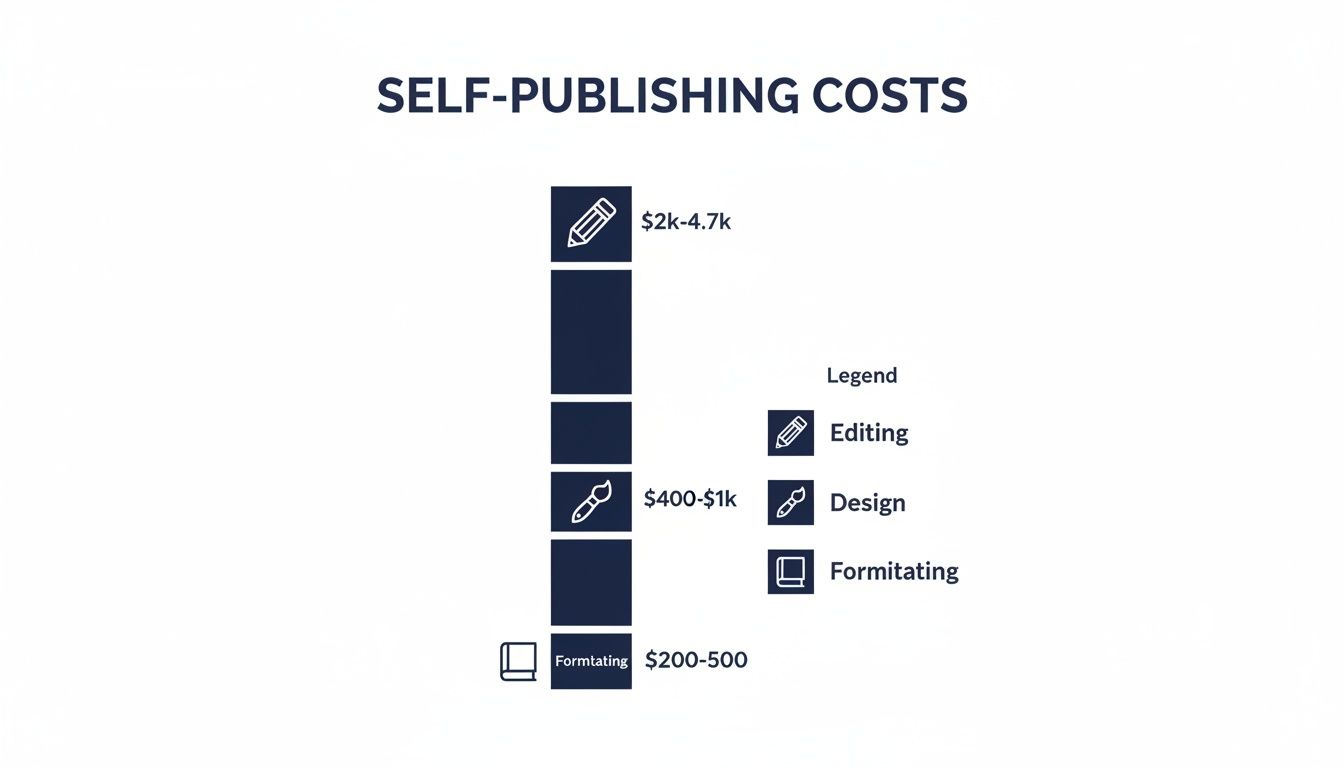
As you can see, editing is by far the biggest piece of the pie. It's a testament to just how critical a sharp, professional edit is for creating a book that readers will love.
To give you a clearer picture, here's a look at what to expect for each key service.
Estimated Self-Publishing Cost Breakdown
This table provides a summary of typical cost ranges for the essential services you'll need to produce a professional-quality book. The "Low-End" reflects what you might pay for more basic services or by doing some of the work yourself, while the "High-End" represents hiring experienced, top-tier professionals.
| Service Category | Low-End Estimate (DIY/Basic) | High-End Estimate (Professional) |
|---|---|---|
| Editing | $2,000 | $4,720 |
| Cover Design | $400 | $1,000 |
| Formatting/Typesetting | $200 | $500 |
| Marketing | $340 | $4,500+ |
| Total Estimated Range | $2,940 | $10,720+ |
Keep in mind that these figures are estimates. Your final costs will depend on your book's genre, word count, and the specific professionals you choose to hire.
Breaking Down the Core Services
- Editing: This is your most important investment, period. It’s not just about catching typos; it’s about making sure your story flows, your characters are compelling, and your writing is as sharp as it can be.
- Cover Design: People absolutely judge a book by its cover. It's your most powerful marketing tool, instantly telling a potential reader what your book is about and signaling its quality. A professional design is non-negotiable.
- Formatting/Typesetting: This is the invisible art of making a book readable. Good formatting ensures the interior looks clean and professional for both print and ebooks, creating an effortless experience for the reader.
- Marketing: This is where things can really vary. You can start small with some online ads or go big by hiring a publicist. While technically optional, a dedicated marketing budget is what helps readers discover your book in a crowded market.
The Core Investment: Editing and Design
Think of your manuscript as a raw block of marble. Editing and design are the tools you use to chip away the rough edges and polish it into a work of art. It’s always tempting to cut corners on these two, but they are hands-down the most critical investment you'll make in your book's quality and its chances of success.
Skimping on editing is like building a house on a shaky foundation. No matter how pretty it looks from the outside, the whole thing is destined to crumble. Likewise, a bad cover is a locked door. It doesn't matter how incredible your story is if a potential reader’s first glance tells them it’s not worth their time. Investing here signals that your book is professional and worth a read, often making the difference between a sale and a scroll-past.
How to Budget for Editing
Editing isn't a one-and-done deal. It's a multi-stage process, and each stage has a specific job. For a typical 80,000-word book, you can expect the total cost for professional editing to land somewhere between $2,000 and $4,720. Knowing what you're paying for helps you budget smart. For a deeper dive into the numbers, check out this complete breakdown of how much book editing costs.
Here are the four main types of editing you'll encounter:
- Developmental Editing: This is the 10,000-foot view. A developmental editor looks at the big picture—plot, character development, pacing, and overall structure. They're like an architect reviewing the blueprints to make sure the building will actually stand up before you start putting up walls.
- Line Editing: Once the structure is solid, the line editor comes in to work on your writing at the sentence level. They focus on the flow, clarity, and voice of your prose, making sure every sentence pulls its weight. This is about elevating the craft of your writing.
- Copyediting: Now we get into the nitty-gritty. The copyeditor is your technical expert, meticulously hunting down errors in grammar, spelling, punctuation, and syntax. They're the inspector making sure all the wiring and plumbing is up to code.
- Proofreading: This is the final quality check. After the book has been formatted and laid out, a proofreader does one last pass to catch any typos or formatting glitches that slipped through. It’s the last line of defense before your book goes public.
You wouldn't let a car roll off the assembly line without a final inspection. Proofreading is that final inspection for your book, ensuring your reader has a smooth, enjoyable experience.
Designing a Book That Sells
While editing refines what's inside, design is what gets a reader to pick up the book in the first place—whether from a shelf or a grid of online thumbnails. A professional book cover design will typically run you about $880, though this can vary depending on the designer’s experience and the cover's complexity. Don't cheap out here. Your cover is your single most important marketing tool.
A truly effective cover does three things in an instant:
- It signals the genre. A reader should know immediately if they're looking at a thriller, a romance, or a fantasy novel.
- It conveys the tone. Is your book dark and serious or lighthearted and funny? The cover sets the right expectations.
- It looks professional. A quality design tells the reader that there's a quality story inside, allowing it to compete with books from major publishing houses.
But design doesn't stop at the cover. The interior formatting, or typesetting, is just as important for readability. This process ensures the text is easy to read, the margins are correct, and the layout is clean and consistent. Simple formatting can often be done with free tools, but for more complex projects—like a cookbook or a heavily illustrated nonfiction book—you'll likely need a professional typesetter, which can cost between $450 and $1,190.
The goal is to create an experience so seamless that the reader gets lost in the story and never even thinks about the formatting. This holds true for both print books and ebooks, as each format has its own specific requirements to look its best.
Getting Your Book Into Readers' Hands
You've done the hard work of writing and editing. Now, how do you actually get your book into the hands of readers? This is where the magic of distribution comes in, turning your polished manuscript into a real product people can buy and enjoy.
It might sound intimidating, but it really boils down to two main things: giving your book an official ID number and then setting up a system to print and ship it. Thankfully, the modern publishing world makes this easier and more affordable than ever. You don't need a garage full of unsold books anymore.
Securing Your Book’s Official ID
Think of an ISBN (International Standard Book Number) as your book's unique social security number. It's a 13-digit code that retailers worldwide—from Amazon to your local bookstore—use to track and sell your book. If you want to be in their stores, you need one.
You've got a couple of choices here:
- Platform-Provided ISBN: A service like Amazon's KDP will give you an ISBN for free. The catch? They are listed as the publisher, which can tie you exclusively to their platform and limit your sales channels.
- Buying Your Own ISBN: The best move for serious authors is to buy your ISBNs directly from Bowker, the official US agency. A single ISBN costs $125, but a block of 10 is only $295. It’s a smart investment if you see more books in your future.
Owning your ISBN puts you in the driver's seat. It makes you the publisher, giving you the freedom to print and distribute your book anywhere you want, with no strings attached.
Remember, you'll need a different ISBN for every format: paperback, hardcover, ebook, and audiobook. That’s why the 10-pack is such a popular, cost-effective strategy for career authors.
The Power of Print-on-Demand
Say goodbye to the old days of authors taking out a second mortgage to pay for a massive print run. Print-on-demand (POD) has completely changed the game for self-publishers. With POD, a physical copy of your book is printed only after a customer buys it.
The two giants in this space are Amazon KDP and IngramSpark. The process is simple: you upload your final book files, and when a reader clicks "buy," the service prints a fresh copy and ships it straight to them.
The best part? There are zero upfront printing costs. The printing fee is just taken out of your royalties for that sale. This model removes all the financial risk and logistical nightmares, making it the standard choice for nearly every indie author today. Getting the logistics right is crucial, which is why many authors rely on expert book distribution services to ensure they reach the widest possible audience.
Ebook Conversion and Other Formats
While print is powerful, ebooks are a huge slice of the pie. It's critical to get your manuscript formatted correctly for digital readers like Kindle, Apple Books, and Kobo. Messing this up can lead to a terrible reader experience and a flood of bad reviews. It’s a small investment that pays off big time.
And don't stop there. Once your book is out, think about expanding its reach. Learning how to record an audiobook can open up an entirely new audience and revenue stream, tapping into the massive and growing market of listeners. Each new format is another way for readers to discover and fall in love with your work.
How Author Royalties Actually Work
Getting a handle on the costs of self publishing a book is only half the battle. The other, far more exciting half, is understanding how you actually get paid. Author royalties can feel a bit mysterious at first, but the idea is simple: it’s the slice of the pie you get to keep after everyone else takes their cut.
Think of it like selling something you made at a local market. The market owner (the platform, like Amazon KDP) takes a fee for the table space, and you have to cover the cost of your materials (in this case, printing). What’s left over is your profit—your royalty.
The Basic Royalty Formula
For a physical print book, the math for what you earn on a single sale is pretty straightforward.
Retail Price – Platform Fee – Printing Cost = Your Royalty
This little formula shows you the three main moving parts. You really only control the retail price, but how you set it directly impacts how much the other two factors eat into your earnings. Each platform calculates its fees a little differently, so where you sell your book can definitely change your profit margin.
Ebook Royalty Rates
With ebooks, things get much simpler. Since there’s no physical book to print, there are no printing costs. This is why ebook royalty rates are so much higher, making them a fantastic part of any author’s sales strategy.
- Amazon KDP: Amazon has two main royalty options. If you price your ebook between $2.99 and $9.99, you can get a 70% royalty. Price it outside that sweet spot, and the royalty drops to 35%.
- Other Platforms: Retailers like Apple Books, Barnes & Noble Press, and Kobo are a bit more direct, usually offering a flat 70% royalty, no matter the price.
This structure really incentivizes authors to price their digital books in that competitive mid-range. A 70% cut means you keep most of the money from every sale, which adds up fast.
Paperback and Hardcover Royalty Realities
When it comes to selling a physical book, the numbers get a bit more complicated. For an ebook priced at $6.99 on Amazon, you might see a royalty of around $4.80. Not bad at all.
But for a standard 200-page, 6"x9" paperback listed at $16.99, the printing cost alone can be anywhere from $3.40 to $4.28. If you sell that book directly on Amazon, you might earn $6.79 per copy. But if that same book sells through an expanded distribution channel to another bookstore, your royalty plummets to just $3.40. For a deeper dive, you can find more details about these royalty calculations on danieljtortora.com.
Your distribution choice is one of the biggest factors affecting your print royalties. Selling directly on a platform like Amazon always yields a higher return than selling through its expanded network to other retailers.
Why the big drop? Expanded distribution adds another middleman—the bookstore or library buying your book—and they need to take their cut, too. That cut comes directly out of your pocket.
A Practical Royalty Comparison
Let's look at how this plays out with a real-world example. Say you've written a 250-page paperback and priced it at $15.99. The table below gives you a snapshot of what you could expect to earn across different platforms and channels.
Sample Royalty Calculation Per Book Sale
| Platform | Retail Price | Est. Printing Cost | Platform Fee | Author Royalty Per Sale |
|---|---|---|---|---|
| Amazon KDP (Direct Sale) | $15.99 | ~$4.10 | 40% ($6.40) | $5.49 |
| Amazon KDP (Expanded) | $15.99 | ~$4.10 | 60% ($9.60) | $2.29 |
| IngramSpark (US Retailer) | $15.99 | ~$4.07 | 55% ($8.80) | $3.12 |
This comparison makes the trade-off crystal clear. Selling direct-to-customer on Amazon gives you the biggest profit on each book. However, using expanded distribution or a platform like IngramSpark gets your book into more places—physical bookstores, libraries, other online shops—which can lead to more sales overall, even if you’re making less on each one.
Budgeting for Book Marketing and Promotion
Getting your book professionally edited and designed is a massive win, but it’s only half the battle. Let's be honest: a brilliant book that nobody knows exists isn't going to sell itself. This is where marketing and promotion come in, moving you from creator to promoter.
Think of it like opening a new restaurant. You might have the world's best chef and a stunning menu, but if you don't put up a sign, run a few local ads, or host a grand opening, the seats will stay empty. Marketing is your book's grand opening, and it needs a dedicated budget to make a real impact.
It's critical to factor marketing into the total costs of self publishing a book. While the spending can vary wildly, smart authors treat it as an investment—a necessary one to make sure their hard work finds its way into the right hands. Without a plan to get discovered, even the most incredible book can vanish on the crowded digital shelves.
Building Your Foundational Marketing Assets
Before you spend a dime on ads, you need a home base for your author brand. Think of these as one-time or low-cost investments that pay off for years to come. They give readers a place to find you and connect with your work.
Your most critical asset is a professional author website. This is your personal turf on the internet, a hub you control completely. It should showcase your book, tell readers who you are, maybe include a blog, and—most importantly—have a clear way for people to join your email list.
Next up is your social media presence. You don't need to be everywhere at once. Just pick one or two platforms where your ideal readers hang out and focus on building genuine connections there. These first steps are all about establishing your credibility and making yourself findable.
Paid Advertising and Promotional Campaigns
Once you've laid that groundwork, you can start exploring paid strategies to give your book's visibility a serious boost. These costs can range from a small monthly experiment to a significant investment, all depending on your goals.
Here are a few of the most common paid marketing channels for authors:
- Amazon Ads: This is one of the most direct routes to reaching people who are actively shopping for books. You can start with a daily budget as low as $5-$10 per day to get your book in front of readers searching for similar titles.
- Social Media Ads: Platforms like Facebook and Instagram offer incredibly powerful targeting options. To get the most out of your budget, you really need to master social media marketing costs so you can understand what to spend and what to expect in return.
- Book Promotion Sites: Services like BookBub, Fussy Librarian, or Bargain Booksy will blast news of your discounted ebook out to their huge email lists. A featured deal can run anywhere from $50 to over $1,000, depending on the site's size and your book's genre.
A well-planned marketing campaign isn't about throwing the most money at the wall; it's about spending it wisely. Start small, see what resonates with readers in your genre, and then double down on what works.
Professional Services and Publicity
For authors aiming to make a bigger splash, bringing in professionals can dramatically expand your reach. These services come with a higher price tag, but they can deliver a major return in terms of visibility and sales. A publicist, for instance, might charge $2,000 to $5,000 for a campaign spanning several months to land media features and reviews.
Getting professional book reviews is another key piece of the puzzle. It builds "social proof." Services like Kirkus Reviews or Reedsy Discovery can provide credible, third-party reviews that give your book instant authority, though they typically cost a few hundred dollars each.
In the end, your marketing budget is entirely personal to your goals. You might kick things off with just a simple website and a tiny ad spend, or you could go all-in with a publicist right from the start. The most important thing is to have a clear strategy. Building a comprehensive book marketing plan will help you put your money where it matters most, ensuring every dollar works hard to connect your story with eager readers.
Smart Strategies to Lower Your Publishing Costs
Watching those numbers climb can be a little intimidating, I get it. But the good news is you have more control over the final costs of self publishing a book than you probably realize. With a bit of smart planning and a dash of creativity, you can bring your expenses way down without sacrificing the professional quality your book deserves.
Think of it like renovating a house on a budget. You'd never try to rewire the electricity yourself, but you might tackle the painting to save some cash. The same principle applies here: invest in the essentials you can't afford to get wrong, and look for clever ways to save on the rest.
Prioritize High-Impact Investments
Let's be honest, not all publishing expenses are created equal. Some investments give you a much bigger bang for your buck because they directly influence whether someone buys your book. When you’re figuring out where to spend, these two areas should be at the very top of your list.
- Professional Cover Design: This one is non-negotiable. Your cover is your book's #1 marketing tool. A cheap, amateur-looking cover immediately signals "low quality" and will sink your sales before a reader even bothers to read the description.
- Thorough Copyediting: Even the most incredible story will fall flat if it's littered with typos and grammatical mistakes. A clean, professionally edited manuscript tells readers you respect their time and is absolutely critical for earning good reviews.
By funneling the bulk of your budget into these two areas, you’re giving your book a fighting chance to compete with traditionally published titles. You can be frugal elsewhere, but skimping here is a risk that just isn't worth taking.
Get Creative with Cost-Saving Tactics
Beyond just prioritizing, there are plenty of practical ways to trim your budget. One of the best methods is to lean on the writing community and the resources available to you.
"Share your finished work with a range of trusted people, ideally those who are your target readership… These are called beta readers." – Alex M., Professional Editor
This is an amazing way to get feedback on your story's flow and catch any big-picture problems before you shell out for a pricey developmental edit. Beta readers can spot plot holes, confusing character arcs, or pacing issues—all for free.
You can also think about bartering your skills. Are you a talented graphic designer? Maybe you can trade a cover design for editing services. A social media pro? Offer to help another author with their launch plan in exchange for some proofreading. It's a classic win-win that saves everyone money.
And here’s a simple one: buy your ISBNs in a block of 10 for $295 instead of just one for $125. If you plan on writing more than one book (and I hope you do!), this move alone offers huge long-term savings.
Your Top Questions About Self-Publishing Costs, Answered
Let's be honest, figuring out the financial side of self-publishing can feel a little overwhelming. Below, I’ve answered a couple of the most common questions authors ask when they're trying to budget for their book launch.
So, Can You Really Self-Publish a Book for Free?
The short answer is yes, technically you can. Platforms like Amazon KDP don't charge you to upload a file, and you could theoretically do everything yourself.
But the real question is, should you? The "free" route means skipping professional editing and cover design. Think of it this way: you wouldn't open a restaurant and do all the cooking yourself unless you were a trained chef. Doing it all yourself is a surefire way to get lost in a crowded market and rack up negative reviews.
A professional presentation isn't a luxury; it's the price of entry. Investing in great editing and a killer cover is a direct investment in your book's ability to find its audience and succeed.
What’s the Single Biggest Cost I Should Plan For?
For nearly every author I've worked with, professional editing is the most significant line item in the budget. And for good reason.
This isn't just about fixing typos. A thorough edit—which might include developmental, line, and copyediting phases—is what makes your story coherent, compelling, and clean. It’s the foundation of your book's quality. While the cost will depend on your book's length and the editor's experience, cutting corners here will hurt your book's reception more than anything else.
Ready to turn your manuscript into a professionally published book without the guesswork? BarkerBooks offers comprehensive, all-in-one packages that cover everything from editing and design to global distribution. Let our team of experts handle the details so you can focus on writing. Explore our publishing packages today.