
So, you’ve poured your heart and soul into writing a manuscript. What’s next? Getting it into the hands of readers can feel like a daunting task, and navigating the world of publishing is often confusing. That's where a book publishing program comes into the picture.
Think of it as the sweet spot between going it completely alone (DIY self-publishing) and handing over your manuscript to a massive corporation (traditional publishing). A program gives you access to a team of seasoned pros—editors, designers, and marketers—all dedicated to bringing your book to life, but with one crucial difference: you keep complete creative control and all the rights to your work.
What Is a Book Publishing Program, Really?
Let’s use an analogy. Say you want to build a house. You've got the vision, the floor plan (your manuscript), but you're not a plumber, an electrician, or an architect.
You could try to build the entire thing yourself. That’s the DIY self-publishing route. It's incredibly rewarding if you pull it off, but it’s also time-consuming, and a few mistakes can compromise the whole structure.
On the other end of the spectrum, you could sell your blueprint to a huge development company. This is like traditional publishing. They'll build the house, but they’ll also own it, and they might decide to swap out those bay windows you loved for something more "market-friendly."
A book publishing program is like hiring a top-notch general contractor. You’re still the owner, and you make all the final decisions. But the contractor brings in their trusted crew of specialists to handle the wiring, plumbing, and framing. You’re investing in expertise to ensure your dream home is built to the highest possible standard.
The Modern Middle Path for Authors
This approach isn't a one-size-fits-all solution; it's a flexible pathway built for the modern author who values both quality and autonomy. You get the benefit of a team that knows the ins and outs of the industry, from editorial best practices to the complex logistics of distribution.
Here’s a look at how the three main publishing paths stack up.
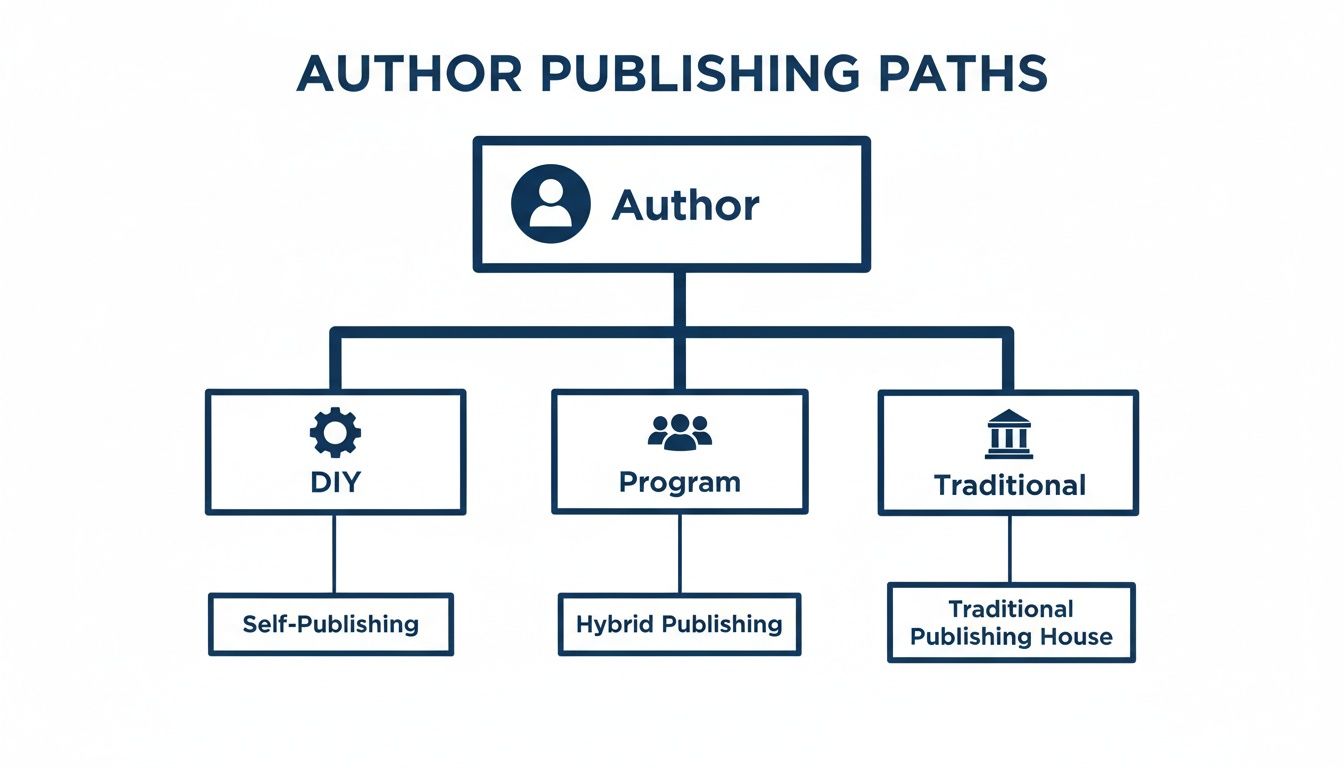
As you can see, a program offers a collaborative, team-based approach. It’s a genuine partnership, not the lonely road of DIY or the gatekept world of traditional houses.
A book publishing program is an investment in your author career, not just in a single book. You are building an asset you fully control, backed by the machinery of a professional publisher.
This is a critical point. While a traditional publisher might offer an advance, they also take the lion's share of the profits—often 90% or more of net receipts. With a publishing program, you cover the production costs upfront but in return, you can earn anywhere from 70% to 100% of the royalties. Over the life of a book, that financial difference can be staggering.
For a clearer picture, let's break down the key differences between these options side-by-side.
Publishing Paths Compared at a Glance
This table offers a quick comparison of the three primary routes an author can take to get their book published.
| Feature | Book Publishing Program | Traditional Publishing | DIY Self-Publishing |
|---|---|---|---|
| Creative Control | Full control | Limited control | Full control |
| Ownership & Rights | Author retains 100% | Publisher owns rights | Author retains 100% |
| Upfront Cost | Author invests | No cost to author | Author pays for all services |
| Royalties | High (70-100%) | Low (5-15%) | High (40-70%) |
| Time to Market | Fast (3-6 months) | Very slow (1-3 years) | Very fast (as quick as you are) |
| Expert Support | Built-in professional team | Provided by publisher | Author must find and vet freelancers |
| Barrier to Entry | Low (must have a quality manuscript and budget) | Very high (requires an agent and acceptance) | None (anyone can upload a file) |
Each path has its place, but as you can see, a program provides a unique balance of support, speed, and financial reward that appeals to a growing number of authors.
Who Is a Publishing Program For?
This model isn't right for everyone, but it’s a game-changer for authors who are serious about their work and want to build a sustainable career.
A book publishing program is an excellent fit for:
- Entrepreneurs and experts who see their book as a cornerstone of their brand and a powerful credibility-builder.
- First-time authors who feel overwhelmed and need expert guidance to avoid common pitfalls.
- Established authors leaving the traditional system in search of more creative freedom and a much bigger slice of the financial pie.
- Writers with a polished manuscript who simply don't have the time or specialized skills to manage dozens of production and marketing tasks themselves.
Ultimately, when you choose a book publishing program, you're stepping into the role of publisher-in-chief, but with a seasoned crew supporting you every step of the way. You're the CEO of your book, making the final call on everything from the cover art to the launch strategy, ensuring the finished product is exactly what you envisioned.
The Core Services That Create a Professional Book
A brilliant manuscript is the soul of a book, but it's the professional services built around it that turn that soul into a body ready to meet the world. Think of your manuscript as a stunning architectural blueprint. The blueprint is essential, but you still need a team of expert builders, electricians, and designers to construct the actual house. That's exactly what a book publishing program provides: the team of specialists who bring your vision to life.
Each service plays a critical part in the journey, and knowing the "why" behind them is what separates hopeful writers from successful authors. These aren't just items on a checklist; they're interconnected steps that ensure your book can hold its own against bestsellers from major publishing houses. Let's pull back the curtain on the essential components that transform your words into a polished, market-ready book.
Editorial Services: The Foundation of Quality
Before a single page gets designed, the manuscript itself has to be rock-solid. This is where editing comes in, laying the groundwork for everything that follows. Many authors hear "editing" and immediately think of catching typos, but it's a much deeper, multi-layered process that strengthens your book from its core concept down to the last comma.
The editorial journey is typically broken into a few key stages:
- Developmental Editing: This is the big-picture edit. A developmental editor is like a story architect, looking at your book's overall structure, plot, character development, and pacing. They'll ask the hard questions: Is the narrative arc satisfying? Are the characters' motivations believable? For non-fiction, is your argument clear, compelling, and well-supported?
- Copyediting: With the structure firmly in place, the copyeditor steps in to work at the sentence level. Their job is to polish your prose, refining grammar, syntax, word choice, and maintaining consistency throughout. This is all about making your writing sharp and professional without sacrificing your unique authorial voice.
- Proofreading: This is the final, meticulous quality check right before the book goes public. A proofreader is your last line of defense, hunting down any sneaky typos, formatting errors, or punctuation mistakes that have managed to survive the earlier stages.
These editing phases work in harmony to take a manuscript from good to truly exceptional. Skipping proper editing is one of the most common pitfalls that immediately flags a book as amateur. To get a better handle on this crucial first step, you can learn more about professional book editing services and see how they shape a manuscript.
Design That Sells: The Cover and Interior
Let's be honest: people absolutely judge a book by its cover. In the blink-and-you'll-miss-it world of online bookstores, your cover is the single most important marketing tool you have. It has just a few seconds to grab a reader's attention. A professional book publishing program knows that great cover design is both an art and a science, using genre cues and striking visuals to create an immediate, irresistible appeal.
A great cover makes a promise to the reader about the experience inside. A professional interior layout ensures the book delivers on that promise.
But incredible design doesn't end with the cover. The interior layout, often called typesetting, is what shapes the actual reading experience. This involves everything from choosing the right fonts and setting the margins to managing how the text flows on the page. A clunky, poorly designed interior is jarring and can easily pull a reader out of the world you’ve worked so hard to build.
The Backstage Essentials: ISBN and Distribution
Once your book is beautifully edited and designed, it needs the right credentials to officially enter the marketplace. This is where the technical, behind-the-scenes work becomes so important. A huge piece of this puzzle is the International Standard Book Number (ISBN). Think of the 13-digit ISBN as your book's unique passport for the entire world of commerce.
Without an ISBN, your book simply can't be sold by major retailers, tracked in industry databases, or ordered by libraries and bookstores. A true book publishing program takes care of this entire process for you, assigning a unique ISBN that identifies you as the publisher.
This brings us to the next vital service: global distribution. A publishing program plugs your book into a massive network of wholesalers and retailers, making it available for purchase across the globe. This means your book won’t just be on Amazon—it will be listed and orderable through:
- Major Online Retailers: Including giants like Barnes & Noble, Apple Books, and Google Play.
- Physical Bookstores: Giving independent and chain bookstores the ability to stock your book on their shelves.
- Libraries and Academic Institutions: Opening up your work to an entirely new and diverse audience.
This distribution network is what gives your book maximum reach, putting it in the very same channels used by the world's biggest publishers. Without that infrastructure, even the best book will struggle to find its readers.
Weighing the Benefits and Investment

So, is a book publishing program the right move for you? It's a big question, and the answer hinges on a trade-off: a significant upfront investment for some truly powerful advantages. Getting a clear picture of this balance is the only way to know if this path lines up with what you want to achieve as an author.
On one side of the scale, you get a direct line to a team of publishing pros. Forget about spending months trying to find, vet, and manage a dozen different freelancers. With a program, you’re plugging into a well-oiled machine, which can seriously speed things up. We often see authors go from a finished manuscript to a published book in just 3-6 months, a world away from the 1-3 years you might wait with a traditional publisher.
Retaining Control and Maximizing Returns
Speed is great, but the two biggest draws are creative control and a much bigger piece of the pie. When you work with a publishing program, you’re in the driver's seat. Every decision, from the final cover art to the marketing plan, is yours to make. Your book will be exactly what you envisioned, with no compromises forced by a sales committee.
That ownership extends right to your bank account. A traditional publisher might offer royalties in the 5-15% range (of net receipts, no less). But with a service-based program, you keep the lion's share of the profits—typically 70% to 100%. This completely changes the financial equation, turning your book from a small income stream into a valuable asset you own outright.
Of course, these benefits come with that one major consideration: you have to fund the project yourself. Unlike traditional publishing, where the publisher foots the bill, you’re making the initial investment. This reality makes this path a much better fit for authors who are treating their book as a serious business venture.
A book publishing program is an investment in your author career, not just in a single book.
Thinking about it this way is key. You're not just buying services; you're building a professional-grade asset and laying the foundation for your long-term author platform.
Mitigating Risk Through a Reputable Partner
Naturally, putting your own money on the line feels risky. And that’s exactly why choosing the right partner—one with a solid reputation and a track record you can verify—is an absolute must. A high-quality publishing program reduces that risk by being transparent about its process, showing you its portfolio of successful books, and dedicating a team of experts to your project. Their proven system for editing, design, and distribution ensures your money goes toward creating a book that can actually compete in the marketplace.
Ultimately, it all comes down to your goals, your budget, and what you want your author career to look like. For many, the ability to keep full creative and financial control while working with a team of experts makes the upfront cost a smart, strategic investment in their future.
How to Choose the Right Publishing Partner
Picking a book publishing program is a huge decision. Think of it less like a service you're buying and more like choosing a business partner for your author career. The right fit can set your book up for success, but the wrong one can turn into a nightmare of frustration and wasted money. To protect your manuscript and your bank account, you have to vet potential partners with a healthy dose of skepticism, always looking for transparency, real results, and a genuine interest in seeing authors thrive.
This isn't just about finding a company that will say "yes" to your book. It's about finding a team with the actual expertise and infrastructure to turn your manuscript into a professionally polished product. Predatory companies love to make grand promises wrapped in vague language, but a legitimate partner will be an open book themselves. They'll welcome your toughest questions and give you clear, straight answers that build your confidence.
Your Vetting Checklist: Four Critical Questions
Before a contract ever hits your inbox, it's time to put on your detective hat. Your mission is to gather hard evidence that proves what a company can actually do for you. By arming yourself with the right questions, you can cut straight through the slick marketing copy and find out what a program truly offers.
Start with these four essential inquiries:
- What specific services are included in your packages? You need a detailed, line-by-line breakdown. Vague phrases like “marketing assistance” or “editorial review” are major red flags. A professional program will tell you exactly what you’re getting—for instance, a 5,000-word developmental edit, a custom cover design with three initial concepts, or distribution to specific, named retailers.
- Can I review a portfolio of books you’ve published in my genre? A company's past work is the best predictor of its future performance. If you wrote a sci-fi novel, you need to see other sci-fi novels they’ve brought to market. This is the only way you can judge the quality of their cover designs, interior layouts, and editing for books aimed at an audience just like yours.
- What does your distribution network look like? Don't let them get away with a simple, “we distribute everywhere.” Ask for the nitty-gritty details. Do they have direct relationships with major wholesalers like Ingram? Will your book be available for order by brick-and-mortar bookstores and libraries? A powerful distribution network is the absolute backbone of a successful book launch.
- What marketing support do you provide after the book launches? Getting the book published is only half the battle. Find out what happens on launch day and in the weeks that follow. Do they help authors set up Amazon ads? Do they provide social media assets? Do they offer press release distribution? A true partner invests in your book's long-term visibility, not just its release.
Look for Social Proof and Transparency
Asking direct questions is just the first step. You also need to look for outside validation. Social proof is a powerful gut-check on a company's reputation and track record. A long history of happy authors is one of the clearest signs you've found a trustworthy book publishing program.
A reputable publishing partner doesn't just sell services; they showcase results. Their website and public presence should be filled with author testimonials, case studies, and a diverse portfolio of high-quality books.
Keep an eye out for these key signs of a quality partner:
- Verified Reviews: Look for reviews on third-party sites like Google, Trustpilot, or the Better Business Bureau. These are much harder to fake and give you a more honest picture of what it's like to work with them.
- A Robust Author Portfolio: A strong portfolio doesn't just show experience; it shows versatility. It proves they can handle different genres and produce consistently professional work across the board.
- Transparent Pricing: All costs should be laid out clearly upfront, with zero hidden fees. If a company gets cagey about providing a detailed quote, that’s a massive warning sign. You can learn more about finding a publishing company that fits your needs in our detailed guide.
As you evaluate potential partners for your book, it's smart to explore all the different ways authors are building their careers these days. You might even find it useful to compare the best Patreon alternatives for writers to see how other creator-focused platforms work. Doing this kind of homework ensures you end up with a partner that truly aligns with your vision and goals.
Understanding the Costs and Potential Returns

Let's talk about the elephant in the room: money. The price of a book publishing program is often the biggest question mark for authors. It's easy to see it as a huge expense, but it’s more helpful to think of it as a strategic investment in your business asset—your book.
This isn't like buying a new laptop. You're funding the entire professional team and process required to build a high-quality product that can hold its own in a crowded global market. That price tag isn’t random; it directly reflects the expertise, time, and resources needed to get your manuscript from a Word document to a polished, professional book.
This is exactly why costs swing so wildly from one program to another. A bare-bones package for essential editing and a simple cover will, of course, cost less. On the flip side, an all-inclusive program with ghostwriting, audiobook production, and a major marketing push is a much bigger investment, but one with a potentially much bigger payoff.
What Drives the Final Price
So, what actually determines the total investment? A few key factors will move the needle on any quote you receive. Knowing these will help you figure out what you truly need and where your money is going.
- Editorial Complexity: A clean, well-organized manuscript needs a different level of attention than a rough first draft that requires a complete structural overhaul. The deeper the edit, the more it costs.
- Design Choices: A simple, elegant text-based cover takes far less time and resources than a custom-commissioned illustration or a complex photo shoot. Your artistic vision directly shapes the price.
- Marketing Scale: There's a big difference between a basic launch plan and a sustained, multi-channel advertising campaign. The scope and duration of your marketing are major cost factors.
- Format Add-Ons: Want an audiobook or a beautiful hardcover edition? These require specialized skills and production steps, which will be reflected in the final investment.
If you want to dig deeper into the specific numbers, our guide on the cost to publish a book breaks it all down.
Connecting Your Investment to a Growing Market
Putting money into professional services isn't just about making your book look good. It's about giving it a real shot at success in a booming industry. The global book publishing market is on an incredible growth trajectory, projected to jump from $136.5 billion in 2024 to $229.5 billion by 2035. You can explore more data on the growing global book market on Fortune Business Insights.
A book publishing program provides the essential infrastructure—quality, credibility, and distribution—to effectively access this expanding market and maximize your potential for a strong return.
This surge creates a massive opportunity, but only for authors who can deliver a professional-grade product that meets reader expectations.
Ultimately, your investment is a calculated risk. It's about bringing in an expert team to dramatically increase your book's chances of finding its readers, driving sales, and building your author brand for the long haul.
Getting Your Manuscript Ready for a Professional Eye
So, you understand how a book publishing program works. Fantastic. Now, let's get down to brass tacks and talk about what you need to do next. The path from a finished draft to a book on the shelf always starts with one thing: getting your manuscript ready for review.
Think of it like getting a house ready to sell. You could leave it as-is for the stagers and renovators, but their job is much easier—and the result far better—if you've already decluttered, done a deep clean, and handled the obvious little fixes. A polished manuscript lets the pros zero in on the big-picture improvements that truly matter, instead of getting bogged down in the small stuff.
This is your chance to show you're serious about your work. A little prep now sets the stage for a much smoother, more successful publishing journey.
The First Pass: Why Self-Editing Matters
Before you even think about sending your manuscript out, you have to do a thorough review yourself. This is your first line of defense, where you focus on mastering formal writing style to make sure your tone, clarity, and structure are solid.
The goal here isn’t to catch every single error—that’s what professional editors are for. Your mission is to make the manuscript as clean and clear as possible.
- Read Your Work Aloud: This is a classic for a reason. You'll immediately hear the clunky sentences and awkward phrasing that your eyes just skim over.
- Do a Consistency Check: Are your character's names spelled the same way in chapter 1 and chapter 15? Do timelines make sense? Little inconsistencies can pull a reader right out of the story.
- Hunt Down Repetitive Words: We all have them. Grab a thesaurus and find some fresh alternatives to make your writing more engaging.
Putting in this effort sends a powerful message to any publishing program: you're a professional who respects the process and is ready to be a true partner in creating a high-quality book.
Write a Synopsis That Sells
You’ll also need a synopsis. Don't mistake this for a simple plot summary—it's a sales pitch. Its job is to grab the attention of the reviewing team and prove your book has a compelling core.
A great synopsis gets straight to the point. For a novel, you'll want to highlight the main character's journey, the core conflict, and how it all gets resolved. If you've written non-fiction, clearly state your main idea and how you back it up.
A killer synopsis makes a promise to the acquisitions editor. It says: this manuscript has a clear vision, a solid structure, and a hook that will make people want to read it.
Know Who You're Writing For
Finally, get crystal clear on your target audience. A book for young adults is going to feel completely different from a leadership guide for corporate executives. Your ideal reader dictates everything from your vocabulary and tone to the final cover design.
Taking the time to do this groundwork is crucial, especially when you consider the stakes. The U.S. book publishing market alone is projected to hit $24.77 billion in net revenue in 2025. To get a piece of that pie, your manuscript has to be sharp and strategically positioned. You can dig into more of these book sales statistics on Newprint.
By polishing your manuscript, writing a tight synopsis, and defining your audience, you take the essential step from just being a writer to becoming a published author.
Frequently Asked Questions About Publishing Programs
When you start digging into your publishing options, a few questions tend to pop up again and again. It makes sense—the publishing world is full of jargon and promises that can be hard to sort through.
Let's clear the air and tackle some of the most common questions and concerns we hear from authors just like you.
How Is This Different From a Vanity Press?
This is a big one, and the difference comes down to quality and partnership. A genuine book publishing program is your partner. We’re invested in your book's success in the actual marketplace. That means we have a selection process and deliver professional, industry-standard work—from deep editing to bookstore-quality design—to create a book that can truly compete.
A vanity press, on the other hand, is basically just a printing service. They'll publish almost anything as long as you pay them, often with little concern for quality control, editing, or design. The result? You're often left with a garage full of poorly made books and no real way to sell them.
A professional program builds a book for the marketplace; a vanity press simply prints a book for the author. The distinction is crucial for your reputation and your investment.
Think of it like this: a publishing program is the expert general contractor building your house to last. A vanity press is just the company that drops a pile of lumber in your driveway and wishes you luck.
Do I Still Own My Rights With a Publishing Program?
Yes, absolutely—and this is a huge benefit of this model. Unlike traditional publishing, where you sign over your rights, a service-based book publishing program operates differently. You are hiring a team of publishing experts to bring your vision to market.
You keep 100% of your rights and maintain complete creative control. You aren't selling the rights to your book; you're investing in the professional services needed to publish it. That means every future opportunity, from film rights to translations, belongs to you and you alone.
What Kind of Sales Can I Realistically Expect?
That's the million-dollar question, isn't it? A book's sales depend on so many things: your genre, your author platform, how much marketing you put behind it, and even plain old timing. Any legitimate program will tell you the same thing: we can't—and shouldn't—guarantee specific sales figures or bestseller status. If someone makes that promise, run.
What a professional program does is give your book its best possible shot. By creating a knockout cover, a flawlessly designed interior, and getting you into global distribution channels, we build the foundation for success. We give you the tools and the professional-grade product to compete, but ultimately, how the book connects with readers will determine its journey.
Ready to turn your manuscript into a professionally published book available worldwide? At BarkerBooks, we've helped over 7,500 authors achieve their publishing dreams. Explore our publishing packages today and take the next step in your author journey.