
A manuscript is finished, and the author is weighing two very different launches: publish first in English and Spanish, where readers and editorial support are already within reach, or commission five languages at once to pursue a wider international audience. The second option sounds bigger. It also means more translators, more editors, more market decisions, and more chances for one edition to fall short.
Here is the rewritten paragraph:
That's the question behind bilingual vs multilingual publishing. The labels matter, but the operational choice matters more: can you validate demand, maintain literary quality, and support each edition after publication? My advice is direct. Choose two languages when you can give both strong editorial attention. Add more only when each additional market has a case of its own.
An Author's First Big Decision
A debut author may have readers in Brazil, Tokyo, and Paris in mind before the manuscript has even reached an editor. A more experienced writer may already have a Spanish-English backlist and wonder whether the next title should also appear in French, German, and Portuguese. Both authors are deciding how much publishing complexity they're prepared to manage, not just how many languages sound appealing.
That decision affects the whole project. Each edition needs a translator and a language-specific review process. Cover copy and metadata may need localization, while rights, distribution, and launch plans have to account for each market. If the author treats language count as the strategy, those practical obligations can arrive as expensive surprises.
I'd begin with evidence and capacity, not ambition. Which readers are already asking for the book? Can you recruit qualified translators and native-language editors for those readers? Who will approve terminology, review the finished pages, and support marketing in each language? If the answers are clear for two markets but vague for five, the two-language edition is the stronger publishing decision.
The distinction also shapes what vendors promise. “Multilingual” may describe a translator's range, a book's available editions, or a publisher's production capacity. Ask what the term means in the specific proposal, and get the per-language work spelled out. A label doesn't guarantee that every edition will receive equal editorial care.
What Bilingual and Multilingual Mean
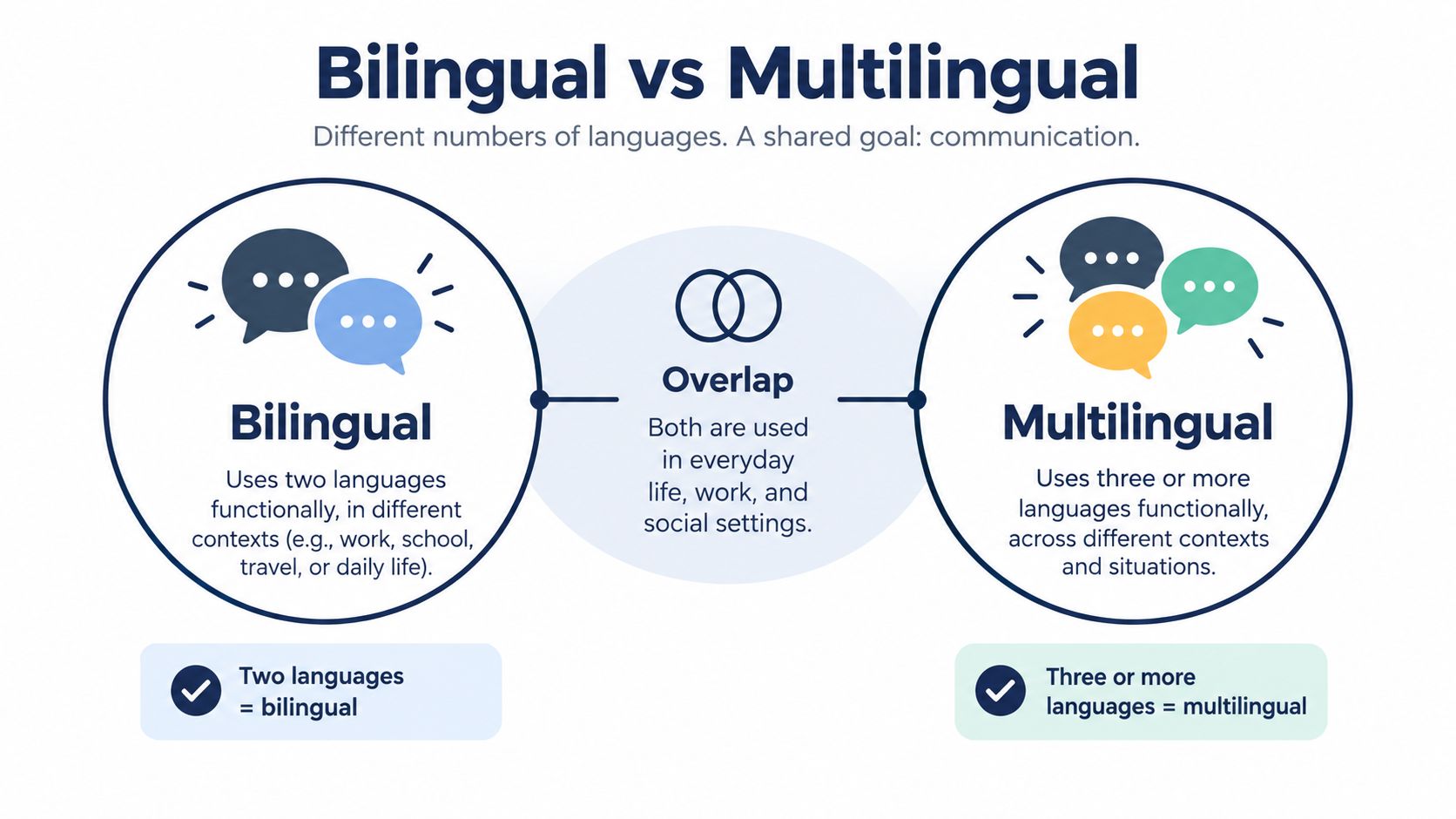
For a publisher, the distinction matters most when the manuscript moves into production. Bilingualism generally means functional use of two languages. Multilingualism generally describes the use of three or more languages, or a broader language repertoire. In publishing, these terms also describe a book's editions and the work required to prepare them. A bilingual project produces editions in two languages; a multilingual program coordinates several editions, each with its own translation, review, and approval process.
The world's language use extends well beyond English paired with one other language. UNESCO estimates that at least half of the global population uses two or more languages or dialects in daily life, and that about 7,000 spoken or signed languages are in use worldwide (UNESCO on multilingual education and inclusion). For publishers, that is a reminder to define the intended readers and languages precisely, rather than treating every audience as part of a simple two-language pair.
Don't treat the terms as interchangeable
A national measure of English-French bilingualism captures one particular language combination. A broader measure of multilingual ability can include Indigenous, heritage, immigrant, and other languages. Canada makes the distinction clear: 41.2% of residents could converse in more than one language in the 2021 Census, while 18.0% were specifically English-French bilingual (Statistics Canada's 2021 Census language results). Those figures describe different populations, so don't use them as interchangeable measures of potential readership.
A useful distinction: a bilingual book centers two languages; a multilingual edition requires a plan for a wider language range and the separate quality control each edition needs.
For authors who dictate drafts or notes across languages, the workflow starts before translation. An AIDictation review of bilingual dictation can help compare how dictation tools handle language switching. That tool choice is separate from deciding which languages the finished book should support. Don't use claims about cognitive benefits as a shortcut in marketing; decide on editions based on language-specific editorial capacity, terminology resources, and evidence of demand in each market.
Comparing the Two Approaches Side by Side
The table below is the short version. A bilingual edition focuses editorial attention on two languages. A multilingual program widens potential reach, but each additional edition adds a separate quality and market task.
| Criterion | Bilingual Edition | Multilingual Program |
|---|---|---|
| Audience reach | Concentrates on two defined language audiences | Targets several language audiences |
| Production complexity | One main translation direction or a focused pair of editions | Multiple language pairs, reviews, and handoffs |
| Cost per language | More budget can go toward refining each edition | Budget must cover work for each target language |
| Terminology management | A focused glossary is usually easier to maintain | Shared terminology infrastructure becomes more important |
| Marketing effort | Supports deeper campaigns in two anchor markets | Requires localized campaigns and market choices for each edition |
| Quality risk | Risk is concentrated in two editions | More per-language quality gates can be missed |
What the rows mean in practice
Audience reach is a reason to consider more languages, not proof that readers will buy in every market. The author still needs to identify likely readers, suitable retailers, and a way to reach them. Two editions can be a sound choice when each has a clear audience and the author can support both.
Production and quality are connected. In a two-language project, an editor can spend more time on each edition's voice, terminology, and final proof. A multilingual program needs a dependable process for every language, rather than one general approval that treats all editions as equivalent.
Marketing effort doesn't shrink just because the translation is finished. Every edition still needs useful metadata, appropriate cover copy, and a launch plan that speaks to its intended readers.
Per-language validation, not the number of languages on the cover, is what protects publishing quality.
Use the table as a planning tool, not a universal rule. A multilingual project can work well when the publisher has validated several markets and built a repeatable production process. A bilingual project can still fail if one edition gets little review or no meaningful launch support.
Translation Quality Across One Pair or Many
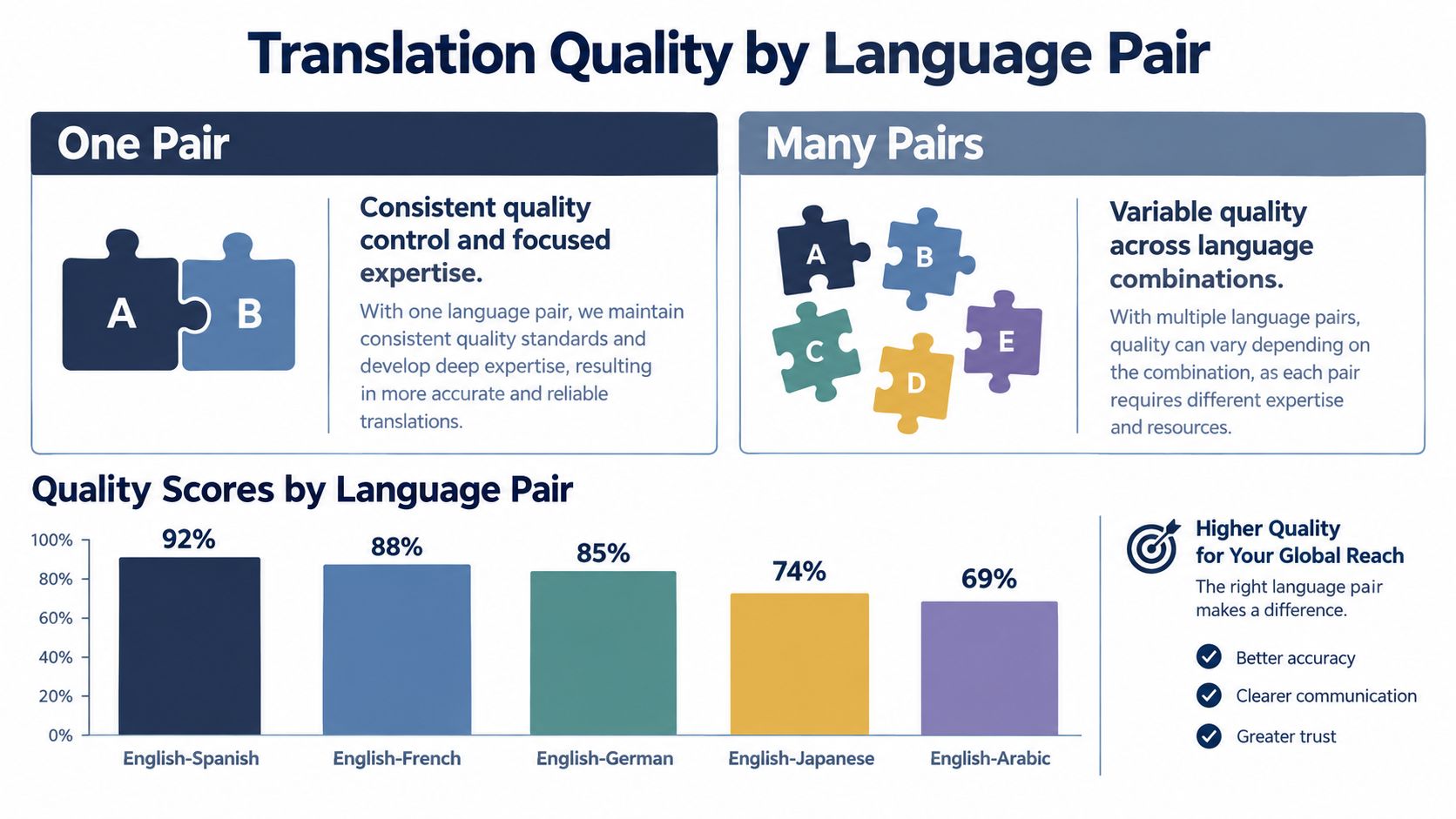
Translation quality is not a single score that travels intact from one language pair to another. Performance can vary by direction as well as by pair. The FLORES-101 benchmark contains 3,001 professionally curated sentences and supports evaluation across 10,100 language pairs. Its results show that translation into English is comparatively strong, while translation out of English is weaker; many African-language directions score below 5 spBLEU, while numerous European-language directions exceed 10 spBLEU (the FLORES-101 evaluation benchmark).
Those differences have direct editorial consequences. A strong result for English-Spanish doesn't establish that Spanish-French or English-to-an-African-language will perform equally well. A two-language edition can focus translators and editors on a smaller set of directions. A multilingual program needs to repeat its quality checks for every direction, including languages for which automated tools may be less dependable.
Set a separate quality gate for each edition
Build a language-specific style sheet and glossary, and maintain translation memories where they help preserve approved terms. Then have a qualified native-language reviewer assess the finished text in context. For fiction, that review should include voice, rhythm, idiom, and genre conventions. For nonfiction, it should also check terminology, clarity, and whether examples make sense for the intended readership.
Automated metrics such as spBLEU can help screen outputs consistently, but they can't certify literary quality. A single pooled score may hide a weak direction behind stronger results elsewhere. Report and review performance by language pair, direction, and domain, then make human acceptance the publication gate.
Editorial rule: Don't let a good English-to-Spanish result stand in for review of every other edition.
If you're evaluating a less commonly supported language, a focused resource such as this Irish language translator guide can help clarify language-specific considerations. For the production process itself, BarkerBooks' translation quality assurance approach is a relevant reference point for planning review around each edition. Machine translation can accelerate parts of a workflow, but it shouldn't replace human literary editing.
Translation Versus a Parallel Multilingual Edition
A translated edition starts with an existing book and adapts it for another language. A parallel multilingual launch treats several language editions as coordinated releases from the outset. Neither approach is automatically better. The right choice depends on the book's release plan, rights arrangements, available editorial resources, and market evidence.

Plan the publishing mechanics before commissioning
For an existing title, begin by identifying the master files, confirming who controls translation rights, and selecting a translator for the target edition. Decide how the edition will be identified and distributed, including whether it requires a new ISBN under the relevant publishing arrangement. ISBN requirements depend on the edition and publication setup, so confirm them with the publisher or the relevant ISBN agency rather than assuming one identifier covers every format or language.
A parallel release needs coordination earlier. The rights agreement should define the territories and languages covered, and the production schedule should account for each translation, edit, proof, cover variant, and release date. A shared launch calendar can help avoid a situation where one edition is ready while another still needs substantial review.
Cover design deserves more than a title swap. The translated title may be longer or carry a different tone, and the back-cover description, author biography, and metadata need to read naturally in each language. Distribution options may include Amazon Kindle, Apple Books, Barnes & Noble, and Google Books, but availability and retailer fit should be checked market by market.
An existing backlist title often suits a staged translation, because the author can learn from one edition before expanding. A franchise launch may justify coordinated releases if rights, editorial capacity, and audience demand are in place. Audiobook recording and promotional video production should also be planned by language: a translated book doesn't automatically create an effective localized audio or video campaign.
The following production overview can help authors distinguish the editorial decisions from the publishing logistics:
Localization, Marketing, and Distribution by Market
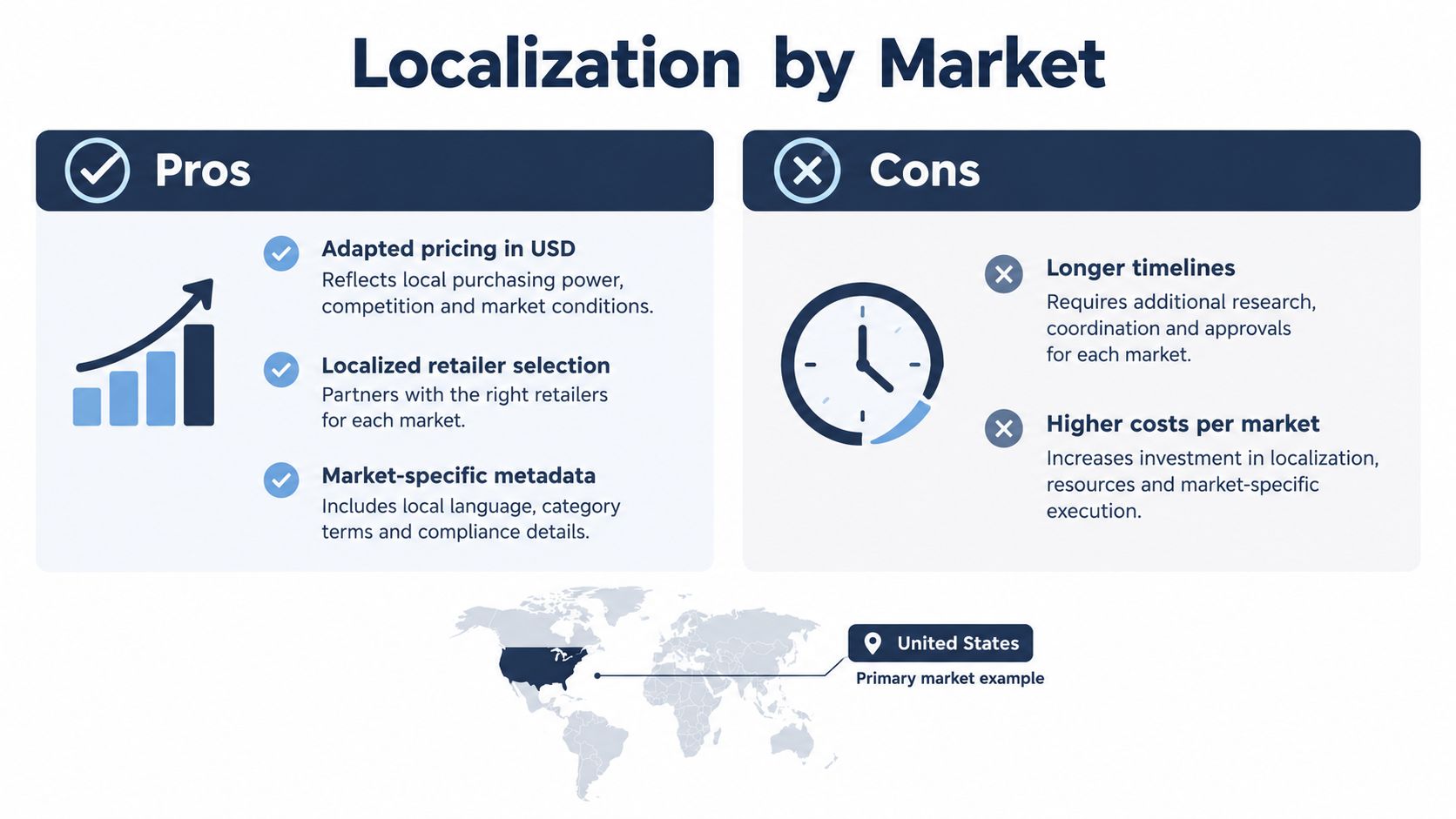
Translation gives readers the text in another language. Localization makes the edition and its launch relevant to the market. That can affect cover copy, metadata, retailer selection, promotional channels, and the way the book is described. A technically accurate translation can still feel poorly prepared if the publisher hasn't checked whether the edition fits local reading habits and discovery paths.
Choose languages for readers, not prestige
A publisher should ask which language a community reads in, not which language appears to offer the greatest international prestige. UNESCO reports that 40% of learners globally, more than 250 million people, cannot access education in a language they speak and understand fluently; in some low- and middle-income countries, the share reaches 90%. UNESCO also reports that only 351 of approximately 7,000 spoken or signed languages are used as languages of instruction (UNESCO's discussion of multilingual education and learning access).
These education figures aren't a sales forecast for books. They do, however, make one point hard to ignore: language access and cultural ownership matter. An author choosing editions should consider who the book is for and which language lets those readers engage with it, rather than defaulting to a global-language pairing without examining the audience.
For each market, align the cover, book description, keywords, distribution plan, and advertising with local reader expectations. A bilingual launch can support a concentrated campaign in two anchor markets. A multilingual rollout may benefit from shared glossaries and translation memories, but those efficiencies don't eliminate the need for separate local marketing decisions.
For more on coordinating international editions and distribution, see BarkerBooks' guide to global book publishing. The guiding principle is simple: choose a market because you understand its readers and can serve them, not because a language looks impressive in a list.
Why More Languages Does Not Automatically Mean More Readers
A finished edition can sit unread if its intended audience never finds it or has little interest in buying it. Language access signals potential reach, not purchase intent. Publishers need to test demand for the title itself before paying to translate, edit, produce, and promote another edition.
Validate demand before you commission
Test interest with reader surveys, retailer category signals, or pre-orders when available. Ask local booksellers, reviewers, and audience partners whether the subject and positioning fit their readers. Expressions of interest can justify further research, but they do not prove that distribution will work. Confirm who will stock or promote the book, and how readers will discover it.
Treat each language as a separate publishing workflow. Budget for qualified translation, independent review, terminology decisions, and market-specific presentation. If you cannot assign responsibility for quality control in every edition, reduce the number of languages. A smaller release with careful editing and a credible route to readers is better than a broad list of editions no one is equipped to support.
Don't use claims about cognitive benefits as a marketing shortcut. A systematic review of 368 studies found 27.45% reported null effects. Among studies reporting bilingual adaptations, 73.41% attributed them wholly or partly to sociolinguistic factors, including proficiency, exposure, language use, communicative context, and socioeconomic conditions (the systematic review of sociolinguistic factors and cognition). Those findings do not support promises that multilingualism automatically increases intelligence or executive function. Such claims distract from the stronger case: readers need and want access to this particular book.
Choose each edition on its commercial and editorial merits. Validate demand, establish terminology and review processes, and confirm a route to readers before commissioning translation. Count committed readers, not languages.
Choosing the Right Approach for Your Book
Choose bilingual publishing when you have strong demand in two specific markets, a limited budget, or a book whose voice needs close literary attention in every edition. It's also a sensible first move when you already have a reliable process for two languages but haven't yet built the people and tools needed to manage more.
Choose a multilingual program when demand is supported across several markets, your rights and production plans cover those editions, and you can maintain quality control in every language. It can make sense for established intellectual property with readers in multiple regions, provided each edition has a named editor or reviewer and a credible route to distribution.
Use this checklist before you commit
- Confirm market demand. Identify the readers and retailers for each proposed edition, and decide how you'll test interest.
- Assess every language direction. Check that you can recruit a qualified translator and an independent native-language reviewer for each edition.
- Plan publishing infrastructure. Clarify rights, ISBN arrangements, schedules, cover variants, and distribution before work begins.
- Budget for the launch, not just the translation. Allow for localized metadata, marketing materials, and support in each target market.
- Set a quality threshold. Decide who signs off on terminology, tone, proofreading, and final files in each language.
If you're moving from a finished manuscript toward translation, BarkerBooks' guide to how to translate a book can help you think through the process. My recommendation remains practical: choose bilingual when you can make two editions excellent; choose multilingual when you can validate and quality-check each market one by one.
BarkerBooks offers editorial support, translation and bilingual publishing, cover and interior design, ISBN registration, and worldwide distribution for authors planning Spanish-English or broader publishing projects. If you want help deciding which editions your book is ready for, visit BarkerBooks to explore its publishing services.