
The default elevator pitch is about 30 seconds, and the working range is 30 to 60 seconds, or roughly 65 to 150 spoken words. Lock that short cut first, then prepare longer and shorter versions for different rooms.
That's the answer to how long is an elevator pitch. It isn't one script you recite everywhere. It's a pitch ladder, and you climb it only when the listener gives you permission to keep talking.
Seconds and Words for an Elevator Pitch
Start with 30 seconds. The MIT Communication Lab guidance describes a successful policy elevator pitch as being executed in about 30 seconds and recommends keeping it no longer than that to accommodate listeners' limited attention span.
That limit isn't about politeness. Attention is the constraint, not completeness. You've got time to make one idea memorable, not to explain everything you've written.
At a typical speaking rate of roughly 130 to 160 words per minute, 30 seconds corresponds to approximately 65 to 80 spoken words, according to that same MIT guidance. Pauses and emphasis will move your count a little, so time yourself out loud instead of trusting the page.
For the broader band, the University of Cincinnati guide stated in 2025 that an elevator speech should last 30 to 60 seconds, equivalent to approximately 75 to 150 words. Use the table below as your working lookup.
| Version | Seconds | Spoken words | Use it when |
|---|---|---|---|
| Chance meeting | 15-20 | 30-50 | A hallway, badge line, or online intro |
| Networking default | 30 | 65-80 | An unplanned professional conversation |
| Invited detail | 45-60 | 100-150 | The listener has agreed to hear more |
| Booked conversation | up to 120 | 260-320 | A scheduled publishing or rights talk |
What 30 Seconds Can Hold
A 30 second cut holds three things and nothing else. Name the book or project, say who it's for, and give one reason it matters. Then stop and let the other person respond.
It can't hold a full synopsis, your biography, comparable titles, or a publishing plan. If you try to squeeze those in, you'll talk faster, sound rushed, and lose the one line the listener might have remembered.
Practical rule: If you can't say it in 65 to 80 words without speeding up, you haven't decided what matters yet.
Build the Default First
Don't start with the long version and hope you can shrink it in the moment. Write the 30 second networking default, rehearse it until it sounds like speech, then build outward. The short version forces the choices that make every longer version clearer.
If you want more on making a brief impression stick, the German podcast episode Mit wenigen Worten nachhaltig überzeugen from PreSales Unleashed GmbH explores how a few well chosen words can leave a lasting mark. It's a useful companion listen once your own 30 second cut is written.
Lock that cut before you touch anything else. Every other length is an edit of it, not a separate speech.
Match Pitch Length to the Room
Published advice on pitch length varies widely, so the right length depends on the setting rather than one official number. A manuscript pitch, author introduction, book club hello, media pitch, and rights conversation each have a different purpose. Match the length to what the listener has agreed to hear.
Use a ladder, not one script.
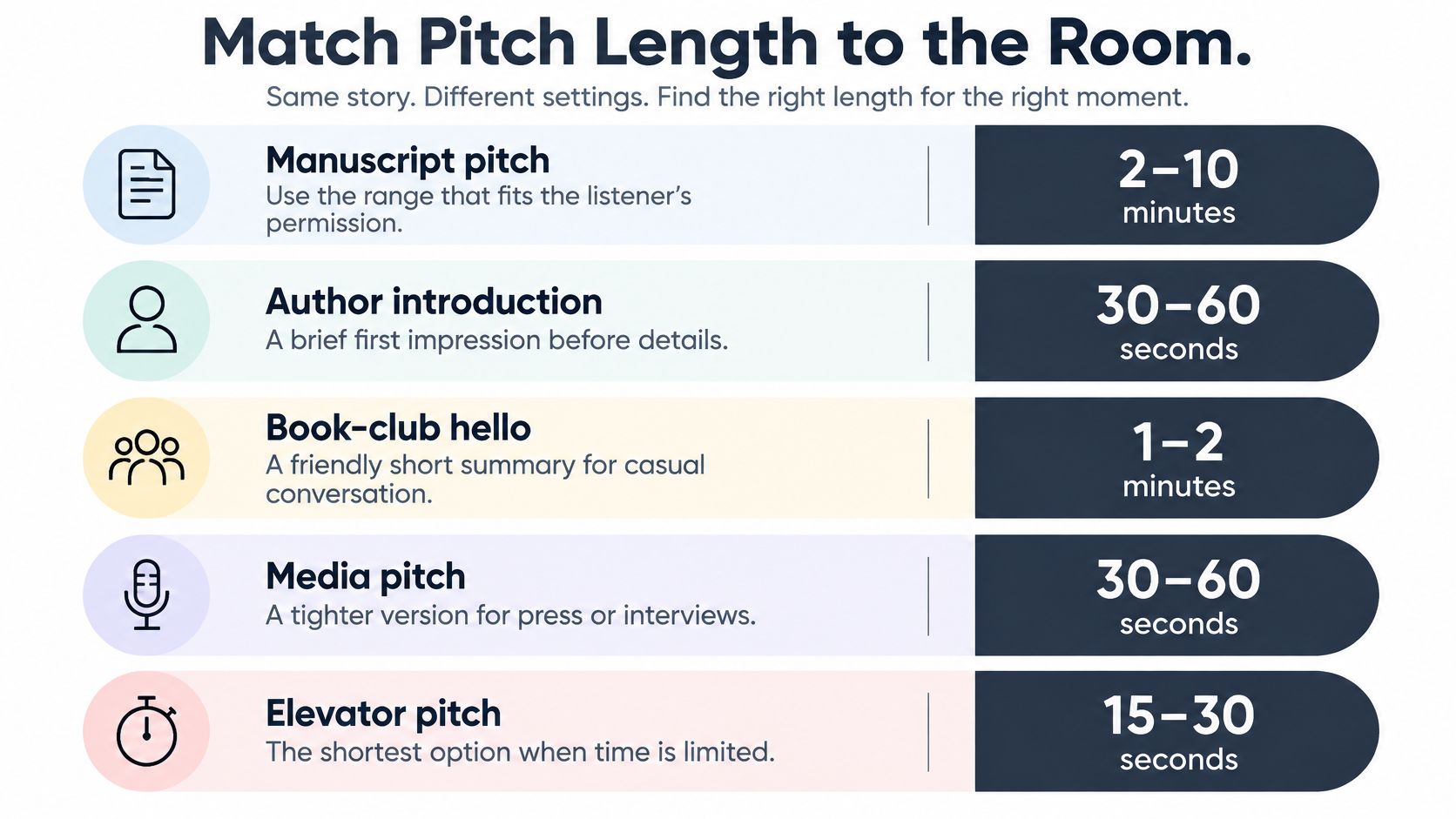
| Room | Length | Keep in | Leave out |
|---|---|---|---|
| Nametag line | 10 seconds | Name, title, one hook | Genre essay, bio |
| Networking | 20-30 seconds | Reader, distinctive value | Subplots, comparison titles |
| Asked what it's about | 45-60 seconds | Genre, premise, one proof point | Full synopsis |
| Book club or interview | About 60 seconds | Reader promise, why now | Rights or pricing talk |
| Publishing or rights meeting | Up to 2 minutes | Manuscript status, market fit, specific ask | Every service you might want |
The Decision Rule
Start with the shortest version that fits the room. Watch for a question, a lean in, or “Tell me more.” Expand only when the listener invites it.
Without that signal, stop. You've offered the hook; let the other person respond or ask what they're working on. If an editor gives you two minutes, use that time for manuscript status, market fit, and a concrete ask instead of cutting back to 30 seconds.
Length follows permission and context. Match both, and your pitch will fit the conversation.
How to Build a Pitch That Fits the Clock
Build for a chosen slot, not for "sometime." The most reliable default is a 30 to 60 second pitch, with a compressed 15 second version and an expanded 60 to 90 second version ready for different contexts, as set out in Cornell's science communication guidance, which also recommends 30 to 60 seconds because most elevator rides last less than a minute.
Use these five steps in order.
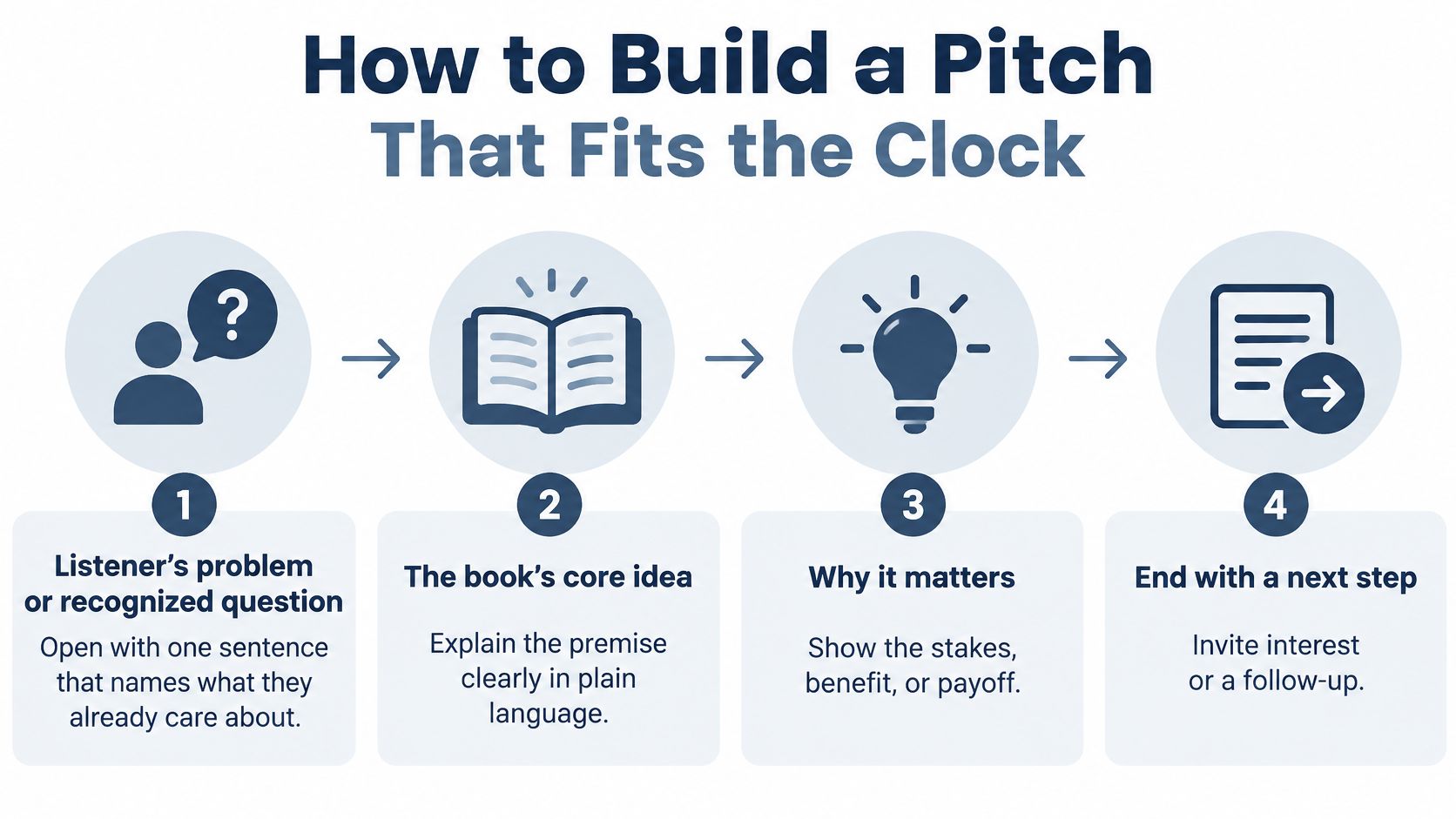
- Open with the listener's problem. Write one sentence naming a question they already recognize, before you name the book. If they don't care in the first line, your title won't save you.
- Identify the manuscript in plain language. Give the title or working title, the genre, and where it stands, such as a complete draft or a revised sample. Don't dress this up with adjectives.
- State the distinctive value in one line. Name the reader change or the premise nobody else is offering. No subplot, no second example. If you need help sharpening that line, our guide on writing a hook that earns attention walks through the craft.
- Close with one next step. Ask for something you can do in that room, like sending a sample chapter, sharing a one page synopsis, or booking a short call. Vague endings produce vague results.
- Read it aloud against a timer. Run it at 30 seconds, then at 60. Cut jargon, second credentials, and any sentence that doesn't serve the hook, the reader, or the ask.
Draft Long, Then Trim
Draft the one minute version for a knowledgeable listener first, then adapt and trim it for a general listener. That order works better than stuffing the short version and hoping it holds. Cutting reveals what's essential, while padding hides it.
For a publishing conversation, your 60 second cut can carry genre, reader, manuscript status, and the kind of help you want. Your 15 second cut keeps only hook, audience, and outcome. If a sentence doesn't fit one of those three, it belongs in the follow up conversation, not the pitch.
Rehearsal is where this becomes real, and it helps to practice in front of people who'll interrupt you. Founders do the same thing, and where Dubai founders rehearse startup pitches from Founder Connects shows how structured practice sessions expose weak lines fast. Borrow that habit. Say it out loud, get interrupted, and cut what dies under pressure.
Sample Book Pitches at Three Lengths
Scripts beat rules when you're preparing for a real event. Time each sample below, swap in your own title and reader, and stop when the timer ends.
The 15 Second Hallway Line
Target about 35 words, for a contemporary novel.
I'm Maya Chen. I write contemporary novels for readers who love second chance love stories set in small coastal towns. My new one follows a lighthouse keeper who inherits a rival's boat. Want the title?
Name, reader, hook, and an easy invitation. That's all a hallway allows.
The 30 Second Networking Pitch
Target about 75 words, for a leadership book.
Most new managers tell me their first hard conversation went badly, and nobody taught them how to prepare for it. I'm Daniel Ruiz, and my book gives first time managers a simple way to plan those talks in ten minutes, so they stop avoiding them. It's for people promoted for their skills, not their people training. Does that problem show up on your team?
Notice the ending. A question hands the turn back and turns a pitch into a conversation.
The 60 Second Invited Version
Target about 140 words, for the same leadership book when an editor asks for more.
Most new managers tell me their first hard conversation went badly, and nobody taught them how to prepare for it. I'm Daniel Ruiz, and my book gives first time managers a simple way to plan those talks in ten minutes, so they stop avoiding them. It's for people promoted for their skills, not their people training. The method has three steps, name the outcome, script the first two sentences, and decide your response if it gets heated. I spent twelve years leading operations teams, and the manuscript is complete and revised. Would you be willing to read the first chapter and tell me if the opening works?
That isn't a new speech. It's the 30 second script plus two sentences, one on method and one on credibility, with a concrete ask. Build yours the same way.
Watch a short pitch delivered at natural speed before you time your own, so you calibrate your pace against a real voice.
To adapt the frame, memoir writers swap the method line for the turning point, and fiction writers swap it for the central choice the protagonist faces. Neither swap adds plot, and your spoken pitch should later match the promise in your copy, which is why our guide to writing a book description that sells the promise pairs well with this work. Replace the sample titles and time the result before the event, not in the taxi on the way there.
Dos and Don'ts Once the Clock Starts
A script that fits on paper can still fail in the room. Delivery decides whether your 30 seconds feel like a conversation or a recitation.
Do This in the Room
- Speak to one named person. Pitch to the individual in front of you, not to a category like "readers everywhere." Specific listeners make you choose specific words.
- Mirror their vocabulary. If they say "memoir," don't correct them with your preferred label. Meet them in their language and you'll sound less like a brochure.
- Pause after the hook. A beat of silence lets the premise land and gives them room to react. Rushing past your best line buries it.
- End on a question. Hand the turn back. Their answer tells you whether to expand or gracefully stop.
- Keep a recovery card. A phone note with your three lengths helps you find your place if you blank. Glance at it to recover, not to read.
Don't Do This
- Don't recap every chapter. Chapter summaries are synopsis material, not pitch material.
- Don't stack credentials. One proof point persuades. Four sound defensive.
- Don't apologize for taking their time. It wastes seconds and tells them your pitch isn't worth hearing.
- Don't pitch a service package before the book is clear. Nobody can evaluate help for a project they can't picture yet.
Live Fixes When It Goes Sideways
The most common overrun is stretching a 30 second script past 70 seconds because you keep adding "one more thing." There is no one more thing. Stop.
If the listener interrupts with a question before 15 seconds, drop the script and answer it. That question is the longer meeting you wanted, arriving early. If they stay polite but flat, cut to your 15 second close and ask what they're working on.
When you do run long in rehearsal, delete the biography first, then any second example. Those cuts almost always fix the timing without touching the hook.
The pitch is finished when they know who the book is for and what to do next, not when the plot is complete.
Take the Pitch into a Real Conversation
Practice needs a deadline, so give yourself three days.
On day one, say the 30 second version aloud ten times until the hook comes without notes. On day two, practice the 15 second and 60 second cuts and time each one against the sample word counts. On day three, rehearse with a friend who's asked to interrupt at random, and note every point where the pitch loses them.
That interruption practice matters more than polish. Tools like an AI interview assistant from AIApply can also help you rehearse answering unexpected follow up questions out loud, so a curveball in the room doesn't restart your script from the top.
Then choose the single ask you'll use at your next event, such as a sample chapter, a one page synopsis, or a review of the first pages. One ask, decided in advance, keeps your close clean. If you'll also be introduced on stage or on a panel, align that wording with your pitch using our speaker bio sample for authors so listeners hear one consistent story.
Once your manuscript is ready for outside eyes, clients can start with a manuscript review or an outline session. A consultation call with us covers your goals, manuscript status, service options, and next steps, and you leave with pricing, a target date, and a short list of tasks. Starting a project involves that brief call covering goals, clear pricing and a launch date, booked through the consultation form or by WhatsApp.
The pitch is the way in. The call is where length stops mattering, because both sides have agreed to talk.
Your 30 second pitch opens the door, and we help you walk through it with editing, design, and publishing support matched to your manuscript's stage. Tell us your book, its reader, and the outcome you want, and we'll map the next step with clear pricing and a target date. Visit BarkerBooks to book your consultation and turn a good pitch into a published book.