
You've received a publishing contract, and the editor wants it signed. You're checking the advance and publication date when you notice a grant covering every format, every language and uses nobody has discussed.
Don't treat that paragraph as boilerplate. Your book publishing rights determine who can earn from your manuscript, who can authorize new editions and what you must do to regain control.
The Rights Bundle a Publishing Deal Can Split
Say you sign what you think is a print deal. Later, an audio producer approaches you, but the publisher says it controls narration too. The problem isn't necessarily that the publisher has overreached. You may have signed a broader grant than you understood.
Think of copyright as the house. Each publishing right is a separate key to a room: print, ebook, audio, translation or adaptation. Handing over a key shouldn't mean surrendering the building.
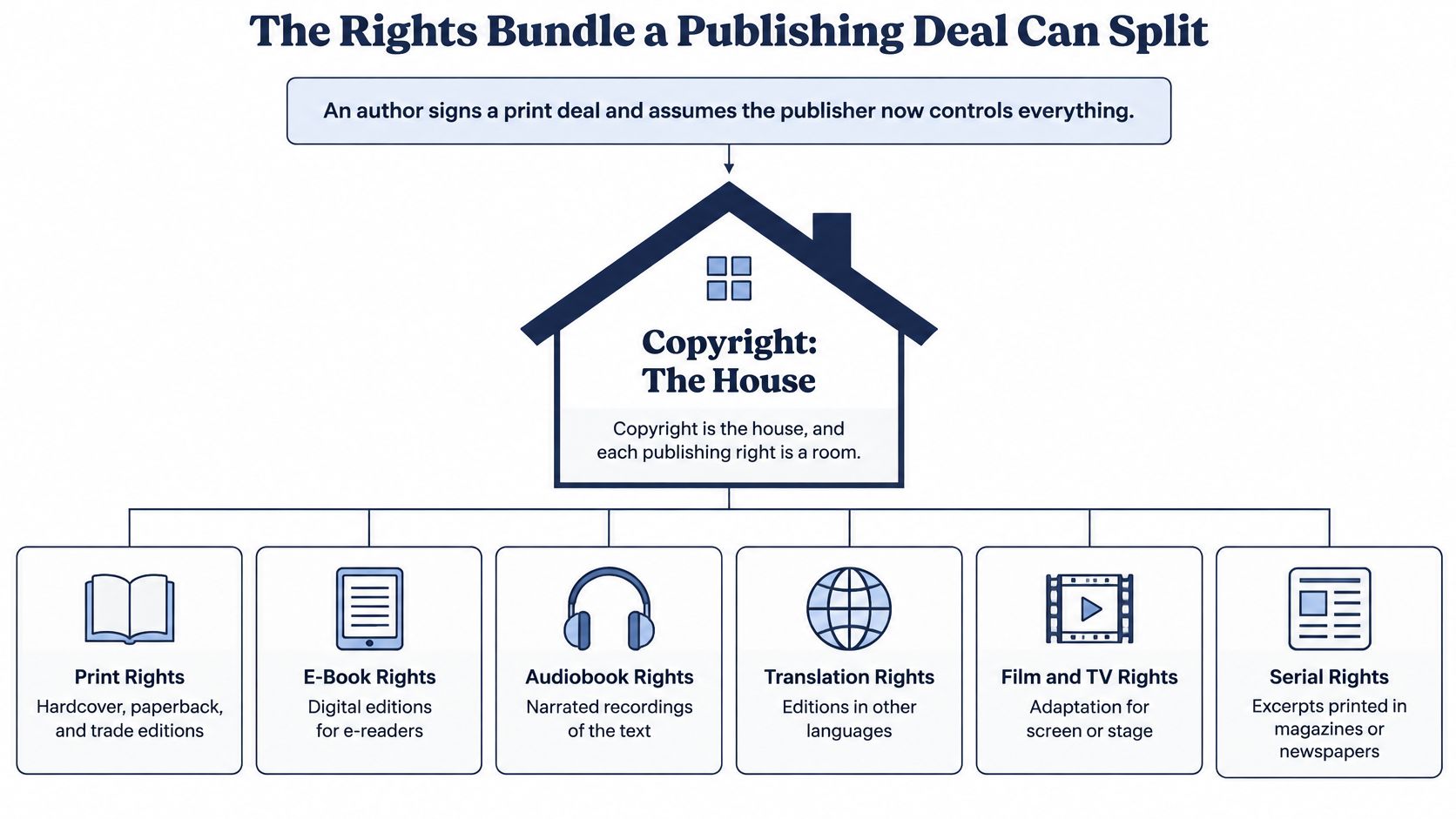
The separate rights in a book deal
These are common negotiating positions, not ownership rules. The signed grant controls.
| Right | What it covers | Usual holder in trade deals | Negotiation note |
|---|---|---|---|
| Hardcover, paperback and other physical editions | Publisher under license | Name each physical format covered | |
| Ebook | Digital text editions sold through retailers | Publisher, often alongside print | Address platform, library and subscription income |
| Audiobook | Narrated editions | Publisher or separate audio licensee | Reserve it unless the licensee has a production plan |
| Translation | Text in another language | Publisher when granted, with author participation in income | Specify languages, income allocation and translator approval |
| Foreign territory | Publication or sales in named countries | Publisher or foreign sublicensee | Define countries and exclusivity |
| Film, TV and dramatic | Screen, stage and series adaptations | Author, sometimes subject to an option | Set exercise deadlines and lapse consequences |
| Serial and excerpt | Chapters or extracts in periodicals and online | Publisher when included | Limit length, uses and promotional permissions |
| Merchandise and games | Products and interactive derivatives | Author unless expressly granted | Require separate approval and commercial terms |
| AI training | Using text or metadata to train models | Often unaddressed in the agreement | Expressly reserve or separately authorize it |
Each row can be licensed, withheld or assigned independently. A publisher's ability to produce an ebook doesn't establish its ability to sell a film adaptation.
But silence isn't enough to resolve ownership. An unnamed format might fall within a broadly drafted grant covering all media or derivative uses. Read the operative grant and definitions together, not just the headings.
Practical rule: Make the publisher identify the rights it will actually exploit. A possible future opportunity isn't a sufficient reason to surrender control now.
Mark the gaps before negotiating
Copy the table into a working document. Beside each row, record the contract clause that addresses it, the named licensee and the event that ends its control.
Mark omitted categories as unresolved, not automatically granted or safely retained. Ask for an express reservation of everything outside the agreed grant.
How Copyright Starts and Who Holds It First
For an ordinary author-written manuscript, copyright generally begins when you fix original expression in writing or another recorded form. You don't need to finish the book before protection can exist. Nor does sending a manuscript to an editor transfer ownership.
The international foundation is the Berne Convention, administered by the World Intellectual Property Organization. Its automatic-protection principle generally removes registration formalities as a condition of protection in member countries, while recognizing rights including translation and adaptation.
Automatic protection isn't identical protection everywhere
The WIPO summary of the Berne Convention describes a minimum general term of the author's lifetime plus 50 years, while many major markets provide life plus 70 years, including the UK, where literary copyright normally ends after the calendar year containing that anniversary of the author's death.
National law still controls important details. Registration may matter to enforcement even where it isn't necessary to create copyright. Employment, work-for-hire arrangements and joint authorship also require closer attention before you assume you alone own the manuscript.
For a plain-language foundation, use this explanation of what copyright protection covers. Then check the law governing your particular work and agreement.
A deed is different from a lease
An assignment transfers ownership of the copyright or an identified part of it. A license authorizes specified uses while leaving ownership with the author.
The distinction resembles a deed versus a lease. A publisher with a license can occupy the agreed commercial space without owning the land. An exclusive license can still restrict you heavily, so retaining copyright doesn't automatically mean retaining freedom to publish competing editions.
- Check the operative verbs. Language assigning or transferring copyright deserves different scrutiny from permission to publish specified editions.
- Check the ownership exceptions. Identify commissioned illustrations, coauthor material and any employer claim.
- Check the reserved rights. Require the contract to identify what remains yours, rather than relying on a reassuring copyright notice.
Copyright also isn't a substitute for confidentiality. If your nonfiction manuscript contains proprietary business processes, Kons Law's guidance on safeguarding your company's trade secrets addresses a separate concern: keeping commercially sensitive information confidential before disclosure.
Your publishing agreement should name the uses being granted. Ownership language, publication permissions and confidentiality obligations solve different problems.
Exclusive or Non-Exclusive and Where the Right Applies
Suppose a UK publisher licenses exclusive English-language print rights for a defined UK and Commonwealth territory. A US publisher licenses the remaining English-language print territories, while an audio platform receives a non-exclusive audio license. Those arrangements can coexist if their boundaries don't overlap.
Exclusivity answers a narrow question: who else may exploit the same right, in the same market, during the same period? It doesn't answer who controls another language or format.
Exclusivity levels and what each one means for the author
| Grant type | Who else can exploit the right | Typical use | Main risk for the author |
|---|---|---|---|
| Exclusive, worldwide, full term | Nobody within the granted scope, including the author | Broad trade publishing agreement | Other licensees remain blocked throughout the term |
| Exclusive, one territory | Parties authorized outside that territory | UK and Commonwealth publishing license | Unlicensed territories may remain commercially idle |
| Non-exclusive | Author and other authorized licensees | Ebook or audio distribution across platforms | Conflicting listings, pricing and quality control |
| Option | Determined by the option's holdback and exercise provisions | Film development or a proposed future acquisition | Rights can remain unavailable while nothing gets produced |
| Right of first negotiation or refusal | Others after the contractual process permits | Sequels or the author's next manuscript | Unclear procedures can delay another offer |
| Sublicense | Third parties authorized within the original grant | Foreign-language publication or audio licensing | Author loses direct oversight without approval provisions |
An option isn't merely a first look. A film option can reserve adaptation rights while the producer decides whether to exercise it. Likewise, first negotiation and first refusal aren't interchangeable: one requires an initial discussion; the other can permit matching an outside offer.
Draw boundaries that administrators can use
WIPO's publishing-contract guidance supports distinguishing retained copyright from licensed exploitation rights. Turn that distinction into an operational schedule naming format, language, territory, exclusivity, term, sublicensing authority and reversion trigger.
Don't accept a territory described only as international. List the countries or attach a defined territorial schedule. Address cross-border online orders and overlapping retailer availability.
A bilingual author also needs to distinguish permission to create a translation from permission to distribute it. This guide to how to translate a book can help you scope the production work before licensing the resulting edition.
Local distribution introduces another contract layer. RNC Group's guidance on distribution contracts for Israeli market entry is relevant when assessing distributor authority, territorial restrictions and termination in that market.
For a first-time author targeting a local print readership, start with a narrow exclusive print grant in the publisher's actual market. Expand it only for a credible exploitation plan. Bilingual authors should split languages and territories where practical, and reject worldwide exclusivity unless both the advance and the publisher's reach justify it.
One Novel's Rights Split Across Six Deals
Consider a fictional novelist who keeps an edition-by-edition rights ledger. Rather than inventing supposedly standard fees or contract lengths, she records the negotiated payment basis and the event ending each grant.
Her agreements could look like this:
- Hardcover. A trade publisher licenses domestic hardcover rights until the agreed expiry date; the author receives an advance against the stated hardcover royalty.
- Paperback. A publisher in another territory licenses paperback rights until its separate expiry date; its contract pays the author the negotiated local-edition royalty.
- Ebook. A digital platform receives non-exclusive distribution permission until withdrawal takes effect under its terms; the author receives sales proceeds less the specified platform deductions.
- Audiobook. An audio producer hires the narrator and licenses recording rights until the audio agreement ends; the author receives the agreed royalty, with production-cost deductions expressly defined.
- Spanish translation. A Spanish-language publisher holds the named language-and-territory license until its contractual expiry; the author receives the agreed advance and translation-edition royalty.
- Film option. A producer controls the option until its exercise deadline; the author receives an option fee and, if exercised, the separately negotiated purchase payment and participation.
These are separate payment arrangements. The hardcover publisher receives none of the other income unless a contract expressly gives it a share or licensing role.
The edition can carry another layer of rights
Now suppose the novelist wants to reuse pages from a publisher's finished edition. Owning the underlying manuscript doesn't necessarily entitle her to reproduce its typesetting or cover.
The National Archives guidance on copyright and related rights explains that UK protection for a published edition's typographical arrangement lasts 25 years from the end of its publication year.
That distinction matters especially with classics. An underlying text may be in the public domain while a new translation, original annotation, illustration or protected typographical arrangement is not.
Permission to reuse the words isn't necessarily permission to copy the finished pages.
Clear the contributions separately
Before commissioning a replacement edition, ask:
- Who typeset it? Confirm whether you may reuse the layout and whether editable production files must be supplied.
- Who translated or illustrated it? Obtain permission covering the intended language, format and territory.
- When does edition-specific protection end? Check the publication record and applicable law rather than using the original author's death date alone.
Not every editorial change creates a separate copyright. Identify the actual protected contribution, its owner and the permission you need.
Getting Rights Back After a Book Goes Quiet
Your book is still listed on Amazon. A print-on-demand copy remains orderable, but the publisher has stopped promoting it and your statements show little activity. That listing may be enough to defeat a poorly drafted out-of-print clause.
Availability and commercial exploitation aren't the same test. Negotiate a measurable sales or author-income trigger instead of allowing digital availability alone to keep rights locked up.
Contractual reversion compared with statutory termination
| Route | What triggers it | Timing | What the author must do |
|---|---|---|---|
| Out-of-print reversion | The book meets the contractual test | After any required notice and cure period | Document sales across formats and send compliant notice |
| Reprint-first reversion | Publisher fails to reprint as required after notice | Following the contractual reprint opportunity | Preserve the request, response and evidence of performance |
| US statutory termination | A qualifying author grant under federal law | Statutory eligibility and notice schedule | Serve signed notice and record it with the Copyright Office |
| Non-US termination | A right available under applicable national law | Local eligibility, notice and effective-date rules | Check the local statute and obtain jurisdiction-specific advice |
A 2025 Cambridge analysis of publishing contracts found that, among contracts meeting out-of-print criteria, only four provided immediate reversion after author notification, while 93% required an opportunity to reprint first.
Don't assume a qualifying sales statement ends the agreement. Follow the notice clause, including the recipient, delivery method and cure period. Track audio, foreign and subsidiary licenses separately, because their treatment may differ.
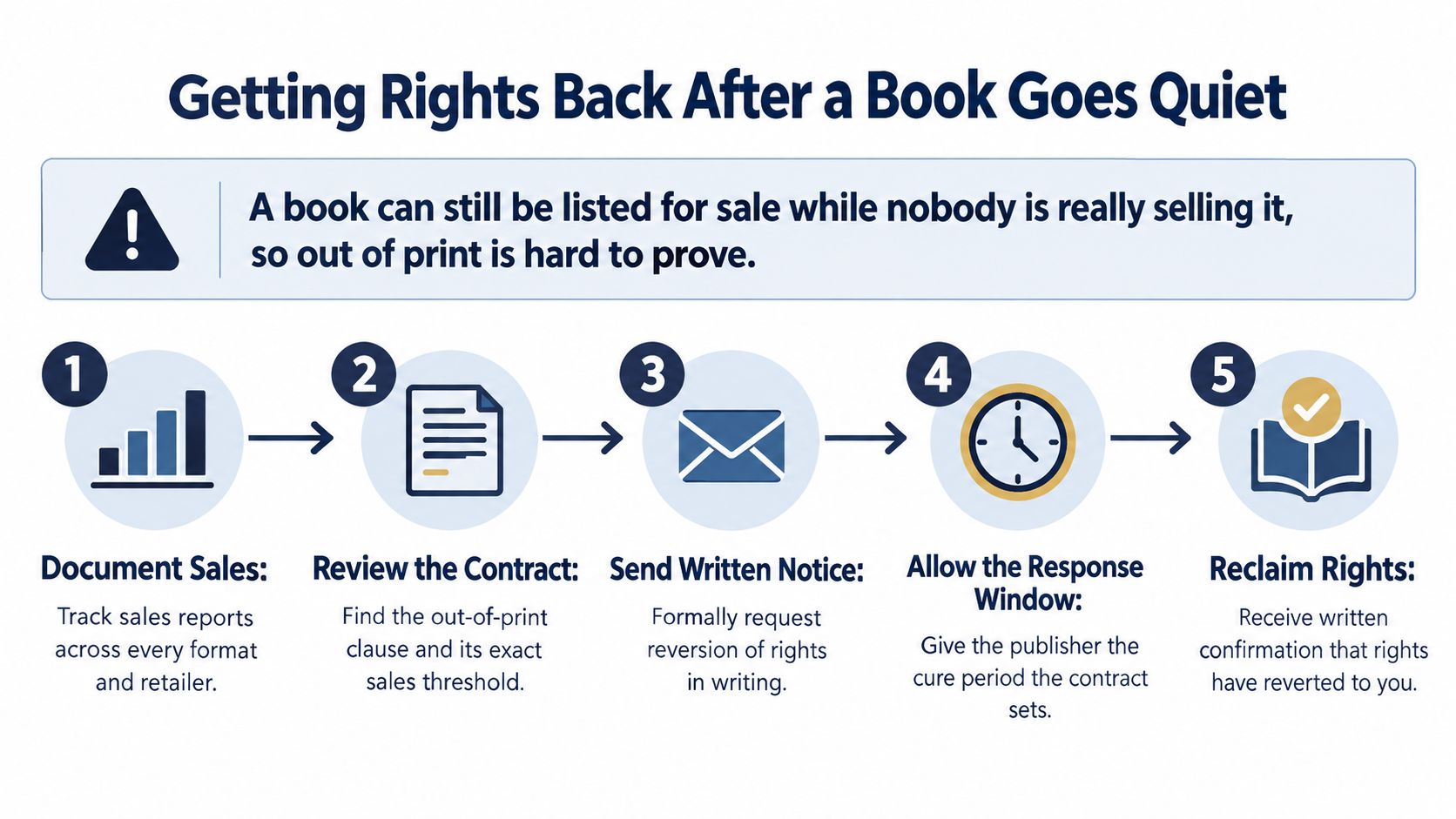
Statutory termination follows a different clock
The U.S. Copyright Office's termination guidance explains that qualifying non-work-for-hire author grants executed on or after January 1, 1978 generally have a five-year termination window beginning 35 years after execution; publication grants use the earlier applicable point based on 35 years after publication or 40 years after execution, with notice generally served 2–10 years before the effective date.
Have a copyright lawyer calculate that schedule. Statutory termination isn't an out-of-print remedy, and it doesn't depend on proving weak sales.
The contractual timeline in the graphic is a useful administrative sequence, not the statutory procedure. Keep the original grant, amendments, publication dates and successor details so the correct recipient can be identified.
- Before relaunching. Obtain written confirmation of contractual reversion, or legal confirmation that statutory termination has become effective.
- Before approaching new licensees. Identify surviving sublicenses, inventory sell-off permissions and any continuing restrictions.
- Before closing the file. Request final statements and preserve correspondence showing which rights returned.
Termination is never automatic. A commercially dormant book still requires the correct legal route, valid notice, proper timing and, where applicable, recordation.
AI Training Clauses in Modern Publishing Contracts
Does signing a print or ebook deal authorize the publisher to license your manuscript for AI training? Don't accept an answer based solely on the fact that the book is being published.
A conventional format grant may not clearly resolve training uses. Broad language about digital exploitation, sublicensing and future technologies can leave room for disagreement. Silence creates uncertainty, not reliable protection.
Consent and licensing aren't interchangeable
In the Australian Society of Authors' 2025 survey, 98% of respondents wanted permission before AI training, while 92% of traditionally published respondents said their publisher hadn't asked them to license their work for that purpose.
Those findings concern respondents' preferences and experiences. They don't establish what your publisher can legally authorize. Your agreement needs its own answer.
For background on a specific dispute, you can explore the settlement involving Anthropic authors through SourceX. Keep settlement eligibility separate from decisions about future licensing.
Put the training decision in writing
Request clauses that address the actual transaction:
- Express authorization or prohibition. State whether the publisher may use or license manuscript text and associated metadata for model training.
- Reserved rights. Confirm that ordinary publication permissions don't themselves authorize training, and require separate written consent for any exception.
- Notice and audit access. Require identification of the proposed licensee, material supplied, permitted purpose and payment records.
- Separate compensation. Set the fee or revenue allocation, permissible deductions and accounting obligations before any material is delivered.
- Collective licensing and territory. Specify whether an agency may authorize uses on your behalf and where that authority applies.
- Technical scope. Distinguish training from proofreading tools, accessibility processing, search indexing and other publishing operations.
A blanket ban on all AI-related processing may also prohibit tools you want your editor to use. Define the prohibited conduct precisely, including whether service providers may retain your manuscript or use it to improve their models.
Treat AI training as a separately negotiated use, not an incidental benefit attached to an ebook license.
Don't accept a verbal promise that the publisher has no current plans. Ask what the contract allows its successors, platforms and sublicensees to do.
Negotiate Your Rights Before You Sign
Treat signing as the end of a checking process, not the beginning of a relationship built on assumptions. Keep a marked-up agreement, a rights schedule and a written record of unresolved questions.

Run the pre-signature checks
- Name every format and language granted. If you skip this, broad definitions may capture editions you intended to license elsewhere.
- Define exclusivity and territory for each grant. Missing boundaries can create conflicting promises to different publishers.
- Set a term with an identifiable end date. Without one, you may need to satisfy a demanding exit clause before pursuing another opportunity.
- Require notice and appropriate approval before sublicensing. Otherwise, an unfamiliar third party may control publication without your input.
- Write a measurable reversion trigger and response deadline. A listing-only availability test can leave an inactive title tied up.
- State the AI-training position explicitly. Omitting it can force you to argue later about the meaning of a general technology clause.
- Confirm the income allocation for translation, audio and film. An attractive headline share means little if undefined deductions reduce the amount being shared.
- Preserve chain-of-title records and every amendment. Missing documents can delay a new license, ownership verification or an exit.
Match the deal to the work being promised
A first-time author should reject an unexplained all-rights clause. Offer the narrowest grant that enables the publisher to perform its actual publishing plan, then negotiate additional rights against additional commitments.
An agent can help assess the commercial bargain and negotiate subsidiary rights. This explanation of what a literary agent does helps distinguish representation from publishing services; use a publishing-contract lawyer for jurisdiction-specific legal advice.
Self-publishing and distribution agreements deserve the same attention. A service provider may need permission to format, upload and distribute your book, but that operational permission shouldn't slowly become ownership of unrelated rights.
Signing test: You should be able to explain who holds each right, how they may use it, how you're paid and how it returns.
Pull your current or proposed contract, mark which checks it passes, and send the unmarked items to the publisher as written questions.
BarkerBooks offers editorial support, cover design, interior layout and distribution services for authors preparing their books for publication. Visit BarkerBooks to discuss the services your manuscript needs and ask for written confirmation of the rights and permissions attached to your proposed package.