
You've got the manuscript, the cover brief, and a deadline that keeps moving left. The question isn't whether the book can be finished, it's which decisions still need to be made, who owns them, and what has to be locked before the next person can do clean work. In production of a book, the fastest teams don't rush, they sequence.
book production is a chain of approvals, file handoffs, and quality checks. When that chain is loose, you get layout rewrites after cover sign-off, wrong metadata at retailer launch, and EPUB files that look fine in one reading app and break in another. When it's tight, each stage hands the next one a stable file and a clear decision.
From Manuscript to Published Book
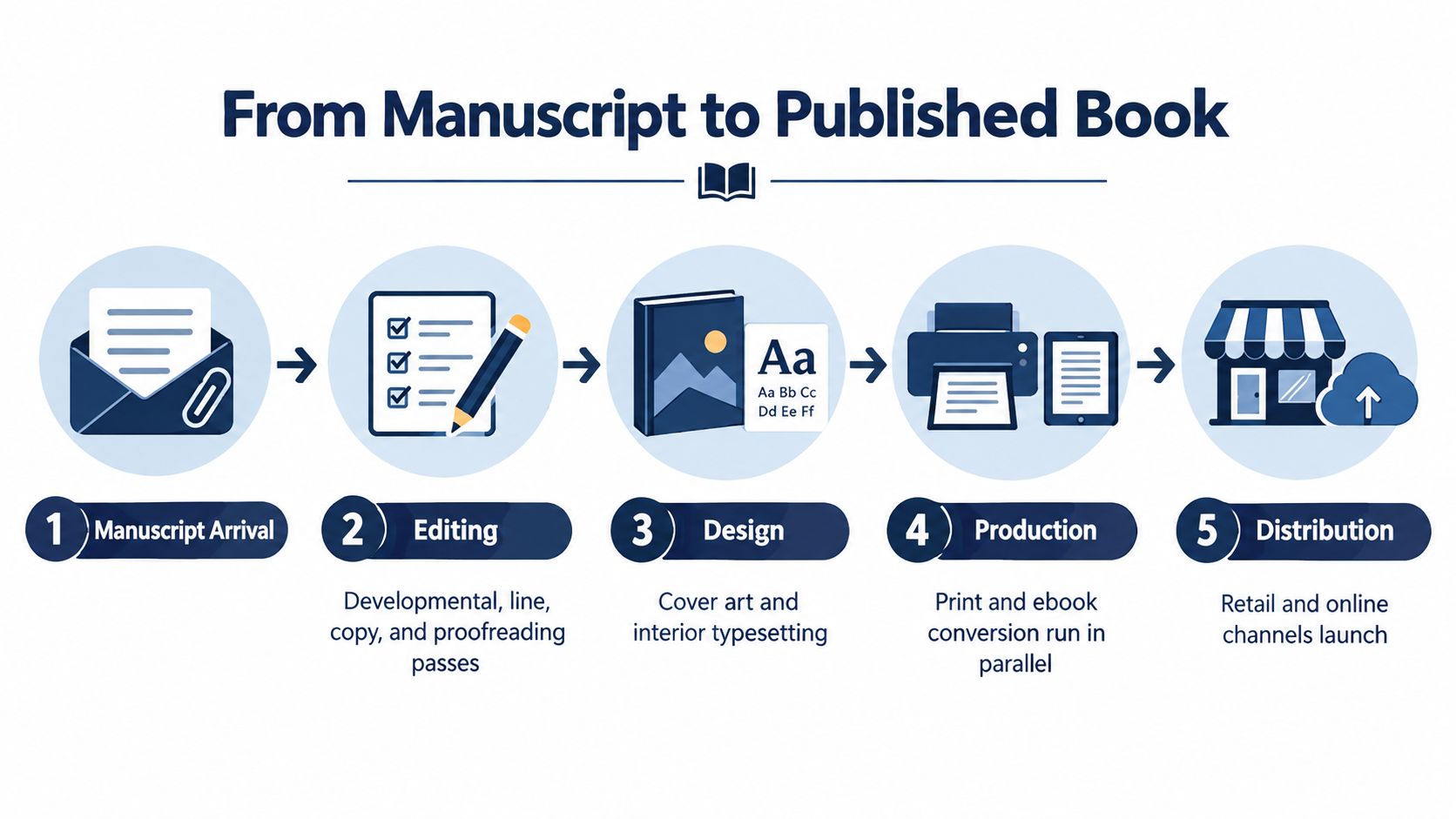
The moment a manuscript lands in production, I stop thinking in terms of “a book” and start thinking in deliverables. The file has to move through preparation, editorial, design, print and digital conversion, then distribution and marketing, and each phase needs an owner, a deadline, and a sign-off rule. If those rules are fuzzy, the schedule becomes a series of rescue missions.
The workflow starts before design
The first job is to decide what kind of book this is. A trade title, an academic reference, a children's picture book, and a multilingual edition don't share the same production rules, even if the source manuscript looks similar at first glance. UNESCO's guidance on book production also makes the point that titles, editions, re-editions, and physical copies aren't interchangeable measures, so the project definition has to be clear before anyone starts formatting or registering files. UNESCO's recommendation on book production statistics is a good reminder that the market sees every edition as a separate production decision.
Practical rule: if the title, edition, format, and language aren't fixed, distribution will force you to revisit work you thought was already done.
Production is governance, not just design
A clean workflow assigns ownership. The author owns content approval and final intent, the editor owns text quality, the production team owns files and specifications, and the publisher or project lead owns the release decision. That's the difference between a book that moves and a book that stalls in endless review cycles.
A useful way to think about the pipeline is this:
- Preparation: confirm scope, audience, format, and the manuscript source file.
- Editorial: complete the text work, resolve structural issues, and lock the content.
- Design and typesetting: shape the reading experience and create print-ready and ebook-ready files.
- Printing and digital conversion: generate durable physical files and structured digital files.
- Distribution and marketing: load metadata, push feeds, and launch the title into channels.
The ordering matters. Metadata for an international edition has to be ready before retailer feeds go live, and accessibility validation has to happen during conversion, not after launch.
Preparing the Manuscript for Production
Most production failures start with a manuscript that wasn't ready to leave the author's desk. The document may be complete in the emotional sense, but incomplete in the operational sense. Names change halfway through, headings are inconsistent, citations are missing, and there's no single file that clearly represents the version everyone should be working from.
A 2025 survey of 2,065 authors and creators found that 94% of authors self-published, while 68% edited their own books and 57% designed their own covers, underscoring how often production responsibility falls back on the author. Lulu's 2025 Books and Business Insights Report reflects what production managers already see every week, the author is often doing work that used to be distributed across a publishing team.
What a production-ready manuscript looks like
At minimum, I want a clean source file with heading styles applied, tracked changes resolved, and notes separated from body text. A well-organized Word file or an equivalent structured manuscript saves more time than a prettier but messy document ever will. If the chapter sequence is still moving around, or if the reference list is unfinished, the file is not ready for design.
This is also where the brief matters. The manuscript brief, target word count, reference sources, and intended formats should be confirmed in writing before editing starts. Otherwise, people edit toward different assumptions and the later rounds become expensive correction work.
When content needs more than cleanup
Not every manuscript needs the same kind of intervention. Some need developmental editing because the structure doesn't support the argument or narrative. Others need a line-level pass because the sentences are flat, repetitive, or unclear. A few need commissioned material, not just revision, because a missing chapter, case study, or appendix can't be patched with style changes.
A manuscript is production-ready when the content decisions are settled and the file is structurally stable. Everything else is recovery work.
That's the standard I use before I hand a project to design. If the content is still moving, every later stage gets dragged back into editing.
Editing Passes and What Each One Delivers
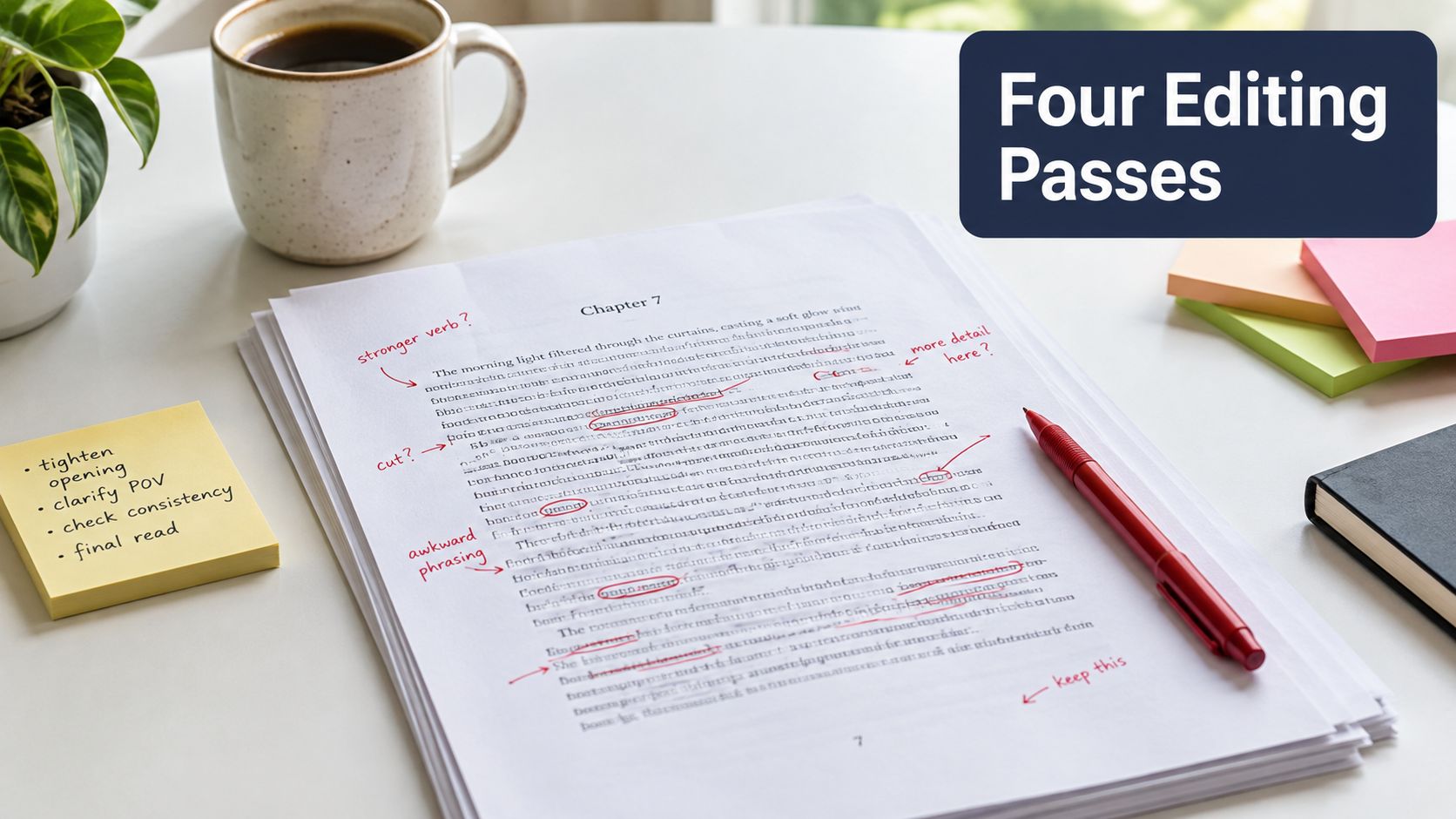
Editing gets treated like one job, but in practice it's four different jobs with different owners and different outputs. If you scope them incorrectly, you either overspend on the wrong pass or skip a pass and pay for it later in proof corrections, reader complaints, or a delayed launch. Clear governance helps here because each pass should have a yes-or-no approval gate.
Structural work comes first
Developmental editing shapes the book's logic. It addresses chapter order, pacing, argument flow, section balance, and whether the book delivers what the premise promises. The deliverable is usually a memo or editorial letter with structural recommendations, not a polished page-by-page manuscript.
That pass belongs to the editor, with the author retaining approval over content changes. If you don't define that boundary early, the author may rewrite late and undo the structural improvements.
Sentence work is a different service
Line editing is about how the book reads at the sentence level. It tightens phrasing, smooths transitions, removes repetition, and protects voice while improving clarity. The editor works inside the prose, but the goal isn't to make every sentence sound uniform, it's to make the book easier to follow.
Copyediting follows with mechanical consistency. Grammar, punctuation, spelling, terminology, style-sheet alignment, figure labels, and internal consistency are the focus here. The output should include a marked manuscript, a style sheet, and a clean file that can move into design without constant interpretation.
If your team needs help organizing those stages, a service like manuscript editing support is only useful when it maps clearly to one of those passes instead of blending them into a vague “editing package.”
Proofreading happens on the proof, not the draft
Proofreading is the final check against a typeset proof. It catches typos, broken line breaks, missing words, bad page references, and layout errors that only appear after composition. It is not the place to rethink structure or rewrite chapters.
For teams trying to approve content faster without losing control, a structured faster content approval process is useful as a workflow reference, especially if it helps define who signs off on what and when. In publishing, approval speed comes from fewer surprises, not from shorter review windows.
Cover Design and Interior Typesetting
Design is where the manuscript starts behaving like a product. The cover has to signal genre, audience, and shelf position in a single glance, while the interior has to make the reading experience feel intentional, not improvised. Those two jobs are connected, because trim size, page count, and typographic choices all affect the cover wrap and the cost of the final files.

The cover begins with positioning
Cover development starts with genre research, not pretty pictures. A thriller, a business book, and a memoir all use visual cues differently, and a good production team studies those cues before sketching concepts. Back-cover copy also belongs in the design brief, because the cover isn't just image work, it's a sales surface.
That's one reason I like locking the trim size before the cover is finalized. If the trim changes later, the cover art has to be resized and reworked, which can push the whole schedule back.
Interior layout is a reading system
Interior typesetting is more than dropping text into a template. Chapter openings, front matter, margins, gutter width, leading, running heads, footnotes, tables, and image placement all affect readability. The wrong font pairing or cramped line spacing can make a polished manuscript feel cheap, even if the words are strong.
If you need a practical reference point for layout work, book layout and formatting guidance is the kind of service description that should translate into a real production spec, not just a sales page. The useful question is always the same, what does the interior need to do for this specific book type.
Production note: a beautiful cover can't rescue a badly paced interior, and a clean interior can't compensate for cover art that misses the market signal.
Files should be approved before export
I want design specs written down and approved before files are exported. That means the title page, chapter opener pattern, image treatment, and page geometry are all settled while the layout is still easy to change. Once the cover and interior are locked, the production team can export with confidence instead of building around shifting preferences.
That discipline also makes the next stage easier. Print and ebook conversion can move in parallel only if the source design is stable enough to support both outputs.
Printing and Ebook Conversion in Parallel
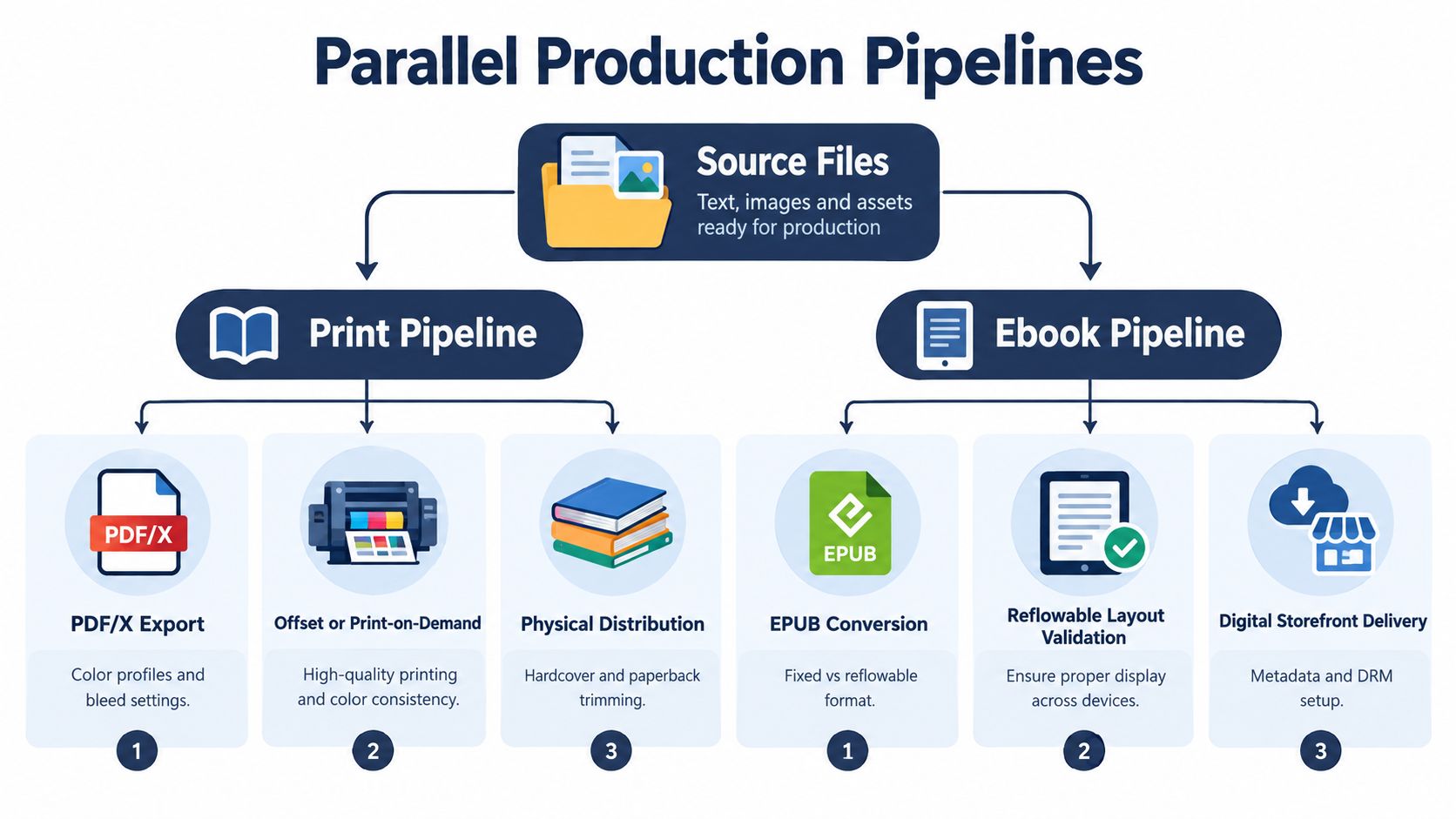
Modern book production usually splits into two tracks after design, one for physical print and one for digital ebook. They share the same source text, but they do not share the same technical rules. The print file needs to survive binding, paper handling, and repeated use, while the ebook needs to remain structured, reflowable, and accessible on different reading systems.
Print files are durability decisions
For long-term preservation, the U.S. Library of Congress recommends archival-quality paper conforming to ISO 11108:1996, with offset lithography as the preferred printing process and hardcover or library binding ranking highest in durability, followed by sewn-through-fold construction. The Library of Congress hierarchy as summarized in W3C's EPUB accessibility specification gives producers a practical way to match materials to expected use.
That hierarchy matters because paper, print method, and binding aren't just budget choices. They're service-life choices. A title meant for frequent handling needs a stronger construction than a short-run promotional paperback.
EPUB production is structured, not flattened
On the digital side, EPUB should be treated as a structured publication, not a PDF copy exported into another format. The W3C EPUB Accessibility 1.1 specification requires conformance at least to WCAG 2.0 Level A and strongly recommends Level AA. It also requires publication metadata to declare conformance through a precisely formatted conformsTo property. W3C's EPUB Accessibility 1.1 working draft is clear that fallback mechanisms don't replace a conforming accessible publication.
The practical production rules are simple:
- Use semantic headings: preserve reading order so navigation works.
- Keep text machine-readable: don't hide text inside images.
- Add meaningful alt text: only where images carry information.
- Validate metadata: confirm the publication declares accessibility conformance.
- Test across reading systems: one good preview isn't enough.
Two formats, one source, separate quality gates
Print and ebook can share the same manuscript, but they need different sign-offs. Print checks focus on trim, bleed, binding, and physical durability. Ebook checks focus on navigation, Unicode behavior, screen-reader compatibility, and whether the file behaves like a real publication instead of a visual approximation.
That's why accessibility work belongs in conversion, not in post-launch cleanup. Once the file is distributed, fixing structure gets harder and the cost of correction jumps.
Distribution Setup and Retailer Metadata
A finished file is not a saleable book until the distribution infrastructure is ready. That includes identifiers, rights data, retailer feeds, library metadata, and channel-specific formatting. This stage doesn't look creative, but it decides whether anyone can find and buy the title.
U.S. ISBN output reached 3,279,217 registrations in 2022, compared with 2,884,609 in 2021 and 3,931,270 in 2020, reflecting the scale at which modern book production operates across formats and editions. Compiled ISBN output data shows why format control matters, because a single title can generate multiple registrations when hardcover, paperback, ebook, and audiobook versions are all in play.
What has to be registered and matched
The identifier layer comes first. Each format needs the right ISBN, and the metadata attached to that ISBN has to match the actual product. If the subtitle, contributor list, or edition note is wrong at registration, the retailer side will mirror the error.
A strong launch package usually includes:
| Format | Identifier | Metadata | Validation |
|---|---|---|---|
| Hardcover | ISBN for the hardcover edition | Title, subtitle, contributors, description | Cover wrap, pagination, barcode placement |
| Paperback | ISBN for the paperback edition | Matching edition details | Trim, spine width, proof copy |
| Ebook | ISBN or platform identifier, depending on channel | Reflowable metadata, description, keywords | EPUB validation and reading-system tests |
| Audiobook | Separate format identifier if used | Narrator, contributors, edition details | Audio file checks and channel specs |
Retail feeds need discipline
Retailers and library wholesalers depend on consistent metadata and clean catalog feeds. That means title, subtitle, contributors, BISAC categories, description, and keywords have to be entered carefully, then checked again when the files go live. A broken feed can make a perfectly finished book hard to discover.
If you need an outside team to handle that setup, book distribution services should be evaluated on whether they control the metadata cleanly, not just whether they claim wide reach.
A distribution launch succeeds when every channel sees the same book, the same edition, and the same rights information.
Launch Promotion and Post-Publication Quality
Promotion starts earlier than most authors think, because the cover, description, categories, and format choices already shape discovery before any ad runs. If those inputs are weak, marketing has to work against the book instead of with it. That's why I treat launch prep as a production responsibility, not just a sales task.
A practical launch timeline checklist for creators can help writers organize release activity, but the book itself still needs to be stable before any campaign goes live. Review copies, retailer listings, and ad creative only work when the metadata and final files are already locked.
Pre-launch and launch need different assets
Before release, the checklist is straightforward. Final files go to the printer and ebook channels, retailer listings are verified, review copies are sent, and promotional assets are produced. If an author landing page or promotional video is part of the plan, it should reflect the final title treatment and metadata, not a draft version.
Post-launch is quality control, not panic
After publication, the work doesn't stop. Retailer-side issues need monitoring, reader feedback should be collected for the next edition, and the team should note any production problems that show up in real use. A typo in a proof can be corrected in the next print run, but a metadata error can follow the title across channels if no one fixes it.
Post-publication also tells you whether the book should have a second edition, a translation, or an audiobook version. Those decisions belong to the same governance model as the launch, because each new format creates its own production path.
Timelines, Decisions, and Common Production Questions
A straightforward trade title often moves through production in two to four months, while academic or translated editions usually take longer because more approvals and format decisions are involved. That range is only useful if the sign-off chain is clear. The biggest source of delay is usually not the work itself, it's unclear authority at the moment a decision needs to be made.
Research from Brigham Young University summarizing a survey of 819 authors found that 35% of traditionally published authors were unhappy or only somewhat happy with their books' publication timelines, while self-published authors most often cited retaining power over book decisions as a reason for choosing independence. The BYU summary of the author survey points to a central trade-off: control speeds some projects up and slows others down when approvals aren't managed well.
The questions authors ask most often
How much control should the author keep? Enough to approve intent, voice, and final content, but not so much that every stage becomes a negotiation.
What costs get missed? Editing, design, accessibility validation, and format-specific adjustments are the ones that often get underestimated.
Does multilingual publication change the process? Yes, because edition control, translated metadata, and channel setup all need to be managed per language.
When does audiobook work belong in the plan? Early, if it's part of the launch strategy, because narration adds another production track with its own timing.
The cleanest projects don't give up author control, they define it. That's what keeps the workflow moving without sacrificing the parts of the book that matter to readers.
If you want a publishing team that treats production of a book as a managed workflow, not a loose collection of tasks, BarkerBooks can handle editing, layout, ISBN and copyright setup, distribution, and launch support in one place. Visit the site to see how that process fits your manuscript, your format, and your release timeline.