
A professional proofread for an average 50,000-word novel typically costs between $500 and $2,250, though the final quote varies widely with word count, genre, manuscript condition, and formatting stage. Some projects are priced by the word, while others use hourly, per-page, or fixed-project fees.
You've finished the manuscript, named the characters, solved the plot, and read the final chapter so many times that the words have started to blur. Then a practical question interrupts the excitement: how much does it cost to proofread a book?
The answer isn't one universal price. Proofreading is a final quality-control service, and the cost depends on what the proofreader must review, how the work is priced, and whether the manuscript is ready for a light error check or still needs heavier editorial attention. A clear comparison method can help you avoid both underbudgeting and paying for work you don't need.
The Anxiety of the Finished Manuscript
Maya closes her laptop after completing a 50,000-word romance novel. She's proud of the story, but the finished document still contains small uncertainties: a character's name may be spelled two ways, a chapter heading may use inconsistent capitalization, and a few commas look suspicious. She searches for proofreading prices and finds hourly quotes, per-word rates, page fees, and package prices that seem impossible to compare.
That confusion is normal. A proofreading quote doesn't describe only the number of words. It also reflects the manuscript's condition, the proofreader's experience, the expected turnaround, the file format, and whether the work happens before or after typesetting.

The Editorial Freelancers Association reports proofreading rates of approximately $1.00 to $4.50 per 100 words, or about $0.010 to $0.045 per word, alongside hourly rates of roughly $35 to $65. Using its standard of 250 words per manuscript page, that range equals approximately $2.50 to $11.25 per page. You can review the EFA rate survey for the association's market-rate context.
For Maya, the word-based calculation gives a useful starting point. A 50,000-word manuscript priced strictly by word produces an estimated $500 to $2,250, but an hourly quote might differ because two proofreaders can spend very different amounts of time on manuscripts of the same length.
The practical question isn't only “What's the rate?” It's “What work does that rate buy?”
Proofreading generally checks spelling, punctuation, grammar, typographical errors, consistency, and issues introduced during production. It doesn't automatically include developmental editing, line editing, rewriting, fact-checking, or translation. Defining the service before comparing prices is the first step toward a sensible budget.
Decoding the Three Main Pricing Models
Proofreading providers usually present prices in three ways: per word, per hour, or per manuscript page. Each model can be reasonable, but each shifts a different part of the pricing risk between author and proofreader.
Per-word pricing
A per-word quote is often the easiest model for a complete book. Multiply the manuscript's word count by the quoted rate, and you have a predictable estimate.
For example, the EFA range of $0.010 to $0.045 per word means a 50,000-word manuscript would calculate to $500 to $2,250 before any separately stated services or adjustments. This model works best when the manuscript's scope is clear and the file is reasonably clean.
The limitation is that word count doesn't reveal everything. A plain-text novel and a technical book with equations, references, captions, and cross-references may contain the same number of words but demand different levels of attention.
Hourly pricing
Hourly pricing charges for the time spent on the project. The EFA reports approximately $35 to $65 per hour. This approach can be useful when the manuscript's condition is uncertain, the proofreader expects substantial file cleanup, or the work includes specialized checking.
For authors, the main drawback is uncertainty. A quote based on hours should state whether it's an estimate, a not-to-exceed amount, or an open-ended arrangement. Ask what happens if the proofreader discovers that the manuscript needs copyediting rather than proofreading.
Per-page pricing
Page pricing can work well when everyone agrees on the definition of a page. The EFA uses 250 words as a standard manuscript page, which converts its proofreading range to approximately $2.50 to $11.25 per page.
A typeset page and a double-spaced manuscript page aren't interchangeable. Before accepting a page-based quote, ask whether the provider means a 250-word manuscript page, a formatted PDF page, or another production measure.
To compare quotes, convert each one into an estimated per-word cost where possible. Then compare the scope, number of passes, file type, and delivery requirements, not just the headline figure.
Fiction Versus Nonfiction and Technical Works
Genre changes the amount of attention a proofreader must give each page. A conventional novel mainly requires careful review of spelling, punctuation, grammar, continuity, dialogue formatting, capitalization, and typographical errors. Nonfiction may add references, headings, tables, captions, terminology, citations, and internal cross-references.
For fiction, professional proofreading commonly benchmarks at approximately $0.012 to $0.020 per word, according to Editor World's book editing rates guide. At those rates, an 80,000-word novel produces an estimated cost of $960 to $1,600.
The calculation is simple:
| Manuscript | Rate range | Estimated proofreading cost |
|---|---|---|
| 60,000 words | $0.012 to $0.020 per word | $720 to $1,200 |
| 80,000 words | $0.012 to $0.020 per word | $960 to $1,600 |
These figures describe proofreading rather than copyediting or developmental editing. If the proofreader must restructure sentences, repair weak paragraphs, or rewrite unclear passages, the project has moved into a different editorial category.
Technical nonfiction commonly falls around $0.020 to $0.035 per word, because the work can require close attention to specialized terminology, abbreviations, equations, captions, references, and consistency with a style guide. An 80,000-word technical manuscript therefore estimates to $1,600 to $2,800 at that range.
Nonfiction also tends to have a wider definition of “correct.” A novelist may need a consistent character name, while an academic author may need every abbreviation, table reference, equation label, and citation to align. That extra checking can reduce the number of words a proofreader handles per hour, which helps explain the higher quote.
A genre premium usually reflects additional operations, not an arbitrary surcharge.
Memoir, children's books, illustrated nonfiction, bilingual editions, and heavily designed books can each require a specific scope. Ask for a sample review when the manuscript includes unusual formatting or specialist content.
Hidden Variables That Shift Your Final Quote
Word count is only the visible part of a proofreading estimate. Two manuscripts with identical lengths can receive different quotes because one is a clean final draft and the other needs extensive preparation before proofreading can begin.
Start by identifying the file and production stage. A proofreader working in a Word manuscript may focus on text and tracked changes. A proofreader reviewing a typeset PDF can also identify errors caused by layout, such as awkward line breaks, missing text, inconsistent page headers, widows, or misplaced captions.
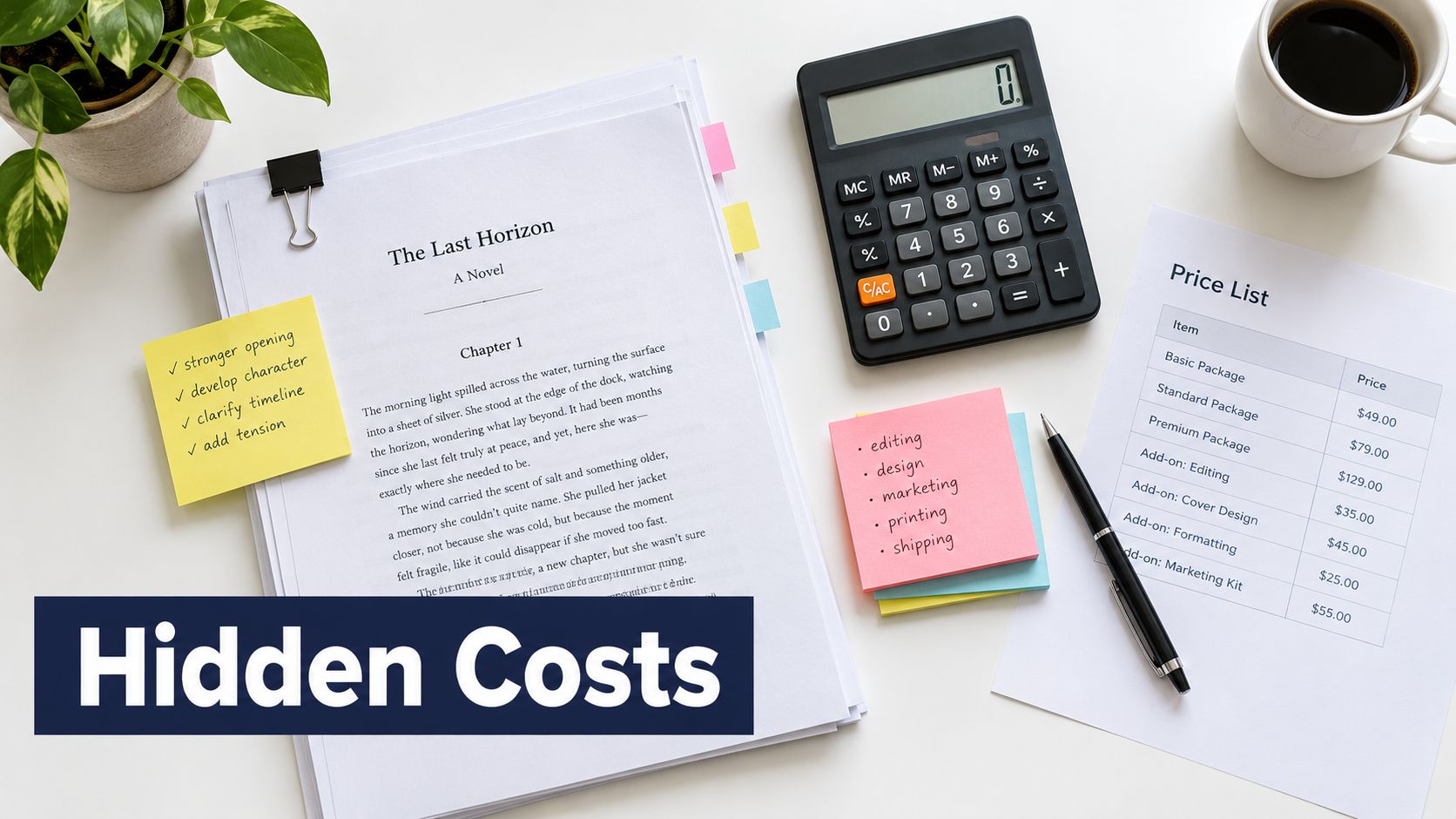
Questions to ask before accepting a quote
- Manuscript condition: Is the file already copyedited, or does it contain sentence-level problems that may require a broader service?
- Formatting stage: Will the proofreader review a manuscript file, a designed interior, or both?
- Scope: Does the fee include one pass, a formatted proof, style-sheet maintenance, and a final corrections check?
- Turnaround: Is the deadline standard, or does the schedule require the proofreader to rearrange existing work?
- Additional elements: Are tables, citations, illustrations, captions, footnotes, indexes, or multilingual sections included?
A sample edit is one of the most useful ways to clarify the scope. It lets the proofreader assess the manuscript's error density and lets you see whether the provider's comments match your expectations. It also helps separate proofreading from copyediting, a distinction explained in this guide to the difference between proofreading and copyediting.
The contract should state what happens when the proofreader encounters work outside the agreed scope. For example, the provider might pause and offer a revised quote if the manuscript needs substantial rewriting. Clear boundaries protect both sides.
For broader guidance on communicating costs and deliverables, Fluidwave's resource on honest pricing offers a useful framework for evaluating whether a quote explains the service clearly.
A video can also help authors understand how professional proofreading fits into the publishing workflow:
Don't compare a low per-word quote with a higher fixed fee until you know whether both providers are reviewing the same version of the book and delivering the same number of checks.
Why Package Deals Offer Better Value
Hiring separate providers can give you control, but it also creates coordination work. You may need to send the proofread manuscript to a formatter, review a new PDF, return layout corrections, and confirm that no new errors appeared during production.
A publishing package can reduce those handoffs by combining related services. Depending on the provider, a package might connect proofreading with editorial support, interior formatting, cover design, distribution setup, or other production tasks. The value isn't automatically a lower price. It's the clearer chain of responsibility.
What bundled support can protect
A proofreader may correct a chapter heading in the manuscript, but a later formatting change can introduce a different inconsistency in the final book. When one service coordinates the workflow, the author has a clearer place to report problems and a better chance of keeping the production sequence organized.
BarkerBooks states that it has published over 7,500 authors, holds a 4.9 Google average rating, and works with authors in more than 91 countries. These are company-provided facts rather than an independent pricing benchmark, so authors should still request a detailed scope, sample work, timeline, and written cost before choosing a package.

A package makes particular sense when your manuscript needs more than a final text check. It can be less suitable if you've already hired a formatter, have a finished cover, and only need a narrowly defined proof pass.
Judge a package by scope and accountability, not by the number of services listed on the sales page.
Ask whether the package includes one proofread or multiple stages, who owns corrections after typesetting, and whether revisions beyond the agreed scope cost extra. A transparent package should make those answers easy to find.
The Financial Case for Professional Proofreading
Professional proofreading is financially justified when errors could damage trust, create production problems, or require expensive corrections after publication. A book with technical claims, complex references, children's content, heavy formatting, or multiple language versions carries more quality-control risk than a simple, carefully prepared manuscript.
The commercial case still needs restraint. A higher proofreading bill doesn't guarantee higher income, and spending more on editing doesn't automatically produce a proportional return. Recent industry summaries cite a 2025 survey in which successful authors generally invested in editing, while many authors clustered around $250 to $999 for editing and spending above $2,000 didn't create an automatic income advantage, as reported in this self-publishing budget breakdown.
That finding supports a risk-based decision rather than a prestige-based one. You're not buying a guaranteed sales result. You're buying a review intended to reduce avoidable errors and protect the reader's experience.
The publishing environment is crowded. The same industry summary reported more than 3.5 million self-published US ISBN registrations in 2025, which means authors compete not only on story and marketing but also on perceived professionalism. The figure describes registrations, not guaranteed sales or readership.
For a broader comparison of editorial service categories and possible budgets, review this guide to how much book editing costs. Then separate proofreading from other investments, such as cover design, formatting, distribution, advertising, and launch planning.
A useful question is: What error would be most expensive to discover after publication? If the answer involves damaged credibility, a reissued file, incorrect technical information, or a poor reader experience, professional proofreading may be worth prioritizing.
Your Step-by-Step Guide to Budgeting for Success
Begin with the number that every provider needs: your manuscript's exact word count. Then describe the genre and identify whether the manuscript is fiction, general nonfiction, technical nonfiction, illustrated, multilingual, or heavily referenced.
Next, prepare the file for evaluation. Remove duplicate drafts, identify the version that should be reviewed, and gather any style guide, spelling preferences, character list, reference list, or terminology sheet. A proofreader can quote more accurately when the project materials reflect the actual work.
Build a comparable quote
Request proposals from providers using the same brief. Ask each one to state:
- The pricing model and effective per-word or per-page equivalent.
- The exact service included.
- The file or production stage covered.
- The number of passes and correction checks.
- The expected delivery schedule.
- Any minimum fee, rush charge, or out-of-scope rate.
A sample proofread should come before commitment whenever possible. Use it to assess both the manuscript's condition and the proofreader's approach. If you're preparing author or team images for a publishing website, resources such as Secta Labs' headshot inspiration can help you think about the wider presentation of your author brand, but that work sits outside the proofreading quote.
Create a simple comparison sheet rather than judging by the lowest number. Put the total price in one column, the normalized per-word estimate in another, and the scope, deadline, file stage, and revision policy beside it.
Finally, decide whether you need proofreading alone or a larger publishing workflow. If you're comparing bundled support, review how much it costs to publish a book and separate editorial costs from design, distribution, registration, and marketing services.
A confident budget leaves room for the work your manuscript needs. Choose the narrowest service that solves the core problem, and don't mistake a low proofreading quote for a bargain if substantial editing remains.
BarkerBooks offers proofreading and broader publishing support, including editorial assistance, formatting, cover design, and distribution services for authors preparing books for readers. Visit BarkerBooks with your word count and manuscript stage to request a scope-based publishing estimate.