
Choosing to publish your own book isn't a fallback anymore. For a growing number of writers, it's a strategic business decision that offers complete creative control and a much bigger slice of the financial pie.
This path isn't a shortcut, though. It's a process with clear stages, from getting your manuscript professionally polished to designing a killer cover and navigating the worlds of distribution and marketing. This guide is your roadmap—think of it as a step-by-step plan to sidestep the traditional gatekeepers and get your book directly into the hands of readers.
Welcome to the Indie Author Revolution

The publishing landscape has been completely upended. The old-school model, where landing a deal with a major publisher was the only legitimate way to see your book in print, is a thing of the past. Today, you have the power to control your own career, shape your projects exactly as you envision them, and earn a much larger share of the profits.
This isn't just a small trend; it's a seismic shift in the industry. We've seen a staggering 264% increase in the self-published book market over the last five years. To put that in perspective, indie authors in the U.S. released around 1.7 million books in 2022. That number absolutely dwarfs the 10,000 new titles from traditional publishers. The indie movement isn't just surviving; it's a dominant force.
Why Go Indie?
When you decide to publish your own book, you're not just an author anymore—you're the CEO of your own publishing company. It's about building a business on your own terms. Here’s what you stand to gain:
- Total Creative Freedom: From the cover art and title to the final edit and marketing copy, every single decision is yours. Your vision stays yours, without compromise.
- Significantly Higher Royalties: A typical traditional deal might offer you 10-15% in royalties. As an indie author, you can keep 60-80% of your earnings. That difference can be life-changing.
- Speed to Market: The traditional publishing process can drag on for years. As an indie author, you can move from a finished manuscript to a book for sale globally in just a few weeks.
- Direct Connection with Readers: Self-publishing lets you build a real relationship with your audience through your email list, social media, and author website. That direct line to your fans is priceless for building a long-term career.
The real power of self-publishing comes from a mindset shift: you are no longer just a writer; you are an entrepreneur. Embracing this turns your passion into a sustainable business.
Think of this guide as your trusted companion for the journey ahead. We’re going to walk through every critical step, from polishing your manuscript to professional standards, to handling the technical nuts and bolts of distribution, and finally, to creating a launch plan that gets your book noticed. This is real, actionable advice born from experience, designed to show you that this path is more achievable than you might think.
You can learn even more about the key benefits of self-publishing in our detailed article.
Getting Your Manuscript Ready for Prime Time

Before you even think about a killer cover design or a launch-day marketing blitz, let's talk about the heart of the project: your manuscript. This is the bedrock of everything. A brilliant story can easily be crippled by sloppy execution, and that’s a surefire way to turn a potential fan into a one-time reader.
The path from that messy first draft to a book that feels professionally published is a journey with several critical stages. I’ve seen countless indie authors try to skip a step here or there to save a few bucks, and it almost always comes back to bite them. Each layer of editing has a specific job to do, and together, they make your book shine.
Of course, you have to finish the draft first. Even seasoned pros get stuck, so knowing how to overcome writer's block is a skill every author needs. You have to push through the tough parts to get to the rewarding work of polishing your story.
The Make-or-Break Layers of Professional Editing
Most new authors think of "editing" as one big task. It's not. Real editing is a multi-stage process that strengthens your book from the 30,000-foot view all the way down to a single comma. Hiring a pro is an investment, but it’s one that pays off in reader trust and better reviews.
Here are the four main types of editing you'll encounter:
- Developmental Editing: This is the big-picture stuff. A developmental editor is looking at the skeleton of your book—the plot, character arcs, pacing, and structure. They’re asking the hard questions: Is the plot solid? Are the stakes high enough? Does the ending feel earned?
- Line Editing: With the structure locked in, a line editor gets into the nitty-gritty of your prose. They work sentence by sentence to sharpen your voice, improve the flow, and make sure your writing is clear and powerful. This is where your craft as a writer truly gets polished.
- Copyediting: Now we get technical. A copyeditor is your grammar guru. They hunt down errors in spelling, punctuation, and syntax while ensuring consistency in things like character names, world details, and timelines.
- Proofreading: This is the final, last-ditch quality check. After the book has been designed and formatted, a proofreader gives it one last pass to catch any sneaky typos or formatting bugs that slipped through. It's the final polish before you hit "publish."
“Authors work so hard and so long on their books that I think it's almost impossible for them to do the final two stages—copy-edit and proofread—with any kind of objectivity. They've seen those words on the page so many times. A fresh pair of eyes here is invaluable.”
It’s crucial to understand how these roles differ. If you want to dig a bit deeper, you can learn more about the distinctions between proofreading and editing here.
Build Your Team of Beta Readers
Long before you pay a professional editor, you need to get some real-world feedback. That's where beta readers come in. A good beta reader isn't your mom or your best friend who will tell you everything is wonderful. They are avid readers in your specific genre who can give you honest, actionable feedback.
Their job is to read like a typical reader and tell you where things went wrong for them.
- Were there parts that confused them?
- Did they struggle to connect with a main character?
- Did the story drag in the middle?
Getting this kind of feedback before you hire an editor can save you a ton of time and money. It lets you fix the big story problems yourself, so your editor can focus on refining what’s already working. Look for beta readers in Facebook groups for writers, genre-specific online forums, or even local writing circles. Aim for a small team of three to five sharp readers. This gives you a good range of opinions without getting overwhelmed by conflicting advice.
Designing a Book Readers Can't Resist
Let's be blunt: people absolutely judge a book by its cover. In a crowded digital bookstore, your cover is the single most powerful marketing tool you have. A professional, genre-appropriate design can literally stop a reader mid-scroll, while an amateur one is a surefire way to be ignored. Getting this right is a non-negotiable step toward successfully publishing your own book.
But the reader’s experience doesn’t end there. A book's interior design—the typesetting, font choices, and layout—is the invisible art that makes reading a pleasure. You might not notice good interior design, but you’ll definitely feel a bad one. It can make a reader feel tired or frustrated without them even knowing why, subtly pulling them out of the world you’ve built.
The Power of a Professional Cover
Your cover has one job: communicate your book's genre and tone in less than three seconds. Think of it as a visual elevator pitch. A dark, gritty cover with sharp, modern typography instantly signals a thriller. A pastel illustration with a flowing script font just screams romance. Get this wrong, and you're not just confusing potential readers—you're losing sales before they even read the blurb.
Let's look at how this plays out in the real world:
- Thrillers & Mysteries: These covers lean into high-contrast imagery, dark color palettes (think blues, blacks, and deep reds), and bold, condensed fonts. The whole point is to create tension and intrigue at a glance.
- Romance: You'll typically find illustrations or photos of couples, bright or soft color schemes, and elegant, handwritten-style fonts designed to evoke emotion.
- Fantasy: This genre relies on epic illustrations, often with custom typography and symbols that hint at the incredible world-building inside.
A great book cover can potentially double your sales. It’s not just an expense; it’s an investment in your book's visibility and commercial appeal.
When you're briefing a designer or trying to create a cover yourself, always prioritize clarity over complexity. One strong, central image is almost always more effective than a busy collage of different elements. For a much deeper dive, check out our guide on essential book cover design tips that sell copies.
Crafting a Flawless Interior Layout
A professionally typeset book feels effortless to read. The reader glides through the words, completely immersed in the story. In contrast, a poorly laid-out book is full of little distractions—awkward line breaks, inconsistent spacing, or fonts that are a struggle to read—that constantly pull the reader out of the experience.
It's also crucial to understand that the technical needs for print and ebook formatting are worlds apart. What looks fantastic on a printed page can be an absolute disaster on a Kindle screen.
Key Formatting Differences: Print vs. Ebook
| Element | Print (PDF) | Ebook (EPUB) |
|---|---|---|
| Fonts | You embed specific fonts (like Garamond or Caslon) for a fixed, classic look. | You use standard, web-safe fonts (like Georgia) because the reader can change them. |
| Layout | It's a fixed layout. You control margins, page numbers, and headers/footers precisely. | The text is reflowable, meaning it changes based on the device and the user's settings. |
| Images | High-resolution (300 DPI) is mandatory for crisp, clean printing. | Lower resolution (72-150 DPI) is better to keep ebook file sizes small. |
| File Type | The industry standard is a print-ready PDF for platforms like KDP and IngramSpark. | EPUB is the universal format that works on nearly all ebook retailers. |
These technical details are not suggestions. KDP and IngramSpark have strict file specifications, and if you don't meet them, you'll face frustrating upload errors or, even worse, a book that looks terrible in print. I've seen it happen—incorrect margin settings can cause text to get sliced off during printing, and low-resolution images will look pixelated and instantly brand your book as amateur.
While DIY tools like Vellum or the Reedsy Book Editor are fantastic for standard fiction and most nonfiction, books with complex layouts almost always need a professional. If you're creating a cookbook, a photography book, or a children's picture book, hiring an interior designer is the only way to go. They’ll ensure every element is perfectly placed, creating a beautiful reading experience that honors all the hard work you put into writing your story.
Navigating the Business of Being an Author
With a polished manuscript and killer designs in hand, it’s time to shift gears. You're no longer just a writer; you're stepping into the role of a publisher. This is where you make the strategic decisions that turn your book from a file on your computer into a product in the global marketplace.
Don't let the business side of things intimidate you. Think of it like starting your own small business—each step is manageable when you tackle it one piece at a time. This is where you build the foundation for your author career.
Getting Your Book's Paperwork in Order: ISBNs and Copyright
First things first, let's get your book's legal and commercial credentials sorted. These are the non-negotiables that make your book official.
ISBN (International Standard Book Number): This 13-digit number is your book's unique fingerprint in the retail world. You absolutely need a separate ISBN for each format you release—one for the paperback, one for the hardcover, another for the ebook, and so on. Retailers from Amazon to your local indie bookstore rely on these numbers to track sales and inventory. In the U.S., you'll get these from Bowker; other countries have their own designated agencies.
Copyright Registration: The moment you write something, you technically own the copyright. But formally registering it with the U.S. Copyright Office (or your country's equivalent) is a crucial step. It creates a public record of your ownership, which is essential if you ever need to defend your work from infringement.
Registering your copyright is a small administrative task that provides huge peace of mind. It’s the legal armor that protects your intellectual property.
Choosing Your Distribution Channels
Okay, how are you going to get your book into readers' hands? For most self-published authors, this comes down to two power players: Amazon's Kindle Direct Publishing (KDP) and IngramSpark. Many of us use both to get the best of both worlds.
KDP is the undisputed giant for reaching Amazon's enormous customer base. It’s free to use, the interface is straightforward, and the royalty rates for books sold on their platform are strong. The catch? Its "Expanded Distribution" network for print books beyond Amazon is a bit weak and pays out less.
That's where IngramSpark comes in. As a premier book wholesaler, IngramSpark plugs your book into a massive network of over 40,000 retailers, libraries, and online stores across the globe. This is how you make your book available for order at Barnes & Noble or a university library. There are small setup fees, but it's the price of true global reach.
This decision tree can help you visualize the path ahead for designing and formatting your files for these platforms.
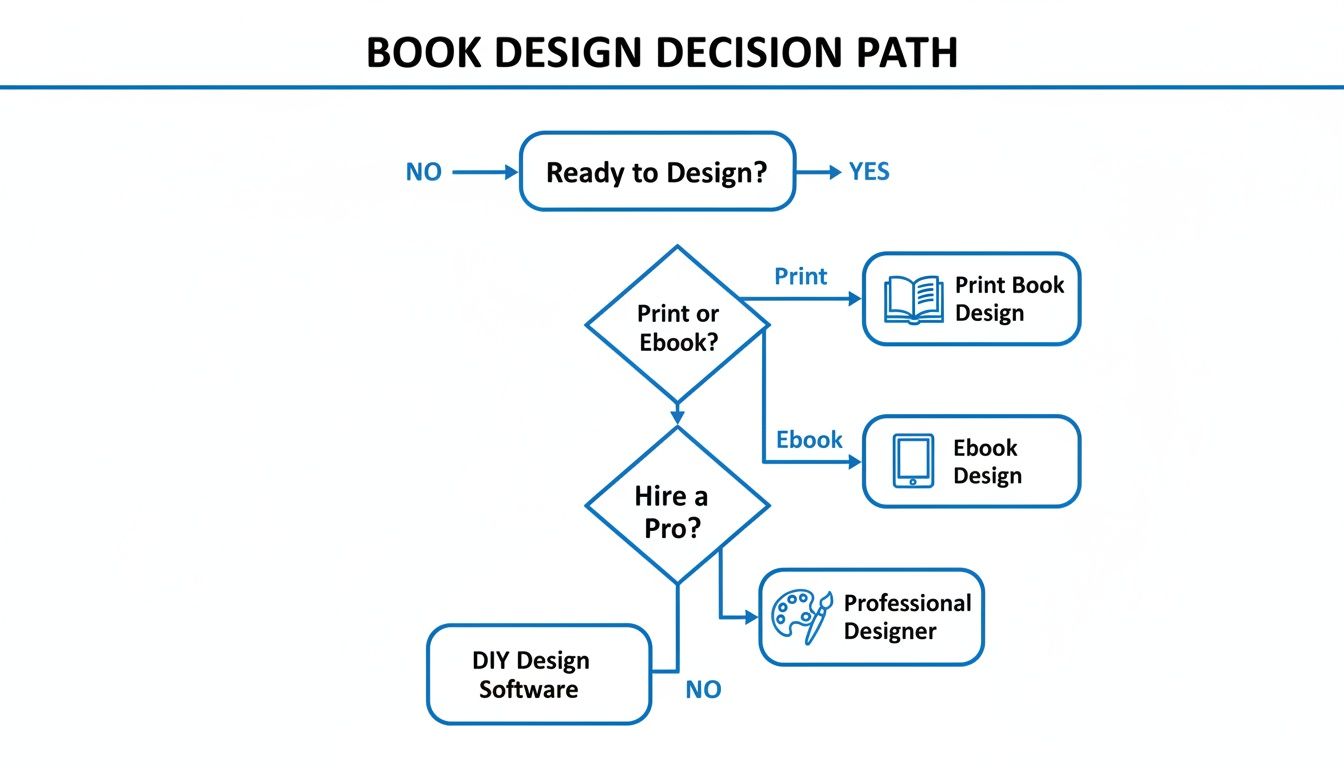
As the chart shows, your early choices—like DIY versus hiring a pro—directly influence the technical steps you'll need to take to get your files ready for primetime.
KDP Select vs. Going Wide: An Ebook Strategy Choice
For your ebook, you have a big decision to make right out of the gate: Do you go exclusive with Amazon or distribute your book far and wide?
KDP Select: This means you agree to sell your ebook only on Amazon for renewable 90-day periods. In return, Amazon includes your book in Kindle Unlimited (where you get paid for every page read) and gives you access to exclusive promotional tools like Kindle Countdown Deals and Free Book Promotions.
Going Wide: This is the strategy of making your ebook available on every possible retail site—Apple Books, Barnes & Noble Press (for Nook), Kobo, and dozens more. You can do this yourself or use an aggregator like Draft2Digital to handle it all for you.
Going exclusive with KDP Select can give a new author a powerful launch, leveraging Amazon's ecosystem to find your first wave of readers. Going wide, however, builds a more resilient, long-term career by diversifying your income and reaching readers who don't shop on Amazon.
Why Self-Publishing Pays (Literally)
The single biggest financial incentive for self-publishing is the royalty structure. It's a game-changer. Let's take a look at how the numbers typically break down.
| Publishing Path | Typical Royalty Rate (eBook) | Typical Royalty Rate (Print) |
|---|---|---|
| Self-Publishing (KDP) | 35% or 70% (depending on price) | 40% – 60% (minus print costs) |
| Self-Publishing (IngramSpark) | 45% – 65% | 45% – 65% (minus print costs) |
| Traditional Publishing | 25% of net receipts | 5% – 15% of list price |
As you can see, the difference is staggering. While a traditionally published author might earn a 10% royalty on their paperback, a self-published author can earn 40% or more on the exact same sale. This control over your earnings is what empowers so many authors to turn their passion into a viable career.
Launching and Marketing Your Book for the Long Haul

So you hit "publish." That feeling is incredible, isn't it? But this is the starting line, not the finish. The real work of a successful indie author starts right now. Choosing to publish your book yourself means you're not just the writer; you're the marketing director, too. A big launch gives you a burst of momentum, but a smart, long-term strategy is what builds a career.
This isn't about just tossing things at the wall to see what sticks. It's about building a real, sustainable system to connect your book with the people who will love it, and keeping it selling for years, not just a few weeks.
Building Your Pre-Launch Buzz
The best book launches I’ve ever seen started months before the book was even available. The whole point is to build up anticipation so that on day one, you have a crowd of people chomping at the bit to buy, read, and most importantly, review. That early flurry of activity sends a massive signal to retailers like Amazon that your book is worth paying attention to.
Your most powerful tool for this? Your email list. Forget social media—your email list is the one audience you truly own, an audience that isn't at the mercy of some algorithm. Start building it early. Offer people something valuable for free in exchange for their email, like a prequel short story, a character art sheet, or a handy checklist related to your book's topic.
Another huge asset is an ARC (Advanced Reader Copy) team. Think of them as your street team. These are your biggest fans who get a free, early digital copy of your book. Their "payment" is leaving an honest review on launch day. Try to get a solid team of at least 20-30 reliable readers to create that essential burst of social proof right out of the gate.
Your pre-launch period is your greatest marketing asset. It’s when you transform a book release from a quiet event into an anticipated moment that drives initial sales and boosts your book’s visibility from day one.
The Launch Day Push
Alright, it's game day. Your job is to pull all the levers you've set up. The goal is to make as much noise as possible in a very short window of time to get those bookseller algorithms to notice you.
A well-coordinated launch day could look something like this:
- Send a broadcast to your email list announcing the book is live, with easy-to-click purchase links.
- Blast it across your social media channels with fresh graphics and a clear call to action. Don't be shy!
- Gently remind your ARC team that today's the day to post their reviews on Amazon and Goodreads.
- Consider a limited-time launch price (like $0.99 for the first 48 hours) to drive a spike in sales.
That initial surge in sales and reviews is everything. It tells Amazon’s all-powerful algorithm that people are interested, which can land you on "also-bought" carousels and even category bestseller lists.
Sustainable Marketing for Long-Term Sales
The launch week high is fantastic, but it will eventually level off. That doesn't mean your sales have to die. Now you pivot to the long game—sustainable marketing tactics that keep introducing your book to new readers. When you decided how to publish your book yourself, you also signed up for these ongoing efforts.
Mastering Amazon Ads
Amazon Advertising is probably the most direct way to get your book in front of readers who are actively looking for something new to read. You don't need a monster budget, either. I've seen authors get great results by starting small, with a daily budget of just $5-$10, and focusing on hyper-specific keywords.
Let's say you wrote a historical mystery set in Victorian London. You wouldn't just bid on "mystery books." That's a waste of money. Get specific:
- "Victorian detective series"
- "Gaslight mystery novels"
- "Books like Sherlock Holmes"
This kind of laser-focus puts your book right in the path of your most likely buyers, which means a much better return on your ad spend.
Content Marketing and Your Author Platform
Your author platform—your website, blog, social media—is your home on the internet. Use it to give readers value beyond just asking them to buy your book. If you write fantasy, blog about your world-building process. If you write nonfiction on productivity, share your top five time-saving apps.
This does two brilliant things. First, it establishes you as an expert and builds a real community. Second, it creates a library of content that search engines can find, pulling new, curious readers into your orbit month after month, completely for free.
The Never-Ending Quest for Reviews
Reviews are the lifeblood of an indie book. They're the social proof that gives a new reader the confidence to take a chance on you. So, make it ridiculously easy for people to leave them. At the end of your book, in the back matter, add a simple, polite note asking for a review and—this is key—include a direct link to the review page. This one small step can make a huge difference in how many reviews you collect, keeping your book looking fresh and relevant long after launch day.
Common Questions About Publishing Your Book Yourself
Even with a detailed roadmap, you're going to have questions as you learn the ropes of self-publishing. That's not just normal; it's a sign you're taking this seriously. Let’s tackle some of the most common things I hear from authors who are stepping into the publisher's seat for the very first time.
And if you're wondering if it's a good time to jump in, the answer is a resounding yes. The global book publishing market is expected to climb from $136.5 billion in 2024 to an incredible $229.5 billion by 2035. This isn't just corporate growth; it's fueled by indie authors and readers hungry for new voices. You can dig into more of these exciting publishing market trends yourself.
How Much Does It Really Cost to Self-Publish?
This is the million-dollar question, isn't it? The honest-to-goodness answer is that it varies wildly. It all comes down to how much you're willing and able to do yourself versus where you bring in a pro. While you can technically hit "publish" for free, creating a book that looks and feels as good as one from a major publisher requires some investment.
Here's a realistic look at where your money might go:
- Professional Editing: This is your single most important expense. Budget anywhere from $1,000 to $5,000+. The final cost depends on your book's length and how much work it needs—from big-picture developmental editing down to the final proofread.
- Cover Design: A killer cover that fits your genre can run between $300 and $1,000. Don't be tempted to cheap out here. Your cover is your #1 sales tool, period.
- Interior Formatting: You could use a DIY tool for a small fee, but for a truly polished look (especially for complex layouts), hiring a formatter for $250 to $700 is money well spent.
- ISBNs: A single ISBN from a service like Bowker is $125. My advice? Grab the 10-pack for $295. It’s a much better value, and you'll want separate ISBNs for your ebook, paperback, and hardcover.
- Marketing & Ads: This budget is entirely up to you. You can dip your toes in with $5-$10 a day on Amazon Ads or go bigger with a full-blown launch campaign.
All told, a solid budget for a professionally produced indie book typically lands somewhere between $2,000 and $5,000.
What Are the Biggest Pitfalls to Avoid?
I see so many first-time authors fall into the same few traps. Just knowing what they are puts you way ahead of the game.
Trying to do everything by yourself is a common pitfall. Never underestimate the value of a human professional who has spent years honing their skills. There is more to a cover than a bunch of drawings and a title.
Watch out for these three classic mistakes:
- Skipping Professional Editing: Thinking a spell checker and a few read-throughs are "good enough" is the surest way to get slapped with one-star reviews. A real editor is absolutely non-negotiable if you want readers to take you seriously.
- Designing an Amateur Cover: Your cover has one job: to scream "professional" and instantly tell a potential reader what genre your book is. A homemade cover kills sales before anyone even reads your book description.
- Ignoring Marketing: Publishing is not a "build it and they will come" situation. Hitting the publish button is the starting line, not the finish. Your marketing efforts should start months before your launch and continue long after. Without a plan, your book will simply get lost in the noise.
How Long Does the Whole Process Take?
Here's one of the best parts about being an indie author: you set the timeline. You're not stuck in the years-long traditional publishing queue. From a polished manuscript to a live book, you can realistically get it all done in four to six months.
That buffer gives you plenty of time for thorough editing, thoughtful design, proper formatting, and, crucially, building up that pre-launch buzz. Trust me, rushing any of these steps will almost always backfire and compromise the quality of your final book.
Ready to turn your manuscript into a professionally published book without all the guesswork? At BarkerBooks, we live and breathe this stuff. We can handle every single step—from world-class editing and stunning design to global distribution and a marketing plan that gets results. Let our team of experts help bring your book to life.