
Advertising a book well is all about a smart game plan. It's a blend of building excitement before the launch, hitting the ground running on release week, and keeping the momentum going long after. It all starts with defining your reader, setting a budget, and then launching a targeted campaign that speaks directly to them.
Your Blueprint for an Unforgettable Book Launch
So, how do you actually advertise a book to make a real splash? The work begins long before you touch an ad platform. It starts with a solid blueprint that connects your book's soul to a savvy marketing strategy. This planning is what separates the books that fly off the digital shelves from the ones that get lost in the crowd.
It’s tempting to jump right into running ads on Amazon or Facebook, but that’s like trying to build a house without pouring the foundation first. A launch that really works stands on three core pillars: knowing exactly who you’re selling to, figuring out what you can realistically invest, and writing ads that make people need to know what happens next.
Define Your Ideal Reader
Before you spend a single cent, you have to know who you're talking to. And I mean really know them, not just basic demographics. You need to build a detailed picture of your perfect reader.
- Writing a gritty sci-fi novel? Your ideal reader might be a 35-year-old software engineer who binges science podcasts, idolizes authors like Andy Weir, and hangs out on Reddit's r/printSF.
- Publishing a cookbook? You might be targeting a 28-year-old parent desperate for quick, healthy weeknight meals. They probably follow their favorite food bloggers on Instagram and do their weekly shopping at Whole Foods.
Getting this specific is a game-changer. It lets you fine-tune your ad targeting, your copy, and your images to connect with the very people who are most likely to fall in love with your book.
Establish a Realistic Budget
Your advertising budget sets the stage for what’s possible. You don’t need a Hollywood-sized budget to make an impact, but you do need to be realistic. A great way to start is by setting a small daily budget, maybe $10–$20, just to test the waters and see what resonates. Keep a close eye on your return on ad spend (ROAS)—the goal is to find a profitable combination of ad and audience that you can confidently scale up.
A classic mistake is blowing the entire budget during launch week. The smarter play is to spread your funds across pre-launch buzz, the big launch-day push, and post-launch ads to maintain that initial sales velocity.
Craft Compelling Ad Copy and Creative
Think of your ad as the first handshake with a potential reader. You have seconds to make an impression and get them to stop scrolling.
- The Hook: Kick things off with a question or a bold statement that taps right into your genre's core appeal. For a thriller, you could try: "What if the one person you trust most is the one you should fear?"
- The Intrigue: Briefly tease the central conflict or premise. Give them just enough to be curious, but don't spoil the good stuff.
- The Call to Action (CTA): End with a clear, direct instruction. Something like "Read the first chapter now" or "Grab your copy today" works perfectly.
This whole process—from reader to budget to ad—is a simple but powerful flow.
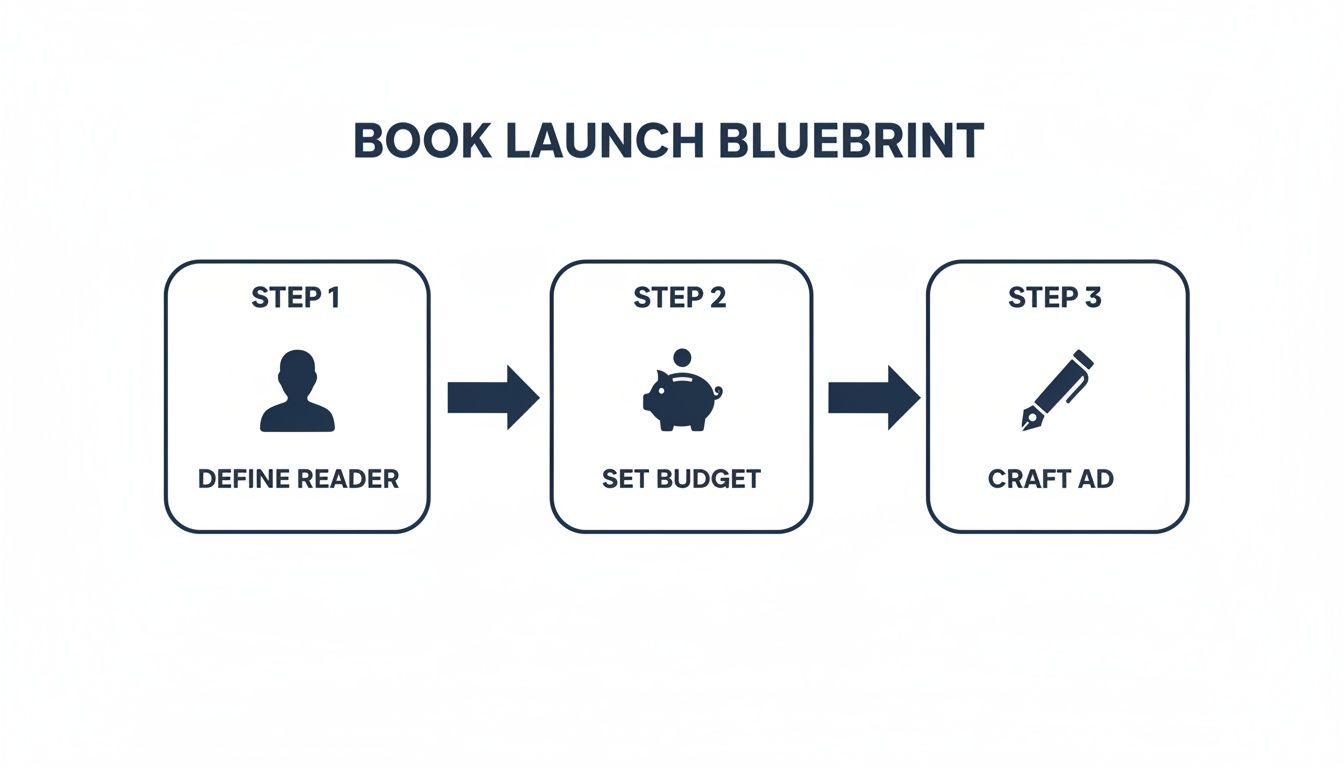
As the infographic shows, each step logically builds on the one before it, creating an advertising plan that’s cohesive and, most importantly, effective.
This strategic approach is proving its worth globally. In 2023, book revenues climbed in 12 out of 16 major markets. Mexico, for example, saw a +10% increase, showing that smart promotion can drive real growth, even when the economy is unpredictable.
To help you build out your plan, these 10 data-driven product launch strategies for Amazon offer a fantastic framework you can adapt for your book's debut. And for even more creative sparks, don't miss our guide on https://barkerbooks.com/book-launching-ideas/.
To give you a clearer picture, here's how the entire advertising journey breaks down into distinct phases.
Key Stages of a Book Advertising Campaign
This table outlines the typical lifecycle of a book's promotional campaign, from the early planning stages right through to sustaining long-term sales.
| Phase | Primary Goal | Key Activities | Example Tactic |
|---|---|---|---|
| Pre-Launch | Build anticipation and an initial audience. | Cover reveals, ARC distribution, grow email list. | Running a "coming soon" giveaway to your email list. |
| Launch | Drive a massive spike in sales and visibility. | Paid ad campaigns, email blasts, influencer outreach. | A coordinated BookBub Featured Deal on launch day. |
| Post-Launch | Maintain sales momentum and gather reviews. | Ongoing "always-on" ads, review requests. | Targeting readers of similar authors with Amazon Ads. |
| Growth | Scale readership and expand your author brand. | Series promotions, audiobook marketing, backlist sales. | Running a "first book free" promotion for a series. |
Each of these stages requires a slightly different mindset and set of tactics, but they all flow together to support your book's success over the long haul.
Building Momentum Before Your Book Launch
A huge book launch doesn't just materialize on release day. It’s the grand finale of a marketing performance that should start months before your book ever hits the shelves. This pre-launch window is your golden opportunity to turn mild curiosity into genuine, can't-wait-to-read-it anticipation. You’re building an audience that’s not just aware of your book, but is counting down the days until they can buy it.
I’ve seen it time and time again: the biggest mistake authors make is waiting until their book is already out to start marketing. By that point, you're playing catch-up. The key is to think of your launch not as a single announcement, but as a rolling event—a steady drumbeat of excitement that builds to a crescendo on the big day.
Orchestrate a Compelling Cover Reveal
Let's be blunt: your book cover is your single most critical marketing tool. It’s the first thing readers see, and studies show that a staggering 57% of U.S. readers buy books based on the cover alone. A well-planned cover reveal is the perfect way to kickstart the conversation.
Don’t just drop the image one day and call it a wrap. Turn it into an event. For a week leading up to the reveal, post tantalizing snippets on social media—a cropped corner, a blurred version, or just the color palette. Then, for the main event, coordinate the big reveal with popular book bloggers or influencers in your genre to amplify your reach. Getting the cover and title out there 4-6 months before launch is a solid timeframe to start building that crucial visual recognition.
Distribute Advance Reader Copies Strategically
Want to have glowing reviews on your sales page from day one? Advance Reader Copies (ARCs) are how you make that happen. These are pre-publication versions of your book sent out to a select group of reviewers, bloggers, and influencers to generate early buzz and testimonials.
Timing is everything here. You need those reviews to pop up the moment your book goes live because that social proof is an incredibly powerful motivator for new buyers. Here’s a simple timeline that works:
- 2-3 Months Pre-Launch: Send out your digital ARCs. This gives everyone plenty of time to read your book and write a thoughtful review without feeling rushed.
- 1 Month Pre-Launch: Send a friendly follow-up. A gentle nudge reminding them of the launch date with direct links to your book's Amazon and Goodreads pages makes it super easy for them to post their review.
The real magic of ARCs isn’t just about collecting reviews. It’s about building a team of true advocates. By giving these readers an exclusive sneak peek, you make them feel like insiders who are a vital part of your book’s journey.
Grow Your Most Valuable Asset: Your Mailing List
Social media is fantastic for getting your name out there, but your email list is where you forge real, lasting connections with your core fans. It’s the one audience you truly own, completely immune to the whims of algorithms. The best way to get people to sign up? Offer them a reader magnet—a free short story, a prequel novella, or a character guide exclusive to subscribers.
Once they’re on your list, the goal is to nurture that relationship. Avoid only sending "buy my book!" emails. Instead, share behind-the-scenes glimpses of your writing life, post deleted scenes that didn't make the final cut, or tell personal stories about your creative process.
This consistent, genuine engagement transforms casual subscribers into superfans. In a survey of over 850 authors, 78% used social media weekly, but they confirmed that email remains one of the absolute best channels for driving actual sales. When launch day finally arrives, an email to this dedicated group will be your single most effective tool for kicking off that all-important initial sales surge. For long-term success, mastering this is a fundamental answer to the question of how do you advertise a book.
Executing a Powerful Launch Week Strategy
All that pre-launch work? It all comes down to this. Launch week is when the steady drumbeat of anticipation you’ve been building finally explodes into a full-blown sales symphony. This is where your careful planning pays off, hopefully sending your book shooting up the charts and into the hands of brand-new readers. It’s an intense, exciting, and frankly, exhausting period that requires a clear head and a tactical game plan.
A killer launch week isn't about just doing a lot of things at once. It’s about making sure every effort amplifies the others. Your paid ads need to be running when your email blast goes out, which should be happening right as influencers start posting. It all works together to create a massive wave of momentum.
Let's break down the tactical playbook for making your launch week one for the books.
Mastering Paid Advertising for Launch
During launch week, paid ads are your secret weapon for reaching readers who have never heard of you. Platforms like Amazon Ads and Facebook Ads are your best friends here, driving highly motivated buyers straight to your book’s sales page.
On Amazon Ads, you’ll want to lean heavily on Sponsored Product campaigns. Now is the time to be aggressive. Target authors whose readers are a perfect match for your book. For example, if you wrote a fast-paced thriller, you’d target readers of Lee Child or David Baldacci. I recommend a mix of automatic campaigns (let Amazon’s algorithm do some discovery for you) and manual campaigns where you bid on specific, high-intent keywords like "new military thrillers" or "best psychological suspense 2024."
Over on Facebook and Instagram, it's all about the visuals. Your gorgeous cover is your hero. Create short, snappy video clips or animated graphics that stop the scroll. You can get incredibly specific with targeting, zeroing in on users based on interests like "Kindle readers," "Goodreads," or even fans of an author's official page.
A common mistake I see is authors setting a tiny daily budget and just hoping for the best. Launch week is when you invest. A budget of $25-$50 per day on each platform gives you enough data to quickly see what’s working, kill what isn’t, and scale up the winners.
Coordinating Your Email and Influencer Push
While ads are great for finding new readers, your email list and influencer network are for activating your true fans. These are the people who are already on your team, the ones most likely to buy on day one and start the sales snowball rolling.
Your launch day email needs to be more than a flat announcement; it has to sizzle with excitement and urgency.
- Nail the Subject Line: Go for something like, "It's Here! My New Book Is Finally Live" or "The Wait Is Over – Grab Your Copy Now!"
- Get Personal: Readers connect with the author's journey. Share a brief, heartfelt note about what writing this book meant to you.
- Use a Crystal-Clear Call-to-Action (CTA): Big, bold buttons that link directly to your book on Amazon, Barnes & Noble, and other key retailers are a must. Make it dead simple for them to click and buy.
At the same time, this is your final nudge to your influencer team. Circle back with the bloggers and Bookstagrammers who received your ARCs. Send a friendly reminder that the book is live, and make it easy for them by providing ready-to-use graphics and swipe copy for their posts. Their authentic reviews provide powerful social proof when potential buyers are still on the fence.
Your Sample Launch Week Schedule
Feeling a bit overwhelmed? It's normal. A clear schedule keeps all the moving parts from spiraling out of control. Here’s a sample timeline showing how to advertise a book effectively during its most critical week.
| Day | Key Focus | Tactical Actions |
|---|---|---|
| Launch Day | Maximum Impact | – Send main email blast to your list. – Go live with all paid ad campaigns. – Post announcements across all social media channels. |
| Day 2 | Maintain Momentum | – Monitor ad performance; turn off underperformers. – Share early reader reviews and testimonials. – Send a follow-up email to non-openers. |
| Day 3-4 | Amplify Social Proof | – Reach out to influencers for scheduled posts. – Run a giveaway or contest on social media. – Share "behind the scenes" content from your launch. |
| End of Week | Final Push | – Announce if your book hit any bestseller lists. – Send a "last chance" email for any launch promotions. – Analyze ad data to plan post-launch strategy. |
This isn't about throwing spaghetti at the wall. This structured approach ensures each activity builds on the last, creating a sustained buzz that will carry your book through its first week and set the stage for long-term success.
Where Should You Spend Your Advertising Budget?
Alright, you've got your launch week mapped out. Now for the million-dollar question: where do you actually spend your money? Dropping your ad budget in the right place can mean the difference between a bestseller and a book that never finds its audience.
The single most important rule is to go where your readers are. If you write hard sci-fi, your people might be hanging out in niche Reddit forums. If you're a romance author, they're probably devouring content on TikTok. Put yourself in your reader’s shoes, and you’ll start seeing the best places to invest.
Amazon Ads: The Author’s Home Turf
Let's be direct: for most authors, advertising on Amazon is non-negotiable. It's the biggest bookstore on the planet, and people don't go there to browse cat videos—they go there to buy books. That built-in purchase intent is what makes it so powerful.
The magic of Amazon Ads is in the targeting. You can put your book right in front of readers as they're searching for specific keywords ("dystopian thriller with a female lead") or looking at books by authors just like you. Imagine a reader browsing a bestseller in your genre, and your book pops up as a suggested read. That’s prime real estate.
If you really want to get this right, our https://barkerbooks.com/amazon-advertising-for-books/ is your next stop. It breaks down exactly how to build campaigns that actually sell books.
Facebook and Instagram: Finding Readers Before They Search
While Amazon is for buying, social media is for discovering. Platforms like Facebook and Instagram are fantastic for building awareness and letting readers get to know you and your work through compelling visuals.
Here, the targeting is all about interests and behaviors. You can zero in on people who've "liked" pages for similar authors, are part of book club groups, or have shown interest in Kindles. This lets you build an audience from scratch that looks just like your ideal reader. A sharp ad with your cover or a quick, animated video can be a total scroll-stopper.
Once you have a feel for a platform, check out this complete guide to social media optimisation to really dial in your strategy and make every post count.
The Overlooked Power of Print
In a world obsessed with digital, it's easy to forget about physical books. But here's a reality check: ignoring print is a huge mistake.
Print book sales saw an unbelievable 249% growth in 2023, and sales on Amazon Print specifically skyrocketed by 381%. Readers still love the feel of a real book in their hands, and your advertising needs to reflect that.
So, how do you make this work for you?
- Flaunt the physical copy. Use high-quality photos or mockups of your paperback in your ad creative.
- Shout about availability. Let people know your print book can be shipped globally thanks to print-on-demand.
- Run bundled deals. Create promotions that pair the ebook with a discounted print version.
This multi-format approach ensures you're ready to sell to any reader, no matter how they prefer to read.
BookBub and TikTok: Tapping Into Reader Communities
Beyond the big two, a few specialized platforms can give you a direct line to the most passionate readers out there.
BookBub, for example, is an absolute beast. It's essentially a massive email list of hungry readers just waiting for their next great deal. If you manage to land a BookBub Featured Deal, you can expect to see thousands of sales in a single day. It’s a game-changer.
And then there's TikTok. The #BookTok community has become one of the most powerful forces in publishing, capable of making a book a viral sensation overnight. While you can't just buy virality, you can absolutely get in on the action by running ads or, better yet, collaborating with BookTok creators who genuinely love your genre.
The smartest campaigns don't just pick one channel; they blend them. You might run Amazon Ads for consistent sales, use Facebook to build a loyal following, and drop a BookBub deal to shoot up the bestseller charts—all while keeping a finger on the pulse of what's buzzing on TikTok.
Comparing Top Book Advertising Platforms
Deciding where to allocate your budget can be tough. This table breaks down the main players to help you see where your book fits best.
| Platform | Best For | Key Targeting Options | Average Cost |
|---|---|---|---|
| Amazon Ads | Reaching readers with high buying intent; direct sales. | Keywords, similar products (ASINs), author names, categories. | $0.50 – $1.00 per click (CPC) |
| Facebook/Instagram Ads | Building author brand awareness and finding new readers. | Demographics, interests (authors, genres), lookalike audiences. | $0.70 – $1.50 per click (CPC) |
| BookBub Ads | Reaching dedicated bargain-hunters and avid readers. | Author interests, genres, retailer preferences. | $0.60 – $2.00 per 1000 impressions (CPM) |
| TikTok Ads | Tapping into viral trends and the #BookTok community. | Hashtags, interests, video interactions, creator collaborations. | Varies widely; can be higher CPC but with massive reach. |
Each platform has its strengths. Your job is to create a marketing mix that plays to those strengths and aligns with your specific launch goals.
Using Genre Trends for Smarter Advertising
If you want to advertise your book without breaking the bank, you need to speak your reader's language. This isn't about shouting into the void and hoping someone hears you; it's about whispering directly to the fans who are already looking for a book just like yours. That means getting to grips with what makes your genre tick—the tropes, the character types, even the pacing—and letting that understanding shine through in every single ad.
Think about it. You wouldn't use the same ad copy for a cozy mystery and a gritty military sci-fi novel, right? It would just feel… off. One reader is looking for a quaint village and a quirky detective, while the other wants high-tech battles and deep philosophical questions. Knowing what your audience craves is the first step to creating ads that don't just get clicks, but actually attract real, paying fans.
Decode Your Genre's DNA
To really nail your advertising, you have to become a student of your genre. I'm not just talking about knowing the basic plot points. You need to identify the specific emotional buttons that make a reader in your niche hit that "buy" button without a second thought.
A great place to start is by digging into the top 20 bestsellers in your specific subcategory on Amazon. Don't just browse—analyze. Look for patterns in:
- Cover Imagery: Are the covers dominated by illustrated characters, bold typography, or moody landscapes? What’s the vibe?
- Ad Copy Hooks: What questions are they asking in their blurbs? What promises do they make to the reader right out of the gate?
- Reader Reviews: This is gold. Pay close attention to the exact words readers are using. Are they raving about the "slow-burn romance," the "mind-bending plot twist," or the "laugh-out-loud dialogue"?
These aren't just minor details; they're your marketing blueprint. When you spot these common threads, you’re essentially collecting the keywords, imagery, and emotional triggers you need to build a campaign that feels instantly familiar and compelling to your ideal reader. It shows them you don't just write in their genre—you get it.
Ride the Wave of Current Market Trends
Genres are living things. They have seasons, and what's hot today might be lukewarm tomorrow. Timing your ad campaigns to catch a rising wave can give your book a massive advantage.
For instance, a 2023 analysis showed that while steamy romance saw a small dip, Science Fiction absolutely surged, becoming the second most promoted genre and making up 8.0% of all paid promos. At the same time, Self-Help and Children's Books were also on the upswing. This is crucial intel. You can dive deeper into these book marketing trends and what they mean for authors to see where the momentum is.
Here’s a pro tip: Your book probably straddles a few categories. If you've penned a "sci-fi romance" and you see sci-fi is trending hard, lean into that angle in your ads. You might just pull in a much wider audience than if you focused only on the romance element.
Match Your Pricing Strategy to Genre Expectations
Finally, let's talk price. This is a huge, often overlooked, piece of genre-specific advertising. A $0.99 promotional price for the first book in an urban fantasy series is practically an industry standard. But that same price on a dense, 500-page non-fiction guide could make it look cheap and untrustworthy, especially when readers expect it to cost $9.99 or more.
Do your homework. Check out the typical full-price and sale-price points for books in your specific category. Readers have a built-in sense of what a book "should" cost based on its genre. When you price your book in line with those expectations, you remove a major obstacle to the sale and make your ads far more likely to convert.
Keeping Your Book Selling Long After Launch
A huge launch week feels amazing, but the real mark of a successful author career isn't a seven-day sales spike. It's building a book that becomes an evergreen asset, selling steadily for months and even years. So, how do you advertise a book for the long haul? You have to pivot from that frantic launch energy to smarter, more sustainable growth strategies.
The initial buzz will always die down. That’s natural. But your marketing can't stop with it. This is the phase where you build the systems that keep your book in front of a constant stream of new readers.
Cultivate Continuous Social Proof
Reader reviews are the lifeblood of your book's long-term health. They're powerful social proof, signaling to potential buyers that your book is a safe bet—something others have read and enjoyed. While you can't ask for positive reviews on sites like Amazon, you absolutely should encourage readers to share their honest opinions.
One of the simplest and most effective ways to do this is by adding a polite request right in the back matter of your book. A short, friendly note like, "If you enjoyed this story, please consider leaving a review. It makes a huge difference for authors like me," works wonders. Make it even easier for them by including a direct link to the review page.
Reignite Interest with Strategic Promotions
Even a book that's been out for a while can get a massive sales boost with the right promotion. Running periodic price drops, like a limited-time $0.99 sale, can introduce your book to a whole new audience of readers who love a good deal.
Of course, a sale is useless if no one knows about it. You need to get the word out, and that's where book promotion services are invaluable:
- Newsletter Services: Submit your deal to services like BookBub, Bargain Booksy, or The Fussy Librarian. They can put your discounted book in front of hundreds of thousands of hungry readers.
- Social Media Push: Announce the sale to your own followers and consider running a small, targeted ad campaign focused on the new low price.
This one-two punch creates a sales spike that can dramatically improve your book's ranking and visibility, giving it a "halo effect" long after the promotion ends. For a deeper dive on building these into a calendar, our complete book marketing plan shows you how to integrate these tactics for the long run.
Think of your backlist as a portfolio of assets. You’ve already done the hard work of writing them. Now, your job is to keep them working for you by strategically reminding readers they exist. A well-timed promo can bring an older book roaring back to life.
Leverage Your Series as a Marketing Engine
If you write a series, you're sitting on one of the most powerful long-term marketing tools an author can have. The first book is no longer just a book; it's your primary advertising vehicle—a gateway drug to your entire fictional universe.
A tried-and-true strategy is making the first book in the series perma-free or using it as a "loss leader" with heavy, frequent promotions. The goal isn't to profit from book one. It's to get as many readers as possible hooked on your story and characters. Once they've torn through the first installment, they're far more likely to snap up the rest of the series at full price. This is how you build a loyal fanbase and a reliable, long-term income stream.
Common Questions About Advertising a Book
Stepping into book advertising for the first time can feel like learning a new language. You're bound to have questions. I’ve heard them all over the years, so let's tackle some of the most common ones head-on.
How Much Should I Budget for Ads?
This is the big one, isn't it? While there’s no universal magic number, a great place to start is with $10–$20 per day.
That amount is the sweet spot. It's enough to get you real, actionable data from platforms like Amazon Ads or Facebook, but it won't drain your bank account while you're still figuring things out. The strategy is to test small, find out what resonates with readers, and then pump your royalties back into the ads that are actually working.
Think of your initial budget not as a cost, but as an investment in data. You're paying to learn who your readers are and what ad copy resonates with them. This knowledge is invaluable for long-term success.
When Should I Start Advertising?
If you wait until launch day to start marketing, you're already behind. Seriously. You want to start building that buzz 4-6 months before your book even comes out.
This is the time for things like cover reveals, getting early reviews from an ARC team, and growing your author mailing list. Then, when launch week hits, you unleash the paid ads. This pushes that critical initial sales velocity, which helps with rankings, and you can keep that momentum going long after the launch buzz has faded.
What’s More Important: Clicks or Sales?
Clicks are nice. They tell you people are interested. But at the end of the day, sales are the only metric that truly matters.
A ton of clicks but no sales is a classic sign that something's disconnected. Maybe your ad is fantastic, but it's sending readers to a book page with a weak blurb or a cover that doesn't match the ad's vibe. The ad promises one thing, and the product page delivers another.
Keep your eye on your Return on Ad Spend (ROAS). If you put $5 into ads and get $10 back in royalties, you've got a profitable, sustainable machine. That's the goal.
Do I Need a Big Social Media Following?
It certainly helps, but don't let a small following stop you. A huge platform is a bonus, not a prerequisite.
The beauty of targeted ads is that you can put your book directly in front of your ideal readers, even if you have exactly zero followers. Your job is to create a compelling ad; the platform's algorithm will do the heavy lifting of finding the right audience.
Ready to turn your manuscript into a global success story without the guesswork? The expert team at BarkerBooks handles everything from cover design and global distribution to managing targeted ad campaigns, so you can focus on writing. Learn more about our author services and get published today.