
So, you’ve written a book. Congratulations! Now comes the real challenge: getting people to actually buy it on Amazon. If you’re asking yourself, “How do I promote my book on Amazon?”, you’re already on the right track. It’s the single most important question you can ask.
A successful book launch isn’t about one magic bullet. It’s a coordinated strategy—a powerful mix of a perfectly tuned book page, smart use of Amazon’s own marketing tools, and a solid plan to get reviews and drive traffic from outside Amazon.
Your Blueprint for Amazon Book Promotion Success
Launching a book on Amazon can feel like shouting into a hurricane. With millions of other books all vying for eyeballs, just clicking “publish” and hoping for the best is a recipe for disappointment. The real work, the work that sells books, starts with promotion.
Think of Amazon as more than just a bookstore. It’s a massive search engine, and your book is a product. To win, you have to play by its rules. This guide is your roadmap. We’ll break everything down into simple, actionable steps, starting with the basics and moving up to more advanced tactics. My goal is to give you a clear, repeatable blueprint you can use for every single book you launch.
Why Amazon Is Your Top Priority
Let’s be clear: focusing your energy on Amazon isn’t just a good idea, it’s essential. The sheer scale of the platform makes it the undisputed center of the book universe.
Consider this: Amazon accounts for over 50% of all new book sales in the U.S. and an incredible 80% of all book distribution. For ebooks, it’s even more dominant, with its ecosystem driving up to 85% of all consumption in the U.S. These numbers make one thing obvious: mastering your Amazon presence is non-negotiable. You can dive deeper into Amazon’s dominance in the book market if you’re curious.
A successful book promotion isn’t a one-time event; it’s a continuous process of optimizing, advertising, and engaging. Think of your book page as a living entity that needs consistent care and strategic input to thrive.
Before we dive into the nitty-gritty, let’s look at the foundational pillars that support any strong Amazon promotion plan.
Key Pillars of Amazon Book Promotion
This table gives you a quick snapshot of the core areas we’ll be covering. Each one plays a critical role in how visible—and desirable—your book becomes to potential readers.
| Promotional Pillar | Primary Goal |
|---|---|
| Product Page Optimization | Make your book irresistible to both shoppers and Amazon’s algorithm. |
| Internal Promotional Tools | Use KDP Select and Amazon Ads to reach targeted readers on the platform. |
| Launch & Review Strategy | Build momentum and social proof right from day one. |
| External Traffic Generation | Drive your own audience to your book page to signal popularity. |
By mastering these four areas, you stop being a passive author who just lists a book and become an active marketer inside the world’s biggest bookstore.
Your Amazon Product Page is Your Digital Storefront
Let’s be blunt: your Amazon book page is your most important sales tool. Think of it as your digital storefront. Before anyone reads a single word of your manuscript, they’re judging your book by its cover, title, and description. This is where the sale is won or lost.
Optimizing this page isn’t just a “nice-to-have” — it’s non-negotiable for anyone serious about selling books. Your page has two critical jobs. It has to grab a potential reader’s attention and convince them your book is worth their time and money. At the same time, it needs to feed all the right signals to Amazon’s search algorithm so the right readers can find you in the first place.

Crafting a Title and Subtitle That Sells
Your title and subtitle are prime keyword real estate. Don’t waste them. For fiction authors, this is your chance to use genre signifiers. Think “A Gripping Psychological Thriller” or “A Steamy Enemies-to-Lovers Romance.” It’s a simple trick, but it instantly tells both readers and the Amazon algorithm what kind of story they’re getting.
Non-fiction authors, your subtitle is where you make your promise. “The Productivity Paradox” sounds interesting, sure. But adding a subtitle like “How to Stop Being Busy and Finally Get Your Most Important Work Done” is what makes a reader click. It speaks directly to their pain point and offers a clear solution.
Your Cover: The Silent Salesperson
On Amazon, your cover is almost always a tiny thumbnail, fighting for attention among a sea of others. This is not the place to skimp. In fact, a staggering 57% of readers say the cover is a huge factor in their decision to buy.
A great cover does three things well:
- It’s legible at any size. Can you read the title and your name when it’s the size of a postage stamp? If not, it’s back to the drawing board.
- It screams the right genre. A thriller cover looks and feels completely different from a lighthearted romance. Your design has to fit reader expectations instantly.
- It looks professional. A DIY cover usually looks like a DIY cover. To a potential buyer, that can signal that the writing inside might also be amateurish.
A professional cover isn’t an expense; it’s an investment in your book’s discoverability and credibility. It’s the first promise you make to a reader about the quality of the story inside.
Writing a Book Description That Hooks Readers
After the cover, your book description is what seals the deal. Its only job is to get someone to click “Buy Now” or download that free sample. This isn’t the place for a dry plot summary. You need to forge an emotional connection and leave the reader dying to know what happens next.
Start with a killer one-sentence hook. Follow that with a couple of short, punchy paragraphs that introduce your main character, the central conflict, and what’s at stake. For non-fiction, lay out the core problem your reader is facing and hint at the transformation your book offers. Always end with a cliffhanger or a compelling call to action. If you’re struggling, learning how to write a book description that actually converts is a skill worth mastering.
Choosing Keywords and Categories Strategically
This is the behind-the-scenes magic of Amazon’s algorithm. Keywords and categories are how readers who have never heard of you find your book. KDP gives you space for seven keywords, but you need to think like a reader. Forget single words; focus on the phrases people actually type into the search bar.
For instance, “mystery” is way too broad. A much sharper keyword phrase would be “cozy mystery with a female detective.” You’re targeting a very specific reader who knows exactly what they want.
The same logic applies to categories. It’s incredibly hard to stand out in a massive category like “Thrillers.” But if you can drill down and become a bestseller in a niche like “Technothrillers,” you gain massive visibility and that coveted orange “Bestseller” tag. For a deep dive, this guide on Amazon listing optimization for higher rank and sales is an excellent resource for getting both discoverability and conversions right.
Once your product page is polished and ready to go, it’s time to start pulling the levers inside Amazon’s own ecosystem. These are the tools Amazon gives you to get in front of the millions of people already browsing the Kindle store. Think of it as your inside track.
The first big question most authors face is whether or not to enroll in KDP Select. This is Amazon’s exclusivity program—you give them the exclusive digital rights to your ebook for 90 days, and in return, you get access to a powerful set of marketing tools. It’s a big decision, and frankly, there’s no one-size-fits-all answer.
The KDP Select Decision: Weighing the Pros and Cons
Going “all-in” with KDP Select puts your ebook into the Kindle Unlimited (KU) library. This is a huge pool of voracious readers who subscribe to read as much as they want. KU readers can be a fantastic way to build a fanbase fast, especially if you write in a popular genre. They’ll read your book as part of their subscription, and you get paid for every page they flip.
The catch? Exclusivity. You can’t sell your ebook anywhere else—not on Apple Books, Kobo, or even directly from your own website. For an author with a well-established audience on other platforms, this can be a non-starter. But for new authors, the sheer visibility you get from KU often outweighs the benefit of being “wide” on multiple stores.
My Take: Enrolling in KDP Select is a strategic gamble. If your main goal is to get as many eyeballs on your book as possible and build momentum on Amazon, the benefits of KU are hard to ignore, especially when launching a new series.
Sparking Sales with Kindle Countdown Deals
If you do enroll in KDP Select, one of the best tools you get is the Kindle Countdown Deal. This is a classic, urgency-driven promotion that flat-out works.
Here’s the gist: You set up a limited-time discount that lasts up to seven days. The magic is that the price climbs back up in steps throughout the sale. A ticking clock right there on your book page shows shoppers how much time is left before the price goes up again. It’s a powerful psychological nudge to get people to buy now.
To really make this work, don’t just set it and forget it. Time your Countdown Deal to coincide with a newsletter blast, a social media campaign, or a paid ad push to drive a flood of traffic while the price is at its lowest.
Attracting New Readers with Free Book Promotions
Another great KDP Select perk is the Free Book Promotion. You can make your book free for up to five days every 90-day period. Now, giving your work away might sound crazy—you don’t earn royalties on free downloads—but the strategic value can be massive.
So, why would you do it?
- Massive Visibility: A well-promoted free run can lead to thousands of downloads. You’re putting your book in the hands of a huge new audience who might never have taken a chance on you otherwise.
- The Perfect Series Hook: This is the go-to strategy for the first book in a series. Get readers hooked on book one for free, and a good portion of them will happily pay full price for the rest of the series.
- Kickstart Your Reviews: More readers mean more opportunities for reviews. That social proof is gold for attracting future paying customers.
The ebook market is only getting bigger. Global sales are projected to hit $14.92 billion by 2025, with the U.S. market alone expected to reach $5.38 billion. And here’s a telling stat: Amazon Prime members buy about 20% more books than non-members. Using Kindle deals is a smart way to tap into that audience. You can see more data on how digital trends are shaping the book market on newprint.com.
Getting Started with Amazon Ads
Beyond KDP Select, your most direct path to customers is Amazon Ads (what used to be called AMS). Don’t let the ad platform intimidate you. You don’t need a huge budget to see what works. Starting with just $5-$10 per day can give you some incredibly valuable feedback.
The easiest way to dip your toes in is with a Sponsored Products ad. These are the ads you see in the search results and on the product pages of other, similar books.
Start with an “automatic targeting” campaign. This is where you let Amazon’s algorithm do the heavy lifting, showing your ad to shoppers it thinks are relevant. Let it run for a week or two, then dive into the data. You’ll see which search terms customers actually used to find and buy your book. You can then take those winning terms and create a “manual targeting” campaign for much greater control and efficiency.
For a deeper dive, our detailed guide offers more advanced strategies for optimizing your Amazon advertising for books.
Weaving Together Your Launch and Review Strategy
A killer book launch isn’t just about hitting “publish.” It’s a strategic campaign, a carefully planned burst of energy designed to make Amazon’s algorithm sit up and take notice. The whole point is to generate a concentrated wave of activity that tells the system, “Hey, readers love this book!” This process begins weeks, sometimes months, before your release and carries on long after launch day.
The two most valuable assets you have during a launch are visibility and social proof. Visibility is getting eyeballs on your book page. Social proof—in the form of reader reviews—is what convinces those eyeballs to click the “buy” button. Without reviews, even a perfectly polished product page will have a tough time converting casual browsers into paying customers.
Building Your Street Team of Advance Readers
The absolute bedrock of a solid review strategy is your Advance Reader Copy (ARC) team. Think of them as your launch-day MVPs. This is a hand-picked group of readers who get a free, early copy of your manuscript with the understanding they’ll leave an honest review on or right after launch day. I can’t stress this enough: getting those first few reviews live is probably the most critical promotional task you’ll undertake.
You don’t need an army. A tight-knit group of 20-30 reliable readers is worth more than a list of 100 people who might flake out. So, where do you find these gems?
- Your Email List: These are your people. They’ve already signed up to hear from you, making them the warmest leads you have. Start here.
- Social Media Groups: Find genre-specific reader communities on places like Facebook. If you’ve been an active, contributing member, you’ll have a much easier time finding volunteers.
- Reviewer Services: If you’re starting from scratch, platforms like BookSirens or Reedsy Discovery can be a great way to connect with vetted reviewers actively looking for books just like yours.
Once you’ve assembled your crew, clear communication is everything. Get the ARC into their hands about 2-3 weeks before launch. Be crystal clear (but friendly!) about when and where they should post their review. A gentle nudge a day or two before the big day often works wonders.
An ARC team is your launch-day insurance policy. Having just five to ten reviews live on day one can dramatically increase your conversion rate, telling potential buyers that your book is a safe bet.
This timeline gives you a bird’s-eye view of how Amazon’s own promotional tools can work together to boost your launch.
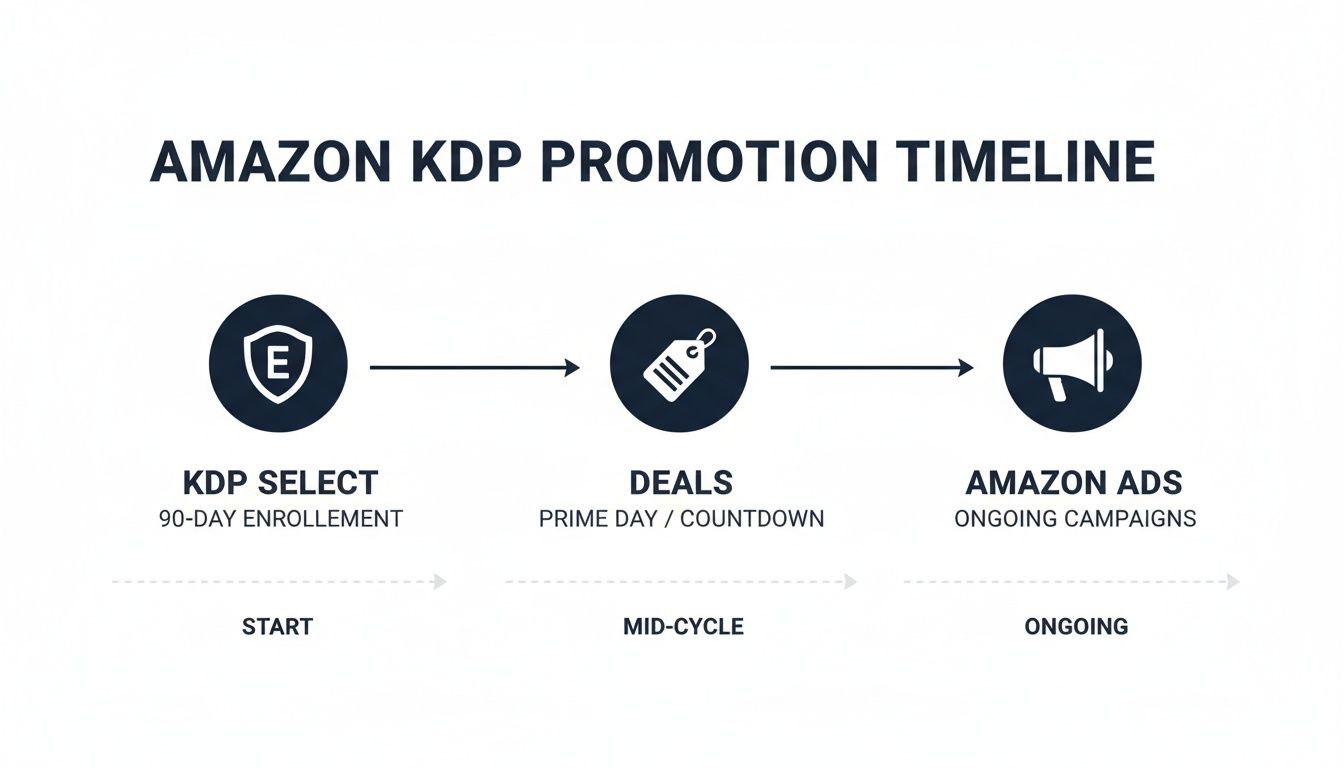
As you can see, enrolling in KDP Select is the key that unlocks powerful promotional tools like Countdown Deals and ads. When you time these features around your launch, you create a much bigger impact.
How to Ask for Reviews (Without Breaking the Rules)
After the initial launch buzz, getting more reviews becomes a long-term game. It’s crucial to remember that Amazon has very strict policies against incentivizing reviews. That means no offering cash, gift cards, or anything else in exchange for a rating. Period.
That said, you absolutely can—and should—make it ridiculously easy for happy readers to leave their thoughts.
One of the best-kept secrets is the “Request a Review” button hiding in your KDP sales dashboard. For each order, you have a 30-day window to click this button, which sends a generic, Amazon-approved email to the buyer asking for a review. It’s simple, fully compliant, and surprisingly effective.
And don’t underestimate the power of a simple, direct ask. Add a polite note in the back matter of your book. In a sentence or two, explain how much reviews mean to authors and then give them a direct link to your book’s review page to remove any friction.
Mapping Out a High-Impact Launch Week
Think of your launch week as a seven-day sprint. The objective is to cram as much sales velocity as you can into that short window. This is how you climb the charts, especially the all-important “Hot New Releases” list in your categories. Hitting that list gets you in front of thousands of new readers, creating a self-perpetuating cycle of visibility and sales.
To help you visualize this, I’ve put together a sample timeline that shows how to structure your promotional efforts for maximum impact.
Sample Amazon Book Launch Timeline
| Phase | Key Activities | Timeline |
|---|---|---|
| Pre-Launch | Finalize metadata & cover. Build ARC team. Send out ARCs. Plan launch-week promotions. Tease the book on social media. | 4-6 Weeks Out |
| Launch Week | Send launch announcement to email list. Ensure ARC reviews go live. Launch with a special price ($0.99 or $2.99). Start Amazon Ads campaigns. Run scheduled promos on book sites. | Day 1-7 |
| Post-Launch | Gradually increase the price to its regular level. Thank readers & share positive reviews. Analyze ad performance & optimize. Use the “Request a Review” button in KDP. | Week 2-4 and Ongoing |
This framework is just a starting point, of course. For those looking for more creative ways to make a splash, exploring different book launching ideas can spark inspiration tailored to your genre and audience.
Ultimately, a powerful launch is all about synergy. It’s the result of solid preparation, a concentrated marketing push during release week, and consistent follow-through.
Driving External Traffic to Your Amazon Page
While Amazon’s own promotional tools are essential, relying on them exclusively is like leaving money on the table. The most successful authors I’ve worked with know a crucial secret: driving your own traffic to your Amazon page sends a powerful signal to its algorithm.
When Amazon sees sales coming from off-site sources—your blog, social media, or an email blast—it recognizes your book as popular and in-demand. This can trigger a visibility boost, getting your book in front of more organic Amazon shoppers. You’re not just making sales; you’re kickstarting the flywheel that leads to organic discovery on the world’s biggest bookstore.
Your Email List is Your Biggest Asset
If you focus on just one thing outside of Amazon, make it your email list. Seriously. It is the single most powerful tool in your author arsenal. Forget social media algorithms; your email subscribers represent a direct line of communication that you own and control. These are your superfans, the ones ready to buy on launch day.
A well-timed email campaign during launch week can create a massive sales spike. That initial velocity is exactly what you need to climb the charts and get Amazon’s algorithms to sit up and take notice.
Here’s how to build and nurture that list:
- Create a Reader Magnet: Offer something irresistible for free in exchange for an email. Think a bonus chapter, a prequel short story, or a character art bundle.
- Segment Your Audience: If you write across different genres, group your subscribers accordingly. This lets you send targeted announcements that people actually want to open.
- Serve, Don’t Just Sell: Your emails can’t all be “buy my book!” Share behind-the-scenes glimpses of your writing life, ask for feedback, or recommend other great books. Keep them engaged between your own launches.
Engaging Readers on Social Media
Think of social media as your authorial living room, not a billboard. It’s less about hard-selling and more about building a community. The goal is to create content that pulls readers into your world, so when you do post a link, your warm, engaged audience is happy to click it.
Be smart about where you spend your time. A fantasy author might thrive on Instagram and TikTok, while someone writing business non-fiction will likely get more traction on LinkedIn. Go where your readers are.
Don’t mistake activity for progress. It’s far better to genuinely engage on one platform your readers love than to spread yourself thin across five different networks with generic, uninspired content. Authenticity builds trust, and trust drives sales.
Building an external audience is a core business activity. For a broader look at this, check out these essential digital marketing tips for small businesses—the principles apply perfectly to authors.
The Quiet Power of Pinterest
Platforms like Facebook and TikTok get all the hype, but many authors are sleeping on a surprisingly effective tool: Pinterest. The trick is to stop seeing it as just another social network and start treating it for what it truly is—a visual search engine.
People on Pinterest are actively looking for things, including their next great read. A well-designed Pin can drive traffic to your book page for months, even years, unlike a tweet that vanishes in an hour. It’s a fantastic tool for long-term, sustainable promotion.
Here’s how to put Pinterest to work:
- Create Vertical Pins: Design eye-catching, vertical graphics for your book cover, character art, or pull-quotes.
- Use Keyword-Rich Descriptions: Think like a reader. What would they type into the search bar? Use phrases like “dark academia books,” “enemies-to-lovers romance,” or “thrillers with a shocking twist.”
- Link Strategically: Pins can point directly to your Amazon page, a blog post reviewing your book, or a landing page for your reader magnet to grow that all-important email list.
I know a cozy mystery author who created a few simple pins with character introductions and mood boards for her new series. In her launch month, Pinterest became her second-highest source of traffic, sending over 250 clicks to her preorder page from a single pin. That’s real proof that a small, consistent effort can produce big results over time.
Measuring Success and Refining Your Strategy
Launching your book isn’t the finish line; it’s the starting gun. The real work of building a long-term seller happens after the launch, once you can dig into the data and see what’s actually moving the needle.
This is where you stop guessing and start making intelligent, data-backed decisions. Your KDP dashboard is mission control for this. Don’t let the charts and graphs overwhelm you—you only need to focus on a few key metrics to understand your book’s real-world performance.
Key Metrics to Monitor in Your KDP Dashboard
I recommend checking these numbers at least once a week. They’ll give you a clear, honest picture of how your marketing is translating into sales and reads.
Ordered Units: The bottom line. This is your raw count of print and ebook sales, the most direct measure of whether people are buying your book.
Kindle Edition Normalized Pages (KENP) Read: If your book is in KDP Select, this number is pure gold. It tracks the pages read by Kindle Unlimited subscribers, which determines your share of the KDP Select Global Fund payout. It’s a huge part of many authors’ income.
Ad Impressions & Clicks: This is the pulse of your Amazon Ads campaigns. Impressions tell you how many people see your ad, and clicks show how many were intrigued enough to check out your book page.
Advertising Cost of Sales (ACOS): This is arguably the most critical ad metric. It tells you exactly what percentage of a sale you spent on ads to get it. A low ACOS means you’re running profitable, efficient campaigns.
Adopting a mindset of continuous improvement is what separates a flash-in-the-pan launch from a book that sells for years. Your data isn’t just a report card; it’s a roadmap showing you exactly where to go next.
Test, Measure, and Adapt Your Approach
Once you’re comfortable with your numbers, it’s time to start experimenting. You’d be amazed at how small, strategic tweaks can lead to big jumps in your conversion rate.
Think of it like A/B testing. Try changing just the first line of your book description to something with a stronger hook. Let it run for a couple of weeks, watch your sales, and see what happens. You can do the same with your keywords, your A+ Content, or even your primary category.
Your Amazon Ads are the perfect laboratory for this. Dive into your search term reports and find out which keywords are actually driving sales at a profitable ACOS. Double down on those winners. For the keywords that are just burning through your budget with no return? Pause them without mercy. It’s an ongoing process of refinement, not a “set it and forget it” task.
A Few Lingering Questions About Amazon Book Promotion
Diving into Amazon’s promotional ecosystem for the first time can feel like trying to drink from a firehose. It’s totally normal to have questions. In fact, most authors, whether they’re just starting or have a few books under their belt, tend to grapple with the same core challenges. Let’s tackle a couple of the big ones.
Is KDP Select a Good Move for a New Author?
I get this question all the time, and for most new authors, my answer is a firm yes.
Think of it this way: KDP Select is your backstage pass to some of Amazon’s most powerful promotional tools. You get to run Kindle Countdown Deals and Free Book Promotions, which are fantastic for generating early buzz.
But the real game-changer is getting your book into Kindle Unlimited (KU). This is a huge library filled with voracious readers who are always looking for their next favorite author. By being in KU, you remove the biggest barrier to entry—the purchase price—and let readers take a chance on you risk-free. Yes, it means you’re exclusive to Amazon for your ebook for 90 days, but the visibility you gain in that massive marketplace often blows away what you might earn from a handful of sales on other platforms, especially when you’re still building a name for yourself.
What’s a Realistic Daily Budget for Amazon Ads?
You absolutely don’t need a Hollywood budget to get started. In fact, throwing a ton of money at ads from day one is a bad idea.
A smart starting point is $5 to $10 a day. This is enough to get your feet wet and, more importantly, start collecting crucial data.
Don’t think of your initial ad spend as a sales expense. It’s tuition. You’re paying for an education in what your readers actually search for, which ads they click on, and what ultimately convinces them to buy your book.
Once you find a few keywords that are actually leading to sales, that’s when you can start to strategically increase your budget. The goal isn’t to spend a lot; it’s to spend smart. Start small, see what sticks, and then pour your resources into the campaigns that are proven to work.
Ready to turn your manuscript into a global success story? The team at BarkerBooks has helped over 7,500 authors with everything from editing and design to worldwide distribution and marketing. Find out how we can help you at BarkerBooks.com.