
Learning to write a book description isn't about summarizing your plot. It's about crafting a killer hook, hinting at the core conflict, raising the stakes, and finishing with an irresistible urge for readers to hit that "Buy Now" button.
Think of it less as a synopsis and more as a powerful piece of sales copy designed to turn browsers into buyers.
The Power of a High-Converting Book Description
Your book description is your hardest-working salesperson. It's on the job 24/7 across Amazon, Kobo, and Apple Books, constantly pitching your story to anyone who scrolls by. It’s not just a summary; it’s the final, crucial step that bridges a reader's curiosity and a sale.
In a sea of endless options, those first few sentences are everything. You have just seconds to grab a potential reader's attention and pull them into your world. This is where you have to switch hats—from the creative author to the strategic copywriter. Your goal isn't just to tell a story anymore; it's to sell one.
From Author to Marketer
Making that mental leap from storyteller to salesperson can feel unnatural, but it's absolutely vital. As an author, you've lived inside your story for months, maybe even years. As a marketer, your job is to distill that entire, complex world into a few potent paragraphs that scream conflict, emotion, and promise.
This shift is a must-have skill in the global book publishing market, which is projected to be worth around $126.9 billion in 2025. You're competing for attention, and the data doesn't lie: a staggering 70% of book purchases on sites like Amazon are heavily influenced by the cover and the description.
Getting your blurb right—keeping it under the 4,000-character limit for platforms like Amazon and hooking readers from the very first line—can boost click-through rates by an average of 25%.
To get a better handle on the persuasion side of things, it helps to break down the essential components that make a book description truly work.
Here’s a quick-reference table that outlines the key elements of a description that sells.
Key Elements of a Winning Book Description
| Element | Purpose | Quick Tip |
|---|---|---|
| The Hook | Grab the reader's attention with a compelling question, a shocking statement, or a bold premise in the first 1-2 sentences. | Make it short, punchy, and intriguing. Focus on the core emotion or conflict. |
| The Premise | Briefly introduce the main character, the world, and the central problem or inciting incident. | Don't get bogged down in details. Give just enough context to set the scene. |
| The Stakes | Explain what the character stands to lose. What happens if they fail? This creates tension and urgency. | Raise the stakes from personal to potentially world-altering, if your genre allows. |
| The Promise | Hint at the genre, tone, and overall experience the reader can expect (e.g., a twisty thriller, a heartwarming romance). | Use genre-specific keywords and tropes that resonate with your target audience. |
| Call-to-Action | A final, direct invitation for the reader to buy the book. | End with a confident command like, "One-click now to start this thrilling adventure!" |
Each of these pieces works together to build a compelling case for why your book is worth a reader's time and money.
The Anatomy of Persuasion
A description that converts doesn't just list plot points; it persuades. It taps directly into reader psychology by forging an immediate emotional connection and creating a sense of urgency. Every single word has a job to do.
Mastering this skill is a massive part of the journey when you're learning how to become a published author who can actually reach an audience.
Think of your book description as the final polish before you send your work out into the world. If you want a deeper look at the entire publishing journey, check out this complete guide on how to publish your book on Amazon. A great blurb is what ensures your book doesn’t just sit there—it actively sells itself while you sleep.
Crafting Your Blurb from Hook to Cliffhanger
Think of your book description less like a summary and more like a perfectly engineered slide. The whole point is to get a potential reader from that very first word down to the "Buy Now" button without giving them a single reason to stop. This is where we get tactical and build your blurb piece by piece.
To really nail this, you have to shift your thinking from a creator to an entrepreneur. It's a fundamental change in perspective.
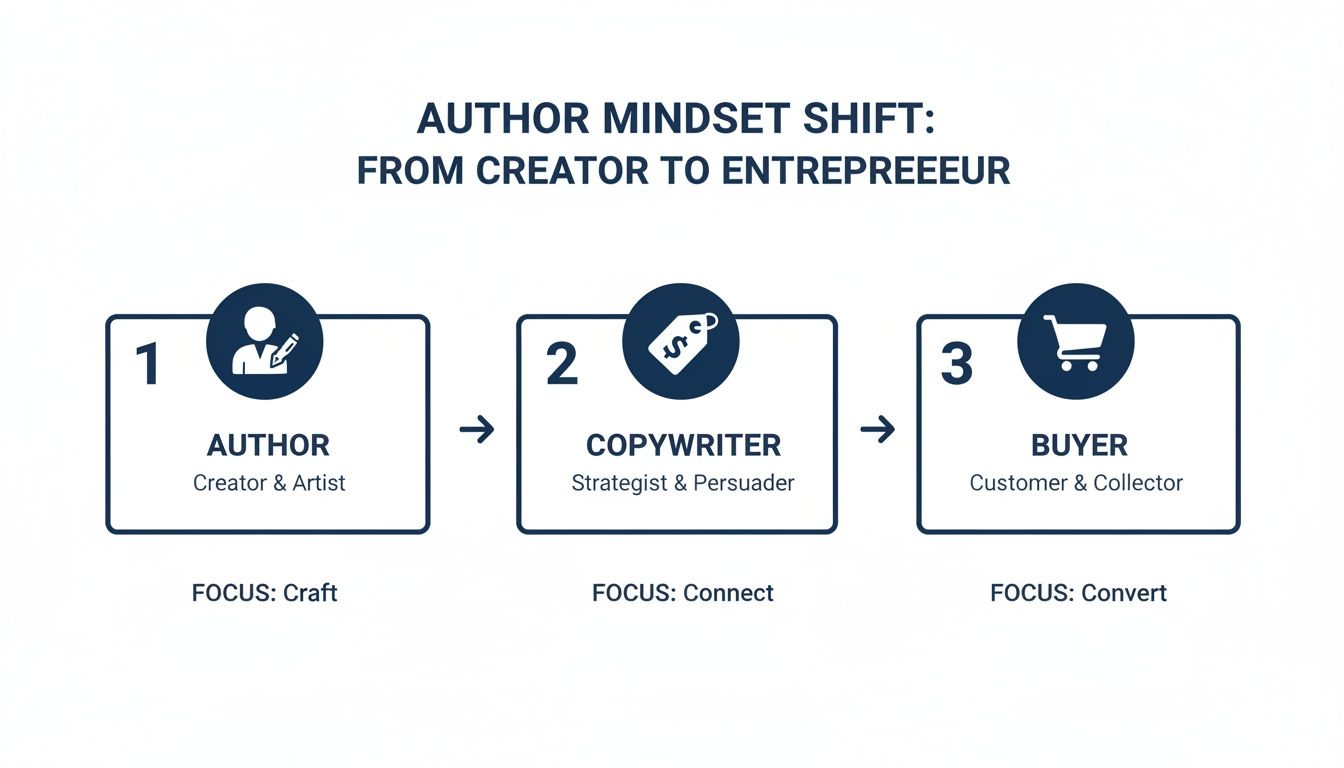
The real takeaway here is that successful authors are also copywriters. You have to be the one who builds the bridge between your art and the reader's decision to buy.
This sales-first mindset is absolutely crucial in the $93.8 billion global publishing market. On retailer sites like Amazon, a jaw-dropping 80% of book purchases are impulse buys. Shoppers are spending a mere 10-15 seconds to make up their minds.
A recent study of 10,000 authors found that descriptions using emotional triggers—like curiosity or fear—boosted sales by 28%. For non-fiction with benefit-driven copy, that number jumped to 35%. You're not just telling them about the book; you're selling an experience.
Mastering the All-Important Hook
Your hook is, without a doubt, the most important sentence in your entire description. It's your one chance to digitally grab a reader by the collar and stop their endless scrolling.
It has to be short, punchy, and dripping with intrigue. A killer hook doesn't explain things; it implies them. It might pose a question, drop the reader into a shocking scenario, or present a paradox their brain can't help but want to solve.
For a thriller, you might try something like: “The only thing worse than your husband disappearing is finding out he never existed at all.”
A non-fiction book could open with: “What if everything you know about productivity is wrong?”
These lines instantly create an information gap that ignites curiosity. If you want to really dig into this, our dedicated guide covers more techniques on how to write a hook that absolutely command attention.
Introduce Character and Core Conflict
Once you've got their attention, your next job is to quickly introduce a relatable character and the central problem they're up against. Don't get bogged down in backstory or world-building. Just give the reader enough to get their bearings.
Zoom in on the inciting incident—that moment where everything changes.
- Who's the protagonist? Give a quick, defining trait. An ambitious young detective…
- What's their goal? State what they want more than anything. …on the verge of cracking her first big case.
- What's in their way? Introduce the main obstacle. …when the prime suspect is the man she loves.
This simple structure immediately establishes empathy and a clear narrative path. Now, the reader has someone to root for and a problem they need to see solved.
Raise the Stakes to Create Urgency
A conflict without any real consequences is just an argument. To make a reader care, you have to show them exactly what the protagonist stands to lose. The stakes are the emotional engine of your entire blurb.
You need to ask yourself: what happens if the hero fails?
Is it just a personal setback, or does the fate of a city, a kingdom, or the entire world hang in the balance? The higher the stakes, the more tension you create.
Pro Tip: Make the stakes intensely personal. Connect them directly to the protagonist's deepest fears or desires. If a character is terrified of being alone, put their most important relationship on the line. This makes the external conflict feel visceral and relatable.
For instance, if our detective fails, she doesn't just lose the case. She loses her career, her integrity, and the only person she trusts. Now that's a compelling reason to turn the page.
End with a Compelling Cliffhanger
The final lines of your description are your closing argument. This is where you leave the reader hanging, desperate to find out what happens next. You want to back them into a corner with an impossible choice, a shocking revelation, or a question that demands an answer.
Whatever you do, don't resolve the core conflict in the description. Your job is to lead the reader to a pivotal moment and then just… stop.
- “To save her family, she must betray her country. But a traitor’s price is one she may not survive to pay.”
- “Now he has 24 hours to uncover the truth, or become the conspiracy’s next victim.”
This final push is what converts a passive browser into an active buyer. It’s that last little nudge that sends them tumbling right over the edge and straight to that one-click button.
Tailoring Your Description to Genre and Audience
A blurb that sells a gritty sci-fi epic will absolutely fall flat for a sweet, contemporary romance. This is the cardinal rule of writing a book description that actually converts: you have to speak the language of your specific genre and its audience. Writing one-size-fits-all copy is a surefire way to disconnect from readers and lose sales.
The goal here isn't to reinvent the wheel—it's to lean into reader expectations. When a mystery fan picks up a book, they are actively hunting for specific cues: an unsolved crime, a flawed detective, a trail of red herrings. Your description is the handshake that says, "Yes, this is exactly the kind of story you love."

This means you need to get familiar with the tropes, tone, and trigger words that make your ideal readers feel right at home. It’s all about signaling that your book delivers the precise emotional experience they’re searching for.
Writing for Fiction Readers
With fiction, your description needs to be a masterclass in miniature storytelling. You’re trying to spark an emotional connection and create immediate intrigue by zeroing in on character, conflict, and stakes. Each genre has its own unique flavor and makes a different promise to the reader.
Key Strategies for Fiction Genres:
- Romance: It's all about the central couple and the delicious conflict keeping them apart. Don't be shy—use emotionally charged words and highlight popular tropes like "enemies-to-lovers," "fake dating," or "second chance." The tone should also promise the heat level, whether it's sweet and clean or five-alarm spicy.
- Thriller & Mystery: Get right to it. Open with the crime or the inciting incident. Hammer home the ticking clock, the sky-high stakes, and the promise of shocking twists. Short, punchy sentences work wonders here to build urgency and suspense.
- Fantasy & Sci-Fi: Your job is to establish the unique world or concept quickly without getting bogged down in jargon. Ground the reader with a relatable protagonist who's up against an epic threat. Hint at the cool stuff—the magic system, the advanced tech, the political scheming—that makes your world tick.
- Horror: From the very first line, the tone needs to be creepy and atmospheric. Focus on the source of the fear, whether it’s a monster in the closet or a psychological demon, and emphasize the main character’s vulnerability. Asking questions that play on common fears is a classic, effective move.
By leaning into these genre-specific elements, you’re telling readers that your book will scratch their itch. You're not just selling a plot; you're selling a familiar, yet fresh, emotional ride.
Writing for Non-Fiction Readers
When you switch to non-fiction, the whole game changes from plot to promise. Readers aren't here for a story; they’re here for a solution. Your description has to be relentlessly benefit-driven, clearly outlining the transformation or knowledge the reader will walk away with.
The entire non-fiction blurb should answer the reader's unspoken question: "What's in it for me?"
Critical Insight: Non-fiction buyers are purchasing an outcome. Whether it's to learn a new skill, solve a business problem, or improve their personal life, they are investing in a better version of themselves. Your description must sell that future state.
To pull this off, you need to structure your description around the reader's biggest pain points.
Building a Benefit-Driven Blurb:
- Nail the Pain Point: Start by directly calling out the problem your reader is wrestling with. Use their language to show you get it. For example: "Tired of feeling unproductive and completely overwhelmed by your to-do list?"
- Position Your Book as the Solution: Present your book as the clear, authoritative answer to that pain. Briefly mention your unique method or framework that finally solves their problem.
- Map Out the Transformation: This is where bullet points are your best friend. List the key takeaways, skills, or benefits the reader will gain. Make them tangible and action-oriented. You could promise they'll learn to:
- Master the art of deep work and obliterate distractions.
- Organize their entire week in under an hour.
- Reclaim 5-10 hours of their time, every single week.
- Establish Your Authority: Give them a reason to trust you. A quick mention of your credentials or experience builds instant social proof. Something like: "From a productivity coach who has helped thousands of professionals…"
This structure is so effective because it follows a classic problem-solution copywriting formula. It draws a straight line from the reader's current frustration to the future relief your book offers, making the purchase feel less like a want and more like a need.
Weaving SEO Keywords into Your Blurb
An incredible book description doesn't do you any good if readers can't find it. This is where search engine optimization (SEO) comes into play, and it’s not just for websites anymore. For authors, it's the art of making your book discoverable on giants like Amazon and Google.
Think about it: every second, potential readers are typing phrases into search bars, hunting for their next great read. Your job is to figure out what those phrases are and sprinkle them into your blurb naturally. When you do this right, your book pops up at the exact moment your ideal reader is looking.
With the global books market expected to jump from $150.99 billion in 2024 to $215.89 billion by 2033, you can't afford to just guess. Since the self-publishing boom, tools have shown that a keyword-optimized description can rank up to 40% higher—a massive advantage when 1.7 million new ISBNs are registered every year.
Finding Your Reader’s Language
The first step is to get inside your reader's head. What words are they actually typing into that search box? You aren't just looking for single words; you're hunting for powerful long-tail keywords. These are the longer, more specific phrases that signal someone is ready to buy.
For instance, a reader probably won't just search for "fantasy." They’re much more likely to look for things like:
- "epic fantasy with dragons and magic schools"
- "enemies-to-lovers romantic comedy"
- "military sci-fi set in space"
These phrases are a goldmine. They tell you exactly what a reader is craving, and using them in your blurb signals to both the reader and the search algorithm that your book is a perfect match.
Pro Tip: Your blurb's SEO is part of a bigger puzzle. It works hand-in-hand with your seven KDP keyword slots and your category choices. When you align all three, you create a powerful multiplier effect that can dramatically boost your book’s visibility.
How to Research Keywords Like a Pro
You don't have to guess what people are searching for. A great place to start is right on Amazon. Type your book’s basic premise into the search bar and pay close attention to the auto-complete suggestions that appear. That's Amazon literally telling you what real shoppers are looking for.
Next, it's time to spy on your competition. Go to the book pages of the top 5-10 bestsellers in your specific subgenre. Read their descriptions and look for recurring phrases and buzzwords. Are they all mentioning "a gripping psychological thriller with a twist you won't see coming"? If so, that’s a keyword phrase you need to consider.
Search engines are always getting smarter. As they evolve, it pays to learn the strategies for Answer Engine Optimization which can give you an edge by focusing on how real people ask questions online.
Weaving Keywords in Seamlessly
Once you have your list of keywords, the real trick is to work them into your blurb without sounding like a robot. The last thing you want is a description that feels clunky or stuffed with awkward phrases just to please an algorithm.
Remember, your primary goal is still to write compelling copy that hooks a human.
A good rule of thumb is to place your most important keyword phrase within the first couple of sentences. This is prime real estate for both grabbing a reader's attention and signaling relevance to search algorithms.
Let's look at an example:
- Keyword Stuffing (The Bad Way): "This slow-burn enemies-to-lovers office romance is a funny romantic comedy about two rivals."
- Natural Integration (The Right Way): "For fans of hilarious, slow-burn romantic comedies, this enemies-to-lovers office romance will have you rooting for the one person she was determined to hate."
See the difference? The second example flows perfectly while still hitting those key search terms. Your goal is to make your keywords invisible to the reader but unmissable to the algorithm. Do that, and you'll put your book directly in front of the audience that's actively looking for it.
Formatting and Testing for Higher Conversions
You can write the most compelling blurb in the world, but if it shows up on the sales page as a dense, intimidating wall of text, readers will just scroll right past it. It's a hard truth, but how your book description looks is just as important as what it says.
Good formatting is like a magnet for the reader's eye. It creates breathing room, highlights the juicy parts, and makes the whole experience feel effortless. Bad formatting, on the other hand, just feels like work.
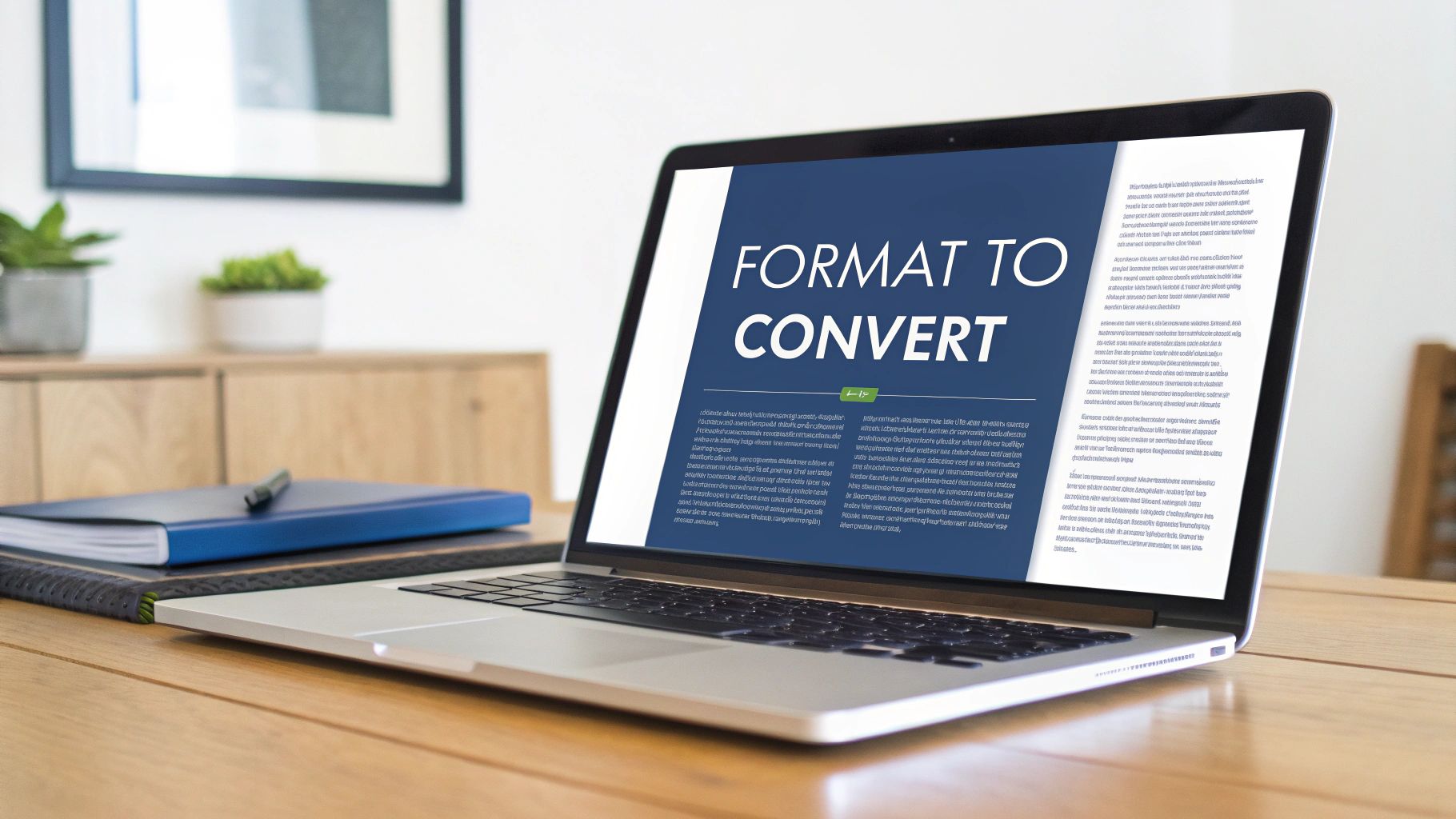
The idea is to make your description instantly scannable. Even a reader who's just skimming should be able to pick up the core concept in a few seconds. This is an often-overlooked secret to writing a description that truly sells.
Using Basic HTML to Stand Out
When you're uploading your description to a platform like Amazon KDP, the formatting from your Word doc won't carry over. You have to tell the system how you want it to look using a few simple HTML tags. Don't let the word "HTML" scare you; it’s incredibly easy.
These are the only tags you’ll likely ever need:
- For bold text:
<b>Your Text Here</b> - For italicized text:
<i>Your Text Here</i> - For bullet points:
<ul><li>First Point</li><li>Second Point</li></ul>
Use bolding to make your hook pop or to emphasize a powerful review snippet. Italics are great for character thoughts or adding a bit of emotional flair. For non-fiction, bullet points are your best friend—they’re perfect for listing out the key takeaways or benefits a reader will get from your book. Getting this right is a huge part of what professionals do in their book formatting services.
The Golden Rule of Readability
Beyond the code, the most powerful formatting tool you have is white space.
Keep your paragraphs short. I mean really short—one to three sentences, max. This creates visual breaks that make the text feel approachable and easy to digest, not like a chore.
Key Takeaway: A reader's eye is naturally drawn to short, punchy lines. Long paragraphs signal "work," while short ones signal "easy." Make your description feel as effortless as possible to read.
By breaking up your text, you create a more dynamic experience. It encourages the reader to keep scrolling and ensures your killer lines actually stand out instead of being buried in a block of words.
A/B Testing Your Way to More Sales
Okay, so you've written and formatted a brilliant description. You're not quite done yet. The most successful authors I know treat their blurbs as living marketing assets, not something you just write once and forget. It's time to test.
A/B testing is just a fancy way of saying you try out two different versions to see which one performs better. You create Version A and Version B, changing only one single thing between them. It could be the hook, the call to action, maybe even the order of your bullet points.
Here’s a simple way to approach it:
- Pick One Thing to Test: Decide on the single variable you want to measure. For instance, you could test a hook that asks a question against one that makes a bold statement.
- Run Version A: Publish your book with the first description. Let it run for a specific amount of time, say 30 days, and keep an eye on your sales and page reads.
- Swap in Version B: After the test period, change only that one element and publish the new version. Let it run for the same amount of time.
- Compare the Results: Now look at the data. Did one version lead to a noticeable bump in sales? That’s your winner.
This data-driven approach takes all the guesswork out of the equation. It lets you systematically figure out what language and hooks truly connect with your specific audience, helping you build a description that doesn't just inform—it actively turns browsers into buyers.
Got Questions About Book Descriptions? We've Got Answers.
Even after you've got a solid draft, a few nagging questions can pop up when you're trying to polish your book description. It happens to everyone. Think of this as your quick-reference guide for those common sticking points.
Getting these final details right is often what separates a book page that looks professional and converts well from one that just… sits there. Let's tackle these common hurdles so you can get your blurb finished and feel great about it.
What's the Perfect Length for a Book Description?
There’s no single magic number, but I've found the sweet spot for most online stores is between 150 and 250 words. That’s just enough space to land a killer hook, lay out the core conflict, hint at the stakes, and wrap up with a compelling call to action without bogging the reader down.
Remember, on sites like Amazon, readers only see the first ~160 characters in search results before they have to click to see more. That tiny bit of text is your most valuable real estate—make it count.
Pro Tip: Your blurb is an ad, not a book report. The goal isn't to explain the whole plot; it's to spark enough curiosity to get that click and, ultimately, the sale.
This forces you to be incredibly disciplined with your words. Every single sentence has to earn its place and push the reader closer to hitting that "buy now" button.
How Do I Handle a Description for a Book in a Series?
This is a classic challenge. You need to pull in new readers without confusing or boring your loyal fans. The trick is to tailor your approach based on where the book sits in your series.
- Book One: Treat it like a standalone. Your only job is to hook readers who know nothing about your world. I always advise authors to avoid phrases like "the first book in an epic new series," as it can scare off readers who aren't ready for a long-term commitment.
- Later Books (Two and beyond): Start with a quick, one-sentence orientation to remind returning readers where things left off. Then, jump straight into the hook for this book's adventure. Always, always end by clearly labeling its position, like "The gripping third book in the Shadow Chronicles saga."
Following this method ensures Book One feels accessible to everyone, while the rest of the series gives existing fans the context they need to dive right back in.
Should I Put Reviews or Blurbs in My Description?
Absolutely, but placement is everything. A fantastic review or a snappy quote from a well-known author is powerful social proof, but you can't just slap it anywhere.
Never lead with a review. It completely kills the narrative momentum you're trying to build with your hook. Instead, tuck a short, punchy quote right at the end of your description, just before you ask for the sale.
Here’s how that looks in practice:
…With time running out, she has one last shot to save her city, even if the price is her own soul.
"A heart-pounding thriller you won't be able to put down." – Bestselling Author Jane Doe
One-click now to find out what happens next!
This way, your story hooks them first, and the endorsement swoops in to seal the deal with a dose of credibility. Using italics helps it stand out just enough without disrupting the flow.
Ready to turn your manuscript into a professionally published book that finds its readers? At BarkerBooks, we’ve guided over 7,500 authors through the entire process, from expert editing and cover design to global distribution. Let us manage the complexities so you can stay focused on your writing. Learn more about our publishing packages and start your journey today.