
At its heart, the choice boils down to this: self-publishing gives you, the author, total creative control and much higher royalties, turning you into an entrepreneur for your own work. A traditional publishing house, on the other hand, offers industry validation and powerful distribution muscle, but you'll have to give up a good deal of control and a much larger slice of the revenue pie.
Your Publishing Path: Key Differences at a Glance
Deciding whether to self-publish or go with a traditional house is the first major fork in the road on your journey as an author. It shapes everything that comes next, from how your manuscript is edited to how it reaches readers.
Self-publishing puts you in the driver's seat. You’re the CEO of your book—it's an entrepreneurial path where you call the shots on everything from editing and cover design to marketing and pricing. The traditional model is a long-standing system where gatekeepers (agents and editors) select manuscripts. If your book is chosen, the publishing house invests its own money, team, and distribution network in exchange for the rights to your work and the lion's share of the profits.

The trade-off is pretty clear: do you want speed and complete autonomy, or are you chasing industry prestige and built-in support? This first choice really does set the stage for your potential earnings, creative fulfillment, and the entire trajectory of your writing career. To make things a little clearer, let's break down the essential differences.
Core Differences Self Publishing vs Traditional Publishing
To get a quick handle on things, this table lays out what you can generally expect from each path. Think of it as a cheat sheet for the most important factors you'll need to weigh.
| Factor | Self-Publishing | Traditional Publishing House |
|---|---|---|
| Upfront Cost | Author pays for all services | Publisher covers all costs |
| Creative Control | 100% author control over content and design | Collaborative, but publisher has final say |
| Royalties | Higher rates (40-70% of net) | Lower rates (5-15% of net) |
| Time to Market | Fast (weeks to months) | Slow (18-24+ months) |
| Rights Ownership | Author retains all rights | Publisher acquires most rights |
| Distribution | Strong in digital/online; POD for print | Strong in physical bookstores; digital varies |
| Validation | Based on sales and reviews | Industry prestige and agent/editor selection |
After looking at the table, it becomes obvious why so many authors are now charting their own course.
Realizing just how hard it is to get a book published through the old-school channels can be a major factor. The gatekeeper system is famously competitive. This reality has led many to seek out alternatives, like in the story of one author's decision to self-translate after giving up on traditional publishers.
The Financial Reality: Royalties, Advances, and Upfront Costs
When we talk about money in publishing, we're really talking about two completely different business models. They're worlds apart, going way beyond a simple royalty percentage. One path asks you to be the investor in your own work for a shot at much higher long-term returns. The other offers a small, guaranteed payment up front but, in exchange, takes the lion's share of your book's future earnings.
This image nails it—you’re juggling numbers no matter which route you take. You have to put on your business hat.
Self-Publishing: Upfront Costs for High Royalties
When you self-publish, you’re the entrepreneur. You foot the bill for everything needed to turn your manuscript into a professional-grade book that can actually compete. Think of it as investing in your own small business.
These investments aren't optional if you want to succeed. You're looking at:
- Professional Editing: This is non-negotiable and can run anywhere from $1,000 to $5,000 (or more), depending on how much work your manuscript needs—from big-picture developmental edits to line-by-line copyedits.
- Cover Design: People absolutely judge a book by its cover. A striking, genre-appropriate design is one of your most powerful sales tools. Budget between $300 and $1,500 for a real pro.
- Interior Formatting: A clunky layout or bad ebook formatting screams amateur. Getting this done right for both print and digital versions will cost about $150 to $600.
- Marketing and Promotion: Your book won't sell itself. A realistic starting budget for launch ads and early promotions is in the $500 to $2,000 range.
That initial cash outlay can feel steep, I know. But here’s the trade-off: much, much higher royalty rates. Self-published authors typically pocket 40% to 70% of their book's list price. That’s a night-and-day difference from the traditional model. A key part of your strategy will be calculating profit per unit for book sales to set the right price and make smart financial decisions.
Key Insight: Self-publishing is a high-risk, high-reward game. You take on all the financial risk, but you also stand to gain a vastly larger piece of the profit pie over the life of your book.
Publishing House: The Advance vs. Lower Royalties
Traditional publishing flips the financial script entirely. The publisher takes on all the financial risk, paying for the editing, design, printing, and distribution. In exchange for this, you get an advance against royalties.
An advance is basically a signing bonus. The catch? You have to "earn out" that full amount from your small share of book sales before you ever see another dime. For most first-time authors, advances are pretty modest, often in the $5,000 to $10,000 range from a big publisher and even less from smaller presses. The hard truth is that many authors never earn out their advance, which means it’s the only money they’ll ever make from that book.
If you do earn it back, you'll start getting royalty checks. But the rates are a fraction of what self-published authors earn:
- Hardcover: Usually 10-15% of the cover price.
- Trade Paperback: Drops to around 5-7.5% of the list price.
- Ebook: Typically 25%, but it’s of the publisher's net receipts—what they get after the retailer takes their cut—not the price the customer pays.
This system gives you some financial security right away but puts a firm cap on your long-term earning potential. It's critical to understand these different pay structures, and you can get a deeper look in our guide on https://barkerbooks.com/royalties-for-books/.
Recent data from the 2023 Authors Guild survey shows that serious independent authors are pulling ahead financially. Full-time self-publishers reported a median income of $12,800 from their books alone. For authors who have been at it since 2018, that number jumps to $24,000—a massive 76% increase from their 2018 earnings. The Alliance of Independent Authors has more on these findings.
Ultimately, the financial choice comes down to your personality and goals. Are you willing to bet on yourself and invest upfront for a higher potential payday? Or does the security of a guaranteed (but small) advance and no production costs sound more appealing?
Creative Control and Intellectual Property: Who's Really in Charge?

The vision for your book is its soul. But how much of that soul makes it to the final printed page? The path you choose—self-publishing or a traditional house—directly answers that question. One route puts you in the driver's seat, while the other asks you to hand over the keys.
When you self-publish, you keep 100% creative control. Every single decision rests with you. The cover art, the final edits, the chapter breaks, even the title… it's all your call. You are the ultimate authority, ensuring the book that hits the shelves is the one you intended to write.
This level of autonomy is a huge draw for authors with a very specific, non-negotiable vision. It gives you the freedom to hire editors and designers who get what you're trying to do, rather than having to fit your work into a publisher's pre-existing brand or marketing strategy.
The Publishing House Partnership
Going the traditional route means entering a partnership where, frankly, you're the junior partner. You get access to a team of seasoned professionals, but their job is to create a product that sells. Sometimes, that goal aligns perfectly with your artistic vision. Often, it doesn't.
A publisher holds the final veto power on some of the most critical elements of your book:
- The Title and Subtitle: They'll often change your title to something they believe is more commercial or fits genre expectations, no matter how attached you are to your original.
- Cover Design: The cover is a sales tool. The publisher’s art department designs it based on market data and trends, and your input is usually limited, if considered at all.
- Editorial Changes: A great editor is priceless, but a publisher can demand deep, structural changes to your plot, characters, or tone to chase a wider audience. Pushing back is rarely easy.
Key Differentiator: Self-publishing makes you the sole guardian of your artistic vision. Traditional publishing requires you to surrender final creative authority in exchange for their resources and industry access.
This isn't to say it's a bad trade-off; many a great book has been made even better by a publisher's expert touch. But you have to be ready and willing to compromise on things you might hold dear.
Who Owns Your Work?
Beyond the creative side, the question of intellectual property (IP) rights creates an even starker divide. When you self-publish, you own everything, forever. It’s a massive long-term asset.
A traditional publishing contract, on the other hand, is fundamentally a transfer of rights. You grant the publisher a license to publish your book in various formats, typically for the full term of copyright—that’s your entire life plus 70 years.
The rights you sign away often include:
- Print and Ebook Rights: The bread and butter of the deal.
- Audiobook Rights: A booming market you could lose control over.
- International/Translation Rights: The publisher decides if and when your book is sold and translated abroad.
- Ancillary Rights: This is a big one. It can cover everything from film and TV adaptations to merchandise.
A good literary agent will fight to carve out and keep some of these rights for you, but the publisher's goal is to acquire as many as possible. Getting them back is notoriously difficult, usually requiring a reversion of rights clause that only kicks in if the book goes out of print and sales dip below a tiny threshold.
With self-publishing, you have the agility to do whatever you want with your IP. Want to update a non-fiction book? Release a new edition with a fresh cover? Bundle it into a box set? You just do it. That kind of freedom is simply off the table when a publisher holds the reins, making the self publishing vs publishing house debate a pivotal one for your long-term career.
Understanding Timelines and Distribution Channels
How quickly can your book actually get into a reader's hands? The answer reveals one of the most dramatic differences in the self publishing vs publishing house debate. One path is a multi-year marathon demanding immense patience, while the other is a sprint where you set the pace.
Of course, the journey to market isn't just about speed; it's also about reach. Where your book is sold—be it a major bookstore chain or a global ebook platform—is determined by the distribution channels you can access. These two factors, timeline and distribution, will fundamentally shape your entire launch strategy and your book's long-term potential.
The Race to Publish
Going the traditional route is a notoriously slow process. From the moment you sign a contract, you're looking at an 18 to 24-month wait before your book hits shelves. That long timeline accounts for multiple rounds of edits, cover design, typesetting, printing schedules, and fitting your book into the publisher's already crowded seasonal catalog.
This long lead time can be incredibly frustrating, especially for authors writing about timely topics. The world can change a lot in two years, and you run the risk of your work feeling dated before it even has a chance to be read.
Self-publishing, on the other hand, puts you in the driver's seat. Once your manuscript is edited, designed, and formatted, you can technically publish it in a matter of days. A more realistic, professional timeline that includes proper editing, design, and a solid pre-launch marketing plan is typically around three to six months. This agility lets you launch when it makes the most sense for you, your book, and your audience.
Accessing the Global Marketplace
Historically, a publishing house’s biggest trump card was its distribution network. They had the power to place physical books in brick-and-mortar stores, and that was that. Major publishers have long-standing relationships with bookstore chains and distributors, giving their titles prime shelf space that's incredibly difficult for an independent author to secure on their own.
But the book-buying world has changed. While traditional publishers still have a firm grip on physical retail, self-publishing platforms have thrown open the doors to a global marketplace for both digital and print-on-demand (POD) books.
Key Takeaway: The whole debate over distribution has shifted. Traditional publishing still wins for physical bookstore placement, but self-publishing offers superior speed and, often, a wider global reach in the massive, ever-growing digital and print-on-demand markets.
This shift is obvious when you look at the sheer volume of new books. In 2023, the self-publishing sector saw over 2.6 million titles registered with ISBNs—a 7.2% jump from the year before—while the number of traditionally published titles actually went down. You can discover more insights about self-publishing growth at Publishers Weekly to see the full picture.
This chart from their report really illustrates the widening gap between the two worlds.
The data makes it clear: self-publishing isn't just a viable alternative anymore. It has become the dominant force in terms of title production, a trend fueled by its accessibility and speed.
A Modern Distribution Comparison
The old assumption that a publisher automatically guarantees wider reach just isn't true today. The reality is far more nuanced, and each path offers its own distinct advantages. Knowing the difference is key to making the right call for your book.
Let's break down how the distribution channels really stack up now:
-
Physical Bookstores: The advantage here still goes to publishing houses. Their dedicated sales teams and established relationships make it much easier to get print copies onto the shelves at Barnes & Noble or your local indie bookstore.
-
Online Retail (Ebooks): Self-publishing platforms like Amazon KDP give authors direct, unfettered access to the world's largest ebook market. You can reach millions of readers across the globe, often with better promotional tools than a publisher might offer a debut author.
-
Online Retail (Print): Thanks to print-on-demand services, self-published authors can list their physical books on major online stores worldwide without paying a dime for upfront printing costs. Explore our comprehensive book distribution services to see exactly how you can achieve that global reach.
-
Libraries and Academia: Getting into these channels has traditionally been easier through a publisher’s established partners. However, services like IngramSpark are helping self-published authors close that gap significantly.
Ultimately, your choice depends on your primary goal. If seeing your book in a physical store is your absolute dream, the traditional route still holds a powerful appeal. But if your top priority is reaching a global audience quickly and efficiently, self-publishing offers direct and powerful pathways to make that happen.
Marketing and Promotion: Who's Really Doing the Work?
One of the most persistent myths in the self-publishing vs. publishing house debate is that a traditional deal means you can just write the book and let the publisher handle the rest. I’ve seen countless authors get a rude awakening when they realize that landing a contract is just the beginning of their marketing work.
The truth is, you'll be marketing your book no matter which path you take. The real difference isn't if you market, but how much help you get, what you control, and how long those efforts last. Getting this straight from the start is key to having realistic expectations for your book’s journey.
The Publishing House Marketing Model
Signing with a traditional publisher gets you a seat at their marketing table. You'll likely get a publicist and your book will be part of a larger campaign. But for most new or mid-list authors, that support is a flash in the pan—intense for a few weeks around the launch, and then it's gone.
Publishers focus on things an individual author struggles to do alone. Think big-picture, industry-focused tasks like:
- Chasing trade reviews in places like Kirkus Reviews or Publishers Weekly.
- Sending out Advance Reader Copies (ARCs) to reviewers and influencers via platforms like NetGalley.
- Pitching for media coverage, though these big opportunities are usually reserved for the season's lead titles.
But the daily grind of connecting with readers? That’s on you. Publishers now expect authors to arrive with a built-in audience and an active social media presence. You'll still be writing the newsletters, posting on Instagram, and being the face of your own book.
The Reality Check: A publisher’s marketing budget is a finite pie, and the biggest slices always go to their star authors and guaranteed bestsellers. For everyone else, publisher marketing is more of a launchpad boost than a long-term flight plan.
Once your launch window closes, the publisher’s attention shifts to the next season’s catalog. From that point on, you’re the one solely responsible for keeping your book in the public eye. This is a common point of frustration for many traditionally published authors, who watch their book’s initial momentum fizzle out without that continued push.
The Self Publishing Marketing Model
When you self-publish, you are 100% in the driver's seat for marketing. From day one and for as long as you want, it's all on you. That might sound intimidating, but it’s also where the real power lies. This is your business, after all.
You get total control over your brand, your budget, and your strategy. Instead of relying on a temporary push for one book, you can build a platform that supports your entire writing career. As the CEO of your author business, you can:
- Run highly targeted ads on Amazon or Facebook to find your perfect readers.
- Build an email newsletter—your single most powerful tool for a long-term career.
- Play with pricing and promotions to spike sales or gain visibility whenever you see an opportunity.
- Market your entire backlist indefinitely, ensuring your older books keep finding new readers and earning you money for years to come.
This entrepreneurial mindset is what separates a hobbyist from a career author. A traditionally published book might enjoy a brief, bright spotlight, but a savvy self-published author can build a loyal, engaged readership brick by brick. You're creating a direct line to the people who love your work—a genuine connection a corporate marketing department can never truly replicate.
Choosing Your Path: A Scorecard for Your Author Goals
The big question isn't whether self-publishing is "better" than a traditional house, but which one is better for you. It all comes down to your personal goals, how much risk you're comfortable with, and how hands-on you want to be.
Let's cut through the theory and make this practical. Are you a business owner who needs a book on the market ASAP to build your brand? Or are you a novelist hoping for the kind of prestige that comes with a major publisher's stamp of approval? Each path serves a different master. A quick, honest assessment can make this complicated choice a whole lot clearer.
Author Publishing Path Scorecard
Below is a scorecard designed to help you weigh what matters most. For each factor, rate its importance to you on a scale from 1 (not important) to 5 (critically important). Then, see which column your high scores land in. This isn't about getting a "right" answer, but about revealing which publishing model is built to deliver on your priorities.
| Priority Factor | Importance (1-5) | Favors Self-Publishing | Favors Publishing House |
|---|---|---|---|
| Total Creative Control | You keep 100% final say on cover, title, content, and timeline. | You collaborate, but the publisher has final authority. | |
| Speed to Market | You can publish in a matter of months. | The process typically takes 18-24 months after signing. | |
| Upfront Financial Investment | You fund all costs for editing, design, and marketing. | The publisher pays an advance and covers production costs. | |
| Royalty Rates & Long-Term Income | You can earn 40-70% royalties per book. | You typically earn 5-15% royalties per book. | |
| Marketing & Promotion | You are solely responsible for building your platform and marketing. | The publisher provides marketing support, but author participation is key. | |
| Distribution & Reach | You get easy access to online retailers but must work for B&M. | You get automatic placement in brick-and-mortar bookstores. | |
| Industry Validation & Prestige | Prestige comes from sales, reviews, and building a brand. | Prestige comes from the publisher's selection and brand name. | |
| Rights & Licensing | You retain 100% of all subsidiary rights (film, audio, foreign). | The publisher typically acquires and manages most rights. |
Once you've filled it out, take a step back. A scorecard heavily weighted toward the "Self-Publishing" column suggests you value autonomy, speed, and long-term financial control. If your highest scores align with the "Publishing House" column, you likely prioritize external validation, upfront support, and broad distribution.
A self-published author is the CEO of their book, making every single strategic decision. A traditionally published author is more like a key partner in a large venture, contributing their immense talent but yielding final say.
One of the biggest forks in the road is marketing—who does the heavy lifting? This decision tree lays it out perfectly.
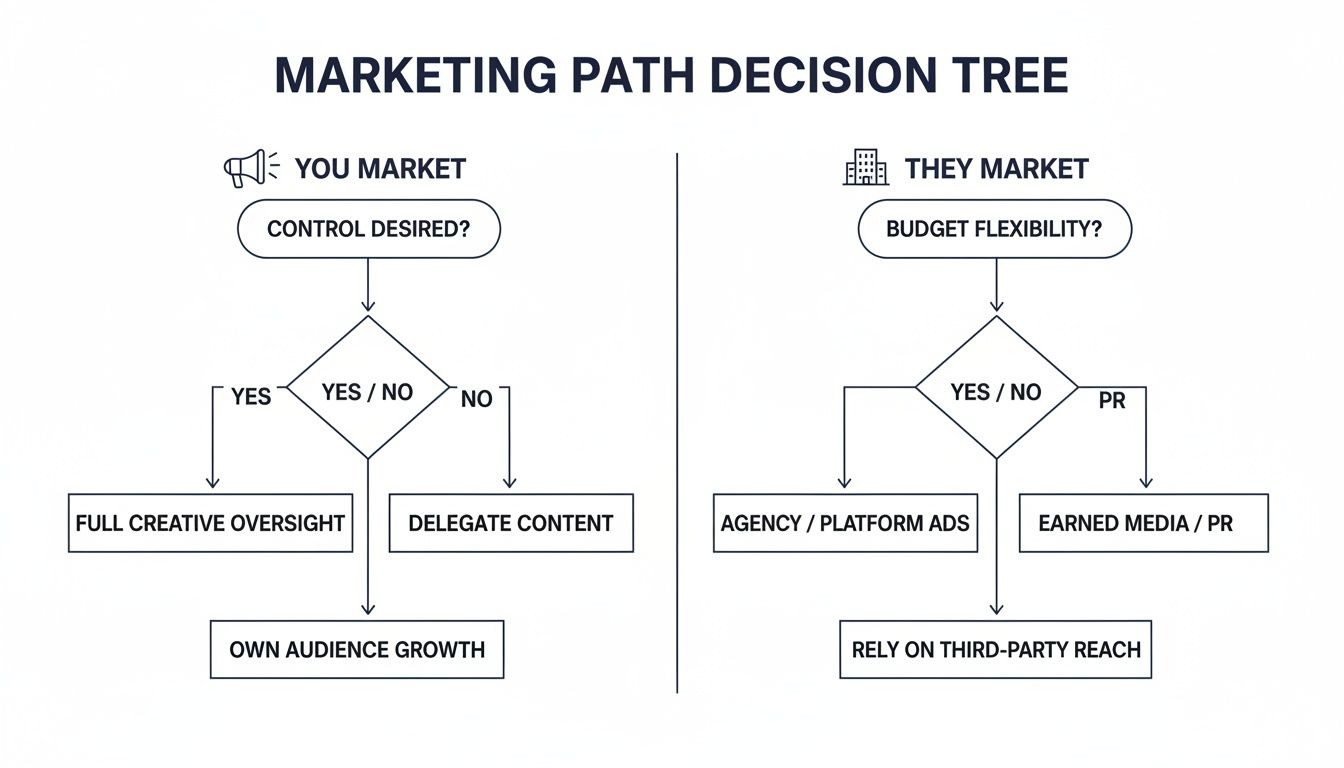
This distinction is crucial because it directly shapes what your day-to-day life as an author will actually look like.
Making Your Final Call
Look at your totals. If your highest scores landed on creative control, speed to market, and royalty potential, you have an entrepreneurial spirit. Self-publishing is almost certainly your natural home.
On the other hand, if your top priorities are industry validation and you're comfortable with a slower, more collaborative process where you aren't footing the bill, then the traditional route holds the most promise for you. There's no wrong choice—only the one that's wrong for your specific goals.
Frequently Asked Questions
Even after a side-by-side comparison, a few questions always seem to pop up. Let’s tackle some of the most common ones we hear from authors trying to decide between self-publishing and going the traditional route.
Can I Switch From Self-Publishing to Traditional Publishing?
Yes, and it happens more often than you might think. Many authors now use self-publishing as a strategic first step to prove their book has an audience. Think of it as building a case for your work.
Once you have a track record of strong sales, literary agents and publishers see your book not as a risk, but as a proven asset. This can lead to a traditional deal for that same book or for future projects, often with a much better advance and terms than you'd get as an unknown author. This path is so common it even has a name: the "hybrid author."
Is There Still a Stigma Against Self-Published Books?
Honestly, among readers, that stigma is all but gone. While a few old-school literary circles might still look down on it, the average book buyer just wants a great story. They don’t check the publisher's name before they click "buy."
If your book has a professional cover, sharp editing, and a compelling description, it stands shoulder-to-shoulder with any traditionally published title online. Success stories like Andy Weir's The Martian, which started as a self-published serial, have completely changed the game and shown what's possible.
The modern reader's verdict is in: quality trumps origin. A well-produced book will find its audience, regardless of whether it came from a major publishing house or a dedicated independent author.
Do I Need a Literary Agent if I Self-Publish?
Nope, not at all. Agents are the gatekeepers to the traditional publishing world. Their job is to represent you and sell your manuscript to an editor at a publishing house.
When you self-publish, you are the publisher. You get to skip that entire submission process. You won't need an agent to get your book on the market, but you will need to assemble your own team of professionals, like a great editor and a talented cover designer, to create a top-notch book.
Which Path Is Better for a First-Time Author?
There's no single "better" path—it truly comes down to your personal goals, your timeline, and your resources. What do you want most for your first book?
If your top priorities are having 100% creative control, getting your book out quickly, and earning a higher royalty percentage for the long haul, self-publishing is probably your best bet. On the other hand, if you're looking for the prestige of a publishing house, the chance at an advance, and a stronger shot at getting into physical bookstores, then the traditional route might be a better fit. Just be ready for a very long, very competitive process.
Ready to turn your manuscript into a professionally published book available worldwide? The team at BarkerBooks has helped over 7,500 authors achieve their publishing dreams with end-to-end support, from editing and design to global distribution and marketing. Explore our publishing packages today and start your journey.