
Every great story starts with a spark, but it's the blueprint that turns that spark into a roaring fire. Before you even think about writing that killer opening line, you need to lay the foundation. This is all about capturing an idea that genuinely excites you, giving it a solid frame, and mapping out the journey before you take the first step.
Building Your Story's Blueprint
Think of yourself as an architect. You wouldn't start building a house by just nailing boards together, right? You'd have a detailed plan. The same goes for your novel. This initial phase is where you transform a vague "what if?" into a concrete roadmap that will guide you from the first page to the last.
This whole process really boils down to three key stages.
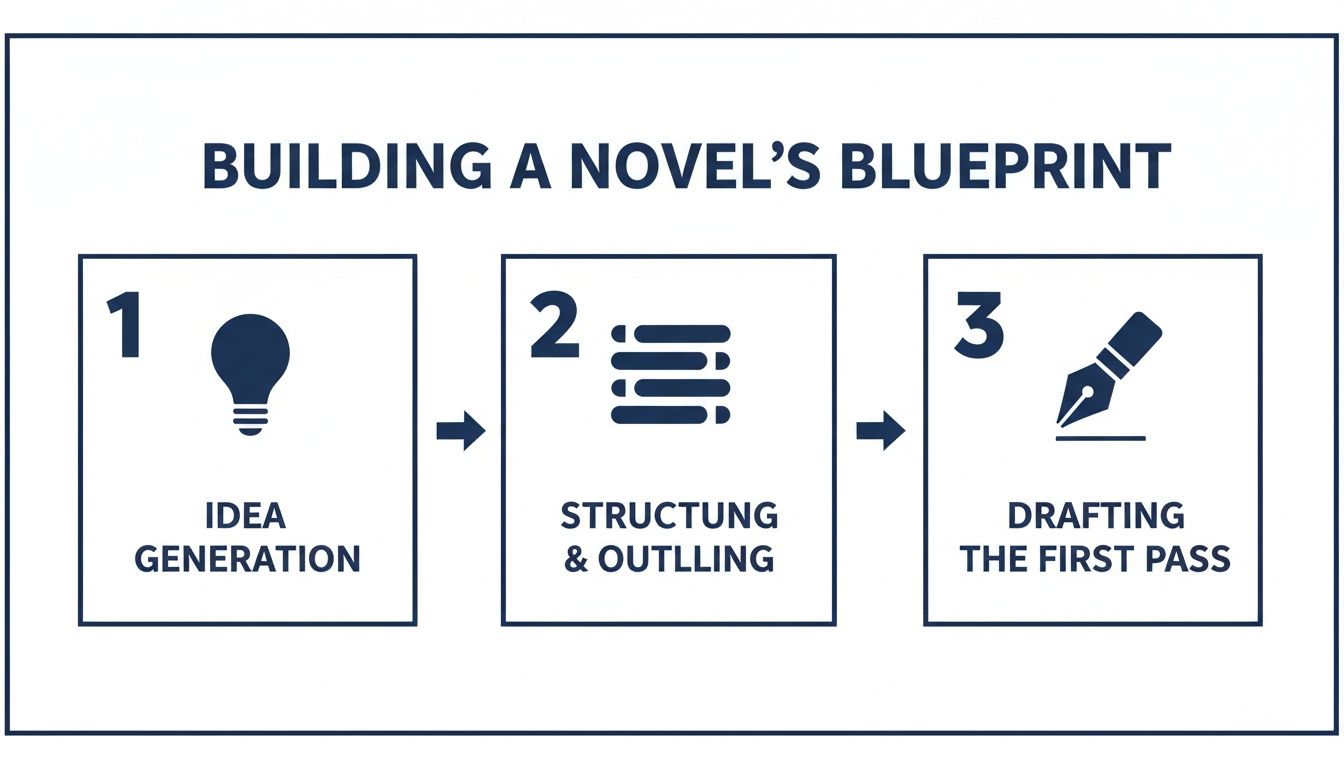
Moving methodically from a raw idea to a solid structure before you start drafting is the best way I know to sidestep writer's block and keep your narrative on track.
Finding Your Core Idea
So, where do you start? With an idea you can't shake. This is the seed of your novel—the question or concept you’re willing to spend months, or even years, exploring. Don't stress about being 100% original; focus on what you're passionate about. Ideas are everywhere: a snippet of a dream, a weird news story, a personal memory.
To keep all these brilliant thoughts, bits of research, and plot bunnies from getting lost, you need a system. I'm a huge fan of digital tools for this; you can build a robust 'second brain' in Notion to create a searchable database for everything related to your novel.
It also doesn’t hurt to know what readers are excited about. The global fiction market is worth a staggering $10.88 billion, and some genres are just on fire right now. For example, romance and fantasy/sci-fi sales recently shot up by 41.3%, with "romantasy" becoming a breakout star. Finding that sweet spot where your passion meets market demand can be a game-changer.
Choosing Your Narrative Structure
Once you've landed on an idea, you need to decide how to tell the story. That's where narrative structure comes in. It’s the skeleton that holds everything together, controlling the pacing and making sure your plot builds to a climax that feels earned.
There are a handful of classic structures that writers have relied on for centuries.
-
The Three-Act Structure: This is the bread and butter of storytelling. It breaks your novel into a clear beginning, middle, and end: Setup (Act I), Confrontation (Act II), and Resolution (Act III). It’s incredibly versatile and works for almost any story you can imagine.
-
The Hero's Journey: If you're writing an epic fantasy or a sweeping adventure, this one's for you. It’s a more detailed roadmap that follows a protagonist's call to adventure, their trials and transformation, and their eventual return home, changed.
-
Fichtean Curve: Perfect for thrillers and mysteries, this structure throws the reader straight into the action. You start with rising action, use flashbacks to fill in the backstory, and then race toward the climax. It's a fantastic way to create immediate tension.
To help you visualize these, here's a quick comparison of some popular frameworks.
Popular Novel Structures at a Glance
| Structure Type | Key Stages | Best For |
|---|---|---|
| Three-Act Structure | Setup, Confrontation, Resolution | Most genres, especially contemporary fiction, thrillers, and romance. A classic for a reason. |
| The Hero's Journey | The Ordinary World, Call to Adventure, The Ordeal, The Road Back, The Resurrection | Epic fantasy, sci-fi, and adventure stories centered on a character's deep transformation. |
| Fichtean Curve | Rising Action, Climax, Falling Action, Resolution | Thrillers, mysteries, and any story that needs to hook the reader from the very first page. |
| Seven-Point Story | Hook, Plot Point 1, Pinch Point 1, Midpoint, Pinch Point 2, Plot Point 2, Resolution | Plot-driven stories where mapping out key turning points is essential for maintaining momentum. |
Choosing the right one gives you a framework to ensure your story hits all the right emotional beats.
A story structure isn't a cage; it's a compass. It’s there to give you direction and keep you from getting lost in the woods, not to dictate every single step you take.
If you want to explore these frameworks more, we've put together a handy story structure template to help you get started.
Outlining Your Plot
With your structure chosen, it's time to outline. Now, "outline" can be a scary word for some writers, but it doesn't have to mean a 50-page document with every scene detailed down to the last word. An outline can be as simple as a few bullet points for each major plot point or as detailed as a scene-by-scene breakdown in a spreadsheet.
The point is to have a map. You need to know your protagonist's starting point, the major obstacles they'll face, and where they'll end up. This simple act of preparation is your best defense against plot holes and the dreaded "saggy middle" that can derail an otherwise great story.
Crafting Characters Readers Won't Forget
Plot gives a novel its shape, but characters give it a soul. They’re the living, breathing heart of your story—the reason readers stay up way too late, desperate to find out what happens next.
A flat, predictable character can tank even the most brilliant plot. On the flip side, a complex, flawed hero can make a simple story absolutely unforgettable.
Creating characters that feel real is about so much more than listing their hair color and favorite food. It’s about digging deep into their psychology, figuring out what drives them, and giving them authentic imperfections that readers can connect with on a human level.
Building from the Inside Out
The most memorable characters are defined by what they want and what they fear. This internal tug-of-war is the engine that powers their actions throughout the entire novel. Before you even think about writing a scene, take some time to really get to know the core of your main characters.
Start by asking these big questions:
- What is their primary motivation? What goal are they trying to achieve at all costs? This desire needs to be strong enough to carry them through the whole story.
- What is their greatest fear? What’s the one thing they would do anything to avoid? More often than not, this fear is what stands directly in the way of their goal.
- What is their fatal flaw? Nobody's perfect. A character’s flaw—whether it’s pride, insecurity, or a tendency to act before thinking—makes them relatable and creates natural conflict.
Think about a detective who wants to solve a high-profile case to finally prove her worth (motivation), but her greatest fear is trusting a partner after a past betrayal. Her flaw could be a stubborn refusal to accept help, which constantly puts her in danger. This internal landscape makes her far more compelling than just a "tough cop."
The best protagonists are complex individuals who may think they want one thing but in reality want another, or they may want two things that are at odds with each other. Once you know what a character wants, their personality becomes an expression of how they go about getting it.
This same thinking applies to your antagonist. A villain who is simply "evil" is boring. A villain who genuinely believes their destructive goal is for the greater good? Now that's a compelling story. Give them a motivation that’s just as powerful as your protagonist's.
Choosing Your Narrative Lens
Once you have a handle on who your characters are, you need to decide how the reader will experience their story. This is where Point of View (POV) comes in, and it's one of the most critical decisions you'll make. Your choice of POV shapes the tone, intimacy, and overall scope of your narrative.
Here are the main options you'll be weighing:
- First-Person ("I"): This POV is incredibly intimate, dropping the reader directly into the narrator's head. It's fantastic for character-driven stories but is limited to what that one character knows and experiences.
- Third-Person Limited ("He/She"): A popular and versatile choice. The narrative sticks closely to one character, giving us access to their thoughts and feelings, but with the flexibility of a third-person voice. You can switch perspectives between chapters, but within a single scene, you're locked into one person's head.
- Third-Person Omniscient ("He/She" with full access): The narrator is an all-knowing god of the story who can dip into any character's mind at any time. This allows for a grand, sweeping scope but can create emotional distance if you're not careful.
The voice you choose will also have a huge impact on your dialogue. To make conversations feel authentic and reveal character, it’s worth sharpening your skills. You can find some excellent dialogue writing tips to make sure your characters sound like themselves. Ultimately, choosing the right POV is about finding the perfect lens to tell your specific story and connect the reader to your world.
Conquering the First Draft
Alright, this is it. The moment you go from having an idea to actually writing the book. This is where the magic happens, but let’s be honest—it’s also where the hard work really kicks in. The most important thing to get out of your head right now is the myth of the perfect first draft. It doesn’t exist.
This first pass is all about getting the story down on paper. It will be messy. It will be flawed. And that’s perfectly okay.

Think of it as exploration. You’re giving yourself permission to make mistakes, chase down weird plot threads, and truly discover what your story is about. The only rule is to keep moving forward.
Find Your Personal Writing Rhythm
Forget what you’ve seen in movies. There’s no one “correct” way to write a novel. The secret is finding a routine that fits your life, not some idealized version of a writer's life. For some, that’s a rigid 5 AM writing session. For others, it’s squeezing in a few paragraphs on a lunch break or tapping away on a laptop after the kids are asleep.
Experiment with these methods to see what sticks:
- Word Count Goals: This is a classic for a reason. Aiming for a set number of words—say, 500 words a day—provides a clear, tangible target that builds incredible momentum over time.
- Time-Based Goals: If word counts stress you out, try this instead. Just commit to an hour of writing each day. The focus shifts from output to the simple act of showing up.
- Scene-Based Goals: Perfect for plot-focused writers. Your goal isn’t a number, but a narrative unit: finish one scene, or maybe a whole chapter, per session.
Consistency is the real goal here. Writing just 250 words a day will get you a 90,000-word novel in less than a year. It's all about the cumulative effect of just showing up.
Are You a Planner or a Pantser?
Every writer has a different relationship with the blank page. Figuring out your natural style will help you play to your strengths and avoid some common frustrations. Most writers tend to lean one of two ways.
Planners (or Outliners) are the architects. They map out everything before the first chapter is written—major plot points, character arcs, even the ending. This approach gives you a solid roadmap, which is a lifesaver when you feel lost and can help create a tightly woven story from the get-go.
Pantsers (or Discovery Writers), on the other hand, love to "write by the seat of their pants." They might start with just a character or a compelling situation and see where the story takes them. This method feels spontaneous and can lead to some genuinely surprising twists, but it often means you'll have a much bigger editing job on your hands later.
Honestly, there's no superior method, and most of us are a hybrid of the two. Feel free to start with a loose outline and let your characters run wild. The first draft is for you—let yourself play.
Embrace the Mess and Keep Moving
Let me say it again: the only job of the first draft is to exist. It’s the block of marble you'll later carve into a sculpture. It’s going to be clunky. You’ll find plot holes you could drive a truck through. The dialogue will make you cringe. This isn't failure; it's progress.
The most important thing to remember is that this is not the final product. Your only job is to get words on the page. You can’t edit a blank screen.
You have to muzzle your inner critic. The urge to go back and polish Chapter 1 when you're supposed to be writing Chapter 10 is a classic trap that kills momentum. Resist it. Keep pushing forward until you finally get to type "The End." That’s a milestone worth celebrating.
Finishing a novel is an incredible act of persistence. The publishing world can seem intimidating; out of nearly a million titles published a year, only a tiny fraction—around 0.01%—sell more than 100,000 copies. But success isn't just about sales; it's about finishing what you started. In fact, 8% of authors write at least one full novel before their breakout book, proving that perseverance is key. You can learn more about the industry by diving into these book sales statistics on Newprint.com.
The Art of Editing and Revision
You did it. You finished the first draft. That’s a huge accomplishment, and you should absolutely take a moment to celebrate. But once the confetti settles, you'll look at that manuscript and see it for what it is: a beautiful, chaotic mess. This is where the real craft of writing a novel begins. Editing isn't just about catching typos; it’s about taking that lump of clay and sculpting it into a story that works.
The biggest mistake I see new writers make is trying to fix everything at once. You can't untangle a plot knot while simultaneously worrying about comma splices. It just doesn't work. The secret is to revise in layers, starting with the big-picture stuff and gradually zeroing in on the tiny details. This part of the process demands patience and a willingness to be absolutely ruthless with your own words.

The First Pass: Developmental Editing
Before you dare touch a single sentence, you need to examine the story's skeleton. This is the developmental edit, and it's all about the core elements: structure, plot, character, and pacing.
Seriously, put the manuscript away. Hide it in a drawer for at least two weeks—a month is even better. This distance is non-negotiable. It’s the only way to come back with fresh eyes and see the story as a reader would, not as the creator who knows all the behind-the-scenes justifications.
When you're ready, read the entire thing through without making any small corrections. Your only job is to diagnose the big problems.
- Plot and Structure: Does the narrative actually hold together? Are there glaring plot holes or subplots that fizzle out? Think about the pacing—does the middle sag? Does the climax feel rushed?
- Character Arcs: Do your characters feel like they’ve been on a journey? Are their motivations clear, or do they just do things because the plot needs them to? Most importantly, is your protagonist an active participant, or are they just along for the ride?
- Stakes and Conflict: Are the stakes high enough? Do we care if the hero fails? Is there a central conflict that propels the story from start to finish with escalating tension?
This is the stage where you might make terrifyingly large changes. You could cut whole chapters, completely rewrite the ending, or merge two characters into one. It feels daunting, but this structural work is what makes a story truly satisfying.
Sharpening Your Prose with Line Editing
Once your story’s foundation is solid, it's time to get out the microscope and focus on the sentence level. This is line editing, and its goal is to make your prose sing. You're looking at the rhythm, flow, and clarity of your writing.
Every single word needs to earn its place on the page. The best trick in the book? Read your manuscript aloud. This will instantly reveal awkward phrasing, clunky dialogue, and repetitive sentence patterns that your eyes skim over.
As you go, keep an eye out for ways to make your language more powerful:
- Swap weak verbs for strong, active ones. Instead of "she walked slowly," try "she ambled" or "she trudged."
- Kill filter words like "he saw," "she felt," and "I realized." These create distance. Just show the thing happening.
- Hunt down and destroy unnecessary adverbs and adjectives that tell the reader what to think instead of showing them.
It's a meticulous, word-by-word process, but this is where your unique authorial voice really starts to shine.
Revision isn't a sign that you failed the first time. It's a fundamental part of the creative process. Every great novel you love went through painstaking drafts. Embrace it as the chance to uncover what your story truly wants to be.
Getting Feedback and That Final Polish
After you’ve pushed the manuscript as far as you can on your own, you need fresh eyes. You are simply too close to the project to see all its flaws. This is where beta readers come in. Find a few trusted people—ideally folks who read and love your genre—who can give you honest, constructive feedback from a reader’s point of view.
Don't just hand it over and ask, "Did you like it?" Give them specific questions. Ask about confusing scenes, characters they couldn’t connect with, or moments where their attention started to drift. Their insights will be pure gold.
Once you’ve incorporated that feedback, you’re ready for the final polish. This is proofreading, your last line of defense against embarrassing typos, grammatical goofs, and formatting errors. By now, your brain is so familiar with the text that it will auto-correct mistakes as you read. Consider using a tool like ProWritingAid or even hiring a professional to ensure your book is as clean as it can possibly be.
Navigating The Path To Publication
You’ve done it. The manuscript is polished, edited, and as perfect as you can make it. Now comes the part that often feels the most daunting: turning that file on your computer into an actual book that people can read.
When you reach this stage, you’re standing at a fork in the road. One path leads to traditional publishing, the other to self-publishing. There’s no right or wrong answer here. The best choice depends entirely on your goals, your budget, and how much control you want to have over your novel's destiny. Let's walk through what each journey looks like.
The Traditional Publishing Route
Going the traditional route is all about partnership. You’re essentially asking a literary agent and a publishing house to invest their time, money, and expertise in your book. To get their attention, you need a submission package that’s as polished as your manuscript.
Think of it as your book's professional resume. You'll need a few key documents:
- The Query Letter: This is your one-page sales pitch. It needs to be sharp, compelling, and grab an agent's attention in the first paragraph. You’ll introduce the hook, the main character, and the central conflict, along with a brief, relevant author bio.
- The Synopsis: A one-to-two-page summary that lays out your entire plot—yes, spoilers and all. Agents need to see that you’ve crafted a coherent story with a satisfying arc before they commit to reading 300 pages.
- The Manuscript Itself: If your query works its magic, an agent will ask for the first few chapters or even the full manuscript. Make sure it’s formatted to industry standards—that usually means double-spaced, 12-point Times New Roman font.
Getting a traditional deal means navigating a world of gatekeepers, and it requires a thick skin and a lot of patience. But the payoff can be huge: a professional team handling editing, cover design, distribution, and marketing. We cover this process in more detail in our guide on how to become a published author.
The Indie Author Path: Self-Publishing
What if you'd rather be in the driver's seat? For authors who value complete creative control and want to move at their own pace, self-publishing is an incredible opportunity.
When you go indie, you become the publisher. Every decision—and every responsibility—is yours. You’ll be in charge of hiring a freelance editor, commissioning a cover designer, formatting the interior, and running your own marketing campaigns. It’s as much an entrepreneurial venture as it is a creative one. Before you dive in, it’s smart to get a handle on the real-world costs of self-publishing so you can plan your budget.
Whether you’re querying agents or uploading your book to Amazon, remember this: quality is everything. A professionally edited, well-designed book stands a much better chance of finding its readers, no matter how it’s published.
Traditional vs. Self-Publishing Paths
Choosing between these two paths can feel overwhelming. To make it a little clearer, here’s a breakdown of the key differences. This table should help you weigh the pros and cons based on what matters most to you as an author.
| Aspect | Traditional Publishing | Self-Publishing |
|---|---|---|
| Upfront Cost | No cost to the author; publisher pays. | Author pays for all production costs. |
| Creative Control | Author gives up some control (e.g., cover, title). | Author has 100% creative control. |
| Timeline | Slow: often 18-24 months from signing to launch. | Fast: can publish as soon as the book is ready. |
| Royalties | Lower (typically 5-15% of net receipts). | Higher (typically 40-70% of the list price). |
| Distribution | Broad access to physical bookstores and libraries. | Primarily online, with print-on-demand for physical copies. |
| Validation | The "gatekeeper" model provides external validation. | Success is defined and driven by the author. |
| Marketing | Publisher provides support, but authors are still expected to participate heavily. | Author is solely responsible for all marketing efforts. |
Ultimately, your decision comes down to your personal priorities. Do you want the prestige and support of a traditional house, or do you crave the freedom and higher royalty rates of being an indie author?
Marketing and Reaching Your Readers
Getting your book published isn't the finish line—it's the starting gun. No matter which path you take, you have to find your readers.
Today, an author’s platform is non-negotiable. Social media, especially, has completely changed the game. Just look at how TikTok’s BookTok community has turned romance and fantasy novels into runaway bestsellers. With global online book sales expected to climb to $26.04 billion, the power of direct reader engagement is undeniable. Authors who build a genuine connection with their audience can create the kind of organic buzz that marketing departments dream of. It's a crucial piece of the puzzle for building a long-term career as a novelist.
Got Questions About Writing a Novel? We've Got Answers
As you dive into writing your first novel, you'll find that certain questions seem to pop up for just about everyone. These are the common hurdles that can trip up even the most dedicated writer. Let's break down some of the biggest ones with practical, no-nonsense answers to keep your project on track.
How Long Does It Realistically Take to Write a Fiction Novel?
Ah, the classic "how long is a piece of string?" question. The honest answer is, it completely depends on your life, your writing pace, and how complex your story is. There’s no magic number.
For someone who can dedicate serious time to it, cranking out an 80,000-word first draft in three months is possible. You see this kind of sprint during events like National Novel Writing Month (NaNoWriMo). But for most of us juggling jobs, family, and everything else, a year or two for just the first draft is a much more realistic goal.
And that's just the start. You'll want to budget another six months to a year for the real work: revising, getting feedback, and editing. The key isn't speed—it's consistency.
What’s the Best Way to Overcome Writer’s Block?
Writer’s block feels like a giant, immovable wall, but it’s usually just a symptom of something else going on under the surface. Instead of staring at a blinking cursor, try to figure out what's really causing it. It almost always comes down to fear, perfectionism, or a genuine problem with your plot.
Here are a few ways to get moving again:
- Fighting fear? Set a timer for 15 minutes and just write. Don't worry about it being good; the goal is just to get words on the page. This simple trick can break the mental paralysis.
- Stuck on one scene? Who says you have to write in order? Skip it. Jump ahead to a part of the story you’re actually excited about. You can always come back and tackle the tricky bit later with fresh eyes.
- Is it a plot hole? Sometimes, writer's block is your subconscious screaming that something in the story just isn't working. Step away from the manuscript, pull out your outline, and see if you can find the weak spot. Talking it through with a friend often helps a solution click into place.
Sometimes, all it takes is a change of scenery. Grab your laptop, head to a coffee shop, and see what happens.
Writer's block isn't a lack of talent; it's a signal. Your story is telling you to take a break, look at the problem from a new angle, or just give yourself permission to write a messy draft for a little while.
Do I Need a Creative Writing Degree to Get Published?
Nope. Absolutely not. While a formal degree can provide great structure, feedback, and connections, it’s far from a golden ticket. Plenty of bestselling authors have never set foot in a creative writing classroom.
What you do need is a deep commitment to learning the craft of storytelling. Think of it as a different kind of education—one you design yourself. It means reading constantly, both in your genre and outside of it, to figure out what makes a story tick. It means writing on a regular schedule, especially on the days you don't feel like it.
Most of all, it means actively seeking out knowledge from books on writing, workshops, and critique partners. Your persistence and hunger to improve will always be more valuable than a diploma.
How Can I Find and Work with Beta Readers?
Getting fresh eyes on your manuscript is one of the most important steps in revision. Beta readers are your test audience; they'll spot the plot holes, confusing sentences, and clunky dialogue that you've become blind to.
So, where do you find these magical people?
- Online writing communities are a great place to start. Check out forums on Goodreads or genre-specific Facebook groups.
- Look for local writers' workshops or meetups in your area.
- Ask trusted friends or family—but only if they are avid readers in your genre. Your mom might love you, but she might not give you the critical feedback your space opera needs.
When you ask someone, be professional. Give them a clean, polished draft, not a messy work-in-progress. More importantly, give them specific questions to guide their feedback. Asking "Was the pacing in the third act too slow?" or "Did you find Sarah's motivation believable?" will get you much more useful insights than a vague "So, what did you think?"
Ready to turn your manuscript into a masterpiece? The expert team at BarkerBooks offers comprehensive publishing services, from editing and cover design to global distribution, helping you navigate every step of the journey. Let us help you bring your story to the world. Learn more about our author services at barkerbooks.com.