
You've poured your heart, soul, and countless hours into writing your ebook. Now comes the critical next step: getting it into the hands of eager readers. The question 'where can I sell ebook?' isn't just about finding a marketplace; it's about choosing a partner that aligns with your goals for audience reach, royalty rates, and author control.
This comprehensive guide is your direct answer. We cut through the noise to analyze the 12 best platforms for 2025, giving you a detailed breakdown of each option. Whether you're aiming for the massive audience of global retailers, the curated support of a full-service publisher like BarkerBooks, or the high-margin freedom of direct sales, the right choice depends entirely on your strategy.
Inside, you'll find a detailed analysis of each platform, complete with screenshots and direct links, covering fees, features, and strategic advantages. We'll explore major retailers like Amazon KDP and Apple Books, aggregators such as Draft2Digital, and direct-to-consumer tools like Gumroad. Beyond these platforms, building your own author brand is crucial for long-term success, and exploring a dedicated website builder for authors can help establish your personal digital storefront. Our goal is to equip you with the insights needed to make the most informed decision for your author career.
1. BarkerBooks
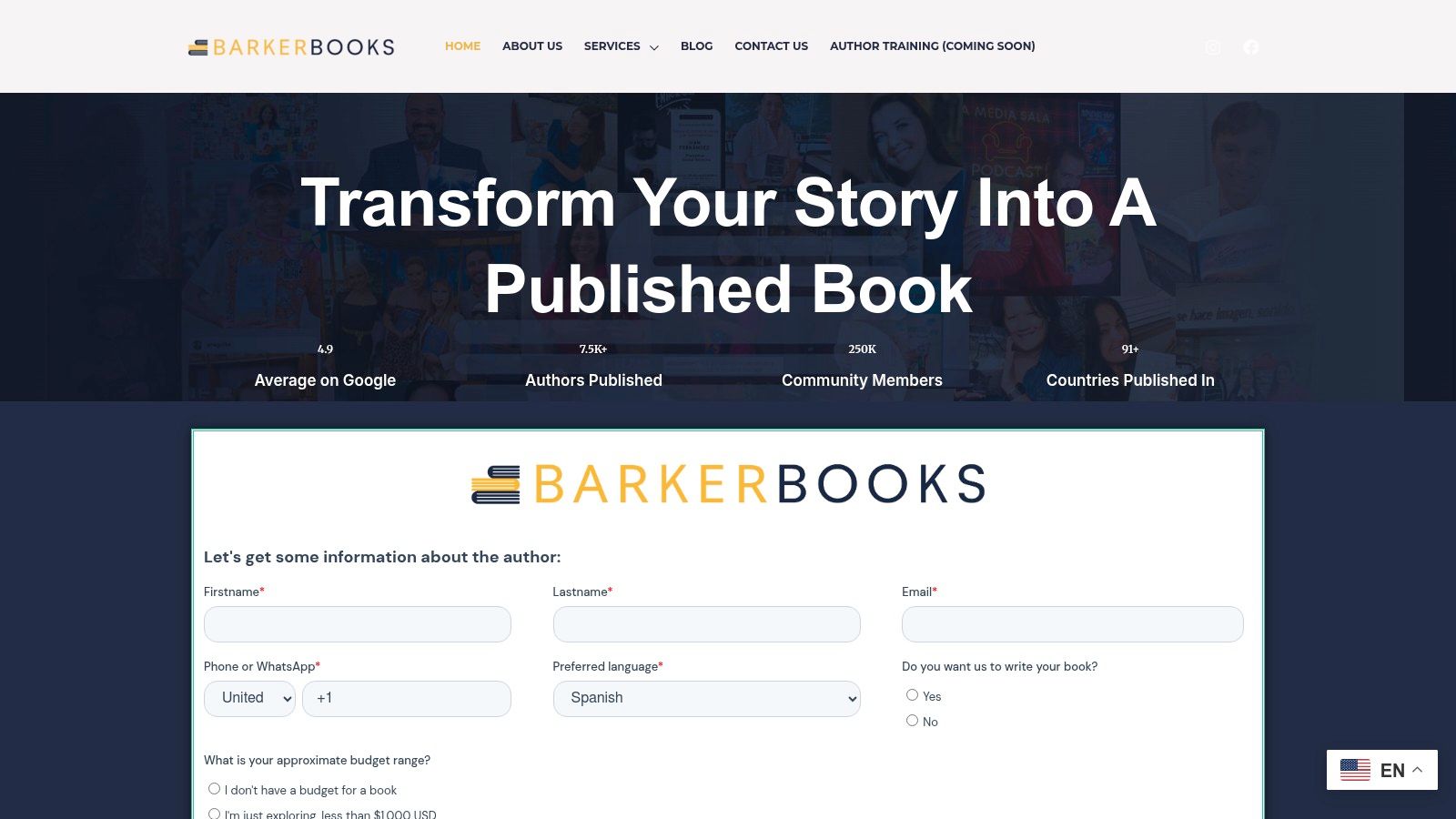
For authors seeking a comprehensive, full-service partner rather than a DIY platform, BarkerBooks presents a compelling solution. It’s an ideal choice for writers who want to bypass the technical complexities of publishing and focus on their craft, entrusting the entire process-from editing to global distribution-to a single, experienced team. This model is especially beneficial if you’re looking for where to sell an ebook with integrated professional support.
BarkerBooks operates as a bilingual publishing house, managing everything from editorial services and professional design to marketing and worldwide distribution. Their proven track record includes publishing over 7,500 authors and distributing to more than 91 countries, backed by strong social proof like a 4.9-star average Google rating.
Key Strengths & Use Cases
What truly sets BarkerBooks apart are its high-touch, value-added services that are rarely found in one package. Authors benefit from personalized live editorial sessions, dedicated manuscript diagnostics, and tailored literary advice. This makes it an excellent fit for first-time authors or established writers who value collaborative, human-centered support.
The platform's marketing and promotional tools are a significant advantage. Features like custom-built author landing pages (bilingual and hosted for two years), 3D promotional videos, and 30 days of targeted social media advertising are designed to build author brands and drive discoverability right from launch. Their strong footing in the Spanish-language market offers a unique gateway for bilingual publication and reaching a wider international audience.
Pricing & Considerations
Pricing is structured into three main packages (Essential, Professional, Elite), with budget indicators for projects under $1,000, between $1,000 and $3,000, and over $3,000. However, specific costs are not listed publicly; you must request a personalized quote based on your manuscript's needs. Be aware that certain premium services, like English-language audiobook production or advanced audio effects, may incur fees beyond the initial package price.
Website: https://barkerbooks.com
| Feature Analysis | Assessment |
|---|---|
| Best For | Authors wanting a full-service, hands-off publishing experience with robust marketing support and global reach. |
| Distribution Reach | Global, including Amazon Kindle, Apple Books, Barnes & Noble, Google Books, and Audible. |
| Royalties & Rights | The author retains full rights; royalty specifics are discussed during the consultation process. |
| Unique Selling Point | Integrated, high-touch support combining editorial quality, marketing, and bilingual (English/Spanish) publication. |
2. Amazon Kindle Direct Publishing (KDP)
When authors ask "where can I sell my ebook," Amazon Kindle Direct Publishing (KDP) is often the first answer. As the largest ebook retailer in the United States, KDP provides unparalleled access to a massive audience already engaged with the Kindle ecosystem. Publishing is free, and the platform offers a straightforward process for uploading and converting your manuscript into a Kindle-ready format.
The platform's key differentiator is its optional KDP Select program. By granting Amazon 90-day exclusivity for your ebook, you gain access to Kindle Unlimited (a subscription service for readers) and powerful promotional tools like Countdown Deals. Beyond just listing your book, success on KDP often involves leveraging its internal marketing engine. Authors can significantly boost their visibility by implementing effective Amazon email marketing strategies to connect with readers directly.
Key Features & Royalties
- Royalty Options: Choose between 70% or 35% royalties. The 70% option, available for books priced between $2.99 and $9.99 in eligible territories, includes a small "delivery fee" based on your ebook's file size.
- KDP Select: This exclusive program enrolls your book in Kindle Unlimited, allowing you to earn royalties based on pages read. It also unlocks free book promotions and Kindle Countdown Deals to drive initial sales velocity.
- Global Reach: Your ebook is automatically listed across Amazon's international storefronts, expanding your potential audience without extra effort.
Pros:
- Unrivaled access to the largest US ebook market.
- Robust, built-in promotional tools for discovery.
- Strong analytics and sales reporting dashboard.
Cons:
- KDP Select's exclusivity clause prevents you from selling your ebook elsewhere.
- Delivery fees on the 70% royalty option can eat into profits, especially for image-heavy books.
For a detailed walkthrough, you can learn more about how to publish on Amazon KDP.
Website: https://kdp.amazon.com
3. Apple Books for Authors (direct)
For authors seeking a powerful alternative to Amazon, Apple Books presents a high-quality platform with a dedicated and affluent readership. Publishing directly to Apple provides access to the vast ecosystem of iPhone, iPad, and Mac users. The platform prides itself on a clean user interface and a straightforward, author-friendly publishing process, making it an excellent non-exclusive option if you're wondering where can I sell my ebook beyond a single retailer.
Apple’s key differentiator is its simple and transparent royalty structure. Unlike competitors who often have variable rates and hidden fees, Apple offers a flat 70% royalty on all sales, regardless of the book's price. This simplicity allows authors to predict their earnings with much greater accuracy. The platform also offers next-day sales reporting, providing near-instant feedback on marketing efforts and promotional campaigns.
Key Features & Royalties
- Royalty Options: A straightforward, flat 70% royalty on every ebook sold, with no delivery fees or complicated pricing tiers to navigate.
- Full Control: Authors retain complete control over pricing, metadata, and promotional assets, with the ability to offer pre-orders and free books to attract readers.
- Affiliate Program: An optional affiliate program allows authors to earn an additional commission on sales generated through their unique links.
- Reporting: Access to powerful, next-day sales and trends data to monitor your ebook's performance across 51 countries.
Pros:
- Simple, transparent 70% royalty with no delivery fees.
- Strong presence among dedicated iPhone and iPad readers.
- No exclusivity requirements, allowing for wide distribution.
Cons:
- Smaller market share than Amazon in many genres.
- The direct publishing process can be more complex for Windows users without an approved aggregator.
Website: https://authors.apple.com
4. Google Play Books Partner Center
For authors wondering where to sell an ebook beyond the Amazon ecosystem, Google Play Books offers a powerful alternative. Tapping into the massive Android user base, the platform provides significant global reach, making your book accessible to millions of smartphone and tablet users. Publishing is free, and Google offers a flexible, non-exclusive environment, allowing you to sell your work on other platforms simultaneously.
Google's key advantage is its integration with the broader Google ecosystem, including search and discovery features. While its partner dashboard can have a steeper learning curve than KDP's, it provides robust tools for managing your titles. Authors can set flexible pricing, run promotions using coupon codes, and benefit from features like the Family Library, which allows buyers to share their purchases with family members, potentially increasing your book's exposure.
Key Features & Royalties
- Revenue Split: Authors receive a 70% revenue split in most supported countries, provided they accept the updated terms of service. In territories where this doesn't apply, the split defaults to 52%.
- Global Distribution: Google automatically makes your ebook available in dozens of countries, handling currency conversions and regional pricing adjustments for you.
- Promotional Tools: The platform allows you to create and distribute promotional codes for discounts or free copies, giving you direct control over your marketing campaigns.
- No Exclusivity: Unlike KDP Select, you are free to sell your ebook on any other platform without restriction, making it a great component of a wide distribution strategy.
Pros:
- Direct access to a huge audience of Android and Google ecosystem users.
- No exclusivity requirements, offering greater publishing flexibility.
- Strong global reach with automatic availability in numerous countries.
Cons:
- The partner dashboard and reporting interface can be less intuitive than competitors.
- Revenue split can vary by country if new terms are not accepted.
Website: https://play.google.com/books/publish
5. Kobo Writing Life
For authors wondering where to sell an ebook beyond the US-centric market, Kobo Writing Life (KWL) is a powerful contender. As Rakuten Kobo's self-publishing portal, it provides direct access to a significant global audience, with a particularly strong presence in Canada. KWL operates on a non-exclusive basis, allowing authors to diversify their distribution channels without being locked into a single platform.
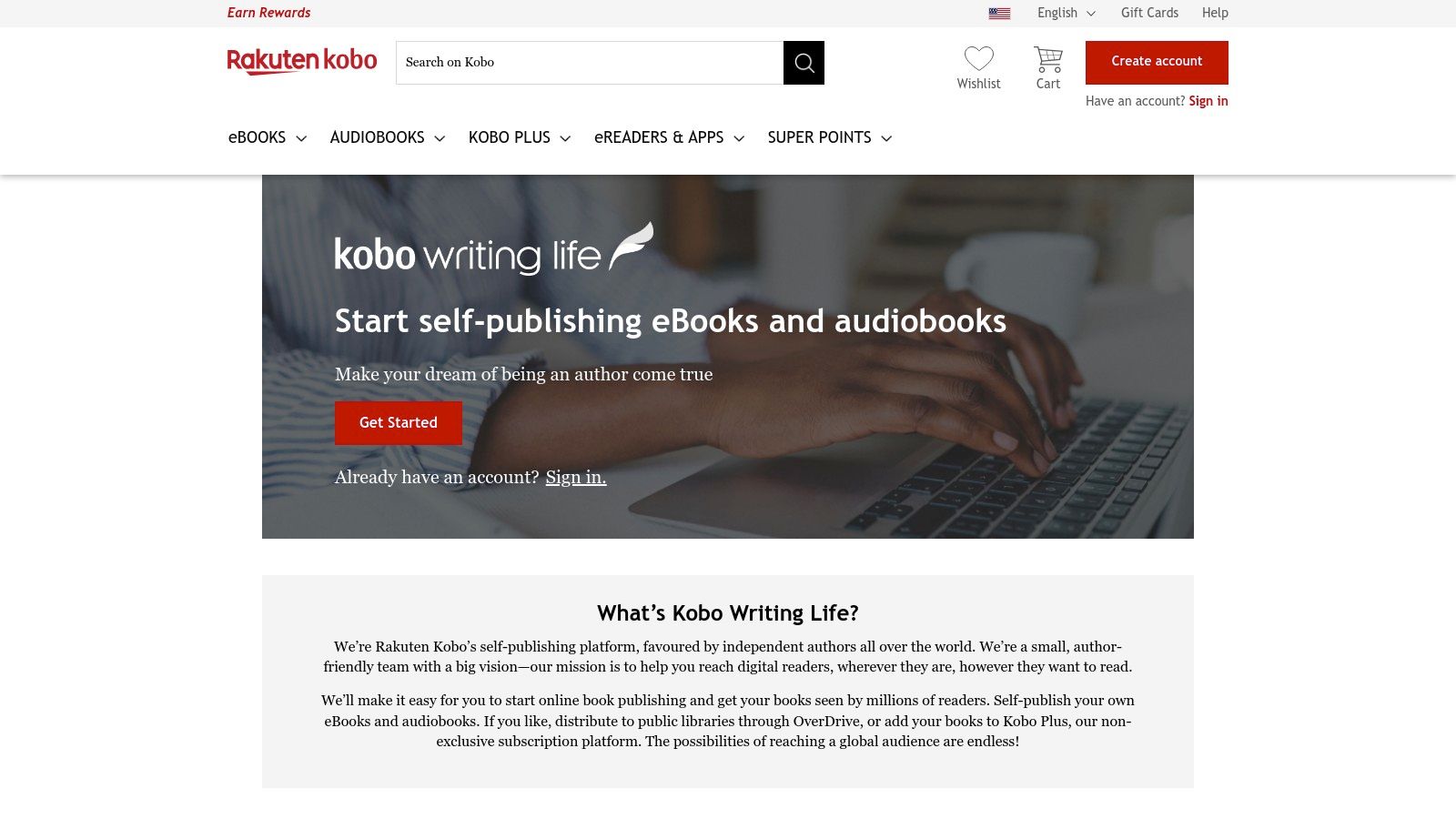
The platform's key differentiator is its wide-friendly approach and partnership network. Publishing through KWL places your ebook not only on the Kobo store but also in the catalogs of its numerous retail partners and library services like OverDrive. This gives independent authors reach into sales channels that are otherwise difficult to access directly. KWL also offers an opt-in to its Kobo Plus subscription program, providing another revenue stream based on minutes consumed, similar to Kindle Unlimited but without the exclusivity requirement.
Key Features & Royalties
- Royalty Options: Authors receive a 70% royalty for ebooks priced at or above $2.99 USD. For books priced below this threshold, the royalty rate is 45%.
- Kobo Plus: This non-exclusive subscription program allows you to earn from a shared fund based on reader engagement, offering an additional income path alongside direct sales.
- Global & Partner Distribution: Your book is distributed through Kobo's international storefronts and a network of partners, including major retailers and library systems.
- User-Friendly Dashboard: The platform is known for its clean, intuitive interface that makes uploading books, tracking sales, and managing your catalog straightforward.
Pros:
- No exclusivity requirements, making it ideal for a "wide" publishing strategy.
- Strong international reach, especially in the Canadian market.
- Simple dashboard and fast payouts (45 days after month-end).
Cons:
- A smaller US market share compared to Amazon or Apple Books.
- The 45% royalty for books under $2.99 is less competitive than other platforms.
Website: https://www.kobo.com/writinglife
6. Barnes & Noble Press (NOOK)
For authors seeking to diversify their sales channels beyond Amazon, Barnes & Noble Press offers a direct route into the NOOK ecosystem. This platform is a strategic choice for those wondering where to sell an ebook to reach a dedicated US readership that prefers the B&N brand. It allows independent authors to get their work featured alongside traditionally published titles in the well-known NOOK store, complete with opportunities for merchandising and promotions.
Publishing is free, and the platform provides a clean, user-friendly interface for uploading your manuscript and cover. B&N Press distinguishes itself by offering authors direct access to its established customer base and in-store merchandising potential, something not available through aggregator services. This direct relationship also unlocks longer pre-order windows and B&N-specific promotional tools, helping authors build buzz before launch.
Key Features & Royalties
- Royalty Structure: Authors can earn a 65% royalty on ebooks priced between $2.99 and $199.99. For titles priced from $0.99 to $2.98, the royalty rate is 40%.
- Merchandising Opportunities: B&N Press offers select self-published titles opportunities for features in email newsletters and inclusion in special curated collections on the NOOK store.
- Pre-Order & Promotions: Set up your ebook for pre-order up to 12 months in advance and utilize built-in tools to run price promotions directly on the B&N website.
Pros:
- Direct access to a major US retailer and its loyal customer base.
- Strong brand recognition and potential for in-store or online merchandising.
- Higher royalty rates compared to distributing to B&N via an aggregator.
Cons:
- A significantly smaller market share and audience compared to Amazon KDP.
- Royalty terms have seen historical changes, so authors should always verify current rates in their dashboard.
Website: https://press.barnesandnoble.com
7. Draft2Digital
For authors seeking broad distribution without the hassle of managing multiple platforms, Draft2Digital is a top-tier answer to the question, "where can I sell my ebook?" As a leading aggregator, it simplifies the process by allowing you to upload your manuscript once and distribute it to a vast network of retailers like Apple Books, Barnes & Noble, Kobo, and even library services like OverDrive and hoopla. This "publish wide" strategy is ideal for reaching readers beyond the Amazon ecosystem.
Draft2Digital's primary advantage is its efficiency. The platform provides free formatting tools, a universal book link to direct readers to their preferred store, and a single dashboard for tracking sales across all channels. There are no upfront fees; instead, Draft2Digital takes a commission of approximately 10% of your ebook's list price, making it an accessible, low-risk option for independent authors. For an in-depth comparison, you can learn more about various book distribution services.
Key Features & Royalties
- Wide Distribution: A single upload sends your book to major online retailers and library systems, maximizing your reach.
- Aggregated Royalties: Most retailers pay out around 60% of the list price as a royalty. Draft2Digital takes its ~10% cut from this amount, meaning your final take-home is roughly 60% of the net royalty paid by the retailer.
- Payment Splitting: An invaluable feature for co-authors or collaborations, allowing for automated royalty splits between multiple contributors.
- Free Tools: Access free ebook conversion, formatting templates, and a universal book link at no cost.
Pros:
- Saves significant time by managing metadata and updates across many retailers from one place.
- Provides access to the lucrative library market (OverDrive, hoopla).
- No upfront costs to publish or distribute.
Cons:
- Overall earnings per sale are lower than publishing directly with a retailer due to the aggregator's commission.
- Distributing to Amazon via Draft2Digital may have some limitations compared to using KDP directly.
Website: https://www.draft2digital.com
8. Smashwords
Smashwords has long been a champion for indie authors and remains a relevant place to sell your ebook, especially since its acquisition by Draft2Digital. It functions as both a direct-to-reader storefront and a distributor, known for its community of readers actively seeking out independent talent. Its key strength lies in its powerful, author-centric promotional tools that encourage discovery and backlist sales.
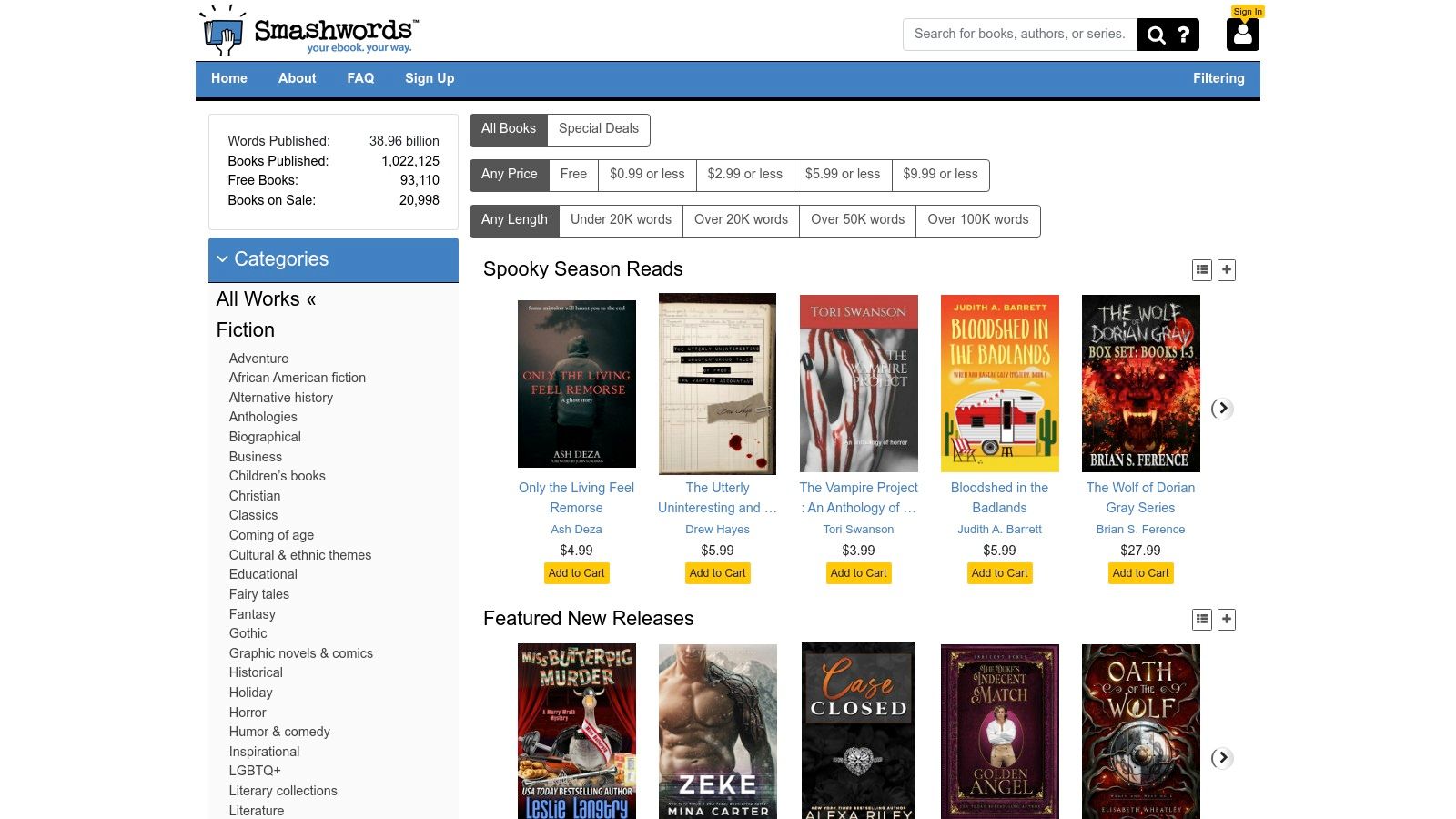
What makes Smashwords unique are its site-wide promotional events, like the annual Read an Ebook Week and End-of-Year Sale. During these periods, authors can opt-in to offer discounts, driving significant traffic and visibility. The platform's robust couponing system also gives authors granular control over their marketing efforts, making it a valuable tool for targeted campaigns. While most authors now access it via the Draft2Digital dashboard, its reader-facing store is a key destination for deal-seeking ebook lovers.
Key Features & Royalties
- High Royalty Rates: Authors can earn up to 80% on direct sales through the Smashwords store, a significantly higher rate than many other retailers.
- Promotional Tools: The platform provides extensive couponing options and facilitates participation in major site-wide sales events, giving authors direct control over their pricing and promotions.
- Indie-Focused Storefront: The store is designed to help readers discover new independent authors, creating a supportive ecosystem that rewards quality indie publishing.
Pros:
- Generous royalty rates on direct sales.
- Powerful discounting and store-wide promotional events.
- An active, loyal reader base that specifically supports indie authors.
Cons:
- The direct audience is smaller compared to major retailers like Amazon or Apple.
- Authors typically upload and manage their books through the Draft2Digital platform now, not directly on Smashwords.
Website: https://www.smashwords.com
9. Gumroad
For authors prioritizing direct reader relationships and complete control, Gumroad is a leading choice when considering where can I sell ebook. Unlike traditional retailers, Gumroad is a creator-first e-commerce platform that allows you to sell digital products directly from your own customized storefront. It handles payment processing, file delivery, and global tax compliance, freeing you to focus on marketing and connecting with your audience.
The platform’s standout feature is its simplicity combined with powerful creator tools. You own the customer list and can directly communicate with your buyers, a crucial advantage for building a long-term author career. Success on Gumroad hinges on your ability to drive traffic through your own channels, like social media or an email newsletter. It’s an ideal solution for authors who already have an established online presence.
Key Features & Royalties
- Fee Structure: A flat 10% transaction fee. Gumroad acts as the merchant of record, handling VAT and sales tax collection and remittance, which is included in this fee.
- Direct Sales Model: You own the customer relationship, gaining direct access to your readers' email addresses for future marketing efforts and community building.
- Flexible Pricing: Offers options for standard pricing, "pay what you want" models, product bundles, and discount codes to drive sales.
- Built-in Tools: Includes a native affiliate marketing system, allowing you to easily recruit partners to help promote and sell your ebook.
Pros:
- You own the customer data and can build a direct email list.
- Handles complex global sales tax and VAT automatically.
- Extremely fast and simple to set up a product page and start selling.
Cons:
- The 10% fee can be higher than some royalty splits on larger platforms.
- Limited built-in discovery; you are responsible for driving nearly all your own traffic.
For a deeper dive into creating your digital product, you can learn more about how to make and sell an ebook.
Website: https://gumroad.com
10. Payhip
Payhip is an excellent answer for authors wondering "where can I sell my ebook" with maximum control and minimal setup. It’s an e-commerce platform designed for creators to sell digital products, including ebooks, directly to their audience from a customizable storefront. Unlike a traditional retailer, Payhip gives you the tools to build your own sales funnel, making it ideal for authors with an existing audience or a strong social media presence.
The platform's main advantage is its simplicity and direct-to-creator model. It removes the complexities of handling digital sales tax by automatically managing EU and UK VAT for you. This allows authors to focus on marketing and connecting with readers, rather than on administrative hurdles, while getting paid instantly after each sale.
Key Features & Royalties
- Pricing Tiers: Payhip offers a free plan with a 5% transaction fee, a Plus plan at $29/month with a 2% fee, and a Pro plan at $99/month with no transaction fees. All features are available on every plan. Note that standard Stripe/PayPal processing fees apply on top of these rates.
- Direct Payouts: Funds are transferred directly to your PayPal or Stripe account immediately after a purchase is made.
- Sales & Marketing Tools: Features include an affiliate system, coupon codes, social discounts, pay-what-you-want pricing, and an embeddable checkout button for your existing website.
Pros:
- Extremely simple and fast to set up a digital storefront.
- Instant payouts; no waiting for monthly royalty payments.
- All features, including the affiliate system, are available even on the free plan.
Cons:
- You are responsible for driving 100% of your own traffic.
- Transaction fees on the free plan are higher than some competitors.
Website: https://payhip.com
11. Leanpub
For technical writers and nonfiction authors asking "where can I sell my ebook," Leanpub offers a unique, iterative publishing model. It is designed for authors who want to release their books "in-progress" and incorporate reader feedback as they write. This approach is particularly effective for programming, business, and technical subjects where content can be updated frequently.
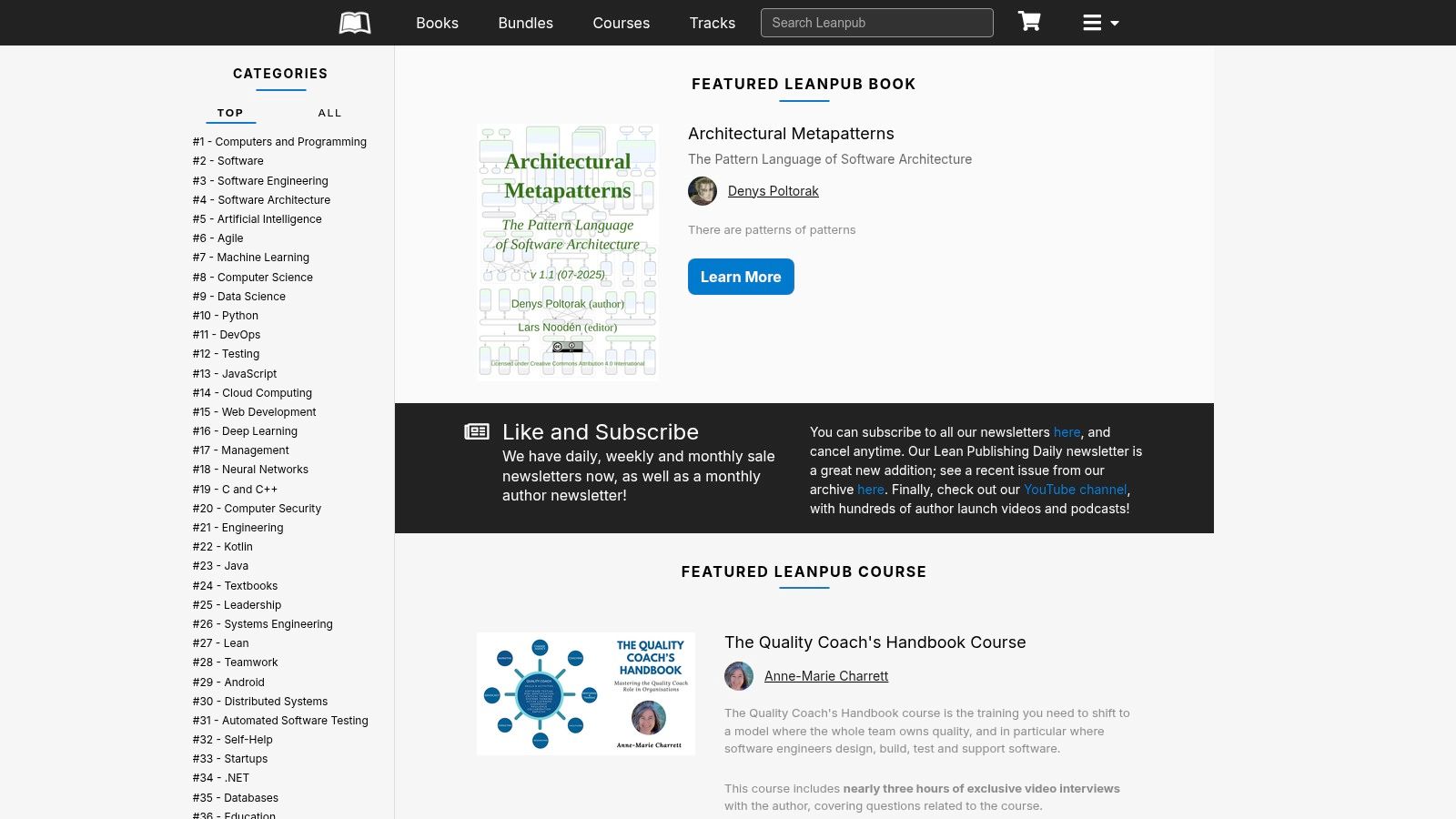
Leanpub’s standout feature is its "Publish Early, Publish Often" philosophy. Authors can sell early access to their books, build a community of readers, and provide updates as new chapters are completed. The platform also offers a "variable pricing" model, where you set a minimum and suggested price, empowering readers to pay what they feel the book is worth.
Key Features & Royalties
- Author-Friendly Royalties: You earn a straightforward 80% royalty on every sale, minus a $0.50 transaction fee on sales below $7.99.
- Publishing-in-Progress: Easily publish updates to your manuscript. Readers who have already purchased are automatically notified and can download the latest version for free.
- Variable Pricing: Set a minimum price and a suggested price, giving readers the flexibility to support your work at a level they choose.
- Multiple Formats: The platform automatically generates PDF, EPUB, and MOBI files from your manuscript, ensuring compatibility across all major e-readers.
Pros:
- Excellent for iterative writing, early access models, and technical content.
- Highly transparent and generous royalty model.
- Strong support for multiple output formats and frequent updates.
Cons:
- Limited built-in discovery tools; authors must drive their own traffic.
- The audience is niche and less focused on mainstream fiction.
Website: https://leanpub.com
12. Lulu
Lulu offers a unique hybrid approach for authors asking where they can sell their ebook, combining direct sales with broad distribution. The platform is well-known for its print-on-demand services, and its ebook publishing tools provide a seamless way to create and sell digital versions alongside physical copies, all managed through a single vendor. This integrated system is ideal for authors who want to offer their work in multiple formats without managing separate platforms.
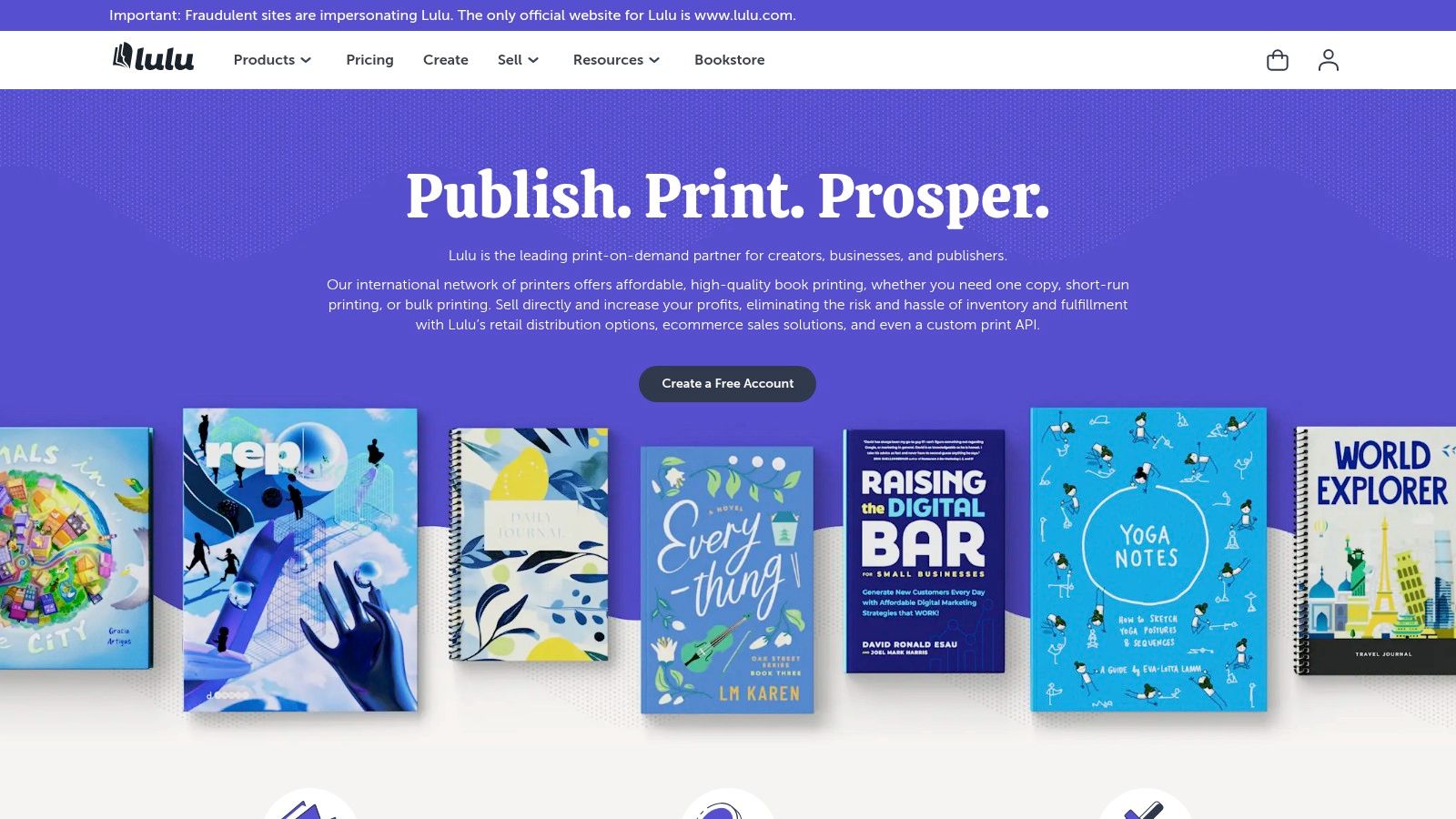
Authors can sell EPUB and PDF files directly through the Lulu bookstore, a great option for creators with an existing audience they can direct to their storefront. For broader reach, Lulu offers a global distribution service for English-language EPUBs to major retailers like Amazon, Barnes & Noble, and Apple Books. While this service requires a small one-time review fee for the first submission, it simplifies the process of reaching multiple stores at once.
Key Features & Royalties
- High Creator Revenue: Lulu aims for authors to receive approximately 90% of the gross profit from direct ebook sales on its bookstore, making it a lucrative direct-to-consumer option.
- Global EPUB Distribution: Distribute your English-language EPUB to major online retailers. Lulu acts as your agent, consolidating your sales data and payments. Note that the first distribution submission has a one-time $4.99 review fee.
- Integrated Print-on-Demand: Easily bundle and manage both ebook and print book sales from one unified dashboard, creating a comprehensive sales strategy for your title.
Pros:
- Excellent option for selling both print and digital books from one platform.
- High direct-sale revenue potential through the Lulu bookstore.
- Helpful pricing calculators provide clear guidance on potential earnings.
Cons:
- Global distribution is limited to English-language EPUBs only.
- Distribution processing to retailers can take several weeks to complete.
Website: https://www.lulu.com
12 eBook Sales Platforms Comparison
| Service | Core Features ✨ | Quality ★ | Price / Value 💰 | Target Audience 👥 |
|---|---|---|---|---|
| BarkerBooks 🏆 | End-to-end bilingual publishing: editorial, proofreading, cover/interior design, audiobook, 3D promo, ISBN/copyright, global distro (Amazon, Apple, B&N, Google) ✨ | ★4.9; 7,500+ authors; professional, punctual support | Packages: Essential → Elite (brackets: < $1k; $1k–$3k; > $3k); add-ons available 💰 | Authors seeking full-service, hands-on bilingual (EN/ES) global launch 👥 |
| Amazon KDP | Direct Kindle storefront, KDP Select (KU), promo tools, royalty tiers (70%/35%) ✨ | ★ Excellent Amazon discoverability & analytics | Free to publish; delivery fee may reduce 70% option 💰 | Indie authors prioritizing Amazon reach & promo features 👥 |
| Apple Books | Direct Apple storefront; flat 70% royalty; next-day sales reporting, affiliate option ✨ | ★ Simple, transparent reporting | Free to publish; consistent 70% royalty 💰 | Authors targeting iPhone/iPad readers and non‑exclusive distribution 👥 |
| Google Play Books | Google ecosystem reach, flexible pricing, promo codes, Family Library support ✨ | ★ Broad global reach on Android devices | Revenue split 70% (opt-in TOS) or 52% default; flexible pricing 💰 | Authors seeking Android/global exposure without exclusivity 👥 |
| Kobo Writing Life | Kobo store + partner retail, Kobo Plus opt-in, clean dashboard, fast payouts ✨ | ★ Strong in Canada; user-friendly dashboard | 70% ≥ $2.99; 45% below; subscription opt-ins 💰 | Authors targeting Canada/partner retailers and subscription readers 👥 |
| Barnes & Noble Press (NOOK) | Direct NOOK publishing, pre-orders, B&N merchandising opportunities ✨ | ★ Good US retail visibility outside Amazon | ~65% for $2.99–$199.99; lower tiers for cheaper prices 💰 | US-focused authors seeking bookstore merchandising & NOOK presence 👥 |
| Draft2Digital | Aggregator: one upload to many retailers + libraries (OverDrive/hoopla), payment splits ✨ | ★ Saves time; solid library distribution | No upfront fees; ~10% commission on list price 💰 | Authors who want broad reach without managing multiple dashboards 👥 |
| Smashwords | Indie storefront, seasonal/site-wide sales, coupons, D2D integration ✨ | ★ Strong indie discovery & promotion events | Store royalties up to ~80% (varies); smaller audience 💰 | Indie/backlist authors who benefit from site promotions 👥 |
| Gumroad | Direct-to-reader commerce, checkout, affiliates, tax/merchant-of-record handling ✨ | ★ Full customer ownership & easy checkout | 10% + $0.50/txn (profile); 30% marketplace fees; merchant handling 💰 | Authors selling directly to fans, owning the email list 👥 |
| Payhip | Direct storefront, EU/UK VAT handling, pay-what-you-want, affiliate tools ✨ | ★ Fast setup and instant payouts | Free (5% fee), Plus $29/mo (2%), Pro $99/mo (0%) 💰 | Creators driving traffic via newsletter/social; simple storefront needs 👥 |
| Leanpub | Iterative publishing, reader-updates, multiple formats, variable pricing ✨ | ★ Ideal for tech/nonfiction; iterative model | Author-friendly royalties (~80% with small adjustments) 💰 | Technical/nonfiction authors and those publishing-in-progress 👥 |
| Lulu | Direct Lulu store, print-on-demand integration, EPUB distribution (English) ✨ | ★ Good POD + ebook bundle options | One-time $4.99 review fee for first retailer submission; high creator revenue target 💰 | Authors needing POD + optional retailer distribution (English) 👥 |
Choosing Your Path: From Manuscript to Marketplace
The journey from a completed manuscript to a published ebook with sales notifications is an exhilarating one, but the path you take is just as important as the destination. We've explored a wide landscape of platforms, from retail giants to direct-to-consumer specialists, each offering a distinct set of tools and opportunities. The central question of where can I sell ebook doesn't have a single, universal answer; instead, it has your answer, tailored to your specific goals, resources, and author strategy.
The decision ultimately hinges on a trade-off between reach, royalties, and control. Platforms like Amazon KDP offer unparalleled access to a massive built-in audience, but often at the cost of exclusivity or lower royalty rates on certain pricing tiers. Going "wide" with an aggregator like Draft2Digital or Smashwords multiplies your storefronts, placing your work in online bookstores and libraries globally, but it introduces a middleman that takes a small percentage of your earnings. Conversely, direct sales platforms like Gumroad and Payhip put you in the driver's seat, offering the highest profit margins and direct contact with your readers, but they require you to build and bring your own audience.
Making the Right Choice for Your Author Career
To navigate this decision, start by honestly assessing your priorities. Are you a new author looking to build a name and willing to leverage Amazon's ecosystem to gain initial traction? Or are you an established creator with a dedicated following, ready to maximize your income through direct sales?
Consider these key factors as you finalize your strategy:
- Your Time and Technical Skill: Direct sales and managing multiple retail platforms require more hands-on effort. Aggregators simplify this process significantly, while a full-service partner like BarkerBooks can manage the entire technical and logistical process for you.
- Your Long-Term Goals: Do you want to build a global brand or focus on a niche, highly engaged community? A "wide" strategy supports global discovery, while a direct-sales approach excels at community building.
- Your Genre and Audience: Certain genres perform exceptionally well on specific platforms. Research where readers of your genre congregate. Is it Kindle Unlimited, Kobo's international markets, or a niche community you can reach directly?
Choosing where to sell your ebook is a foundational decision in your publishing journey. It dictates your potential audience, your revenue model, and the amount of administrative work you'll handle. Use this guide not as a set of rigid rules, but as a map. Pinpoint your desired destination, evaluate the various routes available, and select the platform or combination of platforms that will best carry your story from your desktop to the digital bookshelves of readers around the world.
Ready to skip the logistical hurdles and focus on what you do best: writing? If you're looking for a professional partner to handle everything from expert editing and cover design to global distribution and marketing, BarkerBooks offers a comprehensive, all-in-one publishing solution. Let our team of experts guide you through every step of the process to ensure your ebook launch is a resounding success. Learn more about our author services at BarkerBooks.