
Breaking Down Book Publishing Expenses
Publishing a book requires financial planning. This listicle details the cost to publish a book in 2025, covering seven key expense categories. Understanding these costs is essential for budgeting and achieving your publishing goals. Whether you're pursuing traditional publishing, self-publishing, or exploring hybrid options, this breakdown helps you anticipate and manage expenses effectively. From professional editing and cover design to marketing and ISBN registration, we’ll explore the investment needed to bring your book to market.
1. Professional Editing Services
Professional editing is a crucial step in the book publishing process and significantly impacts the final product's quality and marketability. When considering the cost to publish a book, editing services often represent the largest single expense, but it's an investment that pays off in the long run. This process involves multiple stages designed to refine your manuscript into a polished, professional piece of work ready for readers. From ensuring the overall structure and narrative flow to catching minor grammatical errors, professional editing elevates your book to industry standards. Neglecting this vital step can lead to negative reviews, poor sales, and damage to your reputation as an author.
Professional editing typically encompasses three key levels:
-
Developmental Editing: This high-level edit focuses on the "big picture" aspects of your manuscript. A developmental editor analyzes your story's structure, plot, character development, pacing, and overall narrative arc. They provide feedback on inconsistencies, plot holes, and areas that need strengthening or restructuring. This stage ensures your story is engaging, compelling, and well-paced. Costs typically range from $0.08-$0.20 per word.
-
Copy Editing: Once the developmental edits are implemented, copy editing delves into the finer details of your writing. A copy editor focuses on grammar, punctuation, spelling, consistency, and style. They ensure your writing is clear, concise, and error-free. This stage polishes your prose and enhances readability. Costs typically range from $0.02-$0.05 per word.
-
Proofreading: The final stage of the editing process, proofreading, is a meticulous review of your manuscript for any remaining errors after copy editing. A proofreader checks for typos, misspellings, punctuation errors, and formatting inconsistencies. This final polish ensures your book is free of distracting errors that could detract from the reading experience. Costs typically range from $0.01-$0.03 per word.
Professional editing packages often include multiple revision rounds, ensuring you're satisfied with the final product. Editors also apply industry-standard style guides, guaranteeing your manuscript adheres to professional publishing conventions. This is essential for aspiring authors with completed or in-progress manuscripts, professionals seeking ghostwriting and editorial support, bilingual or international authors aiming for global distribution, self-published writers needing design, formatting, and marketing, and authors looking for comprehensive copyright and ISBN registration. Learn more about Professional Editing Services at https://barkerbooks.com/how-to-become-a-published-author/.
Benefits of Professional Editing:
- Improved Manuscript Quality: Professional editing dramatically improves the quality and readability of your manuscript, making it more engaging and enjoyable for readers.
- Professional Credibility: Investing in professional editing demonstrates your commitment to producing a high-quality product, enhancing your credibility and professionalism.
- Market Competitiveness: A well-edited book is more likely to stand out in a competitive market and attract readers and publishers.
- Reduced Negative Reviews: Professional editing minimizes the risk of negative reviews stemming from poor writing quality.
- Valuable Industry Insights: Editors often provide valuable feedback and insights into the publishing industry, helping you navigate the process more effectively.
Drawbacks of Professional Editing:
- High Upfront Cost: Professional editing can be expensive, with costs ranging from $1,000 to $5,000+ for full-length novels.
- Increased Timeline: Editing can add 4-12 weeks to your publishing schedule.
- Variable Quality: The quality of editing services can vary significantly between editors, so it's essential to do your research and choose a reputable editor.
- Potential for Multiple Revisions: Multiple rounds of revisions, while often included in packages, can extend the timeline and potentially increase costs.
Authors like Hugh Howey, who invested over $3,000 in editing for his self-published bestseller Wool, exemplify the importance of professional editing. Platforms like Reedsy and The Book Khoj offer access to vetted editors and comprehensive editing packages.
The infographic below illustrates the cost ranges per word for the three main types of editing services.
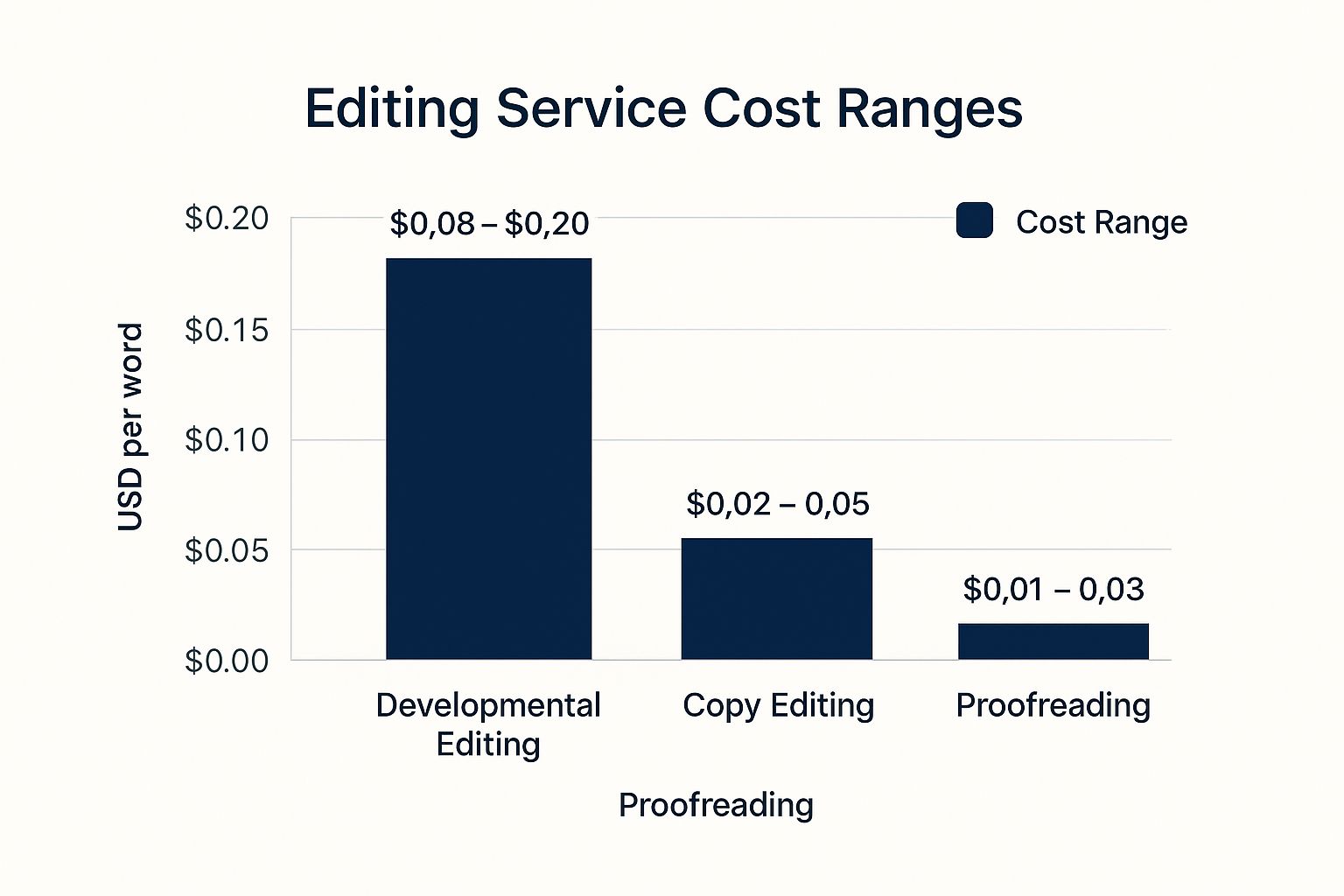
As the bar chart clearly demonstrates, developmental editing is the most expensive service per word, followed by copy editing, and finally proofreading. This reflects the depth and complexity of each stage, with developmental editing requiring the most time and expertise.
Tips for Hiring an Editor:
- Request Sample Edits: Request sample edits from multiple editors before making a decision. This allows you to assess their skills and style.
- Budget Accordingly: Allocate 20-30% of your total publishing budget for editing services.
- Phased Editing: Consider editing in phases (developmental, copy editing, proofreading) to spread the costs over time.
- Seek Recommendations: Join author communities and online forums to find editor recommendations and reviews.
By understanding the different levels of editing and their associated costs, you can make informed decisions and invest wisely in professional editing services that will ultimately enhance your book's quality and contribute to its success. When considering the cost to publish a book, professional editing should be viewed not as an expense, but as a crucial investment in your work.
2. Professional Cover Design
One of the most crucial investments in your book publishing journey is professional cover design. When considering the cost to publish a book, cover design should be a high priority. Your book cover is the first, and often only, impression you make on potential readers. It's the visual representation of your story, and it plays a pivotal role in marketing success, directly impacting sales and reader perception. A well-designed cover will attract attention, communicate genre, and ultimately entice readers to learn more. Investing in a professional cover design is not merely an aesthetic choice; it's a strategic decision that can significantly impact your book's success.

Professional designers understand the nuances of visual communication and marketing psychology. They create genre-appropriate covers that stand out in the crowded online marketplace, especially in thumbnail format on retailers like Amazon, Barnes & Noble, and Apple Books. These designers are skilled in typography, color theory, and image selection, crafting covers that are not only visually appealing but also effectively communicate the essence of your book. They also ensure your cover meets technical specifications for various formats, including print, ebook, and even audiobook covers.
A professional cover design typically includes features like custom illustrations or photography, carefully selected typography and layout, adherence to genre conventions, and optimization for multiple formats. Most designers also provide source files and include several rounds of revisions in their pricing. This ensures you have the final say in the design and receive files suitable for various printing and distribution platforms.
Pros of Professional Cover Design:
- Increased Click-Through Rates and Sales: A compelling cover is a powerful marketing tool, drawing readers in and encouraging them to click and purchase.
- Professionalism and Quality: A professionally designed cover instantly conveys a sense of quality and professionalism to potential readers, setting your book apart from self-published works with amateurish covers.
- Optimized for Online Display: Designers optimize covers for online thumbnail display, ensuring they are visually appealing and legible even at small sizes.
- Genre-Appropriate Design: A cover that adheres to genre conventions helps attract the right target audience, increasing the likelihood of sales.
Cons of Professional Cover Design:
- Cost: Quality designers charge anywhere from $300 to $1,500 or more, which can be a significant investment for some authors.
- Risk of Amateurish Design if Choosing Budget Options: Opting for extremely cheap designs can often result in a cover that looks unprofessional and detracts from your book's potential.
- Potential for Additional Revision Costs: While most designers include revision rounds, significant changes beyond the agreed-upon scope might incur extra fees.
- Changing Trends: Design trends evolve, and your cover might require a redesign down the line to stay current and competitive.
Examples of Cover Design Services and Successes:
- Pre-made Covers: Websites like 100 Covers offer affordable pre-made designs ranging from $100 to $300, providing a budget-friendly option.
- Genre-Specific Designers: Services like GetCovers specialize in creating covers for specific genres, ensuring a strong understanding of genre conventions and target audience preferences.
- High-End Designers: Designers like Stuart Bache work with bestselling indie authors and offer premium cover design services.
- Branding Consistency: Authors like James Patterson consistently use a recognizable style and branding for their thriller covers, creating a strong brand identity.
Tips for Choosing a Cover Design:
- Genre Research: Study the covers of bestselling books in your genre for inspiration and to understand current trends.
- Cover Testing: Test different cover options with your target audience to gauge their reactions and identify the most effective design.
- Thumbnail Effectiveness: Ensure your cover works well as a small thumbnail image, as this is how it will often be displayed online.
- Consider Pre-made Covers: If budget is a concern, explore pre-made covers as a cost-effective alternative to custom design, ranging from $50 to $300.
When deciding on the cost to publish a book, remember that a professional cover design is an investment that can significantly impact your book's visibility, marketability, and ultimately, its success. Whether you choose a custom design or a pre-made option, prioritize a cover that effectively communicates your book's genre and story, attracts your target audience, and presents a professional image.
3. ISBN and Copyright Registration
ISBN and copyright registration are essential steps in the book publishing process, directly impacting the cost to publish a book and influencing its reach and legal protection. These seemingly administrative tasks play a crucial role in establishing your book's professional credibility and ensuring its availability to a wider audience. Understanding their importance and navigating the associated costs are crucial for any aspiring author.
An International Standard Book Number (ISBN) is a unique 13-digit identifier assigned to each format of your book. Think of it as your book's fingerprint, distinguishing it from every other publication in the world. This numerical code is essential for bookstores, libraries, online retailers, and distributors to identify, order, and track your book. Without an ISBN, your book will face significant limitations in reaching readers through traditional channels. Each format of your book – paperback, hardcover, ebook, and audiobook – requires a separate ISBN.
Copyright registration, while not mandatory in every country, provides legal protection for your intellectual property. It establishes you as the rightful owner of your work and safeguards it against unauthorized reproduction or distribution. This legal documentation can prove invaluable should you ever need to defend your work against infringement.
Why are these elements critical to consider when calculating the cost to publish a book? Because while they offer significant benefits, they also come with associated fees. In the US, ISBNs are purchased through Bowker, the official ISBN agency, and cost $125 for a single ISBN or $295 for a pack of 10. This is a one-time cost, but it's essential to factor into your budget. Copyright registration through the US Copyright Office incurs an additional fee, typically ranging from $65 to $85 per work.
The advantages of obtaining ISBNs and copyright registration far outweigh the costs. For aspiring authors aiming for widespread distribution, ISBNs are non-negotiable. Most bookstores and online retailers require an ISBN to list and sell a book. These numbers also link your book to your publisher information in global databases, enhancing your professional standing within the book industry. Furthermore, having an ISBN is often a prerequisite for participation in many marketing and promotional opportunities.
Copyright registration provides concrete legal documentation of your ownership, enabling you to take legal action if your work is infringed upon. This protection also extends to derivative works, ensuring that you retain control over adaptations of your original content. This is particularly relevant for authors considering translations or film adaptations of their work. For international authors or those aiming for global distribution, international copyright registration offers further protection in different territories.
While traditional publishing houses typically handle ISBN acquisition and copyright registration, self-published authors must manage these processes themselves. This adds to the overall cost to publish a book independently, but it also grants authors greater control over their work. Some self-publishing platforms, like Amazon KDP, offer free ASINs (Amazon Standard Identification Numbers) for books published exclusively through their platform. However, this limits distribution solely to Amazon and restricts access to wider bookstore placement. Other distributors like IngramSpark require authors to provide their own unique ISBNs for distribution.
Learn more about ISBN and Copyright Registration
To make informed decisions regarding ISBNs and copyright, consider the following tips:
- Purchase ISBNs in bulk: If you plan to publish multiple books or different formats of the same book, purchasing ISBNs in packs of 10 offers significant cost savings.
- Buy your own ISBNs: Even if using a self-publishing platform, purchasing your own ISBNs establishes you as the publisher of record and gives you more control over your book’s metadata and distribution.
- Register copyright before publication: Registering your copyright before publication provides the strongest legal protection.
- Consider international copyright registration: If you are targeting international markets, explore international copyright registration options for comprehensive protection.
In conclusion, while ISBN and copyright registration contribute to the cost to publish a book, they are indispensable investments for authors seeking wide distribution, professional recognition, and legal protection for their work. These seemingly small steps can have a significant impact on your book’s success and longevity in the literary marketplace. They are a crucial component of understanding the true cost to publish a book and should be factored into your budget and planning from the outset.
4. Book Formatting and Layout
Book formatting and layout is a crucial step in the publishing process that significantly impacts the cost to publish a book. It's the process of preparing your manuscript for printing or digital distribution, ensuring it meets industry standards and provides a professional, readable experience for your audience. This involves much more than simply typing your words onto a page; it includes careful consideration of typography, page layout, chapter headings, and technical optimization for various devices. Ignoring this step can lead to a book that looks amateurish and may deter readers. Investing in professional formatting, or dedicating sufficient time to DIY formatting, is an essential part of presenting your work in the best possible light.
This stage transforms a raw manuscript into a polished, professional product. Imagine picking up a book with inconsistent fonts, uneven margins, or chapters that start abruptly without proper headings. It immediately undermines the author's credibility and makes for a frustrating reading experience. Professional formatting avoids these pitfalls, creating a visually appealing and easy-to-read book that reflects the quality of the content within. It's an investment that pays off by enhancing your book's perceived value and attracting readers.
Specifically, book formatting encompasses several key features:
-
Interior Page Layout and Design: This involves setting margins, choosing appropriate line spacing, and determining the placement of text and images on each page. A well-designed layout enhances readability and creates a visually appealing flow.
-
Typography and Font Selection: Selecting the right fonts for your book significantly impacts its overall aesthetic and readability. Different fonts evoke different moods and cater to various genres. Professional formatters understand these nuances and can choose fonts that complement your book's content.
-
Chapter Headings and Page Styling: Consistent and well-designed chapter headings and page numbers contribute to a professional look and help readers navigate your book easily. This includes elements like page breaks, running headers, and footers.
-
Print Specifications and Bleed Setup: For print books, formatting includes setting up the correct bleed area (the area beyond the trim line) to ensure no important content is cut off during the printing process. This also involves choosing the appropriate paper size and trim size.
-
Ebook Optimization for Multiple Devices: Ebooks need to be formatted to display correctly on a variety of devices, from e-readers like Kindles to tablets and smartphones. This involves using reflowable text and optimizing images for different screen sizes.
While professional formatting comes with a cost, typically ranging from $200 to $800 depending on the book's length and complexity, it offers numerous advantages:
Pros:
- Creates professional, readable interior layouts.
- Ensures compatibility across all platforms and devices.
- Saves time on technical formatting requirements.
- Reduces printing and display errors.
Cons:
- Professional formatting can be expensive.
- DIY formatting requires a significant time investment and technical knowledge.
- Format requirements vary between platforms.
- Changes to the manuscript often require reformatting across all versions.
Several tools and resources are available for formatting your book:
- Vellum: This software (exclusively for Mac users) provides a user-friendly interface and professional-looking templates. While it has a one-time cost of $249.99, it’s a powerful tool for those planning to publish multiple books.
- Atticus: This cross-platform formatting software offers similar functionality to Vellum, making it a strong option for non-Mac users.
- Freelance Formatters: Platforms like Reedsy and Upwork connect authors with experienced freelance formatters who can handle the entire process.
- Scrivener's Compile Feature: While not as robust as dedicated formatting software, Scrivener offers basic formatting capabilities for creating ebooks and print-ready files.
Here are some tips to consider when approaching book formatting:
- Learn Basic Formatting: Even if you hire a professional, understanding the basics can help you communicate your needs effectively and reduce ongoing costs for minor revisions.
- Use Templates: Templates help maintain consistency across a series and save time on formatting each book individually. Resources like those from Brad West (Book Design Templates) can be invaluable.
- Test Formatted Books on Multiple Devices: Before publishing, test your formatted book on various e-readers, tablets, and smartphones to ensure it displays correctly.
- Consider Software Investment: If you plan to publish multiple books, investing in formatting software like Vellum or Atticus can be more cost-effective than hiring a formatter for each project.
Experts in the field, like Joel Friedlander (The Book Designer) and 180g Software (the creators of Vellum), emphasize the importance of professional formatting for a successful book launch. They offer valuable resources and insights for authors navigating the complexities of book formatting and design. By understanding the options and making informed decisions about formatting, you can control a significant portion of the cost to publish a book while ensuring a professional and polished final product.
5. Print Setup and Printing Costs
One of the most significant factors contributing to the cost to publish a book is print setup and printing costs. This aspect is crucial for authors choosing the traditional print route, and understanding its nuances can significantly impact your budget and profitability. This section will delve into the various printing options, associated costs, and strategic considerations for maximizing your return on investment.
Essentially, print setup and printing costs encompass all expenses related to transforming your digital manuscript into a tangible book. This includes initial setup fees, the per-unit cost of printing each book, and the cost of shipping those books to you or your distributors. These costs vary significantly based on several factors: your chosen printing method, book specifications (like page count, trim size, and color vs. black and white), the quantity of books printed, and your distribution requirements.
Two primary printing methods dominate the publishing landscape: print-on-demand (POD) and offset printing. POD services, such as Amazon KDP Print, print books only when an order is placed. This eliminates the need for large upfront investments and the risk of unsold inventory. While generally more expensive per unit, POD offers a lower barrier to entry, making it ideal for new authors or those anticipating lower sales volumes. Offset printing, conversely, involves printing a large batch of books at once. While requiring a higher initial investment and carrying inventory risk, offset printing offers significantly lower per-unit costs, making it more cost-effective for large print runs and authors anticipating high sales volumes. Services like IngramSpark, which charges a setup fee (currently $49) for each title, provide access to wider distribution channels, often favored by authors seeking bookstore placement.
Choosing the right printing method and understanding its associated costs is vital for setting a profitable retail price for your book. For example, if your per-unit printing cost is $5 and you want to earn a $5 profit per book, your retail price needs to account for that $10 base cost, plus any additional expenses like marketing or distribution fees.
Several factors influence your overall printing costs. Setup fees, charged for tasks like file preparation and proofing, are common with offset printing and some POD services. Per-unit printing costs are affected by the page count, trim size, ink color (color printing is considerably more expensive than black and white), paper quality, and binding method. Shipping costs, both for author copies and distribution, are another essential consideration. These can vary widely depending on the printing service, destination, and shipping method.
The features available through different printing services also play a role in determining your overall cost to publish a book. Options range from basic paperback printing to hardcover books, various paper types and weights, and different binding methods like perfect binding or saddle stitching. Services like BookBaby offer comprehensive packages that bundle printing, distribution, and other services, potentially simplifying the process but often at a higher price point. For authors with smaller print runs, local print shops can sometimes offer competitive pricing.
Pros of focusing on print setup and printing costs:
- Print-on-demand eliminates inventory risk: This allows new authors to enter the market without significant upfront investment.
- Professional printing quality available at reasonable costs: POD and offset printing offer high-quality printing options accessible to most authors.
- Multiple paper and binding options available: Authors can choose from a range of options to create a book that meets their specific needs and budget.
- Global distribution through major platforms: Services like Amazon KDP Print and IngramSpark offer access to a wide audience.
Cons of focusing on print setup and printing costs:
- Per-unit costs reduce profit margins on print sales: Especially with POD, higher per-unit costs can impact profitability.
- Color printing significantly increases costs: If your book requires color interiors, expect a significant increase in printing costs.
- Setup fees for each new title or revision: Some services charge fees for each new title or revision, adding to the overall cost.
- Author copies still require payment and shipping: Even if using POD, authors must pay for and ship their own copies.
Tips for Managing Print Costs:
- Compare per-unit costs across different platforms: Don't settle for the first quote you receive. Compare pricing from different POD services and offset printers.
- Order proof copies before approving final print setup: This allows you to catch any errors and avoid costly reprints.
- Consider standard trim sizes to minimize costs: Non-standard sizes can significantly increase printing costs.
- Factor printing costs into retail price calculations: Ensure your retail price covers your printing costs and desired profit margin.
Learn more about Print Setup and Printing Costs This article provides additional context on publishing timelines, which can impact your printing decisions. Understanding the timeframe for printing and distribution can help you plan your book launch and manage your expectations.
By carefully considering these factors, you can effectively manage your print setup and printing costs, contributing to a successful and profitable book publishing journey. Remember to weigh the pros and cons of each printing method and choose the option that best aligns with your budget, sales goals, and distribution strategy. This careful planning is essential to minimizing your overall cost to publish a book.
6. Marketing and Advertising Expenses
Marketing and advertising are crucial components of the overall cost to publish a book and significantly influence its success. This stage encompasses a range of activities designed to increase visibility, generate pre-orders, and drive sales after launch. While some authors may be hesitant to invest in marketing, viewing it as an optional extra, it’s essential to understand that even the best books can get lost in the crowded marketplace without strategic promotion. Marketing is an investment in your book’s potential and, ultimately, in your career as an author.

Book marketing encompasses a wide spectrum of tactics, from organic social media engagement to paid advertising campaigns. One popular avenue is paid advertising on platforms like Amazon and Facebook, targeting specific demographics interested in your genre. Promotional services such as BookBub and other newsletter features offer opportunities to reach a wider audience of avid readers. Social media advertising and organic content creation are vital for building an online presence and engaging directly with potential readers. Forging connections with book bloggers and utilizing review services can generate valuable word-of-mouth buzz and build credibility. Finally, organizing launch events and implementing publicity campaigns can create significant pre-publication excitement and media attention.
The beauty of book marketing lies in its scalability. Aspiring authors with limited budgets can leverage free or low-cost strategies like social media engagement, guest blogging, and participating in online writing communities. As budget allows, authors can explore paid advertising, starting with small campaigns and gradually increasing spending based on performance. This allows authors to test different marketing avenues and optimize their strategies for maximum impact.
Successful implementation of a marketing strategy often involves a multi-faceted approach. For instance, an author might combine a BookBub Featured Deal with a targeted Amazon Advertising campaign and simultaneous social media promotion. This creates a synergistic effect, maximizing reach and driving traffic to the book's sales page. Another effective strategy is building an email list through giveaways and opt-in forms. This provides a direct communication channel for sharing updates, announcing new releases, and fostering a loyal readership.
Pros of Investing in Marketing and Advertising:
- Direct Impact on Book Visibility and Sales: Effective marketing brings your book to the attention of potential readers who might otherwise never discover it.
- Scalable Investment: Adapt your spending based on your budget and goals.
- Trackable ROI: Advertising platforms provide data on campaign performance, allowing you to measure success and optimize future efforts.
- Builds Long-Term Author Platform and Audience: Consistent marketing builds brand recognition and establishes a loyal reader base.
Cons of Investing in Marketing and Advertising:
- No Guarantee of Positive Return on Investment: Marketing requires testing and optimization; not every campaign will be a success.
- Requires Ongoing Learning and Optimization: The marketing landscape is constantly evolving, demanding continuous learning and adaptation.
- Costs Can Escalate Quickly: Without careful planning and management, advertising costs can quickly spiral out of control.
- Highly Competitive Advertising Landscape: Breaking through the noise and reaching your target audience can be challenging.
Examples of Marketing Expenses:
- BookBub Featured Deal placements ($500-$2,000+)
- Amazon Advertising campaigns ($5-$50+ daily budgets)
- NetGalley for advance review copies ($450+ per title)
- Bookstagram influencer partnerships ($50-$500 per post)
Tips for Effective Book Marketing:
- Start Small and Scale: Begin with modest advertising budgets and increase spending on campaigns that demonstrate positive ROI.
- Build Your Email List: An email list is a valuable asset for long-term marketing, enabling direct communication with your readers.
- Track Everything: Monitor all marketing expenses and results to identify what works and refine your strategy.
- Leverage Free Opportunities: Explore free marketing options, such as social media engagement and guest blogging, before investing in paid promotion.
Marketing and advertising are indispensable elements in the cost to publish a book. While the initial outlay might seem daunting, remember that even small, strategic investments can significantly impact your book's visibility and sales potential. By carefully planning your marketing strategy, tracking results, and adapting your approach, you can maximize your return on investment and build a thriving author career.
7. Website and Author Platform Development
In today's digital age, a robust online presence is no longer optional for authors; it's a necessity. This is why website and author platform development deserves a prominent place on the list of costs to publish a book. While traditional publishing houses often handle some marketing, self-published authors, and increasingly, traditionally published authors as well, are expected to actively participate in promoting their work. A strong online platform allows you to connect directly with your readers, build a loyal following, and ultimately, sell more books. This encompasses several key elements, impacting the overall cost to publish a book.
Building an author platform means creating a central hub – your website – and extending its reach through various online channels. This involves several interconnected components:
-
Domain Registration and Web Hosting: Securing your own domain name (e.g., yourauthorname.com) and hosting space are the foundational elements. This gives your website a unique address and ensures it's accessible online. Hosting services store your website's files and make them available to visitors.
-
Professional Website Design and Development: While DIY website builders are a cost-effective starting point, investing in professional design can significantly enhance your credibility and user experience. A well-designed website reflects your brand and makes it easier for readers to find information about your books, events, and connect with you.
-
Email Marketing Platform Integration: Building an email list is one of the most valuable assets an author can cultivate. Integrating an email marketing platform with your website allows you to collect email addresses, send newsletters, announce new releases, and engage directly with your audience. This is a crucial element when considering the cost to publish a book, as it forms the backbone of your long-term marketing strategy.
-
Social Media Management Tools: Social media platforms like Twitter, Facebook, Instagram, and TikTok offer immense potential for reaching readers. Management tools streamline the process of scheduling posts, tracking engagement, and analyzing results across multiple platforms. They are an important part of understanding the comprehensive cost to publish a book in the modern era.
-
Analytics and Tracking Implementation: Integrating analytics tools allows you to monitor website traffic, understand reader behavior, and track the effectiveness of your marketing campaigns. This data-driven approach helps refine your strategy and maximize your reach.
Examples of Successful Author Platforms:
Authors like James Clear (author of Atomic Habits) and Tim Ferriss (author of The 4-Hour Workweek) exemplify the power of a strong online presence. Their websites serve as central hubs for their content, connecting readers with their books, podcasts, blogs, and other resources. These platforms have been instrumental in their success, proving the worth of investing in online infrastructure as part of the cost to publish a book.
Pros of Developing an Author Platform:
-
Creates Professional Author Credibility: A professional website instantly elevates your image and establishes you as a serious author.
-
Provides Direct Communication Channel with Readers: You control the narrative and can engage directly with your audience, fostering a loyal community.
-
Enables Independent Marketing and Promotion: You're not solely reliant on a publisher's marketing efforts and can proactively promote your work.
-
Builds a Valuable Email List Asset Over Time: Your email list becomes a direct line to your readers, allowing you to announce new releases, promote events, and build lasting relationships.
Cons of Developing an Author Platform:
-
Requires Ongoing Monthly/Annual Subscription Costs: Domain registration, hosting, email marketing platforms, and social media management tools all come with recurring fees.
-
Technical Learning Curve for Setup and Maintenance: Managing a website can be technically challenging, especially for those unfamiliar with web design and online marketing.
-
Takes Time to Build a Meaningful Audience: Growing an engaged online following requires consistent effort and patience.
-
Professional Design Services Can Be Expensive: Hiring a professional web designer can be a significant upfront investment.
Tips for Building Your Author Platform:
-
Start with a Basic Website and Upgrade Features Over Time: You don't need all the bells and whistles from day one. Start with a simple website and gradually add features as your budget and needs evolve.
-
Focus on Building Your Email List from Day One: Make email signup prominent on your website and offer valuable content in exchange for email addresses.
-
Use Free Social Media Tools Before Investing in Premium Options: Explore free social media scheduling and management tools before committing to paid subscriptions.
-
Consider DIY Website Builders to Reduce Initial Costs: Platforms like WordPress and Squarespace offer affordable and user-friendly options for creating professional-looking websites.
Investing in your author platform is an essential part of the cost to publish a book today. By carefully considering your needs and budget, and by implementing these tips, you can build a strong online presence that will help you connect with readers, build your brand, and ultimately, achieve your publishing goals.
7 Key Cost Factors for Book Publishing
| Cost Factor | 🔄 Implementation Complexity | 💡 Resource Requirements | 📊 Expected Outcomes | ⚡ Ideal Use Cases | ⭐ Key Advantages |
|---|---|---|---|---|---|
| Professional Editing Services | High – multiple editing stages, 4-12 weeks timeline | Skilled editors, multiple revisions needed | High manuscript quality, professional credibility | Quality-focused indie authors aiming for publishable work | Dramatic quality improvement, industry insights |
| Professional Cover Design | Medium – design iterations, format optimizations | Graphic designers, image resources | Increased sales, better marketing appeal | Authors needing strong visual branding | Boosts sales, genre-appropriate, professional appearance |
| ISBN and Copyright Registration | Low – one-time registration process | Budget for ISBN purchase and legal fees | Legal protection, broad distribution access | Authors seeking bookstore/library placement | Legal ownership, professional credibility |
| Book Formatting and Layout | Medium – technical setup, platform-specific standards | Formatting software or freelancers | Professional interior layout, platform compatibility | Authors publishing in multiple formats | Enhances readability, reduces technical errors |
| Print Setup and Printing Costs | Medium – print specs, proofs, shipping logistics | Printing services, budgeting for units | Quality print copies, global distribution | Print-on-demand and offset print projects | Eliminates inventory risk, multiple options |
| Marketing and Advertising Expenses | High – ongoing optimization, campaign management | Advertising platforms, content creation | Increased visibility and sales | Authors launching or promoting books | Scalable investment, trackable results |
| Website and Author Platform Development | Medium-High – initial setup plus ongoing maintenance | Web hosting, design, marketing tools | Build author brand and direct reader connection | Authors establishing long-term platform | Professional credibility, direct marketing channel |
Planning Your Publishing Budget
Understanding the true cost to publish a book involves more than just the initial printing expenses. From professional editing and cover design to ISBN registration, formatting, marketing, and even building your author platform, each step contributes to the overall investment. This article has outlined seven key expense categories to consider when planning your publishing budget. Mastering these concepts empowers you to make informed decisions, avoid unexpected costs, and ultimately, achieve your publishing goals.
One of the most valuable takeaways is recognizing the interconnectedness of these elements. For example, a well-designed cover isn't just aesthetically pleasing; it's a crucial marketing tool that can significantly impact your book sales. Similarly, while professional editing might seem like a substantial upfront cost, it can save you money (and headaches) down the line by preventing costly revisions or negative reviews. Even understanding how ISBN and copyright registration works protects your intellectual property and sets the stage for broader distribution.
If you're looking to gather information or feedback related to your book, such as gauging interest in your topic or gathering early reviews, consider using free form builders. These tools, highlighted in 7 Typeform Alternative Free: Top Form Builders in 2025 from BuildForm, can help you collect data efficiently and affordably. Ultimately, a well-planned budget isn’t just about managing expenses; it's about investing strategically in your book's success and your career as an author.
Navigating the complexities of publishing can be daunting, but it doesn't have to be. For a comprehensive and stress-free experience, consider partnering with BarkerBooks. We offer tailored publishing packages designed to address every aspect of the process, from manuscript preparation to marketing and distribution, helping you manage the cost to publish a book effectively and achieve your publishing dreams.
Article created using Outrank