
Young adult book publishing isn't a side aisle of the book business anymore. It's a commercial category with serious scale, and the numbers make that plain. In 2025, children's and YA books sold $2.512 billion according to Publishers Weekly industry statistics, while AAP StatShot reported $5.4 billion in children's and young adult fiction revenue and $1.0 billion in young adult non-fiction in the same year. If you're launching a YA title, you should think like a publisher from the start, not like someone uploading a file and hoping the algorithm smiles.
That shift changes almost every decision. The manuscript still matters most, but YA now rewards authors who build for online discovery, audio, and cross-format packaging early. It also punishes lazy assumptions. A sharp premise can still miss if the metadata is weak, the cover dies at thumbnail size, or the book depends on bookstore placement in a category where online retail already dominates.
Why Young Adult Publishing Matters Right Now
Children's and YA books generated $2.512 billion in 2025, according to industry reporting cited earlier. That headline matters, but the bigger publishing lesson sits underneath it. YA is now an online-first, multi-format business where revenue can pool around a few breakout titles and a few winning channels.
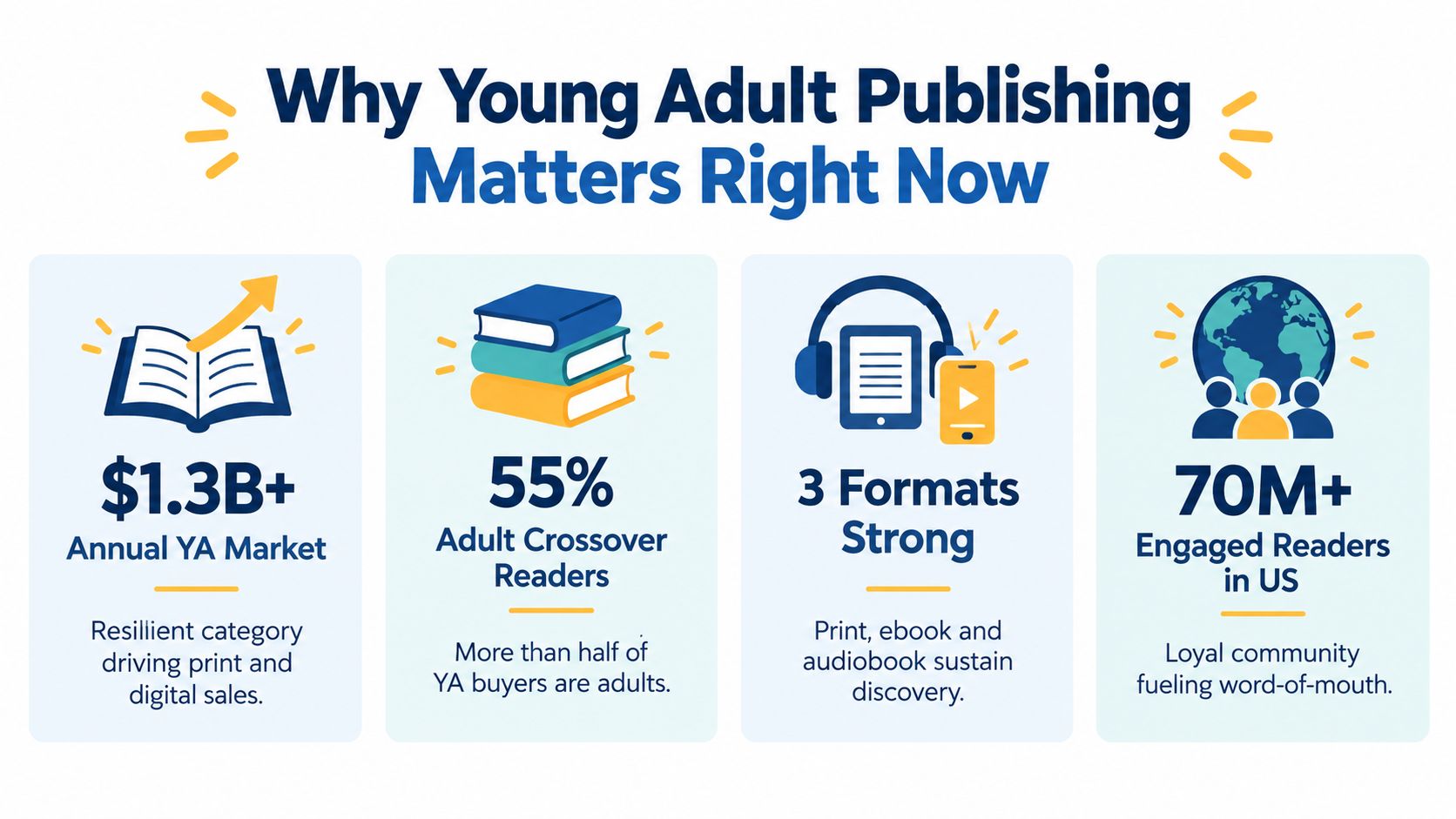
YA is a real business category
A YA manuscript is only the starting asset. The commercial version of that book may need to work as a hardcover, e-book, audiobook, foreign-rights package, collector edition, and a product that can be sampled, shared, and recommended on retail platforms long before a reader sees it in a store.
That shift changes how smart publishers evaluate a project. A strong premise still matters. So do voice and emotional accuracy. But marketability now includes thumbnail clarity, series potential, audio appeal, metadata precision, and whether the concept can travel outside one domestic print run.
The global young adult fiction market was valued at about $16.4 billion in 2025 and is projected to reach $28.9 billion by 2034, according to Dataintelo's young adult fiction market report. The same report says online retailers account for 47.3% of channel revenue compared with 29.4% for bookstores. That split should affect where authors and small presses put their early effort. Retail pages, retailer categories, comp positioning, and digital sampling often matter before store placement does.
Format planning starts before launch
The old print-first workflow leaves money on the table.
The broader children-and-young-adult-books market reached $12.16 billion in 2025 and is forecast to grow to $13.81 billion by 2030, with Asia-Pacific as the largest region and North America the fastest-growing, according to The Business Research Company's market report. That report also points to audiobook growth and interactive formats as demand drivers.
For YA, that has practical consequences:
- Audio has to be considered early: First-person narration, dual POV, humor, and pacing all affect whether a book performs well in audio.
- Global reach is part of the business model: Books with clear emotional stakes and portable hooks are easier to pitch across territories.
- Digital discovery is not extra marketing: It is part of product design. Covers, subtitles, series naming, and opening pages need to convert on phones and retailer screens.
I see writers miss this point all the time. They prepare a clean manuscript, then treat audio, foreign rights, and digital merchandising as add-ons. By then, the easy decisions are gone and the expensive fixes begin.
Concentration risk is real
YA has scale, but it also has concentration risk. A category can look healthy from the top while the middle tightens.
Industry coverage cited in Alibaba's market analysis of bestselling YA books noted that in 1H 2025, YA unit sales were nearly flat overall, but excluding Suzanne Collins' Hunger Games prequel, YA sales were down 10%. That is the sort of number publishers pay attention to, because it shows how easily one franchise can mask softer demand elsewhere.
For authors, the trade-off is clear. Chasing the current blockbuster rarely works. Building a book that can be found in multiple formats, sold in multiple territories, and discovered without a front-table push gives you a stronger base. In YA, the safer strategy is not betting everything on one format, one retailer, or one breakout week.
Preparing Your YA Manuscript for Today's Readers
A YA manuscript succeeds because the reader trusts the voice fast. Not because the prose is trendy, not because the chapter titles are clever, and not because the author tried to reverse-engineer whatever sold last season.
The modern category has history behind it. An Oxford University Press chapter on the history of young adult literature traces four broad eras and identifies 1967, when The Outsiders was published by Viking Press, as a defining landmark for contemporary YA fiction. That same chapter notes that diversity in YA publishing rose sharply after 2014, reached 28% in 2016, and later hit 31%, described as the highest level on record since 1994. If your manuscript feels disconnected from the breadth of contemporary YA life, readers will feel that gap.

Get the age perspective right
YA readers forgive a lot. They won't forgive a false note in perspective.
A reliable revision pass asks simple questions:
- Who owns the emotional center: If every insight sounds fully processed and adult, the voice is drifting out of category.
- What does the character want right now: YA momentum depends on immediate stakes, not only reflective depth.
- Does the language talk down to the reader: Teen readers spot condescension immediately. Adult crossover readers do too.
- Has the protagonist aged out: If the character's life stage, power, and concerns read fully adult, the book may belong elsewhere.
One of the easiest ways to sharpen this is to test scenes for reaction speed. YA usually benefits when emotion, action, and consequence arrive close together.
Revise for inclusion and specificity
Inclusion isn't a box to tick at the end. It's a craft issue. Characters need social context, cultural texture, and believable interiority. If those elements are thin, the book feels generic even when the plot works.
Use outside readers with purpose:
- Teen beta readers for pace, credibility, and boredom points.
- Adult crossover readers for emotional clarity and broader market pull.
- Sensitivity readers or subject-aware editors when the book draws from lived experiences outside your own.
A lot of characterization problems show up when writers describe a cast rather than dramatize them. If you need a useful refresher on that distinction, BarkerBooks has a solid piece on questions about characterization.
Your protagonist doesn't need to be likable on page one. They do need to be legible. Readers must understand why this person is acting, resisting, wanting, or hiding.
Common YA manuscript mistakes
I see the same misfires repeatedly, and most are fixable in revision.
| Problem | What it looks like | Better move |
|---|---|---|
| Overexplaining feelings | Long internal monologues after every scene | Let action carry part of the emotion |
| Trend chasing | Plot built around a market fad rather than a core conflict | Strengthen the character problem first |
| Flattened supporting cast | Friends exist only to serve the lead | Give each major side character a private agenda |
| Inconsistent register | Teen characters speak like polished adults | Tighten diction and reaction timing |
The books that travel tend to feel current without sounding fabricated. That usually comes from clean stakes, lived-in voice, and restraint. Not from trying to sound young.
Choosing Your Path Between Traditional and Self Publishing
Most writers ask the wrong first question. They ask, “Which path is better?” The useful question is, “Which path fits the book I wrote, the timeline I can tolerate, and the level of control I want?”
Traditional publishing gives you gatekeeping, distribution relationships, and in-house support if the book is acquired. Self-publishing gives you speed, control, and the ability to shape the whole package. Both routes can work in YA. Both can also go badly if chosen for the wrong reasons.
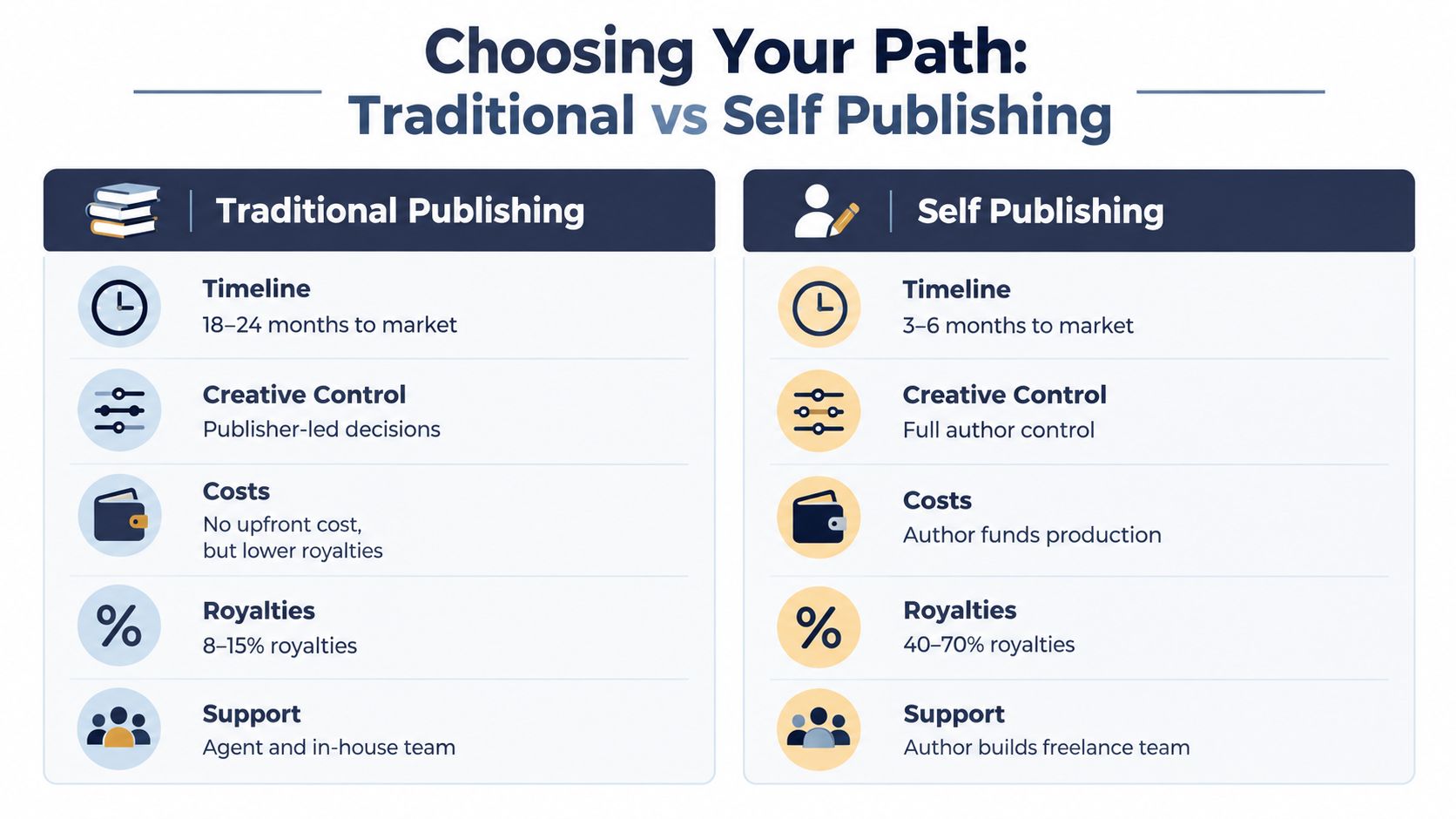
Traditional publishing works best when
Traditional is usually the stronger route if you want editorial validation from the market, if your manuscript has strong agent potential, or if your book may benefit from rights sales and institutional reach later.
Choose that path when these points sound right:
- You want a team selecting the package: Cover, positioning, and release timing won't rest entirely on your shoulders.
- You can tolerate waiting: Querying, agenting, submission, acquisition, editing, and scheduling all take time.
- You're writing for long-term career placement: Some authors want bookstore access, trade reviews, and rights management more than immediate speed.
This short breakdown helps if you're weighing those trade-offs in detail: traditional vs self-publishing.
Self-publishing works best when
Self-publishing is the better fit when you already understand your reader, care about packaging decisions, and don't want to spend years waiting for external approval. It also suits books with strong niche hooks, rapid release potential, or direct audience access through social and email.
What matters most is whether you'll publish professionally. Self-publishing fails when authors treat it as shortcut publishing.
| Decision factor | Traditional route | Self-publishing route |
|---|---|---|
| Control | Shared with publisher | Held by author |
| Speed | Slower | Faster |
| Upfront responsibility | Lower | Higher |
| Team building | Publisher-led | Author-led |
| Flexibility after launch | More limited | Easier to revise and relaunch |
This video gives a quick visual comparison before you commit to either model.
A practical decision test
If you're still stuck, use this three-part filter.
- Choose traditional if your patience is high, your manuscript is highly polished, and you want outside market endorsement before launch.
- Choose self-publishing if your urgency is high, your entrepreneurial tolerance is high, and you're willing to pay for editing, design, and marketing support.
- Choose a managed service model if you want self-publishing control but don't want to coordinate every freelancer yourself.
That last category is where full-service publishing partners come in. Some authors hire individual editors, designers, and formatters separately. Others use integrated providers. BarkerBooks, for example, offers editing, design, formatting, retailer uploading, and launch support as one workflow, which can simplify production for authors who don't want to assemble a team from scratch.
Editing Design and Legal Setup That Makes Your Book Retail Ready
A YA book becomes publishable in layers. The first layer is story. The second is sentence quality. The third is packaging. The fourth is compliance. If any layer is weak, the book may still go live, but it won't feel retail-ready.
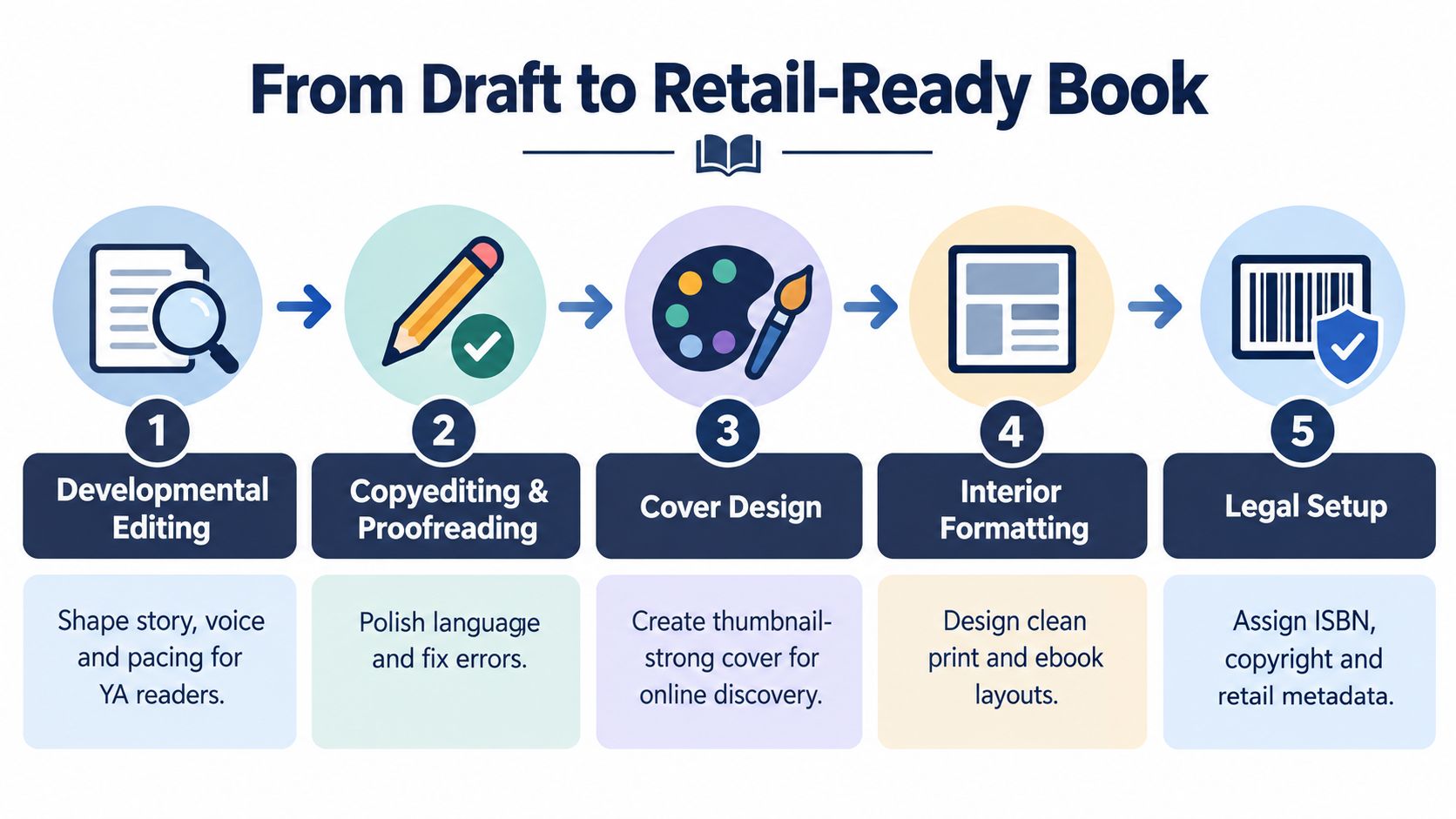
Edit in the right order
A lot of money gets wasted when authors pay for polishing before the structure is stable.
Use this sequence:
Developmental editing
Fix premise execution, pacing, scene order, character arcs, and category fit.Copyediting
Clean grammar, repetition, awkward syntax, continuity slips, and line-level clarity.Proofreading
Catch the last errors after layout, not before.
If you reverse that order, the clean sentences often get rewritten anyway.
Editorial reality: Proofreading can't rescue a drifting point of view, weak midpoint, or mismatched age category.
Design for digital storefronts first
YA covers don't just sit on bookstore tables now. They compete as tiny rectangles on retail screens.
That changes the brief. Your cover needs clear typography, strong focal hierarchy, and instant genre signaling at thumbnail size. A beautiful cover that blurs on a phone is underperforming before launch day.
Interior design matters too, but for different reasons. Print layout needs readable margins, stable chapter styling, and front matter that doesn't feel improvised. E-book formatting needs clean navigation, consistent scene breaks, and device-friendly styling. If you're creating promo assets to support launch, tools like customizable book templates can help you mock up social visuals, presentation images, and marketing materials without reinventing every asset by hand.
Handle the legal and retail basics cleanly
This part is less glamorous, but it prevents avoidable friction later.
- ISBN assignment: Make sure each edition is tracked correctly.
- Copyright registration: Protect ownership and simplify documentation.
- Metadata preparation: Finalize title, subtitle, BISAC-style categories, keywords, description, contributor names, and series data before upload.
- Final file checks: Confirm print PDF, EPUB, cover spread, and back-cover barcode area are ready before distribution starts.
A simple pre-upload checklist helps:
| Item | What to verify |
|---|---|
| Cover file | Spine width, trim size, readable title at small scale |
| Interior print file | Page numbers, headers, chapter opens, bleed where needed |
| EPUB | Clickable table of contents, clean paragraph styling, no broken scene breaks |
| Metadata | Consistent title, author name, series info, keywords |
| Rights and identifiers | ISBNs assigned, copyright details aligned |
Retailers can distribute a messy book. They won't fix it for you. Clean production still wins.
Distribution Marketing and Expanding Beyond Print
The launch mistake I see most often is treating distribution as a clerical step. It isn't. Distribution is part of positioning. Where the book appears, how it appears, and which formats are ready on day one all shape discoverability.
Recent industry coverage points to hybridization, audio-first habits, and serialized digital origins as important growth vectors for YA, with breakout projects increasingly emerging from web serials, comic platforms, and newsletter ecosystems rather than only from traditional manuscript pipelines, according to Alibaba's analysis of 2026 YA market trends. That aligns with what many authors are already seeing. Readers often find the story world before they buy the finished book.
Build the launch around discoverability
Start with retail pages. On Amazon Kindle, Apple Books, Barnes & Noble, and Google Books, the sales page does the work your pitch once did.
That means you need:
- A sharp product description: Not a synopsis dump. A conversion asset.
- Keyword-aware metadata: Terms readers use when browsing.
- A category strategy: Broad enough to gather traffic, narrow enough to signal fit.
- Strong sample pages: If the opening pages sag, ads and social can't save the conversion.
If you need a practical framework for improving how your book appears in search-driven retail environments, this guide to book search engine optimization is worth reviewing before launch.
Expand formats before demand forces you to
Too many YA books add audio late, foreign-language editions later, and interactive or serialized extensions never. That usually leaves sales on the table.
Think in launch waves instead.
Wave one is your core retail edition set, usually e-book and print.
Wave two is audiobook, especially if the story relies on voice, banter, dual POV, or emotional performance.
Wave three is regional adaptation, multilingual packaging, and adjacent content like bonus scenes, serialized prequels, or newsletter exclusives.
If your YA concept has fandom potential, don't ask only whether the book is good. Ask whether the world can travel across formats.
Marketing that fits YA behavior
YA discovery often starts socially, but sales still need owned channels. Social platforms can spark interest. Your website and email list help you keep it.
One overlooked problem is inbox placement. If your preorder campaign emails don't land, your launch sequence weakens fast. A practical primer on this is Mailadept's email deliverability guide, which explains why list hygiene, sender reputation, and engagement patterns matter before you scale campaigns.
A durable YA marketing stack usually includes:
- An author landing page with series hooks, retailer buttons, and reader magnet signup.
- Short-form social content that foregrounds tropes, emotional stakes, aesthetics, or character dynamics.
- Reader capture through newsletter incentives, ARC signups, or bonus content.
- Targeted ads only after the product page and cover are already converting.
The old fantasy of “get into bookstores and the rest follows” is thinner now than many debut authors think. Online merchandising and cross-format readiness usually do more practical work.
Your Actionable Timeline Costs and Final Checklist
Titles that hit with teen readers rarely arrive by accident. The clean launches I see follow a calendar, a budget, and a format plan early enough to prevent expensive rework.
For YA, that matters because the book is not only a print object. It is also a retailer page, a thumbnail, a sample, an audiobook candidate, a social hook, and sometimes the first asset in a series world. If any one of those pieces is late or weak, release week gets harder.
A workable production sequence
Phase one is manuscript stabilization. Finish the revision that changes structure, pacing, and character logic. Do not send a manuscript to copyediting while you are still cutting chapters or rewriting the ending.
Phase two is package creation. Cover, interior formatting, metadata, back-cover copy, retailer description, comp positioning, and series labeling belong here. For YA in particular, I want the cover and sales copy tested at thumbnail size before anyone approves final files.
Phase three is legal and distribution setup. ISBNs, copyright paperwork, edition planning, vendor accounts, territory settings, and final file checks happen before upload week. If you plan to sell ebook, paperback, hardcover, and audio, decide who controls each format and each revenue stream now, not after launch.
Phase four is prelaunch marketing. Build the landing page, recruit ARC readers, prep email and social assets, confirm preorder links, and create short excerpts that can travel across TikTok, Reels, Shorts, and retailer samples. Good YA campaigns usually have one clear hook sentence, three visual assets, and one reader capture path.
Phase five is post-launch expansion. Review what converted, then decide whether to fund audio, special edition print, foreign rights outreach, bonus scenes, or paid ads. Expansion works best when it follows proof of demand, not wishful planning.
Where authors usually slip
The delays usually come from late decisions.
- Changing the book after copyediting: You pay twice, once for the original edit and again for cleanup.
- Settling for a weak cover: YA readers click covers before they read your blurb.
- Waiting until upload week to finalize metadata: Categories, keywords, age band, and series data affect discovery from day one.
- Treating audio or international rights as a future problem: If your contracts, files, or budget ignore those formats early, expansion gets slower and more expensive later.
A common trade-off shows up here. Fast release schedules help you capitalize on momentum, especially in trope-driven YA. Slower schedules usually produce better packaging, cleaner metadata, and a stronger preorder runway. The right choice depends on whether you are publishing into an existing audience or trying to build one from zero.
Final prelaunch checklist
Use this before release:
| Checkpoint | Done when |
|---|---|
| Manuscript | Voice, pacing, age-category fit, and ending are locked |
| Editorial | Developmental, copyedit, and proofread passes are complete |
| Cover | Full-size and thumbnail versions read clearly in the right subgenre |
| Interior files | Print and EPUB files pass device and print proof checks |
| Metadata | Description, keywords, BISAC or store categories, age range, and series info are final |
| Legal setup | ISBN, copyright, contributor credits, and rights ownership are confirmed |
| Retail pages | Price, trim, formats, preview, and retailer links are correct |
| Launch assets | Email copy, social posts, graphics, ARC follow-up, and preorder messaging are ready |
| Format plan | Audio, large print, special edition, or translation priorities are ranked |
| Reporting | You know who will track sales, ad spend, email performance, and review intake in the first 30 days |
For costs, ask for line items, not a vague project total. Editing, cover design, formatting, audiobook production, ad management, and translation belong in separate quotes. Ask what files are included, how many revision rounds you get, what rights you keep, and whether the vendor is delivering source files or only finished exports. That is how you compare offers without getting trapped by a low headline price.
One practical 30-day pre-launch assignment closes more gaps than a generic pep talk. Create a release sheet and assign an owner to every moving part: final EPUB upload, print proof approval, ARC follow-up, retailer page check, launch email draft, three short-form videos, and audio rights decision. The deliverable is simple. One shared document with due dates, asset links, passwords, and format status for ebook, print, and any expansion format you intend to pursue next.
If you want help turning a YA manuscript into a retail-ready book, BarkerBooks offers editorial support, cover and interior design, distribution setup, copyright and ISBN services, and launch assistance in one workflow. For authors who want professional execution without managing every moving part alone, it is a practical place to start.