
Think of your narrative voice as the soul of your story. It’s the unique personality that leaps off the page, the distinct sensibility that colors every word, sentence, and scene. It’s not just what happens in your story, but how it feels to be told that story.
Understanding Narrative Voice: The Soul of Your Story
Imagine your best friend telling you about a wild vacation. It’s not just the list of events that makes the story great, right? It’s their way of telling it—the breathless excitement when describing a beautiful view, the sarcastic humor about a travel mishap, and the specific, quirky details they choose to focus on.
That’s their voice.
In writing, narrative voice does the same thing. It’s the invisible character guiding the reader from start to finish. A strong voice is what makes the same plot, told by two different authors, feel like two completely different books.
Distinguishing Voice from Other Literary Concepts
It's easy for new writers to get narrative voice tangled up with similar ideas like narrator, point of view (POV), tone, and style. They're all related and work together, but they aren't the same thing. Getting a handle on the differences is a huge step toward mastering your craft.
Let's quickly untangle them:
- Narrator: This is the who. It’s the specific character or entity telling the story. Think of the narrator as the vessel that carries the voice.
- Point of View (POV): This is the camera angle. It’s the technical perspective you use—first-person ("I"), third-person limited ("he/she"), etc.
- Tone: This is the attitude. It’s how the narrator feels about what’s happening, whether they’re being cynical, nostalgic, terrified, or joyful.
- Style: This is the mechanics. It's about your sentence structure, word choice (diction), and pacing.
And finally, the Narrative Voice is the big one—it's the overarching personality that blends the narrator, POV, tone, and style into a single, cohesive whole.
This concept map shows how voice is the central hub, connecting all these other elements to create a unified reader experience.
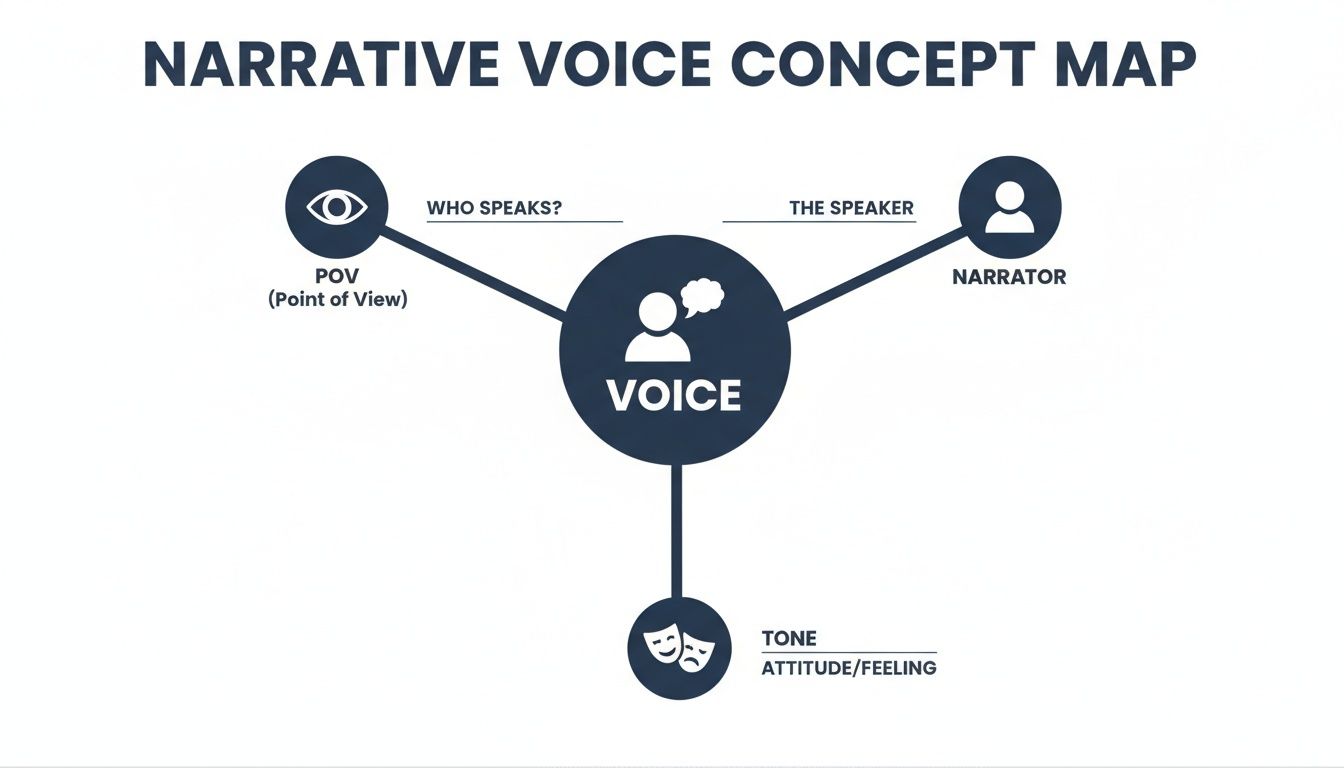
As you can see, voice isn’t just one thing. It’s the end result of several other literary tools working in harmony.
To really nail down the differences, a simple comparison can help.
Narrative Voice vs. Related Literary Concepts
This table puts everything side-by-side to clarify how each concept functions within a story.
| Concept | What It Is | Simple Analogy |
|---|---|---|
| Narrative Voice | The unique personality and perspective telling the story. | The friend telling the story. |
| Narrator | The specific person or entity speaking. | The identity of that friend (e.g., John). |
| Point of View | The camera angle (e.g., first or third person). | Is John telling his own story ("I") or are you watching him ("he")? |
| Tone | The attitude or emotion about the subject. | John’s mood (excited, angry, sad). |
| Style | The way words and sentences are put together. | John's speech patterns (fast, slow, formal, slang-filled). |
These concepts are the essential building blocks of all fiction. To see how they fit into the larger structure of a novel, you can explore more about the https://barkerbooks.com/what-are-the-literary-elements/ that shape every story you read.
A powerful, consistent voice is what grabs a reader and refuses to let go. It builds intimacy, creates trust, and makes your fictional world feel completely real. To dig deeper into the "how-to," exploring various 10 Narrative Writing Techniques can give you practical tools to bring your own unique voice to life. It’s a skill worth honing for any writer who wants to connect with readers on a deeper level.
Connecting Directly with First-Person Narrative
When you want to drop your reader directly into a character's head, nothing beats the first-person narrative. Using pronouns like "I," "me," and "my," this perspective closes the distance between the story and the reader, creating an unfiltered connection to the narrator's innermost thoughts and feelings.

Think of it like reading someone's private diary or listening to a close friend tell you a secret. This deep intimacy is the first-person voice's superpower. It forges a powerful bond, making every triumph feel personal and every heartbreak hit with real force. You’re not just watching the story unfold; you’re experiencing it through the character’s eyes.
The Power of Intimacy and Immediacy
This direct line to a character's consciousness is an incredibly effective tool for writers. It’s no wonder that genres like Young Adult (YA) fiction, taut thrillers, and revealing memoirs so often lean on this perspective.
- In YA novels, a first-person voice captures the raw, confusing, and intense emotions of adolescence with an authenticity that truly connects with its audience.
- For thrillers, being trapped inside the protagonist's mind cranks up the suspense. The reader only knows what the character knows, turning every unexpected sound into a potential threat.
- In memoirs, this voice is non-negotiable. It provides the personal testimony and reflection that gives the entire genre its power and credibility.
The real magic here is how a first-person voice pulls the reader so close that the story feels like their own. This style exploded in popularity during the 20th century, with a landmark example being J.D. Salinger's The Catcher in the Rye. First published in 1951, it sold over 65 million copies worldwide by 2023, largely because readers connected so deeply with Holden Caulfield's raw, authentic voice. A compelling voice is critical—a 2023 survey found that nearly 60% of audiobook listeners have stopped a book just because they disliked the narrator. You can dig into more audiobook listener preferences from the full survey.
A classic example is Holden Caulfield from The Catcher in the Rye. His cynical, wandering, and deeply personal voice isn't just telling a story; it is the story. Readers connect not just with the events but with the very soul of the character narrating them.
Understanding the Inherent Limitations
Of course, the greatest strength of the first-person perspective is also its biggest weakness. Because the entire story is filtered through a single character's mind, the reader’s view is naturally restricted and biased.
This brings a few realities to your narrative:
- Limited Knowledge: Your reader can only know what your narrator knows. You can’t show a scene happening across town unless your character finds out about it. What they see is what the reader gets.
- Subjective Reality: The narrator’s opinions, prejudices, and moods will color every single description. If your narrator can't stand another character, the reader is going to be swayed to feel the same, at least at first.
- The Unreliable Narrator: This limitation can be cleverly twisted into a powerful literary device. A narrator who misunderstands events or even deliberately lies to the reader adds a compelling layer of mystery and psychological tension.
Choosing a first-person voice means you're making a trade-off. You sacrifice the broad, objective view of your world for a deep, personal, and emotionally charged journey. But when you get it right, this perspective doesn’t just tell a story—it invites the reader to live it.
Unlocking the Power of the Third-Person Perspective
While a first-person narrator throws the reader headfirst into a single character's mind, the third-person perspective gives you incredible range as a writer. Using pronouns like "he," "she," and "they," this narrative voice works like a camera. You get to decide exactly how close to the action you want to be. You can zoom in for an intimate, over-the-shoulder view or pull back to paint a sprawling, panoramic picture of your world.

This flexibility is why third-person is the most common voice in fiction, but it's not a one-size-fits-all approach. It breaks down into two powerful forms that achieve very different storytelling goals: limited and omniscient. Nailing the difference is the key to controlling your narrative and giving your story the exact feel it needs.
Third-Person Limited: The Intimate Observer
Third-person limited is, without a doubt, the reigning champion of modern fiction. It sticks close to a single character, giving the reader a front-row seat to their thoughts, feelings, and perceptions. The catch? The inner lives of all the other characters are off-limits, which creates a fantastic blend of intimacy and suspense.
Think of it like being tethered to one character. We see only what they see and know only what they know. This forges a strong emotional bond, much like first-person, but it gives you the creative freedom to describe your protagonist from an outside view.
This perspective is a powerhouse for:
- Building Mystery: Since we're in the dark about everyone else's motives, secrets and twists can unfold naturally, creating page-turning tension.
- Deepening Empathy: By living inside one character's head, readers really get their struggles and desires. It builds a powerful connection.
- Maintaining Focus: The story stays tightly focused on one person's arc, which is perfect for character-driven plots.
Ever felt like a fly on the wall during a tense conversation? That’s the magic of third-person limited. It’s been a literary staple since Jane Austen's Pride and Prejudice in 1813, which has since sold over 20 million copies and shaped entire genres. It’s the engine behind countless bestsellers today, especially in genres that thrive on tension. For instance, romance audiobook sales recently jumped 30% year-over-year—a genre that leans heavily on third-person limited to build that delicious will-they-won't-they suspense. You can explore more recent publishing trends on BookBaby.com.
Third-Person Omniscient: The All-Knowing God
If third-person limited is a spotlight following a single actor, then third-person omniscient is the set of floodlights bathing the entire stage in light. The word "omniscient" literally means "all-knowing," and that’s exactly what this narrator is. It can go anywhere, see anything, and dip into the thoughts and feelings of any character at any time.
This god-like perspective is perfect for epic stories with sprawling plots and a huge cast of characters. It gives the writer the ultimate freedom to guide the reader, offering insights and connecting dots that no single character could see on their own.
Literary Example: War and Peace by Leo Tolstoy
Tolstoy’s monumental novel is the gold standard for third-person omniscient narration. The voice moves effortlessly from the strategic mind of Napoleon on the battlefield to the private anxieties of a young debutante at her first ball, weaving an incredibly rich tapestry of Russian society during a time of immense upheaval.
This voice is incredibly powerful, but it takes a skilled hand to pull it off. The biggest pitfall is "head-hopping"—jumping between characters' minds so often that you leave the reader feeling dizzy and disconnected. But when done right, it delivers a rich, layered experience that no other perspective can touch.
Deciding between these two forms of third-person is a foundational choice. Do you want the focused, emotional journey of a limited perspective, or the grand, sweeping scope of an omniscient one? Your answer will fundamentally shape how your readers experience the story you've worked so hard to create.
Time to Bend the Rules: Exploring Unconventional Narrative Voices
Once you have a firm grip on the basics of first-person and third-person, you can start having some real fun. Unconventional narrative voices are the secret weapons in a writer's toolkit—they can take a solid story and turn it into something a reader will never forget.
These advanced techniques definitely require a bit of confidence to pull off, but the creative payoff is huge. Choosing a unique voice is your chance to build suspense, play with reader expectations, and write a story that genuinely feels different.
Let's look at a few of the most powerful and fascinating options out there.
The Unreliable Narrator
Ah, the unreliable narrator. This is a true masterstroke of storytelling. You're using a first-person narrator who, for whatever reason, the reader simply can't trust. Maybe their memory is shot, maybe they're biased, mentally unstable, or maybe they're just a flat-out liar.
This sets up a brilliant game between you and the reader. They have to become a detective, constantly trying to piece together the truth from a narrative that's intentionally warped. The tension isn't just in the plot anymore; it’s in the very act of reading.
Modern Example: Gone Girl by Gillian Flynn
Flynn’s thriller is a masterclass in this technique, using two unreliable narrators. Both Nick and Amy present their sides of the story, but their accounts are so riddled with manipulation and deceit that you're constantly shifting your allegiance. It creates this profound sense of distrust that fuels the entire book.
The Collective First-Person Voice
This one is less common, but when it's done well, it's absolutely haunting. The collective first-person voice uses "we" instead of "I," speaking for an entire community—a town, a family, even a generation. It weaves a tapestry of individual experiences into one unified perspective.
It’s an incredible choice for stories about shared trauma, group identity, or the inner workings of a tight-knit community. The "we" narrator feels both deeply personal and strangely epic, like a ghost chorus telling a story that belongs to everyone at once.
Jeffrey Eugenides’ The Virgin Suicides is the classic example here. The story is narrated by a group of neighborhood boys, looking back years later on the mysterious Lisbon sisters. Their collective obsession and patchy memories form the very soul of the novel.
The Immersive Second-Person Voice
Using the second-person voice is probably the boldest move a writer can make. By addressing the reader as "you," you're not just telling them a story; you're putting them directly into it. The wall between the reader and the protagonist completely dissolves.
It's tough to maintain for a whole novel, but for short stories or specific, high-impact scenes, it creates an unparalleled sense of immediacy and even complicity.
You've probably seen this voice in:
- Interactive Fiction: The classic "Choose Your Own Adventure" series is built entirely on the "you" perspective, giving the reader agency.
- Literary Fiction: N. K. Jemisin’s The Fifth Season masterfully deploys second-person sections to forge an intense, confrontational bond with the reader, making the emotional stakes feel incredibly personal.
These voices aren't just gimmicks; they fundamentally change how a reader experiences your story. Don't be afraid to experiment. Interestingly, we're even seeing a comeback of the classic omniscient voice, popular in 19th-century literature. Think of Leo Tolstoy's War and Peace (1869), which has sold over 36 million copies and needed an all-knowing narrator to handle its sprawling cast. The modern audiobook boom seems to be giving this voice a new lease on life. Between 2010 and 2020, the number of new audiobook titles exploded by 1083%, and many sci-fi and YA epics are using omniscient narrators to build out their vast worlds. You can find more fascinating book and reading statistics on TonerBuzz.com.
How to Discover Your Unique Narrative Voice
Finding your narrative voice isn't about inventing something from thin air. It's more like an archaeological dig into your own creativity. You're simply dusting off the layers to uncover the authentic sound that is uniquely yours. This isn't a process of force; it’s one of focused, hands-on exploration.

The real work begins when you move past abstract ideas and start putting pen to paper. The goal here is to build a kind of muscle memory, trying on different voices until one clicks and fits your story perfectly. Think of it as an active, engaging part of the writing journey that truly breathes life into your world.
Start with Practical Writing Exercises
You can theorize all day, but true discovery happens on the page. Targeted writing exercises are your best friend here, as they're designed to push you out of your comfort zone and reveal new facets of your writing personality.
Here are a few practical exercises to get you started:
-
Rewrite a Single Scene: Pick a simple scenario—someone making breakfast, waiting for a bus—and write it from three wildly different perspectives. First, as a cynical detective. Then, as an anxious teenager. Finally, as a cheerful retiree. Notice how the word choice, sentence rhythm, and what the narrator focuses on completely transform with each voice.
-
Character Journaling: Spend 15 minutes a day free-writing a journal entry from your main character’s point of view. Forget the plot. Just have them react to a small, everyday event. This is an incredible tool for tapping into their internal rhythm and unique way of seeing the world.
-
Dialogue Transcription: Go hang out in a coffee shop and just listen. Jot down snippets of real conversations, paying attention to all the "ums," interruptions, and half-finished sentences. Real speech is wonderfully messy, and absorbing these patterns will make your own dialogue feel far more authentic.
As you explore these different voices, remember that a strong command of the craft is what allows that voice to shine. To build a solid foundation, it's always helpful to find new strategies to improve your overall writing ability.
Read Widely and Actively
For a writer, reading is never a passive activity. It’s active research. If you want to develop your own distinct voice, you have to immerse yourself in the voices of others. And don't just stick to your favorite genre; read everything you can get your hands on.
Read poetry to master rhythm and conciseness. Read literary fiction to see how authors build complex character voices. Read thrillers to understand pacing and tension. As you read, keep a notebook handy. Analyze how the author achieves their effect. Ask yourself: What specific word choices stand out? Are the sentences long and flowing or short and punchy? What’s the narrator’s attitude?
The Takeaway: Your narrative voice is a blend of your natural instincts and your conscious craft. It’s the sum of your vocabulary, your worldview, and the specific technical choices you make to tell a story that connects. It’s what makes your writing sound like you.
This kind of analytical reading turns every book into a masterclass. Seeing what makes another writer’s voice tick is a crucial step in understanding what voice in writing truly means for your own work.
Your Narrative Voice Development Checklist
To make this process more concrete, a simple checklist can help guide your practice. This table breaks down a few key techniques, clarifies their purpose, and gives you a self-reflection question to make sure you're heading in the right direction. It's a clear roadmap for honing your unique sound.
| Technique or Exercise | Primary Objective | Self-Assessment Question |
|---|---|---|
| Perspective Rewrites | To explore how POV and personality alter word choice and focus. | Does this scene feel fundamentally different when told by another character? |
| Character Journaling | To discover a character’s internal thoughts and natural speech patterns. | What unique phrases or observations has my character revealed? |
| Active Reading | To deconstruct how other authors successfully create a distinct voice. | What specific techniques can I identify and potentially adapt from this author? |
| Read Aloud | To catch awkward phrasing and unnatural dialogue you might miss on the page. | Does this sound like something a real person would actually say? |
Ultimately, finding your narrative voice is a journey of discovery, not a one-and-done task. By consistently putting these practices into play, you’ll cultivate a voice that is authentic, consistent, and powerful enough to hook readers from the very first page.
Editing and Refining Your Narrative Voice
Finding your narrative voice is a huge first step, but the real magic happens in the editing room. This is where you take a promising voice and sharpen it into a powerful tool that truly connects with readers. It’s all about spotting the common pitfalls that can weaken your writing and then carefully refining your prose until it sings.
The editing process isn't about massive, earth-shattering changes. Instead, think of it as a series of small, deliberate adjustments that make your voice consistent, active, and authentic from the first page to the last.
Tackling Common Voice Pitfalls
Even seasoned writers can stumble into traps that water down their narrative voice. One of the biggest issues is accidentally sacrificing a close, consistent perspective while trying to follow other writing advice, like the classic "show, don't tell." This can create a weird, unintentional distance between the reader and the character. For a deeper dive on this, check out our guide on how to show not tell in writing.
Another problem that crops up all the time is a passive tone, which just sucks the energy right out of your scenes. Keep an eye out for sentences where the subject is just sitting there having things happen to it, instead of actually doing something.
Before (Passive Voice): The decision was made by the council.
After (Active Voice): The council made the decision.
See? That small change immediately makes the sentence more direct and gives the narrative voice a sense of agency.
Finally, watch out for generic dialogue. If all your characters sound the same, you're flattening out your story's personality. Every character needs a unique verbal fingerprint that reflects who they are—their background, their mood, and what they want.
Practical Tips for Polishing Your Voice
Refining your voice requires a hands-on approach. The goal here is to train your ear to recognize awkward phrasing, inconsistencies, and any moment where the voice just doesn't feel right.
Here are a few actionable techniques to work into your revision process:
- Read Your Manuscript Aloud: This is absolutely non-negotiable. Your ears will catch clunky sentences and unnatural dialogue that your eyes just glide right over. If you stumble while reading a line out loud, it's a sure sign it needs a rewrite.
- Create a Voice "Cheat Sheet": For your main character, jot down a few key descriptors of their voice. Is it sarcastic? Poetic? Blunt? Keep this little list next to you as you edit to make sure their voice stays consistent from start to finish.
- Search and Destroy Filter Words: Words like "saw," "heard," "felt," and "realized" can sneak in and create distance. Cutting them often drops the reader directly into the character's experience, making it much more immediate.
Example of Removing Filter Words:
Before: She saw the storm clouds gathering on the horizon and felt a sense of dread.
After: Storm clouds gathered on the horizon, sparking a familiar dread.
This revision process isn't just about fixing mistakes; it's about elevating your craft. By meticulously polishing your narrative, you ensure your unique voice resonates powerfully with every reader, turning a good story into an unforgettable one.
Answering Your Questions About Narrative Voice
Getting the theory is one thing, but putting it into practice is where the real questions pop up. Let's tackle a few of the most common hurdles writers face when trying to master narrative voice.
Can You Switch Narrative Voice Mid-Story?
Absolutely, but you have to be deliberate about it. Think of it like passing a baton in a relay race—it needs to be a clean, intentional handoff.
Plenty of successful novels bounce between different characters' perspectives. The trick is to give each voice its own space, usually a dedicated chapter or a clearly marked section break. Jumping between heads in the middle of a single scene is a surefire way to give your reader whiplash and pull them right out of the story.
If you're going to switch, make sure it has a purpose. Does it reveal a crucial piece of information? Does it build tension by showing a different side of the action? A new chapter or a section break acts as a signpost, telling the reader, "Okay, new perspective coming up!"
How Is Narrative Voice Different from Authorial Style?
This is a great question, and it's easy to get them tangled up.
Here’s a simple way to think about it: Authorial style is the DNA of a writer's work. It's their unique fingerprint—the rhythm of their sentences, their go-to vocabulary, the way they structure their ideas. You can spot an Ernest Hemingway or a Jane Austen sentence from a mile away, regardless of the story, because their style is so distinct.
Narrative voice, on the other hand, is the specific personality chosen for a single story. A masterful writer can wear many different hats. In one book, they might adopt the voice of a jaded, world-weary detective; in the next, they could write from the perspective of a naive, hopeful teenager. Their personal style might still peek through, but the voice is tailored to that specific character and that specific narrative.
Think of it this way: Voice is the costume a character wears for one story. Style is the author’s natural accent you can hear no matter what costume they put on.
How Do I Write an Authentic Voice for a Character Who Isn't Me?
This is where empathy and a bit of detective work come into play. You can't just invent a voice out of thin air; you have to truly get inside your character's head.
-
Go Beyond the Basics: Don't just figure out their hair color and favorite food. What are their deepest-held beliefs? What keeps them up at night? What's their educational background, and how does that shape the words they choose?
-
Immerse Yourself in Their World: You have to do the homework. What kind of music would they listen to? What books would be on their nightstand? Watch movies or documentaries that reflect their life experiences.
-
Become a People-Watcher (and Listener): Pay close attention to how people with similar backgrounds or experiences to your character actually talk. Notice their cadences, their slang, their unique ways of looking at the world.
The goal isn't to create a stereotype. It's to build such a rich, deep understanding of their perspective that writing from their point of view feels less like acting and more like channeling.
Ready to transform your manuscript into a professionally published book? BarkerBooks offers comprehensive services from editing and design to global distribution. Discover how we can help you achieve your publishing dream.