
You've promised a book to your audience, a keynote to your team, or a memoir to your family. The idea is clear in your head, but the manuscript remains a blank document. A ghostwriter helps turn that knowledge, experience, or story into polished writing that appears under your name, through a structured process rather than a mysterious handoff.
What Ghostwriting Services Actually Are
Ghostwriting services are paid writing arrangements in which one writer creates the text while another person receives the public credit. The client supplies the ideas, experiences, expertise, interviews, or source material. The ghostwriter turns those raw materials into a finished manuscript, article, speech, script, or other publishable piece in the client's voice.
A first-time memoirist might share recorded conversations, old photographs, diaries, and memories. A CEO might provide internal presentations, customer insights, and a brief for a business book. The deliverable is not just “words on a page.” It may be a clean manuscript ready for editorial review, a keynote prepared for live delivery, or a series of articles written to sound like the executive who commissioned them.
Ghostwriting is not the same as editing
An editor usually starts with a draft that already exists. The editor may improve structure, clarity, pacing, grammar, or consistency, but the client remains the primary writer. A freelancer with a byline, meanwhile, creates content for a client but may be publicly identified as the author.
A ghostwriter creates original prose on the client's behalf and generally gives up public authorship. That requires more than strong grammar. The writer must listen closely, identify the client's vocabulary and rhythm, understand the intended audience, and make written passages feel consistent with the client's spoken personality.
The practice has deep roots in publishing and public communication. Historical accounts trace forms of unnamed writing back to royal scribes and hired speechwriters, while the modern commercial term became popular in the early 1900s. The history of ghostwriting shows why the service is better understood as an established professional function than as a modern shortcut.
Practical rule: You're not paying someone to hide a few sentences. You're commissioning a writing partner to translate your authority into a form readers can use.
Ghostwriting can also extend beyond books. A creator developing audio projects may need help shaping lyrics or concepts with stream music creation tools, while an executive may need speeches, newsletters, or articles. The format changes, but the central agreement stays the same: the client owns the public authorship, and the ghostwriter's contribution remains undisclosed or separately acknowledged.
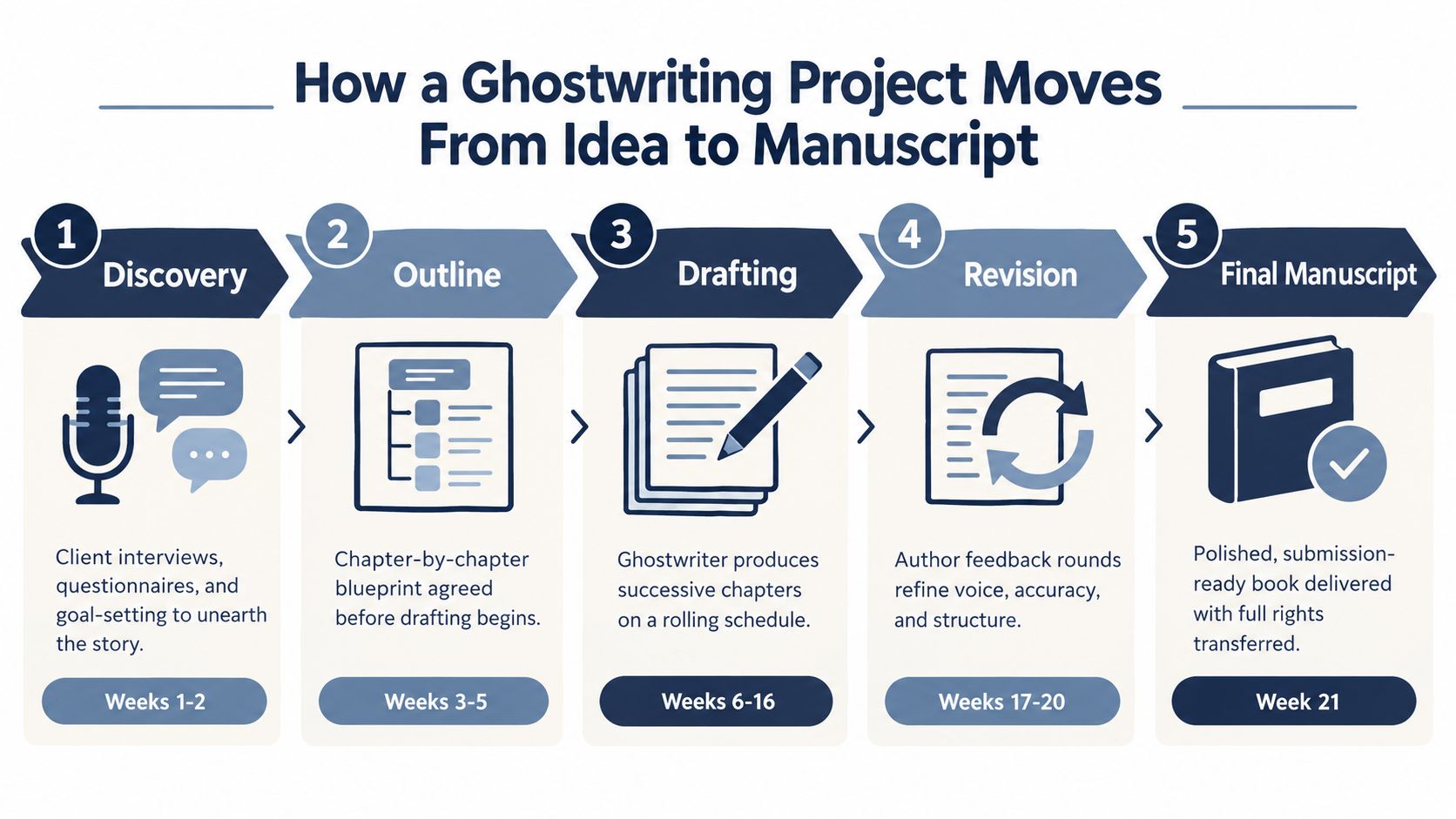
How a Ghostwriting Project Moves From Idea to Manuscript
Consider a founder with a strong business story but no book. She wants to explain how her company recovered from a difficult period and turn those lessons into a practical guide. A professional engagement usually begins long before the first chapter is drafted.
Discovery comes before prose
The ghostwriter starts with interviews, questionnaires, background documents, existing presentations, and examples of the client's natural communication. The writer may record conversations, review emails, and ask which authors or speakers sound appealing. This stage produces a working understanding of the story, the audience, the purpose of the book, and the client's voice.
The client should leave discovery with more than a vague feeling that the writer “gets it.” They should have agreed goals, source-material requirements, interview notes, and a clear description of the intended reader.
The outline prevents expensive confusion
Next, the writer turns the material into a chapter plan. For the founder's book, that might mean arranging the story chronologically, separating personal narrative from business lessons, and deciding where practical exercises belong.
The client reviews a chapter-by-chapter blueprint before substantial drafting begins. A signed-off table of contents gives both sides a reference point. It also makes structural changes cheaper than discovering halfway through the manuscript that the central argument is in the wrong place.
Drafting happens in controlled deliveries
The ghostwriter then produces chapters or sections on a rolling schedule. The client receives draft prose, comments on voice and accuracy, and corrects facts while the material is still fresh. This exchange is important because voice matching improves through specific feedback, not through a single questionnaire completed at the beginning.
Shorter projects compress the same workflow. An article or speech may move from interview to outline, draft, and revision within days, while a full book requires a longer collaboration because its structure and factual demands are greater.
Revision creates the final handoff
The last phase combines client feedback, structural refinement, fact-checking, copyediting, and formatting. The agreed deliverable might be a clean manuscript file, a script formatted for production, or a speech document with performance notes. A well-scoped project also states how many feedback rounds are included and what happens when requested changes expand the original brief.
The Ghostwriting Market and Why Demand Keeps Rising
Ghostwriting is now a formal global service category, although market estimates vary according to what each report includes. One estimate values the global ghostwriting market at $1.9 billion in 2022 and projects 8.1% CAGR from 2023 to 2030, while another estimates the worldwide ghostwriting services market at $817.8 million in 2025, rising to $1.52 billion by 2032 at a 9.3% CAGR. These figures come from different definitions and shouldn't be treated as interchangeable. The market estimates and project categories illustrate the size and breadth of the commercial category.
| Estimate | Range / Figure | What It Covers |
|---|---|---|
| Global ghostwriting market | $1.9 billion in 2022, with 8.1% projected CAGR from 2023 to 2030 | A broad market estimate for ghostwriting activity |
| Worldwide ghostwriting services market | $817.8 million in 2025, projected to reach $1.52 billion by 2032, with 9.3% projected CAGR | A narrower services-market definition |
| Project mix | Memoirs represented 35% of projects in 2023 | A category view of commissioned ghostwriting work |
| Client needs | Business and self-help books represented 28% of projects, while academic thesis and dissertation work represented 17% in 2022 | Evidence that demand extends beyond celebrity memoirs |
Demand concentrates where expertise exceeds available writing time. Public figures may have stories but need help shaping them. Executives may want a business book that supports speaking, consulting, or a company launch. Professionals may need continuing thought-leadership content but can't personally draft every article, newsletter, or speech.
The service has also expanded beyond text production. Recent coverage of ghostwriting services describes a broader workflow involving intake, editorial coordination, structured handoffs, revision scope, and platform-led ordering. Clients increasingly buy project management around the writing, not just isolated pages.
AI-assisted drafting has changed the workflow, but it hasn't removed the need for human ghostwriters. Generic tools can produce plausible language, yet they don't independently conduct a meaningful interview, distinguish a client's private hesitation from their public position, or take responsibility for a book's narrative architecture. Clients who care about credibility still pay for judgment, voice matching, confidentiality, and sustained collaboration.
Common Types of Ghostwriting and How They Differ
The same basic arrangement can produce very different working relationships. A book requires sustained narrative development. A keynote must sound natural when spoken aloud. A blog post may need fast research and search-aware structure. A script must obey production constraints that prose doesn't face.
| Format | Typical Length | Process & Turnaround | Best For |
|---|---|---|---|
| Full-length book | A complete manuscript, with scope agreed during discovery | Interviews, research, outline, chapter drafting, feedback, and final revisions over an extended engagement | First-time authors, executives, public figures, and established authors |
| Articles and blog posts | Individual pieces or an ongoing series | Brief, interview or source review, draft, editorial feedback, and quick delivery | Professionals building thought leadership and businesses publishing regularly |
| Speeches and keynotes | A performance-ready speech | Audience research, speaker interview, argument structure, spoken-language editing, and rehearsal revisions | Executives, politicians, founders, and conference speakers |
| Screen or podcast scripts | A script shaped for its intended runtime and format | Concept development, beat sheet, scenes or segments, dialogue, and production revisions | Creators, producers, educators, and brands developing audio or video |
Books usually require the deepest discovery because the writer must sustain voice and logic across a long manuscript. Articles can rely on a focused brief and a smaller source set. Speeches need sentences that work in the ear, not merely on the screen, so pauses, repetition, emphasis, and audience response matter.
Scripts introduce their own constraints. A podcast script may need clear segment transitions and host cues. A screen project must account for scenes, dialogue, action, and production realities. The writer isn't just shortening a book. They're changing the architecture to suit the medium.
First-time buyers often benefit from starting with a defined, smaller project, such as an article or speech, if they aren't ready for a long collaboration. An author with a clear book concept should assess the provider's experience in that genre and review what a ghostwriter may cost before requesting proposals.
How Ghostwriting Services Are Priced
Ghostwriting fees depend on the format, scope, access to the client, research burden, and rights being transferred. There isn't one universal rate card, but three pricing structures appear frequently.
- Per-word or per-piece pricing: Short articles, blog posts, newsletters, and similar assignments may use a unit rate or a fixed fee for each completed piece.
- Per-project pricing: Books, memoirs, speeches, and scripts are usually quoted as projects because their value depends on interviews, structure, research, coordination, and revision, not just word count.
- Royalty or credit-sharing arrangements: A smaller group of high-profile projects may combine an upfront payment with royalties, shared credit, or another back-end arrangement.
A proposal should explain what the fee includes. Ask whether discovery interviews, research, outlining, fact-checking, formatting, and revisions are covered. Confirm the number of feedback rounds, the delivery schedule, payment milestones, and the treatment of additional chapters or major changes to the approved outline.
The writer's experience and the client's public profile can affect the quote, but so can deadline pressure and source complexity. A memoir built from extensive interviews requires a different commitment from a short article based on a supplied brief. A project where the ghostwriter receives no public credit may also require compensation that reflects the loss of visible portfolio value.
For a practical explanation of how pricing works, compare proposals by deliverables rather than headline totals. A low bid may exclude interviews, revisions, research, or project management. It may also indicate subcontracting, limited experience, or a misunderstanding of the brief. The cheapest quote is only cheaper if it delivers the manuscript you need.
Ownership, Contracts, and the Disclosure Question
A ghostwriting agreement should answer a basic question in precise language: who owns the work, and when does ownership transfer? Many contracts assign copyright and related rights to the credited client after final payment, but the exact wording controls the result. Don't rely on a casual email promise.
Clauses that deserve close attention
A fair agreement should address:
- Copyright assignment or work-for-hire terms: State who owns the manuscript and when the transfer becomes effective.
- Credit and attribution: Explain whether the ghostwriter is named in acknowledgments, listed privately, or kept entirely confidential.
- Confidentiality: Define what information is protected, for how long, and whether the writer may discuss the project in a portfolio.
- Revision limits: Specify included feedback rounds and the fee for substantial rewrites outside the agreed scope.
- Cancellation and kill fees: Protect both parties if the client abandons the project or the writer becomes unable to complete it.
- Reversion rights: Explain what happens to drafts, rights, and payments if the project ends before delivery.
The same principle applies across creative work. A reader comparing writing agreements with copyright terms for indie musicians should look for clear ownership, permitted uses, and transfer conditions rather than assuming payment automatically settles every right.
A ghostwriting contract template can help you identify topics to discuss, but a template isn't a substitute for legal advice when the project involves substantial money, publishing rights, or multiple contributors.
Disclosure depends on the setting
Trade publishing can openly acknowledge a ghostwriter in an acknowledgments page or author note. That arrangement recognizes the collaboration while preserving the client's primary public authorship.
The ethical position changes when undisclosed writing is used to deceive a reader, employer, institution, or professional audience. Research-integrity literature treats ghostwriting as a form of uncredited authorship, including sponsored manuscripts drafted by writers who aren't named in the published byline. The research-integrity discussion of ghostwriting is especially relevant to academic and regulated contexts. Before signing, ask not only whether the work is legally transferable, but also whether presenting it under your name is honest in the setting where it will appear.
Benefits and Real Risks of Hiring a Ghostwriter
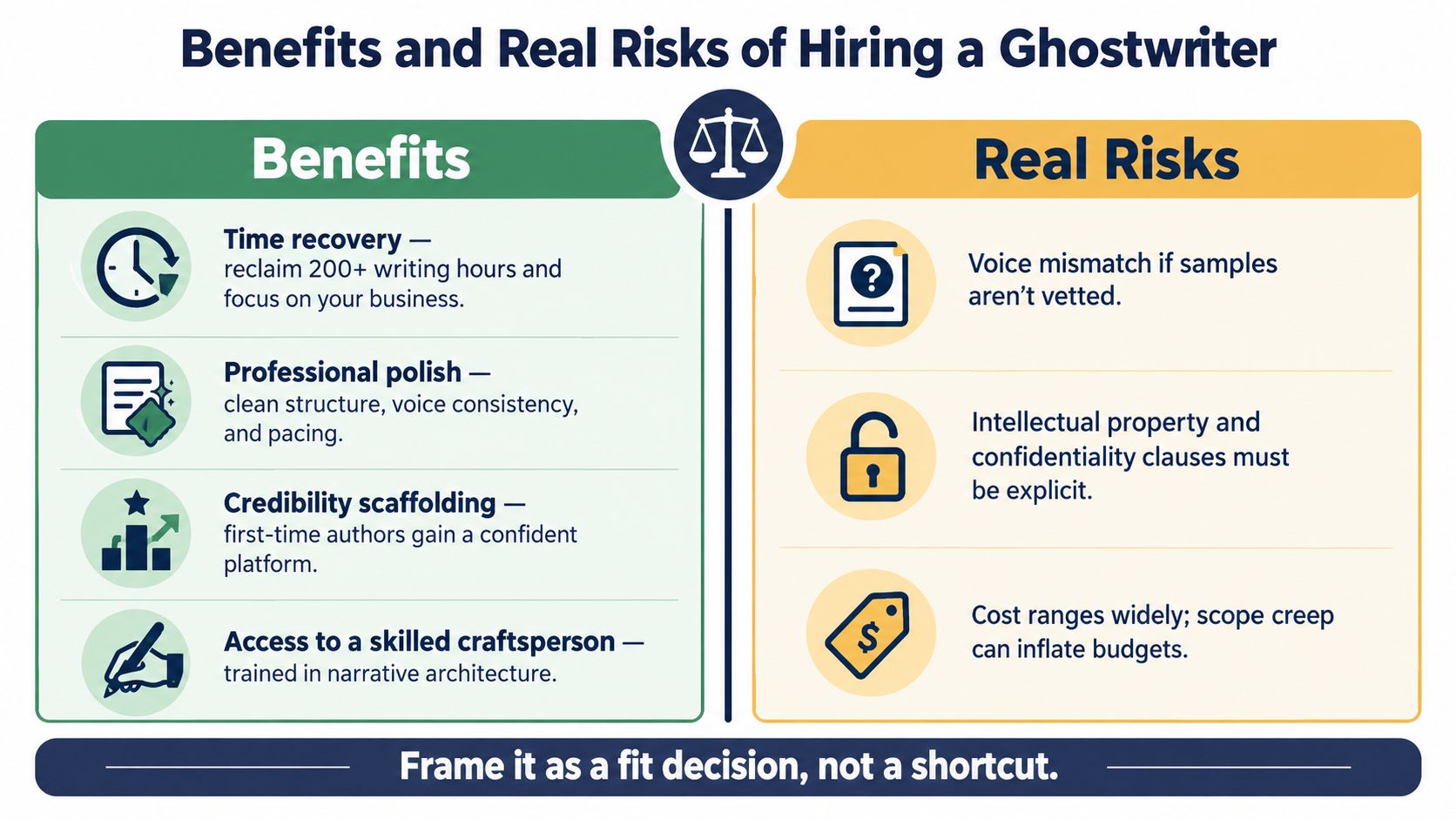
Ghostwriting is a fit decision, not an automatic shortcut. The right writer can recover time, impose structure on scattered ideas, and give a first-time author access to professional narrative craft. The wrong engagement can produce polished pages that sound nothing like the person whose name appears on the cover.
What clients gain
A busy executive may have the knowledge needed for a strong book but no uninterrupted time to draft one. Interviews let the writer extract that knowledge while the executive continues running the business. A skilled ghostwriter can then organize the material, identify missing context, improve transitions, and maintain a consistent voice.
A client may also gain credibility scaffolding. The writer doesn't manufacture expertise, but can make the client's existing experience easier to understand and remember. For a memoir, that means shaping events into a meaningful narrative. For a business book, it means turning lessons into a useful argument rather than a collection of anecdotes.
Where the arrangement can fail
- Voice mismatch: The manuscript may be grammatically strong but emotionally false if the writer has not studied how the client speaks and thinks.
- Weak rights language: Unclear contracts can create disputes over drafts, derivative works, confidentiality, or future adaptations.
- Financial exposure: Paying a large amount before checking the provider's process and reliability increases the cost of a failed engagement.
- Reputational harm: Undisclosed writing can create serious problems in politics, academia, journalism, or corporate thought leadership when audiences expect personal authorship.
- Lost development: A client who delegates every stage may receive a finished product without learning how to articulate their own ideas more effectively.
Ask yourself: Do you need a finished product, a thinking partner, or a writing coach?
Those are different services. A ghostwriter is appropriate when you want another professional to create the deliverable in your voice. An editor may be better when you already have a complete draft. A coach may be the right choice when you want to build the skill yourself and remain responsible for the writing.
A project can include AI-assisted tools without becoming fully AI-written. For example, a writer might use software to organize interview notes or test outline variations, while the client and writer remain responsible for accuracy, judgment, voice, and disclosure. Agree on those boundaries before drafting begins.
Choosing a Ghostwriting Provider You Can Trust
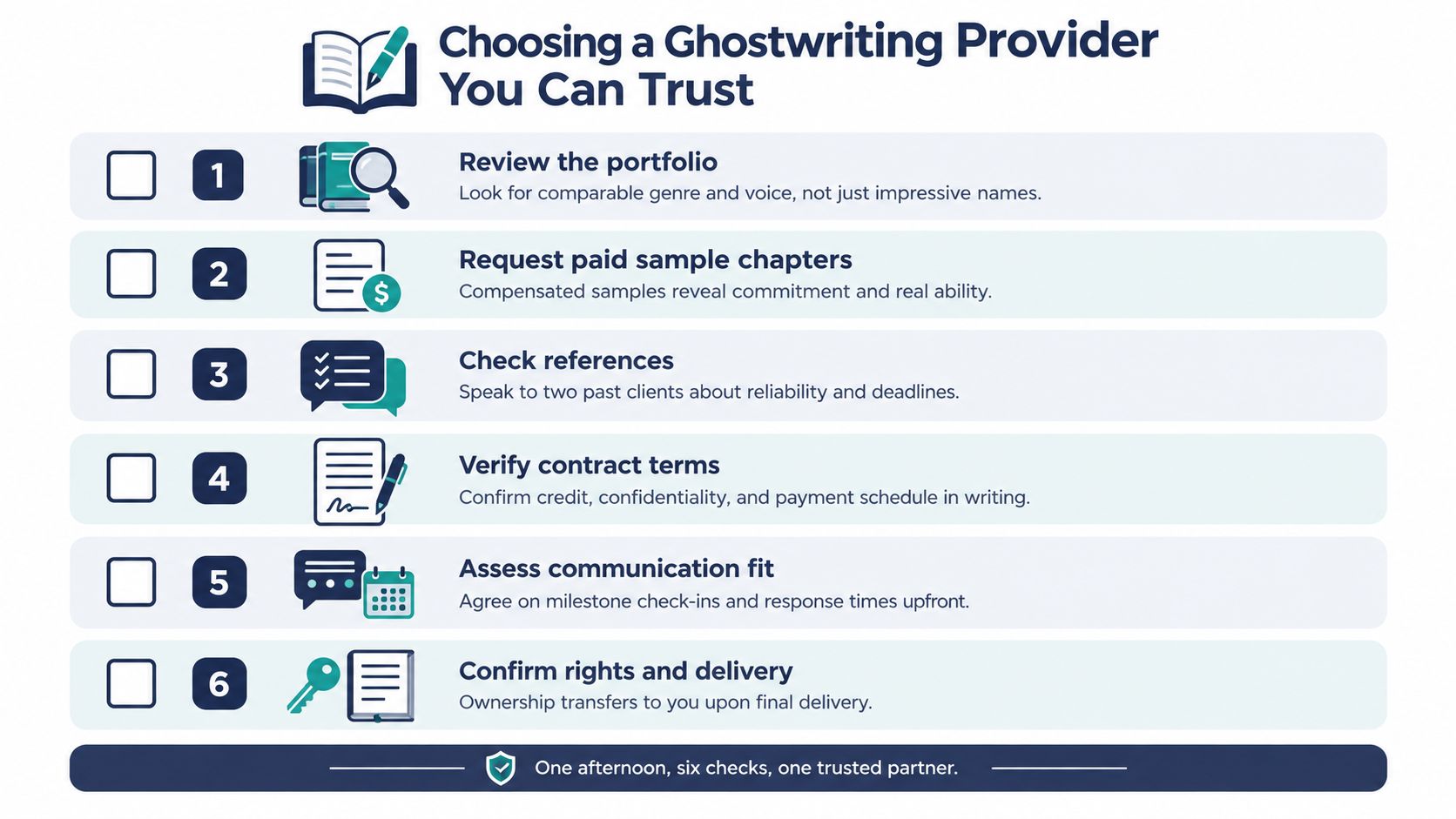
You can complete a useful first screening in an afternoon. Start with the work, not the sales language.
Inspect evidence of fit
A provider's impressive client list doesn't prove that they can write your memoir, business book, or keynote. Look for comparable genre, audience, tone, and narrative complexity. Ask whether the samples were written by the person who will handle your project.
Request a paid sample chapter based on a real outline or interview. A compensated sample gives the writer enough context to demonstrate voice and structure, while giving you a fair way to evaluate the collaboration. The point isn't to demand a large unpaid audition. It's to test whether the writer can turn your material into prose that sounds credible.
Read the contract before discussing the deposit
Check for milestone payments tied to actual deliverables, a clear cancellation fee, copyright assignment language, confidentiality terms, and a defined revision ceiling. Confirm who conducts interviews, who researches and verifies facts, what file format you'll receive, and how the writer handles delays.
You should also test communication fit. Ask how often you'll review work, who gives consolidated feedback, how quickly questions are answered, and what happens when you disagree about structure. A reliable process makes uncertainty visible early rather than hiding it until the final delivery.
For more questions to ask and places to look, use this guide on how to find a ghostwriter. BarkerBooks is one option for clients seeking an end-to-end publishing partner, offering ghostwriting alongside editorial support, design, formatting, distribution, and related publishing services.
Map the provider to the assignment:
- Busy executive: Choose someone experienced with interviews, business arguments, and speech-ready language.
- Aspiring memoirist: Prioritize empathy, life-story structure, confidentiality, and demonstrated memoir work.
- Content-marketing lead: Look for a writer who can maintain a brand voice across articles, newsletters, and thought-leadership assets.
- International author: Confirm language capability, cultural sensitivity, rights handling, and the intended distribution markets.
Before the discovery call, ask: Who will write the work? How do you capture voice? What will I receive at each milestone? How are revisions counted? Who owns the drafts? What happens if the project pauses? The answers will tell you more than a polished promise that the writer can “make your story come alive.”
If you have an idea, rough draft, or unfinished manuscript, BarkerBooks can help turn it into a structured, professionally prepared book through ghostwriting and publishing support. Visit BarkerBooks to discuss your project, clarify the workflow, and decide whether full-service help fits your goals.