
So, you’ve poured your heart and soul into a manuscript. The big ideas are there, the story is compelling, but now it’s time for the fine-tuning. This is where copy editing comes in, acting as the crucial quality check that elevates your writing from good to truly exceptional. Think of it as the final polish that makes your message crystal clear and professional before it ever meets your reader’s eyes.
What Is Copy Editing Really?
Imagine a master woodworker who has just finished carving an intricate sculpture. The shape is perfect, but the surface is still a bit rough. They then pull out their finest tools to sand every curve, polish the grain, and apply the final finish until it glows.
That’s exactly what a copy editor does for your words. They aren’t there to rebuild your story or change your core message. Instead, they meticulously refine what you’ve already created, making it as flawless as it can be. This is the critical step that transforms a raw draft into a professional piece ready for the world.
The Core Focus of Copy Editing
At its heart, copy editing is about making sure your writing is clear, consistent, and correct. It’s all about the technical details—the nuts and bolts that hold your sentences together and make them work. A good copy editor will zero in on a few key areas:
- Grammar and Syntax: Is the subject-verb agreement correct? Are pronouns used properly? Do sentences flow logically or are they clunky and hard to follow?
- Punctuation and Spelling: They’ll hunt down misplaced commas, rogue apostrophes, and any spelling errors that snuck past your spell-checker.
- Clarity and Flow: Awkward phrasing gets re-worked. Choppy transitions are smoothed out. The goal is to create an effortless reading experience.
- Consistency: Are characters’ names spelled the same way in Chapter 1 and Chapter 20? Does the timeline make sense? Is the formatting uniform?
This kind of detailed work isn’t just for novelists. It’s a vital service across the entire content world. In the global copywriting industry, for instance, a staggering 73% of copywriters also offer copy editing to give their work maximum impact. That really underscores how essential it is for refining tone and clarity. You can dig into more of those insights in the ProCopywriters survey.
A copy editor is your manuscript’s best friend. They honor your voice and story while ensuring technical perfection, so your readers can focus on your message without distraction.
The need for this kind of precision goes way beyond books. Think about video content, where understanding what is closed captioning shows how meticulous text work is essential for accessibility and clarity. It’s all proof that no matter the medium, careful editing is what makes communication work.
Understanding the Three Levels of Editing
Navigating the publishing world can feel like learning a new language, especially when terms like “developmental editing,” “copy editing,” and “proofreading” get thrown around. People often use them interchangeably, but they represent three very different—and equally critical—stages of getting a book ready for readers.
Knowing the difference helps you understand what your book needs and, just as importantly, when it needs it.
Think of it like building a house. You wouldn’t hire a painter to pour the concrete foundation. You also wouldn’t ask the architect to come back and fix a leaky faucet after you’ve moved in. Every professional has a specific job, and the project’s success depends on bringing them in at the right moment. The same goes for editing your book.
Developmental Editing: The Architectural Blueprint
This is the very first, big-picture stage. A developmental editor is your book’s architect, focused entirely on the structural integrity of your story. They aren’t worried about comma splices or typos just yet; they’re making sure the building itself is sound. If your plot has holes the size of a garage door or your character arcs fall flat, this is where you fix it.
This macro-level work tackles the core of your narrative—plot, pacing, character development, and overall structure. It’s all about making sure the story works before you start polishing the sentences.
To get a much deeper look into this foundational process, check out our complete guide on what is developmental editing. This phase is all about ensuring your core ideas are powerful and land with readers.
Copy Editing: The Interior Finishing
Once the blueprint is solid and the house is built, it’s time for the copy editor to come in. Think of them as your interior finishing crew—the electricians, plumbers, and painters who make the house functional, safe, and beautiful. They aren’t moving walls or adding a new wing; they are perfecting what’s already there.
Here, the focus zooms in from the big picture to the sentence level. A copy editor’s job is to refine your writing for clarity, consistency, and correctness. They fix grammar, polish syntax, and correct punctuation and spelling to create a smooth, professional reading experience.
Proofreading: The Final Walkthrough
Proofreading is that last, meticulous inspection right before you hand over the keys. After all the copy edits are done and the manuscript has been designed and formatted for printing (or e-reading), the proofreader steps in for one last check. Their job is to hunt down any lingering typos, formatting glitches, or stray punctuation errors that were missed or even introduced during the layout phase.
Grasping the key differences between copy editing and proofreading is crucial. A copy editor refines the raw manuscript for flow and correctness, while a proofreader polishes the final, formatted version to catch any surface-level mistakes. It’s your absolute last line of defense before publication.
To make this crystal clear, here’s a simple table breaking down the three stages.
The Three Levels of Book Editing Compared
This table provides a quick reference to help you distinguish between the three main types of editing, so you can easily identify which service your manuscript needs right now.
| Editing Type | Primary Focus | When It Happens | Key Questions It Answers |
|---|---|---|---|
| Developmental Editing | Big picture: Plot, characters, structure, pacing | Early, on a finished draft | Does the story make sense? Are the characters compelling? Is the pacing effective? |
| Copy Editing | Sentence level: Grammar, spelling, clarity, consistency | Middle, after developmental edits are complete | Is this sentence clear and correct? Does the language flow well? Is the tone consistent? |
| Proofreading | Final polish: Typos, punctuation, formatting errors | Last, on the final, formatted version | Are there any typos left? Is the formatting correct? Is it ready to publish? |
Each stage builds on the last, taking your rough draft and systematically transforming it into a polished, professional book that you can be proud of.
What a Copy Editor Actually Does: A Checklist
So, when a copy editor gets their hands on your manuscript, what’s really happening? It’s far more than a simple spell-check. Think of it as a deep, systematic polish of your writing, guided by a framework known as the “4 Cs”.
These four principles—Clarity, Coherency, Consistency, and Correctness—are the pillars of a great copy edit. They give the editor a roadmap to follow, ensuring that every sentence, every word, and every comma is working hard to support your story and engage your reader.
This is the nitty-gritty work that happens after the big story-level issues are sorted out but before the final pre-press proofread. It occupies a crucial middle ground in the editing process.
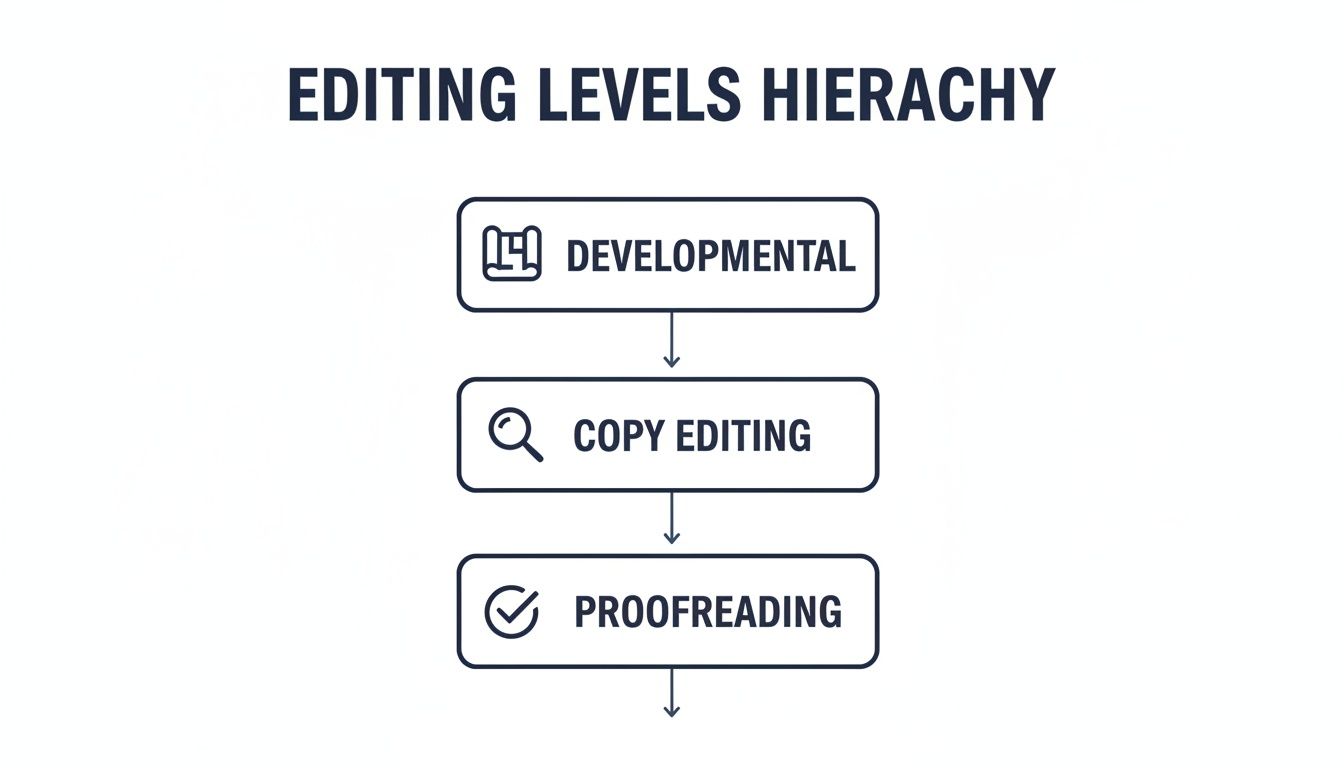
As you can see, copy editing is the detailed line-by-line work that gets the manuscript ready for its final review.
Clarity and Coherency
These first two Cs are all about making sure your writing is not just understood, but effortlessly absorbed. If a reader has to stumble over a sentence or reread a paragraph to get the meaning, the flow is broken. The editor’s job is to smooth out all those bumps.
- Improving Readability: The editor will hunt down and rephrase convoluted sentences, untangle jargon, and break up dense paragraphs. The goal is to create a seamless reading experience.
- Strengthening Transitions: They check that your ideas connect logically from one sentence to the next, and from one paragraph to the next, adding a transitional word or phrase if it helps guide the reader.
- Eliminating Ambiguity: Any phrase that could be read two ways is clarified. The editor works to ensure your intended meaning is the only possible one.
The best copy editors are invisible advocates for the reader. Their goal is to remove every single obstacle—an awkward phrase, a confusing term, a clunky sentence—that stands between the reader and your story.
Consistency and Correctness
This is where an editor’s eagle eye and meticulous nature really shine. Consistency means ensuring everything stays the same from page 1 to page 300. Correctness is about applying the established rules of grammar, spelling, and punctuation.
To keep track of it all, an editor creates a unique style sheet for your book. This document becomes the project’s official guide, recording every specific decision made—from how to spell a character’s name to whether to use the Oxford comma.
What they look for in Consistency:
- Character and Setting Details: Does your protagonist’s hair suddenly change from blonde to black? Is the name of his hometown spelled consistently?
- Timeline Logic: Do the events in your story unfold in a sequence that makes sense? Does a character mention something before they could have possibly known about it?
- Formatting Rules: They ensure that things like capitalization, hyphenation, and how numbers are written follow a single, consistent rule, usually based on a guide like The Chicago Manual of Style.
What they fix for Correctness:
- Grammar and Syntax: This goes deep, covering everything from subject-verb agreement and proper sentence structure to dangling modifiers that can make sentences unintentionally hilarious.
- Punctuation: An editor makes sure every comma, semicolon, apostrophe, and em dash is in its right place and serving its proper function.
- Spelling: This is more than a simple spell-check. They catch the sneaky errors that software misses, like homophones (e.g., “their,” “there,” and “they’re”) and contextual mistakes.
See the Difference Before and After Editing
Talking about “clarity” and “flow” can feel a little abstract. The best way to really get what a copy editor does is to see the transformation for yourself. It’s in the before-and-after that the magic really happens.
Let’s look at a few common writing hiccups and see how an editor’s touch can smooth them out, making your prose more powerful and professional. Notice how these changes don’t rewrite the author’s voice—they just turn up the volume on what you were trying to say all along.
Example 1: Ditching the Passive Voice
Passive voice has a way of creeping in and making your sentences feel a bit sluggish and indirect. A good editor will spot this and flip the sentence into an active, more dynamic structure.
- Before: The decision was made by the council to delay the project.
- After: The council decided to delay the project.
Why it’s better: The “after” version is punchier and puts the doer of the action (the council) front and center. It’s more direct, confident, and easier for the reader to process.
Example 2: Cutting the Clutter
We all have our go-to phrases that add words without adding meaning. An editor acts as a declutterer, trimming the excess to make sure every single word earns its place on the page.
- Before: Due to the fact that the weather was bad, the game was cancelled.
- After: The game was cancelled because of bad weather.
Why it’s better: The edit gets rid of the clunky “due to the fact that” and cuts straight to the point. The result is a crisper, more professional sentence that respects the reader’s time.
A copy editor’s goal is not to rewrite your work but to reveal its strongest form. By removing obstacles like wordiness and ambiguity, they help your core message shine through with greater impact.
Example 3: Improving Sentence Rhythm and Flow
Sometimes, a series of sentences can be grammatically perfect but still feel choppy and disconnected. A copy editor looks at the bigger picture, rearranging words and combining ideas to create a smoother ride for the reader.
- Before: She ran to the store. She needed to buy milk. She was in a hurry.
- After: In a hurry, she ran to the store because she needed to buy milk.
Why it’s better: Instead of three separate, staccato thoughts, the revised version weaves them into one cohesive idea. It explains why she was in a hurry and connects her actions logically. It’s these subtle tweaks to rhythm and flow that separate a good manuscript from a truly great one.
So, you’re ready to hire a copy editor. It can feel like a pretty big step, handing over your manuscript to someone else. But it’s not about someone coming in to tear your work apart; it’s a partnership meant to make your book the best it can be. Let’s walk through what the process actually looks like, so you can feel confident instead of anxious.
The First Step: The Sample Edit
Almost every professional editing relationship kicks off with a sample edit. An editor will typically offer to work on a small chunk of your manuscript—usually around 1,000 to 1,500 words—either for free or for a small fee.
Think of it as a test drive. You get a real feel for their editing style and can see if it clicks with your vision for the book. At the same time, the editor gets a clear picture of how much work your manuscript needs, which helps them give you an accurate quote.
From Quote to Collaboration
After reviewing the sample, the editor will send you a formal quote and a proposed timeline. This isn’t just a number pulled out of thin air; it’s their professional assessment of what it will take to get your manuscript polished.
Pricing can be structured in a few different ways:
- Per-Word Rate: This is the industry standard for copy editing. You can expect rates to fall somewhere between $0.02 and $0.05 per word.
- Hourly Rate: Some editors prefer to charge by the hour, which is often the case for projects that are particularly complex or have an unpredictable scope.
- Project Fee: A flat fee for the entire manuscript gives both you and the editor total clarity on the cost from the very beginning.
Once you’ve agreed on the terms, the real work begins. One of the first things your editor will do is create a style sheet. This document is basically the official rulebook for your book, tracking everything from the spelling of a character’s name to how you use hyphens. It’s the key to maintaining consistency from page one to the very end.
Working with a copy editor is an investment in your book’s professionalism. They are your first reader, your quality control expert, and your advocate for clarity, all rolled into one.
The editing itself is almost always done using Track Changes in Microsoft Word or the Suggesting feature in Google Docs. It’s a completely transparent process. You’ll see every single change, whether it’s a tiny comma fix or a completely rephrased sentence. Remember, you’re always in the driver’s seat and have the final say to accept or reject any suggestion.
Why This Matters in Today’s Market
This kind of collaboration is more important than ever. The book editing services market is projected to hit $271 million by 2025, a boom driven largely by the explosion of self-publishing.
With more than 1.5 million books self-published on Amazon every single year, professional editing is what separates the good from the great. It’s what allows indie authors to release a book that can stand shoulder-to-shoulder with titles from major publishing houses. You can discover more insights about this growing market and what it means for authors.
A great editor does more than just fix mistakes. They’ll often leave comments explaining why they made a more significant change, which helps you grow as a writer. This turns the whole process from a simple transaction into a powerful learning experience, leaving you with a manuscript that’s polished, professional, and ready for readers.
How to Hire a Copy Editor
Finding the right editor isn’t just about hiring someone to fix typos; it’s about finding a creative partner for your manuscript. Think of it this way: you’ve spent months, maybe even years, pouring your heart and soul onto the page. The person you hand it to next should not only have impeccable technical skills but also a deep respect for your voice as a writer.
The search starts with one simple question: do they get your genre? An editor who spends their days on dense academic texts probably isn’t the best choice for your fast-paced sci-fi thriller. Likewise, a romance specialist might not grasp the specific beats of a historical biography. Always look for an editor whose portfolio aligns with the kind of book you’ve written. This is your first clue that they understand the world you’re building and the expectations of your future readers.
Vetting Your Potential Partner
Once you have a shortlist, it’s time to dig a little deeper. Asking the right questions is less about grilling them on credentials and more about seeing if your working styles will click. You’re looking for someone who can elevate your writing, not erase your personality from it.
Here are a few essential questions to get the conversation started:
- Experience: What genres are your specialty? Can you show me a few books you’ve edited that are similar to mine?
- Philosophy: How do you approach editing? Where do you draw the line between correcting a manuscript and preserving the author’s unique voice?
- Process: What does your workflow look like? Do you use a specific style guide, like The Chicago Manual of Style?
Taking the time to vet an editor is one of the most important things you can do for your book. For a more exhaustive list of questions and tips, check out our complete guide on how to find a book editor.
Your ideal editor is a collaborator who improves your manuscript without erasing your identity from the page. They are your book’s first true advocate.
This partnership has become even more important as the publishing world has changed. Many traditional publishers now rely on a network of trusted freelancers to handle editing, a shift driven by rising in-house costs. When you hire an editor, you’re bringing on a true professional—the median wage hit $75,020 in May 2023. It’s an investment in an expert who is dedicated to their craft and to making your book shine.
Common Questions About Copy Editing
As you get your manuscript ready for the final stretch, a few questions always seem to pop up. Let’s tackle them head-on so you can feel confident about your next move.
Can I Just Use Grammar Software?
Tools like Grammarly are fantastic for catching obvious typos and basic grammar goofs, but they have their limits. They simply can’t replace the nuanced eye of a professional human editor.
An AI often misses the subtle rhythm of your prose, the specific context of a scene, or the consistency of your authorial voice. A good copy editor will flag an awkward sentence that software says is “correct,” ensure your unique style isn’t flattened out, and apply a style guide with a precision that algorithms just can’t replicate.
Think of it this way: an AI can tell you if a sentence is grammatically correct, but a human editor can tell you if it’s good.
How Much Does Professional Copy Editing Cost?
This is the big question, and the answer is: it depends. The cost is usually based on your manuscript’s word count, how complex the subject matter is, and the editor’s experience level.
You can generally expect industry rates to fall somewhere in the $0.02 to $0.05 per word range. That said, many authors find better value in comprehensive publishing packages that bundle copy editing with other services. This can be a much more cost-effective and straightforward way to get your book published than hiring for each step individually.
Does My Manuscript Need to Be Finished First?
Yes, one hundred percent. Copy editing is a finishing touch, not a structural overhaul. It should only happen after your story is complete and you’ve incorporated all the big-picture feedback from any developmental editing.
Think of it as polishing a sculpture—you wouldn’t start polishing before you’ve finished carving. Handing over a final draft lets the editor focus on the sentence-level details that will make your writing shine. For a deeper dive into where this fits in the process, our guide on the differences between proofreading and editing can clear things up.
Ready to give your manuscript the professional polish it deserves? The expert team at BarkerBooks offers comprehensive editing services designed to make your story shine. Explore our publishing packages today!