
So, what's the real cost to self-publish a book? Let's get straight to it. For a high-quality, professional book that can stand shoulder-to-shoulder with traditionally published titles, you should plan on investing somewhere between $2,000 and $5,000.
This budget covers the must-have services—like professional editing and a compelling cover design—that truly make a book shine. The great news? The final price tag is completely up to you.
Unpacking the Real Cost to Self Publish a Book
Figuring out your self-publishing budget is a bit like planning to build a house. You could go for a simple, functional design with standard materials, or you could opt for custom architecture and high-end finishes. Neither approach is wrong, but the final cost—and the look of the final product—will be worlds apart. The same logic applies to bringing your book to life.
There’s no one-size-fits-all price. Your total investment is simply the sum of all the choices you make during the process. Are you going to hire a seasoned developmental editor to shape your story, or just a proofreader to catch typos? Will you commission a custom-illustrated cover or start with a pre-made template? Every one of these decisions adds up.
To give you a clearer picture right from the start, here's a quick look at how different approaches stack up financially.
Quick Overview of Self-Publishing Cost Ranges
This table provides a summary of estimated costs for different self-publishing approaches, from a minimal DIY budget to a professional, full-service investment.
| Publishing Approach | Low-End Cost Estimate | High-End Cost Estimate | Key Services Included |
|---|---|---|---|
| DIY / Shoestring | $200 | $800 | Basic proofreading, pre-made cover, self-formatted interior. |
| Professional Indie | $2,000 | $5,000 | Multiple rounds of editing, custom cover design, professional formatting. |
| Full-Service / Hybrid | $6,000 | $15,000+ | All professional services plus project management, marketing, and distribution support. |
As you can see, the path you choose has a major impact on the budget. Now, let's explore why making a smart investment is so important.
Why Quality Investment Matters
While it’s tempting to cut corners and save a few dollars, the most successful independent authors treat their writing career like a business. They know that investing in quality production isn't just an expense—it's a strategic move to create a product that can actually compete.
Think about it from a reader's perspective. A book with polished prose and a stunning cover signals that the story inside is worth their time and money. It builds trust before they even read the first page.
Industry data backs this up. The Alliance of Independent Authors, a leading voice in the community, found that the average cost to self-publish a book professionally is between $2,940 and $5,660. This figure comes from analyzing over 230,000 real-world quotes and includes the essentials: editing, cover design, and some initial marketing. It confirms what many of us have learned from experience: a professional-grade book requires a real investment.
In this guide, we're going to break down every potential expense so you know exactly where your money is going. We’ll cover:
- Core Production Costs: The non-negotiable services that make or break a book's quality.
- Printing and Distribution: How to get your book into readers' hands without overspending.
- Marketing and Promotion: The crucial investments needed to get noticed and drive sales.
By the end, you'll have a clear understanding of the financial landscape, empowering you to create a realistic budget that aligns with your goals. Think of this as your financial roadmap to a successful book launch.
We'll provide itemized cost ranges, compare different publishing paths, and even share some sample budgets. This isn't just about crunching numbers; it's about making informed decisions that give your book the best possible chance to succeed. Let’s dive in.
The Core Production Costs You Cannot Ignore
If you’re building a self-publishing budget, think of production costs as the foundation of your house. They're the non-negotiables that determine whether your book stands tall and impresses visitors or crumbles under scrutiny. It's always tempting to cut corners here, but believe me, skimping on these core services almost always backfires, leading to bad reviews and lost sales.
These are the three big investments that signal to the world your book is a professional product worth a reader's time and money: editing, cover design, and interior formatting. Let's break down what you’re actually paying for with each.
Professional Editing: The Foundation of a Great Story
Editing isn't just about catching typos; it's about shaping your raw manuscript into a polished, compelling story. Think of a sculptor working with a block of marble. Editing is the careful chipping and sanding that reveals the masterpiece inside. Trying to skip this step is hands-down the biggest mistake an independent author can make.
You'll encounter a few different levels of editing, and each has a specific job:
- Developmental Editing ($2,000 – $3,000): This is the "big picture" edit. A developmental editor looks at your plot, pacing, character development, and overall story structure to make sure everything holds together.
- Copyediting ($1,500 – $2,500): Now we're getting down to the sentence level. A copyeditor tightens up your prose, improves clarity and flow, and fixes grammatical mistakes or awkward phrasing.
- Proofreading ($1,000 – $1,500): This is the final quality check. A proofreader is your last line of defense, catching any pesky spelling, punctuation, or formatting errors that slipped through before your book goes live.
For a typical 80,000-word novel, a full editing package is a serious line item in your budget. But it's an investment that pays for itself over and over by creating an incredible reading experience.
Compelling Cover Design: Your #1 Marketing Tool
People absolutely, 100% judge a book by its cover. In a crowded online bookstore, your cover has maybe two seconds to grab someone's attention and tell them what your book is about. It’s not just pretty art; it's a hard-working marketing asset.
A professionally designed cover does three crucial things:
- It Catches the Eye: Strong visuals and clear typography make your book pop in a sea of tiny thumbnails.
- It Signals Genre: A thriller fan should know your book is for them instantly, just like a romance reader should. The cover sets expectations.
- It Conveys Professionalism: A polished cover builds immediate trust, telling the reader that the writing inside is just as professional.
Costs here can vary wildly. A sharp design using high-quality stock photography might run you $500 to $900. If you need a fully custom illustration, which is common in genres like fantasy or sci-fi, the price can easily top $1,500. This isn't where you find the cheapest designer; it's where you find the right one for your book's genre.
Clean Interior Formatting: The Invisible Art
Great interior formatting (sometimes called typesetting) is like the sound design in a great movie—when it’s done well, you don't even notice it's there. It creates a smooth, immersive reading experience. Poor formatting, on the other hand, is a nightmare of weird fonts, awkward page breaks, and clunky spacing that screams "amateur hour."
A clean, professional interior shows respect for the reader. It ensures your words are presented in the most readable and appealing way, whether in a paperback or an ebook.
For a standard, text-heavy book like a novel, you can expect professional formatting to cost between $300 and $800. If your project is more complex—think cookbooks with images, or non-fiction guides with charts and callouts—that cost will climb.
If you're looking to make your budget stretch, exploring ways of reducing production costs without sacrificing quality is a savvy move. Costs can also vary by region. In the UK market, for instance, a full manuscript edit might range from £700 to £1,050, with cover design adding another £250 to £600. This shows how authors everywhere must balance these same essential elements.
One fixed cost you can't forget is the ISBN, which is your book's unique identifier. In the UK, a single ISBN costs £91, but a block of ten is £169—a great example of how buying in bulk can save you money in the long run. If you're new to this, our guide on how to get an ISBN for my book is a great place to start.
You’ve done the hard work. The manuscript is polished, the cover is a work of art, and now it's time for the final leap: getting your book into the hands of readers. This is where printing and distribution come in, and the path you choose here will dramatically shape your budget and logistics.
For most independent authors today, the answer is Print-on-Demand (POD). Think of it like this: your book lives as a digital file until someone clicks "buy." Only then does a single copy get printed and shipped.
Platforms like Amazon KDP or IngramSpark have completely changed the game with this model. You don't have to guess how many copies to print or risk your garage filling up with boxes of unsold books. The cost to print a book is simply deducted from your royalty when a sale is made, which means there are virtually $0 in upfront printing fees. It's a lifesaver.
The Two Paths of Printing
When it comes to putting ink on paper, you're looking at two very different philosophies. Each one serves a different kind of author with different goals.
-
Print-on-Demand (POD): This is the go-to for the vast majority of self-published authors. With no minimum orders, your book is always "in stock" and available online. It's a low-risk, hands-off approach that lets you focus on writing and marketing, not inventory management.
-
Offset Printing: This is the old-school method of printing in bulk—we're talking 1,000 or more copies at a time. The per-book cost is much, much lower, but you’re facing a massive upfront investment. This route really only makes sense if you have a huge, established audience, a speaking tour lined up, or a solid plan for in-person sales.
For almost everyone starting out, POD is the smartest financial move. It lets you test the waters without taking a huge financial plunge.
Understanding Per-Copy Print Costs
While setting up your book for POD is free, you still need to know what each copy costs to produce. This "per-unit" cost is what gets subtracted from your book's list price before your royalty is calculated, so it's a critical number for pricing your book competitively while still making a profit.
For a standard paperback, you can expect the printing cost to be somewhere between $3 to $5 per copy. A hardcover is more substantial, often landing closer to $10 per copy, depending on things like page count, trim size, and paper quality.
To get a much more accurate feel for your own project, playing with a calculator is the best way to go. You can use our book printing cost calculator to plug in your book's specific details and get a solid estimate.
Why You Must Own Your ISBN
Here’s a crucial detail that trips up a lot of new authors: the ISBN (International Standard Book Number). Some platforms will offer you a "free" one, and while that sounds great, it's a trap for anyone serious about their author career.
Think of an ISBN as your book’s social security number. If you use a free one from a platform like Amazon, they become the publisher of record, not you. This can severely limit where you can sell your book and undermines your professional credibility.
When you buy your own ISBN from Bowker (the official US agency), you are officially the publisher. This gives you total control over your book's future and allows you to distribute it through any retailer, library, or bookstore in the world.
The costs are straightforward:
- Single ISBN: Costs $125
- Block of 10 ISBNs: Costs $295
Since you need a unique ISBN for every format—paperback, hardcover, ebook, and audiobook—the block of ten is easily the best value. If you plan to write more than one book, it’s a no-brainer.
Finally, don’t forget to budget for author copies. These are the books you buy for yourself at print cost. They're absolutely essential for sending to book reviewers, running giveaways, and selling at local events. It's a good idea to budget for at least 20-50 copies for your launch, which could add another $100-$250 to your initial outlay.
Budgeting for Effective Book Marketing and Promotion
You wrote the book. The marathon is over, but the race isn't. Now comes the marketing sprint, which is just as vital. Even a masterpiece can get lost in the noise without a smart promotional plan. This part of the self-publishing journey has the most flexible costs, but it’s also where you have the most direct control over your book's future.
Think of it this way: your book is a brilliant new product. But if no one knows it exists, it’s just going to collect dust on a digital shelf. Marketing is all about building a bridge between your story and the people who are dying to read it. It's not a one-and-done expense; it's a continuous investment in your career as an author.
The good news? You don’t need a blockbuster movie budget to get noticed. A strategic, focused approach can deliver amazing results, whether you’re just starting out or shooting for the bestseller list.
Building Your Foundational Marketing Assets
Before you spend a dime on ads, you need a home base—a central hub for your author brand. These are the core tools that will support every single promotional effort you make.
-
Author Website ($60 – $500 per year): This is your digital storefront. It's where readers can find you, learn about your books, and, most importantly, sign up for your mailing list. The cost usually breaks down into a domain name ($10 – $20/year) and website hosting ($50 – $480/year).
-
Email Marketing Service ($0 – $300+ per year): An email list is the single most valuable tool in your marketing arsenal. Why? Because you own it. Platforms like Mailchimp or MailerLite are often free for your first 500 to 1,000 subscribers, which makes it a no-brainer for authors at any stage.
These two pieces are essential for any author who's serious about building a career. They signal professionalism and open a direct channel to your biggest fans.
Direct Advertising and Paid Promotions
With your foundation firmly in place, it’s time to start reaching out to new readers. Paid advertising is one of the fastest ways to get your book in front of people who are actively looking for stories just like yours.
For most indie authors, Amazon Ads is the natural starting point. You can target readers with surgical precision based on the genres, authors, and keywords they’re already searching for on Amazon.
Budgeting for Ads: A sensible starting budget for Amazon Ads is $5 to $10 per day. That’s enough to get your feet wet and gather useful data without breaking the bank. Many authors find a sweet spot by budgeting $150 to $300 per month for a consistent, ongoing campaign.
Beyond Amazon, paid newsletter features are another powerful option. Services like Freebooksy, The Fussy Librarian, or the gold standard, BookBub, will promote your book to their huge email lists of avid readers. A feature can cost anywhere from $50 to over $1,000, but the right one can trigger a massive surge in sales and visibility.
Expanding Your Reach and Credibility
Long-term success isn’t just about short-term sales spikes. It’s about building social proof and generating genuine buzz around your work.
-
Paid Book Reviews ($50+ per review): Let’s be clear: you should never pay for a reader review. However, professional editorial reviews from trusted sources like Kirkus or Reedsy Discovery offer unbiased critiques. A glowing quote from one of these can be a powerful marketing tool for your book cover and sales page.
-
Book Awards ($70 – $150 per entry): Submitting your book to a few well-regarded awards in your genre is a smart move. Just becoming a finalist or nominee can earn you a prestigious "sticker" for your cover and lend your work instant credibility.
-
Public Relations (PR) Campaign ($2,000 – $5,000+): If you're planning a major launch and want to make a big splash, hiring a publicist might be worth the investment. They can help you land media features, podcast interviews, and guest spots on popular blogs.
To make sure your money is working for you, it's a good idea to learn how to calculate marketing ROI for your campaigns. This shows you exactly which activities are driving sales. And for a huge list of creative strategies, our guide is packed with book promotion ideas for every budget.
Your marketing budget is a dial you can turn up or down. The key is to start small, test relentlessly to see what works, and then reinvest your profits back into the strategies that give you the best return.
Sample Budgets for Three Distinct Author Paths
It’s one thing to know the individual costs, but seeing how they all fit together is what turns a price list into an actual plan. So, to help you get a clearer picture of your own publishing journey, let’s walk through three common author scenarios. Each one is built around different goals and resources, showing you exactly where your money might go.
Think of these as starting points. You can always mix and match services to build a budget that feels right for you. The most important thing is to be honest about your ambitions and what you're comfortable investing. Spending more doesn't guarantee a bestseller, but spending it wisely definitely stacks the odds in your favor.
H3: The Bootstrapper: $500 to $1,500
This is the path for the scrappy, resourceful author who's willing to put in some serious sweat equity to keep costs down. You're probably comfortable with tech, have a decent eye for design, and are ready to learn a few new skills to get your book published.
The focus here is purely on the essentials—the absolute must-haves to produce a clean, readable book.
- Editing: You might have to skip a full developmental edit. Instead, you'll put your money toward a solid professional proofread ($500 – $800) to catch those sneaky typos and grammatical errors that are nearly impossible to find yourself.
- Cover Design: A high-quality pre-made cover ($100 – $250) is your best friend here. You can find stunning options from professional designers that look custom without the custom price tag.
- Formatting: This is where your DIY spirit shines. You’ll handle the interior formatting yourself using great free tools like the Reedsy Book Editor or by mastering a program like Scrivener.
- Marketing: With a lean budget, you’ll focus on free and low-cost tactics. Maybe you set aside $100 – $200 to experiment with Amazon ads and another $50 – $100 for your author website's domain and hosting.
- ISBN: Don't skip this. A single ISBN ($125) is crucial to officially establish yourself as the publisher.
H3: The Professional Author: $2,500 to $5,000
This is the most common route for authors who are serious about building a career and want their book to stand shoulder-to-shoulder with traditionally published titles. You understand that investing in professional quality is key to earning reader trust and driving sales.
Here, you're strategically outsourcing the heavy lifting to experts, which frees you up to do what you do best: write and connect with readers.
- Editing: A comprehensive editing package is non-negotiable. At a minimum, this means copyediting and proofreading ($2,000 – $3,500) to make your manuscript shine.
- Cover Design: You’ll hire a professional for a custom cover ($500 – $900). This ensures your book's most important marketing asset is perfectly designed to attract your ideal readers.
- Formatting: A pro will handle your ebook and print formatting ($300 – $600), guaranteeing a smooth and enjoyable reading experience on any device.
- ISBN: A block of 10 ISBNs ($295) is a smart move. It's a fantastic long-term investment if you plan on writing more books or releasing different formats like hardcovers or audiobooks.
- Marketing: You'll have a dedicated launch budget of $500 – $1,000 to play with. This could cover Amazon ads, a few paid newsletter promotions, and ordering author copies for early reviews and giveaways.
As you think about your marketing spend, it's helpful to see how it scales with your goals.
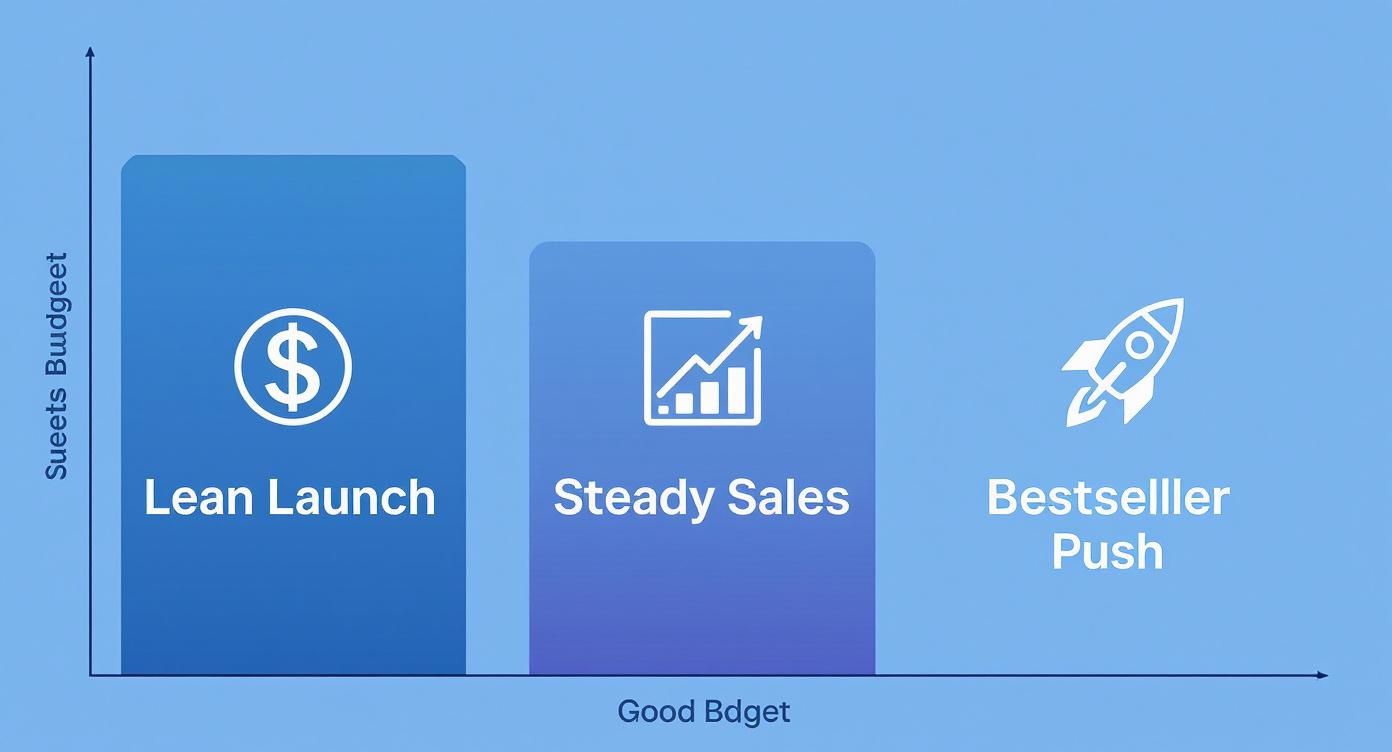
This chart really drives home the point: a big bestseller push requires a significantly larger financial commitment upfront compared to a launch focused on steady, long-term sales.
H3: The Bestseller Campaign: $5,000+
This is the all-in approach. It’s for authors with big commercial ambitions, maybe a strong backlist of existing books, or simply the desire to make the biggest splash possible right from day one. Every single element of the book and its launch is fine-tuned for maximum visibility and sales momentum.
Think of this as a major product launch, with a budget to match. It’s an aggressive, high-stakes strategy designed to hit bestseller lists and carve out a serious presence in the market.
- Full Editorial Suite ($3,500+): You're investing in the works: a developmental edit, a line edit, a copyedit, and a final proofread, all from top-tier editors in your genre.
- Premium Cover Design ($1,000+): This could mean commissioning custom illustration from a well-known artist or working with an A-list designer who has a proven track record of creating bestselling covers.
- Marketing and PR ($2,000+): Your budget is built for a multi-channel blitz. This could include hiring a publicist, securing a coveted BookBub Featured Deal, running extensive ad campaigns on Amazon and social media, and paying for a slate of professional editorial reviews.
H3: Self-Publishing Budget Scenarios
To make it even clearer, here’s a table that breaks down how these budgets might look side-by-side. It shows how the same expense categories are treated very differently depending on the author’s goals and investment level.
| Expense Category | The Bootstrapper ($500 – $1,500) | The Professional Author ($2,500 – $5,000) | The Bestseller Campaign ($5,000+) |
|---|---|---|---|
| Editing | Proofreading only ($500 – $800) | Copyediting & Proofreading ($2,000 – $3,500) | Full Suite: Developmental, Copy, Proof ($3,500+) |
| Cover Design | Pre-made cover ($100 – $250) | Custom design ($500 – $900) | Premium/Illustrated cover ($1,000+) |
| Formatting | DIY with free tools ($0) | Professional ebook & print ($300 – $600) | Professional with custom elements ($500+) |
| ISBNs | Single ISBN ($125) | Block of 10 ($295) | Block of 10 or 100 ($295 – $575) |
| Marketing | Basic ads & website ($150 – $300) | Ads & promo campaigns ($500 – $1,000) | PR, ads, major promotions ($2,000+) |
Ultimately, choosing the right path comes down to your personal goals. Whether you’re a determined bootstrapper or you're aiming for the top of the charts, there’s a budget that can turn your publishing dream into a reality.
If you’re looking for a guided, professional experience without the guesswork, exploring the publishing packages at BarkerBooks can give you a clear roadmap and the full-service support you need.
Your Top Questions About Publishing Costs, Answered
Once you get a handle on the main costs of self-publishing, the smaller, more specific questions start to pop up. It's easy to feel stuck when you're trying to nail down a realistic budget. Let’s clear the air and tackle some of the most common questions I hear from authors.
My goal here is to give you direct, no-nonsense answers so you can move forward with confidence and make smart financial choices for your book.
Can I Really Self-Publish a Book for Free?
Technically, yes, platforms like Amazon KDP won't charge you a fee to upload your files. But publishing a book that people will actually buy and enjoy for $0? That's a whole different story. A "free" book almost always means you’re the one doing all the editing, designing the cover, and formatting the interior.
Frankly, this DIY-or-die approach often produces a book that screams "amateur." Readers can spot it a mile away, and that usually leads to bad reviews and next-to-no sales, which completely wastes all the effort you put into writing it. If you do nothing else, spend money on professional editing and a great cover. It’s the absolute bare minimum needed to give your book a fighting chance in a crowded market.
How Much Should I Budget for Marketing After Launch?
Marketing isn't a one-time thing you do at launch; it's an ongoing part of being an author. For the launch itself, a budget of at least $500 is a solid starting point. That can get you some initial visibility with a week of Amazon ads or a feature in a book newsletter that targets your specific genre.
After that, think about a recurring monthly budget. It could be something small, like $50-$100 a month to keep some light advertising running, or you might scale it up for special promotions. The authors who find long-term success are the ones who consistently reinvest a portion of their royalties back into marketing. It's how they stay visible and keep the sales coming in.
Think of it this way: a book without marketing is like a shop with no sign out front. You could have the best product in the world, but if no one knows you exist, you won't make any sales.
Are Hybrid Publishers a Cheaper Option?
Not usually, no. A hybrid publisher is just a different business model, not necessarily a more affordable one. You’re still on the hook for the production costs, and that often means an upfront payment of several thousand dollars.
In return for that investment, they offer their expertise and distribution channels, but here’s the trade-off: you give up a lot more creative control and a much bigger slice of your royalties. The total self publish book cost with a hybrid publisher can easily match or even surpass what you'd spend doing it yourself with high-quality freelancers. You have to be incredibly careful to research them and make sure they aren't just a vanity press in disguise.
What Are the Most Common Hidden Costs?
I see a lot of first-time authors get blindsided by a few expenses they just didn't see coming. Planning for these from the start can save you a lot of stress down the road.
- Buying Your Own ISBNs: This is crucial if you want to be listed as the official publisher of your book.
- Ordering Author Copies: You'll need physical copies for book signings, sending to reviewers, and local giveaways.
- Book Award Entry Fees: Getting an award is fantastic for credibility, but most of them charge a fee to enter.
- Author Website Costs: Don't forget the annual costs for your domain name and web hosting.
- Email Marketing Services: As your mailing list grows, you'll likely need to upgrade to a paid subscription plan.
These might seem small on their own, but they add up fast. I always recommend adding a 10-15% contingency line item to your budget to handle these kinds of unexpected but necessary expenses.
Feeling a bit overwhelmed by all the numbers and moving parts? You don't have to piece it all together on your own. At BarkerBooks, we've created all-in-one packages that bundle professional editing, cover design, global distribution, and marketing into one clear, manageable plan. Let our team of experts handle all the details so you can get back to what you love—writing.
Explore our publishing packages and get a personalized quote today.