
Controlled proofreading research reports average catch rates of 81% for nonword errors and 66% for word errors in a single pass. Professional script proofreading services therefore provide structured quality assurance, not a guarantee that every flaw will disappear.
That distinction matters because a script can be dramatically improved without being creatively rewritten. Proofreading should protect the author's meaning, voice, continuity, and formatting while removing distractions that can make a polished manuscript look careless. It belongs at the end of the writing process, after major story decisions are settled and before the script reaches readers, producers, publishers, contest judges, or production teams.
The strongest service providers make that boundary explicit. They tell you what they'll inspect, what they'll change, what they'll only flag, and what remains entirely yours.
Why No Author Should Trust Their Own Eyes
In 1631, printers produced an English Bible that omitted the word “not” from the seventh commandment. The resulting sentence reversed its intended meaning, and the edition became known as the “Wicked Bible.” The error contributed to the near-total destruction of the print run, a severe reminder that one missing word can become a publishing failure rather than a minor typo. Historical scholarship on proofreading and early print production shows that printers faced errors from typesetting, damaged type, inking, page layout, image placement, paper quality, and transcription.

Modern scripts face different production conditions, but the underlying risk hasn't changed. A screenplay can assign a line to the wrong speaker, alter the timing of an action, introduce a contradictory character name, or change the meaning of dialogue through a small punctuation error. A stage script can create confusion about entrances, exits, props, or delivery. A manuscript prepared for digital publication can carry layout faults from an earlier file into the final edition.
One pass isn't enough
The catch-rate research gives this risk a practical shape. A synthesis of controlled proofreading experiments reports average detection rates of 81% for nonword errors and 66% for word errors, where a correctly spelled word is wrong in context. The highest catch rate summarized in that research was 95%, which still leaves some errors undiscovered. The research synthesis explains why proofreading requires staged quality control.
Applied hypothetically to a manuscript containing 3,000 errors, an 81% catch rate would identify about 2,430 nonword errors, while a 66% rate would identify about 1,980 word-level errors. Even the 95% result would leave approximately 150 errors. Those figures don't predict the quality of a particular provider. They show why a single author read, software scan, or rushed final glance can't establish complete confidence.
Practical rule: Treat proofreading as a sequence of controlled checks, not as a promise of absolute perfection.
Authors also need distance from the document. That can mean hiring an independent proofreader, asking for a blind read after formatting, or using a fresh reviewer for a final pass. Even a professional headshot workflow recognizes the value of selecting and reusing one strong headshot across author materials. The same principle applies to text, consistency matters, but a fresh perspective still reveals problems familiarity conceals.
The result isn't a script stripped of personality. It's a script that carries its personality without avoidable interference.
What Script Proofreading Actually Covers
A script proofreading service should answer one question clearly: what will the reviewer detect or correct, and what will they leave alone? Many service pages combine grammar, punctuation, formatting, dialogue, scene description, and story notes under one broad label. That may sound thorough, but it makes the buyer responsible for guessing where proofreading ends and creative intervention begins.
Proofreading is the final quality-control layer. It can cover typographical errors, grammar, punctuation, capitalization, textual inconsistencies, formatting slips, dialogue mechanics, and continuity signals that affect reading accuracy. It can be applied to a manuscript, page proofs, a PDF, an EPUB, or another production file. It shouldn't become an unrequested rewrite.
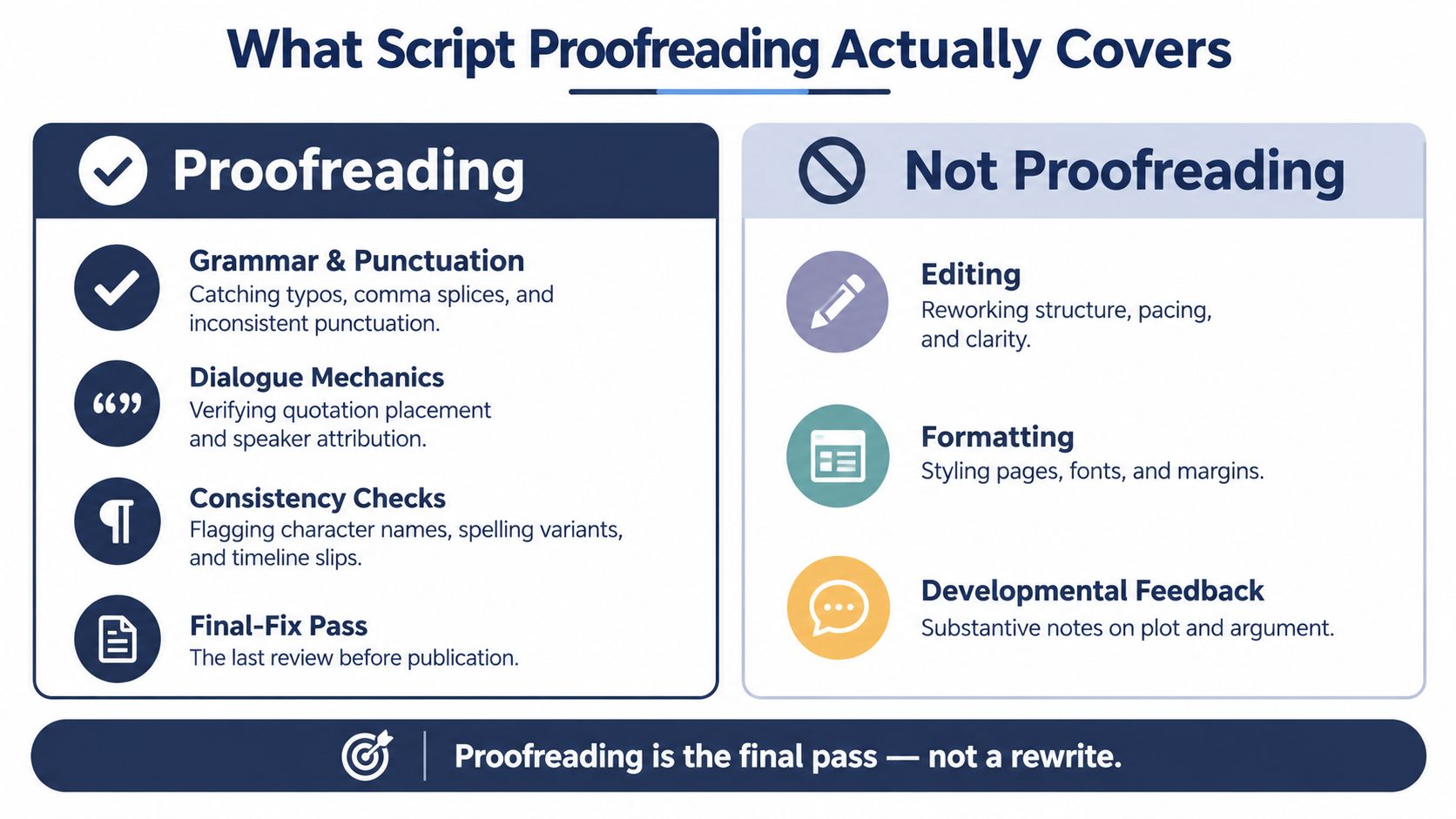
The boundary buyers should demand
The cleanest way to evaluate a provider is to separate four functions:
| Service | Primary question | Typical intervention |
|---|---|---|
| Proofreading | Is the final text accurate and consistent? | Corrects or flags surface and production errors |
| Copyediting | Is the language consistent and clear? | Adjusts style, usage, grammar, and house conventions |
| Formatting | Does the file display correctly? | Handles layout, spacing, fonts, margins, and page presentation |
| Coverage or developmental feedback | Does the story or argument work? | Comments on structure, pacing, character, logic, and impact |
A copyeditor may recommend a cleaner sentence. A developmental editor may question whether a scene belongs in the script. A formatter may change page architecture. A proofreader should normally preserve those creative decisions unless the agreed scope says otherwise. The difference between proofreading and copyediting is especially important when a provider sells both services under one package.
The distinction protects authors from two opposite failures. A narrow proofreading pass won't repair a weak plot, and a broad editing pass may alter voice when the writer only wanted errors removed. A service that promises everything without defining intervention levels is difficult to evaluate and harder to hold accountable.
What should remain untouched
A proofreader shouldn't change dialect, cultural phrasing, intentional fragments, unusual rhythm, character idiolect, or deliberate formatting without raising the issue first. A line that looks grammatically unconventional may be precisely what makes a character sound authentic. The reviewer can flag it, explain the concern, and let the author decide.
That isn't passive proofreading. It is disciplined restraint. The final script should be cleaner, but it should still sound like the person who wrote it.
The Two-Pass Workflow That Protects Voice
The most useful technical distinction in script proofreading is detection before correction. In controlled research involving spelling, grammar, and meaning conditions, participants missed more errors than they failed to correct. The practical lesson is direct: a reviewer must first notice and classify a possible problem before deciding how, or whether, to change it. The study on error detection and correction supports this separation.
Pass one identifies risk
The first pass should be deliberately conservative. The proofreader reads for possible problems and records them without immediately rewriting every questionable line.
That log may include:
- Ambiguous wording: A sentence can be grammatically sound while allowing two interpretations.
- Pronoun references: “She told her” may leave the speaker or recipient unclear.
- Dialogue attribution: A line may appear beside the wrong character name or action.
- Tense shifts: A scene can move between past and present without a deliberate reason.
- Homophones: A correctly spelled word can still be wrong in context.
- Continuity signals: Names, props, locations, ages, times, and entrances may conflict across scenes.
This pass matters most in dense exposition, nonlinear sequences, technical dialogue, and passages that intentionally depart from standard grammar. A reviewer who corrects while reading can unconsciously normalize the writing before deciding whether the deviation has a creative purpose.
A proofreader safeguards the manuscript. The proofreader doesn't quietly become its co-writer.
Pass two applies approved corrections
The second pass turns the log into action. Clear errors can be corrected, while uncertain changes should be queried or flagged. Every intervention should be tested against character voice, scene logic, intended meaning, and performance.
Dialogue needs special care. A comma, pause, speaker change, or omitted word can alter delivery without making the sentence look obviously broken. Stage directions require the same discipline because an apparently small adjustment can change when an action occurs or who performs it.
A fast drafting system can help authors reach a complete draft, and resources such as Kohru's fast writing method may be useful during production. Speed belongs earlier in the process, though. Final proofreading requires slower judgment, documented decisions, and permission to leave an intentional choice intact.
The proofreader should return a marked file, a clean file, or both, with the intervention categories explained. That gives the author control instead of forcing them to reverse-engineer unexplained changes.
How Familiarity Hides Errors From You
Authors don't miss errors because they lack intelligence or care. They miss them because they know what the sentence is supposed to say. The mind supplies omitted words, smooths awkward repetition, and interprets a familiar scene according to remembered intention rather than the exact text on the page.
Research on collaborative writing links familiarity with reduced error salience, while substantive changes that make text less familiar can improve visibility. That finding supports a strict separation between drafting, editing, and proofreading. The final reviewer should work from a clean manuscript and shouldn't rely on the author's memory of earlier versions or explanations.

Make the text unfamiliar again
A practical protocol starts with the final-format file, not a working draft full of tracked changes and abandoned alternatives. The reviewer compares the proofread version against the source, records interventions by category, and conducts a blind read after corrections have been applied.
Reading aloud adds another useful layer. For screenplays and stage scripts, the ear can catch:
- Omitted words: The line sounds incomplete when spoken.
- Repeated phrases: The eye accepts duplication that the ear exposes.
- Unnatural rhythm: Punctuation creates a delivery problem.
- Missing speaker changes: The dialogue sequence doesn't match the intended performance.
- Meaning-changing punctuation: A pause or emphasis shifts the line's interpretation.
Text-to-speech can provide similar distance, particularly when the author is too familiar with their own voice to read objectively.
AI tools can also make text feel unfamiliar quickly, but unfamiliarity isn't the same as judgment. They may identify a possible typo or suggest a smoother phrase, yet they can flatten dialect, remove deliberate fragments, or treat culturally specific dialogue as defective. A human reviewer still has to decide whether a proposed correction preserves intent.
Watch the video only after the manuscript has been read independently, so the media doesn't replace the actual review process.
The strongest workflow uses technology for mechanical assistance and people for interpretation. It also asks providers what happens to unpublished files after delivery, whether automated systems retain content, and whether clients approve substantive changes before they enter the manuscript.
The AI Reality, Speed Versus Reliability
AI now belongs in the script-workflow conversation, but the useful comparison isn't AI versus human. A recent study reports that 78% of screenwriters have integrated AI into traditional workflows, including work on plot, screenplay text, ideas, and dialogue. The study examines how screenwriters are using AI in practice.
The more relevant question is where AI belongs. Automated review can serve as triage. It can surface possible spelling problems, repeated terms, punctuation anomalies, or formatting irregularities for a human to inspect. It can also process a large document quickly. One tool claims approximately 70 pages per hour, but that is a speed claim, not evidence of editorial reliability.
Compare the roles, not the slogans
| Workflow option | Strength | Weakness | Appropriate use |
|---|---|---|---|
| Automated check | Fast pattern detection | Can misread intent, dialect, and context | Preliminary triage |
| Human proofreading | Interprets meaning, continuity, and voice | Requires time and careful scope | Final quality-control pass |
| AI plus human review | Combines broad scanning with judgment | Needs privacy rules and approval controls | Efficient hybrid workflow |
An automated suggestion might replace a bilingual expression with a more familiar English phrase. It might remove a fragment that defines a character. It might “correct” an industry-specific convention or normalize dialogue that was intentionally rough. These aren't merely stylistic risks. They can change characterization and meaning.
Authors should ask four practical questions before uploading an unpublished script:
- Privacy: Is the file processed in a private environment?
- Retention: How long does the service keep the manuscript?
- Training: Will the text or prompts be used to train a system?
- Approval: Can the author reject every substantive suggestion before it enters the final file?
Bilingual writers should also ask whether the provider can review both languages and preserve code-switching, regional usage, and culturally specific phrasing. A human proofreader remains necessary for intent, dialect, continuity, and industry-specific formatting, even when automation accelerates the first scan.
The sensible model is not “AI does the proofreading.” It is “AI helps sort possible issues, and a qualified person decides what belongs in the manuscript.”
Pricing, Deliverables, and Red Flags
Pricing varies sharply across script proofreading services. Automated or light checks may sit around $20 to $40, while human proofreading may range from $75 to $300 or more, with added charges for length and rush delivery. These ranges are market guidance rather than a quality rating, so the deliverables matter more than the headline price. A service overview discusses the distinction between light and human proofreading scopes.
| Service Type | Typical Price Range | Scope | Best For |
|---|---|---|---|
| Automated check | $20 to $40 | Pattern-based spelling, grammar, and consistency flags | Early triage |
| Light human proofread | Within the broader human range | Surface corrections and limited formatting checks | A nearly final short script |
| Full human proofread | $75 to $300 or more | Detailed language, dialogue, continuity, and final-file review | Submission or publication preparation |
| Proofreading plus editing | Varies by scope | Proofreading combined with stylistic or structural intervention | Authors who explicitly want both services |
Before comparing quotes, request a short sample annotation. Ask whether the provider returns a clean file, a marked file, or both. Confirm how many review passes are included, whether formatting is included, and whether comments are limited to errors or may include creative suggestions.
Red flags that cost more than they save
- Blended scope: A package calls itself proofreading but promises structural rewrites without separate approval.
- Unclear privacy: The provider requests a full manuscript without explaining retention or access.
- Unbounded changes: The service doesn't state whether it will preserve voice or how it handles intentional deviations.
- No quality record: The vendor can't describe an error log, final read, or comparison against the source.
- Automation presented as judgment: The provider implies software removes the need for human review.
Authors researching broader publishing budgets may also compare adjacent production expenses, such as video plan costs, but a video budget shouldn't obscure the manuscript's immediate quality-control needs. For a wider view of editorial pricing, consult how much book editing costs, then ask the provider to separate proofreading from copyediting and developmental work in the quote.
How to Work Effectively With a Proofreader
Start with a clean, final-format manuscript. Remove obsolete drafts, unresolved tracked changes, duplicate files, and comments that could confuse the reviewer. Tell the provider whether the file is a screenplay, stage script, teleplay, manuscript, PDF, or digital edition, and identify any deliberate dialect, bilingual dialogue, unusual punctuation, or formatting conventions.
Request a dedicated proofreading pass with detection separated from correction. Ask for a sample annotation on a short excerpt before committing, then require an intervention log that distinguishes spelling, grammar, punctuation, formatting, continuity, dialogue mechanics, and queries requiring author approval.
A reliable handoff follows this sequence:
- Prepare the final source: Deliver one clearly named file and keep your original version untouched.
- Define the boundary: State that proofreading should preserve voice and that substantive edits require permission.
- Review the sample: Check whether the proofreader recognizes intentional style instead of normalizing it.
- Receive the marked work: Compare corrections against the source and resolve every query.
- Format the approved changes: Apply the final layout or production file after language decisions are settled.
- Run a blind read: Use a fresh reader, read aloud, or text-to-speech after formatting.
- Confirm confidentiality: Record how the provider stores, accesses, and deletes unpublished material.
If you use AI, keep its triage separate from the human pass. No automated suggestion should become a substantive change without author approval. Writers comparing providers can also use this guide on how to find a book editor to assess experience, scope, samples, and communication before sending a complete manuscript.
The right proofreader doesn't make your script sound like someone else. They make it easier for readers to encounter the script you wrote.
BarkerBooks offers proofreading and broader publishing support, including checks for spelling, grammar, punctuation, capitalization, formatting, and consistency while preserving the writer's voice and intent. If your script or manuscript needs a defined final quality-control pass before publication, visit BarkerBooks to discuss the appropriate level of support.