
So, you've written a book. Congratulations! Now comes the part every author is curious about: getting paid. The money you earn from book sales is called a royalty, and understanding how it all works is one of the most important things you can do for your writing career.
How Royalties From Books Really Work
Think of a royalty as your commission. For every single copy of your book that sells, you get a small piece of the pie. When you sign a contract with a publisher, you’re essentially licensing them the right to print, market, and sell your work, and royalties are their payment to you for that privilege.
Before we get into the nitty-gritty of the numbers, it's worth taking a moment to think about your writing from a business perspective. A fantastic resource for this is understanding if your writing is a hobby or a trade, which has some major implications for how you handle your income and taxes down the line.
Now, let's break down the two key components of author pay: the advance and the royalty itself.
The Advance: An Upfront Investment
Many authors, especially in traditional publishing, receive an advance. This is a lump sum of money the publisher pays you before your book even hits the shelves.
Let’s say a publisher offers you a $20,000 advance. That money is yours, and you get to keep it even if your book doesn't sell well (as long as you hold up your end of the deal and deliver the manuscript, of course).
But here’s the catch: it's an advance against future royalties. You won't see another penny from sales until your portion of the book's earnings has paid back that initial $20,000. This is known as "earning out." Only after you've earned out do you start receiving those exciting royalty checks.
An advance is essentially a publisher’s vote of confidence in your book's future success. It's a risk they take, guaranteeing you some income while they work to make the book a hit.
Your Ongoing Royalty Earnings
Once your advance is paid back, the real fun begins. From this point forward, royalties become your ongoing income stream from that book. These payments are a set percentage of each sale.
But not all royalties are created equal. The actual percentage you receive can swing wildly depending on a few key things:
- Your Publishing Path: A traditional publisher will offer a very different rate than a hybrid press or a self-publishing platform like Amazon KDP.
- The Book's Format: Hardcovers, paperbacks, ebooks, and audiobooks all come with their own standard royalty percentages.
- Where It's Sold: You might earn a different amount from a book sold online versus one sold in a brick-and-mortar bookstore or internationally.
Getting a firm grip on these two concepts—the advance you get upfront and the royalties that flow in later—is the first real step toward building a financially stable life as an author.
Comparing Royalty Rates Across Publishing Paths
Choosing how to publish your book is easily one of the biggest financial decisions you'll make as an author. The path you take—whether it's traditional, hybrid, or self-publishing—will have a massive impact on the percentage of royalties that actually ends up in your bank account. It's a classic trade-off, really, a balance between creative control, how much you invest upfront, and your potential for long-term earnings.
Think of it like this: Signing with a traditional publisher is like partnering with a big-name restaurant franchise. They bring the brand recognition, marketing machine, and distribution network, but they take a hefty slice of the profits for their trouble. Self-publishing, on the other hand, is like opening your own independent bistro. You foot all the bills, but every dollar a customer spends is yours to keep, minus your costs.
Traditional Publishing Royalties
When you land a deal with a traditional publisher, you're essentially handing off the financial risk. They cover the costs of editing, cover design, printing, marketing, and distribution. The catch is that your royalty rates are a much smaller piece of the pie.
A typical contract might break down something like this:
- Hardcover: Usually starts at 10% of the retail price. Sometimes, this can increase to 12.5% and then 15% after you hit certain sales targets, like selling 5,000 and then 10,000 copies.
- Trade Paperback: The rate here is generally a bit lower, hovering around 7.5% of the retail price.
- Ebook: This is where it gets tricky. A common rate is 25%, but it’s often calculated on the publisher's net receipts—what they get after the retailer takes its cut—not the sticker price. That detail can make a huge difference in your earnings.
While these percentages might seem low, remember what you're getting in return. The publisher’s marketing power and ability to get your book into physical bookstores can generate a volume of sales that’s tough to achieve on your own.
Self-Publishing Royalties: The High-Stakes, High-Reward Path
Self-publishing puts you squarely in the driver's seat. You’re not just the author; you’re the publisher. That means you pay for everything: editing, design, formatting, and marketing. But here's the payoff: you get dramatically higher royalty rates.
With a platform like Amazon's Kindle Direct Publishing (KDP), you can earn up to 70% on ebooks priced between $2.99 and $9.99. That’s a world away from the 7.5% to 15% you might see in a traditional print deal. This model gives you total control over pricing and rights, which is a major departure from traditional deals where the publisher calls most of the shots.
This chart really drives home the difference between a traditional advance and the long-term income potential of royalties.
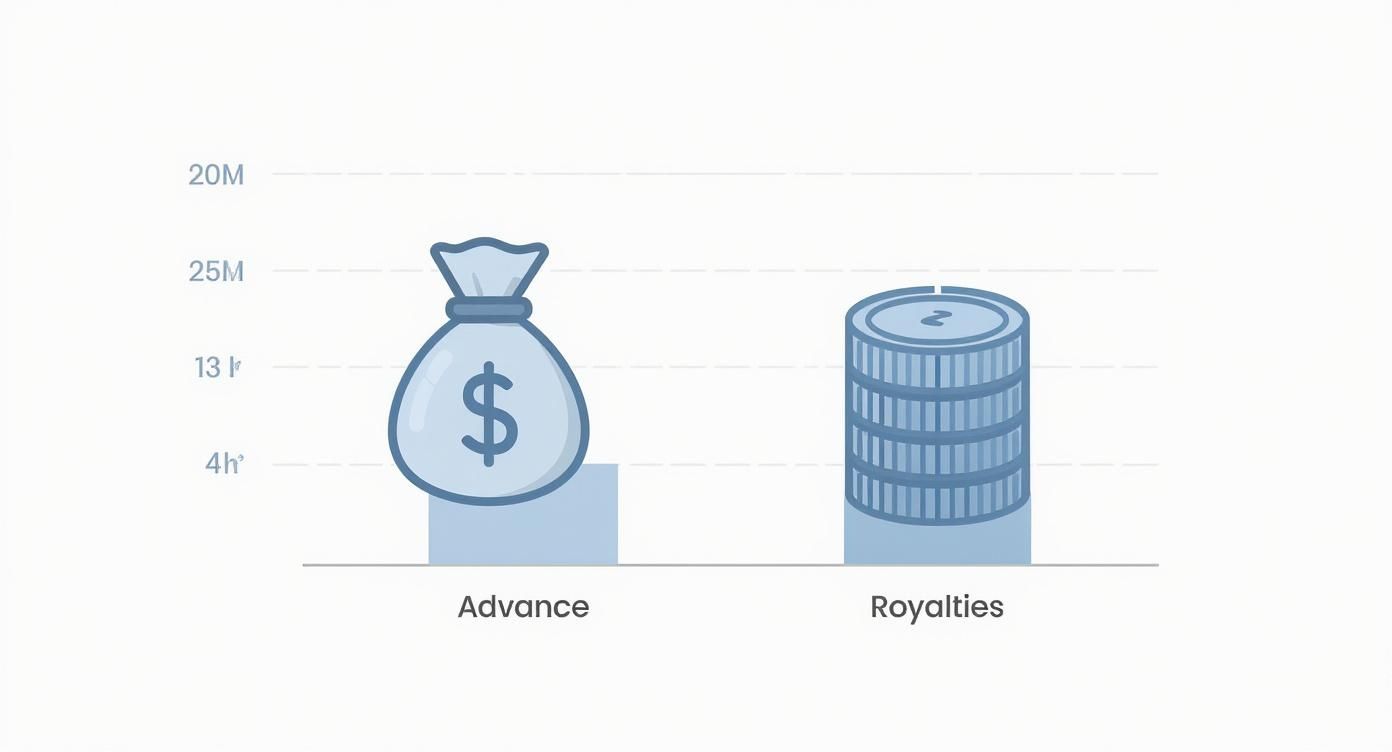
As you can see, an advance is a nice guaranteed payout, but the potential to earn more over the life of a successful book through higher royalty rates can be significantly greater.
Hybrid Publishing: Finding a Middle Ground
Hybrid publishing tries to offer a blend of both worlds. In this model, an author pays a fee to a publishing company for their professional services—think editing, design, and distribution support.
Because you’re sharing the financial investment, the royalty rates are much better than traditional deals but not quite as high as going it completely alone. A hybrid publisher might offer something in the 20-50% range. This can be a great option for authors who want professional guidance but also want more creative say and a larger share of the profits. To dig deeper into these models, check out our guide on traditional vs. self-publishing options.
To make it even clearer, let's break down what you can generally expect from each path.
Typical Book Royalty Rates by Publishing Model
| Publishing Model | Hardcover Royalty | Paperback Royalty | Ebook Royalty |
|---|---|---|---|
| Traditional Publishing | 10% – 15% of retail price | 5% – 7.5% of retail price | 25% of net receipts |
| Hybrid Publishing | 15% – 25% of net receipts | 15% – 25% of net receipts | 25% – 50% of net receipts |
| Self-Publishing | 40% – 60% of list price (minus print costs) | 40% – 60% of list price (minus print costs) | 35% – 70% of list price |
Keep in mind these are just industry averages. The actual numbers can vary based on the publisher, the platform, and your own negotiating power.
Ultimately, there is no single "best" path. The right choice comes down to your personal goals, your budget, and how much of an entrepreneur you want to be. After all, a high royalty percentage doesn't mean much if the book isn't selling.
Let's Do the Math: How Royalties Look in the Real World
This is where the rubber meets the road. Seeing how abstract percentages translate into actual dollars and cents is the key to understanding your real earning potential as an author. But before we crunch the numbers, we need to talk about the single most important detail in any royalty clause: list price vs. net receipts.
This one distinction can make a massive difference to your bottom line.
-
List Price (or Retail Price): This is the simple, straightforward cover price. If your book is priced at $25.00 and you get a 10% royalty, you earn $2.50 for every copy sold. Easy.
-
Net Receipts (or Net Revenue): This is a bit trickier. It's the money the publisher actually gets after the bookstore or retailer (like Amazon or Barnes & Noble) takes its cut. For that same $25.00 book, a retailer might take a 50% discount, meaning the publisher only sees $12.50. Your royalty is then calculated on that smaller amount.
As you can see, a "net receipts" deal can literally cut your per-book earnings in half. Pay very close attention to this in your contract. Now, let's walk through a few common scenarios.
Example 1: The Traditionally Published Hardcover
You’ve landed a deal for your debut novel! It’s a hardcover with a list price of $26.99, and your contract has a standard tiered royalty rate based on the list price.
Here's how your earnings would likely stack up as sales grow:
- For the first 5,000 copies sold: You're on a 10% royalty.
$26.99 (List Price) x 0.10 (Royalty Rate) = $2.70 per book
- For the next 5,000 copies (from 5,001 to 10,000): Your rate jumps to 12.5%.
$26.99 (List Price) x 0.125 (Royalty Rate) = $3.37 per book
- For all sales over 10,000: You hit the top tier of 15%.
$26.99 (List Price) x 0.15 (Royalty Rate) = $4.05 per book
Just remember, if you received a $20,000 advance, you won't see any of these direct royalty payments until you've "earned out." In this case, you'd need to sell about 7,408 copies at the 10% rate to pay back the advance.
Example 2: The Self-Published Ebook on Amazon KDP
Let's flip the script and say you've self-published your ebook on Amazon KDP. You've priced it competitively at $4.99, which qualifies you for the much-loved 70% royalty option.
The math here is a little different. Amazon also subtracts a tiny "delivery fee" based on your book's file size. Let's imagine that fee is $0.08.
$4.99 (List Price) x 0.70 (Royalty Rate) = $3.49$3.49 - $0.08 (Delivery Fee) = $3.41
You walk away with $3.41 for every ebook sold.
What's fascinating here is that even with a much lower cover price, your take-home pay per unit is higher than the starting rate for the traditionally published hardcover. This really shows the power of high-margin digital products.
Example 3: The Print-on-Demand Paperback
Finally, let's look at a self-published paperback using a print-on-demand (POD) service, whether it's through KDP or a platform like IngramSpark. The game-changer here is the printing cost, which is always deducted before you get paid.
Let's say your 300-page book is listed at $15.99. The printing cost is a fixed $4.60 per book, and KDP's paperback royalty rate is 60%.
Here’s how it breaks down:
- First, we figure out the royalty before costs.
$15.99 (List Price) x 0.60 (Royalty Rate) = $9.59
- Next, we subtract the cost to print the book.
$9.59 - $4.60 (Print Cost) = $4.99- Your profit on every paperback sold is $4.99.
Running these numbers for your own project is crucial. It pulls the curtain back on how your publishing path and format choices directly impact your bank account, helping you make smarter decisions to hit your financial goals as an author.
How Ebook and Audiobook Royalties Work
The jump to digital formats has completely changed the game for author earnings. Ebook and audiobook royalties work on a whole different set of rules compared to traditional print, and getting your head around them is key to making the most of your book's potential.
Here's the most important thing to remember: unlike print books that often pay you based on the cover price, digital royalties are almost always calculated from net receipts. That’s the money left after the online store (like Amazon or Apple) takes its cut. It’s a crucial difference that directly shapes how much you make per copy sold.
Breaking Down Ebook Royalty Rates
When you think of ebooks, you probably think of Amazon's Kindle Direct Publishing (KDP), and for good reason—it’s the biggest player in the market. But on KDP, your royalty isn't a simple flat rate. It all hinges on how you price your book.
KDP gives you two main options:
- The 70% Royalty Option: This is the one you want. To get it, your ebook has to be priced between $2.99 and $9.99. It's the sweet spot where most self-published authors live, and it maximizes your profit on every sale.
- The 35% Royalty Option: If you price your book below $2.99 or go above $9.99, your royalty rate gets slashed to just 35%. A super-low price might seem tempting for a promotion, but it takes a big bite out of your income for each download.
This pricing choice is easily one of the biggest financial decisions you'll make as an indie author. While Amazon sets the pace with its 35% or 70% tiers, other stores have their own compelling offers. Apple Books, for instance, offers a straight 70% royalty. Kobo Writing Life gives you 70% for ebooks priced over $2.99, but it drops to around 45% for cheaper books.
What About Kindle Unlimited?
Then there’s Kindle Unlimited (KU), which adds another wrinkle. Instead of getting paid for a sale, you get paid for every page a subscriber reads from your book. The per-page rate changes every month, but it usually sits around $0.005. If someone reads your 300-page book from start to finish, you might earn about $1.50. It’s less than a direct sale, but for many authors, the sheer volume of KU reads can add up to a very healthy income stream.
Navigating Audiobook Royalties
Audiobooks are booming, but their royalty structures can feel even more complicated. The go-to platform for most indie authors is Audible’s ACX (Audiobook Creation Exchange), and right out of the gate, it forces you to make a big decision.
At its core, ACX asks you to choose between an exclusive or non-exclusive distribution deal. This single choice will dramatically alter what you can earn.
- Exclusive Distribution: If you agree to sell your audiobook only through Audible, Amazon, and iTunes, you get the highest royalty rate—up to 40%. You gain access to the biggest audience by far, but you can’t sell your audiobook anywhere else.
- Non-Exclusive Distribution: If you want the freedom to sell your audiobook on other platforms like Kobo, Google Play, or even directly from your own website, your ACX royalty rate drops to 25%.
The trade-off is pretty straightforward: a higher royalty per sale versus a much wider reach. On top of that, how you produce the audiobook also plays a role. If you pay a narrator their fee upfront, you get to keep your full royalty share. But if you do a "royalty share" deal with your narrator to avoid upfront costs, you split your earnings 50/50 with them forever. It’s a great way to get started with no money down, but it cuts your long-term income in half.
If you're weighing these options, our guide on where to sell my ebook offers some great insights that can also help shape your audiobook strategy.
How to Read Your Royalty Statement and Get Paid
That first royalty statement landing in your inbox is a huge moment. It's tangible proof that your book is out in the world, selling. But then you open it, and it feels like you're trying to read a different language. Don't worry, they can be confusing, but once you know what to look for, they tell a fascinating story about your book's journey.
Learning to decode these reports is a crucial skill. It’s how you’ll understand your book's performance, track its financial health, and know exactly when you'll see money in your bank account.
Think of it as a financial report card for your book over a specific period, usually every six months. It breaks down every sale, return, and deduction to show you precisely how your final payment figure was reached.
Decoding Key Terms on Your Statement
When you first glance at the statement, a few key terms will pop out. Getting a handle on these is the first step to making sense of it all.
- Gross Units Sold: This is the total number of books your publisher shipped out to retailers. It’s a big, encouraging number, but it's not the one your payment is based on.
- Returns: Bookstores have the right to send back unsold copies for a full credit. This figure shows how many books were returned, and it gets subtracted from the gross number.
- Net Units Sold: This is the number that really matters. It’s gross units minus returns, giving you the final count of how many copies actually stayed sold. Your royalties are calculated based on this figure.
- Reserve Against Returns: Publishers anticipate that some books sold near the end of a reporting period might be returned in the next period. To buffer against this, they hold back a percentage of your earnings as a "reserve." This isn't money you've lost; it will be paid out on a future statement if those books aren't returned.
A reserve against returns is essentially the publisher's financial safety net. It prevents them from overpaying an author for books that might just end up back in the warehouse, ensuring the accounting stays accurate over time.
Understanding Payment Schedules and Delays
One of the first questions almost every new author asks is, "Why does it take so long to get paid?" It can be a shock, but the delay between a book sale in a store and you receiving your check is a standard, if sometimes frustrating, part of the publishing cycle.
For starters, most publishers only issue statements and payments semi-annually, meaning you might only get paid twice a year. On top of that, there's a significant time lag. The statement you get in September, for instance, probably covers sales from January through June of that same year.
This delay gives retailers time to finalize their sales reports and for all those returns to be processed. While the wait can test your patience, it’s all in the name of accurate reporting. If you’re eager for more immediate feedback, you can learn more about how to track book sales using dashboards and other tools for a closer-to-real-time view.
Managing Your Financial Responsibilities
The moment you earn royalties, you're officially running a business—your author business. And with that comes some important financial housekeeping, especially when it comes to taxes.
Your royalty check will be accompanied by a tax form, most likely a 1099-MISC if you’re in the United States. It's up to you to report this income to the government and pay the appropriate taxes on it.
Because an author's income can be notoriously inconsistent, it's a very smart move to set aside a portion of every royalty payment specifically for your tax bill. I always recommend talking to a tax professional who gets the creative industries. They can be a lifesaver, helping you spot potential business deductions and turning a confusing obligation into a manageable part of your career.
Actionable Strategies to Maximize Your Book Royalties
Knowing how book royalties work is one thing. Actually growing them is a whole different ballgame. It's time to shift from being a passive earner to an active strategist—that's how you build a real, sustainable writing career.
Whether you've got a traditional contract or you're running the show as an indie author, the power to boost your earnings is in the details. It comes down to everything from the fine print in your contract to smart, targeted promotions.
Let's dig into some real-world strategies you can use to squeeze every last drop out of your royalty potential.
Negotiate Your Contract with Confidence
If you’re going the traditional route, that contract negotiation is the single most important moment for your financial future. It's easy to get dazzled by a big advance, but focusing only on that number is a rookie mistake.
Look past the advance and zoom in on the royalty rates. Even more importantly, fight tooth and nail to keep your subsidiary rights. These are the rights to create other things based on your book, and they can be a goldmine.
Here are the rights you absolutely want to protect:
- Film and Television Rights: A movie or TV deal can change your life overnight.
- Foreign Translation Rights: Selling your book in other languages opens up entirely new markets and revenue streams.
- Audiobook Rights: If you hang onto these, you can produce the audiobook yourself and earn a much, much higher cut.
When you retain these rights, it means that if Hollywood comes calling or your book becomes a bestseller in Germany, that money flows straight to your bank account, not your publisher's.
Master Dynamic Pricing and Promotions
For self-published authors, your greatest weapon is total control over pricing. This lets you get creative and run dynamic strategies that drive sales volume and, ultimately, your total royalties.
Don't just set a price and walk away. Play with it! Run a limited-time discount or even a free promo to hook new readers and get a little boost in the sales rankings. A $0.99 weekend sale can generate a wave of new fans who stick around to buy your other books at full price long after the deal is over.
The global book market is huge and only getting bigger—it's projected to reach $156.04 billion by 2030. Digital formats are a massive piece of that pie. You can dive deeper into the numbers with these book sales statistics on Newprint.com. If you’re not using smart, flexible pricing to tap into this global digital readership, you’re leaving money on the table.
Your backlist is your long-term financial engine. Every new book you release is not just a single product; it's a marketing tool for all your previous work, creating a stable and diversified income stream.
One of the most powerful long-term plays is building a solid backlist—your catalog of older books. Every time you launch a new book, you introduce a fresh wave of readers to your entire world. Many of them will circle back to buy your previous work.
This creates a fantastic compounding effect, turning your books into assets that can generate a steady stream of income for years to come.
Common Questions About Book Royalties
Once you get a handle on the basics, you'll find that specific questions about book royalties still come up. It's totally normal. Here are some straightforward answers to the things authors ask most often as they figure all this out.
Do Authors Get Paid When I Borrow a Book From the Library?
Yes, they absolutely do! It's not quite the same as a bookstore sale, but authors definitely earn money from library books.
When a library buys a physical copy of a book, the author gets a royalty from that one-time sale, just as if you'd bought it yourself. Simple as that.
For ebooks and audiobooks, it’s a little different. Libraries license digital copies through platforms like OverDrive or Hoopla. Sometimes, the author gets a one-time payment for that license. Other times, especially with models like Hoopla's, the author might get a small payment every single time someone borrows their book, which can add up over time.
Is It Better to Buy a Paperback or an Ebook to Support an Author?
Great question, and the honest answer is, it really depends on how the author published their book.
- For a self-published author, an ebook sale is often where they make the most money. For example, an indie author might walk away with $4.13 from a $5.99 ebook, but only $4.39 from a $14.99 paperback after you subtract the printing costs. The ebook clearly has a much healthier profit margin.
- For a traditionally published author, the numbers can be a bit different, but ebooks still tend to provide a strong return for them because the royalty is based on the publisher’s net revenue.
At the end of the day, the best way to support any author is to buy their book in whatever format you'll actually read and enjoy. A sale is a sale, and every single one truly helps.
Want to give an author the biggest financial boost? Try buying directly from their personal website or their publisher's online store if they have one. This cuts out the middleman, meaning more of your money goes straight to the creator.
How Much Is a Typical Book Advance?
This is the million-dollar question, isn't it? Advances are all over the map and depend heavily on the publisher, the book's genre, and the author's previous sales. Sure, a big-name celebrity can land a multi-million dollar deal, but for most writers, the numbers are much more down-to-earth.
Recent data suggests the median advance for an author is around $25,000.
But that figure can swing wildly. For example, the average for adult fiction might hover closer to $65,000, while a debut author might see much less. And don't forget, an advance isn't just a bonus—it's a loan against your future royalties that you have to earn back.
At BarkerBooks, we think you deserve total clarity on how you earn money from your work. We provide the professional support and global distribution you need to turn your manuscript into a success story. Explore our publishing packages today and start your journey with a partner you can trust.