
For many authors, book royalties are the light at the end of the tunnel—the reward for all the hard work. But what are they, really? In simple terms, a book royalty is the commission you earn every time a copy of your book sells. It’s calculated as a set percentage of the book’s price.
The exact rate you get isn’t one-size-fits-all. It’s shaped by your publishing path—whether you go with a traditional publisher, self-publish, or choose a hybrid model—and the book’s format, like hardcover, paperback, or ebook.
How Do Royalties for Books Actually Work

Think of a book royalty as your slice of the pie for every sale. When you sign a publishing contract or upload your manuscript to a platform like Amazon KDP, you’re agreeing to a specific percentage you’ll receive. This is the bedrock of how an author gets paid, but the fine print can change everything.
The biggest factor swaying your potential earnings is how you choose to publish. Each route strikes a different balance between risk, creative control, and reward, which directly ties into your bottom line.
- Traditional Publishing: Here, authors typically see a smaller percentage, often between 7.5% and 15% on print books. The trade-off? The publisher foots the bill for all production, marketing, and distribution.
- Self-Publishing: This path offers the highest potential royalty rates, sometimes climbing as high as 70% on ebooks. The catch is that you, the author, are responsible for every upfront cost, from editing and cover design to marketing campaigns.
Understanding Royalty Structures
Beyond the publishing model, the book's format also plays a huge role in your royalty rate. A hardcover edition, which is more expensive to produce, will naturally have a different royalty structure than a nearly-zero-cost ebook.
Paperback royalties are almost always lower than hardcover rates. And ebooks? They often have their own unique calculation, sometimes based on a sale price you get to set yourself.
The key takeaway is that your royalty isn't a single, fixed number. It’s a dynamic figure influenced by your contract, the format of your book, and the sales channels it's sold through.
This performance-based income means your earnings are directly tied to how well your book connects with readers. Getting a handle on these payment structures is a must for any serious author. For a wider perspective on how creative professionals are paid, it can be interesting to see how various creators are compensated in other fields.
To help make sense of it all, let's break down what you can generally expect to see.
Typical Royalty Rate Ranges at a Glance
This table gives a quick snapshot of the standard royalty percentages authors can expect from different publishing models and book formats.
| Format | Traditional Publishing | Self-Publishing (e.g., KDP) | Hybrid Publishing |
|---|---|---|---|
| Hardcover | 10% – 15% of retail price | N/A (Author sets price) | 15% – 50% of net receipts |
| Paperback | 5% – 8% of retail price | 40% – 60% of list price | 15% – 50% of net receipts |
| Ebook | 25% of net receipts | 35% or 70% of list price | 50% of net receipts |
As you can see, the numbers vary wildly. Your publishing choice doesn't just impact your creative journey; it has a massive effect on your bank account.
Breaking Down the Different Royalty Types
So, you get that you earn a percentage from book sales. That’s the easy part. The real trick is understanding that not all royalties for books are the same. Your book’s format and the fine print in your publishing contract will split your income into different streams, each with its own set of rules and rates.
Think of it like a diversified investment portfolio. You wouldn't put all your money into one stock, right? It’s the same with your book. Income can flow from print, digital, audio, and a handful of other sources. Knowing how each one works is the key to actually making a living from your writing.
Print Royalties: Retail vs. Net Price
When it comes to physical books—your hardcovers and paperbacks—the single most important detail in your contract is whether your royalty is based on the retail price or the net price. This one word can make a massive difference to your bottom line.
-
Retail Price Royalties: This is the straightforward one. It’s calculated based on the book’s cover price. If your book is priced at $20 and your royalty is 10%, you get $2 for every copy sold. Simple.
-
Net Price Royalties: This is where it gets a little murkier. "Net" is the amount the publisher actually receives after giving deep discounts to wholesalers and retailers. That same $20 book might be sold to a bookstore for 50% off, so the publisher only gets $10. Your royalty is then calculated on that $10, not the full $20.
As you can guess, a net royalty almost always means a smaller check for the author. You have to know which model your contract is built on.
Key Insight: The difference between "retail" and "net" isn't just publishing jargon; it’s a critical factor that directly controls how much money lands in your bank account. Always, always get clarity on this during negotiations.
Ebook and Digital Royalties
The digital world plays by a completely different set of rules. With no printing, warehousing, or shipping costs, the potential for a bigger author payout is huge. But it also means your pricing strategy becomes incredibly important.
With a traditional publisher, you might see an ebook royalty of 25%, a nice jump from the typical 7.5% to 15% for print. But if you self-publish through a platform like Amazon KDP, you can earn as much as 70% on ebooks priced in that sweet spot between $2.99 and $9.99. You can dive deeper into how these numbers stack up with some book sales statistics from Newprint.com.
This tiered system means your pricing decision directly dictates your royalty percentage. Price it too high or too low on some platforms, and your earnings can get slashed in half overnight.
Audiobook Royalties Uncovered
Audiobooks are booming, opening up another fantastic income stream for authors. But the royalty structure here adds a new wrinkle: production costs.
If the publisher fronts the cash to produce the audiobook—hiring the narrator, booking the studio, handling the engineering—they’ll recoup those costs from sales before you see a dime. It works just like an advance. In other cases, you might find royalty-share deals where you and the narrator split the earnings, often with no upfront cost to either of you.
Subsidiary Rights: The Hidden Income Stream
Beyond the book itself, a huge and often overlooked source of income comes from subsidiary rights (or "subrights"). This is simply the right to use your book's content in other ways.
This is where a single manuscript can explode into a global, multi-format property. Common subrights include:
- Foreign Translation Rights: Selling the rights to publish your book in another language.
- Film and Television Rights: A production company options your story for a movie or TV show.
- Merchandise Rights: Allowing your characters or world to be featured on t-shirts, mugs, and more.
- Book Club Rights: Special print runs for major book clubs.
These deals can be incredibly lucrative, sometimes earning you far more than the original book sales ever did. Publishers and authors typically split the revenue from these deals, but the author should always get the lion's share—often in the 70-90% range. Managing these rights well can completely change your financial future as an author.
Understanding Advances Against Royalties
In traditional publishing, one of the most exciting terms you’ll hear is the "advance." It's easy for new authors to think of this as a signing bonus, but that’s not quite right. An advance is actually an upfront payment of the royalties your publisher expects your book to earn down the line.
Think of it as the publisher giving you a loan against your book's future income. They're making a calculated bet on you and your work, giving you money to live on while you're writing or to support your promotional efforts. The best part? This money is yours to keep, no matter how many copies your book eventually sells.
What It Means to Earn Out Your Advance
Once your book hits the shelves and starts selling, you won't immediately get royalty checks in the mail. Instead, every dollar your book earns in royalties first goes toward paying back that initial advance. This is called "earning out."
Only after your book's earnings have completely covered the advance do you start receiving additional royalty payments.
Let's break it down with a simple example:
- The Advance: Imagine your publisher offers you a $10,000 advance.
- The Royalty: Your contract specifies that you earn $2 for every hardcover sold.
- The Calculation: To see when you'll earn out, just divide the advance by your per-book royalty: $10,000 ÷ $2/book = 5,000 books.
- The Result: You need to sell 5,000 copies before you see another dime. But once that 5,001st book sells, that $2 royalty for each sale comes straight to you.
How Publishers Determine an Advance
Publishers aren't just guessing when they make an offer. An advance is a business decision based on a forecast of your book's potential sales. They're weighing several factors to decide how big of a bet to place.
Here’s what they’re looking at:
- Your Author Platform: Do you have a big social media following, a popular blog, or an engaged email list that can drive initial sales?
- Your Sales Track Record: For previously published authors, they’ll dig into the sales data from your past books.
- Market Trends: Is your book in a hot genre? Does the topic tap into a current cultural conversation?
- The Publisher's Enthusiasm: Sometimes, an editor just falls in love with a manuscript and champions it internally, convincing the team to make a bigger investment.
A debut author with a modest online presence might get an advance in the $5,000 to $20,000 range. On the other hand, a big-name author or a book caught in a bidding war could easily land a six- or even seven-figure deal.
A larger advance is exciting, but it also comes with higher expectations. The publisher has made a significant investment and will expect a strong sales performance to justify it, which can add considerable pressure on the author.
The great news for authors is that advances are almost always non-recoupable. If your book doesn't earn back the full amount, you don't have to write the publisher a check for the difference. The publisher absorbs that financial risk. This security is one of the biggest draws of a traditional publishing deal, giving authors a financial cushion as they focus on their writing.
A Practical Guide to Calculating Your Royalties
Knowing the theory behind book royalties is great, but seeing the numbers in action is where it all clicks. When you can move past the concepts and actually do the math, you start to get a real feel for how your book will generate income.
Let's break down a few real-world examples. We'll look at different formats and publishing routes to show how things like wholesale discounts, platform fees, and production agreements can really change what you take home.
Scenario 1: The Traditionally Published Hardcover
Imagine you've landed a traditional publishing deal for your debut novel. The publisher prices the hardcover at $26.00, and your contract specifies a 10% royalty. Here’s the catch, though: that 10% is almost always based on the net price, not the retail price.
So, what does that mean? The publisher sells your book to bookstores at a deep discount, typically around 50%. They aren't getting the full $26.00 from Barnes & Noble; they're getting half of that—$13.00. Your royalty is calculated from that smaller number.
- Retail Price: $26.00
- Wholesale Discount: 50% ($13.00)
- Net Price (What the publisher receives): $13.00
- Your Royalty (10% of Net): $1.30 per book
For every $26.00 book someone buys, you earn $1.30. This is exactly why the "retail vs. net" clause in your contract is one of the most important lines to understand. It makes a world of difference.
And remember, you won't see a dime of that royalty money until your sales have "earned out" your initial advance.
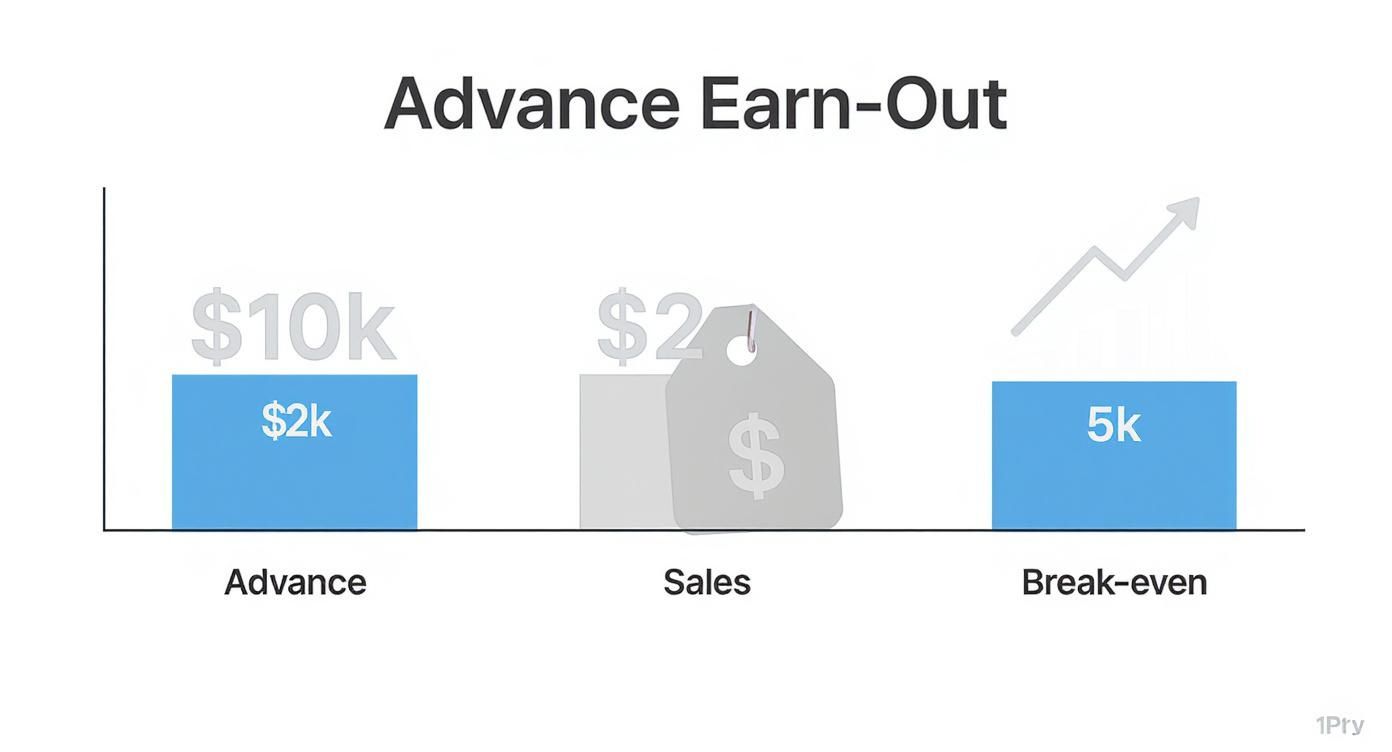
As the infographic shows, if you received a $10,000 advance and earn $2.00 per book, you need to sell 5,000 copies just to break even before those royalty checks start arriving.
Scenario 2: The Self-Published Ebook
Let's flip the script and say you're self-publishing an ebook on a platform like Amazon KDP. Here, you're in the driver's seat. You set the price, and that choice directly impacts your royalty rate.
Let's say you price your ebook at $4.99. This smart move puts you in KDP's 70% royalty tier, which is a huge jump from the traditional model.
But it’s not quite a simple 70% cut. Digital platforms also charge a tiny "delivery fee" based on your ebook's file size to cover bandwidth costs. If your file is a standard size, that fee might be around $0.12 per download.
Here’s the breakdown:
- List Price: $4.99
- Royalty Rate: 70%
- Gross Royalty: $4.99 x 0.70 = $3.49
- Subtract Delivery Fee: $3.49 – $0.12
- Your Net Earning: $3.37 per ebook sold
Suddenly, you're earning significantly more per unit. It’s also a good reminder that a well-formatted, smaller ebook file literally puts more money in your pocket on every single sale.
The real power of self-publishing is this direct link between your pricing strategy and your royalty rate. Bumping your price from $2.98 to $2.99 on Amazon can be the difference between a 35% and a 70% royalty, completely changing your financial picture.
Scenario 3: The Audiobook Royalty Share
Finally, let's explore the world of audiobooks, specifically through a royalty-share agreement. This is a fantastic option for indie authors because you avoid paying thousands of dollars for a narrator and producer upfront. Instead, you split the profits.
A platform like ACX (Audiobook Creation Exchange) offers a 40% royalty if you agree to distribute exclusively through them, Audible, and iTunes. That 40% is then split down the middle: half for you, half for the narrator.
If your audiobook is priced at $19.95, the math works like this:
- Sale Price: $19.95
- Platform Royalty (40%): $19.95 x 0.40 = $7.98
- Your 50% Share of Royalty: $7.98 ÷ 2 = $3.99
- Narrator's 50% Share: $3.99
You pocket $3.99 per sale without spending a penny on production costs, making it a very low-risk way to get into the booming audiobook market.
To truly understand which formats are working for you, it’s critical to track book sales across all your different platforms and retailers. That data tells you where to focus your marketing energy.
Sample Royalty Calculation Scenarios
To bring it all together, here’s a table showing how earnings might stack up for an author who sells 5,000 copies of their book through these different paths.
| Scenario | Retail Price | Royalty Rate | Gross Sales | Net Earnings for Author |
|---|---|---|---|---|
| Traditional Hardcover | $26.00 | 10% of Net | $130,000 | $6,500 |
| Self-Published Ebook | $4.99 | 70% (minus fees) | $24,950 | $16,850 |
| Audiobook (Royalty Share) | $19.95 | 20% (author's share) | $99,750 | $19,950 |
These numbers paint a clear picture: there's no single "best" way to publish. The right path depends on your goals, risk tolerance, and how involved you want to be in the process.
Ultimately, "royalties for books" isn't a one-size-fits-all formula. It’s a dynamic calculation that shifts with your publishing model, format, and the fine print in your contracts.
How Your Publishing Path Affects Your Paycheck
The biggest decision you'll make for your author income isn't about your genre or marketing plan. It all comes down to your publishing path. Choosing between traditional, self-publishing, or a hybrid model is a fork in the road that defines everything: your control, upfront costs, and, most critically, the royalties for books you'll earn.
Think of it as picking a business model for your book. Each path has its own unique balance of risk and reward, designed for authors with different goals and comfort levels with entrepreneurship. Getting a handle on these trade-offs is the first real step to building a career that lasts.
The Traditional Publishing Route
Signing with a traditional publisher is a bit like partnering with a big, established corporation. They foot the bill for everything upfront—we're talking editing, cover design, printing, distribution, and marketing. You pay nothing out of pocket and usually get an advance, which is essentially a pre-payment on your future royalties.
So, what's the catch? In exchange for that security, you get a much smaller slice of the revenue. Royalty rates are lower because the publisher took on all the financial risk. You get their industry muscle and massive distribution network, but you hand over a lot of creative control and a big chunk of every sale.
The Self-Publishing Revolution
Self-publishing puts you squarely in the driver's seat. You're the CEO, the publisher, and the creative director all in one. This means you have the final say on every single detail, from the last word in the manuscript to the final marketing campaign. Best of all, you keep a much, much larger share of the profits.
Of course, with great control comes great financial responsibility. You’re on the hook for funding the entire operation yourself. Every dollar for editing, design, formatting, and marketing comes straight from your bank account. This path promises the highest potential reward, but it also carries the biggest upfront financial risk.
The Hybrid Publishing Middle Ground
Hybrid publishing tries to strike a balance, offering a bit of the best from both worlds. In this model, authors invest in their project to partner with a publishing company. That investment pays for the same professional services you’d get from a traditional house.
Because you're sharing the risk, you get much higher royalty rates than a traditional deal—often in the 25% to 50% range. You get the professional support and distribution you need without giving away the lion's share of your earnings. It’s a great fit for authors who want expert guidance and are willing to invest in their own work to see a better long-term return.
The core difference really boils down to this: Who invests and who profits? In traditional publishing, the publisher invests and takes most of the profit. In self-publishing, you invest and take all the profit. Hybrid splits that difference.
Weighing these models is a crucial step for any author planning their career. To dive deeper into this, you can check out our guide on traditional vs self-publishing.
The royalty rates alone paint a pretty clear picture. With a traditional publisher, authors typically see between 7.5% and 15% of the retail price for print books. On the flip side, self-publishing platforms like Amazon KDP can offer up to 70% on ebooks priced between $2.99 and $9.99. As you can see, the numbers vary wildly. You can discover more insights about book industry statistics on zipdo.co.
Choosing your path isn't just a creative decision—it's a financial one that will shape your earning potential for years.
Strategies to Maximize Your Author Royalties

Knowing how royalties for books are calculated is just step one. The real game begins when you start actively working to increase them. You're not just a passive recipient waiting for a check to arrive—you can take the driver's seat and make choices that seriously boost your long-term earnings, no matter how you publish.
It all comes down to thinking like a business owner. Every decision, from negotiating a contract clause to setting your ebook price, has a direct impact on your bank account.
Strengthen Your Contract Terms
If you're going the traditional route, the contract negotiation is your golden opportunity to set yourself up for a better financial future. While some parts of a publishing agreement are pretty standard, many terms are more flexible than you might think. Don't be afraid to push for a better deal.
Here are a few key areas to focus on:
- Royalty Escalators: This is a big one. Ask for your royalty percentage to climb as you sell more books. For instance, your rate could jump from 10% to 12.5% after the first 5,000 hardcover copies are sold.
- Subsidiary Rights: Try to hold onto as many subrights as you can, like foreign translation or film rights. If the publisher insists on controlling them, negotiate for a much larger slice of the revenue—you should be aiming for the 70-90% range.
- Advance Structure: A massive advance feels great, but it also means you have a bigger hole to dig out of before you see a single royalty payment. Sometimes, a smaller advance is smarter because you'll "earn out" faster and start receiving those ongoing checks sooner.
Leverage Your Author Platform
An engaged audience—your social media followers, newsletter subscribers, and blog readers—is one of your greatest financial assets. Think of it as currency. Publishers are far more willing to offer a higher advance and better terms to an author who can essentially guarantee a chunk of initial sales.
Building a direct connection with your readers isn't just about marketing; it's a direct investment in your earning potential. It gives you leverage in negotiations and a built-in customer base for every new release.
Master Your Pricing Strategy
For self-published authors, pricing is your most powerful tool. You have direct control over a lever that influences both your sales volume and your royalty rate per sale. Amazon KDP, for example, famously offers a 70% royalty rate for ebooks priced between $2.99 and $9.99, but that rate plummets to just 35% for any price outside that sweet spot.
A tiny price change can literally double what you earn on each book sold. You can experiment with promotional pricing, create box sets, and run strategic discounts to drive sales and maximize your income. To dig deeper, you can learn more about how to price your book for the best results. By actively managing your pricing, you can keep your books in the highest royalty tiers and attract a much wider readership.
Common Questions About Book Royalties
Even once you get the math down, the practical side of royalties can still feel a bit murky. Things like payment schedules, taxes, and how your agent fits into the picture bring up a whole new set of questions. Let's clear up some of the most common ones.
When Do I Get Paid?
Don't expect a check the day after your book sells. Traditional publishers usually pay out royalties twice a year. They'll take a six-month period, add up all your sales, and then send you a statement and payment a few months after that period ends.
For instance, you might get a statement in September covering sales from January through June, with your payment arriving soon after. It's a different story with self-publishing platforms. Amazon KDP, for example, is much quicker on the draw, typically paying authors monthly, about 60 days after the end of the month the sales were made.
Do I Have to Pay Taxes on My Royalties?
Yes, you absolutely do. Any money you make from your book—whether it’s part of your advance or your regular royalty checks—is considered taxable income. The best thing you can do is treat your writing like a small business from day one and stash away a portion of every payment for tax season.
Remember: Your publisher or agent won't withhold taxes for you. The check you get is the gross amount, and you're the one responsible for handling federal, state, and local taxes.
A simple pro-tip? Open a separate bank account just for your writing income. It makes tracking everything for tax purposes a whole lot easier.
How Does a Literary Agent Get Paid?
If you've got a literary agent, they're your partner in the deal, and they work on commission. In short, they don't make a dime until you do. The industry standard is a 15% commission on domestic deals and 20% for foreign sales, which require more legwork.
Here’s how it works: the publisher sends your advance or royalty payment to your agent’s agency first. The agency takes out their commission and then sends the remaining 85% on to you. An agent earns that percentage by fighting for the best possible contract and advance on your behalf.
What Happens if My Book Goes Out of Print?
Sometimes, a traditionally published book’s sales slow down to a trickle, and the publisher decides it's no longer worth keeping it in stock. When this happens, they can declare it "out of print."
But that doesn't have to be the end of the road for your book. Your contract should include a "reversion of rights" clause. This is a critical piece of the agreement that says if sales dip below a certain number for a specific amount of time, you can officially ask for the rights to your work back.
Once those rights revert to you, you're free to give the book a second life by self-publishing it or even selling it to a new publisher.
Figuring out the world of royalties can feel overwhelming, but you don't have to go it alone. The expert team at BarkerBooks is here to guide authors through the entire publishing journey, from the first draft to the final sale. We make sure you have the clarity and support you need to maximize your earnings and hit your goals. Find out how we can help you publish your book.