
Imagine your story reaching over 500 million potential readers across more than 20 countries. That’s not just a number; it’s the incredible opportunity that comes with publishing in Spanish. You’re opening the door to a vibrant, growing global market that is genuinely hungry for new voices and fresh stories.
Your Gateway to 500 Million New Readers
This guide is your roadmap. My goal here is to take what feels like a complicated process and break it down into a series of achievable milestones. We’ll walk through the entire journey together, from adapting your manuscript for a new culture all the way to mastering global distribution and marketing. Think of this as your field guide, built from real-world experience to help you navigate the unique details of the Spanish-speaking literary world.
The Opportunity in Numbers
The Spanish book market isn’t just big; it’s thriving. To give you some perspective, in 2024, Spain’s publishing industry hit a major milestone, pulling in over €3 billion in domestic sales for the first time since the 2008 financial crisis. This isn’t a fluke—it marks 11 straight years of revenue growth.
Ebooks are a huge part of this story, generating €165.5 million, which is a 14.9% jump from the year before. You can dig deeper into these trends over at Publishing Perspectives.
This financial upswing points to a strong, receptive audience ready for your work. Reaching them isn’t a pipe dream; it’s absolutely within your grasp if you have the right strategy.
To put this opportunity into clearer focus, let’s break down what the market looks like for an author like you.
Spanish Publishing Market at a Glance
This table breaks down key market indicators and growth areas, highlighting the tangible opportunities for authors considering publishing in Spanish.
| Market Indicator | Key Statistic | What This Means for You |
|---|---|---|
| Total Readership | 500+ Million Spanish speakers | Your potential audience is massive and geographically diverse, spanning Europe, North America, and Latin America. |
| Ebook Growth | 14.9% year-over-year increase | The digital market is booming. Readers are actively buying and reading ebooks, making digital-first a viable strategy. |
| Market Value (Spain) | €3+ Billion in 2024 | This isn’t a niche market; it’s a major commercial industry with significant consumer spending on books. |
| Global Reach | 20+ official Spanish-speaking countries | You can target multiple national markets (like Mexico, Argentina, Colombia) with a single translated or original work. |
The takeaway is simple: the demand is there, and the market is healthy. Your next step is figuring out how to tap into it.
What This Guide Will Cover
We’re going to set the stage for your global success by breaking down every essential component. Think of this guide as your complete resource, covering every critical step from start to finish.
Here’s a glimpse of what we’ll dive into:
- Getting Your Manuscript Ready: We’ll tackle the big question: translate your existing book or write an original in Spanish? And we’ll cover the crucial art of cultural localization.
- Production and Distribution: This is the nitty-gritty of securing a Spanish ISBN, registering your copyright, and getting your book onto major platforms like Amazon KDP, Apple Books, and others.
- Pricing and Getting Paid: We’ll look at how to set smart prices in local currencies and untangle the process of how you actually receive your royalties from international sales.
- Marketing That Actually Works: It’s all about connection. I’ll show you how to find Spanish-speaking readers through targeted social media, influential book bloggers, and smart advertising.
Your story deserves a global audience. The key is understanding that publishing in Spanish is more than a simple translation—it’s about building a cultural bridge between your words and a new world of readers.
By following a clear, structured approach, you can confidently find your place in this exciting market. If you’re looking for partners to help along the way, our guide on publishers in Spanish is a fantastic place to start your search.
Getting Your Manuscript Ready for Spanish Readers
Your journey into the Spanish book market starts with your manuscript, but it’s not as simple as swapping English words for Spanish ones. To truly connect, your story needs to feel as natural to someone in Madrid or Mexico City as it does to a reader in New York. This means thinking about cultural connection right from the get-go.
For most authors, the big decision is whether to translate an existing English book or, if you’re bilingual, write a new one from scratch in Spanish. While writing directly in Spanish is a fantastic route, the more common path is adapting a finished English manuscript. This requires a deep dive into not just translation, but true localization.
If you’re starting this process, using effective Spanish translation tools can be a helpful first pass. But let’s be clear: they are just a starting point and can’t replace the nuance of a human expert.
Beyond Words: Translation vs. Localization
So, what’s the difference? Translation asks, “What does this word mean?” Localization, however, asks, “What will this feel like to a local reader?” This is where a literary expert becomes your most valuable player. A direct, word-for-word translation often comes across as clunky, awkward, or even nonsensical.
Think of it this way. A joke that gets a big laugh in English might completely fall flat if its punchline is a cultural reference unknown in Argentina. A quick nod to a classic American sitcom might need to be swapped for a reference to a beloved Latin American telenovela to spark that same flicker of recognition and warmth.
Localization is the art of keeping the heart, soul, and humor of your story intact while making it culturally fluent for a new audience. It’s about making sure your story doesn’t just speak Spanish—it thinks and feels in Spanish, too.
This process means adapting everything from idioms and humor to cultural norms and even the setting’s small details. For instance, I worked with one author whose thriller was set in Chicago. To make it resonate with Spanish readers, we did more than just translate the text. We localized landmarks and colloquialisms to fit a Madrid backdrop, which made the story’s world feel immediate and real to its new audience.
The Non-Negotiable: A Native Editor
Once your manuscript has been translated and localized, the next step is non-negotiable: hire a professional editor who is a native Spanish speaker. I can’t stress this enough. This is not the place to try and save a few bucks.
A native editor does far more than just hunt for typos. They ensure the rhythm, flow, and word choice feel completely authentic. They’ll catch the subtle things that even a fluent non-native speaker might miss.
- Dialect Nuances: Is the Spanish right for your target market? There’s a world of difference between Castilian Spanish for Spain and a more neutral Latin American Spanish.
- Outdated Language: Are you using contemporary vocabulary, or do some phrases sound like they’re from your grandmother’s era?
- Cultural Blind Spots: Does any part of the text unintentionally come across as confusing or, worse, offensive to a local reader?
The Spanish publishing world is a global force with incredibly high standards. In 2024, Spain’s book exports alone hit a massive €361.31 million, and that number doesn’t even include revenue from its vast network of international subsidiaries. Events like LIBER 2025 draw publishers from over 24 countries, all looking to negotiate rights and find the next big thing.
Finding the Right Professional Partners
Your manuscript is the foundation of your success in any language. Investing in a top-notch team to handle the adaptation is one of the smartest moves you can make. The right translator and editor are more than just service providers; they become your cultural guides. Their expertise is what elevates a good translation into a great book.
Their job is to ensure your story’s essence isn’t just preserved but is actually enhanced for its new readers. If you’re looking for that kind of expert guidance, exploring professional book editing services can connect you with the talent needed to perfect your manuscript. A polished, culturally tuned-in book is your best possible entry into the vibrant Spanish-speaking market.
Getting Your Book Produced and Into Readers’ Hands
Once you’ve nailed the manuscript adaptation, it’s time to shift gears from the creative to the technical. This is where we turn your polished Spanish text into a professional, marketable product and figure out how to get it in front of a global audience. It’s a game of logistics, involving everything from legal identifiers to design choices that actually resonate with Spanish-speaking cultures.
The path from a Word document to a book available worldwide has a few critical checkpoints. This diagram lays out the foundational work that comes before production even begins.
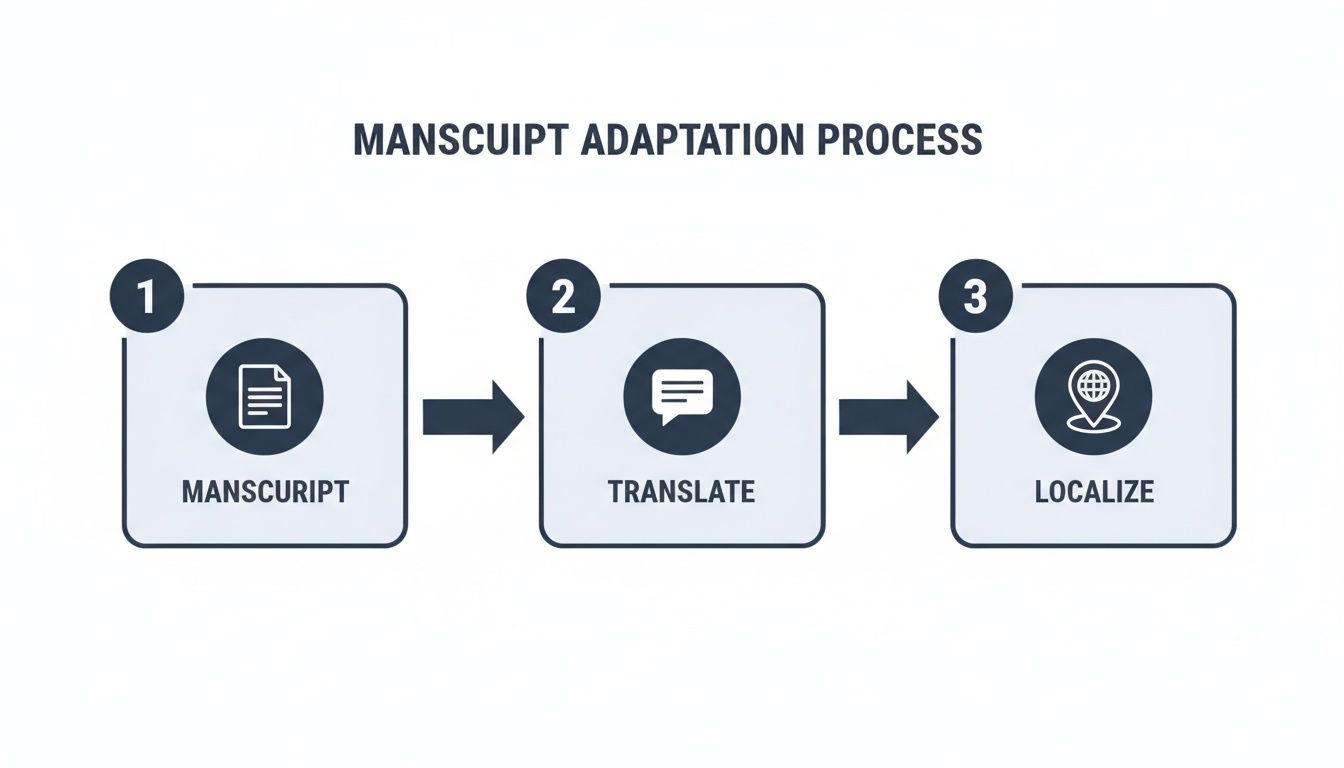
As you can see, a book that truly succeeds in the Spanish market is built on layers of smart translation and cultural localization. This groundwork is what makes the production phase run smoothly.
Securing Your Spanish Edition ISBN
First things first, you need a new International Standard Book Number (ISBN) for your Spanish edition. This is non-negotiable. You absolutely cannot reuse the ISBN from your original English version.
Think of it this way: your English book and your new Spanish translation are two completely different products in the eyes of retailers, libraries, and distributors. They have different text, probably different covers, and need to be cataloged separately. Each format needs its own unique identifier.
- Print Edition: Needs a unique ISBN.
- Ebook Edition: Needs its own separate ISBN.
- Audiobook Edition: Yep, this too. A third, distinct ISBN is required.
Getting an ISBN is pretty straightforward. If you’re publishing exclusively through a platform like Amazon KDP, they can give you a free one, but it’s tied to their ecosystem. For maximum flexibility and wider distribution, your best bet is to buy your own from your country’s official ISBN agency, like Bowker in the U.S.
Copyright and Protecting Your Work Internationally
Next up is copyright. While your original work is technically copyrighted the moment it’s created, formally registering it gives you much stronger legal protection, especially across borders. Your new Spanish translation is legally considered a derivative work.
Registering the copyright for your Spanish translation is a crucial step in protecting your intellectual property across global markets. It establishes a public record of your ownership and is essential if you ever need to address infringement issues in a Spanish-speaking country.
Think of this registration as insurance for all the time and money you’ve invested. It provides the official documentation you need to prove you own the Spanish text, protecting you from plagiarism or unauthorized sales.
Designing for Hispanic Markets
Your cover and interior design are the first things a potential reader sees. A design that hits all the right notes for an American or British audience might fall completely flat with readers in Madrid or Mexico City. Cultural tastes in color, imagery, and even fonts can be worlds apart.
When you’re working on the visual production, modern AI image tools for book covers can be a great starting point for brainstorming concepts that will connect with Spanish-speaking readers.
Here are a few design elements to get right:
- Cover Imagery: Be really careful with cultural symbols. An image that feels artistic or edgy in one culture could be a tired cliché or just plain confusing in another.
- Typography: Fonts have personality, and that personality changes across cultures. Do some homework. Look at the bestsellers in your genre on Amazon.es or Gandhi.com.mx to see what typographic styles are currently popular.
- Color Psychology: Colors carry powerful cultural associations. A bold, bright palette that screams “exciting” in one market might just look garish and cheap in another.
Building Your Global Distribution Network
With your professionally designed book files in hand, it’s time to stock the digital shelves. The goal is simple: make your book available everywhere Spanish-speaking readers are buying. The big players here are Amazon KDP, Apple Books, and Google Play, which give you a direct line into major global markets.
Amazon, for example, is a powerhouse with dedicated storefronts for Spain (Amazon.es) and Mexico (Amazon.com.mx). When you upload to KDP, you can simply check the box for worldwide distribution, and your book will automatically populate across these international sites.
But don’t stop there. It’s smart to look at regional aggregators like Draft2Digital or Smashwords. These services act as a middleman, pushing your book out to a much wider network of smaller online retailers and library systems throughout Latin America and Spain, reaching audiences you’d otherwise miss.
A winning distribution strategy isn’t about choosing one platform; it’s about combining the reach of global giants with the specialized access of regional players. This is the final piece of the puzzle to get your story into the hands of millions of new readers.
Mastering the Digital Spanish Book Market

While print books will always have their charm, launching your Spanish book with a digital-first strategy can give you a massive head start. Why? Because the digital book world in Spanish-speaking countries is absolutely booming. It’s the most direct and budget-friendly way to get your work into the hands of millions of readers, almost instantly.
The numbers don’t lie. The market for ebooks is on a serious upward trend, with projections showing 235,000 titles available by 2025. In 2024 alone, Spanish readers downloaded nearly 13% more ebooks than they did the year before. This isn’t just a niche market; it hit a value of €122 million in 2023. You can see the full breakdown in Bookwire’s comprehensive market report.
This surge tells us one thing loud and clear: there’s a huge, hungry audience out there. Your book could be exactly what they’re looking for, but you have to get the digital side right.
Perfecting Your Spanish Ebook
A fantastic story can be completely undermined by a clunky, poorly formatted ebook. It’s the kind of thing that leads to frustrated readers and one-star reviews. Your goal should be a clean, professional file that looks just as good on a Kindle in Madrid as it does on a smartphone in Mexico City.
This means you have to think beyond just exporting a PDF. The gold standard for ebooks is a reflowable EPUB file. It’s designed to automatically adjust your text and images to fit any screen, which is crucial for a comfortable reading experience.
Here’s a quick checklist to make sure your ebook is reader-ready:
- A Clickable Table of Contents: Non-negotiable. Readers need to be able to jump to chapters easily.
- Consistent Styling: Use paragraph styles for all your formatting—headings, body text, block quotes. This keeps the look professional and clean.
- Optimized Images: Make sure your images are clear and high-resolution, but compress them so they don’t bloat your file size.
Nailing these technical points is key for both discoverability and reader happiness. If you want to get a broader view of your options, our guide on where to sell your ebook is a great next step.
Tapping Into the Audiobook Boom
Audiobooks aren’t just a passing trend—they’re a powerhouse in publishing. Creating a Spanish audiobook version of your work opens up a completely new audience. Think about all the people who “read” while commuting, working out, or doing chores.
But it’s not as simple as just reading your book into a microphone. One of the biggest decisions you’ll face is the narrator’s accent. Are you aiming for a Castilian accent that resonates with readers in Spain, or a more neutral Latin American Spanish to appeal to the massive audience in the Americas? This choice will define the listener’s entire experience.
A great narrator doesn’t just read your words; they perform your story. Their accent, pacing, and emotional delivery are what will bring your characters to life for a Spanish-speaking audience.
After the recording is professionally mastered, it’s time for distribution. Platforms like Audible (through ACX), Google Play, and Kobo Writing Life are your main gateways to listeners around the world.
Optimizing Your Book for Discovery
Okay, so you have a flawless ebook and a fantastic audiobook. That’s a huge win, but it’s only half the battle. Now, you need to make sure readers can actually find them. This all comes down to smart metadata.
Think of your metadata as the digital signposts pointing readers straight to your book.
- Spanish Keywords: Get inside the heads of Spanish-speaking readers. What terms are they typing into the search bar? Go beyond literal translations and dig for culturally relevant phrases and genre-specific terms.
- A Killer Description: Your descripción del libro is your sales pitch. It needs to be written in natural, engaging Spanish and should weave in your keywords without sounding robotic.
- The Right Categories: On platforms like Amazon, don’t just pick broad categories. Drill down into two or three specific niches (categorías) where your book can stand out and find its perfect audience.
These details might seem small, but they’re what separate a book that’s just available from one that’s truly discoverable. Master them, and you’ll be well on your way to making a real impact in the Spanish-language market.
Marketing Your Book to Spanish-Speaking Readers
Getting your book published in Spanish is a massive achievement. Congratulations! But now the real work—and the real fun—begins. It’s time to connect your story with the millions of readers it was written for.
This isn’t about simply translating your old marketing plan. To truly succeed, you need a playbook that understands the nuances of diverse Spanish-speaking cultures. What ignites excitement in Spain might not resonate the same way in Mexico or Argentina. The key is to build genuine connections by meeting readers right where they are.
Build Your Spanish-Language Author Platform
First things first: you need a home base. A place where Spanish-speaking readers can discover you and your work. Trying to pull them into an English-only world creates an immediate barrier, making you seem distant and inaccessible.
You’ve got a couple of solid options here:
- A dedicated Spanish website or landing page. This is the gold standard. It shows you’re serious about this audience and gives you a central hub for your bio, book details, and, crucially, a sign-up for your Spanish newsletter.
- A vibrant social media presence in Spanish. Platforms like Instagram, TikTok, and Facebook are cultural powerhouses across Latin America and Spain. You can launch dedicated accounts (think @AuthorName_ES) or weave Spanish content into your existing profiles, making it clear who you’re speaking to with each post.
Whichever path you take, the goal is to create a welcoming, authentic space. This is where trust is built, one follower at a time.
Collaborate with BookTubers and Influencers
Looking for the fastest way to generate real buzz? Get your book into the hands of people readers already trust. In the Spanish-speaking literary world, “BookTubers” (YouTubers focused on books) and “Bookstagrammers” are kingmakers. A single rave review from a beloved creator can send your sales chart soaring.
Authenticity is everything in your marketing. Readers are sharp—they can smell a generic sales pitch a mile away. Focus on real engagement, cultural respect, and building genuine relationships with both influencers and your audience.
When you’re researching who to connect with, look past the follower count. The real magic is in the engagement. A micro-influencer with a few thousand die-hard fans in your niche is infinitely more valuable than a mega-account with passive followers. Reach out professionally but personally. Always offer a free copy of your book—digital or print—with zero strings attached.
Run Laser-Focused Ad Campaigns
Paid advertising, when done with precision, can be a game-changer. Platforms like Facebook Ads (which includes Instagram) and Amazon Ads are your best tools here because of their powerful targeting capabilities. This is how you stop throwing money at the wall and start investing it wisely.
A successful ad campaign in Spanish is much more than a translated version of your English ad copy. It’s about crafting visuals and text that speak directly to a specific market’s sensibilities.
For example, a targeted ad set might look like this:
- Platform: Facebook Ads
- Location: Mexico, Colombia, Argentina
- Age: 25-55
- Language: Spanish
- Interests: Kindle, Ficción histórica (Historical Fiction), and authors like Isabel Allende or Arturo Pérez-Reverte.
This level of detail means your ad gets in front of people who are already primed to love your book. Don’t be afraid to A/B test different images and headlines to see what connects, and keep a close eye on your results to make every dollar count.
Secure Reviews from Bloggers and Media
Beyond the social media sphere, traditional book bloggers and online literary magazines still carry a lot of weight. A review from one of these respected outlets builds incredible credibility. It provides the kind of social proof you can feature everywhere—on your website, in your ads, and on your book’s sales page.
Start by creating a curated list of reviewers who operate in your genre. Hunt for blogs that champion indie authors or cover your specific niche. A thoughtful, personalized pitch to the right blogger can open doors that ads alone can’t.
Thinking about which channel to prioritize? It really depends on your goals. Some channels are great for a quick burst of launch-day energy, while others are better for building a slow, steady burn of long-term sales.
Comparing Marketing Channels for Spanish Readers
To help you decide where to focus your energy and budget, here’s a breakdown of the most effective channels for reaching Spanish-speaking readers. Each has its own strengths and requires a slightly different approach.
| Marketing Channel | Target Audience | Key Strategy | Potential ROI |
|---|---|---|---|
| BookTubers & Instagram | Younger, highly engaged readers who follow trends and trust creator recommendations. | Build personal relationships, send beautiful book mail, and offer early review copies. | High (for launch buzz) |
| Targeted Facebook Ads | Broader demographic; can be targeted with precision by interest, location, and age. | Use culturally relevant ad copy and compelling visuals tailored to specific countries. | Medium to High (scalable) |
| Amazon Ads | Readers actively shopping for their next book on the world’s largest bookstore. | Target specific keywords (e.g., “thriller en español”) and similar authors. | High (for direct sales) |
| Book Bloggers & Media | Serious readers, literary tastemakers, and librarians who value in-depth reviews. | Professional, personalized outreach with a clear press kit and an easy-to-read copy. | Medium (builds long-term credibility) |
Ultimately, a well-rounded strategy is your best bet. By using a mix of these approaches, you create multiple ways for readers to discover your book. This combination of influencer buzz, targeted ads, and credible reviews is what builds momentum and drives sustainable, organic sales long after your launch week is over.
Your Top Questions About Publishing in Spanish, Answered
Taking your book into a new market is a huge step, and it’s natural to have a lot of questions. You want to be smart about it, protect your work, and give your story the best possible shot at finding a new audience. Let’s tackle some of the most common things authors ask when they’re thinking about publishing in Spanish.
I’ll break down the practical, need-to-know details—from budgeting to timelines—so you can move forward with your eyes wide open.
How Much Is This Really Going to Cost?
This is usually the first question on everyone’s mind, and the honest answer is: it depends. The path you take will be the biggest factor in your total investment. The single largest line item, by a long shot, is almost always the translation itself. A good literary translator will typically charge between $0.10 and $0.25 per word. For a 60,000-word novel, you can see how that adds up quickly.
But that’s just the starting point. Here are the other costs you’ll need to factor into your budget:
- Editing and Proofreading: This is a separate, non-negotiable step. A professional Spanish-language editor can run anywhere from a few hundred to over a thousand dollars.
- Cover Design: You might need a new cover that speaks to Hispanic readers. This could be a small tweak or a complete redesign, costing anywhere from $150 to $800.
- ISBN: If you’re self-publishing, you’ll need new ones. In the US, a single ISBN from Bowker is about $125, but you get a much better deal buying them in a block of ten.
- Marketing: This is the wildcard. You could kick things off with a modest $500 for some initial ads, or you could pour thousands into a major launch campaign.
Try to think of these as investments, not just expenses. A cheap translation or a skipped proofreading stage will kill your book’s chances before it ever gets started. Quality is what gets you in the door.
Why Do I Need a Brand-New ISBN?
This one trips a lot of authors up, but the rule here is simple and absolute. Your Spanish edition is a completely new product, so it needs its own unique ISBN. You can’t just reuse the one from your English original.
Think of it like a barcode at a grocery store. The ISBN tells retailers like Amazon and Barnes & Noble exactly which version of your book they have.
- Your English paperback has its own ISBN.
- Your English ebook has a different ISBN.
- Your Spanish paperback needs a third one.
- And your Spanish ebook needs a fourth.
Every single format and language combination requires its own identifier. It’s the only way to make sure your listings are correct, your sales are tracked properly, and your royalties end up in the right place. Without it, your book can’t be sold.
Castilian or Latin American Spanish?
This is a big strategic decision that really comes down to who you want to read your book. While they are the same language, the Spanish spoken in Spain (Castilian) has some very distinct differences from the Spanish used across Latin America—we’re talking vocabulary, common phrases, and even the overall tone.
Here’s a simple way to think about it:
- Going for the Biggest Audience? If you want to reach readers across Mexico, Colombia, Argentina, and the huge US Hispanic market, you want a neutral Latin American Spanish. It’s the closest thing to a “standard” for mass-market books and will be easily understood by the largest number of people.
- Targeting Spain Specifically? If your story is set in Spain or you’re dead-set on connecting with readers there, then using Castilian Spanish is the right call. It will feel much more authentic and natural to that specific audience.
What’s a Realistic Timeline?
Be patient. This isn’t something you can knock out in a weekend. Rushing any part of the process, especially when you’re working across languages, is a recipe for a sloppy final product that readers will notice immediately.
For a standard-length novel, here’s a timeline you can realistically plan around:
- Translation & Localization: 2–4 months
- Editing & Proofreading: 1–2 months
- Cover & Interior Design: 3–4 weeks
- Production & Distribution Setup: 1–2 weeks
- Pre-Launch Marketing: 4–6 weeks
All in, you should probably budget for a 6 to 9-month process from the day you hand off your manuscript to your official launch. This gives everyone on your team the time they need to do their best work and gives you a solid window to start building some buzz.
Figuring out these details is the first step toward a successful global launch. At BarkerBooks, we walk authors through every single one of these stages, from finding the right translator to building a marketing plan. If you’re ready to share your story with millions of new Spanish-speaking readers, let’s talk about how to make it happen.
Learn more about our comprehensive publishing services at https://barkerbooks.com.