
You've typed “The End,” saved the manuscript, and perhaps even read it several times. Yet a quiet doubt remains. Did a comma disappear during revision? Is a character's name spelled consistently? Will the final layout create a stray heading, awkward line break, or missing reference?
That uncertainty is normal. A finished manuscript can still contain surface-level errors because authors read for meaning, while a proofreader reads for the small details that interrupt a reader's trust. Proofreading services for authors provide a final quality-control check, but only when proofreading is the right service for the manuscript's condition.
The decision isn't about finding the cheapest provider. It's about identifying the problem you're paying someone to solve. A structurally weak book may need developmental editing. A confusing or uneven draft may need copyediting. A polished, formatted book with occasional slips may need proofreading.
This guide explains where proofreading belongs, what a professional pass includes, how it differs from earlier editorial work, what pricing models and turnaround expectations look like, and how to assess a provider before sharing your book. By the end, you'll have a practical way to brief a proofreader, budget sensibly, and protect the work you've already invested in writing.
Introduction Why Final Polish Matters for Authors
An author may spend months or years shaping a book, then approach proofreading as if it were a decorative final touch. It isn't. Proofreading is closer to quality control at the point where the book leaves your hands and reaches readers.
Consider a novel with a strong plot and memorable characters. In the final chapters, the protagonist's surname changes spelling, two sentences contain doubled words, and a chapter reference points to the wrong location. None of those problems necessarily destroys the story, but together they make readers pause. A pause breaks immersion. In nonfiction, a mismatched citation or inconsistent technical term can make an otherwise useful book feel less dependable.
The wider editorial market shows why this work remains part of a substantial professional ecosystem. In the United States, editorial services were estimated at $2.6 billion in 2026, with 71,608 businesses operating in the industry, although the sector recorded a 3.8% annual decline from 2019 to 2024. IBISWorld's editorial services industry snapshot also reports 94,516 people employed in U.S. editorial services in 2024. Proofreading sits within that broader network of manuscript refinement, publishing preparation, and quality control.
The cost of skipping the right stage
Skipping proofreading can leave avoidable errors in the final product. Booking it too early creates a different problem. If you substantially rewrite the manuscript, alter the chapter order, or change the layout after the proofread, you may introduce fresh errors that nobody has checked.
Authors have historically carried much of this responsibility themselves. In the 17th and 18th centuries, authors often checked proofs personally and sometimes asked friends to review them, as described in the history of Distributed Proofreaders. Modern authors can still review their own work, but distance is difficult when you know every sentence and anticipate what it should say.
Practical rule: Book the final proofread after substantive editing and after the book has been formatted for publication.
The purpose isn't to make the writing sound like somebody else. A well-briefed proofreader protects your voice while checking the details readers should never have to notice. The pages should feel like your book, only cleaner, steadier, and ready for its chosen format.
What Proofreading for Authors Really Means
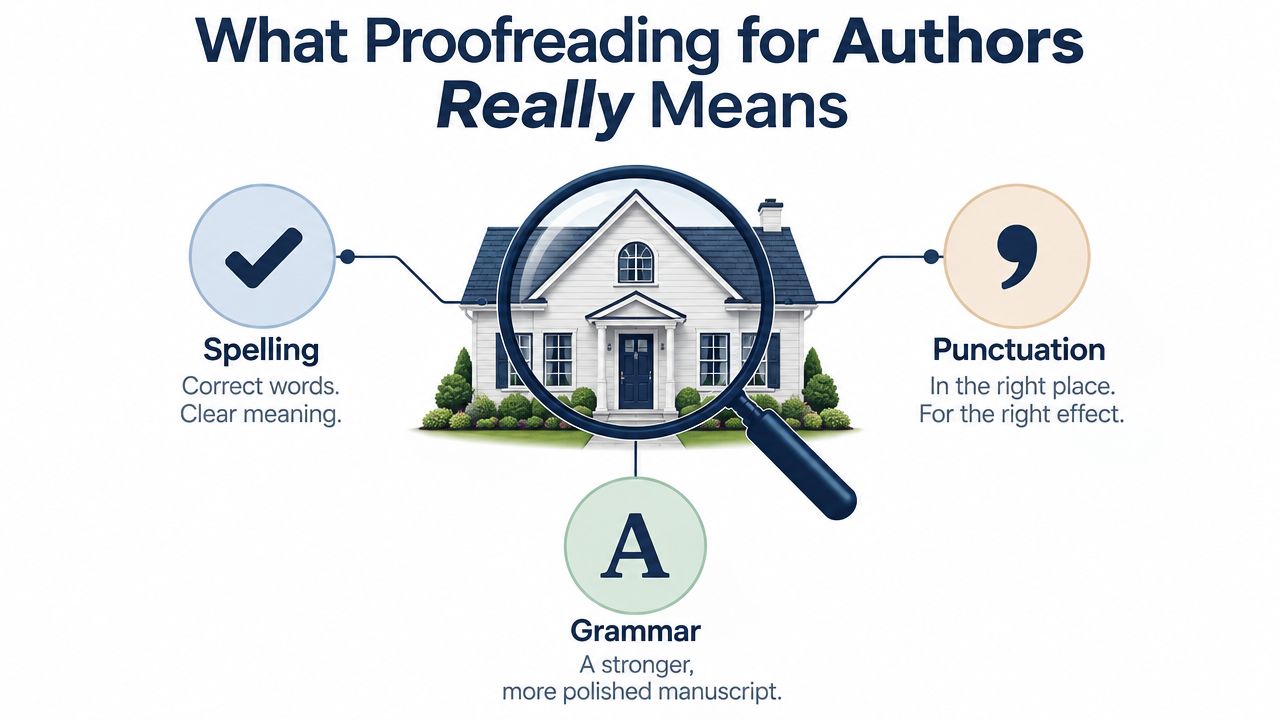
Think of a house that has already been designed, built, decorated, and furnished. A final inspector doesn't decide that the kitchen should move to the other side of the building. They check whether the doors close, the fittings work, the labels are clear, and the finished property matches the plans.
Proofreading is that final inspection for a book. It's a late-stage pass focused on surface-level defects, not a wholesale attempt to improve the manuscript's architecture. The Editing and Proofreading Handbook describes proofreading for authors as a check of spelling, punctuation, typography, formatting, cross-references, and citation or reference mismatches.
Start with the correct file
The proofreader should usually check the final formatted file, not only the earlier manuscript. Formatting can introduce new issues. A heading may be separated from the paragraph it introduces, a page number may disappear, an italic instruction may become plain text, or an illustration may no longer align with the words.
For a print book, that file may be a PDF proof. For an ebook, it may be a final digital file or a format-specific preview. Ask the provider what file types they work with and whether the quoted service includes checking the final output after layout.
Separate the inspection into passes
A single hurried read makes it easy to focus on meaning and miss consistency. A more disciplined workflow separates the work:
- Mechanics pass: Check spelling, grammar, punctuation, capitalisation, hyphenation, typography, and obvious word errors.
- Reference pass: Verify chapter references, tables, figures, footnotes, citations, bibliography entries, and internal links.
- Global consistency read: Look across the book for repeated terms, character names, headings, number formats, quotation styles, and other decisions.
This separation gives each pass a clear purpose. It also helps the proofreader report what they checked, rather than offering a vague promise that the book is “perfect.”
Know what proofreading won't do
A proofreader may query a sentence that appears factually or logically inconsistent, but they aren't normally responsible for rebuilding your argument or rewriting your scenes. They may flag a repeated idea, but they won't usually redesign the book's structure.
If the manuscript still contains paragraphs you're unsure about, characters whose motivations don't hold together, or chapters that could be removed or reordered, pause before booking proofreading. The house isn't ready for its final inspection if the walls are still moving.
How Proofreading Differs From Copyediting and Developmental Editing
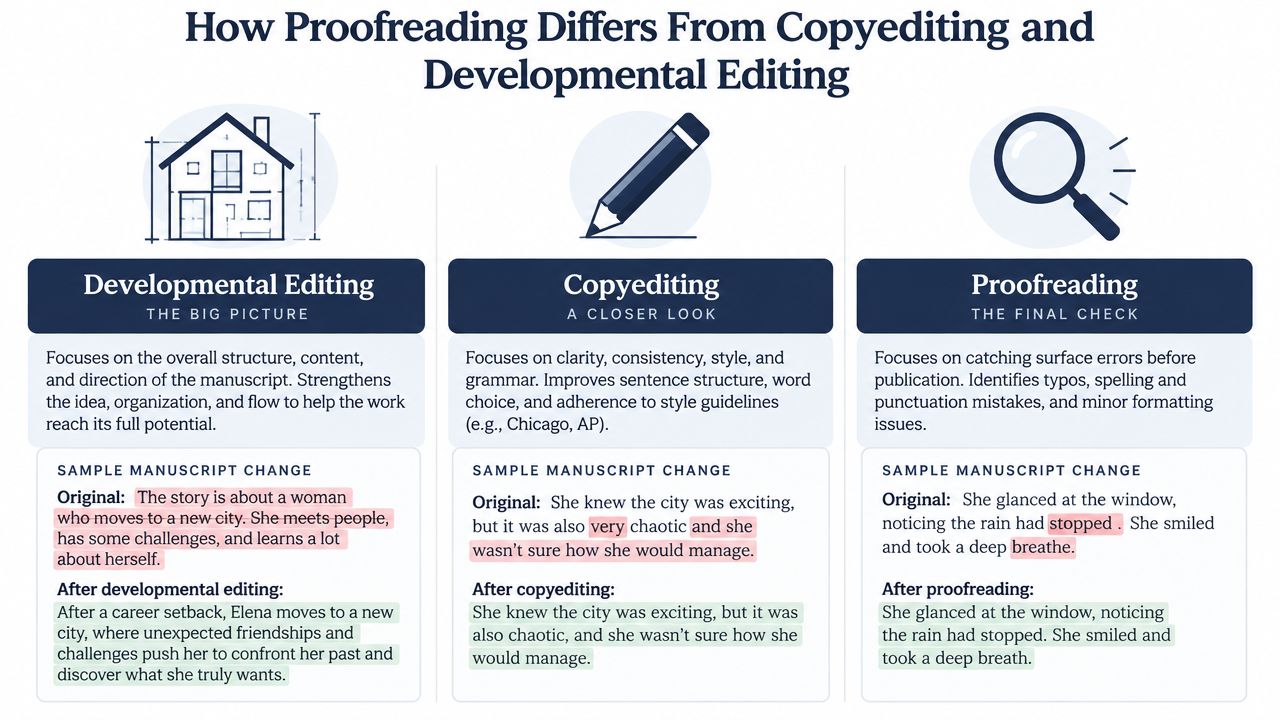
The three editorial levels solve different problems. Confusion happens when authors describe every kind of manuscript help as “proofreading,” then expect a final check to repair issues that needed attention much earlier.
A developmental editor looks at the blueprint. For fiction, that may include plot, pacing, character development, scene purpose, and narrative structure. For nonfiction, it may involve the order of ideas, gaps in the argument, clarity of the promise, and the relationship between chapters.
A copyeditor works closer to the finished rooms. They improve sentence clarity, grammar, usage, consistency, style, and sometimes wording or flow. A proofreader examines the completed property, checking the final text and layout for remaining defects.
One sentence, three possible interventions
Take this draft sentence:
Mara walked into the room and she seen the letter on the table, which was important because it changed everything and made her decide to leave.
Each service might respond differently.
- Developmental editing might ask whether the letter arrives at the right point in the story and whether Mara's decision has enough preparation.
- Copyediting might revise “she seen” to “she saw,” reduce the overloaded wording, and improve the sentence's clarity.
- Proofreading might correct “she seen” only if that error remains in the final formatted file, while checking punctuation and layout. It shouldn't be expected to solve the underlying pacing or story problem.
For a more detailed distinction between the two later-stage services, see this guide to the difference between proofreading and copyediting.
Editing levels compared for authors
| Service Level | Primary Focus | When to Use | Typical Cost Signal |
|---|---|---|---|
| Developmental editing | Structure, content, argument, plot, character, pacing, and reader experience | The book needs reshaping before sentence-level polish | Usually the most substantial editorial investment |
| Copyediting | Clarity, grammar, usage, style, consistency, and sentence-level control | The structure works, but the prose needs careful refinement | More costly than proofreading because it requires deeper intervention |
| Proofreading | Typos, punctuation slips, formatting, typography, references, and final consistency | All other edits are complete and the final file is formatted | Usually the lightest editorial service |
A quick diagnosis
Choose developmental editing if you're still asking whether the book works as a whole. Choose copyediting if readers may struggle with wording, repetition, grammar, or uneven style. Choose proofreading if the content and prose are settled and you want a final professional check before release.
Paying for the wrong level can waste both money and time. A proofreader can identify a sentence that doesn't work, but a copyeditor or developmental editor is better placed to decide how far that sentence needs to change.
Service Levels Pricing Models and What to Expect in 2026
Proofreading quotes vary because providers aren't selling identical work. A short, clean, professionally formatted file may require a different approach from a complex nonfiction book with references, tables, illustrations, or a demanding deadline.
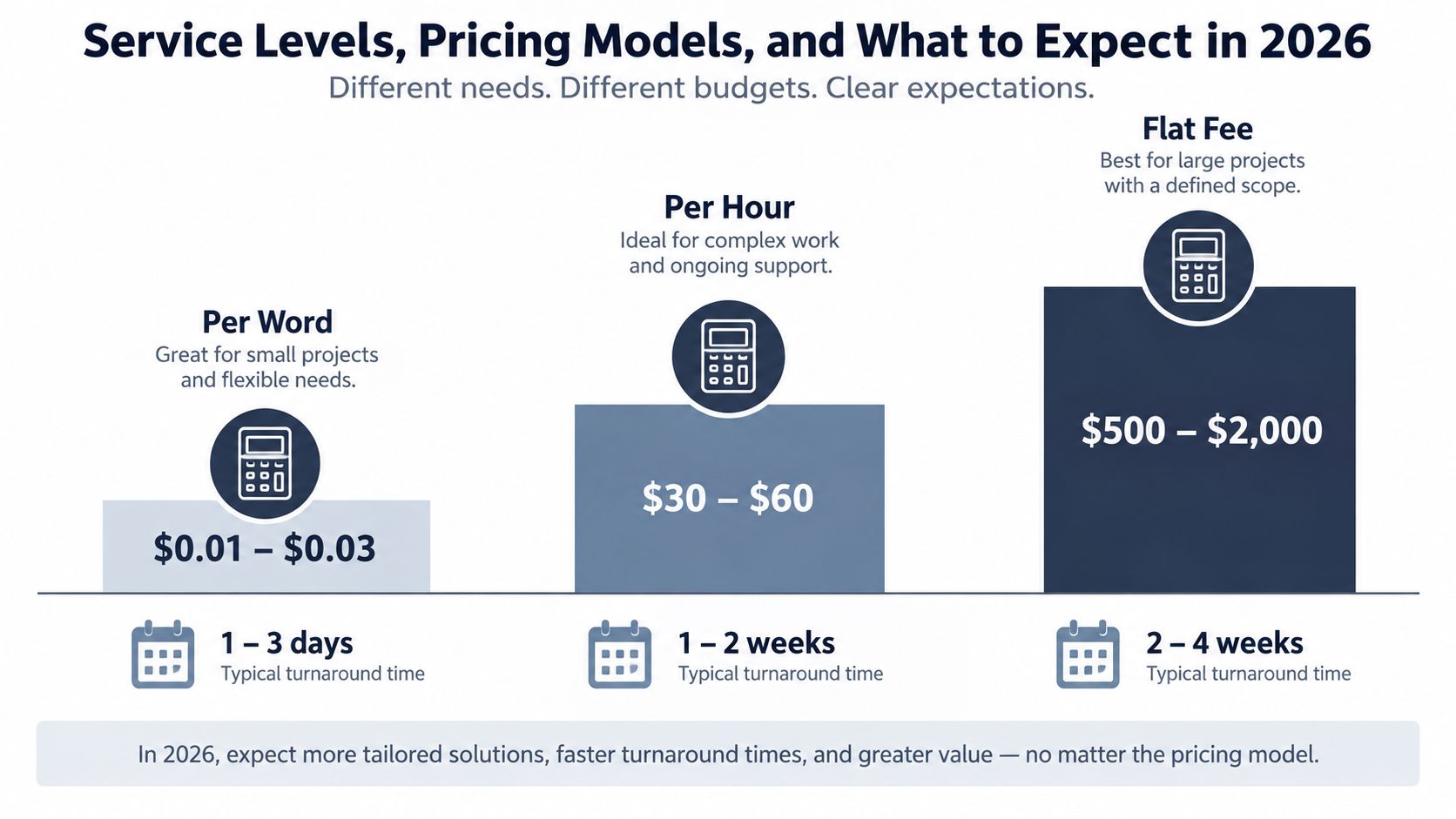
The clearest pricing model is per word. Market summaries for 2026 place proofreading at roughly $0.01 to $0.025 per word, according to Publishing.co.uk's proofreading guide. That model lets you estimate the broad cost from your word count, but the quote may still change according to formatting, genre, file condition, and the provider's schedule.
Three ways providers charge
Hourly pricing suits short documents, sample assessments, or files whose difficulty is hard to predict. You pay for the time spent, so ask how the provider records work and whether the estimate includes queries, communication, and a final review.
Flat-fee pricing gives you a defined project price. It works well when the proofreader has reviewed a sample and understands the scope. Confirm exactly what the fee includes, especially if you need both a marked-up file and a clean file.
Per-word pricing offers easy comparison, but don't compare the figure alone. A low rate may exclude formatted-file checking, reference verification, or a second pass after corrections.
For broader context on how editorial work is priced, consult this explanation of how much book editing costs.
Speed changes the equation
Recent service listings show a wide range, from approximately one day to several weeks for turnaround. Listed examples range from about $105 for 3,000 words to more than $2,000 for an 80,000-word book, depending on the provider and deadline, as summarised by Now Novel's editing services guide.
A rapid deadline may be sensible when a release date is fixed and the file is already clean. It's less sensible when rushing forces the proofreader to skim, reduces time for author queries, or leaves you unable to review suggested changes. A slower pass may cost less than repairing a preventable production error after publication.
Set realistic expectations about accuracy
Human proofreading isn't exhaustive. Independent editing benchmarks cited by Ember Editing report that professional proofreaders catch about 81% of nonword errors and about 66% of real-word errors. The same discussion describes roughly 80% per round as a strong editing standard and cites publication-quality density around three typos per 10,000 words.
That means a professional proofread reduces risk, but it can't guarantee an absolutely error-free book. Build in time for your own final review, especially after accepting corrections or changing the layout.
How to Evaluate and Choose a Proofreading Provider
A polished website and a low quote aren't enough to establish fit. You're handing someone a document that may contain your voice, research, personal experience, or years of creative effort. Evaluate the provider's process as carefully as their price.
Begin with evidence of fit
Ask for a relevant sample or portfolio. A proofreader who works confidently on academic nonfiction may not be the right choice for a picture book, memoir, romance novel, technical guide, or poetry collection. Genre familiarity affects the provider's understanding of conventions, tone, dialogue, terminology, and reader expectations.
A sample edit should show how the provider identifies problems and communicates them. It should also help you see whether they preserve authorial choices instead of making unnecessary changes.
Use this shortlist:
- Sample work: Can the provider show relevant experience without exposing confidential client material?
- Genre match: Have they worked with books similar in audience, format, and subject?
- Workflow: Will they check Word, PDF, ebook files, or a combination?
- Style control: Do they use a style sheet or record decisions about spelling, capitalisation, numerals, and names?
- Queries: How will they raise uncertainties, and how will you respond?
- Revision policy: What happens if you make changes after the first pass?
- Communication: Who answers questions, and how often should you expect updates?
Ask how humans and AI work together
AI tools can help identify patterns, but pattern detection isn't the same as editorial judgement. A tool may flag an intentional fragment, dialogue shaped by character voice, a culturally specific expression, or a deliberate change in spelling. Ask whether the provider uses AI, what it does, and where human review remains responsible for the final decision.
This matters even more when a service is coordinated across countries or marketplaces. You need clarity about who checks English usage, whether the same editor handles the project throughout, and how the provider keeps decisions consistent.
Watch for absolute promises
Treat a guarantee of 100% error-free text as a warning sign. A responsible provider should explain the scope of the pass, identify limitations, and tell you what remains your responsibility after you receive the file.
You can also compare independent freelancers, marketplace providers, and integrated publishing companies through a defined manuscript editing service. The right option depends on whether you need one specialist or coordinated support for editing, design, formatting, and publication.
How BarkerBooks Proofreading Fits Your Publishing Journey
Proofreading makes the most sense when it connects to the production stage that follows. A corrected manuscript still needs a suitable cover, reliable interior layout, accurate metadata, identifiers, rights information, and distribution files. If those pieces develop separately, authors may find themselves rechecking the same pages after each change.
BarkerBooks can place proofreading within a wider publishing workflow that includes editorial editing, ghostwriting, cover design, interior layout, ISBN and copyright support, and distribution to platforms such as Amazon Kindle, Apple Books, Barnes & Noble, and Google Books. Authors can therefore discuss the condition of the manuscript before choosing whether they need a final proofread, earlier editorial intervention, or a combination of services.
Match support to the manuscript's stage
An author with a completed, edited, formatted book may need a focused final check. An author with an unfinished draft may benefit from discussing structure or sentence-level editing first. BarkerBooks presents packages from Essential to Elite, with options that can include multilingual publication, audiobook support, author landing pages, social media marketing, and live guidance.
That broader view helps prevent a common production mistake. Authors sometimes commission proofreading before the cover copy, page design, or final text has settled. If the layout changes later, the book may need another check. Coordinating the stages can make responsibilities clearer and reduce avoidable handoffs.
Think beyond the digital edition
Print projects add their own proofing needs. If you're producing companion material for readings, launches, workshops, or promotion, a resource such as print booklets and brochures can help you consider how your publishing message will appear outside the book itself.
The useful question is still the same: what problem are you paying to solve? BarkerBooks may suit authors who want proofreading connected to a larger publishing route, while an independent specialist may suit someone who needs a narrowly defined final PDF check. Neither choice is automatically right. The brief, file, deadline, and level of support should decide.
Final Takeaways and Your Next Steps as an Author
Start with diagnosis, not price. If you're still questioning the book's structure, character development, chapter order, argument, or reader promise, proofreading is premature. If the structure works but the language is uneven, repetitive, or difficult to follow, copyediting may provide better value. If the manuscript is edited, stable, and formatted, proofreading can focus on the final defects that readers would otherwise encounter.
Prepare a useful brief before contacting providers. Include the genre, audience, word count, file type, publication format, desired deadline, previous editorial work, and any house style or spelling preference. Tell the proofreader whether you want comments, a clean file, or both, and ask whether a final formatted-file check is included.
A practical preparation sequence
- Freeze the manuscript: Complete structural and sentence-level changes before the final proofread.
- Prepare the production file: Send the latest formatted version when layout is part of the check.
- Supply reference material: Include a style sheet, character list, glossary, bibliography, or design notes where relevant.
- Agree the scope: Confirm what the provider will check and what falls outside the service.
- Protect review time: Leave space to answer queries and inspect the corrected file before release.
- Plan for change: If you alter the text or layout afterward, ask whether another proof pass is needed.
A professional proofread is valuable because it protects the work already done. It doesn't replace thoughtful revision, and it can't promise that every possible error will disappear. It gives the final book a careful, independent inspection at the moment when small mistakes are easiest to overlook and most visible to readers.
If your manuscript is in progress, seek the editorial level that matches its actual condition. If it's ready for production, gather the final file and request a sample-based quote. You'll make a better buying decision when you can explain the problem clearly, compare like with like, and choose support that fits your route to publication.
BarkerBooks offers proofreading alongside editorial editing, formatting, design, and wider publishing support for authors preparing books for worldwide distribution. Visit BarkerBooks to discuss your manuscript's current stage and identify the service that matches the work it still needs.