
You’ve spent months, maybe even years, pouring your heart and soul into a manuscript. It feels so close to being done, but you have that nagging feeling it could be better. This is the exact moment a professional book editor becomes the most important person on your team.
Forget the idea of an editor as a simple grammar cop. A great editor is a strategic partner, someone who can see the hidden brilliance in your story and help you bring it to the surface, ready for the world.
Why a Professional Book Editor Is Your Best Ally
Hiring a professional editor is arguably the single most impactful investment you can make in your book’s future. They are the trained, objective eyes that will help you refine your plot, sharpen your voice, and get your manuscript into shape to wow agents, publishers, and readers.
An editor’s job is so much more than catching typos and fixing commas. After living inside your story for so long, you’re too close to it to see it clearly. An editor brings a fresh, expert perspective that’s essential for spotting the plot holes, inconsistent character arcs, or pacing lulls that you’re blind to.
The Strategic Value of an Editor
I like to think of an editor as a personal trainer for your manuscript. A good trainer pushes you past your limits, corrects your form, and helps you achieve results you never could on your own. In the same way, professional book editors strengthen your story’s core, tone your narrative voice, and ensure the entire structure is solid.
This partnership is a game-changer for a few key reasons:
- Clarity and Impact: They help you get your ideas across with power and precision, cutting through the fog to make your message shine.
- Market Readiness: A good genre editor knows what readers and agents are looking for. They help you meet those expectations and position your book for commercial success.
- You Become a Better Writer: The focused, constructive feedback you get from a pro is like a masterclass in writing. You’ll carry those lessons with you to every book you write afterward.
“A professional editor is the author’s most important ally. We all have blind spots in our own writing. An editor is a trained, objective expert who can see what you’re too close to see and who can help you make the story in your head match the one on the page.”
More Than Just a Service
At the end of the day, hiring an editor isn’t just about outsourcing corrections; it’s about respecting the immense effort you’ve already invested. You’ve put in the hours. You’ve written and rewritten. A professional editor is the partner who helps you honor that work by ensuring the version of your book that goes public is the absolute best it can be.
This level of insight relies on human skill. A professional book editor is indeed your manuscript’s best ally, and this focus on skill is often discussed in the broader context of document services, exploring the role of human expertise versus AI in document services.
Understanding the Four Essential Layers of Book Editing
The world of professional book editing isn’t as complicated as it might seem. When you boil it down, it’s a lot like building a house. Each stage of editing has a specific, crucial job to do, answering different questions along the way—from “Is my plot holding together?” all the way down to “Is this comma in the right place?”
Getting a handle on these different layers will help you figure out exactly what your manuscript needs. You’ll be able to talk to editors with confidence and make a smart investment in your book’s future. It’s about hiring the right expert for the job, not asking a plumber to fix your roof.
The Four Essential Layers of Professional Book Editing
To really grasp how these stages fit together, this table breaks down each type of editing, its main focus, and the key questions it helps you, the author, answer.
| Editing Type | Main Focus (The Analogy) | Key Questions Answered |
|---|---|---|
| Developmental Editing | The Architect’s Blueprint | Does the story’s foundation work? Are the characters compelling? Is the plot paced well? |
| Line Editing | The Interior Framing & Flow | Is the writing style engaging? Does the voice feel consistent? Do the sentences flow smoothly? |
| Copy Editing | The Interior Design & Finishes | Is the grammar correct? Is punctuation consistent? Are there any glaring technical errors? |
| Proofreading | The Final Walk-Through | Are there any typos or formatting glitches left? Is it truly ready for the reader? |
As you can see, each step builds on the last, moving from the big-picture structure to the tiniest details.
Developmental Editing: The Architect’s Blueprint
First out of the gate is developmental editing. Think of this as the architectural phase for your book. It’s the big-picture, structural edit that absolutely has to happen before anything else. A developmental editor is looking at the very foundation of your story or argument.
They dig into the core elements—plot, pacing, character arcs, and the overall structure. For non-fiction, they’re sizing up the flow of your arguments, how you’ve organized the chapters, and whether your content actually solves the reader’s problem. Their job is to make sure your manuscript has a solid, compelling blueprint. If you want a deeper dive, you can learn more about what developmental editing is and how it shapes a book from the ground up.
This stage is a real partnership. Your editor will give you a detailed editorial letter and notes right in the manuscript, pushing you with tough questions to help strengthen the story’s bones. This isn’t about commas; it’s about making sure the house will stand.
Line Editing: The Interior Framing and Flow
Once that blueprint is solid, it’s time for line editing. The line editor is like the builder who frames the rooms and makes sure everything flows logically from one space to the next. This edit is all about the craft of writing, honing in on the sentence and paragraph level.
A line editor’s goal is to sharpen your style, voice, and the reader’s overall experience. They’ll be looking at things like:
- Rhythm and Flow: Are your sentences varied enough to create an engaging cadence? Or does the prose feel flat?
- Word Choice: Are you using the most precise, powerful language to get your point across?
- Clarity and Conciseness: Is your meaning crystal clear, or is it buried under awkward phrasing and fluff?
- Tone and Voice: Does your authorial voice sound consistent and right for your genre?
Line editing is what takes good writing and makes it great. It’s about the artistry of the language itself, making every single sentence pull its weight.
This is where you see an editor shift from a strategic partner to a story refiner and, eventually, a manuscript polisher.
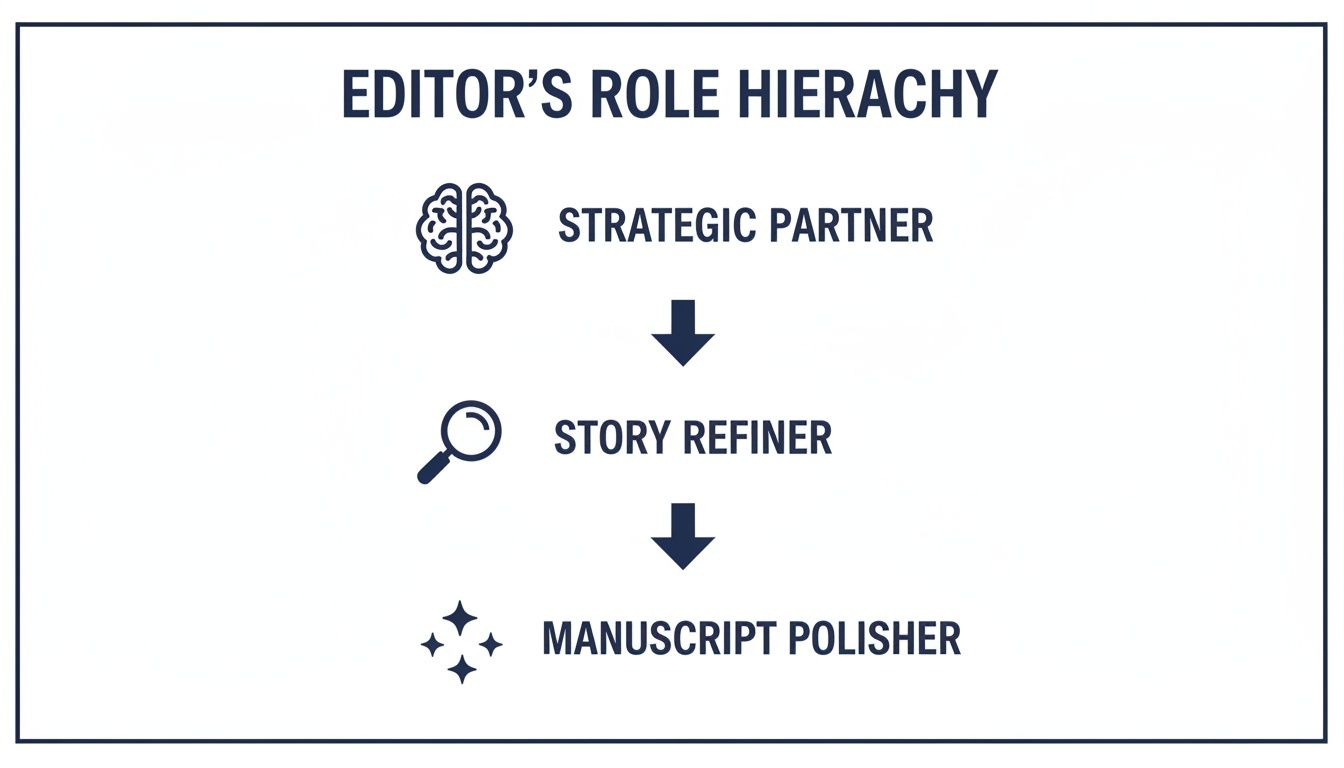
This process moves from the highest-level strategy down to the most detailed polish, ensuring every part of your book gets the attention it needs.
Copy Editing: The Interior Design and Finishing Touches
With the structure and flow locked in, copy editing comes in to handle the interior design and all those finishing details. A copy editor is a perfectionist, focused on the technical side of things to make sure your manuscript meets professional publishing standards.
This is where the rules of grammar, spelling, punctuation, and syntax are king. A copy editor ensures every detail is consistent, from character names and timelines to how you format chapter headings. They are the guardians of consistency, catching all the little errors that can pull a reader right out of the story.
A copy editor’s job is to make the writing invisible so that the reader can fully immerse themselves in the story without tripping over errors.
In today’s publishing world, these services are more vital than ever. The global book editing services market is valued at $271 million as of 2025, a number driven by the incredible 1.7 million books that were self-published in 2024 alone. That kind of competition shows just how crucial an expert polish is for any book hoping to succeed.
Proofreading: The Final Inspection
Finally, there’s proofreading. This is the last quality check before your book goes to print or gets published online. Think of the proofreader as the home inspector doing one last walk-through, clipboard in hand, looking for any tiny imperfection that was missed.
Critically, this step happens after the book has been designed and formatted into its final layout.
A proofreader is hunting for typos, weird formatting glitches, and any stray punctuation mistakes that might have snuck in during the design process. This is not the time for rewrites or stylistic tweaks. Proofreading has one job and one job only: to catch any last, glaring errors before your book finally meets its readers.
Finding and Vetting Your Perfect Editor

Hiring an editor is a huge step. Think of it less like a transaction and more like choosing a co-pilot for the final, most critical leg of your writing journey. You need someone with the right skills, who gets where you’re trying to go, and whose communication style feels like a partnership, not a battle.
Finding that perfect match can feel overwhelming, but a structured approach takes the mystery out of it. The goal is to move beyond just comparing prices and find a real professional who genuinely connects with your manuscript’s voice and vision. It’s an investment in a collaboration that will make your work shine.
Where to Look for Professional Book Editors
Knowing where to start your search is half the battle. Sure, a quick Google search will give you thousands of results, but focusing on curated platforms and professional communities is a much better way to find high-caliber talent.
You want to start by exploring established networks where editors are often vetted or have to meet certain professional standards. These are the places where serious professionals gather.
Here are the most reliable places to begin:
- Professional Organizations: Groups like the Editorial Freelancers Association (EFA) or the Chartered Institute of Editing and Proofreading (CIEP) maintain directories of their members. These editors are committed to their craft and industry standards.
- Curated Freelance Marketplaces: Websites like Reedsy or Upwork host profiles for thousands of editors. The trick is to look for those with extensive portfolios, glowing client reviews, and a clear specialty in your genre.
- Full-Service Publishing Partners: Companies like BarkerBooks offer in-house teams of professional book editors. This route often gives you a more cohesive experience, as the editing process flows smoothly into other steps like design and distribution.
Evaluating an Editor’s Credentials and Fit
Once you’ve got a shortlist of potential editors, the real work begins. This is where you dig deeper to make sure an editor doesn’t just look good on paper but is truly the right fit for your manuscript. Remember, a cheap editor who doesn’t know your genre is a wasted investment.
The most important factor here is genre specialization. An editor who’s brilliant with historical fiction might not have a clue about the pacing and tropes of a sci-fi thriller. Their portfolio should show off successful projects in your genre, proving they understand what your readers expect.
Next, take a close look at their testimonials and client history. Are past clients raving about their communication and insightful feedback, or just their speed? Look for comments that align with what you value most in a creative partnership.
“Your editor is your book’s first reader. Finding one who not only understands the rules of language but also the soul of your story is the key to transforming a good manuscript into an unforgettable book.”
The Power of the Sample Edit
The single best way to vet professional book editors is the sample edit. This is a non-negotiable step. It gives you a firsthand look at an editor’s style and approach before you sign on the dotted line.
You’ll typically send them 1,000 to 2,000 words from your manuscript, and they’ll return it with their edits and feedback. This trial run reveals several crucial things:
- Their Editing Style: Do they offer thoughtful, constructive suggestions, or do they just fix commas?
- Communication: Is their feedback clear, respectful, and easy to follow?
- Compatibility: Do their suggestions actually resonate with your vision for the book?
Many authors find this step makes the decision for them instantly. While some editors charge a small fee for this service, it’s an absolutely invaluable diagnostic tool. For a deeper dive, our detailed article on how to find a book editor offers a step-by-step checklist.
Key Questions to Ask a Potential Editor
Your first conversation with an editor is your chance to see if your working styles will click. Come prepared with a few specific questions to make sure you’re both on the same page from day one.
- What is your experience in my specific genre? Don’t be shy—ask for examples of books they’ve edited that are similar to yours.
- What does your typical editing process look like? Get a feel for their workflow, from the initial read-through to the final delivery.
- What are your communication preferences and availability? Nail down how and when you’ll connect (e.g., email, scheduled calls).
- What is the estimated timeline for my project? Get a clear idea of when you can expect your edited manuscript back.
- What deliverables are included in your fee? Confirm what you’re getting. Will it include an editorial letter, a style sheet, and a manuscript with tracked changes?
Doing this homework upfront protects you from mismatched expectations. More importantly, it lays the groundwork for a successful, productive collaboration that honors all the hard work you’ve already poured into your manuscript.
Navigating Editing Costs and Industry Rates
Let’s talk about money. It can be an awkward topic, but figuring out your editing budget is a non-negotiable step in your journey to publication. The best way to approach it is to stop thinking of editing as just another expense. It’s an investment—a strategic one—in your book and your future as an author. A polished, professionally edited manuscript is your best shot at getting rave reviews and driving sales.
This isn’t just about catching typos. You’re paying for a professional book editor’s hard-earned skill and experience. Editing is a legitimate career, and the rates reflect the incredible value these experts bring to your story. Keeping that in mind makes it easier to budget and truly appreciate what an editor does for your work.
Common Pricing Models Explained
Once you start reaching out for quotes, you’ll notice that editors generally price their services in one of three ways. There’s a reason for each, and the right model often depends on the type of edit your book needs at its current stage.
Per-Word Rate: This is the industry standard, especially for copy editing and proofreading. It’s clean and simple. You know exactly what you’ll pay based on your manuscript’s total word count. You can typically expect to see rates between $0.02 and $0.05 per word.
Hourly Rate: Developmental editing and line editing often fall into this category. Why? Because the work is much more subjective and can vary wildly from one manuscript to another. An editor might spend hours untangling a single plot point. For this kind of in-depth work, rates can range from $50 to $100+ per hour.
Per-Project Fee: Some editors prefer to bundle everything into a single flat fee for the whole project. This is great for comprehensive packages that might cover a few rounds of edits. It gives both you and the editor total clarity on the final cost from day one.
“Investing in a professional book editor isn’t just buying a service; it’s investing in your book’s credibility. The right editor elevates your manuscript, ensuring it meets the high standards that discerning readers and agents expect.”
What Influences the Final Cost
Don’t be surprised if you get quotes that are all over the map. Several key factors go into an editor’s pricing, and understanding them will help you compare apples to apples.
An editor’s experience is the big one. Someone with a shelf full of bestsellers under their belt is going to charge more than a newcomer, and for good reason. The complexity of your book also matters. A dense academic text packed with citations is a much heavier lift than a breezy contemporary romance. Finally, if you need it done yesterday, expect to pay a rush fee. For a deeper dive into this, our guide breaks down how much book editing costs in much more detail.
The Value Behind the Price Tag
It helps to put these numbers in perspective. Professional editors are highly trained specialists who are absolutely essential to the publishing world. According to the U.S. Bureau of Labor Statistics, the median annual wage for editors was $75,260 as of May 2024. That figure really highlights their role as respected professionals.
When you hire a great editor, you’re not just paying for a service; you’re paying for proven expertise in a demanding field. That expertise is what turns a good manuscript into a book that truly shines. To see the official data, you can read the full report on editor wages and outlook.
What a Successful Author-Editor Collaboration Looks Like
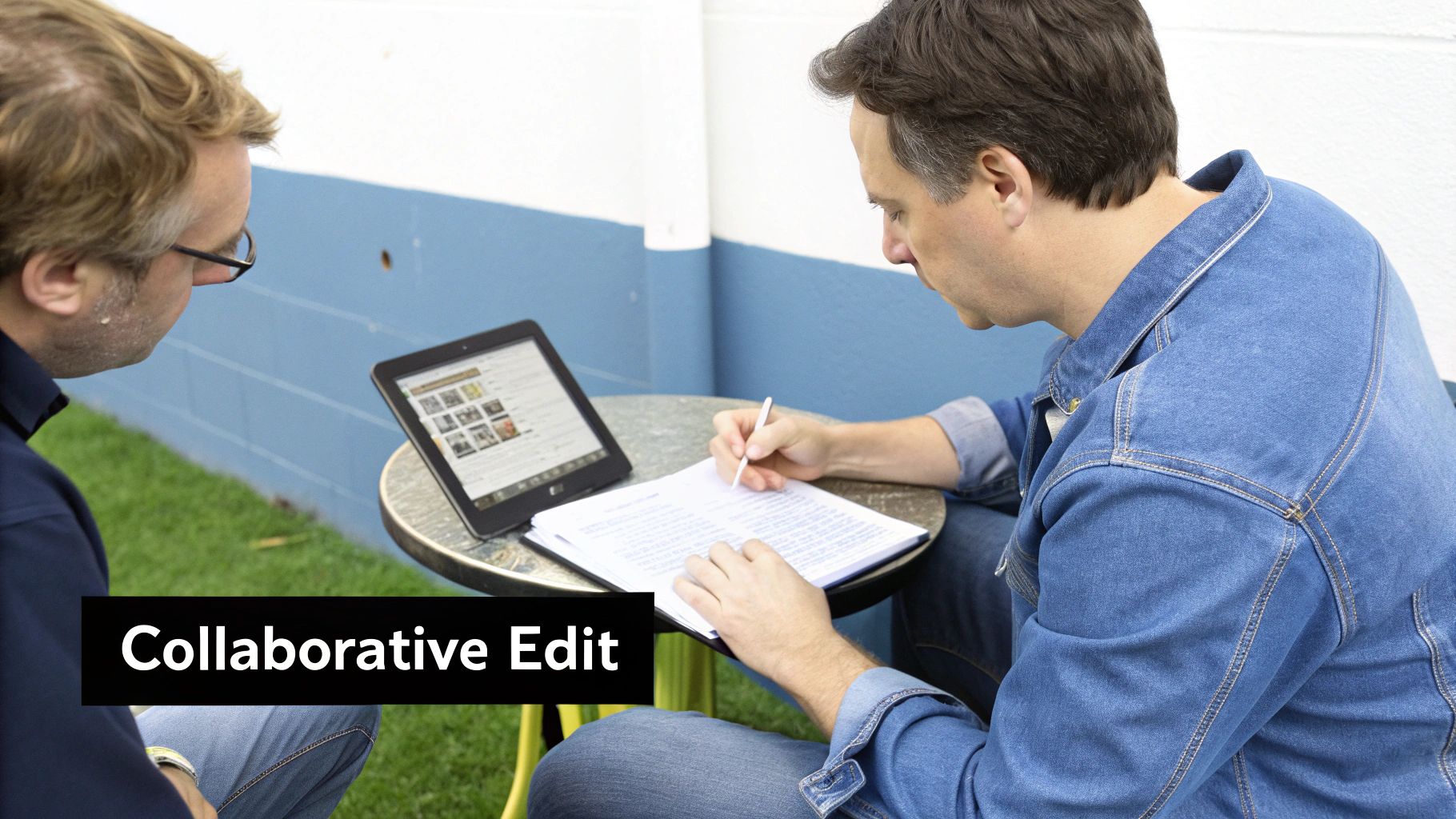
So you’ve found the right editor and signed on the dotted line. Now the real work begins. This is the collaborative dance where a good manuscript becomes a great one. Don’t think of it like dropping your car at a mechanic’s shop for a quick fix; it’s much more like a detailed restoration project where you and the specialist are working side-by-side.
A truly successful partnership hinges on mutual respect, crystal-clear communication, and a shared passion for making your book the absolute best it can be. It means you need to be ready for honest feedback, and your editor needs to know how to deliver it constructively. The whole process should feel professional, transparent, and focused from start to finish.
The Initial Steps: Setting the Stage
The collaboration officially kicks off the moment that contract is signed. Think of that document as your roadmap—it lays out everything from deadlines to deliverables so there are no surprises down the road. Right after that, you’ll send over your manuscript, which is almost always a Microsoft Word document. It’s the industry standard for a reason.
This handoff is a big moment. You’re placing a piece of your creative soul into the hands of a professional, making them your book’s very first critical reader. It’s a huge step and one that really sets the tone for your entire working relationship.
A great editor will always confirm they’ve received your file and will usually give you a quick rundown of what happens next and when you’ll hear from them. That simple piece of communication builds instant confidence and establishes a professional rhythm from day one.
Navigating Constructive Feedback and Revisions
Getting that first round of edits back can be a shock to the system. Your manuscript will return covered in digital red ink, usually using Microsoft Word’s Track Changes feature. Seeing your words dissected with comments and suggestions is completely normal, and honestly, it’s a necessary part of making your book better.
The trick is to approach this feedback with an open mind. Remember, the criticism isn’t about you—it’s a professional assessment designed to make your story stronger. A good editor doesn’t just circle problems; they explain the “why” behind their suggestions, helping you see the manuscript through the fresh eyes of a reader.
“The editor’s job is to serve the story, and the author’s job is to be its ultimate guardian. A successful collaboration happens when both parties respect these roles, communicating openly to find the best path forward for the book.”
To handle revisions like a pro:
- Read Everything First: Before you touch a single comma, read the entire editorial letter and all the in-document comments. Get the full picture first.
- Take a Breath: Let the feedback sink in for a day or two. A little emotional distance will help you see the suggestions objectively.
- Tackle the Big Stuff: Start with the major plot or character suggestions before you get bogged down in sentence-level tweaks.
- Communicate Clearly: If you don’t agree with a suggestion, explain your reasoning. A great collaboration is a dialogue, not a monologue.
This back-and-forth is where the real magic happens. It’s a focused conversation between you and your editor that polishes your manuscript until it shines.
Key Deliverables You Should Expect
A professional editing service delivers far more than just a file with corrections. You should receive a complete package of materials that guide your revisions and ensure consistency. After all, your editor is a key partner in this journey.
Here are the three essential deliverables you should get from any professional book editor:
- A Marked-Up Manuscript: This is your original document with every single edit and comment visible through Track Changes. It puts you in the driver’s seat, allowing you to accept or reject each suggestion.
- A Comprehensive Editorial Letter: This is the high-level analysis—a detailed document (often several pages long) that digs into your book’s strengths, weaknesses, and overarching opportunities related to plot, character, pacing, and theme.
- A Style Sheet: This is your book’s custom-made grammar and style bible. Your editor creates it to track specific choices—how character names are spelled, unique capitalization rules, punctuation preferences—to ensure flawless consistency from the first page to the last.
What About All-in-One Publishing Services?
Hiring a great freelance editor is a solid move, but some authors discover a huge advantage in taking a more bundled approach. Think of it like building a house. You could hire a plumber, an electrician, and a carpenter separately—and spend all your time trying to get them on the same page. Or, you could work with a general contractor who brings a trusted, coordinated team to the project.
An all-in-one publishing service, like what we offer at BarkerBooks, is your general contractor. We bring the professional book editors, cover designers, interior formatters, and distribution specialists together under one roof. Everyone works from the same playbook—your book’s vision. This means the edit’s tone aligns perfectly with the cover’s mood, which in turn matches the interior layout. It takes the project management hat off your head so you can get back to what you do best: writing and connecting with readers.
A Smoother Road to Publication
The biggest win here is a seamless workflow. Instead of spending weeks hunting for and vetting individual professionals, you have a single, dedicated team managing every step. This simple change helps you dodge common, frustrating disconnects—like a cover designer who never read the book or a formatter who doesn’t understand the editor’s style guide.
This unified process is also incredibly efficient. The book editing world is moving fast; the global market is projected to hit $271 million in 2025. We’ve already seen AI tools since 2020 trim editing times by 25-30%, and a coordinated team can make the most of that efficiency. For the 7,500+ authors we’ve published across 91 countries at BarkerBooks, it means a quicker, less stressful path from manuscript to market, complete with everything from cover design to targeted ads. This matters because a professionally polished manuscript can achieve 40% better Amazon rankings—a massive boost for visibility on Kindle, Apple Books, and Google Books. You can dive deeper into these industry shifts in PublishDrive’s latest report.
A Unified Vision from Start to Finish
Working with one provider ensures every piece of your book project tells the same story. The editor’s deep understanding of your book’s voice directly influences the design team. The marketing team’s strategy is then built on the core themes that were sharpened and clarified during the editing process. It all just clicks.
When your editor, designer, and marketer are all on the same team, your book presents a powerful, unified message to the world. This synergy is what separates a good book from a professionally published one that commands reader attention.
Ultimately, an integrated service isn’t just about convenience. It’s about having a supportive, expert-guided partner to navigate the complexities of publishing. From the first round of edits to final global distribution, every element is aligned to give your book the best possible shot at success.
Your Questions About Professional Book Editing, Answered
Hiring a professional editor is a huge step, and it’s only natural to have a lot of questions. Let’s walk through some of the most common things authors ask, clearing up the confusion so you can move forward with confidence.
Is My Manuscript Really Ready for an Editor?
This is probably the most common question I hear. The short answer is: your manuscript is ready when you’ve taken it as far as you can on your own.
You need to have a complete draft—not a collection of chapters or a story that’s still in progress. Before you even think about hiring a developmental editor, your plot, characters, and basic structure should be in place. If you’re looking for a copy editor or proofreader, the story itself needs to be locked down completely.
Why? Because you’re paying for an expert’s high-level skills. If they spend their time fixing basic issues you could have caught yourself, you’re not getting the best value for your money. A polished draft lets them focus on making your good story a great one.
Can’t I Just Use AI Editing Software?
AI editing tools are fantastic for a first pass. Think of them as a super-powered spell-checker that can catch common grammar goofs and typos. They’re a great assistant during your self-editing phase.
But they can’t replace a human. A professional editor brings a deep, nuanced understanding of storytelling that software just doesn’t have. They feel the rhythm of your sentences, hear your character’s unique voice, and know when the pacing is dragging. AI can’t grasp subtext or emotional arcs. For that, you need a person.
A true professional book editor doesn’t just correct your manuscript; they connect with your vision. They understand the subtext, the emotional arc, and the rhythm of your prose in a way that algorithms simply can’t.
What Exactly Is a Sample Edit? Do I Need One?
A sample edit is absolutely essential. It’s a trial run where a potential editor works on a small piece of your manuscript, usually around 1,000 to 2,000 words. Think of it as a test drive.
This is your chance to see their editing style up close. Does their feedback resonate with you? Do they understand the tone of your book? How’s their communication? A sample edit lets you answer all these questions before you sign a contract and commit to the full project. It’s the single best way to find out if you’ve found the right partner for your book.
What Red Flags Should I Look Out For?
You need to be your own best advocate when hiring an editor. Trust your gut, and be wary of anyone who seems too good to be true. Here are a few major red flags:
- Guarantees of Bestseller Status: This is a huge one. No editor on earth can promise your book will be a bestseller.
- No Portfolio or Testimonials: A seasoned pro will have a track record and happy clients they can point to.
- They Won’t Do a Sample Edit: If an editor refuses a sample edit, run. It’s a standard, non-negotiable part of the process.
- No Contract: A formal agreement is there to protect both of you. Never work with an editor who won’t provide one.
Also, be cautious of rock-bottom prices or sloppy communication. A true professional will be transparent, specialize in your genre, and communicate clearly from the start.
Ready to connect with a team that offers transparent, professional editing services designed to make your book shine? At BarkerBooks, we provide a full suite of publishing support, from expert editing to global distribution.
Explore our editing packages and start your publishing journey today!