
You've opened a blank document, typed a working title such as How to Write Self Help Book, and then stalled because the subject feels too large. You may have years of experience, a personal breakthrough, or a method that helped you solve a difficult problem. The challenge is turning that knowledge into a book readers can understand, trust, and use after they close the cover.
A useful self-help book isn't a motivational speech stretched across chapters. It's a transformation system. It gives a defined reader a credible promise, explains a meaningful problem, presents a repeatable method, and supplies enough practice for the reader to act. The manuscript is the center of that system, not the entire system.
Why Self Help Books Succeed When They Deliver a Real Method
An aspiring author often begins with a sincere intention: “I want to help people become happier,” “I want to teach confidence,” or “I want to share what helped me recover.” Those intentions matter, but they don't yet give a reader a reason to follow the book. A reader needs to recognize a specific problem and see a practical path forward.
The modern self-help category grew from nineteenth-century advice literature. The British Psychological Society's history of self-help writing traces important roots to works such as The Pursuit of Knowledge Under Difficulties, Success in Life; A Book for Young Men, and Samuel Smiles's Self-Help: With Illustrations of Character, Conduct and Perseverance. Published in 1859, Smiles's book is widely treated as the first explicitly self-help title, which makes the genre more than 160 years old.
That history reveals an enduring reader expectation. Self-help has long connected practical guidance, character-building, and personal progress. A book can be warm, reflective, and personal, but it still needs to help someone make a decision, change a behavior, understand a pattern, or follow a process.
The manuscript needs a spine
Consider two possible premises:
- “This book will help you live a better life.”
- “This book will help first-time managers run difficult one-to-one meetings without avoiding conflict.”
The first invites broad reflection. The second gives you a reader, a situation, and an outcome. It also gives you editorial boundaries. You'll know which examples belong, which exercises matter, and which interesting ideas should be saved for another book.
The category is commercially durable, but it's crowded. NPD Group data reported by Publishing Perspectives shows that U.S. self-help unit sales rose 11% from 2013 to 2019, reaching 18.6 million copies, while unique self-help ISBNs nearly tripled from 30,897 to 85,253 during the same period. Those figures point to a durable audience and a serious discoverability problem.
Practical rule: Inspiration may earn attention, but a usable method earns completion, recommendation, and return visits.
Authors often waste time adding more advice when the weakness is structural. The stronger approach is to define one transformation, build a sequence that leads toward it, and place practice directly beside the ideas that require practice. Guidance on writing nonfiction with a clear outcome can help you test whether every chapter contributes to that central change.
The rest of the work follows a disciplined order: identify the reader, shape a promise, build a problem-solution architecture, write with evidence and stories, edit for usability, then publish the book as part of a wider reader experience.
Find Your Reader and Shape a Promise They Can Trust
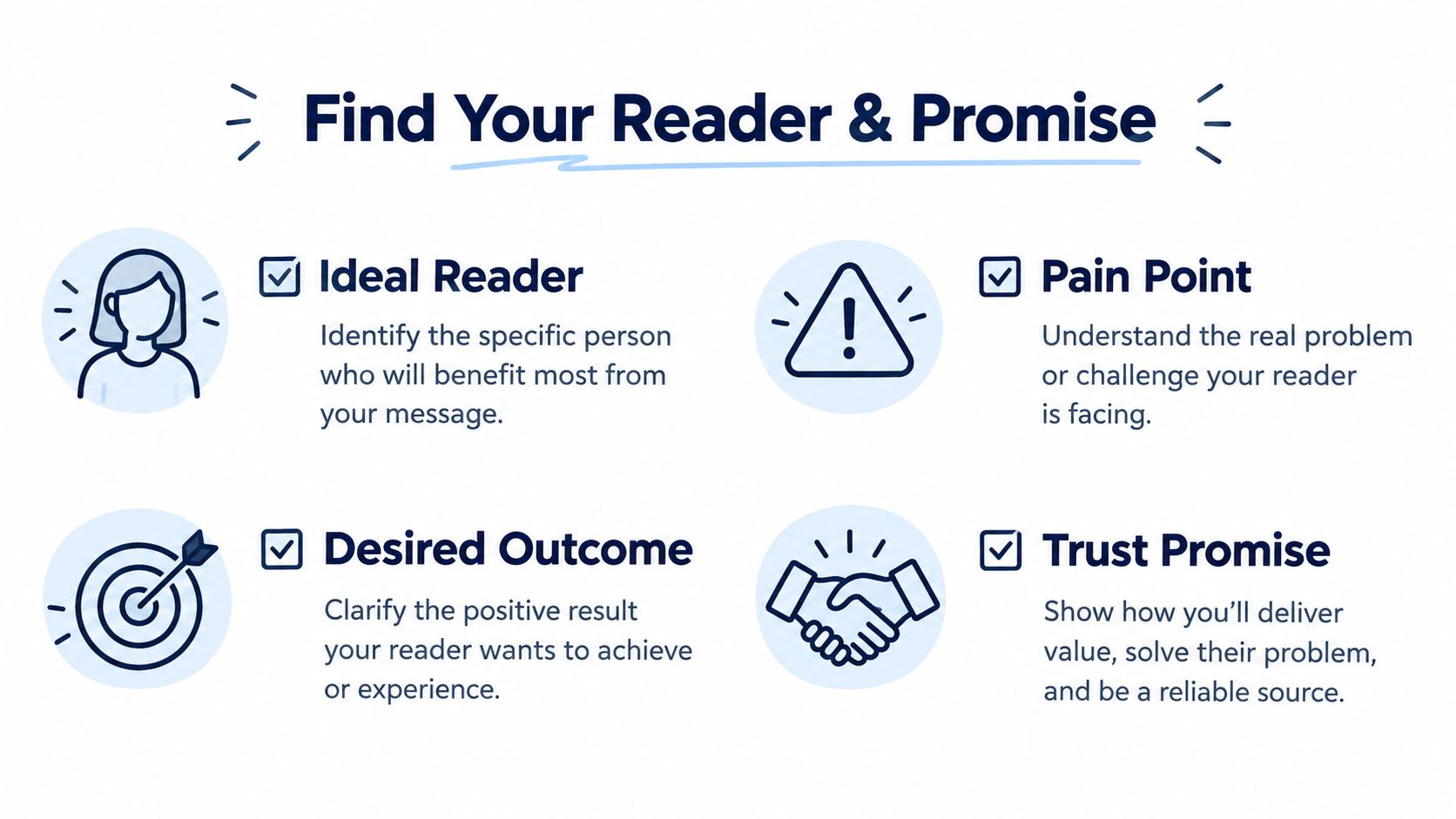
Start with the reader, not the topic. “Confidence” is a topic. “Confidence for newly promoted technical leads who avoid speaking in planning meetings” identifies a person in a situation with a recognizable problem.
A narrow audience doesn't make the book irrelevant. It gives the book a voice. When readers feel that the author understands their circumstances, they're more willing to examine uncomfortable habits and attempt unfamiliar actions.
Diagnose the person behind the problem
Write down the reader's current reality in language they'd use. Avoid clinical or promotional phrases unless your audience uses them. “I struggle with executive functioning” may describe the issue accurately, but “I start five tasks and finish none” may produce a more immediate connection.
Work through these questions:
- Who is this person? Define their stage of life, role, context, and relevant experience.
- What happens repeatedly? Describe the situation, behavior, or decision that causes frustration.
- What have they already tried? Note the advice, tools, or habits that failed to solve the problem.
- What would improvement look like? Describe an observable change, not an abstract feeling.
- What must the book not promise? Set ethical boundaries around outcomes you can't guarantee.
Your answers should narrow the subject until you can describe the reader without using a mass-market label such as “everyone who wants to improve.”
Write one outcome statement
Expert nonfiction guidance recommends anchoring the manuscript to a sentence such as “After reading this book, readers will be able to…” Squibler's nonfiction book-writing guidance uses this outcome-focused approach alongside practical frameworks, supporting evidence, stories, and examples.
Complete the sentence several times:
After reading this book, readers will be able to __________.
Then make the verb concrete. “Understand boundaries” is weaker than “write and deliver a boundary statement without overexplaining.” “Feel less overwhelmed” is harder to assess than “use a weekly decision process to separate urgent tasks from important ones.”
A credible promise also acknowledges limits. Don't imply that a book can replace professional treatment, guarantee financial success, or resolve a complex situation through a short routine. Trust grows when the author explains what the method can do, what it can't do, and who should seek additional support.
Test the promise against the shelf
Search retailer categories, library catalogs, and competing authors' websites. You're not looking for permission to write. You're looking for the exact space your book can occupy.
Compare your draft promise with competing titles:
- Does your book address a specific situation rather than a broad aspiration?
- Does it use language readers recognize?
- Does the method reflect your actual insight, experience, or research?
- Can the promise fit naturally into a title and subtitle?
- Would a reader know what changes after using the book?
Avoid promises built around instant transformation. Recent market coverage reports that titles promising results in 7 or 21 days fell 29% versus 2023, while neuro-informed frameworks grew 44% year over year and represented 68% of nonfiction bestsellers in personal growth, according to the cited 2026 industry summary. Treat that source as directional market context, not as a reason to imitate fashionable terminology. Readers may be responding less to a particular scientific label than to a broader demand for credible explanations and useful systems.
If you plan to pitch the book, your promise should also support a persuasive proposal. BarkerBooks' guide to writing a nonfiction book proposal is relevant here because positioning, audience, competition, and market rationale must align before the manuscript is complete.
Outline Your Book With a Problem Solution Structure
A self-help outline should feel like a guided route, not a storage system for everything you know. The reader starts with a problem, understands its stakes, learns a method, practices it, and reaches a more capable position.
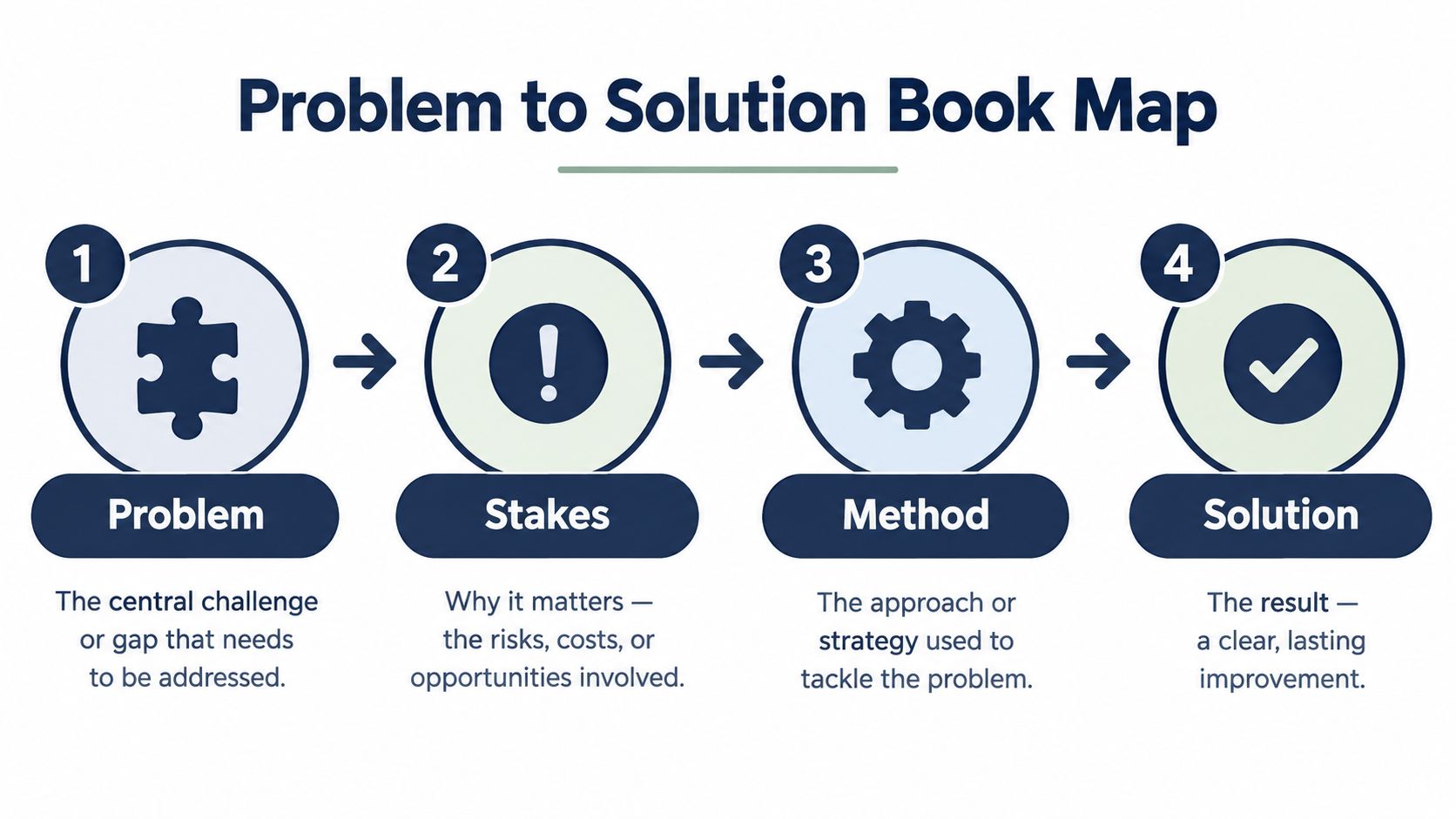
Use this four-part spine:
- Problem: What is happening, and how does the reader recognize it?
- Stakes: What does the problem cost emotionally, practically, or relationally?
- Method: What principles, decisions, or actions change the pattern?
- Solution: How does the reader apply the method in real conditions?
The sequence prevents a common failure. Authors often introduce tools before readers understand why they need them. That produces exercises without urgency. Others spend so long diagnosing the problem that the book feels perceptive but inert.
Build chapters as mini-transformations
A strong chapter usually performs a contained piece of the larger change:
- Open with a recognizable scene, question, or contradiction.
- Name the chapter's specific problem.
- Explain the principle that makes the problem understandable.
- Show the principle through a story, example, or scenario.
- Give the reader an action, decision process, or reflection.
- Close with a brief recap and a bridge to the next step.
The sequence matters. If you introduce an exercise before explaining its purpose, readers may complete it mechanically. If you explain theory without asking for application, readers may agree with you and change nothing.
Draft a chapter map before writing full prose. For each proposed chapter, record the reader's starting point, the idea they need, the action they'll take, and the evidence or story that supports it. Delete chapters that repeat the same lesson under different names.
Decide what belongs outside the book
The book should carry the core logic of the transformation. It doesn't need every worksheet variation, extended script, audio meditation, tracking page, or community discussion prompt.
Keep material in the manuscript when the reader needs it to understand or perform the method. Move it to a companion asset when it's repetitive, highly printable, better consumed aloud, or likely to interrupt the reading experience.
The book should explain the system. Companion tools should make the system easier to practice.
A workbook can hold repeated logs and blank templates. Audio can support guided reflection. A private community can provide accountability and discussion. Separating these layers keeps chapters focused instead of turning them into oversized instruction manuals.
Before drafting, map the reader's progression on one page. If the route jumps from diagnosis to advanced practice and then returns to basic concepts, revise the order now. Fixing sequence in an outline is efficient. Fixing it after every chapter has been drafted is expensive.
For additional guidance on building a usable chapter sequence, consult this resource on how to write an outline for a book.
The following video can also serve as a visual prompt while you turn your method into a chapter map.
Write With Clarity Stories and Evidence That Earn Credibility
Readers trust a self-help chapter when its parts reinforce one another. The explanation gives the reader a lens. The story shows the lens in use. The exercise turns the idea into behavior. The evidence tells the reader how confidently to hold the claim.
A useful drafting pattern is explain, demonstrate, apply. Explain the idea in plain language. Demonstrate it through a relevant story or scenario. Apply it with a prompt that asks the reader to make a decision or complete a small action.
Make stories serve the method
Personal stories can establish lived experience, but they don't automatically prove that your solution works for everyone. Choose stories because they clarify a decision, reveal a common obstacle, or show the method under pressure.
After drafting a story, ask:
- What should the reader notice?
- Which part of the method does the story demonstrate?
- Where does the reader see their own situation?
- What action becomes easier to understand afterward?
If you can't answer those questions, shorten the story or remove it. A vivid anecdote that doesn't advance the argument becomes emotional decoration.
Your opening also benefits from direct, active language. If you're writing headlines, chapter openers, or promotional copy, resources on stop the scroll hook formulas can help you create attention without resorting to exaggerated promises. The same principle applies inside the manuscript: begin with a tension the reader recognizes, then quickly connect it to the chapter's practical purpose.
Translate research without overclaiming
Evidence-based writing doesn't mean filling every page with academic terminology. It means knowing which claims require support, finding appropriate evidence, and representing that evidence accurately.
Use a research note for each important claim:
- Claim: What exactly are you saying?
- Source: Which study, review, book, or professional body supports it?
- Strength: Is the evidence preliminary, mixed, correlational, or well established?
- Application: What can the reader reasonably do with this information?
- Boundary: What should you avoid promising?
The distinction matters because evidence on self-help interventions is mixed across topics and methods. A review of the literature reports that targeted books can produce meaningful improvements and that controlled studies have found many general self-help treatments moderately effective for psychological distress, sometimes comparable to therapist-administered treatment. The same source notes a major credibility problem, with about 95% of self-help books published without empirical validation, as discussed in the review of self-help effectiveness and pitfalls.
Don't turn a limited finding into a universal instruction. “This approach may help some readers under these conditions” is more credible than “This method will change your life.” Cite the source in your notes and bibliography, distinguish your interpretation from the researchers' finding, and explain where professional guidance may be appropriate.
Give the reader a visible next move
End major explanations with an action. It might be a short audit, a conversation script, a decision tree, or a written reflection. Use formatting to make the action easy to locate.
Reader prompt: What is one situation this week in which you can test the method without trying to change everything at once?
Clarity is not simplistic writing. It's controlled complexity. Define unfamiliar terms, keep paragraphs focused, and remove sentences that repeat the same point with new adjectives.
Edit Get Feedback and Prepare a Professional Manuscript
Writing and editing require different judgments. Drafting asks you to generate material. Editing asks you to protect the reader's route through that material.
Start with a pause after the draft is complete. Then read the manuscript as a skeptical first-time reader, not as its author. Mark every place where you ask the reader to accept a claim, perform an action, or move from one concept to another.
Use a lean editing sequence
A practical handoff looks like this:
- Self-edit for purpose: Remove material that doesn't serve the reader's promised outcome.
- Developmental edit: Examine structure, chapter order, repetition, argument, and pacing.
- Line edit: Improve clarity, tone, transitions, sentence rhythm, and consistency.
- Proofread: Correct grammar, spelling, punctuation, captions, references, and formatting errors.
Don't proofread a structurally broken book. Polishing sentences before resolving duplicated chapters creates false progress. Likewise, don't ask a proofreader to solve weak positioning or unclear exercises. Each stage needs a defined job.
Collect feedback without surrendering authorship
Beta readers should represent the intended audience, not friends who want to encourage you. Give them focused questions:
- Where did you feel most understood?
- Which instruction was difficult to follow?
- What did you expect to happen next?
- Where did the book sound too certain?
- Which exercise did you complete, skip, or misunderstand?
Track feedback in a table with the chapter, comment, pattern, and decision. One reader's preference isn't automatically a revision mandate. Several readers reporting the same confusion deserve attention, even if you personally like the passage.
A professional manuscript also needs a consistent interior. Check heading hierarchy, page breaks, exercise spacing, callout styling, references, running elements, and accessibility across print and digital formats. Your cover, title, subtitle, description, and sample pages should make the same promise. A polished design can't rescue an unclear book, but careless production can weaken confidence in a strong one.
Prepare final files only after editorial decisions are closed. Keep a clean master, a marked revision file, and distribution-ready exports so later corrections don't overwrite your source material.
Choose Your Publishing Path and Launch Like a System
Publishing decisions depend on what you value most. Self-publishing offers control over schedule, packaging, pricing, and revisions, but you'll coordinate editorial, design, production, distribution, and promotion. Traditional publishing can provide an editorial and sales infrastructure, but authors generally give up some control and must work through an acquisition process.
| Criteria | Self Publishing | Traditional Publishing |
|---|---|---|
| Control | Author controls positioning, design, schedule, and revisions. | Publisher manages many editorial, design, and production decisions. |
| Timeline | Can move according to the author's readiness and production plan. | Depends on agenting, acquisition, editorial scheduling, and the publisher's list. |
| Costs | Author typically funds or coordinates professional services. | Publisher generally invests in production, with contract terms determining responsibilities and rights. |
| Distribution | Author selects platforms and manages or outsources distribution. | Publisher provides established distribution arrangements, subject to the contract and list. |
| Support | Support comes from freelancers, service providers, or publishing partners. | Support comes through the publisher's assigned editorial and production teams. |
Build the product around the transformation
A book-only plan may leave useful practice material trapped in the manuscript. Recent market coverage reports that standalone print accounted for 41% of revenue among top self-improvement titles, with the remainder coming from bundles that included audiobooks, workbooks, and community access. Another report says self-help print unit sales fell 24.3% in the first half of 2026, the steepest decline among adult nonfiction subcategories, as described in this 2026 market summary.
These figures don't mean every author needs a subscription community or a large product suite. They do suggest that you should decide deliberately where transformation happens:
- Book: The central argument, method, examples, and essential exercises.
- Workbook: Repeated tracking, templates, checklists, and writing space.
- Audio: Guided practices, narrated content, or reflection sessions.
- Community: Accountability, discussion, live implementation, and support.
- Landing page: Clear positioning, reader resources, and next steps.
Don't add formats just to appear thorough. Build only the assets that remove a genuine barrier to application.
Use a practical launch checklist
Before release, confirm that you've handled:
- Rights and identity: Arrange ISBN registration, copyright protection, contributor agreements, and permissions for borrowed material.
- Production: Approve the cover, interior layout, ebook conversion, audiobook plan, and final proof.
- Availability: Set up global distribution across the platforms that fit your audience.
- Discovery: Prepare the title, subtitle, description, categories, keywords, author page, and sample content.
- Conversion: Create a landing page with the promise, reader fit, contents, companion resources, and purchase links.
- Promotion: Choose targeted outreach, partnerships, email communication, interviews, events, or advertising that reaches the defined reader.
BarkerBooks can support authors with proofreading, editorial editing, ghostwriting, cover design, interior layout, promotional video production, global distribution, ISBN registration, copyright protection, and targeted advertising. Treat those services as production options within your plan, not substitutes for a clear promise and useful method.
The best time to solve a publishing problem is before launch. The best time to test whether the book helps is with real readers using the system, not with the author rereading the manuscript.
If you're ready to turn your self-help idea or draft into a polished transformation system, BarkerBooks offers support across editing, design, formatting, publishing, and distribution. Visit BarkerBooks to discuss the specific help your manuscript needs and create a practical path from unfinished draft to published book.