
Writing a fiction book is an incredible journey. It’s the process of taking that initial spark of an idea—that fleeting image, that "what if?" question—and nurturing it into a living, breathing world for others to explore.
But let's be honest, staring at a blank page can be terrifying. The secret isn't some magical muse; it's understanding that writing a novel is a craft with distinct stages. Breaking down the massive goal of "writing a book" into a series of smaller, more manageable steps makes the entire process feel achievable.
Your Fiction Writing Roadmap
So, you want to write a novel. Where do you possibly start? Think of it like a road trip. You wouldn't just jump in the car and start driving aimlessly; you’d look at a map first. This roadmap gives your creativity a structure to work within, ensuring you build a solid foundation for your story before you get lost in the weeds.
This isn’t about shackling your imagination with rigid rules. Instead, it’s a flexible framework that guides you from a rough concept to a polished, published book. Each phase naturally flows into the next, building momentum and keeping you from feeling overwhelmed.
The Major Milestones in Writing Fiction
Your adventure from first word to final draft will move through five core milestones. Knowing what they are ahead of time helps you prepare for the work involved and, just as importantly, celebrate your progress along the way.
- Ideation and Planning: This is the genesis of your story. You’ll brainstorm ideas, nail down your core premise, settle on a genre, and sketch out a basic outline to guide you.
- Character and World-Building: Here, you become a creator. You'll breathe life into your characters, giving them compelling motivations, relatable flaws, and dynamic arcs. At the same time, you'll build the world they live in, making it feel real enough to touch.
- Drafting the Manuscript: This is the part everyone thinks of—getting the words on the page. The mission here is simple: finish the first draft. Don’t worry about perfection; just get the story down from beginning to end.
- Revising and Editing: With a complete draft in hand, the real work begins. You'll step back to analyze your plot, pacing, and character consistency. Then, you'll dive in to polish your prose, sentence by sentence.
- Publishing and Marketing: The final leg of the journey is getting your book into readers' hands. This involves everything from cover design and formatting to choosing a publishing path and letting the world know your story exists.
The secret to writing a fiction book is to stop seeing it as one monumental task. Instead, view it as a series of smaller, interconnected projects. Master each stage, and the path to "The End" becomes surprisingly clear.
To help you visualize the entire journey, here’s a quick overview of what to expect.
Fiction Writing Journey At a Glance
This table breaks down the key phases, the main things you'll be doing in each one, and the essential tools that will make your life a whole lot easier.
| Phase | Key Actions | Essential Tools |
|---|---|---|
| 1. Planning | Brainstorming ideas, choosing a genre, outlining the plot, developing the core premise. | Notebook & pen, outlining software like Scrivener or Plottr, mind-mapping tools. |
| 2. World & Character | Creating character backstories, defining world rules and settings, developing character arcs. | Character questionnaires, world-building worksheets, reference images or a Pinterest board. |
| 3. Drafting | Writing the first draft from start to finish, focusing on story progression over perfection. | A word processor (Microsoft Word, Google Docs), a dedicated writing routine, noise-canceling headphones. |
| 4. Revision & Editing | Structural edits (plot, pacing), line edits (prose, style), proofreading (grammar, typos). | Feedback from beta readers, ProWritingAid or Grammarly, a professional editor. |
| 5. Publishing & Launch | Cover design, book formatting, choosing a publishing platform, creating a marketing plan. | Vellum for formatting, Canva for graphics, an author website, social media presence. |
This at-a-glance guide provides a bird's-eye view, but there's a lot more to each of these stages.
For a much deeper dive, you can explore our comprehensive guide on the entire book writing process to get started.
Building Your Story's Foundation
Great stories don't just appear out of thin air; they're built. I know some writers love to fly by the seat of their pants—what we call "pantsing"—and just discover the story as they write. But in my experience, most authors find that starting with a solid blueprint saves them from massive headaches and structural rewrites later on.
This isn't about boxing yourself in or killing creativity. Think of it as giving your story a strong skeleton. Without it, even the most beautiful prose or fascinating characters won't be enough to hold the whole thing together.
Choosing Your Narrative Blueprint
You don't have to reinvent the wheel. Two of the most reliable and powerful structures out there are the Three-Act Structure and The Hero's Journey. They provide a rhythm that readers instinctively understand, making your story feel satisfying from beginning to end.
- The Three-Act Structure: This is the absolute workhorse of modern storytelling. It breaks your narrative down into three clear parts: the Setup (Act I), the Confrontation (Act II), and the Resolution (Act III). Key turning points at the end of each act push the story forward and keep raising the stakes.
- The Hero's Journey: Made famous by Joseph Campbell, this is the classic pattern of adventure and personal transformation. Your hero is called to an adventure, faces a series of trials, wins a decisive victory, and returns home forever changed. It's the DNA of everything from Star Wars to The Lord of the Rings.
"The spine of the book… is what happens, it’s what you build around, it’s the main event. When people ask you what your book is about, this is what you tell them."
This foundational plot is the promise you make to your reader. You're setting an expectation and then guiding them through a series of events that deliver a meaningful conclusion.
This classic diagram from Wikipedia shows exactly how that tension should build—rising action, a dramatic climax, and then the falling action to the resolution.

Getting this right is what keeps readers turning the pages. You have to build that tension, hit a peak, and then give them a satisfying conclusion.
From Outline to Beat Sheet
Once you’ve settled on a big-picture structure, it's time to zoom in. This is where you create a beat sheet or a scene-by-scene outline, mapping out every critical moment—every "beat"—that moves your story from A to B.
A good beat sheet isn’t just a to-do list of events. It's about connecting your character’s inner journey to the external plot. For every single scene, you should be able to answer:
- What does my character want in this scene?
- What's stopping them from getting it?
- What's the outcome, and how does it change things for them?
This forces you to make sure every scene has a purpose. It's the single best tool for avoiding that dreaded "saggy middle" where the story just stalls out.
And there's a huge audience waiting. The global fiction market is on fire, projected to hit $12.11 billion by 2029. That growth comes from readers who are hungry for compelling stories in every genre you can imagine. A well-structured plot is what will make your book stand out. You can learn more about these booming fiction market trends and see for yourself.
Weaving in Subplots
If the main plot is the spine of your story, subplots are the ribs. They add depth, complexity, and a whole lot of richness to the narrative. A subplot is a smaller, secondary storyline that runs alongside the main one, but a great one will always intersect with and influence the main action.
Subplots are incredibly useful for:
- Exploring a theme: Use a subplot to offer a different angle on your novel's central theme.
- Fleshing out a character: Give a side character their own mini-arc or use a subplot to test your protagonist's beliefs.
- Raising the stakes: A subplot can throw a wrench into the works, making your hero's main goal even harder to achieve.
Imagine you're writing a detective thriller. The main plot is, of course, solving the murder. But maybe a subplot involves the detective's rocky relationship with his teenage daughter. That personal conflict could cloud his judgment during the investigation, raising the personal stakes beyond just the case.
Here at BarkerBooks, our developmental editors live and breathe story structure. We can dive into your outline or early draft to spot plot holes, fix pacing issues, and make sure your foundation is absolutely rock-solid before you get too deep into the writing.
Crafting Characters and Worlds That Feel Real
Here's a hard truth: readers don't connect with plot points. They connect with people. Your characters are the heart of your story, and if they don't feel real, nothing else matters.
This all comes down to giving them genuine desires, messy flaws, and believable motivations. When a reader sees a flicker of themselves in your protagonist's struggles, you've got them hooked.
Developing Deeper Characters
So, how do you get beyond the surface-level character sketch? You have to put them under pressure.
Try this: drop your character into a mini-scene where they're forced to make a tough choice. Imagine a quiet librarian who has to decide between saving a priceless, ancient book from a fire or helping an annoying neighbor escape. That single, split-second decision can reveal more about their core values and hidden fears than pages of backstory. It might even become the cornerstone of their entire character arc.
Here are a few more exercises I've seen work wonders:
- Character Interviews: Go beyond the basics. Ask your character what their childhood bedroom smelled like, their biggest regret, or a secret they've never told anyone. You’re looking for those little quirks that make someone feel like a flesh-and-blood person.
- Inner Monologue Mapping: Take a pivotal scene and just free-write a page of your character's unspoken, unfiltered thoughts. You'll probably end up with a lot of noise, but somewhere in there will be a single, perfect line that captures their true emotional state.
- The Flaw Flip: Take one of your character’s best traits and find its dark side. A deeply compassionate doctor might have terrible personal boundaries, their empathy twisting into a need to control everyone around them.
The goal is to map out an emotional journey. A character who starts the story as a cynical, closed-off loner needs to earn their transformation into someone who can trust again. And it's worth the effort—a recent survey showed 73% of readers feel a stronger bond with characters who overcome clear internal conflicts.
"Characters aren’t born fully formed; they evolve through choices and setbacks." – Author Jane Doe on realistic character growth.
Building Immersive Worlds
Your setting isn't just a backdrop; it's a character in its own right. It should shape the mood, raise the stakes, and influence everyone in the story.
The secret is focusing on tiny, specific sensory details. It’s not just a city street; it’s the sound of distant church bells slicing through the morning fog and the rough texture of a cracked sidewalk under your hero's worn-out boots. Those are the details that anchor a reader in your world.
Think of it as weaving a cultural tapestry, not just painting a scene. Instead of info-dumping about a planet's history, show us a local festival or have a character share a piece of folklore. It adds incredible depth without slowing down the story.
| Element | Small Town Setting | Sprawling Galaxy Setting |
|---|---|---|
| Daily Life | The familiar rhythm of farmer’s market chatter. | The constant, echoing announcements for starliner dockings. |
| Cultural Touch | The town’s pride and joy: the annual harvest parade. | Bustling interplanetary trade fairs with alien merchants. |
| Sensory Detail | The earthy scent of fresh hay on a summer afternoon. | The low, metallic hum of a spacecraft’s life support. |
| Historical Context | The old Civil War memorial standing in the town square. | A monument commemorating the founding of a new space coalition. |
If you need to sprinkle in history, try weaving in flashbacks or dropping in excerpts from old letters or journals. It feels much more organic and creates a sense of lived-in tradition and conflict that truly resonates.
Dialogue And Emotion
Nothing pulls a reader out of a story faster than clunky, unrealistic dialogue. It’s how your characters reveal who they are and how they see the world. For a deeper dive into making your conversations crackle with authenticity, check out our guide on crafting authentic dialogue in fiction.
Integrating Characters And Setting
The real magic happens when your characters and your world feel completely intertwined. A scene becomes dynamic when the setting isn’t just there but is actively shaping the moment.
Think of a rebel commander pacing the narrow, corroded corridors of a derelict starship. Every metallic scrape of his boots against the floor echoes the ship's long, violent history and his own internal turmoil.
Here’s how to make that connection happen:
- Show how environment shapes behavior. A character who grew up in a desert wasteland will react very differently to a torrential downpour than someone from a rainforest.
- Use sensory triggers. The scent of a salty sea breeze could suddenly transport a grizzled sailor back to a home he thought he’d forgotten.
- Reflect mood in the setting. As a character's hope begins to falter, the streetlights on their path could begin to flicker and die, one by one.
Techniques like these ensure your people and places are woven together into a single, cohesive experience. At BarkerBooks, our developmental editors specialize in finding these opportunities, providing feedback on how to make your characters and worlds feel inseparable.
A dynamic interplay between character and world can turn a good story into an unforgettable journey.
Cultural Nuance And History
Finally, remember that culture is what makes a world breathe.
What are the rituals, the family recipes, the ghost stories that get passed down through generations? What folk songs do they sing that hint at ancient wars or forgotten alliances?
When your characters reference these details naturally in conversation, your world stops feeling like something you built and starts feeling like a place someone could actually live. These are the invisible threads that tie everything—and your reader—together.
Finding Your Rhythm to Finish the First Draft
Let’s be honest: writing a novel isn't about waiting for inspiration to strike. That's a myth. Real momentum comes from building a consistent writing practice that actually fits into your life.
I’ve seen it time and again—the authors who finish are the ones who treat writing like a habit. They might use time-blocking for intense morning sessions before the house wakes up, or they might organize quick writing sprints with friends over Zoom. The method doesn't matter as much as the consistency. It's about making progress measurable, not magical.

Creating Your Personalized Routine
There's no one-size-fits-all schedule. Some writers are sharpest at dawn; others do their best work with midnight oil. The key is to find your sweet spot. Start with a realistic word-count target—maybe 500–1,000 words per session—so you don't feel overwhelmed before you even begin.
Veteran novelists know that a rigid routine can backfire. It's better to build a flexible system.
- Block it out: Put focused writing sessions on your calendar just like any other appointment.
- Try timed sprints: Set a timer for 15–20 minutes and just write. You’d be surprised how much you can get down.
- Find a buddy: Get an accountability partner and check in with each other on your daily progress. It works.
Overcoming Roadblocks
Writer’s block is real, and so is burnout. At some point, the momentum will stall. It happens to everyone. The trick is not to panic but to have a plan for when it does.
When you feel that familiar frustration setting in, it’s time to switch gears. For a deeper dive, check out our guide on overcoming writer’s block.
Here are a few tactics that work wonders:
- Do a 5-minute free-write on a completely random topic.
- Get up and go for a walk. A change of scenery can reset your brain.
- Break your goal down into a tiny, laughably easy task, like writing just 100 words.
Persistence trumps perfection when you're racing toward "The End."
Maintaining Momentum
You need to see your progress to believe in it. Tracking your daily word count turns a vague goal into tangible proof that you're moving forward, which is a huge confidence booster on days when you feel like you're getting nowhere.
A simple spreadsheet or a note in a journal can show your target word count versus your actual count. This quick visual helps you see what’s working and what’s not.
It’s also crucial to celebrate the small victories. Did you hit your word count three days in a row? Acknowledge it! These little moments of recognition are what fuel the engine.
At BarkerBooks, we've helped over 7,500 authors get their books out into the world (with a 4.9-star rating to show for it). Our editorial, design, and marketing support is designed to keep you moving forward until you finally type those two beautiful words: The End.
When To Rest And Recharge
Here’s a piece of advice many writers ignore: you have to schedule downtime. You can't sprint a marathon. Pushing through exhaustion will only lead to burnout and dull, uninspired writing.
Deliberate rest is non-negotiable. It keeps your creativity from going stale.
- Schedule at least one full day off from writing each week. No exceptions.
- Take a weekend retreat—mix in some focused sprints with plenty of free time.
- Get lost in a non-writing hobby. It recharges a different part of your brain.
Taking short breaks, or even a mini-vacation, allows you to come back to the manuscript with a completely fresh perspective. It makes the whole process feel sustainable, not like a grueling grind.
Celebrating Small Wins
Don't wait until the entire draft is done to feel good about your work. Recognizing milestones along the way builds positive momentum and keeps you motivated.
I once coached a writer who started rewarding herself with a latte from her favorite coffee shop after every 1,000-word sprint. Within two weeks, that little ritual completely transformed her relationship with writing—it went from a chore to a celebration.
- Treat yourself to your favorite snack.
- Buy a new notebook or a fancy pen to mark a milestone.
- Share your win with your writing group or on social media.
When you layer these practices—planning your sprints, scheduling rest, and celebrating wins—you create a rhythm that is uniquely yours. This balanced approach is what will power you through the tough spots and get you to a complete first draft, ready for the next stage.
From First Draft to Finished Novel
You typed "The End." Take a moment. Finishing a first draft is a huge deal, something most people only ever talk about doing. But the real work? That’s just beginning.
Think of it this way: the first draft is you telling yourself the story. Now, you have to figure out how to tell it to everyone else. This next phase isn't about chasing some mythical "perfect" novel. It’s about methodically turning that raw clay of a manuscript into a story that grips a reader from page one. It means switching hats—from the freewheeling artist to the discerning critic.
First, Do Nothing: The Power of the Cold Read
Before you dare change a single comma, your most powerful move is to walk away. Seriously. Stick that manuscript in a digital drawer, don't look at it, don't even think about it for at least two weeks. A month is even better.
This cooling-off period is non-negotiable. It creates distance. When you come back to it, you won't be the writer who bled over every word; you'll be a reader. This "cold read" is your first, best chance to see the massive, forest-for-the-trees problems you were blind to while you were deep in the weeds.
- Read the whole thing in just one or two sittings, like a book you just picked up at the store.
- Resist the urge to fix typos or tweak sentences. Just read.
- Keep a notepad handy and jot down your big-picture impressions. Does the middle sag? Is the ending a letdown? Do you even like the main character at the beginning?
You’re a diagnostician right now, not a surgeon. Your only job is to find the problems, not to fix them.
"Revision isn't about cleaning up your grammar. It's about re-seeing the story. It's often where you finally discover what the book is truly about."
This is your shot to make sure your theme resonates and that every subplot actually serves the main story you’re trying to tell.
Tackling the Big Rocks: Structural and Developmental Edits
Okay, you’ve got your list of big-picture notes. Now it’s time to roll up your sleeves and get your hands dirty with the story’s architecture. This is the structural edit, and it's easily the hardest—and most crucial—part of the entire process.
Forget pretty sentences for now. We’re talking about the bones of your story. You need to be ruthless and ask some tough questions.
Your Structural Gut-Check List:
- Plot & Pacing: Are there scenes that feel like dead weight, doing nothing to move the story forward? Does Act II feel like a long, slow slog? Every chapter needs to either raise the stakes or reveal something new and important.
- Character Arcs: Does your protagonist actually change by the end of the book? Is that transformation believable, or does it come out of nowhere? Look for consistency in their voice and choices.
- Point of View (POV): Did you stick to your chosen POV? If you're in a tight third-person, make sure you haven't accidentally hopped into another character's thoughts for a paragraph. It’s an easy mistake to make.
- Theme: Do all the little side stories and character relationships tie back to the central theme of your novel? Or are they just fun distractions?
This is the stage where an outside perspective is worth its weight in gold. It's incredibly difficult to see your own plot holes. A developmental editor from a service like BarkerBooks brings that objective, expert eye to find the structural weaknesses you're simply too close to notice.
Polishing the Chrome: Refining at the Sentence Level
Once the foundation is solid, you can finally zoom in on the language itself. This is line editing, and it's where you make your prose sing.
Your focus shifts from the macro to the micro—to the rhythm and flow of every single sentence. The absolute best tool for this is your own voice: read your manuscript out loud. You'll instantly catch awkward phrasing, clunky dialogue, and repetitive sentence patterns that your eyes skimmed right over.
The goal here is to make every word earn its place.
- Hunt down weak verbs. Don't have your character "walk slowly"; have them "shuffle," "amble," or "creep."
- Slash filter words. Phrases like "he saw," "she felt," and "I realized" create distance. Cut them and put the reader directly in the action.
- Sharpen your dialogue. Make sure every character sounds distinct. Cut the "hellos" and "goodbyes" and get straight to the conflict and subtext of the conversation.
This is the meticulous, detailed work that separates a good story from a truly great one. It's the final polish that makes your writing feel professional, creating an immersive experience where the reader forgets they're even reading.
Navigating Publishing and Marketing Your Book
You’ve poured your heart into every scene and polished that last chapter. Now comes the moment of truth: turning your manuscript into something readers will hold in their hands. This stage is all about selecting the best publishing route and crafting a marketing plan that feels authentic to you.
Choosing Your Publishing Path
There isn’t a one-size-fits-all answer—only the path that matches your goals and resources. Here’s how the three main options stack up:
-
Traditional Publishing
You pitch agents, then publishers. They cover production costs, but you trade away a chunk of royalties and some creative say. -
Self-Publishing
You handle every detail, from cover design to launch campaigns. The reward? 100% of your net profits and total creative control—along with all the upfront expenses. -
Hybrid Publishing
You invest in the process, yet team up with a partner (like BarkerBooks) for editing, design, and distribution. Royalties tend to sit between self- and traditionally published rates.
Ask yourself: Is it worth sacrificing some royalties for wider distribution, or would you rather keep full control and handle the business side? Your answer will light the way forward.
If you want to dive deeper into the finer points of author entrepreneurship, take a look at crafting a solid publishing strategy.
Getting Your Book Ready For Market
Once your path is clear, a few must-do steps turn your words into a product readers can buy:
- Secure an International Standard Book Number (ISBN). This 13-digit code is your book’s fingerprint.
- Invest in professional formatting so your pages look crisp in print and on e-readers.
- Research comparable titles to set a competitive price that still honors your work.
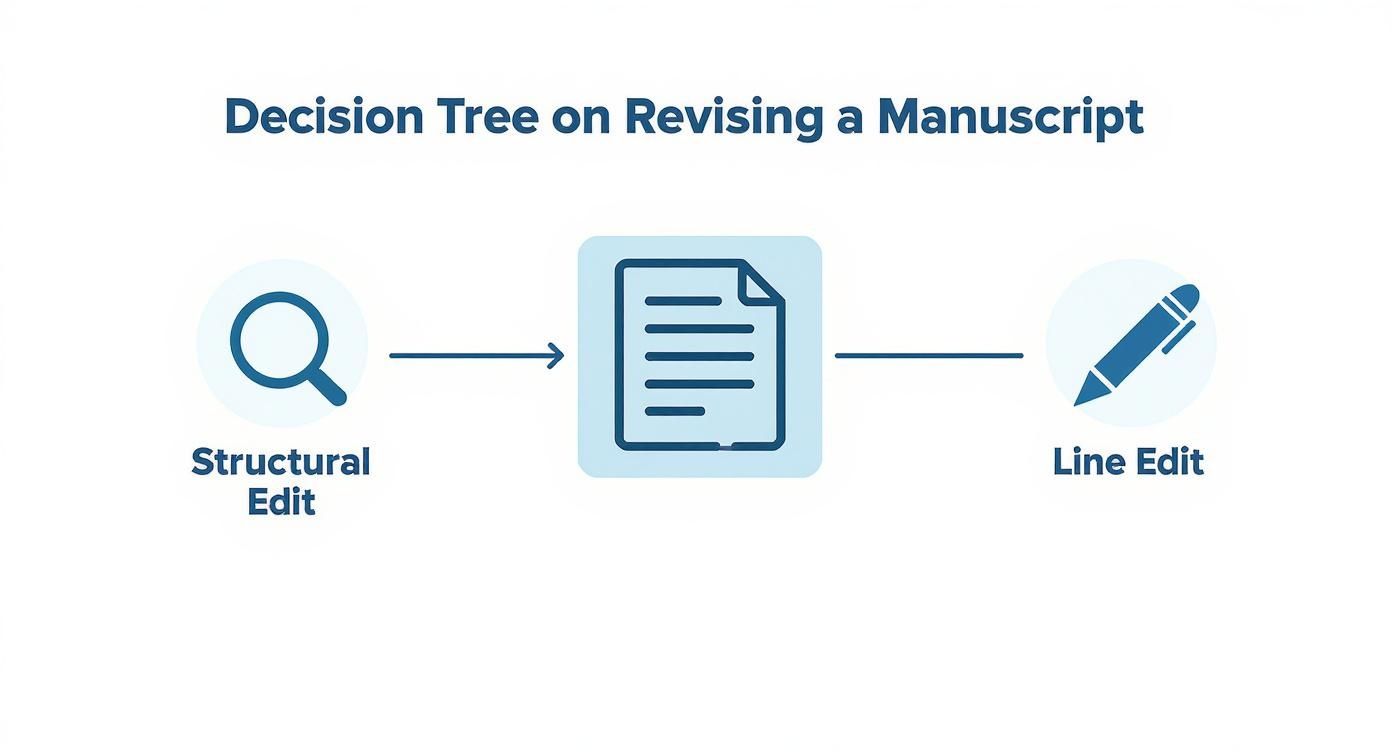
This infographic reminds you to tackle big-picture edits—plot holes, pacing hiccups, character arcs—before you nitpick individual sentences.
Modern Marketing For The Modern Author
Relying on bookstore placement alone won’t cut it anymore. You need a community of readers who are already excited about your voice. Building that following starts well before you hit “publish.”
An email list is the backbone of your outreach. It delivers your news directly to fans who’ve opted in. Meanwhile, social media—especially platforms like TikTok’s BookTok—lets you join conversations where readers swap recommendations.
Social buzz isn’t hype. When authors such as Colleen Hoover saw their sales skyrocket from viral BookTok trends, it proved that genuine word-of-mouth can rival big-budget campaigns. For a closer look at this phenomenon, see how fiction sales are growing in international markets.
At BarkerBooks, we’ve developed targeted social campaigns, polished author landing pages, and review-solicitation plans to help you capture attention. Our goal? Make sure your launch day feels like a celebration, not a scramble.
Got Questions? We’ve Got Answers.
Every writer, no matter how many books they have under their belt, runs into the same stumbling blocks. It’s easy to feel like you’re the only one staring at a blank page wondering, "What now?" but trust me, you're in good company.
Let's tackle a few of the most common questions that pop up on the journey to a finished novel.
How Long Does My Book Actually Need To Be?
Ah, the million-dollar question. While there's no single magic number, your genre gives you a pretty reliable roadmap. For a standard debut novel, you're usually aiming for the 80,000 to 100,000-word sweet spot.
But it varies, of course:
- Young Adult (YA) novels tend to be a bit leaner, often landing in the 60,000–80,000 word range.
- Epic Fantasy or sprawling Sci-Fi sagas can easily push past 120,000 words.
My best advice? Don't get hung up on word count during the first draft. Just focus on telling the best story you can. You can always trim the fat or flesh out scenes later, during the revision process.
What's The Secret To Beating Writer's Block?
First, let’s be clear: writer’s block isn’t some mysterious force. It’s a signal. It’s your brain telling you something isn't working—maybe you’re exhausted, you've painted yourself into a plot corner, or the pressure to be perfect is just too high.
The answer is almost never to chain yourself to the desk and "power through." It’s about changing your perspective. Get up. Go for a walk. Let your mind wander. You'd be amazed how often a solution appears when you stop looking for it.
Try a little creative trick: write something that doesn't "count." Scribble down a scene from your antagonist's point of view or a silly "what if" scenario that will never see the light of day. Taking the pressure off is often the fastest way to get your momentum back.
Traditional vs. Self-Publishing: Which One Is Right for Me?
There’s no "better" option here, only what’s better for you and your specific goals. It really boils down to how much control you want versus how much you're willing to invest upfront.
| Aspect | Traditional Publishing | Self-Publishing |
|---|---|---|
| Control | You give up a lot of creative say to the publisher. | You have complete creative and business control. |
| Upfront Cost | None. They pay you (an advance). | You pay for everything (editing, design, marketing). |
| Timeline | It's a long game. Think 2+ years from contract to bookshelf. | It's fast. You decide when to hit "publish." |
| Marketing | They help, but you're still expected to do a ton. | It's 100% on you to find your readers. |
Going the traditional route can bring prestige and wide distribution, but it's incredibly competitive. Self-publishing gives you total freedom and a bigger slice of the royalties, but it also means you’re the CEO of your own one-person publishing house.
Working through these big questions is all part of the process. If you find yourself needing a guide, the team at BarkerBooks is here to help you navigate everything from professional editing and cover design to a marketing strategy that works. Explore our publishing packages today and let's get your book into the hands of readers.